Instagram Lead Generation – 10 insanely effective tips to boost ROI

Did you know that Instagram has more monthly active users than Facebook, Twitter, and Snapchat? While creating digital marketing strategies, a lot of us don’t consider Instagram to be a useful lead generating platform. This is where we miss out on a lot.

If done right, Instagram can be an extremely effective lead generating platform, even better than Facebook and Twitter. Almost 80% of the Instagram users tend to follow a business account. This is a great sign of intent that digital marketers can capitalize on.

According to a Facebook survey, 80% of the users check Instagram to decide whether they want to buy something or not. You cannot ignore so many useful opportunities to generate leads, especially if you are creating digital marketing campaigns.

In this article, we are going to share 10 simple tactics that will help you generate maximum leads from Instagram. Rest assured that they will accelerate your sales in no time.

Instagram facts
Instagram facts

1. Instagram lead ads

Instagram lead ads are a kind of obvious way to generate leads. The Instagram lead ads are designed in such a way that it helps businesses in collecting customer’s information. These include emails, phone numbers, job titles, and birthdates.

These ads help businesses in learning more about customers which helps in direct marketing campaigns. To create Instagram lead ads, you will need an Instagram business account. The customer information collected from Instagram is useful to fine-tune your ad targeting strategy or set up Lookalike Audiences.

These audiences will target more people on the platform with similar profiles and boost your exposure.

2. Use action buttons in your bio

If you have a business account on Instagram, you will be able to add action buttons to the profile. Include a link to your email, phone number, and business address. This helps people to get in touch with you easily.

Along with this Instagram also offers other action buttons for lead generation like Book, Reserve, and Get Tickets. These buttons bring people to the forms by the Instagram providers like Appointy, OpenTable, Eventbrite, Resy, and more. Choose one that your business uses.

3. Optimize the link in bio

The greatest drawback of Instagram is you cannot add a link to the posts. The only clickable link you can add is in your bio. In most of the posts, people use the reference “link in bio”. This has become old and outmoded. Try out some other smart ways of referencing the link in bio.

The link needs to point customers to whatever objective you are seeking to accomplish. This can be a newsletter subscription, product sales, or a survey. You can change your link in bio as frequently as you want.

Keep the link short, promote in on your Instagram posts, and add a CTA button above the bio link.

4. Engage with your audience

What is the point of using a social media platform if you are not “social”? You need to engage with your audience if you are serious about generating leads. This is applicable to every social media platform.

One of the easiest ways of increasing engagement is to respond to everything. Don’t just throw a “thanks” and carry on with your day. If you want to grow your audience and generate Instagram leads, you need to take some time out to craft a thoughtful response.

This doesn’t mean that you have to create a paragraph of responses, just show that you gave them attention. Use emojis and GIFs in your responses. You can still engage even if you don’t have an audience. Check similar brands and engage with Instagrammers that are engaging with them.

Anything that you can do to make your brand more accessible and engaging will give you more exposure and generate leads.

5. Sharing user-generated content

User-generated content is technically an unpaid content that is put out by the fans. It works best when you have to create a social proof for your brand. People trust what other people tell them about any product or brand, whether it is online or offline.

Instagram is just the right platform for sharing user-generated content for taking advantage of social proof and engagement. You can also use to create an “Instagram collection” of user-generated content to engage with the followers.

6. Use well-optimized landing pages

Once the user has clicked on the link, now it is time to make sure they don’t regret the decision. For this, you need a well-optimized landing page. To make sure that it is optimized here is what you need to do.

  • Double-check to ensure that the page can be scanned
  • It should offer a seamless yet enriching visual experience
  • The landing page has relevant content as expected by the buyer

Everything that your CTA’s promise to deliver, should be supported by an excellent landing page.

7. Use the swipe-up feature in Insta Stories

There is another section where Instagram lets you put links – the Instagram Stories. However, to be able to put links in Instagram stories, you will need more than 10k followers. People whose accounts have a large number of followers; they can embed important links in their Insta stories.

30% of the most-viewed Stories are from the business accounts. All your target audience needs to do is swipe up and they will reach the landing page. Since you can easily embed links and post as many stories as you want, this is an effective tool to generate leads.

8. A goal-oriented creative team

A good CTA is one of the best tools to generate leads on Instagram. The creative department needs to try out multiple CTA’s to check which works the best for their brand and target audience. Also, check whether the phrases like “swipe up”, “link in bio” and “order now” goes seamlessly with the respective content or not.

Also, the CTA and visual content should go hand in hand. In this way, you can keep your audience constantly interested. Your creative team should make ample space where you can add your CTA’s.

9. More footage for popular products

Instagram mentions its official blog. A tap on a certain product will not always lead to a sale. Here is the solution for it. Use Instagram Insights to check which products are performing the best.

Then increase the frequency of posts related to the top five highest-performing products. In this way, your audience will be reminded of the products that they like the most.

10. Use Instagram shopping factor

Yes, it is true that shopping doesn’t include growth in sales but even if a customer clicks on a product, it is considered as a potential lead. More than 100 million followers click on different product tags every month.

With Instagram Insights, you can gauge the audience mentality and product interest. You can also offer curated ads to your target audience. This will make them feel special and you can have a strong emotional appeal towards your audience.

In conclusion, it can be said that Instagram offers innumerable opportunities to generate leads. Your business will have a chance to broaden the outreach, analyze customer intention, and increase sales. Make sure that you post meticulously and constantly on a pre-determined schedule.

A lot of us use Instagram as just a platform to share photos. Apart from being a photo-sharing application, Instagram can help you boost your business by getting you more leads.

A checklist of 15 essential tips to increase organic traffic effectively

Getting a high rank in the search engines is tough. Most of the startups struggle with SEO or digital marketing campaigns. It is very normal.

The challenge for any business is to make sure that when their audience is looking for a service or a product, they find their business and not their competitor.

It is not always about mindless pay per click advertising or random search engine optimization. Spending a lot of money will not always get you the desired results, especially when it comes to getting organic traffic.

There is a lot that you can do to increase organic traffic. Also, there is a lot of misinformation about increasing organic traffic. In this blog, we are going to share a list of tips and tricks that you can use to increase organic traffic.

1. Eliminating the technical errors of the website

Speaking of technical errors, the best way to do it is to get a complete site audit done by the professionals. Optimize the site load speed, ensure consistent posting of unique contents like blogs, articles along with right keyword placement, and make sure the site is mobile optimized with a good theme.

Make use of both paid and free services. This is an optimal solution if you want quick results. You can use services that allow you in identifying SEO errors. The best of such optimizing tools include Semrush, SEOptimizer, and Ahrefs.

Make sure that the site is optimized for the readers and not just for search engines.

2. Make use of long-tail keywords

Don’t only stick to the high-ranking or popular keywords available. Try to use the keywords that are more specific and relevant to your genre of industry, services, or products. With time, Google and other existing search engines will recognize your website or your blog as a destination for a particular subject.

This will boost your content in the search engine results page and help your target audience to find you. Remember that ranking high on Google and getting organic traffic is all about owning something that influences people on a certain topic.

3. Mobile version of your website

This is not only about creating a well-optimized website. It is also important to have a mobile application for your site. 65% of internet users prefer mobile to check things out. You cannot lose such a wide range of audiences.

This is why, along with optimizing your website, you should have a mobile app for your website as well. It helps you to increase target audience coverage and increase sales multiple times. You can either create a separate mobile version or make use of an adaptive design of the main site.

4. Promote yourself on social media but not too much

When you write a blog, an article, create an image, video, or any other form of content, you can link it with social media accounts. Post them on different platforms like Facebook, Twitter, Instagram, LinkedIn, Digg, Stumbleupon, and more.

Social media is a great tool for promoting your products, services, and brand. Make sure that you don’t do it too much otherwise it will be considered as spamming. This will help in getting more traffic.

When people start coming from social media platforms to check your content, it indicates Google that your content is relevant and useful.

5. Use Google Analytics to track and optimize your content

You can use Google Analytics to track visitors to your website. Check where they come from and what kind of keywords they are searching for. This will help you in fine-tuning the content, which, ultimately, will increase organic traffic.

The end goal is to offer the customers what they want, be it quality information, products, advice or insights.

6. URL Optimization

You can complement the URLs with keywords. This will make the links more understandable for the visitors. While optimizing the URL’s make sure you do the following:

  • Use three to five relevant keywords, not more than that. Longer links will be cut off in the SERP.
  • Instead of underscores, make use of hyphens
  • Consider the spam indicators. Keywords from the URLs will be counted within the overall keyword frequency of the page.

The optimized URLs look more attractive and this is why it is likely that the visitors will click on them.

7. Competitive analysis

To be the first, you need to be ahead of your competition. Use the help of professional website audit services. A website audit will help in the following;

  • Reduce keyword cluster
  • Keep you updated with the latest product and services introduced by competitors
  • Create advertising budgets and solve strategic challenges

You can use online questionnaires, newsletter subscriptions; analyze social network groups, and other tools. With this information, you can make a lot of changes and improvements to your website.

8. Use press releases on third party resources

Regular publications of press releases on popular websites will help in solving a lot of issues. First, it increases traffic attraction and the second is it helps in external optimization. Visitors click on the news sites willingly.

The only issue is it is difficult to place these publications. Try to make the most of it by getting a positive result in outreach and lead generation.

9. Proper internal and external website optimization

External optimization is done to obtain links from third-party websites. The external links that don’t remain protected from indexing will transfer link-juice to the acceptor site. While working on creating an external ink mass, you have to consider the following:

  • The domain authority of the donor site, its quality of backlinks, spam levels and indexing
  • Check the rules of posting links. It is advised to surround them with content.
  • The topics of a donor site should be related.
  • Consider the placement frequency. Increase the link juice gradually. Search engines don’t trust young sites. Thus a sharp increase in the link juice will lead to spamming of the acceptor site.

Internal optimization is done to make the site relevant to those queries you use for promotions. It comprises of the following:

  • The use of keywords
  • Keyword grouping
  • Creating and publishing content optimized with Latent Semantic Indexing (LSI) and SEO.
  • Use Meta title and descriptions, subheadings, and image tags.
  • Creating robot.txt files and sitemap.xml if it is not generated automatically
  • Interlink your previous blogs or other content if relevant

Meta tags, titles, and subheadings help in drawing organic traffic. This is why; make sure that the content is properly supplemented with relevant keywords. Again, do not use them too much that it gets spammed.

10. Newsjacking

News Jacking is a sort of guerrilla marketing that offers unobtrusive advertising. It is ideally piggy-banking on the trending news topics to make sure you get noticed. This is done by adding your thoughts and opinions and then posting it on multiple platforms.

This will get you noticed. The users will visit the site using their search queries in news portals or any other platforms. However, the trick is to link your thoughts with new facts and logic, otherwise, this strategy will again turn out to be a repost of original content.

11. Setting up email marketing

Newsletters have demonstrated their effectiveness from time to time. It allows you to communicate with the customers and increase site visits. To configure the newsletters, you have to place a simple registration or subscription form present on the website.

Once you have set up an email marketing campaign, you will be able to establish a communication with the customers and notify them of the promotions, catalog updates, and all other important events.

12. Mailing in the messengers

This is similar to the emails. The difference is, messages in Facebook Messengers, WhatsApp, Snapchat, and other messaging portals have a higher percentage of opening. Everyone is using a smartphone these days and this is why the messages are more convenient.

These messaging portals have a lot of potential. However, before you start using such platforms, it is important to ask them whether they are comfortable in receiving such messages or not. Otherwise, the sender might block you.

13. Community hijacking

When it is about organic traffic generation and link-building, this is a great way. It works better in some industries, but in one way or the other, you will be able to advantage of this. This strategy includes finding online communities that comprise your target audience or people.

A dedicated community on a certain industry will help you get a lot of organic traffic if you can add value by creating posts, videos, or images. You can add links to the products or services that you offer. This will increase traffic on your website.

14. Boosting underperforming content

A major section of organic traffic and leads come from a small percentage of the total content present on a site. This brings a lot of opportunities. You will have a bunch of content ranking on page 2/3 for targeted keywords. These are the “low-hanging fruits”.

From Google analytics, check the data on keywords that are bringing you the maximum traffic. The objective is to find keywords that are hovering between positions 10 to 25. When you find such a keyword, click through to it and check the pages it is ranking for.

Now, on those pages, add links to some of the powerful pages of your website. By powerful, it means the pages with the highest number of external links pointing to them. After adding the links find out if you can make a few more tweaks in the content or not. Finally, upload the keywords and track them accordingly.

15. Find questions that your buyer persona is asking

Good strategies for content marketing are not only about finding the right keyword. The content should resonate with your buyer persona. Start by finding out what the buyer persona is asking, or rather what their demand is.

From there you can align the questions to keywords to draw traffic to your website. Once you start doing this, you will not only increase your website traffic, but also fulfil your potential customer’s needs.

In conclusion, it can be said that there are no ‘hard & fast’ rules for increasing organic traffic. Once you start your website, there are a myriad of ways you can tweak and optimize different elements of a site that helps you in increasing site traffic.

For a complete website audit and optimization, you can get in touch with the professionals at Skyram Technologies.

The game-changing impact of machine learning in digital marketing

Digital marketing needs you to manage different channels that include digital direct, search, email, websites, and social media. Media managers of different companies are always looking for multiple tools to improve marketing efficiency. Also, tools reduce manual labor and save time and money.

Machine learning is gaining traction as one of the best ways for cost optimization, trend recognition, and task automation. However, adopting machine learning will not guarantee immediate results. It is imperative to understand how machine learning can help in digital marketing.

Then, you have to figure out strategies that are in sync with your business objectives.

Now, when you are looking for ways to implement machine learning in digital marketing, you will come across artificial intelligence. There is a difference between machine learning and artificial intelligence.

What is the fundamental work process of machine learning?

Machine learning is a sub-category of artificial intelligence (AI). In the case of AI, it uses algorithm-driven machines for completing its tasks in an intelligent way. Whereas, machine learning involves feeding “data” to teach itself on how to improve and optimize the insights gained from the data.

As you continue to feed more data into the machine, it will improve and refine the algorithms. The changes will be reflected in the output. The more data it analyses, the more accurate the algorithm or model will be.

Why is machine learning influencing digital marketing?

The primary reason why machine learning is influencing is that machines are capable of quickly analyzing a wide range of data. They are efficient and chances of human error are almost non-existent. A machine can identify patterns and trends.

It helps the marketing team members to save a lot of time to create campaign strategies and specialize in other areas. Also, analyzing the data helps the marketing team to get in-depth insights into optimizing the marketing strategies.

By the end of 2020, developers will add some sort of AI functionality in at least one service or application. Along with that, by 2020, 85% of the customer interactions will be managed by AI’s with no human involvement.

The primary goal of machine learning is not to take away the jobs of digital marketers. Its main objective is to make the jobs of digital marketers easy.

Why is the sales process suitable for automation?

Automation is useful when it is applied correctly. However in sales, instead of automation, artificial intelligence is the key. The process of sales conversation has changed a lot. Customers these days are looking for a more personalized experience.

To offer a compelling and customized experience the sellers need to utilize a fusion of human intelligence, AI, and empathy. The sales engagement tools that use automation for streamlining workflows and eradicate mundane administrative tasks can save time for salespeople. They can use the time to make connections with their customers.

Selling is an art, especially while working in a remote environment. When a genuine human connection is combined with AI, it creates a significant impact with more conversions.

What are the primary elements to ensure success?

Customer engagement should be prioritized. To provide maximum value to the customers and meet their demands, salespeople need to be equipped with proper content and guidance. They should know what to say, what to do, and what to show in every conversation with potential buyers.

Intelligent content management, clear guidance and better buyer engagement data is important for success. Collaboration across go-to-market teams is also important for customer acquisition and retention. Teams need to work in true partnership.

How is machine learning used in digital marketing?

Machine learning is already being used in multiple areas of digital marketing. Here are the following ways businesses are using it to enhance marketing efforts.

1. Customization/personalization

Every customer wants to speak directly to a brand. 52% of the customers tend to switch brands if they don’t personalize their responses with them. With advanced machine learning, it is possible to implement customized communication to make your customers feel special.

Personalization in e-commerce means offering the customers with the right information/update/content at the right time. This could be as small as an email with information about products they are interested in, like the “recommended products”.

2. Optimized content

Machine learning can help in crafting content that resonates with your target audience in a better way. There are a lot of tools that help in changing the message tone and individual words that can impact your audience.

Machine learning uses A/B testing to learn more about the products and services you offer. You can experiment with different content on every email, article, headlines, paid social media ads, and call-to-action.

Google is the best example of this scenario. The search engine has become extremely intuitive. It has improved the capability to learn about your intent and searches. All this has become possible due to the machine learning capabilities. At present, it can offer you with more relevant search results.

3. Better bidding

PPC is the most data-heavy channel of marketing. Previously, the PPC executives and managers used to spend long hours in analyzing the datasets and gain workable insights. Machine learning has eased out the process.

With Google’s Smart Bidding option, you will have the help of machine learning to optimize each campaign to increase conversions. Automation is also useful for budget allocation, retargeting the right audience, and reporting as well.

The role of a PPC manager is shifting. At present, they are needed to take on a more strategic advisory role and let the machines do the work. Facebook, Instagram, and LinkedIn have developed sophisticated advertising platforms.

4. Chatbots

Chatbots have revolutionized customer support services, especially of e-commerce stores. It is common to see a chatbot popup in the bottom corner of a website these days. This is done through machine learning to offer better service to customers.

Chatbots are used by multiple e-commerce businesses to answer basic questions and queries immediately. They learn from customer queries and responses to expand their array of data. Thus, it helps the auto-bots to answer better in future queries.

They are available 24/7 without any waiting time for the customer. Chatbots are the best ways to meet the demands of modern customers. Live chat support has the highest satisfaction level of any customer service channel.

At the end, it can be said that the machines cannot replace humans. It is used to improve the experience for both the customers and digital marketing teams. At present, people are craving for more in-person interaction. The true power of AI and machine learning is realized when it is combined with human empathy.

Hacks to increase customer loyalty through digital marketing during a downturn

With the ongoing COVID19 pandemic, a huge number of business organizations and brands are going through a phase of transition. There are a lot of changes going on in the business operations, and work hours. This is due to reduced manpower and disrupted modes of communication.

The well-established e-commerce business organizations or major brands are facing an overload of incoming queries from customers. On the other hand, small and medium businesses are struggling to retain customers. It is tough for them to deliver due to reduced human resources.

Well, the good news amidst all these issues is there has been a sudden spike in the number of people that stay online. This is the best time to reach more people through digital marketing, social media marketing, and online marketing strategies.

India observed a significant growth in the e-commerce sector due to the COVID19 pandemic.

To capitalize on this scenario and maintain customer loyalty, it is important to bring a few tricks in digital marketing strategies. How to do that?

In this blog, we have brought you some simple yet effective hacks to increase customer loyalty through digital marketing even during the downturn.

1. The power visual explanation with videos, animations and GIFs

No doubt that every customer will have a lot of queries regarding their requirements, especially with the COVID19 crisis now. Instead of posting answers for FAQs, or communicating with them verbally, it is better to use videos. Written or verbal communication will solve the query of a single customer.

Videos on the other hand will solve the same queries of thousands of people at once. Animation has become an integral part of marketing, especially among industries like real-estate, e-commerce, SaaS development companies, and more.

There are multiple uses of animation in business like advertisements on social media, explanatory videos for customers, tradeshow videos, and more. Videos create long-lasting impressions, increases engagement, encourage them to stay, and help retain customers.

People are more interested in explanatory videos these days. Such videos are easy to understand and fun to watch. Thus, they are beneficial to the clients because they save a lot of time. No one wants to read long wordy posts for their queries.

It is useful to gain the trust of the customers. When they feel that you have made things easier for them, it makes them return to you for any issues. Et voila! Customer loyalty increased!

2. Improve the virtual illustration by removing the sharp edges

Virtual illustrations create an emotional connection. To associate your brand with a particular digital illustration you have to make things unique and distinguishable. Create a few elements that are present with your brand everywhere.

Starting from the website, the mobile app, the social media marketing campaigns, and advertising banners, those elements should always be there. A seamless and smooth digital illustration can boost marketing and multiply the sales.

If used properly, a digital illustration will smooth out the sharp edges of negative customer experience. A simple example is, if your website or mobile application is facing a technical glitch, instead of displaying “we’re sorry”, put up a fun illustration asking forgiveness.

Chances are, this will make the users smile despite their issues. Thus, they shall continue to stick with your brand, hopefully in a better mood.

3. Use mobile apps to stay connected with customers

Most of the businesses these days have a mobile application for both Android and iOS operating systems. Companies that invest in their own mobile app, have a stable and independent channel of communication. It helps the company to spread the updates and news among their clients with ease.

Yes, we know a lot of factors can cause things to go out of schedule. But, with a mobile application, it becomes easy to retain customer’s trust. Mobile apps offer complete access to the customers to get all their queries resolved quickly.

Customers are loyal to the brands that offer them mobility.

4. Create loyalty programs to survive the downturn

In business, it is not always about profits. The downturn can also help businesses in surviving the market. During a crisis like this, a lot of businesses think of reducing their online marketing efforts.

Well, this might sound contradictory to the popular belief, but the loyalty programs are helpful. The loyalty programs and discounts drive business to get out of the crisis.

Trying to engage more with customers during a downturn makes them more loyal. It enhances their confinement. Offering loyalty programs through digital marketing, social media marketing, or online marketing during such a crisis, increases the chances of enhanced customer loyalty.

If your company can do it, rest assured that your target audience will appreciate it. Companies that take care of their customers, the customers feel the same way. When the brands reveal their care through discounts, loyalty programs, it increases customer loyalty.

At present, mobile loyalty is important to maintain the customer’s interest.

5. Invest in business mobility through delivery services

Amidst this crisis and lockdown, there has been an increase in the mobile delivery services. This has offered businesses a chance to improve their services through mobile delivery. Now, multiple digital businesses, especially the retail stores and e-commerce stores are making it compulsory.

A lot of e-commerce firms are also investing in Progressive Web Applications (PWA) to enhance the online shopping experience. The mobile application development firms need to plan for PWA regarding all digital solutions.

Time is of significant value, especially in this fast-paced era. Ensuring a flawless delivery service is imperative to ensure a better customer experience and increase loyalty. With changing requirements of customers, the brands need to keep up.

To create an intense reputation it is crucial to have a strong customer care service. To survive through crisis, businesses need to improve the quality of customer care and pay attention. This reduces the anxiety among customers. That, in turn, increases customer retention and financial problems for business even during a crisis.

To get a complete digital marketing guidance for your business to stay afloat amidst this crisis, get in touch with Skyram Technologies.

For more insights on digital marketing, social media marketing, and e-commerce strategies, follow our blogs.

Avoid these six first-time Google ad campaign mistakes – a beginners guide

Google ads are extremely effective ways to generate leads and sales. With a wide range of features, customization, and targeting options, there are a plethora of reasons to choose Google ads. However, the factors that led to the success of these ads are the very reason why it can hinder your ROI.

The default recommendation that Google suggests to set up a campaign, can be a significant mistake. These are the features that you should avoid. There is a basic conflict of interest. The agenda of your business is to generate sales while the agenda of Google is to generate clicks.

Sometimes the useful features are so well-hidden that you miss them out. Once you learn to identify these mistakes, you will be closer to your final goal – to drive more traffic to your site and boost your marketing efforts.

Google Ad Campaign Mistakes

Mistake 1: Going all in – too fast

There is an existing misconception among the majority of marketers or businesses that they need to go big or go home. It is not true at all. Don’t fall into the trap of this mindset. If you try to go big without a proper strategy to fall-back, chances are, you will end up blowing your budget.

Google ads can be unpredictable sometimes. Advertisers need to run split tests to evaluate what should be the strategies, audience targeting, and keywords that work best. Understand the specific circumstances where it works.

If you go all-in right from the beginning, it will not offer you enough room to experiment to know what works. Thus, you won’t get the chance to optimize your campaigns.

Even if you get okay-ish results, you will miss out on a lot of opportunities on keywords, copy, and bidding strategies, to enhance conversion rates and increase return on ad spend.

Mistake 2: Not following your competitors’ campaigns

It is a great idea to create campaigns, set up reasonable bids, and get results from our ads. But that is not how Google Ads work. The results we drive are directly affected by the actions of our competitors. Google Ads work on an auction system.

This is exactly why we need to follow the campaigns of our competitors as well. Research on the market. Look around what are your bidding ranges and what are the bidding ranges of your competitors. Check what they say about the keywords in their ads, it will help.

Mistake 3: Not looking at the bigger picture

Don’t succumb to the initial benefits of immediate results. A short-sighted view makes you lose sight of the bigger picture. This can happen in two ways:

  • Accessing the lead-value accurately
  • Attribution

Lead-Value: While creating the ads, a lot of marketers/advertisers think that they can afford to spend a certain amount (for instance, $2.00) and still profit from a minimum sale. But you need to consider the fact that a lot of users will click but not convert.

Also, customers who purchase once will purchase from you multiple times. You need to assess the estimated lifetime value of customers that come from Google Ads. Thus, adjust your bids accordingly because conversion rates can be on the lower side.

Attribution: You have to consider the attribution. Suppose someone clicks on your ads and you pay for that click and sometimes they don’t convert right away.

If the attribution in Google Ads is focused on a broader look instead of a last-click attribution model, you will find someone discovered your business by clicking your ad and then came back through a blog post several weeks later and converted.

Think about the bigger picture here. A lot of customers need to interact with multiple touchpoints before they convert. Consider such an attribution model that will take those points into account.

You can use a linear or time decay model that will offer a complete picture. To change the attribution model, look for “tools” in the Google Ads dashboard and then “search attribution”. You shall see the option to choose the attribution model.

Search Attribution
Search Attribution

Mistake 4: Getting too involved in your brand

Do not be too involved in the brand. Choosing keywords is a tricky option. Our initial impulse tells us to bid on the keywords that will get us to rank in a position that will get the clicks. This is a major mistake that people make while creating the first campaign.

Niched-down keywords are the way to go because they make sure you are creating relevant and targeted messages with keywords that are aligned to the search intent. For instance, if someone is searching for SEO services, and see that an agency has advertised on PPC services, they will not be interested.

The agency does offer SEO services. Since they didn’t properly advertise it, the customer assumed it was not a good fit. The smaller your keyword group is, the easier it is to create ad copy that matches the search intent and the requirements of the user.

It is easy to send users a relevant landing page. All of these together mean a better quality score, higher ad rank, and percentage of the impression share.

Mistake 5: Ignoring what comes next

This is where most of the advertisers and marketers get stuck in a bubble. It is important to make sure that the Google Ad campaign is strong if you want to get ranked well, get clicks, and increase conversion.

But when they click, they are redirected to somewhere else. If the rest of the funnel is not strong enough, then the results will not be either.

This is why a lot of people see tons of clicks on the ads, but there are no conversions. So they think it is a waste of money. If you are also experiencing something of that sort, you will need to tweak the targeting of your landing page.

The landing page needs to be perfect. It should address the search intent and give the necessary information to the users to take the next step.

Mistake 6: Thinking that all the campaigns are equal

While planning out your campaigns, there will be certain campaigns that you want to prioritize more than other campaigns. For instance, you might think that remarketing a campaign will be profitable because you are targeting high-value audience members. There will be some campaigns that are worth more than others.

Someone who is searching for “cheap kickboxing classes” might not be a high-value individual as someone who is searching for “one to one kickboxing training”. The latter is willing to pay a premium price and get long-term lessons.

Google Ads has massive potential in digital marketing. Since it is a platform that requires a strategic financial investment, you have to make sure that you are optimizing your campaigns correctly from top to bottom.

Sentiment Analysis – Google’s modern approach to web page rankings

People are an ever-evolving source of signals that needs to be mined. Sentiment analysis is also known as opinion mining of people. It is the computational study of the opinion of people, their attitudes, and emotions towards a particular entity.

Now, to make things clear, a web page is not ranked because of the sentiment analysis. Sentiment analysis helps in understanding a webpage so that it can be ranked. Google needs to understand a webpage to rank it. Here is where the importance of sentiment analysis comes in.

A lot of SEOs believe that sentiment can affect the ranks of a webpage on Google. If all the webpages in the Search Engine Results Page have a positive sentiment, a page with negative sentiment will not have a good rank.

At present, Google’s research is focused on sentiment analysis.

How useful is Sentiment Analysis to rank a webpage on Google?

Considering the usefulness of sentiment analysis in ranking a webpage, Bill Slawski, an expert in Google related patents states that Google would want some diversity if it wants to rank a webpage based on sentiment. There will not be all negative or all positive.

What he means is, sentiment doesn’t reflect the potential information gain from a content. The information gain is understood using neuro-linguistic programming to extract knowledge. Positive or negative sentiment is not the reflection of how much information/knowledge is present on a topic.

Bill Slawski thinks that Google is not going to favor one sentiment over another. That will be showing a bias towards a topic. This is why Google will look for some kind of diversity. Thus, if they want to rank a webpage based on sentiment, it will not show all positive or negative.

Google Sentiment Analysis

Is Google using sentiment analysis for a webpage ranking?

Google has been mostly silent on the use of sentiment analysis since 2018. On Twitter, someone asked, “…it seems like your search algorithm recognizes and takes into account sentiment. Is there a sentiment search operator?”

To that, Danny Sullivan, an American journalist replied, “It does not recognize the sentiment. So, there is no operator for that”. Earlier that year, there was an official Google announcement about the featured snippets, where sentiment was mentioned.

The context was, for some queries, there can be a diversity of opinions since Google might show two featured snippets, a positive and a negative. Google is exploring solutions for showing results of multiple responses.

For instance, people who search “are reptiles’ good pets” should receive the same featured snippet as “are reptiles bad pets”. Both of them are seeking the same information, which is how reptiles are pets.

The page that states reptiles are good pets is the best for people looking whether they are good and vice versa. This is what Google is trying to resolve. Since the year 2018, Google has stopped showing any featured snippets for vague queries. It is encouraging users for a specific question.

How does Google handle reviews and sentiment?

Terminology crossover is an important aspect of sentiment analysis. It doesn’t account for a sentiment that is expressed by a domain-specific word. The words that are positive in one domain could be negative on another domain.

To deal with this, Google has set a domain-specific-sentiment lexicon. It can be used on documents of a specific nature. Sentiment classification also assists web searchers in seeking information regarding an entity by summarizing the sentiment of an entity.

The entities include companies, products, and people. The sentiment can be positive, negative, or neutral. The documents expressing these sentiments include webpages, texts, newspapers, magazines, emails, newsgroup posts, and any other electronic messages.

Now, a system that classifies a review will need to understand the positive or negative opinion of a sentence or a phrase. This is called opinion mining. It is imperative to classify sentiment on different levels because different applications have different needs.

For instance, a summarization system for the product reviews will require polarity classification at the sentence or phrase level. On the other hand, a question answering system will need a sentiment of paragraphs. A system that determines the articles that create an online news source will need a document level analysis.

Much more than something positive or negative

A search engine cannot accurately answer a question without understanding the web pages that it wants to rank. It is not about using the data as a ranking factor. It is about using the data for understanding the pages so that they can be ranked using the ranking criteria.

There are multiple perspectives on sentiment analysis. One of them is, it is a way of obtaining candidate webpages for ranking. When a search engine can understand a webpage it can apply the ranking criteria on the pages that will answer the question.

This is important for search queries with multiple meanings. Google neither rank nor answer a question that Google cannot understand. Google has stated multiple times that they don’t show pages that reflect the searcher’s sentiment or intent.

Future Snippet Google

In fact, Google says the opposite. It tries to show a wide array of options. There is no sentiment analysis bias at Google. It is not led by a sentiment expressed within a search query. Even though Google claims it, the search results show something different.

As we can see from the above search result that, Google is not promoting the negative sentiment, but it shows the searcher with the result-options that are inclined towards the negative intent of the searcher. The featured snippet shows results that remain balanced between “liking and not liking” a dog.

It is clear from the result that Google’s algorithm IS using sentiment analysis but it is important for Google to perceive the intent of the search. Thus, if Google receives a specific intent from the search query, it is capable of sharing the type of results a searcher is looking for.

Sentiment analysis is a very valuable medium that digital marketing companies can use to understand the intent of their target audience. If you are in search of the best digital marketing company in India, get in touch with Skyram Technologies for all sorts of assistance.

KEEN – A new and unique source of referral traffic from Google

We were already aware of an existing social networking platform by Google, known as, Google+. The search engine giant quietly launched another social networking app, this time, with a focus on content. The app is known as Keen.

Keen is an application for machine learning. It actively promotes users to the relevant webpages of interest. Keen is ready to become the brand new source of referral traffic. This is a place where the users can collect content on a certain topic of their interest and share the collections with other people.

You can also find new content based on what you have saved. According to the developers, the users won’t have to waste endless time in the browsing history. Keen is going to be the “home” for their interests.

Why is Keen different from other applications?

Keen is an experimental web and android application which is a part of the Google’s Area 120 projects. Area 120 is a place of interest where small teams work together in a small startup to create innovative projects.

The idea of this project emerged when a husband and wife shared activities that were important for them. These were the activities that they wanted to share with each other. While they gathered links and resources related to their interests, the Googler realized they needed a tool to curate and share the ideas.

You can share the ideas with the public or if you want, you can keep them private. What makes Keen different from Pinterest is Keen makes use of Google Search and machine learning to surface content that is related to the interest.

With the increasing collection, Keen becomes better at curating the kind of content that the users are interested in. It uses a proactive content discovery method. You can save and add links, images, texts, and web searches. All that you add, will get you more to explore.

The “more to explore” section is where you receive more traffic.

Keen web and mobile app

What are the additional features of Keen?

Keen uses Google Search and machine learning that helps in revealing the contents along with the associated interests. The user will weed out the unnecessary contents and focus on interesting and useful publications.

Filling your collection with Keen becomes better since the user can add more interesting content. This new application is available as a web and Android application. It is not available in the iOS version yet.

Pinterest also invests in the process of machine learning for the recommendation algorithm and trends feature. Till now, Pinterest has been able to garner more than 50 million users to the platform every year.

This app recommends content that people will enjoy. This is more than a competitor of Pinterest. It opens up opportunities to increase traffic and popularity. It will be useful for web-publishers, search marketing, digital marketing, and web-stores. They can use Keen for their marketing strategy.

The similarity between Pinterest and Keen is, in Pinterest, you could put up pins and here, you can create a collection of curated content. Users can make a “keen” of any topic or interest that they wish. Starting from bird watching, baking to typography, you can create any curated collection.

How to save content using Keen?

You can register with the Keen app using an existing Gmail account. The best part is, this new app actively searches and suggests relevant content for the user. A search engine is passive and it waits for someone to ask something, but Keen does it on its own.

All you need to do is create a title and save your collections. The more you save to a keen and organize it, the better will be the recommendations. Even if you are not an expert, you can still start curating a keen and save topics of your interest.

These contents act like seeds and help the app in discovering more related content with time. You can control what you want to share and follow keens created by other users. Keen can save all forms of content, starting from articles to YouTube videos, blogs, and shopping links.

The website comprises of large animations and a scrolling ticker of topics that the users might be interested in. For every keen you curate, Google uses machine learning to look for contents that are related to your interest.

Are you already using Keen on a website or as a mobile application? Do you like it? Share your thoughts with Skyram Technologies here.

For more such interesting blogs, have a look at our blogs section right here.

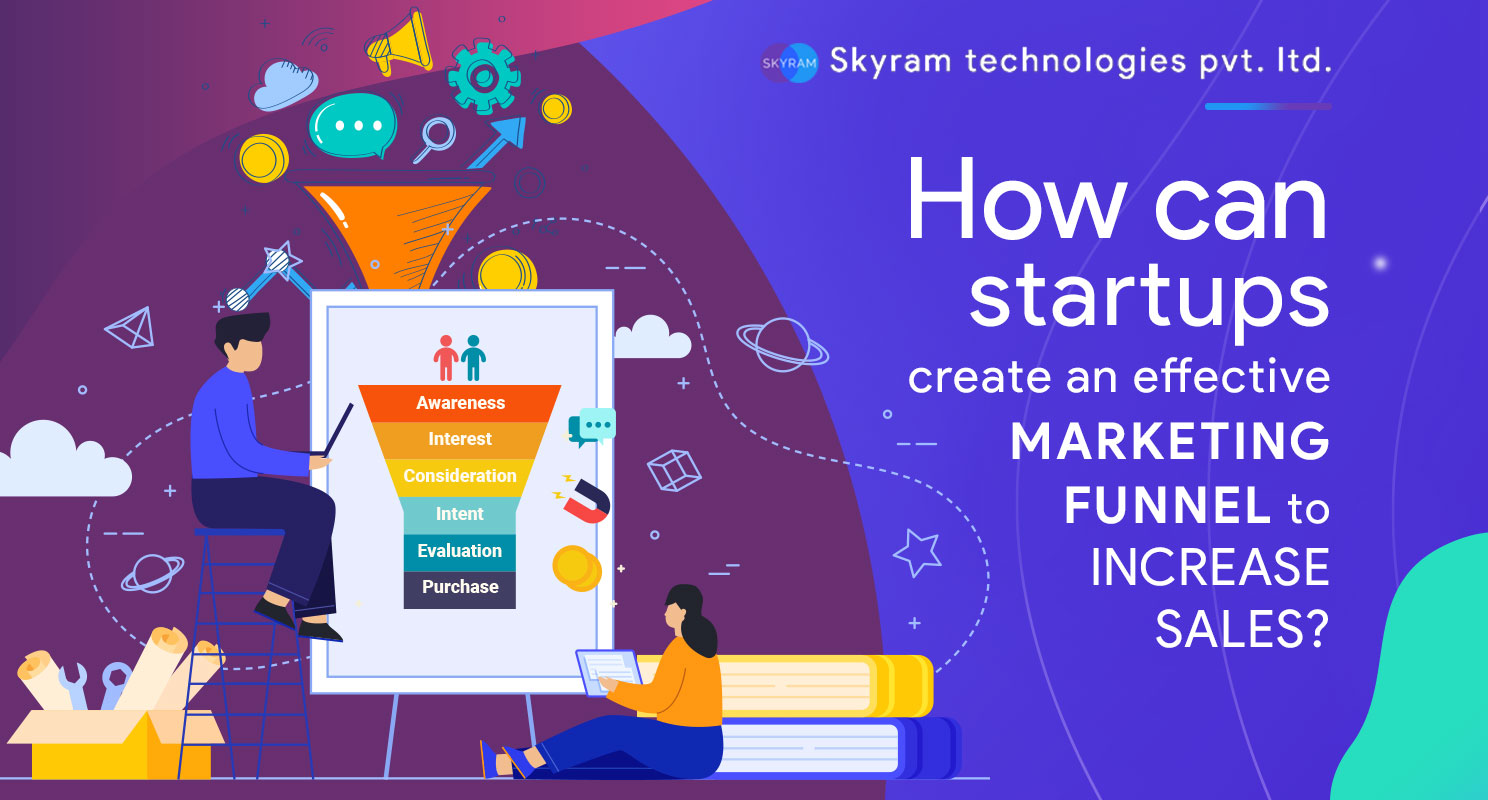
How can startups create an effective marketing funnel to increase sales?

Every business wants their sales process to run smoothly. To make sure that happens, it is imperative for every business to create an effective marketing funnel. The right marketing funnel will help in converting a visitor into a paying customer.

A lot of business owners are drifting away from the “marketing funnel”. It is a misconception to think that marketing funnel is way too mechanical. The funnel is a simple way to describe the lead nurturing sequence, to shift customers from awareness to purchase.

It is a useful way to describe a complicated process that offers startups and marketers with a good visual image. In this blog, we are going to breakdown the different steps to create an effective marketing funnel to boost your sales.

What is a marketing funnel?

A marketing funnel is a way to breakdown the customer journey all the way from the “awareness” stage to the “purchase” stage. The funnels can also include certain post-purchase steps that help in customer retention.

It is a compilation of all the steps that a buyer needs to go through before purchasing. There is no denying the fact that people buy all kinds of stuff at all times, whether they need it or not.

One of the primary reasons people buy stuff that they don’t need is because the top brands understand the consumer journey. Not only that, they know how to instigate demand among customers and guide them to buy something they don’t need.

What are the different types of marketing funnel models?

There are primarily four different types of marketing funnel models. They are as follows:

AIDA Funnel: This is also known as Awareness, Interest, Desire, and Action funnel. It was developed in the late 19th century. It is the most popular and most preferred marketing funnel that comes in four stages including awareness, interest, desire, and action.

The AIDA Model
The AIDA Model

This marketing funnel identifies the varying cognitive stages of an individual while buying a product or a service. It is more of a communications model that enables companies to see opportunities on how and when to communicate during each stage since consumers use different platforms these days.

Inbound marketing flywheel: The inbound marketing funnel is focused on three specific stages, attract, engage, and delight. This method of marketing funnel focuses on developing relationships with the target audience. In this way, you increase credibility and trustworthiness. The inbound marketing flywheel is a great way to get your target audience to look more closely at the products and services.

Conversion funnel: The conversion funnel is a much more open-ended than the first three because it enhances the delight stage. Thus, it transforms the repeat customers to brand advocates and it brings referrals to the business.

Growth funnel: The growth funnel recently became one of the very popular marketing funnels that are used by startups. It is used by Airbnb, Uber, Dropbox, and other premium startups. It is also known as the pirate funnel because it comprises five stages including, acquisition, activation, retention, referrals, and revenue.

The Growth Model
The Growth Model

If you want to capture leads at every stage of the marketing funnel, it is imperative to assign action at every step. Here are the following steps to create an effective marketing funnel for startups.

Steps to create an effective marketing funnel for startups

1. Awareness: Getting the message out in the open

This is stage one of a marketing funnel for startups. It is important for your brand to get discovered by the right people. Here you have to make sure that you target the relevant audiences to bring traffic to your website who will buy your offer.

You can create awareness through SEO using high-ranking keywords and interesting content for your audience. You can reference the product or service in some way or subtly promote the requirement for something like them in content. Keep the sales talk to a minimum.

You can also build awareness with paid advertising. There are other low-intent keywords triggering Google Search. This is also a chance to increase awareness. It is a bit advanced PPC technique where you should have a paid search strategy and solid lead nurturing system in place.

Also, sometimes, low-intent traffic might not click n your ad. Thus, keep an eye on the metrics. Despite the risks, using a low-intent keyword in Google Ads is a good way. It will get your brand seen at the early stage of a consumer journey.

Also, using social media platforms like Facebook, Twitter, Instagram, LinkedIn and more is a great way to build brand awareness.

2. Consideration: Establishing yourself as the most compelling option

This is the stage where you target people that show clear intent or desire to buy. It can be now or in the near future. The key to a successful remarketing strategy is to segment your campaign and target specific user interests.

Depending on the analytics setup, you can track specific user actions. Then create segmented remarketing lists with a specific message for every segment of audience. The actions indicate the extent of the user’s awareness and interest.

You can use this to create relevant campaigns for audiences. Use this similar tactic to target the leads at all stages of the marketing funnel. Also, capture email leads through email marketing for lead nurturing. Create email marketing campaigns to build an email list and get users to sign up.

3. Conversion: Turning leads into customers

The marketing goal is to convert leads, reduce conversion barriers, and turn consideration into action. Purchases are the most valuable types of conversions but there are others whom you can target with different campaigns. These include email signups, content downloads, free trials, account creations, demos, and more.

Creating organic and paid searches, SEO strategies, and Google Ad campaigns are the basics of conversion. Along with that, focus on optimizing the forms to maximize conversion. For every conversion, the user needs to complete a form. Thus, optimizing the form is important for conversions.

Next is, do the CRO in a smart way. There are 9 simple conversion rate optimization (CRO) fixes that influence conversion. These include lesser load times, single-column layouts, using ‘magic number’ technique, using ‘inverted pyramids’ for CTA’s, multi-step firms, remove the navigation from landing pages, testing the best CTA placement, testing secondary CTA’s, and exit-intent popups.

The attention should be on increasing incentives and removing barriers. Start with the most important aspect of the key pages and get them in order.

4. Loyalty: Turning customers into repeat buyers

The primary objective of a marketing funnel doesn’t end with a single purchase. That is just the beginning. You have to make your existing customers keep buying. Make sure that customer service is a top priority.

Regardless of how good your product/service is, customers will face problems of some kind. How you deal with your customers will become a major factor in customer retention. Create online guides, FAQ’s, Chatbots, contact management, and CRMs to help customers have the best experience.

This helps in filtering out cases. The most important aspect is to offer in-person support when needed. The support team should be ready to come in. it can be tricky if you have a large customer base but that is where a good CRM comes in.

Try to reward customers for their ongoing purchase. It works as an incentive, increases loyalty, and m0tivation to come back and buy more.

5. Advocacy: Availing new leads from existing customers

The final step is to turn happy customers into lead generators. How? Happy customers will continue to buy from you but they will also recommend you to others. 83% of the buyers state that recommendations from friends and family play a vital role in their purchasing decisions.

When you have a number of satisfied customers, create a profile of positive reviews. Also, get positive service stories or testimonials from your customers. Create referral campaigns by asking your customers to invite more of their friends and offering them incentives in doing so.

These are the steps that a startup needs to implement an effective marketing funnel. Are you looking to create an impeccable marketing funnel for your business? Get in touch with the certified professionals at Skyram Technologies here.

For more informative blogs, have a look at our blogs section here.

Pro PPC Tips: Advanced Bidding strategies for Google Shopping campaigns

If you want to succeed as a retailer, it is imperative to create an organized Google Shopping campaign. We know that competing in Google Shopping is hard. 56% of the Google PPC budget is spent on Shopping.

It is now more important than ever for the retailers to create a well-thought-out Google Shopping strategy. Google Shopping campaigns are designed to offer companies another opportunity to engage with shoppers.

However, when it comes to the bidding plan, there is a lack of any formal strategies in bidding. If you don’t set up a strong biding strategy from the start, you will end up wasting a lot of money on Google Shopping ads.

Is there any way to solve the bidding problem? Yes, there is, but you need to start by clearly defined objectives and campaign structure. While bidding, it is important to stay competitive to ensure optimal Return on Advertising Spend (ROAS).

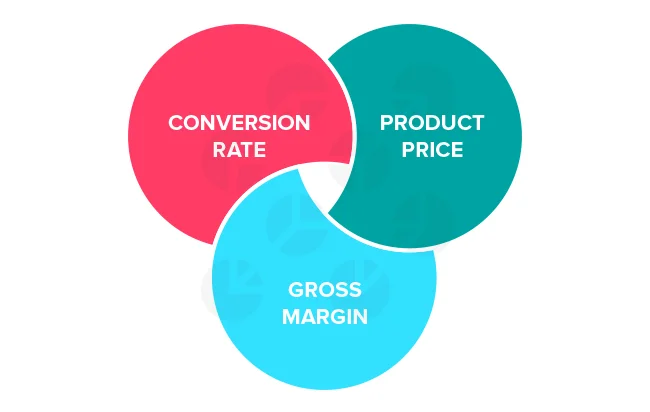
What factors affect Google Shopping Bids?

The factors that affect Google Shopping bids are as follows:

Conversion rate: There are certain products that will convert better than others. You need to invest more resources in products that convert better. Figure out the average conversion rates for the products and then bid accordingly.

Price of Products: ROAS is determined by the product price. A lot of e-commerce merchants make the mistake of not considering the product price. Don’t make the mistake of ignoring it.

Gross Margin: It is important to bid higher for the high-margin products and low for the low-margin products. Categorize the products according to their basic cost margin.

Factors affecting Google Shopping bids

Source

Once you get these numbers, the simple formula for maximum bid is

Maximum CPC = Product Price x Conversion Rate x Gross Margin

This needs to be the starting point. Why? The formula will tell your breakeven point. To make profits from your ad campaign, focus on:

  • Setting up the initial bids 25-50% less than the Max CPC
  • Improving the price
  • Improving the conversion rates

Why should you opt for Google Shopping Bids?

  • A lot of business organizations want to maximize clicks. If you are at the stage of building your brand, then the right Google Shopping bids can enhance the exposure.
  • If you want a high number of conversions, bidding can help your business in building a base of paying customers. It is also a good option if you have high demand products in large margins.
  • If you want to avail of optimal ROAS but your ad budget is limited, then this is a cost-effective way of making the most of it.

Pro tips to bid for Google Shopping campaigns

Bids are the biggest determining factor whether your product wins or not in the auction system. When you manage bids manually, you will have better control over your strategy.

  • Create custom bids for best sellers. Break the product groups according to the item ID’s for attributing custom bids for the best sellers. For the items that are bringing in too low revenue, exclude them by the item ID.
  • Raise the bids during a sale or promotion. The conversion rates get a boost on the products with sales or promotion. When you raise the bids during promotions, it will increase the volume which leads to a temporary drop in the cost per conversion. Google offers automated bidding strategies too.
  • Keep a fixed CPC and make sure the items get promoted with a fixed CPC. In this way, you will be able to exclude certain products for managing the bid by yourself.
  • Set a different target ROAS for different categories and products. The reason for doing this is, products with a low margin get a higher ROAS and the product with a high margin gets a lower ROAS.
  • Do not promote all the products. It is important to exclude certain products. The reason is, products should only be promoted at a certain time span for a particular reason. It is a bad idea to promote old products repeatedly.

A few more details to bid on Google Shopping campaigns

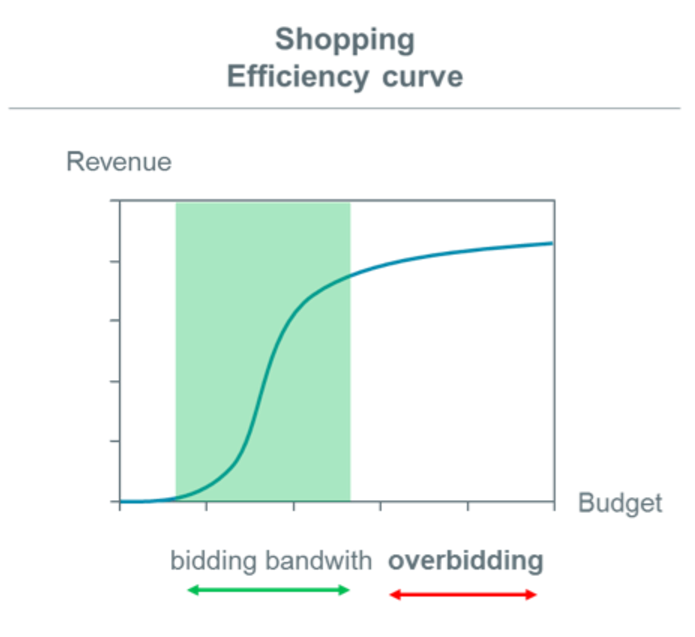
The S-Curve is one of the most important aspects of bidding in Google Shopping. The S-Curve is the Shopping Efficiency curve where two fundamental variables determine the campaign success – budget and revenue. There are three stages in the context of bidding.

  • Underbidding: Reduced bids that are ineffective in generating revenue.
  • Bidding Bandwidth: At this point, the value of a bid starts to increase rapidly.
  • Overbidding: This is the time when you start to see the diminishing returns on the bids.
The Bidding Curve
The Bidding Curve

Source

The bids need to fall into the bidding bandwidth, the section where this curve shoots upwards. That’s the sweet spot. Your campaign structure will segment your traffic and offer you control over the bidding strategy. Every campaign should have a unique bidding strategy to match your goals.

SKU (Stock keeping unit) Level Bidding

SKU (aka product ID or item ID) level bidding is a great way to segment your bids. It gives you the power to segment your bids according to product level vs. generic product traits like brand, category, custom labels. The issue with this strategy is, it is time-consuming to manage a large inventory.

The best idea is to perform an 80/20 analysis of the product inventory depending on a combination of KPIs like revenue, conversion, and returns. After that, create a focused and manageable campaign based on the target characteristic.

You can create an SKU level campaign for categories like bestsellers, high-margin, and high ROAS. After that, place a separate bid for every SKU in your campaign. Use the SKU level bidding on a certain category of products to monitor which matters the most.

Product Attribute Level Bidding

For a limited time, you cannot use SKU level bidding; instead, you can opt for the product attribute level bidding. This is where you combine two product attribute segments like category & brand or category & product.

With a two-product attribute structure, it is easier to set up specific maximum bids for every category. Unlike Google Product Category attribute, you get to choose which value to include. Thus, it will help in creating your own product categorization system within the product feed.

The best idea is to use product types with multiple levels for deeper and much more logical segmentation. The custom labels offer endless possibilities by enabling you to set up your values for five custom label value categories. Mix and match them with other product attributes.

Remarketing Audience Level Bidding (RLSA)

To create repeat visits, you need remarketing. You can remarket repeat visitors on Google Shopping. The keyword here is Audiences. With the RLSA campaigns, you place higher bids within your campaigns to different audiences. In this way, you will have a higher chance of getting traffic from your likely buyers.

For instance, you might be willing to big higher to attract people that abandoned your shopping carts vs. the people who browsed your website a few hours ago. The bidding for RLSA is done under the audiences tab. This ensures that you are more competitive in bidding to attract people from these audiences.

Are you looking to create an effective bidding strategy for Google Shopping? Get in touch with the professionals of Skyram Technologies here.

For more such informative blogs, have a look at our blogs section here.

The top 5 most significant aspects of cybersecurity on digital marketing

There is no denying that every online business needs to deal with the chances of a security breach at one point in time. This includes businesses specializing in digital marketing. Organizations and individuals working in different marketing positions are privy to sensitive information that most of the companies don’t want to share.

This is why it is imperative to uphold safety precautions as a part of everyday work. No matter the size of your company or your brand, if you are online, there is a chance of a security breach. Since digital marketing reaches a broader spectrum of audience, the chances of a security breach are higher.

In 2018, data breaches around the world cost multiple global companies an amount of about $3.86 million. In the USA alone, the average incident of data breach cost a company $7.9 million. This is exactly why cybersecurity is important.

What is Cybersecurity?

Cybersecurity is the process of securing the computers, networks, servers, and data from any sort of cyber-attack. Cybersecurity in digital marketing is also known as information security or information technology security.

Cybersecurity is applicable in multiple contexts. It includes network security, application security, information security, operational security, disaster recovery, and business continuity and end-user education.

Network Security: It is the process of securing the network from intruder attacks (targeted attack or opportunistic malware).

Application Security: This is the process to make sure that the application and software in your system are free of any threats. If an application gets compromised it could offer access to essential data.

Information Security: It is focused to protect the privacy and security of data during transit or storage.

Operational Security: Operational security is the process of protecting and handling data assets. It includes the permissions that the users have for accessing data and the other different procedures for storing or sharing data.

Disaster Recovery and Business Continuity: The disaster recovery policies are the techniques that a company uses for responding to any cybersecurity attacks. This procedure helps in restoring information and operations.

Business continuity is the backup plan that the company utilizes while operating without certain resources after a cybersecurity attack.

End-User Education: End-user education is to teach people not to install applications or software from unknown sources. Also, it teaches important practices like deleting suspicious emails and attachments.

Why is cybersecurity important in digital marketing?

Website protection: One of the primary reasons to opt for cybersecurity in digital marketing is to protect the website. When you are into social media marketing and online marketing, you need to protect the website. If the website is hacked, it will lead to financial loss, damage your brand reputation, and also result in regulatory fines.

IT Systems Protection: Every IT system of a business organization is a major target for the attackers. If they can get access to the local network or servers, the cyber-criminals can wreak havoc and impact your business severely.

Email Protection: Email systems are one of the most favorite tools for cyber-criminals. Most of the malware is distributed through emails. Did you know that 1 out of 130 emails contain malware? 67% of all the malware is distributed globally through emails.

Social Media protection: Cybersecurity is important for social media marketing. A lot of social media accounts get hacked despite the security improvements in multiple platforms. It can create serious damage to the online reputation of your brand.

The top 5 beneficial aspects of cybersecurity in digital marketing

Better Business Reputation: A single breach in data can cause major damage to your company. It can affect your clients and your business. The worst scenario is, it hampers your brand reputation.

Every client/customer wants you to have their best interest in mind. With strong cybersecurity, you can demonstrate that you are prioritizing your customers by offering information and data security. Thus, it assures your customers with peace of mind and increases business stability.

Increases revenue: Another important aspect of cybersecurity is it helps in increasing revenue. In the case of data breaches, a lot of times, lawsuits are filed against a company that leads to the payment of hefty fines. The bad publicity causes customers to shun your company.

Certain cyber-attacks can also shut down your website and prevent potential customers from making online purchases. It is true that the cybersecurity management strategy needs you to spend a good amount of money on the cybersecurity team. Rest assured that this investment is with every penny.

Competitive Edge: With a proficient cybersecurity team in place, you can reduce the potential risks of unexpected losses. Along with protecting your customer and employee data, cybersecurity measures also secure the proprietary information. This can offer you a competitive edge.

Proper cybersecurity management includes creating strong passwords and sharing them with the right employees. It also ensures that private business data is not leaked to other competitors.

Better staff engagement: While investing in cybersecurity, you don’t do it for the clients, but it is also for the employees. The employees are the most important assets of any organization. When employees feel that they are secure, it boosts their morale and confidence.

An organization needs to have a well-defined cybersecurity strategy to secure their employees’ sensitive information. This helps the company to earn their trust. The information can include address, DOB, important documents, social security numbers, and more.

Enhanced IT Support: With a better cybersecurity management plan, you will have a better disaster recovery strategy. Thus, instead of working on a spontaneous plan after a crisis, your organization will be prepared with a disaster recovery plan ensuring smooth operations.

A better cybersecurity plan also creates better work relationships and less stress in teams. This is important for the success of a social media marketing and digital marketing team.

The impact of a proper cybersecurity plan on digital marketing is unquestionable. Not only does it prevent attacks, but also it makes the employees feel secure. Do you have a proper cybersecurity management plan for your organization?

At Skyram Technologies, we have got a team of certified cybersecurity professionals that ensure optimal safety from all sorts of cyber threats. Get in touch with us here.

For more such informative blogs, check out our blogs section here.