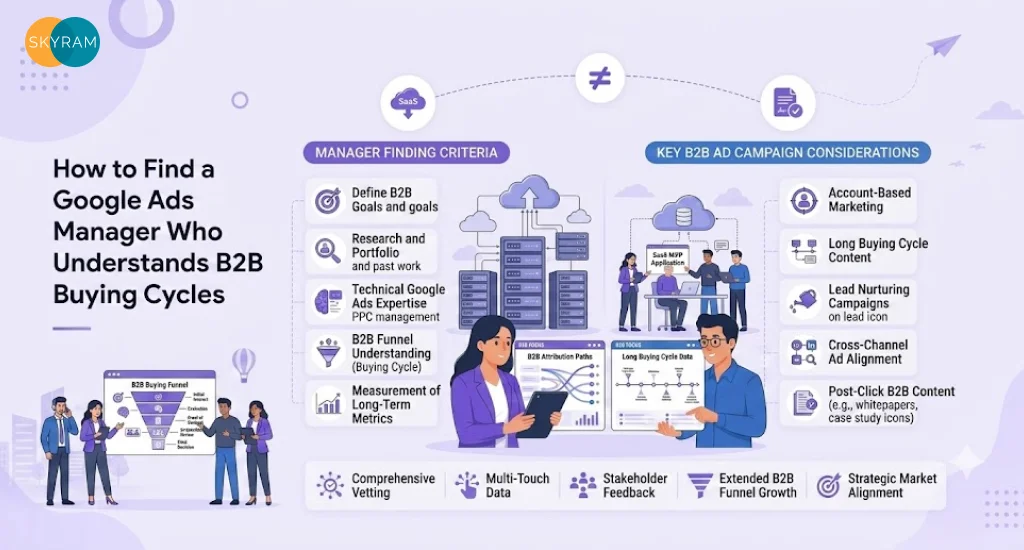
How to Find a Google Ads Manager Who Understands B2B Buying Cycles

How to Find a Google Ads Manager

Finding a Google Ads manager who understands B2B buying cycles means identifying someone who structures campaigns around awareness, consideration, and decision-stage intent separately, not someone who applies a single bidding strategy across all keyword types. B2B buying cycles average 6 to 12 months. A Google Ads manager who has only run B2C campaigns will optimize for immediate conversion signals that do not exist in enterprise buying behavior.

Here is how the failure typically plays out. A CMO brings in a Google Ads manager with genuinely impressive numbers. Their portfolio shows strong CTR improvements, efficient CPCs, and conversion rates that held up under scrutiny. What the portfolio does not show is that every result came from ecommerce and direct-response B2C accounts, where a buyer searches, clicks, and purchases within the same session. Within 90 days of taking over the B2B account, the campaigns are generating high form-fill volume from early-stage researchers who downloaded a whitepaper and will not be ready to buy for six to eight months. Meanwhile, high-intent decision-stage queries from buyers who are actively shortlisting vendors get ignored because the search terms look low-volume and the manager does not recognize them as the most valuable clicks in the account.

This post is the evaluation guide that CMOs and marketing directors need before putting their Google Ads budget behind a manager whose experience does not match the environment they will be working in. It covers what B2B paid search management actually requires, the questions that separate B2B-capable managers from B2C-trained ones, the red flags to watch for in portfolios and interviews, and how to structure the attribution infrastructure that makes any Google Ads engagement measurable against real pipeline.

How B2B Google Ads Management Differs From B2C

The surface-level mechanics of Google Ads are identical across B2B and B2C. Both environments use keyword targeting, bidding strategies, ad copy, and Quality Score. The structural differences sit underneath those mechanics, in how campaigns are organized, what they optimize toward, and how success gets measured over time.

Keyword Intent Stratification Across a 6 to 12 Month Buying Cycle

In B2C ecommerce, keyword intent is relatively flat. Most searches cluster around informational (“what is the best running shoe for flat feet”) and transactional (“buy Hoka Clifton 9 size 11”). The gap between those two intents is measured in days or hours. A buyer researches Monday and purchases Wednesday.

B2B keyword intent spans a much longer timeline and requires deliberate stratification. An enterprise software buyer might search “what is revenue operations software” in January, then “top revenue operations platforms for mid-market SaaS” in March, then “Clari vs Gong comparison” in May, then “Clari pricing and contract terms” in June. Each of those queries represents a different intent stage, a different readiness level, and should trigger a different ad, a different landing page, and a different offer.

A B2B Google Ads manager who understands this architecture builds separate campaigns for each intent layer and sets different conversion objectives and bid strategies across them. Bottom-funnel campaigns targeting decision-stage queries like “best B2B CRM for manufacturing companies” optimize toward demo requests. Middle-funnel campaigns targeting category-awareness terms optimize toward gated content downloads or webinar registrations, measured as micro-conversions, not primary goals. Top-funnel campaigns for problem-awareness queries are managed to engagement signals and brand lift, not direct conversions.

A manager who came up in B2C will compress all of this into one or two campaign types with a single conversion objective and wonder why the lead quality from the high-volume keywords is so poor.

Negative Keyword Strategy for Research-Stage vs. Decision-Stage Queries

Negative keyword management in B2B is substantially more nuanced than in B2C. The stakes are higher because each click costs more and the margin for irrelevance is narrower. In B2B paid search, showing your enterprise software ad to a college student writing a research paper is wasteful at $8 per click. Showing it to an IT Director actively shortlisting vendors is worth $80 per click.

The distinction between those two audiences often comes down to the search terms they use. Research-stage queries frequently include modifiers like “what is,” “how does,” “definition of,” “examples of,” “introduction to,” and “for beginners.” A B2B-experienced manager builds an extensive negative keyword list that filters out research-stage intent from bottom-funnel campaigns, directing those queries toward appropriate upper-funnel campaigns or blocking them entirely if the audience does not match.

Decision-stage negative keyword strategy is equally important. When running competitor conquest campaigns, you need negatives that prevent your ads from showing to people searching for competitor support, competitor login pages, or competitor job openings. Those clicks are expensive and convert at near-zero rates for acquisition purposes. Managers who do not audit search term reports weekly miss these patterns and let budget drain through irrelevant matches continuously.

Bidding Strategy Selection When Conversion Signals Are Sparse and Delayed

Smart bidding in Google Ads works by learning from conversion data. The algorithm needs enough conversion events to identify patterns and predict which future clicks are likely to convert. The standard threshold for stable smart bidding performance is approximately 30 conversions per campaign per month. In B2C ecommerce with transaction volume running in the hundreds, this is trivially achievable. In B2B with a 90-day sales cycle and monthly SQL volume in the single digits, it is a genuine technical constraint.

A B2B-experienced Google Ads manager knows how to navigate this problem. They know to set up micro-conversions, meaningful engagement events like content downloads, video completions, scrolling depth on high-value pages, and time-on-site thresholds, as early optimization signals while the primary conversion data develops. They know to use Maximize Clicks or Manual CPC in new campaigns rather than forcing Target CPA on a dataset too thin to support it. They know that switching to smart bidding before the data is ready produces erratic spend behavior and inflated CPAs that a less experienced manager will misattribute to a poor audience or wrong keyword.

This technical judgment about when automation helps and when it hurts is one of the clearest differentiators between a B2B-capable Google Ads manager and one who is applying a B2C playbook to an environment where it does not fit.

Key Takeaway: B2B Google Ads management requires campaign architecture that mirrors a 6 to 12 month buying cycle, negative keyword discipline that separates research intent from purchase intent, and bidding strategy judgment that accounts for sparse and delayed conversion signals. A manager who does not work this way in B2C accounts will not discover how to do it on the job inside your budget.

The Evaluation Framework for a B2B Google Ads Manager

The interview for a B2B Google Ads manager should function more like a working session than a credentials review. Certifications are table stakes. What you need to surface is how they think about campaign architecture, attribution, and audience design in environments where the feedback loop between ad click and revenue is months long.

1. Campaign Audit Exercise: What Is Wrong with This Search Campaign Structure?

Present the candidate with a simplified version of a flawed B2B search campaign structure and ask them to diagnose it. A well-designed audit exercise might show a single Search campaign with a single ad group, broad match keywords across all intent levels, Target CPA bidding set to a CPA derived from form fills rather than SQLs, and a single landing page for all traffic.

A B2B-capable manager will identify multiple structural problems without prompting. They will call out the intent mixing (decision-stage and research-stage queries in the same campaign bidding at the same CPA). They will question the conversion event choice: if the CPA is based on form fills but the form fills include unqualified research downloads, the algorithm is learning from the wrong signal. They will note the absence of negative keywords and the risks that come with running broad match without them in a B2B account. They will propose a restructure that separates intent layers into distinct campaigns with appropriate conversion objectives for each.

A manager who cannot diagnose a flawed structure in 15 minutes cannot build a sound one from scratch in 90 days.

2. Attribution Question: How Do You Measure Google Ads Contribution in a 90-Day Sales Cycle?

This question surfaces the candidate’s attribution infrastructure knowledge. A strong answer describes their approach to offline conversion import: CRM pipeline events pushed back into Google Ads so that MQL-to-SQL progressions and opportunity creation events become the optimization target rather than raw form fills. They will discuss multi-touch attribution and what model they prefer for assigning value across a long cycle. They will mention GA4 integration, conversion window settings appropriate for a 90-day sales process, and how they communicate attribution limitations to leadership.

A weak answer describes last-click attribution as if it solves the B2B measurement problem. Last-click attribution in a 90-day multi-touch cycle systematically undervalues upper-funnel campaigns that introduce buyers to your brand and systematically over-rewards the final touchpoint before form submission. A manager who does not recognize this will misallocate budget toward bottom-funnel campaigns and starve the awareness layer that feeds pipeline months later.

3. Audience Design: How Would You Structure Remarketing for a Buying Committee?

B2B purchases involve an average of six to ten stakeholders. Remarketing in this context is not about showing an ad to a single user who visited your pricing page. It is about maintaining brand presence across multiple people at the same company who are each conducting independent research and comparing notes internally.

A B2B-experienced manager designs remarketing audiences that account for this. They segment by page visited and stage implied: visitors who hit product or solution pages (higher intent) versus visitors who hit blog posts (earlier stage) should be served different messages and different offers. They use Customer Match to upload company domain lists and target signed-in Google users from those accounts. They adjust remarketing window lengths to match the actual evaluation cycle, setting 90-day or 180-day windows rather than defaulting to 30 days. They understand that the goal is coordinated presence across a committee, not repeated exposure to one individual.

4. B2C Google Ads Profile vs. B2B-Capable Google Ads Manager: Side-by-Side

B2C Google Ads Profile B2B-Capable Google Ads Manager
Campaign Structure Unified campaigns with single conversion objective Intent-layered: awareness, consideration, decision, retargeting
Keyword Strategy Match types optimized for volume and conversion rate Intent stratification with aggressive negative keyword development
Bidding Approach Target ROAS or Target CPA from day one Micro-conversions in early stages; smart bidding introduced once data supports it
Conversion Events Transactions or form fills Form fills plus offline CRM events (SQL, opportunity created, closed-won)
Measurement Framework Last-click, platform-reported ROAS Multi-touch attribution, CRM integration, 90-day conversion windows
Remarketing Design Individual user based on browse and purchase behavior Company-level and committee-aware audience segmentation
Reporting Focus CTR, CPC, ROAS by campaign Cost-per-SQL, cost-per-opportunity, pipeline velocity by campaign
Sales Team Relationship Minimal; marketing owns the handoff Required for lead scoring alignment and quality feedback loops

Key Takeaway: Evaluating a Google Ads manager for B2B requires working exercises, not credential checks. The campaign audit, the attribution question, and the audience design question will reveal faster than any portfolio review whether the candidate thinks in B2B terms or is translating B2C expertise into B2B vocabulary without the substance to back it.

Red Flags in Google Ads Manager Portfolios for B2B Buyers

Before the interview, the portfolio review narrows the field. These are the patterns that should raise immediate concern.

Only B2C or Ecommerce Case Studies in Their Portfolio

A portfolio composed entirely of ecommerce and direct-response B2C case studies is not automatically disqualifying, but it requires a pointed explanation from the candidate. Their results in those environments are real. The question is whether they understand that those environments produced their results through mechanisms that do not transfer to B2B.

If they cannot describe, unprompted, what they would need to change about their approach for B2B, they have not thought carefully about the difference. If they describe B2B paid search as fundamentally similar to ecommerce but “with longer cycles,” they have recognized the symptom without understanding the structural implications.

Reporting Built Entirely Around CPC and CTR with No Pipeline Attribution

A portfolio built on CPC improvements and CTR gains is a B2C reporting portfolio. These are legitimate performance indicators in environments where the click correlates tightly with downstream revenue. In B2B, a lower CPC often means you attracted cheaper but less qualified traffic. A higher CTR on a broad keyword can mean your ad copy is compelling to the wrong audience.

The absence of pipeline attribution in case study reporting tells you what the manager was asked to be accountable for in previous engagements. If no client ever required them to connect campaign performance to SQL volume or cost-per-opportunity, they have not built the muscle for that measurement. They will default to the reporting they know how to produce, which will not satisfy a CMO asking where pipeline is coming from.

No Mention of Negative Keyword Strategy or Search Term Auditing

Search term audits are the baseline quality control for any Google Ads account. Negative keyword lists are the output of that auditing, and in B2B they require ongoing weekly attention because match types in Google Ads continue to expand in ways that pull in unexpected query variants.

A manager who does not mention negative keyword development when describing their process has either never managed a B2B account where this distinction matters, or they are not operating at the level of detail that B2B paid search requires. Either conclusion is a reason to keep looking.

Key Takeaway: Portfolio red flags reveal the environment a Google Ads manager was built to serve. B2C-only case studies, reporting centered on CTR and CPC, and silence on negative keyword strategy are all signals that the candidate has not yet navigated the specific technical demands of B2B paid search. Spotting these patterns before the interview saves significant evaluation time.

In-House Google Ads Manager vs. Agency: Which Fits B2B Better

The decision between an in-house hire and a paid search agency for B2B is not primarily about cost. It is about feedback loop speed, context depth, and who owns the institutional knowledge about your buyers.

An in-house Google Ads manager builds deep product and buyer knowledge over time. They participate in sales calls. They hear which objections kill deals. They understand the nuance between a qualified lead and a form fill that looks qualified on paper. That context produces better keyword decisions, better ad copy, and better offer alignment. The disadvantage is that a single in-house manager carries the whole account, and their technical breadth is limited to what one person can master across platforms.

An agency brings a team with multi-platform depth and exposure to a broader range of B2B account structures. They have seen more failure modes and more optimization patterns than any single in-house hire. The risk is that account management gets distributed across multiple people with varying B2B experience levels, and strategic context about your buyers stays at the surface unless you invest heavily in onboarding and ongoing briefing.

For B2B companies spending under $30,000 per month in paid search, a specialized paid search agency typically delivers more technical depth than an in-house hire at equivalent cost. Above $100,000 per month, an in-house lead managing the strategy with agency support for execution often produces better results because the buyer context compounds internally over time.

What matters most is not the model but the B2B-specific expertise of whoever is making the campaign architecture decisions. A weak in-house hire and a B2C-trained agency both produce the same outcome: a well-reported account that does not feed pipeline. Whether you hire in-house or engage an agency, run the same evaluation framework and ask the same questions about attribution, intent stratification, and committee-level remarketing.

The complete PPC management guide covers the in-house versus agency decision in detail from a platform management perspective, including how to evaluate agency onboarding processes and what a properly structured audit looks like before any spend changes.

Key Takeaway: The in-house versus agency decision is secondary to the B2B expertise question. Both models can produce strong pipeline results and both can fail for the same structural reasons. Evaluate the individual or team doing the work against the same criteria regardless of engagement model.

How to Set Up Attribution Infrastructure Before Your Google Ads Manager Starts

Attribution infrastructure is not the Google Ads manager’s problem to solve after they take over the account. It is a prerequisite that the marketing operations function needs to build before paid search strategy can be evaluated against meaningful outcomes. Asking a Google Ads manager to improve pipeline performance inside a broken attribution environment is asking them to navigate without a map.

The minimum viable attribution stack for a B2B Google Ads program has four components.

The first is conversion tracking that goes beyond form fills. Every significant engagement event should be tracked: whitepaper downloads, demo requests, webinar registrations, pricing page visits above a time threshold, and any chatbot interactions that qualify as a sales conversation. Each event should be classified by its proximity to purchase intent and assigned different conversion values in Google Ads.

The second is CRM integration through offline conversion import. When a lead becomes an MQL and then an SQL in your CRM, those transitions should push back to Google Ads as conversion events tied to the original click through Google Click Identifier (GCLID) matching. This connects the bidding algorithms to the outcomes that actually matter, rather than letting them optimize toward form fills that may never reach the sales team.

The third is GA4 setup with proper B2B goal configuration. GA4 should track the same events as Google Ads and allow you to build audience segments based on behavioral signals: users who visited three or more solution pages, users who spent more than four minutes on the pricing page, users who visited from a target company domain. These audiences feed back into Google Ads for remarketing and Customer Match targeting.

The fourth is a conversion window setting that matches your actual sales cycle. Google Ads defaults to 30-day conversion windows. A B2B company with a 90-day average sales cycle is leaving months of attribution credit on the table. Setting a 90-day click-through window ensures that the algorithm receives credit for deals that take time to develop, and that your reporting reflects the full contribution of campaigns that introduced buyers early in their evaluation.

Teams at Skyram Technologies approach this infrastructure setup as the first milestone of any paid search engagement, before any campaign optimization work begins, because without clean attribution, every subsequent optimization decision is built on unreliable data.

Key Takeaway: Attribution infrastructure is a marketing operations responsibility, not a Google Ads manager deliverable. Set up offline conversion import, CRM integration, GA4 goal configuration, and appropriate conversion window settings before evaluating any paid search performance. Without this stack, you are measuring the wrong outcomes and making budget decisions based on data that does not connect to revenue.

What 90-Day Success Looks Like for a B2B Google Ads Engagement

The 90-day window for evaluating a new Google Ads manager or agency in a B2B context should not produce a clean pipeline verdict. It should produce a clean infrastructure verdict: is the technical foundation in place to generate meaningful data over the following six months?

In the first 30 days, a B2B-capable manager conducts a full account audit: conversion tracking integrity, negative keyword gaps, campaign structure mismatches between intent and bidding strategy, Quality Score distribution, audience configuration, and attribution window settings. They produce a prioritized fix list with estimated impact, not a generic scorecard. They implement the highest-priority technical fixes before making any significant bid or budget changes.

Between days 30 and 60, the manager executes structural changes: separating intent layers into distinct campaigns, building out negative keyword lists from search term report analysis, configuring micro-conversion events to give smart bidding early optimization signals, and setting up audience segments for remarketing that reflect the B2B evaluation cycle rather than standard 30-day retargeting windows.

Between days 60 and 90, the manager begins to see early data from the restructured campaigns and makes tactical adjustments. Micro-conversion rates by campaign and keyword cluster start to show which intent layers are generating real engagement versus wasted spend. The search term reports begin to confirm whether the negative keyword strategy is holding. Early offline conversion data from the CRM, if the integration is working, starts to show which campaigns are generating contacts that survive lead qualification.

At the 90-day mark, the right success metric is not SQL volume from paid, which is too early to judge in a long sales cycle. The right metric is whether the account is technically sound, whether the attribution infrastructure is producing data you can trust, and whether the manager can show you a clear hypothesis about which campaigns are building pipeline and why.

That conversation, grounded in data rather than platform metrics, is how you distinguish a B2B-capable Google Ads manager from one who is producing good-looking reports that do not connect to the outcomes you actually care about. If you also want to understand how paid search integrates with organic and AI-layer visibility, the SEO services overview and generative engine optimization resources clarify where each channel contributes across the B2B evaluation funnel.

Key Takeaway: Ninety days is enough time to evaluate the technical quality of a B2B Google Ads engagement, not enough time to evaluate pipeline contribution. Define 90-day success as a clean attribution infrastructure, a structurally sound account, and a data-backed hypothesis about campaign-to-pipeline connection. Hold pipeline evaluation to the 6-month mark, aligned with your actual sales cycle.

Frequently Asked Questions

  1. What should a Google Ads manager know about B2B marketing?

A Google Ads manager working in B2B should understand how buying cycles affect campaign architecture, attribution, and bid strategy in ways that do not apply to B2C accounts. Specifically, they should know how to structure campaigns around separate intent layers (awareness, consideration, and decision), how to use offline conversion import to connect CRM pipeline events back to Google Ads bidding algorithms, how to build negative keyword lists that protect high-intent campaigns from research-stage query bleed, and how to set conversion windows that reflect a 90-day or longer sales cycle rather than defaulting to 30 days. A B2B Google Ads manager should also understand that the primary success metric is cost-per-SQL or cost-per-opportunity, not cost-per-click or cost-per-form-fill, and that their reporting should speak the language of pipeline contribution rather than ad platform metrics.

  1. How is B2B Google Ads management different from B2C Google Ads management?

B2B Google Ads management differs from B2C management in three foundational ways. First, the buying timeline: B2C purchases often complete within hours of a click, while B2B purchases take 6 to 12 months and require campaigns that serve buyers at different readiness levels simultaneously. Second, the audience structure: B2C targets individuals based on demographics and interest signals, while B2B must account for buying committees of 6 to 10 people at the same company, each researching independently. Third, the measurement framework: B2C optimizes toward transactions tracked in real time, while B2B requires multi-touch attribution, offline conversion import from the CRM, and conversion windows that match the length of the actual sales cycle. A manager trained exclusively in B2C will apply fast-cycle optimization logic to a slow-cycle environment and optimize toward metrics that do not predict revenue.

  1. How do I evaluate a Google Ads agency for B2B lead generation?

When evaluating a Google Ads agency for B2B lead generation, look for four signals. First, case studies from B2B accounts with reporting that shows cost-per-SQL or cost-per-opportunity, not just CTR and CPC. Second, a clear description of how they set up offline conversion import to connect Google Ads performance to CRM pipeline data. Third, a process for intent stratification: how they structure different campaigns for different stages of a B2B buying cycle rather than running all traffic through one campaign type. Fourth, a remarketing strategy that accounts for buying committees rather than individual users. Agencies that cannot describe these four elements in concrete operational terms are applying B2C expertise to a B2B brief.

  1. What is offline conversion import in Google Ads and why does it matter for B2B?

Offline conversion import in Google Ads is a process that connects CRM pipeline events, such as a lead becoming an SQL or an opportunity being created, back to the original ad click that generated that contact. It works by capturing a Google Click Identifier (GCLID) from the initial ad click, storing it in the CRM, and then uploading that GCLID with the downstream conversion event when it occurs. For B2B, this matters because the most valuable conversion events happen weeks or months after the initial ad click, well outside the window that Google Ads can observe through standard pixel tracking. Without offline conversion import, Google Ads bidding algorithms optimize toward form fills, and lead quality suffers because the algorithm has no signal about which form fills actually become qualified pipeline.

  1. How long does it take to see results from a B2B Google Ads campaign?

B2B Google Ads campaigns typically require 60 to 90 days to establish a clean technical foundation and begin generating reliable early signals, and 4 to 6 months before meaningful pipeline attribution data is available for evaluation. The first 30 days should focus on account structure, tracking integrity, and negative keyword development. The next 60 days generate micro-conversion data that indicates which intent layers are producing qualified engagement. Pipeline data becomes statistically meaningful only after enough leads have had time to progress through the full qualification cycle. Organizations that evaluate B2B Google Ads performance at 30 or 60 days and make budget decisions based on that data are measuring before the feedback loop has closed, which leads to premature campaign cuts and missed pipeline contribution.

Work with Google Ads Managers Who Think in Pipeline, Not Platform Metrics

The difference between a Google Ads manager who understands B2B and one who does not is not visible in their certifications or their general performance numbers. It surfaces in how they structure campaigns, how they measure success, and whether they can connect ad spend to pipeline in an environment where the path from click to closed deal takes six months.

Skyram Technologies builds B2B Google Ads programs around proper attribution infrastructure, intent-stratified campaign architecture, and reporting that CMOs and VPs of Sales can both read without translation. If your current paid search program generates traffic without feeding pipeline, the problem is structural and addressable.

Schedule a strategy session to discuss what a pipeline-first Google Ads engagement looks like for your B2B demand generation program.
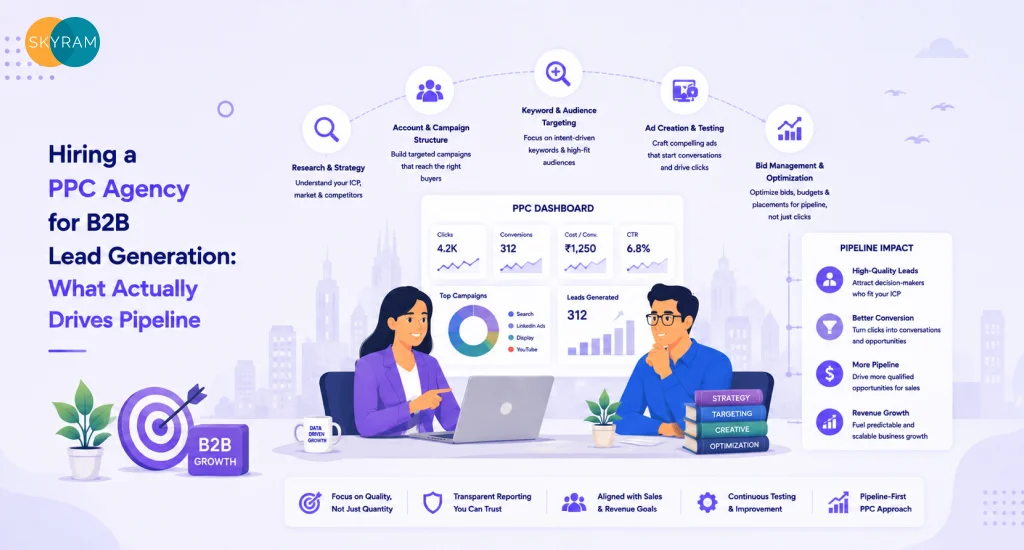
Hiring a PPC Agency for B2B Lead Generation: What Actually Drives Pipeline

Hiring a PPC Agency for B2B Lead Generation

Hiring a PPC agency for B2B lead generation requires evaluating their understanding of long buying cycles, multi-touch attribution, and the difference between form fills and qualified pipeline. B2B PPC performance measured on click-through rate and cost-per-click tells you almost nothing about revenue impact. Agencies that drive B2B pipeline optimize for SQLs and pipeline velocity, not impressions and traffic volume.

Here is the scenario that plays out across B2B marketing teams more often than anyone wants to admit. The demand gen lead brings in a PPC agency for B2B campaigns. Month one report lands: CTR is up 38 percent. Cost-per-click dropped by 22 percent. The agency is thrilled. The sales team, however, is not booking more discovery calls. SQLs are flat. The CRM is filling up with forms from companies that are nowhere near the ICP, from titles that have no budget authority, and from people who downloaded a whitepaper with no intent to ever buy.

The agency optimized the metrics they knew how to move. Not the ones that mattered.

This post is the evaluation guide that demand gen leaders and marketing directors need before they sign an agency contract. It covers what B2B PPC architecture actually looks like, the five questions that reveal whether an agency genuinely understands B2B buying behavior, how to structure accountability around revenue outcomes, and when to combine paid search with organic strategy for full-funnel coverage.

Why Most PPC Agencies Are Optimized for the Wrong B2B Metrics

The core problem with most PPC agencies evaluating themselves against B2B KPIs is that they were trained on B2C performance signals. Retail and ecommerce campaigns produce purchase events within hours of a click. The feedback loop is tight, the signal is clear, and optimization toward conversions works because “conversion” actually maps to revenue.

B2B is structurally different. A qualified B2B buyer might click a LinkedIn ad in January, visit the site twice more in February via organic search, attend a webinar in March, and finally request a demo in April after a colleague forwards a case study. That ad click in January contributed to a closed deal. A CTR-optimized campaign would never surface that relationship.

CTR and CPC as Vanity Metrics in Long-Cycle B2B Buying

Click-through rate measures how many people clicked your ad. It tells you nothing about whether those people had the budget, authority, or need to purchase. In B2B with average sales cycles of 3 to 12 months, a high CTR from poorly qualified audiences accelerates your cost-per-SQL, burns your sales team’s time, and produces pipeline reports that look fine until leadership asks why revenue is not following.

Cost-per-click is even less informative. A lower CPC often means you shifted bidding toward broader match terms or lower-competition placements that attract researchers and students rather than decision-makers. An agency celebrating CPC reduction while your sales team flags lead quality problems has misaligned priorities.

The agencies that understand B2B measure cost-per-SQL, cost-per-opportunity, and pipeline contribution by channel. Those are the metrics that connect paid campaigns to revenue. If an agency’s standard reporting deck does not include those columns, that tells you everything about how they will manage your account.

Form Fills vs. SQLs: Where the Conversion Gap Actually Lives

Every agency will optimize toward your conversion events. The question is whether your conversion events are the right ones. Most B2B teams set form submissions as their primary conversion, then wonder why their cost-per-lead looks manageable while qualified pipeline growth is stagnant.

The conversion gap lives between the form fill and the SQL. A prospect fills out a gated whitepaper download. That registers as a conversion. That person has no buying intent today. They are in research mode. Six months from now, maybe three percent of that cohort becomes an SQL. An agency optimizing toward form fills has just built a system that efficiently delivers people who are nowhere near a buying decision.

Solving this requires connecting your CRM data back to campaign performance through offline conversion imports. When a lead becomes an SQL, that event gets pushed back into Google Ads or LinkedIn as a conversion signal. Now your bidding algorithms are optimizing toward the behavior that actually precedes revenue, not the behavior that precedes inbox noise.

How Agency Reporting Obscures Pipeline Contribution

Standard agency reporting packs in the metrics that look like progress: impressions served, clicks generated, CTR improved, quality score increased. These are real signals that good things are happening in the account. They are not evidence that pipeline is growing.

Pipeline contribution requires a different data layer. You need to know which campaigns and keywords are generating contacts that eventually became opportunities, what the average time lag is between first paid touch and opportunity creation, and what your cost-per-opportunity looks like by campaign type, by offer, and by channel.

Most agencies cannot produce that reporting because they do not have CRM access and they have not set up the offline conversion tracking infrastructure that makes it possible. Insisting on this data architecture before signing is one of the most important steps a demand gen leader can take.

Key Takeaway: B2B PPC performance measured on CTR and CPC tells you almost nothing about revenue impact. Insist on reporting that connects campaign spend to SQL volume, cost-per-opportunity, and pipeline contribution before you evaluate whether an agency is actually performing.

What B2B PPC Campaign Architecture Actually Looks Like

A B2B demand gen PPC program is not a single campaign targeting people who search for your product. It is a layered system designed to reach buyers at different stages of awareness and move them through a buying process that happens over months, not days.

Intent-Layer Targeting: In-Market vs. Awareness vs. Retargeting

A properly architected B2B paid program runs three distinct intent layers simultaneously, each with its own offer, landing page, and measurement approach.

The bottom layer targets in-market buyers who know they have a problem and are actively evaluating solutions. These are high-intent keyword campaigns around terms like “B2B lead generation software” or “demand gen agency” with conversion objectives tied to demo requests or consultation bookings. Cost-per-click is highest here, conversion rates are highest, and sales cycle from this entry point is shortest.

The middle layer targets buyers who are aware of the category but not yet actively shopping. LinkedIn Sponsored Content with educational resources, thought leadership, or comparison content performs well here. The goal is not an immediate demo request. The goal is a documented touch that keeps your brand in the consideration set when the evaluation period begins.

The top layer runs retargeting against people who have already engaged with your content, visited key pages, or opened prior emails. These audiences convert at 3 to 5 times the rate of cold traffic because you are serving ads to people who already know who you are. A B2B agency that is not running structured retargeting is leaving the highest-efficiency segment of your funnel unmeasured.

Account-Based Targeting and How It Differs from B2C Audience Construction

B2C audience construction focuses on demographic and behavioral signals: age, interests, purchase history, lookalike models built from past customers. B2B account-based targeting starts from a different place entirely. You define the companies you want to reach first, then build targeting that serves ads to the people within those companies who participate in the buying decision.

LinkedIn’s company targeting combined with job title and seniority filters is the most precise tool available for this. You can serve ads exclusively to VPs of Marketing and Directors of Demand Generation at SaaS companies with 200 to 2,000 employees that are located in the US. That specificity means higher CPCs, but it also means every impression has a realistic chance of reaching someone in your actual ICP.

Google Ads Customer Match and account lists let you upload company domains and match them against signed-in users, then layer those company signals on top of keyword intent. It is less precise than LinkedIn but dramatically cheaper per impression, and effective for the bottom-of-funnel layer where someone from a target account is actively searching for your category.

Landing Page and Offer Design for B2B Buying Committees, Not Individual Buyers

B2B purchases involve an average of 6 to 10 stakeholders depending on deal size and industry. A landing page designed to convert a single motivated individual fails in this environment because no single person makes the decision. Your paid traffic lands on a page, and within 60 seconds that person is asking: can I forward this to my team? Does this pass the internal credibility test? Does this contain the proof that will hold up in a business case presentation?

Your offer architecture needs to account for that social proof requirement. Case studies with named companies and specific ROI figures convert better than generic outcome statements. ROI calculators that produce shareable outputs give individual champions something to put in front of a CFO. Audit offers and benchmark reports are easy to justify internally because they produce information, not an immediate sales engagement.

An agency that sends your LinkedIn traffic to a generic contact form is not thinking about the committee dynamics that govern B2B buying. That mismatch between ad targeting precision and landing page design is where a significant portion of your budget disappears.

B2C-Optimized vs. B2B Pipeline-Focused PPC Agency: Side-by-Side

B2C-Optimized PPC Agency B2B Pipeline-Focused PPC Agency
Campaign Structure Single-funnel, conversion-focused Intent-layered: awareness, retargeting, in-market
Audience Construction Demographic and interest-based Company, title, seniority, buying committee
Primary KPIs CTR, CPC, cost-per-lead Cost-per-SQL, cost-per-opportunity, pipeline velocity
Measurement Framework Last-click attribution Multi-touch, offline conversion import, CRM integration
Reporting Cadence Monthly PDF with platform metrics Weekly tactical, monthly pipeline review, quarterly strategy
Offer Strategy Single CTA (buy, sign up, trial) Staged offers by intent level (resource, audit, demo, call)
Sales Alignment None required Required for lead scoring, qualification handoff, feedback loop
Landing Page Approach Individual conversion optimization Committee-ready: social proof, shareable assets, credibility signals

Key Takeaway: B2B PPC architecture is fundamentally different from B2C. A pipeline-focused agency builds layered campaigns that match offer to intent, targets buying committees rather than individuals, and measures outputs that actually connect to revenue, not just activity.

The Five Questions That Reveal Whether a PPC Agency Understands B2B

These are not gotcha questions. They are the baseline competency checks that separate agencies that have genuinely managed B2B pipeline programs from agencies that have read about them.

1. How Do You Attribute Pipeline to Paid Campaigns Across a 90-Day Sales Cycle?

This question forces the agency to explain their attribution infrastructure. A strong answer describes their offline conversion import process: how CRM data is connected to ad platforms so that MQL-to-SQL progressions feed back into bidding optimization. It describes their position on multi-touch attribution and which model they use for evaluating channel contribution over a long cycle.

A weak answer talks about last-click attribution or mentions “closed loop reporting” without explaining how the loop actually closes. If an agency cannot describe the technical process by which a deal closed in your CRM connects back to the keyword and campaign that first brought that buyer into your funnel, they are reporting on ad activity, not pipeline contribution.

2. How Do You Approach Targeting a Buying Committee vs. a Single Decision-Maker?

This question surfaces whether the agency thinks about B2B audience construction at all. A strong answer discusses persona segmentation within the same target accounts, separate creative tracks for technical evaluators versus financial approvers, and offer architecture designed for different stakeholder concerns within the same deal.

A weak answer describes job title targeting as if serving one ad to one person completes the committee engagement problem. B2B agencies who have worked real enterprise deals understand that the VP of Marketing who sees your ad is not the person who signs the check or configures the tool. Each of those people needs to encounter your brand and your proof points at some point in the evaluation window.

3. What Is Your Strategy When a Campaign Drives Traffic but Sales Says the Leads Are Not Qualified?

This question tests the agency’s ability to diagnose a structural problem rather than defend their metrics. A strong answer proposes a multi-step investigation: reviewing the search terms triggering ads, auditing the audience signals on LinkedIn, analyzing the company profile of form fills versus actual SQLs, adjusting the offer to attract higher-intent prospects, and installing a lead scoring layer that gates MQL-to-SQL handoff.

A weak answer suggests running more volume to improve conversion rate. If an agency responds to lead quality problems by recommending more spend, they are not aligned with your pipeline outcomes. They are aligned with their management fee tied to budget.

4. What Offer Architecture Do You Recommend for Our Funnel Stage?

A B2B-experienced agency thinks about this in terms of where the buyer is in their awareness journey. They will ask about average deal size, sales cycle length, and how your sales team prefers to initiate discovery. Then they will recommend offers that match: awareness-stage content for cold audiences, audit and benchmark offers for middle-funnel intent, demo requests and consultation bookings for in-market buyers.

An agency that immediately recommends a demo request CTA for all traffic regardless of audience temperature has not thought seriously about B2B buyer behavior.

5. How Do You Handle Campaign Optimization When Conversion Data Is Sparse?

B2B campaigns often struggle with low conversion volume in early months because the pipeline cycle is long and SQLs accumulate slowly. A skilled agency knows how to use micro-conversion events (whitepaper downloads, video completions, time-on-page thresholds) as early optimization signals while the higher-quality conversion data develops. They know how to structure campaign types and bidding strategies to perform in low-volume environments rather than requiring 50 conversions per campaign per month before smart bidding is stable.

Key Takeaway: These five questions identify whether a prospective PPC agency has genuinely managed B2B pipeline programs or has managed B2C campaigns and applied surface-level B2B vocabulary to the same playbook. The answers reveal attribution infrastructure, committee thinking, diagnostic discipline, and technical competency simultaneously.

Campaign Types That Drive B2B Pipeline vs. Those That Just Drive Traffic

Not all paid campaign types are equal contributors to pipeline in a B2B context. Here is how the major campaign types break down by their actual pipeline value:

Google Search: In-Market Demand Capture. When B2B buyers are actively evaluating vendors in your category, Google Search captures that intent precisely. Terms with commercial intent (“B2B demand gen agency,” “LinkedIn ads for SaaS,” “PPC agency for software companies”) produce direct pipeline at the bottom of the funnel. This is the highest-efficiency campaign type for pipeline-per-dollar in mature accounts.

LinkedIn Sponsored Content: Upper-Funnel Awareness. LinkedIn reaches buying committees by company, title, and seniority with content-first formats. Thought leadership content, benchmark reports, and educational assets perform here. Conversion rates are low but audience precision is high, and the people who engage are inside your actual ICP.

LinkedIn Lead Gen Forms: Middle-Funnel Offer. Pre-filled forms that capture contact data from LinkedIn profiles reduce friction for resource downloads and webinar registrations. These produce MQLs at reasonable volume, but require strong lead scoring to prevent the pipeline-fill problem described earlier.

Google Display and YouTube: Brand Reinforcement. These formats keep your brand in the consideration set for buyers who have already shown some intent. They function best as retargeting vehicles rather than cold prospecting tools for B2B. Measuring them on direct conversion metrics misunderstands their role in a multi-touch cycle.

Competitor and Alternative Conquesting. Search campaigns targeting competitor brand terms and “alternative to X” keyword clusters capture buyers who are actively evaluating your direct competition. These campaigns deliver some of the most qualified traffic available because the person has already made the decision to invest. They are often underutilized in B2B paid programs.

Branded Keyword Defense. Running branded keyword campaigns protects your organic SERP real estate from competitors who bid on your name and ensures that high-intent buyers searching for you directly land on your page, not a competitor comparison site. This is table stakes, not optional.

Key Takeaway: In B2B, campaign type selection is as strategic as keyword selection. Google Search captures in-market demand. LinkedIn reaches the committee. Retargeting closes the loop on in-funnel engagement. Agencies that treat all campaign types with the same conversion objective are misapplying the tools they have.

How to Structure Agency Accountability Around Revenue Outcomes

Hiring a PPC agency without structuring accountability correctly is how you end up in the scenario described at the start of this post: great metrics, no pipeline. Accountability structures need to be built into the engagement from day one, not bolted on after frustration accumulates.

OKRs and Reporting Frameworks Tied to SQL Volume, Not Vanity Metrics

The engagement objectives need to be written in the language of pipeline. That means the primary success metric is SQL volume from paid channels, secondary metrics are cost-per-SQL and cost-per-opportunity, and tactical metrics like CTR and CPC are treated as diagnostic indicators rather than proof of performance.

A monthly reporting cadence should include: pipeline generated from paid by campaign type, lead quality score from sales team feedback (on a defined scale), MQL-to-SQL conversion rate from paid channels versus organic versus direct, and cost-per-opportunity by campaign. If those four data points are not in the report, the report is not connected to your business outcomes.

You also need a defined lead scoring framework agreed upon with sales before the first campaign launches. Without shared definitions of MQL and SQL, every conversation about lead quality becomes subjective and adversarial. A lead scoring matrix that uses firmographic, behavioral, and engagement signals to automate the handoff removes that friction.

Milestone-Based Retainer Structure That Aligns Incentives

Standard monthly retainers pay the same fee regardless of whether the account improved or declined. A milestone-based structure ties a portion of the retainer to specific pipeline metrics achieved within defined windows.

A practical structure: a base retainer covers account management and reporting. A performance component activates when SQL volume from paid channels hits defined monthly thresholds. Milestones reset quarterly so the agency is not penalized for market seasonality, but they are rewarded for sustained pipeline contribution.

This structure does not work if attribution is not clean. The agency needs to have visibility into CRM data and the technical infrastructure to connect campaign performance to downstream revenue events. Setting up that infrastructure is a prerequisite to making performance incentives meaningful.

Agencies willing to engage with a milestone-based structure are making an implicit statement about their confidence in their process. Agencies that resist it entirely and insist on flat retainers regardless of outcomes are telling you something about their relationship with accountability.

Key Takeaway: Accountability structures need to be built into the agency contract before work begins. Define success in the language of pipeline, agree on lead scoring with sales, and structure retainers to create shared incentives around SQL volume and cost-per-opportunity.

When to Combine SEO and PPC for Full-Funnel B2B Coverage

Paid search and organic search solve different problems in a B2B marketing program. Running them in isolation produces two underperforming channels. Running them as integrated strategy produces a compounding system where each channel makes the other more effective.

The most immediate integration value comes from keyword intelligence sharing. PPC campaigns generate conversion data on specific search terms within weeks. You learn which queries convert at the highest rate with the lowest cost before committing to the months-long content investment that organic ranking requires. That PPC keyword data becomes the prioritization input for your B2B SEO strategy, compressing the research phase significantly.

The second integration value is coordinated SERP coverage. For high-commercial-intent queries where your target buyers are actively searching, owning both the paid position and an organic position on the same page significantly increases click probability. Research consistently shows that brands appearing in both positions increase total SERP traffic share by 15 to 25 percent compared to organic or paid alone. The cannibalization concern that leads some teams to suppress paid when they rank organically is mostly unsupported when you measure actual contribution.

The third integration dynamic is content performance feedback. Paid campaigns can test messaging, offers, and angles against real traffic in 30 days. High-performing paid ad copy is validated proof that the same angle will resonate in organic content. You are not guessing which blog post headline will get clicked. You have conversion data from split-tested ad copy that already told you the answer.

For B2B programs that want visibility across Google, AI platforms, and voice search in addition to traditional paid channels, answer engine optimization and generative engine optimization round out the full-funnel picture. When a senior buyer asks Perplexity or ChatGPT which demand gen agency to evaluate, organic and AI-layer visibility determines whether your brand is in that initial consideration set before any paid search even enters the picture.

Teams at Skyram Technologies approach this integration as a data-sharing architecture problem, not just a channel coordination question. When paid keyword data, organic ranking data, AI citation tracking, and CRM pipeline data feed into a shared reporting environment, the marketing team and the sales team can see the same pipeline picture with the same attribution logic applied across all channels. That alignment is what separates demand gen programs that compound over time from programs that require constant justification.

Reviewing the complete PPC management guide gives additional context on how platform-level management strategy connects to the B2B pipeline objectives described throughout this post.

Key Takeaway: Integrating SEO and PPC in a B2B program produces more than the sum of the parts. PPC keyword data accelerates organic content prioritization. Coordinated SERP coverage increases total click share. Content performance data from paid ad testing removes guesswork from organic content strategy. A full-funnel program also layers in AEO and GEO to cover the AI platform channels where B2B evaluation increasingly begins.

Frequently Asked Questions

  1. What should I look for when hiring a PPC agency for B2B lead generation?

When hiring a PPC agency for B2B lead generation, the most important factors to evaluate are: their ability to set up offline conversion tracking that connects CRM pipeline data back to campaign performance, their experience with account-based targeting on LinkedIn and Google, their approach to offer architecture for multi-stakeholder buying committees, and whether their standard reporting includes cost-per-SQL and cost-per-opportunity rather than only CTR and CPC. Agencies that understand B2B structure campaigns around intent layers, not a single conversion objective, and they align optimization with sales-qualified pipeline outcomes rather than form fill volume.

  1. How is B2B PPC different from B2C PPC?

B2B PPC differs from B2C PPC in three fundamental ways: the buying timeline, the buying committee, and the measurement framework. B2C purchases often complete within hours of a click. B2B purchases involve 3 to 12 month cycles with 6 to 10 stakeholders. B2C PPC optimizes toward immediate transactions. B2B PPC must optimize toward early-funnel signals, multi-touch attribution, and downstream SQL events that may occur months after the first paid impression. B2C audience construction uses demographics and interests. B2B audience construction uses company, job title, seniority, and intent signals to reach specific members of a buying committee at named accounts.

  1. How long does B2B PPC take to show pipeline results?

B2B PPC typically takes 60 to 90 days before meaningful pipeline data is available for evaluation. The first 30 days establish tracking infrastructure, build out negative keyword lists, and accumulate enough conversion data for smart bidding algorithms to begin optimizing. SQL volume from paid campaigns usually becomes measurable in month 2 or 3, depending on the length of the sales cycle and how quickly MQLs progress through the qualification process. Teams that evaluate B2B PPC performance at 30 days and draw conclusions about channel viability are measuring before the feedback loop has had time to close.

  1. What PPC channels work best for B2B lead generation?

The most effective PPC channels for B2B lead generation are Google Search for in-market demand capture, LinkedIn Sponsored Content for buying committee awareness, and LinkedIn Lead Gen Forms for mid-funnel offer delivery. Google Search targets active buyers searching for solutions in your category. LinkedIn reaches specific job titles at specific companies with content-first formats that build trust before requesting a sales engagement. Retargeting across both platforms captures buyers who have already engaged with your content and converts at 3 to 5 times the rate of cold traffic. The right channel mix depends on deal size, sales cycle length, and the maturity of your brand within the target market.

  1. How do I measure ROI from a B2B PPC agency?

ROI from a B2B PPC agency is measured by tracking four connected metrics: SQL volume from paid channels month over month, cost-per-SQL by campaign type and offer, cost-per-opportunity for deals that entered the pipeline from a paid touchpoint, and pipeline-to-close rate from paid-sourced opportunities compared to other channels. These metrics require CRM integration and offline conversion import infrastructure to be accurate. Agencies that can only report on ad platform data (CTR, CPC, form fills) cannot provide ROI measurement in the B2B sense because they are missing the CRM layer where the actual revenue events are recorded.

Work with a Team That Optimizes for Pipeline, Not Impressions

If your current PPC program is generating clicks but your sales team cannot trace those clicks to closed deals, the problem is usually architectural. The campaign structure, the offer, the attribution layer, or the agency incentives are misaligned with the pipeline outcomes that your business actually needs.

Skyram Technologies builds B2B paid programs that connect ad spend to sales-qualified pipeline through proper attribution infrastructure, intent-layered campaign architecture, and reporting frameworks that your sales team and your CFO can both read.

Schedule a strategy conversation to discuss what a pipeline-first PPC engagement looks like for your demand gen program.

AI and Automation in Modern Digital Marketing

Digital marketing services in Pune are transforming quickly, thanks to AI and automation. In 2026, AI in marketing is now worth over $47 billion globally, growing at a rate of 36.6% each year. Businesses in Pune are adopting tools that boost efficiency and create deeper customer connections.

Nearly two-thirds of top digital marketing companies in Pune plan to increase their investment in generative AI over the next three years. This shift delivers real results: brands using AI can see up to a 40% improvement in campaign ROI. This helps brands save half their time with automation.​

Modern marketing isn’t just about flashy ads anymore. It’s about combining powerful AI chatbots, predictive analytics, programmatic advertising, and personalization engines to deliver tailored experiences at scale.

This blog talks just about that. We shall also see how digital marketing companies in Pune, like Skyram Technologies, are driving this movement. Helping brands unlock new growth and future-proof their strategies for the digital age is no longer a dream.

Let’s know more about it.

The AI Revolution in Digital Marketing

AI has swept through digital marketing like never before. In 2026, nearly 88% of marketers use AI tools to simplify complex tasks and deliver smarter campaigns. The focus isn’t just on doing things faster: it’s about doing them better.​

How AI Helps Businesses

With AI, businesses gain the power to analyze massive customer data in seconds. This means they quickly spot trends, predict behavior, and make confident decisions. Top digital marketing companies in Pune now use AI-driven insights to reach the right audience with the right message.

The Results

The results speak for themselves. AI-powered automation helps brands save up to 50% of their time while boosting campaign ROI by as much as 40%. It’s not surprising that digital marketing services in Pune are turning to AI and automation as an everyday essential.​

The Bottom Line

AI isn’t just for big brands. Small businesses, too, are unlocking new growth by tapping into these smart technologies. AI is the force driving digital marketing’s next wave: Pune is at the heart of this evolution.

Core AI Technologies Transforming Marketing

2026 is the year AI becomes the heartbeat of digital marketing services in Pune. Marketers can now automate tasks, predict trends, and personalize every interaction. These smart tools boost campaign success and keep businesses ahead of the curve.

Let’s explore the four most powerful AI-based technologies reshaping how brands connect with customers.​

Chatbots and Conversational AI

Chatbots handle customer queries instantly, day or night. Over 70% of marketers use AI chatbots to improve response time and customer satisfaction. These bots deliver tailored experiences, answer questions, and guide users seamlessly: all without human intervention.​

Predictive Analysis

Predictive analytics turn data into actionable insights. Marketers forecast trends, target the best customers, and tweak campaigns in real time. In 2026, more than 65% of firms rely on AI-powered prediction to allocate resources and drive conversions.​

Programmatic Advertising

Programmatic advertising uses AI to buy ads with precision. These smart systems analyze user data and deliver relevant ads at the perfect moment. Companies save up to 30% in ad spend while targeting specific audiences with laser accuracy.​

Personalization Engines

Personalization engines let brands tailor messaging for every customer. With AI, marketers send the right content to the right person at the right time. Nearly 51% of businesses use these tools to boost engagement and brand loyalty in every campaign.​

AI-Powered Content Creation and Automation

AI is changing how marketers create, analyze, and share content. In 2026, digital marketing services in Pune no longer see AI writing tools as a luxury: they’re a must-have. With modern tools, marketers generate copy, videos, social posts, and graphics at a once impossible speed.​

AI for Writing

AI-powered writing assistants like Jasper, Copy.ai, and Writesonic produce engaging blogs, social captions, and ad copy. These platforms adapt to brand voice, optimize for SEO, and suggest headline tweaks instantly.

Graphic Tools

Graphic tools now automate the creation of banners, infographics, and even video snippets. As a result, marketers spend less time stuck on drafts and more time brainstorming big ideas.​

Personalized Results

Personalization is at an all-time high. AI systems track user interactions, recommend dynamic content, and tailor emails for specific segments: all without manual labor. Today, 75% of marketers rely on GenAI for faster content creation, while 69% see better engagement thanks to automation.​

Smarter Analytics

Analytics is smarter too. These tools collect and interpret performance data in real time, uncovering what content connects best with each audience. Marketers quickly pivot strategy, test new topics, and double down on winning campaigns without the guesswork.

With AI content tools, teams scale their efforts, improve consistency, and maintain a steady digital presence, even on tight schedules.​ For the top digital marketing companies in Pune, AI content creation and automation have revolutionized productivity. They help brands stay relevant, innovative, and always one click ahead of the competition.

Success and Future Outlook: Present and Beyond

AI delivers clear wins in digital marketing services in Pune. Brands embracing automation report a 40% boost in campaign ROI and up to 60% faster content creation. Over 83% of sales teams using AI experienced revenue growth, compared to just 66% of those who did not.​

Marketers say 93% use AI to generate content faster, while 81% rely on it to uncover deeper customer insights. Automation frees up time for strategy and creative work, letting teams move away from repetitive tasks and focus on ideas that drive growth.​

The future looks bright. By 2028, global AI marketing revenue is projected to reach over $107 billion, with nearly 90% of businesses planning further investment. Companies will shift most production work to strategic planning, testing new ideas, and channeling more efficiently.

Still, ethical challenges and skills gaps remain. Only half of marketers feel confident using AI responsibly, and training is essential to maximize its benefits. But for businesses willing to adapt, digital marketing powered by AI will only become more rewarding.

Skyram Technologies: Your Key to Implementing AI Seamlessly

Ready to make the change with AI? At Skyram Technologies, we understand that digital marketing is always evolving, and so are your needs. Our team specializes in delivering digital marketing services in Pune using AI and automation that drive real growth for your brand.

We blend advanced chatbots, smart analytics, and tailored content automation to help you reach customers effectively. As a top digital marketing company in Pune, we’re committed to clear results, transparent communication, and strategies built just for you.

Let us help your business stay ahead with future-ready solutions and measurable impact in every campaign. The future is here: let’s embrace it together.​

Be a Part of the AI Revolution with Skyram Technologies

The digital marketing landscape in 2026 moves at lightning speed. AI and automation are not just trends: they are fundamental to how brands connect, engage, and grow. Businesses leveraging digital marketing services in Pune are seeing campaigns that are more targeted, impactful, and measurable than ever before.

From AI chatbots that seamlessly interact with customers to predictive analytics and programmatic ads, marketing efforts are now smarter and more efficient. Personalization engines and content automation allow brands to resonate with audiences in real time, driving loyalty and conversions. By embracing these advancements, companies save time, optimize budgets, and unlock new creative possibilities.

Staying ahead is all about adapting quickly and choosing partners with true expertise. Ready to harness the full potential of AI in your marketing? It’s time to partner with a digital marketing company in Pune that leads the charge.

Connect with Skyram Technologies today: your abode for digital marketing services in Pune. Future-proof your strategy for AI implementation for real business success.

Top 10 Digital Marketing Services Every Business Needs in 2026

Digital marketing services have transformed the way modern businesses reach customers. With over 5 billion people online, the digital market is enormous. Companies in every industry need strategies that capture attention and convert leads quickly.

Partnering with professionals is smarter than ever. Agencies provide expertise and tools that maximize results. Their integrated approach helps businesses outpace competitors, adapt to market changes, and secure long-term success.

From startups to large enterprises, digital marketing services are no longer optional: they are essential for today’s ambitious brands.

In this blog, discover the top ten digital marketing services every business needs. Each plays a crucial role in building visibility, trust, and revenue. Let’s explore what makes these services so powerful. We shall also see why your next step should be partnering with experts like Skyram Technologies for real results.

Top 10 Digital Marketing Services in 2026

Section 1: Search Engine Optimization (SEO)

SEO is the cornerstone of effective digital marketing services. It helps businesses improve their online visibility and attract relevant customers. A strong SEO strategy puts your brand on top of search engine results pages.

Digital marketing services focus heavily on SEO to drive consistent, organic traffic. Professional agencies use keyword research, technical optimization, and quality content creation for better rankings. Local SEO is also important for businesses targeting specific cities.

When you work with a digital marketing company in Mumbai, you benefit from their experience in optimizing websites for competitive markets. They keep up with algorithm changes and trends. This ensures your site stays ahead of competitors and reaches the right audience.

Section 2: Pay-Per-Click Advertising (PPC)

Pay-Per-Click advertising is a core feature of digital marketing services. With PPC, businesses pay only when potential customers click their ads. This advertising model drives instant traffic for new offers or services.

Agencies providing digital marketing services use PPC to generate leads fast. Experts research keywords, set up campaigns, and monitor results to keep costs low. Advertisers can target audiences by location, interests, or device for maximum precision.

When partnering with a digital marketing company in Mumbai, you access skilled PPC managers. They optimize campaigns for ongoing performance and manage ad budgets efficiently. This ensures your business appears ahead of competitors when it matters most.

Section 3: Social Media Marketing

Social media marketing is one of the most visible digital marketing services today. It helps brands connect, engage, and build loyal communities online. Businesses use platforms like Facebook, Instagram, LinkedIn, and Twitter to share updates and promote products.

Digital marketing services create campaigns with strong visuals and quick messages. They know each platform has its own audience. Experienced agencies research when audiences are active and craft posts that spark conversation.

A digital marketing company in Mumbai can manage your social profiles. They respond to comments, run paid ad campaigns, and keep your messaging consistent.

Section 4: Content Creation

Content creation is the heart of digital marketing services. It covers blog posts, videos, social media updates, and more. Great content attracts, informs, and engages audiences, building trust with every interaction.

Digital marketing services develop custom content for local and global markets. Their expert teams deliver blogs that answer customer questions, eye-catching videos, and infographics.

A digital marketing company in Mumbai utilizes content to enhance visibility and generate leads. Professional agencies combine creativity with market research to drive effective results. This ensures all content hits the right message and generates results.

Section 5: Email Marketing

Email marketing delivers personalized messages right to a customer’s inbox. As part of digital marketing services, it helps businesses boost brand awareness, nurture leads, and increase sales. Automation makes campaigns smarter and faster. Marketers use data-driven insights to improve open and conversion rates.

Agencies offering digital marketing services in Hyderabad or Mumbai excel at crafting engaging content and targeted offers. With their expertise, your business can build stronger customer relationships, encourage repeat sales, and track campaign success: making every email a valuable growth tool.

Section 6: Website Development and UI/UX

A business website is often the first impression on customers. Digital marketing services in Bhubaneswar and Mumbai provide websites that blend appealing design and smooth navigation. Professional UI/UX ensures your visitors can quickly find what they need and interact easily. Responsive development means sites look great on any device.

Experienced agencies review color schemes, branding, and structure for better engagement. Partnering with skilled firms delivers powerful, user-friendly websites. These improvements boost credibility, encourage long visits, and increase conversions, making each site a vital strategic asset.

Section 7: Analytics and Reporting

Analytics and reporting are essential digital marketing services for any business. They provide key performance metrics and meaningful insights from marketing campaigns. Agencies collect and analyze data from various sources, including websites, social media, and advertisements. These reports help businesses see what works and what needs improvement.

Analytics allows companies to measure marketing ROI, adjust strategy, and identify growth opportunities. With expert reporting, businesses get actionable recommendations and clear dashboards.

Detailed analytics and regular updates support smarter, data-driven decisions every step of the way.

Section 8: Online Reputation Management (ORM)

Online reputation management is a crucial digital marketing service that shapes how customers see your business. ORM monitors reviews on websites, social media, and forums. Negative feedback and false content are addressed promptly, ensuring your brand looks professional.

Agencies use strategies like review management, content creation, and social listening. These efforts promote positive sentiment, resolve reputation threats, and encourage honest feedback.

Regular monitoring allows businesses to respond quickly to issues. Strong ORM leads to better trust, increased credibility, and an improved online image for long-term success.

Section 9: Influencer Marketing

Influencer marketing is now a key part of digital marketing services. It involves working with popular online personalities to promote products and brands. Influencers have loyal audiences, so their recommendations feel genuine and trustworthy. Campaigns can run on platforms like Instagram, YouTube, and TikTok.

Agencies identify the right influencers who match business goals and audience interests. They guide collaborations, negotiate fair terms, and measure campaign success.

Effective influencer marketing boosts brand awareness, credibility, and demand while connecting directly with engaged consumers who trust the influencer’s expertise.

Section 10: Life Cycle and Automation Marketing

Life cycle and automation marketing engage customers at every stage of their journey. These digital marketing services use automated tools to send relevant messages at the right time. Automated emails or app notifications are triggered by actions, such as signing up or making a purchase.

This approach keeps customers informed, welcomed, and loyal. Businesses see improved engagement and higher customer retention. Automation streamlines repetitive tasks, so marketers can focus on strategy.

As the market grows, automated life cycle marketing strategies are essential for scalable, efficient growth.

How Skyram Technologies Can Help

Are you ready to accelerate your growth? At Skyram Technologies, we’re passionate about your success. Our digital marketing services are designed to deliver measurable, lasting results for every business: large or small. Whether you need SEO, PPC, social media campaigns, or expertly crafted content, our team uses a strategic, data-driven approach to maximize your ROI.

We handle design, development, and marketing needs with care and absolute transparency. Our experts listen to your goals and create custom solutions that fit your market and budget. We believe communication and timeliness matter. That’s why we keep you updated and involved during every project stage.

Let us help you stand out across Mumbai, Hyderabad, Bhubaneswar, and beyond. Your journey to digital success starts with Skyram Technologies. Reach out today and experience the difference a committed partner makes.

Skyram Technologies: Driving Success with Digital Marketing Services

Digital marketing services are essential for today’s business growth and brand visibility. From SEO to influencer marketing, each service works together to capture attention, generate leads, and boost sales. Companies that invest in these strategies stay ahead in the constantly changing digital landscape, reaching the right audiences through channels that matter.

If growth, competitive advantage, and lasting customer relationships are your goals, partnering with the right digital marketing team is crucial. Skyram Technologies is ready to help your business unlock its full digital potential.

Contact Skyram Technologies today. Let us design a custom, results-driven campaign that takes your brand to the next level.

Influencer Marketing Strategies for Regional Markets

Influencer marketing is transforming how businesses connect with local audiences across India. Today, digital marketing companies recognize the immense power of authentic regional voices. This shift makes regional influencer campaigns vital for brands aiming to build real connections and drive purchase decisions.

Regional influencer marketing blends creativity and local relevance. It helps digital marketing agencies in Hyderabad craft campaigns that speak directly to their target audience’s culture and language. The rise of micro-influencers (follower bases between 2,000 and 50,000) has brought remarkable engagement rates.

The engagement numbers have even risen to 60% higher than celebrity influencers in local niches. These results show how leveraging content creators in Hyderabad and nearby markets can drive both awareness and authentic interaction.

In this guide, we shall discover actionable strategies for finding genuine influencers, negotiating smart partnerships, measuring your campaigns, and more. Through digital marketing services in Hyderabad, such as those offered by Skyram Technologies, businesses can tap into effective influencer collaborations. These collabs drive visibility and measurable growth.

Whether a small business or a growing brand, working with experienced partners is the best way to unlock new regional success. Ready to dive in? Let’s get started.

Why Regional Influencer Marketing Matters

Regional influencer marketing is quickly gaining traction in India’s digital landscape. Brands now realize that connecting through local voices drives deeper trust and engagement than traditional paid ads. Over 65% of Indian internet users prefer content in their native language. Furthermore, they respond better to local influencers than pan-India celebrities.

Authentic, Relevant Recommendations

One of the prime reasons for this shift is authenticity. Consumers in Hyderabad and similar regions look for real, culturally relevant recommendations from creators who understand their daily lives. This authenticity helps digital marketing companies in Hyderabad build strong, lasting brand-consumer relationships.

The Driving Force Behind the Shift

Micro-influencers, especially in Tier-2 and Tier-3 cities, are powering this revolution. Regional creators consistently drive 2–3 times higher engagement rates than English-only campaigns. Furthermore, a 2023 industry report showed that micro-influencer posts in native languages generated up to 18% more audience interaction.

What the Stats Show: Market Valuation

The influencer market is thriving. India’s influencer marketing industry is valued at ₹2,800 crores in 2025: driven mainly by regional creator partnerships. Digital marketing services in Hyderabad are leveraging these local trends to help brands unlock new audiences, boost sales, and grow loyalty.

The bottom line? Regional influencer campaigns create impact. They honor the diversity of India’s culture, languages, and buying habits. Digital marketing agencies see results when they partner with creators who make audiences feel heard, not just targeted for sales.

The 5-Way Strategy for Influencer Marketing

Regional influencer marketing is reshaping success for brands across India. Businesses today realize that only hyper-local voices can truly influence buyers in places like Hyderabad. As India’s digital marketplace continues to evolve, knowing how to leverage the right influencer strategy has never been more important.

To help businesses and digital marketing agencies get ahead, here’s a focused, five-way strategy for building successful regional influencer campaigns. Let’s break down each step.

Identifying Authentic Regional Influencers

Finding authentic influencers is a crucial step for digital marketing companies in Hyderabad. Brands see better results partnering with creators who share genuine connections with local audiences. This is what you should do.

Engagement Over Followers

Prioritize engagement rates, not just follower counts. Look for influencers who interact personally with their followers and whose audience fits the brand’s location or niche. Regional influencers in Hyderabad usually use local languages and showcase cultural moments, which helps brands build credibility faster.

Verify Prior Records

Check an influencer’s past content to verify real relationships and audience sentiment. Fake followers and shallow endorsements should be avoided. Digital marketing services in Hyderabad rely on social listening tools to evaluate influencer authenticity and relevance.

75% of regional brands say influencer partnerships boost their social media reach and local sales. The right partnerships lead to more meaningful campaigns and a loyal consumer base in Hyderabad’s dynamic market.

Negotiating Successful Partnerships

Negotiating with influencers takes research and respect. Digital marketing companies in Hyderabad see better results when treating influencers as creative partners, not just advertising channels.

The Golden Rule: Prior Addressal

Start by offering clear expectations, fair compensation, and creative freedom. This approach builds trust and longer-lasting partnerships.

Before finalizing agreements, discuss goals and deliverables like content timelines, usage rights, and reporting. Local influencers value collaborations that fit their voice and values.

Agencies also recommend flexible terms, letting influencers suggest ideas or formats for authentic results.

Ensure Transparency

Transparency about budgets and expectations from the start prevents miscommunication. Many digital marketing services in Hyderabad manage influencer contracts, payments, and briefs to keep both brand and creator happy.

A well-negotiated partnership leads to genuinely impactful campaigns and positive word-of-mouth for brands.

Effective Content Collaboration

Effective influencer campaigns rely on genuine collaboration, not just scripted posts. Digital marketing companies in Hyderabad help brands and influencers co-create content tailored for local audiences. The best results come when influencers get creative freedom while respecting brand guidelines.

Content should blend cultural trends and personal stories for higher relevance in Hyderabad’s digital scene. Local languages, traditional elements, and trending hashtags raise authenticity and drive engagement. Brands that adapt their messaging through influencer insights see a visible lift in audience trust and campaign performance.

Digital marketing services in Hyderabad work closely with influencers by providing clear briefs, timely feedback, and open communication channels. This approach creates content that feels personal, relatable, and designed for meaningful audience actions: not just reach.

Compliance and Regulatory Guidelines

Influencer marketing must follow strict legal and ethical standards in India. Failure to comply might result in consequences. These are the following factors to keep in mind.

CPA 2019

The Consumer Protection Act, 2019, directly addresses misleading advertising and holds both brands and influencers accountable for unsubstantiated claims.

Penalties for non-compliance can reach up to ₹10 lakh for first offenses, making diligence non-negotiable for every campaign.

ASCI’s Requirements

Since 2023, the Advertising Standards Council of India (ASCI) has required clear disclosures of all paid partnerships. Influencers must use visible tags like #ad or #sponsored on posts.

Furthermore, endorsements must always be honest, especially in sensitive sectors such as health and finance.

Advent of IIGC

In 2025, a new self-regulatory body surfaced: the India Influencer Governing Council (IIGC). This brought further transparency, accountability, and influencer ratings to safeguard audiences and promote fair marketing.

For digital marketing companies in Hyderabad, guiding clients through these compliance updates is a top priority. Adhering to these regulations helps protect brands, creators, and consumers and builds long-term trust in the local market.

Measuring Campaign Effectiveness

Success in influencer marketing depends on tracking the right metrics: not just likes and shares. Digital marketing companies in Hyderabad focus on key indicators such as engagement rate, reach, click-through rate, and conversion rate to assess campaign impact.

Micro-influencer campaigns in India average engagement rates of 4–6% and conversion rates between 2–5%. Analytics tools let brands monitor growth, brand mentions, and sentiment, helping them optimize strategies and measure real business results after each campaign.

Effective influencer marketing means measuring more than just vanity metrics. Brands should track engagement rate, reach, conversion rate, and sentiment to gauge true impact.

Micro-influencer campaigns often see engagement rates of 4–6% and conversion rates between 2–5% in India. Digital marketing services in Hyderabad rely on analytics to monitor brand recalls and optimize future campaigns for the best results.

How Skyram Technologies Can Help You

Implementing these strategies might seem cumbersome, but not with the right guidance. At Skyram Technologies, we understand the local pulse and deliver digital marketing solutions designed for your market. Our team combines in-depth research, the latest technology, and creative content to help you find, engage, and convert the right audience.

As a leading digital marketing agency in Hyderabad, we support you through influencer identification, campaign management, compliance, and performance tracking. We stay transparent, deliver on time, and provide measurable results to grow your business where it matters most.

At Skyram Technologies, our team partners with you for end-to-end influencer marketing success in Hyderabad. We tap into deep regional expertise, identifying influencers, crafting data-driven campaigns, and ensuring full compliance at every step.

Regional Growth with Influencer Marketing: Simplified by Skyram Technologies

Regional influencer marketing offers an edge for brands that want to connect deeply and authentically in local markets. A credible digital marketing agency understands that partnering with the right voices can boost engagement, trust, and sales far beyond traditional advertising.

Skyram Technologies is here to drive your growth. If a digital marketing agency in Hyderabad with proven influencer expertise is what you’re looking for, then your search ends with us. Let Skyram Technologies help your brand stand out, reach the right local audience, and deliver measurable results that turn strategies into success.

Ready to boost regional growth to the next level with influencer marketing? Reach out to Skyram Technologies, one of the best digital marketing companies in Hyderabad.

Localization and Lead Generation Strategies for Digital Marketing in Kolkata

Kolkata’s business scene pulses with local flavor, cultural depth, and rapidly evolving digital opportunities. To make a real impact here, every marketing strategy needs more than generic campaigns; it demands localization and a focus on tangible results. For businesses aiming to connect with Kolkata’s buyers and convert interest into loyal customers, harnessing effective localization and lead generation tactics is mission-critical.

Digital marketing in Kolkata requires understanding regional language, customs, and online habits. Successful brands partner with a digital marketing agency in Kolkata equipped to shape messaging and campaigns for Bengali audiences, city neighborhoods, and prevailing trends—all with a focus on ROI.

In a crowded local market, the edge goes to businesses that embrace a tailored approach—partnering with a digital marketing company in Kolkata that combines cultural insight, local SEO, and high-converting lead strategies.

Whether building early traction or scaling aggressively, the top performers prioritize regional fit, custom content, and robust tracking. This guide dives deep into the practical side of localization and lead generation, arming Kolkata businesses to make the most of their market’s unique potential.

The Power of Localization in Kolkata’s Digital Market

Kolkata’s market is shaped by language, culture, and strong neighborhood identities. Localization makes marketing messages more relatable and helps brands connect with customers on a personal level.

The most effective digital marketing agency in Kolkata crafts campaigns using the Bengali language, city festivals, local interests, and trending topics, making brands feel “of the city” rather than outsiders.

Location-based keyword targeting is key. Agencies build visibility by optimizing content for Kolkata-specific search terms like “best digital marketing agency in Kolkata,” helping businesses capture genuine intent and outperform broader competitors. Region-specific content, such as street food guides or posts about Kolkata’s football fan culture, amplifies engagement and fosters loyalty.

Local SEO is another pillar: Kolkata businesses thrive by maintaining an updated Google My Business profile, encouraging customer reviews, and tailoring website landing pages for local neighborhoods.

Optimizing websites for mobile and voice search makes discovery seamless for local consumers who favor smartphones and use conversational queries in Bengali or English. Agencies with strong roots in Kolkata understand these nuances and help brands integrate them for measurable, long-term impact.

Building Local SEO That Converts

Local SEO is essential for putting Kolkata businesses on the digital map and driving qualified leads. The most effective strategies begin with optimizing Google Business Profile, keeping business hours, images, and service info up to date, while regularly engaging with local reviews.

Region-specific keywords (such as “digital marketing company in Kolkata” or “cafe in Salt Lake”) used in website content, blog posts, meta descriptions, and headers boost visibility for high-intent local searches.

Consistency is key: your business’s name, address, and phone number must match across all online platforms. Search engines and users reward accuracy and reliability. Publishing location-specific landing pages for different neighborhoods (e.g., Tollygunge, Gariahat) and embedding Google Maps on your site further solidifies local presence.

Don’t forget mobile optimization Kolkata is a mobile-first city. Sites should load quickly, offer accessible contact options, and perform flawlessly on smartphones. Local backlinks, earned through partnerships with Kolkata community blogs or influencers, establish authority and help drive trustworthy, conversion-focused traffic to your business.

Creating Locally Resonant Content and Social Engagement

To spark loyalty and real engagement in Kolkata, businesses must craft marketing content that feels authentic, culturally aware, and locally relevant. Bengali language content consistently delivers higher engagement rates and deeper customer trust, especially among younger and more digitally active audiences. The best digital marketing companies in Kolkata know that mixing tradition with modern trends, celebrating festivals, referencing popular locations, and reflecting city-wide interests makes content relatable and memorable.

Content calendars should align with major local events, holidays, and city news, tapping into Kolkata’s love of “adda” (casual gathering) and community conversations. Leveraging platforms popular with city audiences, such as ShareChat or Facebook groups dedicated to Kolkata culture, enables organic interaction and broad reach. Short-form video, locally relevant memes, and user-generated content help businesses join the digital conversation and grow their following organically.

For maximum impact, leading digital marketing agencies in Kolkata focus on authentic storytelling, high-quality visuals of local places, and strategic collaborations with Kolkata influencers. This mix helps brands become woven into the city’s digital fabric, building reputation and driving meaningful engagement that results in loyal leads and customers

Lead Generation with a Local Twist

Kolkata businesses succeed in lead generation by combining regional insight with digital precision. Successful agencies don’t just blast ads; they build funnels tuned for local interests, seasonality, and platform-native behaviors.

The best digital marketing agency in Kolkata starts with deep market diagnosis, mapping buyer motivations and timing campaigns for high engagement moments.

Effective lead strategies layer several tactics:

  • Precise audience targeting on platforms such as LinkedIn, Facebook, and Instagram, tailored for Kolkata’s diverse market segments.
  • Custom landing pages promoted through paid ads and organic social, matching local neighborhoods and consumer interests.
  • Behavioral retargeting using multi-touch sequences, polls, webinars, and referral loops—all designed to reduce friction and drive qualified conversions, not just raw volume.
  • Always-on optimizations via real-time analytics and CRM integration, ensuring leads are nurtured, tracked, and primed for conversion.
  • Event-based campaigns and direct mail that link digital interactions with local happenings, generating momentum that outlasts single campaigns.

In Kolkata, winning lead generation is about moving qualified prospects from interest to action through transparent, measurable, and region-savvy outreach.

Role of a Digital Marketing Agency in Kolkata

A leading digital marketing agency in Kolkata offers more than generic strategy; they deliver targeted insight grounded in local knowledge and cultural awareness. These agencies understand Kolkata’s consumer pulse, regional platforms, and what motivates real interactions.

They combine expertise in SEO, paid ads, content, and social media with on-the-ground experience translating strategy to action for Bengali audiences, local neighborhoods, and favorite city events. Comprehensive digital marketing services, from web design to influencer partnerships, allow businesses to scale fast while staying relevant.

The best digital marketing agency in Kolkata drives ROI by connecting with prospects through regionally tuned campaigns and measurable reporting. Clients benefit from tailored planning, transparent communication, and proven capability, making local agencies a smart choice for brands serious about growth.

Skyram Technologies: Your Kolkata Specialist for Localization and Lead Generation

For Kolkata businesses aiming to stand out in a competitive, culturally rich market, Skyram Technologies delivers localization and lead generation strategies perfectly tailored to local needs.

As a trusted digital marketing company in Kolkata, Skyram combines deep regional expertise with proven digital tactics, from Bengali SEO and geo-targeted PPC campaigns to content creation that resonates with city culture and local events.

Their team optimizes Google Business Profiles, manages local reviews, and crafts paid ads that reach high-intent Kolkata buyers. Skyram’s approach ensures your messaging matches local language, festivals, and trending interests, making your brand instantly relatable.

For lead generation, Skyram Technologies develops custom funnels and landing pages based on neighborhood insights and online behavior, helping brands move prospects to action with measurable ROI.

For businesses serious about building local authority and driving consistent, qualified leads, Skyram Technologies stands out among digital marketing agencies in Kolkata, not just as a service provider, but as a growth partner fully invested in the city’s digital future

Ready to Win Kolkata’s Market?

Localization and lead-focused strategies power real business growth in Kolkata’s evolving digital space. Businesses that blend cultural insight, local SEO, and targeted campaigns consistently outperform generic competitors and achieve sustainable ROI. The right partnership turns regional preference into tangible leads.

Accelerate growth by choosing a digital marketing agency in Kolkata that truly understands your market. Connect with professionals focused on localized content, lead generation, and lasting brand impact. Start now and set your business apart.

How Can Mumbai SMEs Find the Best Digital Marketing Services for Rapid Growth?

In Mumbai’s fast-paced business landscape, standing out as an SME is both a challenge and an opportunity. While large enterprises dominate the mainstream conversation, small and medium-sized businesses are reshaping industries with innovation, agility, and customer-focused offerings. Yet, without a strong digital presence, even the most promising SMEs risk going unnoticed in a competitive marketplace.

This is where choosing the best digital marketing services in Mumbai becomes critical. With the right partner, SMEs can build visibility, attract the right customers, and transform their growth trajectory. But choosing the right team is not about flashy promises; it’s about finding a digital marketing company in Mumbai that understands local market behavior, aligns with business goals, and delivers results that actually move the needle.

A top digital marketing agency in Mumbai does more than manage ads or social media; it ensures your business story reaches the customers who matter most. For SMEs, the secret is not hiring the first option available but partnering with an agency that believes in long-term growth strategies.

By evaluating the right factors, business owners can confidently select the best digital marketing company in Mumbai, one that doubles up as a growth partner rather than just a service provider.

This blog will guide you step by step on how SMEs can assess the best digital marketing agency in Mumbai for maximum results. More importantly, it will show how informed decisions on digital marketing services in Mumbai can power long-term growth while avoiding common pitfalls.

Why Digital Marketing Is a Game-Changer for Mumbai’s SMEs

Mumbai’s bustling business environment demands innovation, visibility, and customer connection. For SMEs, digital platforms unlock new possibilities that were previously out of reach due to cost barriers or limited geographic access.

By partnering with the best digital marketing services in Mumbai, small and medium businesses gain the power to reach targeted audiences, personalize messaging, and scale their growth at a pace unmatched by traditional advertising.

Engaging a digital marketing company in Mumbai means tapping into a suite of solutions SEO, pay-per-click campaigns, social media management, and strategic content creation each tailored to help local brands cut through the noise.

These strategies drive discovery and nurture trust, ensuring that potential customers not only notice your business but also feel compelled to engage. In a city where over 70% of buyers research online before making a choice, visibility is often the difference between a lead and a lost opportunity.

One of the defining advantages of working with a top digital marketing agency in Mumbai is agility. SMEs benefit from rapid campaign adjustments, real-time analytics, and transparent reporting. Compared to conventional print and TV ads, digital marketing delivers measurable ROI, flexible budgeting, and robust growth even with modest spending.

Smart digital investment allows Mumbai-based SMEs to stand shoulder-to-shoulder with larger competitors making digital marketing not just a good idea but an essential lever for business expansion.

What SMEs Should Look for in the Best Digital Marketing Services in Mumbai

Not all digital marketing solutions are created equal, and the right agency can be the difference between impressive growth and wasted budgets. For SMEs, it’s vital to select the best digital marketing services in Mumbai that match long-term business objectives and operational realities.

A crucial first step is clarity: outline what outcomes are needed, such as more leads, higher sales, or stronger brand recognition, and verify that the agency’s expertise fits those ambitions.

The ideal digital marketing company in Mumbai will offer a service suite that covers the core pillars: search engine optimization (SEO) to drive organic visibility, PPC advertising for instant leads, social media management for relationship-building, and content marketing for trust and authority.

Data analytics, transparent reporting, and regular strategy reviews are non-negotiable; these ensure every rupee spent delivers measurable results. It’s not about chasing trends but about leveraging proven digital channels, always with a view to sustainable, scalable business outcomes.

Finally, SMEs should weigh an agency’s communication style, process transparency, and approach to collaboration. The best digital marketing agency in Mumbai will take time to understand niche requirements and propose tailored solutions, not off-the-shelf packages. This depth of attention signals a true growth partnership, which is exactly why agencies like Skyram Technologies stand out in the Mumbai market.

How to Assess a Digital Marketing Company in Mumbai

With so many agencies promising success, SMEs need a clear framework to evaluate partners before investing. The process begins by examining whether a digital marketing company in Mumbai can demonstrate a direct connection between its services and actual business growth.

This means scrutinizing their case studies, client testimonials, and proven industry experience evidence that shows they can deliver for businesses like yours.

Expertise is only half the story. The best digital marketing company in Mumbai will also showcase a diverse, specialized team, think SEO strategists, creative content developers, and paid ads managers, who stay current with the latest marketing tools and trends.

SMEs should review the agency’s service range to confirm alignment with their unique industry needs. An authentic, multi-channel experience is key; ask to see comprehensive portfolios and find out how they’ve helped Mumbai-based brands achieve measurable performance milestones.

Lastly, transparency and communication make all the difference. Regular updates, clear pricing models, and an openness to collaboration should be non-negotiable for an effective SME-agency partnership. The best digital marketing agency in Mumbai acts as a long-term advisor—not just a vendor sharing strategic recommendations and real-time analytics that help SMEs adapt and thrive in Mumbai’s fast-paced digital environment. Choosing wisely here is the difference between a one-off campaign and sustainable, long-term business growth.

The Advantage of Choosing a Top Digital Marketing Agency in Mumbai

Partnering with a top digital marketing agency in Mumbai offers SMEs more than just outsourced campaigns; it’s about getting access to deep local expertise, the latest marketing tools, and a team of specialists across SEO, social media, and paid ads. These agencies understand Mumbai’s unique audience, which allows for more effective targeting and messaging that resonates.

Outsourcing to the best digital marketing services in Mumbai saves time and resources, letting business owners focus on core operations while the agency handles planning, execution, and performance tracking for measurable results.

With customized strategies built for each SME’s challenges, a growth-focused partnership with the right agency can transform digital presence and unlock growth faster than going it alone, qualities that define teams like Skyram Technologies in the Mumbai market.

Qualities That Define the Best Digital Marketing Company in Mumbai

The best digital marketing company in Mumbai stands out through adaptability, transparency, and a customized approach to each client’s goals. Top agencies focus on strategies that achieve real business results—such as improved leads, brand authority, and measurable ROI, rather than generic metrics or off-the-shelf tactics.

Agencies like Skyram Technologies place a premium on open communication, providing regular updates, clear reporting, and a willingness to tweak strategies based on real-time data for consistent growth. Most importantly, the best digital marketing agency in Mumbai brings local insight, multidisciplinary expertise, and a partnership mindset, ensuring every campaign is built for sustained SME success.

How to Finalize the Best Digital Marketing Agency in Mumbai for Growth

Choosing the best digital marketing agency in Mumbai starts with clarity on business goals and budget. Begin by shortlisting agencies with proven industry experience, solid portfolios, and strong client testimonials, they should specialize in the services your SME needs most.

Schedule discovery calls to assess responsiveness, transparency, and willingness to tailor solutions to your objectives. Prioritize clear communication, flexible contracts, and a partnership approach rather than just a vendor relationship. This systematic process, combined with Mumbai-local expertise, ensures that your business partners with the right team for long-term growth

Why Skyram Technologies Aligns With SME Growth Aspirations

Skyram Technologies stands out as a digital marketing company in Mumbai with a unique understanding of SME needs. Their team delivers growth-focused solutions across SEO, paid ads, social media, and content marketing, all tailored for maximum impact and efficiency within SME budgets.

What sets Skyram Technologies apart is its commitment to ROI-driven strategies, transparent communication, and highly adaptable campaign management, essential traits for SMEs seeking reliable and scalable digital marketing support.

With a proven track record in serving diverse Mumbai businesses, Skyram Technologies’s partnership mindset ensures businesses benefit from measurable results, consistent support, and guidance every step of the way.

Ready to Grow? Partner with the Best Digital Marketing Company in Mumbai

Choosing the best digital marketing services in Mumbai is more than a business decision; it’s the key to unlocking steady growth, increased brand credibility, and a competitive edge for SMEs. By following a structured evaluation process and selecting a digital marketing company in Mumbai known for its local understanding, transparency, and results-driven approach, businesses can thrive in one of India’s toughest markets.

Agencies like Skyram Technologies combine experience with a passion for supporting SMEs, offering tailored strategies that deliver measurable impact at every stage. Now’s the time to put your Mumbai business on the map. Choose a top digital marketing agency in Mumbai that shares your growth mindset—and see the results for yourself.

Take your next step: Connect with Skyram Technologies today and move closer to your business goals backed by the expertise of the best digital marketing company in Mumbai.

Why Do Small Tech Companies in Hyderabad Prefer Specialized Digital Marketing Companies?

In Hyderabad’s fast-paced tech ecosystem, small businesses are finding themselves in a constant race to earn visibility. Larger firms with established brands dominate ad budgets and audience attention, making it difficult for emerging players to compete.

For small tech companies, the challenge is not whether to invest in marketing, but where and how to invest wisely. That’s why many of them are choosing specialized digital marketing companies in Hyderabad that understand both the local marketplace and the needs of tech-focused businesses.

Unlike generic service providers, a well-aligned digital marketing agency in Hyderabad builds strategies tailored to the unique growth journey of smaller firms. These agencies are adept at handling the complexities of B2B marketing, SaaS promotions, and IT service campaigns, all of which are highly relevant for Hyderabad’s growing ecosystem of startups and mid-sized tech companies.

What sets specialized support apart is the ability to combine data-driven insights with local expertise. For a founder juggling product development, client delivery, and team management, outsourcing to a trusted partner offering digital marketing services in Hyderabad can translate into measurable growth.

So, finding the best digital marketing agency in Hyderabad is not a luxury; it’s a strategic necessity for the small tech businesses.

The Small Tech Firm Reality in Hyderabad

Hyderabad’s reputation as a tech hub is undisputed, with global companies setting up R&D centers and the city nurturing hundreds of startups each year. Yet, for small tech firms striving to scale, everyday realities present distinct challenges.

Intense market competition means that building brand recognition and earning trust among a tech-savvy audience is tough, especially when legacy players dominate digital channels.

Budget constraints and limited resources force small tech companies to become selective about marketing investments. Unlike large enterprises with dedicated teams, founders are often responsible for both operations and growth. Hiring and retaining talent proves difficult, as skilled professionals tend to migrate towards better-paying offers from established corporations. Maintaining stability, staying innovative, and delivering results under such pressure calls for a smarter approach.

Generic marketing strategies rarely work for these firms. Their offerings—whether SaaS, IT services, hardware, or deep tech, cater to niche B2B or B2C audiences that demand tailored messaging.

To truly compete, small tech businesses need campaigns that are agile, measurable, and directly aligned with their industry’s nuances. That’s why turning to specialized digital marketing partners is not just a preference, it’s a necessity for survival and breakthrough growth.

Why Specialized Digital Marketing Agencies Matter

Specialized digital marketing agencies in Hyderabad have rapidly become the preferred partners for small tech firms because they deliver more than just standard campaigns; they offer expert alignment with the realities and aspirations of the local tech ecosystem.

Unlike generic agencies, these specialists understand the technical nature of SaaS platforms, IT service offerings, and niche software products, ensuring that marketing messages resonate with B2B or tech-driven audiences.

These agencies employ advanced tools for SEO, paid advertising, social engagement, and analytics, all designed around the rapid growth cycles and limited budgets of small tech enterprises. They can quickly analyze what’s working in real-time, pivot strategies when needed, and adopt creative solutions that larger, less nimble agencies may not offer.

For small tech companies, the value lies in industry-specific insight and proactive support. Many campaigns go beyond basic promotions to drive customer education, trust-building, and technical lead generation, essentials for tech-centric businesses.

By leveraging the expertise of specialized agencies, small tech firms in Hyderabad transform digital marketing from an overhead expense into a strategic engine for scalable growth.

Key Advantages for Small Tech Firms

Specialized digital marketing companies help small tech businesses in Hyderabad turn limited resources into targeted growth. The first major advantage is cost optimization; these agencies offer scalable solutions such as social media marketing, SEO, and PPC that maximize returns without draining budgets. Campaigns are tailored so every rupee spent generates measurable leads or conversions.

Localized insight is another edge. These agencies have a deep understanding of Hyderabad’s tech culture and customer preferences, allowing them to craft campaigns that quickly build trust and visibility among the city’s tech-savvy audience.

Instead of generic messages, they target niche segments, whether B2B startups or SaaS firms—using local language and references that resonate.

Agility and scalability matter too. Unlike bigger agencies with slow processes, specialized teams pivot fast in response to data, fine-tuning campaigns to deliver faster and more effective results.

As tech firms grow, their chosen agency can scale up solutions, integrating advanced digital tools like automation, voice search optimization, and real-time analytics.

By leveraging measurable marketing, small tech businesses in Hyderabad track every campaign in real time, making adjustments that keep them ahead of the competition. The agencies prioritize ROI, driving digital engagement and conversion rates higher while simplifying growth for business owners juggling multiple roles.

How to Choose the Right Fit

Selecting the right digital marketing partner can define whether a small tech company thrives or gets lost in the crowd. It’s not about hiring just any provider; it’s about finding an expert growth partner in Hyderabad that understands the realities of scaling in the local tech market.

Start by defining business goals clearly: Are you targeting more leads, stronger brand visibility, or industry-specific conversions? The best digital marketing agencies in Hyderabad help refine these goals rather than pushing generic packages.

Look for agencies with a robust portfolio and case studies from IT, SaaS, and software services, these prove their strategies are effective for tech-driven audiences.

Transparent communication and detailed reporting ensure every rupee is spent on tangible results. Agency reviews, client testimonials, and well-established reputations provide further reliability; founders should evaluate what actual business owners have said about the agency’s service, support, and outcomes. Pricing models should match the expected services and never hide costs, cost efficiency is critical for small budgets.

Finally, prioritize agencies with technical expertise beyond basic promotion: multilingual SEO, automation, and AI-powered insights are game-changers for innovative tech firms in Hyderabad. Always ask how their digital marketing services in Hyderabad will specifically enable measurable, scalable growth for your business.

Success Stories

Throughout Hyderabad, the impact of specialized digital marketing partnerships is often seen in the rapid growth of local tech companies. Case studies show how these focused agencies lift visibility, boost leads, and drive conversions for startups and small IT service providers.

For example, one Hyderabad-based SaaS company struggled to reach its niche audience amid bigger competitors. By hiring a digital marketing company in Hyderabad with expertise in B2B and technical SEO, its website began ranking for targeted tech keywords within months, resulting in a 50% increase in inbound leads and a reduction in ad spend wastage.

Similarly, a local IT consultancy found that generic campaigns were bringing low-quality leads. The agency crafted tailored content and PPC strategies aimed at decision-makers in mid-sized enterprises. This targeted approach doubled their conversion rate and significantly improved their brand’s trust factor online.

These success stories highlight a recurring pattern: when small tech firms choose industry-aligned, data-driven agencies, even limited marketing budgets turn into substantial business outcomes. Measurable growth, sharper differentiation, and stronger return on investment are not just possible; they’re proven realities for Hyderabad’s tech entrepreneurs

Skyram Technologies: Hyderabad’s Growth Catalyst for Small Tech Firms

Ready to accelerate your tech business? Skyram Technologies is the trusted partner for growth-focused small companies in Hyderabad. With a proven reputation as the best digital marketing agency in Hyderabad, Skyram delivers ROI-driven solutions from SEO and web development to targeted paid campaigns and analytics.

Their award-winning team understands the needs of startups, SaaS, and IT service providers, offering tailored digital marketing services in Hyderabad that maximize every rupee spent. Skyram’s clients consistently praise their proactive support, transparent communication, and measurable results. If you’re looking to scale smartly and stand out in Hyderabad’s busy tech landscape, Skyram Technologies is your competitive edge.

Moving Forward: Small Tech Growth Starts with Smart Digital Marketing

Hyderabad’s small tech companies face a crowded marketplace and resource constraints that demand smarter, not just bigger, digital strategies. Specialized digital marketing companies in Hyderabad have proven they deliver real results, from building trust to generating leads that actually convert.

Case studies show it’s these agencies that repeatedly help tech-driven businesses leap ahead with sector-specific insight, tailored campaigns, and flexible support that adapt as companies grow.

Instead of struggling with generic approaches, smart founders are tapping into targeted digital marketing services in Hyderabad that turn modest budgets into measurable business impact. Choosing the best digital marketing agency in Hyderabad isn’t just a way to solve marketing problems—it’s a step towards driving growth, scaling innovation, and outpacing competitors in one of India’s fastest-moving tech hubs.

Ready to stand out? Align your vision with a noted digital marketing agency in Hyderabad built for your business realities. Start now, partner with the experts who understand your tech, your audience, and your ambition.

7 Actionable Steps to Choose the Right Digital Marketing Company in Bangalore

Choosing the right digital marketing company in Bangalore is more than checking a box—it’s a game-changer for small and medium businesses aiming to compete at scale in India’s tech capital.

Bangalore’s landscape is crowded with agencies, each offering innovative solutions, but not all will truly understand the unique aspirations and constraints of SMEs. Whether launching a startup or scaling a family-owned enterprise, finding a partner that offers real business alignment and proven expertise is essential.

The best digital marketing company in Bangalore focuses on practical strategies, measurable outcomes, and transparent collaboration, giving SMEs the clarity and control they need to grow.

By following a structured, step-by-step approach, any business can shortlist the top digital marketing companies in Bangalore and confidently select a partner. This guide highlights seven actionable steps that build trust and help businesses identify the top digital marketing agency in Bangalore for their real needs, not just promises.

Practicality, experience, and trust define success. With the right choice, local founders unlock digital marketing services in Bangalore that drive ROI and long-term growth, proving that a focused SME strategy supported by expert guidance makes all the difference.

A Proven Framework: 7 Steps to Find the Right Digital Marketing Partner in Bangalore

Taking a structured approach is the smartest way for businesses to avoid costly mistakes when choosing the right partner. The following seven actionable steps offer a practical, proven framework to help Bangalore SMEs confidently evaluate and select the best digital marketing company for their business goals. Each step is designed to maximize outcomes, minimize risk, and ensure the agency chosen truly supports long-term growth.

Step 1: Pin Down Business Goals and Marketing Needs

For SMEs in Bangalore, defining clear digital marketing objectives is the critical first step. Start by identifying growth priorities, whether increasing online visibility, generating qualified leads, or boosting marketplace reputation. Assess immediate needs and how they align with your larger business strategy. This clarity not only guides discussions with potential partners but also helps filter out agencies that aren’t equipped to deliver on your specific requirements.

Step 2: Research and Shortlisting

After defining clear marketing goals, the next step is building a focused shortlist of potential partners. Start by scanning trusted directories and evaluating online reviews of top digital marketing companies in Bangalore.

Referrals from professional networks or fellow SMEs also help surface reputable agencies. Prioritize those with a proven track record in your sector and with digital marketing services in Bangalore tailored for small and medium-sized enterprises.

Shortlist agencies based not just on flashy websites or big promises, but on clear evidence of expertise, local insights, and the ability to scale solutions as your business grows.

Step 3: Evaluate Expertise and Service Range

Shortlist only those agencies covering a full spectrum of digital marketing services in Bangalore SEO, social, PPC, content, and more. Check their track record with SMEs, and confirm they can tailor strategies as business needs change. A top digital marketing agency in Bangalore shows expertise and flexibility with practical case studies and clear deliverables.

Step 4: Assess Transparency and Reporting

Trust grows when agencies share campaign data openly and explain results clearly. Top digital marketing companies in Bangalore provide regular, easy-to-read reports on key metrics like conversions and engagement. Look for honest updates, transparent KPIs, and agencies willing to discuss both successes and setbacks. Data-driven reports help business owners track progress, make decisions, and ensure every marketing effort delivers value.

Step 5: Consider Cultural Fit and Collaboration

Collaboration is most effective when there’s genuine alignment in working style and values. The best digital marketing agency in Bangalore adapts to SME needs, communicates openly, and makes partnerships feel smooth, never forced. Look for agencies that personalize strategies and understand Bangalore’s unique market, ensuring your team works together seamlessly for sustained results.

Step 6: Review Technology and Tools

The best digital marketing company in Bangalore invests in updated tools for SEO, analytics, automation, and campaign optimization. Check for proficiency with platforms like Google Analytics, CRM integrations, social media dashboards, and AI-powered reporting. Tool-driven agencies simplify tracking, improve ROI, and keep SME brands competitive.

Step 7: Request Detailed Proposals and Compare Value

Ask shortlisted agencies to submit clear, detailed proposals outlining deliverables, timelines, and costs. Focus on value and fit—not just price. The best digital marketing agency in Bangalore explains how their digital marketing services will meet your goals, giving SMEs full confidence before signing any deals.

Skyram Technologies: Empowering Bangalore SMEs to Win Online

Looking to achieve more with less? Skyram Technologies is recognized as the best digital marketing company in Bangalore, offering SMEs a full spectrum of growth-driven digital marketing services, from SEO and paid ads to web development, content marketing, and data analytics. What sets Skyram apart is a commitment to transparency and results: clear reporting, proactive support, and customized strategies designed for Bangalore’s dynamic market.

With every campaign, Skyram’s experts prioritize measurable outcomes and real ROI, helping businesses expand their reach, attract qualified leads, and build lasting online reputations. Clients routinely highlight seamless collaboration, rapid responsiveness, and deep insight into the Bangalore SME ecosystem.

For founders serious about scaling their business and staying ahead, Skyram Technologies is more than a vendor; it’s the top digital marketing agency in Bangalore invested in making your success a reality.

Make Your Next Move with Confidence

Choosing the best digital marketing agency in Bangalore is a decision that shapes growth, reputation, and competitive edge. Following these seven actionable steps gives business owners clarity and control, ensuring every partnership is built for results—not risk. From defining goals to scanning for transparency and collaboration, a structured approach builds long-term trust.

For SMEs serious about scaling online, it’s time to take the next step. Shortlist only the best digital marketing companies in Bangalore, ensuring each candidate aligns with your business culture, technical needs, and ambition. If you want an expert team that treats your success as its own, Skyram Technologies is ready to help you win online through personalized, performance-driven digital marketing services.

Hyderabad’s Latest Digital Marketing Trends in 2025

It’s 2025. Hyderabad doesn’t stand merely as India’s IT powerhouse. Instead, it is gradually transcending towards becoming the creative capital of the country’s online marketplace.

Doesn’t matter if we talk about bustling tech parks or busy startup cafes: this city is bustling with marketing innovation. The reason is quite simple- local brands are already rewriting the playbook on their terms. However, the driving force behind this bustle is anchored by digital marketing companies in Hyderabad.

The sheer dominance of digital marketing agencies over Hyderabad’s IT environment has enabled them to set trends in the IT realm. You might ask, “How?” Well, the real deal is bold experimentation.

The truth is, 2025 is turning out to be the year of bold experiments. Strategies are sharper. Campaigns are more personalized than ever. Most importantly, technology has evolved. Curious about the trends? All you need to do is sit back and buckle up: this blog will take you through the mindblowing trends that are transforming Hyderabad’s digital landscape.

The Mindblowing Digital Marketing Trends in Hyderabad

The marketing ecosystem of Hyderabad is gaining momentum faster than ever. Due to this, brands are now blending global innovations with local insights: helping businesses stand out in an overly competitive market.

If you think that these trends are mere buzzwords, then you might be wrong. These trends are a direct indicator of real and measurable shifts. Even better, these trends are redefining how digital marketing services in Hyderabad operate, engage customers, and deliver results. With that being said, let’s glance at the top 5 trends that 2025 has witnessed.

1. The Arrival of the Future: AI in Digital Marketing

Gone are the days when AI seemed to be a far-fetched, sophisticated idea. 2025 has witnessed AI being the backbone of numerous successful campaigns in India as well as worldwide.

Looking at the progress that AI has made in India, it is evident that Hyderabad’s agencies are riding this wave of development (if not leading). The AI marketing in India is all set to touch $8 billion by the end of 2025, with a whopping 40% CAGR.

The cherry on top? Well, digital marketing services in Hyderabad are using AI for deeper customer insights. This analysis is based on AI predictions, and this helps brands understand the buying behaviour of their consumers. Not to mention that chatbots have been established as well. These bots provide instant responses and round-the-clock support.

AI-powered ad targeting is on the rise as well. This ensures that messages reach the right people at the right time. The results? Well, simply put, it turns the tide. Conversion rates are improved, reducing wasted ad spend to a great extent.

AI is also responsible for effective management of hyper-personalised email management. The best part? These adapt in real time and are based on user interaction. The beauty, however, lies in scale. Even small and mid-scale businesses can run AI-driven campaigns, and that too without straining your pockets. The bottom line? It makes things even.

In short, digital marketing companies in Hyderabad consider AI not as a mere tool: they see it as a competitive edge.

2. Personalised and Programmatic Campaigns

Customers are the spine of any firm. Maintaining a healthy relationship with your customers is always a smart and strategic move. The real question is, how do you ensure a good relationship with your customers? The answer is quite simple.

Customers expect brands to recognize them. Not only that, they expect content from you: content that speaks to their unique, individual needs. Now comes another hurdle: how do you tackle this problem? The answer lies in personalization.

You see, personalisation is more of a baseline requirement: not just a bonus. Programmatic advertising takes it further by automating ad buying based on audience data. In India, more than 50% of advertisers are already reliant on AI for programmatic buying.

Digital marketing companies in Hyderabad are adapting to advanced segmentation. This means that campaigns are tailored by location, behavior, and even the device in use. Dynamic creative optimization ensures every ad variation performs at its best. These tweaks happen in real time. The results? Higher engagement rates, better ROI, and more loyal customers.

For any digital marketing agency in Hyderabad, ignoring personalization is no longer an option. It’s a do-or-die now.

3. Local SEO and “Go-Local” Strategies

Sometimes, you need to think micro instead of going all macro. The reason? Reports say that more than 45% of Google searches in India have local intent. This automatically translates to SEO being a critical growth lever.

Keeping this in mind, digital marketing companies in Hyderabad are focusing heavily on hyper-local optimisation. Confused? Well, in simpler words, it means fine-tuning Google My Business profiles, managing local listings, and encouraging positive reviews.

The best digital marketing agency in Hyderabad is aware that a “near me” search can break through the scales. Thus, optimising for location-specific keywords would no longer do the job for you. Agencies are now set to create geo-targeted content: content that resonates with local culture and events.

For service-based firms, location-targeted Google Ads ensure their offers appear right when customers are searching. To clarify, “go-local” is not just a trend. It’s the way Hyderabad businesses stay visible and relevant in 2025.

4. Content-Led Growth and Thought Leadership

Content, as you might know, is the heart of any digital marketing agency. However, posting content regularly is not the real deal in 2025: driving conversions is. It is due to the shift in dynamics that the content marketing industry is projected to grow significantly by the end of this decade. This growth is accompanied by a whopping 18% CAGR.

Digital marketing services in Hyderabad are using blogs, videos, podcasts, and infographics to position clients as industry leaders. These formats educate, inspire, and build trust. Credible digital marketing agencies incorporate the following styles as content:

  • Case studies are becoming powerful trust signals. They show results, processes, and expertise in a real-world context.
  • Short-form video is on the rise. Platforms, such as Instagram, YouTube, and Facebook, are giving local businesses a larger audience reach.
  • Thought leadership also means tapping into trending topics. Agencies that combine expert insight with timely content stand out from the noise.

For Hyderabad brands, content-led growth builds more than traffic: it builds reputation and authority.

5. Integration of AI and Human Creativity

With the advent of AI in the digital marketing world, content generation has been agile than ever. However, AI content is blunt and generic without human intervention. The use of generative AI has been so widespread across firms: so much that almost 3/4th of CEOs believe Generative AI will reshape customer engagement.

Digital marketing companies in Hyderabad are blending AI tools with human-driven storytelling. AI handles data-heavy tasks like trend analysis, A/B testing, and automated ad creation. Humans refine the narrative and thus ensure campaigns connect emotionally.

The result? Marketing that is both efficient and authentic. AI in digital marketing improves targeting, while human creativity ensures relevance and impact. This hybrid approach helps agencies: they can create campaigns. The best part? You don’t need to sacrifice speed.

For any digital marketing agency in Hyderabad, this balance is the secret weapon in 2025.

What This Means for Businesses in Hyderabad

You might have figured out that competition in the digital marketing landscape in Hyderabad is brutal. To set a firm foot, you need to continuously adapt to newer technologies: anything that will make you unique to competitors is worth it!

Whether we’re talking about AI-powered targeting, hyperlocalized SEO, or the trends mentioned above, these emerging trends are changing the entire customer perception. The solution? Accept evolution and act accordingly. The reason? Well, brands that stigmatise these developments run into risks of falling behind.

The real question lies in how you implement these trends. The answer is simple: partnering with an experienced digital marketing agency in Hyderabad does the trick. You can surely distinguish yourself in this competitive environment, provided that you combine the right mix of strategy, technology, and creativity with the ability to stand out from the norm.

Go Trendy with Skyram Technologies

Looking for the best digital marketing agency in Hyderabad that fits the puzzle of trends? Well, Skyram Technology makes it possible. At Skyram, we practice local SEO, launch personalized campaigns, and infuse AI: our digital marketing services in Hyderabad help brands grow faster.

Partner with us to turn these 2025 trends into measurable success.

Conclusion: Your Next Step Towards Digital Growth

In Hyderabad, the marketing space is evolving, is data-focused, and is full of opportunity. However, you can get a leg up on your competitors with the right digital marketing services in Hyderabad. Let’s make 2025 the year you break through! Work with professionals who know the trends and the city. Get in touch with Skyram Technologies today, start your digital transformation journey ASAP!