How to Evaluate a GEO Agency Before Your Brand Gets Left Out of AI Search Results

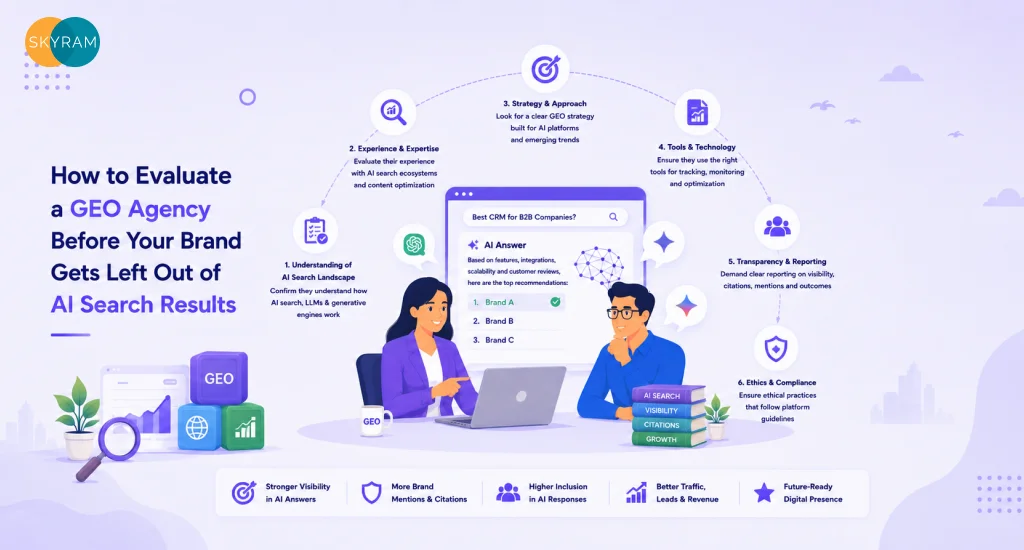
CMO reviewing a GEO agency evaluation framework on a whiteboard showing AI citation footprint and citation frequency metrics

The shift has already happened. Your buyers are not waiting for Google’s blue links anymore. They open ChatGPT, Perplexity, or Google AI Overviews, ask a question about your category, and receive a synthesized answer that names three or four vendors. If your brand is not in that answer, you do not get considered. You do not even get evaluated against. You simply do not exist in that moment of intent.

What makes this urgent for CMOs is the compounding nature of absence. The brands being cited in AI-generated answers today are building a citation footprint that grows with each passing month. The brands absent today are falling further behind as competitors accumulate the entity signals, structured content, and third-party citations that AI systems use to select their sources.

Evaluating a GEO agency before your brand gets displaced in AI search results means checking three things: their ability to audit your current AI citation footprint across ChatGPT, Perplexity, and Google AI Overviews; their structured content methodology for improving LLM extraction; and their measurement framework for tracking citation frequency over time. GEO agencies that cannot show you your current AI visibility baseline before the engagement starts cannot credibly promise to improve it.

This guide gives CMOs and VP Marketing leads the framework to separate agencies that actually deliver GEO from the much larger group that has added the term to their service pages without the capability to back it up.

What a GEO Agency Is Actually Responsible For

Before you evaluate an agency’s capability, you need a clear picture of what a genuine GEO program delivers. Most agency pitches blur GEO into SEO. A precise understanding of GEO responsibilities lets you ask questions that expose whether their scope matches what the discipline actually requires.

AI Citation Audit: Mapping Where You Appear and Where Competitors Do

The first deliverable of any real GEO engagement is an AI citation audit that documents your brand’s current presence across the platforms your buyers use. This is not a keyword ranking report. It is a systematic record of which queries produce AI-generated answers in your category, whether your brand appears in those answers, which competitors are cited instead, and from what content those citations originate.

A citation audit tells you two things simultaneously: where you are absent and why. An agency that delivers this audit before you sign has demonstrated they can actually execute the foundational GEO diagnostic. An agency that skips it and moves straight to a content proposal has shown you their process starts with production, not understanding.

Content Restructuring for LLM Extraction: What Formats AI Answers Prefer to Cite

AI systems do not cite content at random. They extract from pages that are structured for extraction: direct answer blocks in the first 60 words of a section, FAQPage schema marking up question-and-answer pairs, Article schema with author attribution, and entity consistency across the domain. A GEO agency’s content responsibility is to restructure existing pages and produce new content to these standards.

The relevant question here is not whether they “create content.” Every agency creates content. The question is whether their content production follows the structural logic that makes content eligible for AI citation rather than just ranking in traditional search results. Those are different structural requirements, and most content shops are optimizing only for the latter.

Entity Optimization: Building Your Brand’s Knowledge Graph Presence Across Authoritative Sources

AI systems build their understanding of your brand from multiple corroborating sources. Your website is one. Your Google Knowledge Panel is another. G2 and Clutch profiles, LinkedIn presence, industry publication mentions, and consistent Name/Address/Phone signals across directories all contribute to what search engineers call entity clarity. When these sources agree about who you are and what you do, AI systems cite you with confidence. When they conflict or are sparse, you get deprioritized.

A GEO agency’s entity optimization work includes auditing your current entity signals, identifying conflicts and gaps, and building the off-site citation footprint that gives AI systems enough corroborating evidence to name you reliably. This is distinct from link building. It is closer to reputation management at a machine-readable level.

Citation Monitoring: Tracking AI Answer Presence Over Time

GEO is not a one-time project. The competitive landscape in AI-generated answers shifts continuously as competitors publish new content, as platform extraction logic evolves, and as content ages out of the freshness window that Perplexity and Google AI Overviews apply when selecting sources. A GEO agency’s monitoring responsibility is to track your citation rate monthly, identify when competitors gain ground on specific queries, and adjust content and entity strategy accordingly.

Citation monitoring requires tools and a documented methodology. The agency should be running your priority queries across ChatGPT, Perplexity, Gemini, and Google AI Overviews on a defined schedule, recording citation outcomes, and reporting against the baseline established at the start of the engagement. If they have no tool or methodology for this, they are not doing GEO. They are producing content and hoping.

Key Takeaway: A genuine GEO agency is responsible for four distinct functions: an AI citation audit, structured content production for LLM extraction, entity optimization across authoritative sources, and ongoing citation monitoring. An agency that cannot describe all four in concrete operational terms is not offering GEO, regardless of what their service page says.

The Five Evaluation Criteria That Separate Real GEO Agencies From Rebranded SEO Shops

These five criteria are the difference between a GEO agency that compounds your AI search presence and one that produces deliverables that would have been identical if GEO had never been invented.

Can They Show Your Current AI Citation Footprint Before You Sign?

This is the single most revealing test in a GEO agency evaluation. Before any contract is signed, a genuine GEO agency should be able to pull up your current citation presence across your priority queries on ChatGPT, Perplexity, and Google AI Overviews. Not a keyword ranking screenshot. Not a domain authority score. An actual record of which AI-generated answers in your category mention your brand and which mention your competitors.

Ask for this in the first meeting. If the agency cannot produce it or offers to conduct this analysis only after you sign, they are telling you that the baseline measurement capability they would need to demonstrate improvement against does not exist in their current workflow. That gap is disqualifying. Improvement without a baseline is not a measurement. It is a claim.

Do They Measure Citation Frequency or Just Traditional Organic Rankings?

Citation frequency is the core GEO metric. It measures how often your brand appears as a cited source in AI-generated answers for a defined set of priority queries over a defined time period. It is tracked per platform, per query category, and per competitor. It moves independently of traditional keyword rankings and cannot be inferred from a Semrush or Ahrefs dashboard.

Ask the agency to show you a sample citation frequency report from an existing client. The report should distinguish between citation frequency on Perplexity, ChatGPT, and Google AI Overviews separately, because the extraction logic differs across platforms. A report that blends all AI results into a single metric is not granular enough to drive meaningful optimization decisions.

Agencies that lead with domain authority improvements, backlink counts, and organic traffic as their primary GEO success metrics are measuring SEO. That is a legitimate service. It is not GEO.

Do They Produce Structured Content or Just Recommend It?

There is a large class of “GEO consultants” who will audit your site, produce a detailed recommendation report, and leave execution to your internal team. That is a consultant model and it has its place. But if you are evaluating a GEO agency for a retained engagement, the agency must produce structured content directly, not just advise on it.

Ask for a content sample from a recent GEO engagement, anonymized if necessary. The sample should demonstrate: a direct answer block in the first 60 words of the opening section, FAQPage schema implemented on the published version, Article schema with author attribution, and entity references consistent with the client’s Organization schema. If the sample looks like a standard SEO blog post with no structural differences, the agency is producing SEO content under a GEO label.

Understanding what GEO-structured content looks like in practice before the evaluation meeting lets you make that comparison accurately rather than relying on the agency’s description of it.

How Do They Approach Entity Optimization and Brand Mention Building?

Entity optimization is where most agencies claiming GEO capability show their actual limit. Ask them to describe their entity optimization methodology in specific terms: what sources they audit, what conflicts they resolve, what off-site citation channels they build, and how they verify that entity signals are consistent across platforms.

A strong answer describes a systematic audit of Organization schema, Google Business Profile, G2 and Clutch profiles, LinkedIn presence, and third-party publication mentions. It describes a process for normalizing inconsistencies, a plan for building new citations in category-relevant sources, and a timeline for when entity improvements typically reflect in AI citation behavior.

A weak answer describes “building backlinks” or “improving your online presence.” Those are SEO activities. Entity optimization for GEO is more specific, more technical, and more focused on machine-readable signals than on PageRank.

What Does a GEO Report Look Like vs. an SEO Report?

Request a sample GEO report before you sign. A GEO report and an SEO report should look meaningfully different. If they are identical except for the cover page, the agency is delivering SEO.

A genuine GEO report includes: citation frequency by query category and by platform, competitive citation share for the same queries, AI Overview impression data from Google Search Console filtered by appearance type, referral traffic from identified AI platforms in GA4 (chat.openai.com, perplexity.ai), and qualitative notes on which content formats and schema implementations are producing citation gains versus which are not.

An SEO report includes: keyword position changes, organic traffic by landing page, backlink acquisition, Core Web Vitals scores, and indexed page counts. These are useful metrics. They are not GEO metrics. An agency that cannot separate them cannot claim to be running a distinct GEO program.

Comparison Table: Rebranded SEO Shop vs. Genuine GEO Agency

Evaluation Marker Rebranded SEO Shop Genuine GEO Agency
Pre-sign baseline audit Offers SEO audit; no AI citation data Delivers AI citation footprint report before contract
Primary KPI Keyword rankings, organic traffic Citation frequency across ChatGPT, Perplexity, Google AI Overviews
Content structure Standard blog posts, keyword-optimized Direct answer blocks, FAQPage schema, Article schema with author markup
Entity optimization Link building, directory submissions Organization schema, entity consistency audit, off-site citation network
Reporting format Rankings and traffic dashboard Citation frequency by platform, competitive citation share, AI referral traffic
Measurement tool Semrush, Ahrefs, GA4 organic data Profound, Otterly.ai, GA4 AI referral channel, Google Search Console AI filters
Content sample quality Indistinguishable from SEO content Structurally optimized for LLM extraction with verifiable schema
Competitor benchmarking Share of voice in traditional search Citation share in AI-generated answers by query category

Key Takeaway: The fastest way to identify a rebranded SEO shop is to ask for a pre-sign AI citation footprint report and a sample GEO report from an existing client. If either is absent or looks identical to an SEO deliverable, the evaluation is over.

The Questions to Ask in Every GEO Agency Pitch

These questions are designed to produce specific answers that distinguish agencies with genuine GEO depth from those operating on surface familiarity. Vague answers to precise operational questions indicate the process behind the pitch is less developed than the pitch itself.

“Walk me through how you would audit our current AI citation footprint before the engagement starts. Which platforms, which query types, and what methodology?” The answer should name specific platforms (ChatGPT, Perplexity, Gemini, Google AI Overviews), describe a query selection methodology tied to your category’s buyer intent, and explain how they document citation outcomes across a defined query set. Anything less specific than that is a workaround.

“Show me a citation frequency report from an existing client. What does the data look like month over month?” You are looking for per-platform, per-query-category citation frequency data tracked over at least three months. If the agency is new to GEO, they should have tracked their own brand’s citation presence as a proof of capability.

“What structured content formats do you use for LLM extraction, and can you show me a sample that is live and indexed?” You want to see a published, live page with verifiable FAQPage schema and a direct answer block in the first section. If the sample is a draft or a template, the agency has not produced GEO content at scale yet.

“How do you approach entity optimization and what specific off-site citation channels do you build?” Strong answers reference G2, Clutch, LinkedIn thought leadership, and category-relevant publications. They describe a process, not a list of channels.

“What does month three look like if our citation rate has not moved? What changes and why?” This reveals whether the agency has a diagnostic framework for underperformance or whether they will explain static citation rates as “SEO takes time.” GEO optimization decisions should be driven by platform-specific data, and the agency should be able to name the levers they pull when a specific platform is not responding.

Key Takeaway: The pitch meeting is the evaluation. An agency that cannot answer these five questions with operational specificity during the pitch will not answer them with operational specificity during the engagement.

Red Flags That End the Evaluation Immediately

These are not concerns that merit follow-up questions. Each one is sufficient grounds to end the evaluation.

No Mention of LLM Retrieval Logic or Citation Frequency Tracking

If an agency pitches a GEO program without referencing how large language models retrieve and select content for AI-generated answers, they are not designing their work around the actual mechanism they claim to optimize for. LLM retrieval logic, including how platforms weight content freshness, entity clarity, answer-block structure, and off-site citation signals, is the technical foundation of every GEO decision. An agency that cannot articulate this in the pitch meeting does not understand the domain.

Similarly, if citation frequency is not mentioned as a primary metric before you ask, assume it is not in their measurement framework. Agencies that default to ranking and traffic metrics to measure GEO results are not running a GEO program. They are running an SEO program with a different name on the proposal.

GEO Deliverables That Look Identical to Content Marketing Deliverables

Request the scope of work in writing before the pitch concludes. Review the deliverable list. If the list describes blog posts, social media content, email newsletters, and editorial calendars without any mention of FAQPage schema, structured answer blocks, entity optimization, or citation monitoring, you are looking at a content marketing retainer with “GEO” added to the header.

GEO deliverables have specific structural characteristics that distinguish them from content marketing output. If the deliverable list does not reflect those characteristics, the content produced will not achieve GEO outcomes regardless of volume or quality.

No AI Answer Monitoring Tool or Methodology in Their Stack

Ask directly: what tool or methodology do you use to track citation frequency across AI platforms? If the answer is Google Search Console and GA4, that covers Google AI Overviews and referral traffic but misses Perplexity and ChatGPT citation data entirely. A complete monitoring stack should include at least one purpose-built AI visibility tool, Profound, Otterly.ai, or a comparable platform, alongside Google Search Console AI Overview filters.

If the agency has no purpose-built monitoring tool and no documented manual testing methodology to compensate, they are running a GEO program with no way to measure whether it works. That is a budget risk, not an investment.

Key Takeaway: Three immediate disqualifiers: no LLM retrieval logic in the pitch, GEO deliverables indistinguishable from content marketing, and no AI citation monitoring tool in their stack. Any one of these ends the evaluation.

How to Structure a GEO Agency Engagement for Accountability

Even a strong agency needs a contract structure that creates accountability. These three structural elements protect your investment regardless of the agency’s capability level.

Baseline Audit as a Mandatory First Deliverable

The engagement should not begin with content production. It should begin with a baseline AI citation audit that documents your current presence across priority queries on all major AI platforms. This baseline becomes the measurement point against which all subsequent progress is evaluated.

Define the baseline deliverable explicitly in the contract: a report showing citation frequency by query category and by platform, a competitor citation share comparison for the same queries, and a prioritized list of structural gaps that the agency’s content and entity work will address. The baseline audit is the agency’s first opportunity to demonstrate that their diagnostic capability matches their pitch. If it does not meet the standard described above, address that before content production begins.

As your understanding of how GEO services work in practice develops alongside the engagement, this baseline becomes the anchor for every strategic conversation about where to invest next.

Citation Frequency as the Primary KPI, Not Keyword Rankings

Define the primary KPI in the contract as citation frequency for a named set of priority queries across named platforms. Secondary metrics can include AI Overview impression data from Google Search Console, referral traffic from AI platforms in GA4, and competitive citation share. Keyword rankings and organic traffic are useful supplementary data but should not be the primary success indicators for a GEO engagement.

This contractual distinction matters because it prevents the agency from reporting SEO progress as GEO success. An organic traffic increase does not confirm that your GEO program is working. A citation frequency increase for priority queries on Perplexity and ChatGPT does. The KPI definition is what keeps those two signals separate in your reporting.

90-Day Review Cadence with Competitive Citation Benchmarking

Build a 90-day review cadence into the engagement structure. At each 90-day mark, the agency should produce a competitive citation benchmarking report: your citation frequency trend against the baseline, compared to the citation frequency trend of your three primary competitors across the same query set.

This comparison answers the question that monthly reports cannot: are you gaining ground, holding steady, or falling further behind relative to competitors? Citation frequency in isolation is less useful than citation frequency relative to the competitive set. The 90-day cadence also creates a natural checkpoint for strategic adjustment, which is critical given how quickly AI platform extraction logic evolves.

For teams using the GEO vs AEO framework to prioritize investment, this cadence also provides the data needed to decide whether to increase GEO investment, add AEO-specific work on top of it, or adjust the balance between the two disciplines based on where citation gains are actually materializing.

Key Takeaway: Three contractual elements create GEO agency accountability: a baseline citation audit as the first deliverable, citation frequency as the primary KPI rather than keyword rankings, and a 90-day competitive benchmarking cadence.

Why Acting Early on GEO Agency Selection Matters More Than It Did for SEO

SEO allowed late movers to catch up. A brand that ignored SEO for three years could, with enough investment, close most of the gap within 12 to 18 months. The mechanism that made catch-up possible was that Google’s ranking algorithm evaluated current content and current backlinks. Past dominance did not permanently entrench a competitor. Present optimization quality could close the distance.

GEO works differently because AI systems are trained on and weighted toward content that has accumulated citations and entity signals over time. A brand that has appeared consistently in AI-generated answers for two years has built training data associations that newer entrants cannot instantly replicate. The association between your brand name and your category’s core queries, once established in AI systems’ internal representations, is self-reinforcing. Brands cited today get cited again next month. Brands absent today face an increasingly difficult re-entry problem.

The second timing factor is the competitive window. Most markets still have a limited number of brands that have invested in genuine GEO programs rather than rebranded SEO. The brands that establish a strong AI citation footprint in the next 12 months will occupy positions in AI-generated answers that their competitors will struggle to displace. This is analogous to the first-mover advantage in search engine optimization in 2004 to 2008, but the compounding is faster because AI systems update their knowledge representations more continuously than search crawlers built domain authority signals.

Understanding the SEO foundation required before GEO investment compounds is the precondition that makes this timing argument actionable rather than abstract. GEO citation gains stack on top of organic authority. Brands that have built that foundation are already positioned for faster GEO returns.

Alongside answer engine optimization for direct AI answer placement, a GEO program running on an established content foundation is the most defensible position in AI search that a B2B brand can build right now.

Key Takeaway: GEO advantage compounds over time in a way that SEO advantage did not. Brands building AI citation footprints today are establishing positions that become progressively harder for late movers to challenge. The evaluation framework above exists to ensure the agency you hire actually knows how to build that footprint rather than billing you for content production under a GEO label.

Frequently Asked Questions

  1. What does a GEO agency actually do?

A GEO agency improves a brand’s visibility in AI-generated answers across platforms including ChatGPT, Perplexity, Google AI Overviews, and Gemini. The work involves four core functions: an AI citation audit that maps current brand presence and competitor citations across priority queries; structured content production that follows the answer-block and schema formats AI systems extract from; entity optimization that builds consistent brand signals across G2, Clutch, LinkedIn, industry publications, and other authoritative third-party sources; and ongoing citation monitoring that tracks citation frequency by platform and query category over time. A GEO agency is distinct from a content marketing agency or a rebranded SEO shop in that all four functions are present and measured against citation frequency rather than keyword rankings.

  1. How do I know if a GEO agency is legitimate or just an SEO agency with rebranded services?

Three tests identify a rebranded SEO shop claiming GEO capability. First, ask the agency to produce your current AI citation footprint before you sign. A legitimate GEO agency can do this; a rebranded SEO shop cannot. Second, request a sample GEO report from an existing client. A genuine GEO report shows citation frequency by platform and competitive citation share for priority queries. An SEO report shows keyword rankings and organic traffic. If the sample report looks like the latter, the agency is delivering SEO. Third, ask what tool they use to monitor citation frequency across ChatGPT and Perplexity. Legitimate GEO agencies use purpose-built AI visibility tools such as Profound or Otterly.ai alongside Google Search Console. Agencies without these tools have no reliable way to measure GEO performance.

  1. How long does it take to see results from a GEO program?

GEO results follow a staged timeline. Schema implementation and structured content restructuring on existing indexed pages can produce AI Overview citation improvements within four to eight weeks for pages that already receive organic traffic. Entity optimization improvements, including consistent Organization schema and off-site citation building, typically take 60 to 90 days to reflect in AI citation behavior. New content built to GEO structural standards usually requires eight to sixteen weeks to accumulate the crawl frequency, indexing depth, and freshness signals needed for consistent AI-generated answer citations. Perplexity tends to respond faster than ChatGPT because it performs real-time web retrieval; ChatGPT citation depends more heavily on training data accumulation. A realistic expectation for measurable citation frequency improvement across priority queries is 90 days from baseline, with sustained compounding over six to twelve months.

  1. What metrics should a GEO agency report on?

A GEO agency’s primary reporting metric should be citation frequency: how often the brand appears as a cited source in AI-generated answers for a defined set of priority queries, tracked per platform across ChatGPT, Perplexity, Gemini, and Google AI Overviews. Secondary metrics include competitive citation share for the same query set, AI Overview impression data filtered by appearance type in Google Search Console, referral traffic from AI platforms tracked as a distinct GA4 referral channel, and branded search volume lift as a lagging indicator of increased AI citation exposure. Keyword rankings and organic traffic are useful supplementary metrics but should not be reported as GEO success indicators, because improving traditional search performance and improving AI citation frequency are distinct outcomes that can move in opposite directions.

  1. What is the difference between GEO and AEO?

GEO (Generative Engine Optimization) and AEO (Answer Engine Optimization) are closely related disciplines that are often used interchangeably, but they target different surfaces. AEO focuses on getting content surfaced in direct-answer formats including Google AI Overviews, featured snippets, and Bing Copilot answers, primarily through FAQ schema, structured answer blocks, and entity markup on existing pages. GEO focuses more broadly on getting a brand named and cited in responses generated by large language models including ChatGPT and Perplexity, which requires off-site citation building, entity consistency across multiple authoritative sources, and LLM-specific content formats in addition to on-site structural work. In practice, a complete AI search visibility program addresses both, with AEO work serving as the on-site structural foundation and GEO work building the off-site entity and citation network on top of it.

Talk to Skyram About GEO Strategy and AI Search Visibility

If your brand is not appearing in AI-generated answers for your core category queries, the first question to answer is whether the gap is structural or competitive. A structural gap means your content is not formatted for AI extraction. A competitive gap means competitors have built stronger entity signals and citation footprints. Most brands have both, in different proportions across different query clusters.

Skyram Technologies builds GEO programs that start with a citation audit scoped to your specific domain and priority query set. The audit tells you exactly where you stand against competitors in AI-generated answers before any content production begins. From that baseline, the program addresses structural content gaps, entity signal inconsistencies, and citation frequency monitoring in a structured sequence, with AEO optimization layered in where on-site extraction improvements compound the off-site citation work.

If you want to understand how the process works in practice and what a citation baseline reveals about your current position, book a strategy call with the Skyram team and walk through your priority queries, your competitive citation landscape, and what a 90-day GEO roadmap looks like for your specific situation.
How to Hire an AEO Consultant vs. Retaining an AEO Agency: A Framework for B2B Teams

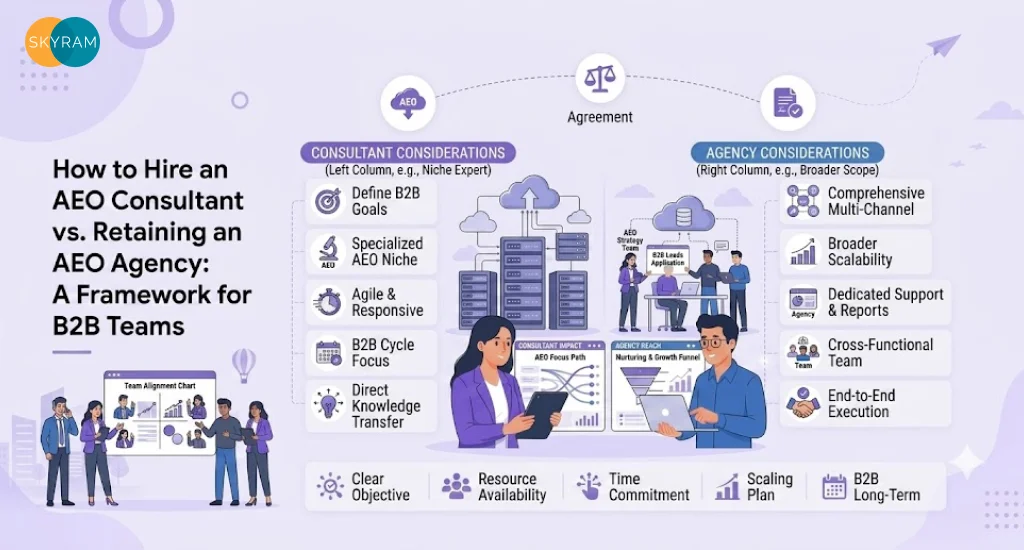
B2B marketing director comparing AEO consultant engagement vs AEO agency retainer on a decision framework whiteboard

You ran the test. You typed your core category queries into ChatGPT and Perplexity. Your competitors appeared. Your brand did not. The problem is real and it is costing you pipeline, because B2B buyers now use AI tools to build their initial shortlists before they ever land on a vendor website.

The question is not whether to address it. The question is how. Two legitimate paths exist. You can bring in an AEO consultant to diagnose the gap, restructure the content that matters most, and hand the implementation blueprint to your internal team. Or you can retain an AEO agency to own citation monitoring, content production, and AI answer presence management as an ongoing function. Both approaches work. Picking the wrong one for your situation wastes budget and extends the time before your brand appears in the answers your buyers read.

B2B marketing teams choosing between hiring an AEO consultant and retaining an AEO agency face a trade-off between depth and breadth. An AEO consultant delivers focused expertise on a defined scope, typically an audit, a content restructuring project, or a schema implementation sprint. An AEO agency provides ongoing citation monitoring, content production, and AI answer presence management across the full keyword universe. The right choice depends on whether AEO is a one-time gap or a continuous channel.

This framework gives you the criteria to make that decision without guesswork.

What an AEO Consultant Delivers vs. What an AEO Agency Delivers

The distinction is not primarily about quality. Both engagement types can deliver excellent work. The distinction is about scope, ownership, and what happens after the initial engagement ends.

Consultant Scope: Audit, Structured Content Sprint, Schema Implementation

An AEO consultant engages on a defined deliverable set with a clear end date. The typical consultant engagement runs eight to sixteen weeks and produces three categories of output.

The first is a citation gap audit: a systematic review of how your brand currently appears, or does not appear, across ChatGPT, Perplexity, Google AI Overviews, and Gemini for your priority queries. This audit identifies which pages are structurally eligible for AI extraction and which are not, and why.

The second is a content restructuring sprint: the consultant rewrites or restructures the highest-priority pages to introduce direct answer blocks, FAQ schema, and author markup. They may produce a content architecture template your internal team uses for new production going forward.

The third is a schema implementation guide or direct implementation: FAQPage, Article, and Organization schema applied to priority pages, validated against Google’s Rich Results Test, and documented for your development team to extend to the rest of the site.

At the end of the engagement, the consultant delivers the work and exits. Your internal team owns execution from that point forward.

Agency Scope: Ongoing Citation Monitoring, Content Production, AI Answer Presence Management

An AEO agency retainer is a continuous function, not a project. The agency maintains active ownership of three workstreams simultaneously.

Citation monitoring is ongoing: the agency tracks how often your brand appears in AI-generated answers for your priority queries, which competitors appear instead, and what content changes move the needle. This tracking happens monthly at minimum, with alerts for significant shifts.

Content production is the volume layer: the agency publishes AEO-structured content at a defined cadence, mapped to the keyword clusters where your brand needs to build or defend citation presence. This is not generic content production. Each piece follows an AI-extractable structure, including a direct answer block in the opening, FAQPage schema, and entity markup.

AI answer presence management is the strategic layer: the agency monitors platform changes across ChatGPT, Perplexity, and Google AI Overviews, adjusts content strategy as extraction logic shifts, and reports citation rate trends alongside traditional organic metrics.

Where the Scopes Overlap and Where They Diverge

Both a consultant and an agency will run a citation audit at the start of an engagement. Both will restructure priority content and implement schema. Both will measure AEO progress using citation frequency rather than rankings alone.

Where they diverge is sustainability. A consultant project produces a strong foundation and a clear execution blueprint. It does not produce ongoing citation growth after the engagement ends unless your internal team executes the blueprint consistently. An agency retainer produces sustained citation growth because production, monitoring, and optimization continue without interruption.

The overlap also creates a strategic opportunity: the best hybrid path often starts with a consultant to build the foundation correctly, then converts to an agency retainer once the baseline is established. More on that in the final section.

Comparison Table: AEO Consultant Engagement vs. AEO Agency Retainer

Dimension AEO Consultant AEO Agency Retainer
Engagement type Project-based, defined scope Ongoing retainer, continuous function
Typical duration 8 to 16 weeks 6 to 12 months minimum
Primary deliverable Audit report, content templates, schema implementation Monthly content production, citation monitoring, reporting
Content production volume Low to moderate (priority pages only) High (sustained cadence across full keyword universe)
Citation monitoring One-time or periodic Continuous, with monthly reporting
Cost structure Fixed project fee Monthly recurring retainer
Typical cost range (US market) $5,000 to $25,000 per project $3,000 to $15,000 per month
Internal team dependency High (team executes the blueprint) Low (agency owns execution)
Best fit Defined gap, capable internal team, budget constraint AEO as a primary acquisition channel, volume need, no internal capacity
Exit flexibility Project ends at defined milestone Requires retainer notice period

Key Takeaway: The choice between a consultant and an agency is primarily a question of who owns execution after the diagnosis is complete. A consultant diagnoses and blueprints. An agency diagnoses and then builds, monitors, and optimizes continuously.

When a Consultant Is the Right Call

Three conditions reliably indicate that a consultant engagement will produce a better return than a full agency retainer.

You Have a Specific Gap: Your Content Is Not Being Extracted by AI Answers

If your diagnostic work points to a clear structural problem rather than a volume problem, a consultant is often the higher-value engagement. A structural problem means your existing content is not formatted for AI extraction: no direct answer blocks, no FAQ schema, no author markup, entity signals that are inconsistent across your site.

A consultant can audit the structural gaps, restructure the 15 to 20 pages that matter most for your priority queries, and produce a template your content team uses for every subsequent piece. This is a defined problem with a defined solution, and a project-based engagement is the right match for it.

The contrast is a volume problem: your content is structured well but you need to publish 30 new AEO-optimized pages across a keyword cluster where you have no presence at all. That is an agency problem, not a consultant problem.

Your Internal Team Can Execute If Given the Right Framework

A consultant engagement produces its best results when your internal content team has the capacity to implement the blueprint after handoff. If your team can publish consistently, apply a content template correctly, and monitor basic citation signals in Google Search Console, a consultant gives them everything they need to sustain progress independently.

The test is honest: can your team publish two to four AEO-structured pieces per month for the next six months without someone actively managing the process? If yes, a consultant is likely sufficient. If the answer is uncertain, be direct with yourself about it before committing to the lower-cost option.

Understanding how AI content optimization works at the structural level helps internal teams assess their own capability gaps before making this call.

Budget Constraints Favor a Bounded Project Over an Open-Ended Retainer

A well-scoped consultant engagement delivers a defined output at a defined cost. For marketing teams operating under budget pressure or working through a formal procurement cycle that prefers project-based spend over ongoing retainers, a consultant engagement is often the path of least resistance to getting AEO work funded and started.

A $12,000 project that produces a 90-day content blueprint is an easier budget conversation than a $5,000 per month retainer that requires a 12-month commitment. If the budget constraint is real, a consultant project lets you demonstrate AEO results before asking for recurring spend.

Key Takeaway: A consultant is the right call when the problem is structural and bounded, your internal team can sustain execution post-handoff, and budget constraints favor a project over a retainer. If any of these three conditions does not hold, the calculus shifts toward an agency.

When an Agency Retainer Is the Right Call

An agency retainer makes the most sense when AEO is no longer a diagnostic exercise. It is a growth channel that needs to compound.

AEO Is a Primary Acquisition Channel You Need to Own Continuously

If a meaningful share of your B2B buyer journey runs through AI-powered research, AEO is not a project. It is infrastructure. B2B buyers in high-consideration categories, including SaaS, professional services, and technology, increasingly use ChatGPT and Perplexity to build their initial vendor shortlists. If your brand is absent from those answers when a buyer in your ICP is actively researching, you lose consideration before you even know the evaluation started.

That level of competitive urgency requires continuous management: monitoring which queries trigger competitor citations, publishing content that closes the gaps, and adjusting content structure as AI platform extraction logic evolves. A one-time consultant project cannot maintain that posture. An agency retainer can.

Understanding how brands get cited in ChatGPT, Perplexity, and Google AI Overviews clarifies how sustained the citation-building process actually is, and why it requires ongoing production rather than a single content sprint.

Your Content Volume and Keyword Universe Exceed What a Consultant Project Can Cover

An AEO consultant working a focused engagement typically restructures 15 to 30 pages and produces templates for the next 20 to 40. That scope covers a defined priority cluster. For B2B companies with broad product lines, multiple buyer personas, or competitive categories where dozens of query variations need coverage, the consultant’s output represents the starting point, not the complete program.

If your keyword universe spans multiple service lines and you need new AEO-structured content across all of them, an agency retainer delivers the production volume that a project engagement cannot. An agency that runs ongoing AEO services for B2B clients maintains the production infrastructure, editorial processes, and platform monitoring tools that individual consultants rarely replicate at scale.

You Need Citation Monitoring and Reporting as an Ongoing Function

Citation monitoring is not a one-time diagnostic. Your competitive position in AI-generated answers shifts as competitors publish new content, as platform algorithms update, and as your own content ages out of the freshness window. A static snapshot from a consultant audit tells you where you were at the moment of the engagement. It does not tell you whether a competitor gained ground in month three.

An agency retainer includes citation monitoring as a standing function: monthly tracking of which queries produce citations for your brand versus competitors, quarterly trend analysis, and strategic adjustment based on what the data shows. For marketing teams accountable for AI search visibility as a reported metric, ongoing monitoring is not optional.

Key Takeaway: An agency retainer is the right structure when AEO is a primary acquisition channel, your keyword universe is broad, and citation monitoring needs to be a continuous reporting function rather than a periodic snapshot.

The Evaluation Framework for AEO Consultants

Once you decide a consultant is the right path, the evaluation narrows to three questions that distinguish consultants with genuine AEO depth from those who have rebranded SEO services.

How Do They Measure Current AI Citation Footprint?

Ask the consultant to walk you through their diagnostic process for measuring AI citation presence. The answer should include specific platforms, specific query types, and a methodology for documenting citation frequency over a defined period.

A strong answer describes: manual query testing across ChatGPT, Perplexity, Gemini, and Google AI Overviews for your priority queries, a process for documenting which content gets cited and from what source, and a framework for interpreting citation gaps in terms of structural content issues rather than just “you need more content.”

A weak answer describes running a Semrush or Ahrefs report and calling it an AEO audit. Citation footprint is not a rankings metric. Consultants who conflate the two are doing SEO under an AEO label.

What Structured Content Formats Do They Prioritize for LLM Extraction?

AEO content structure is specific. Ask the consultant which formats they prioritize and why. The answer should include direct answer blocks of 40 to 80 words at the opening of key sections, FAQPage schema with questions phrased in buyer language, Article schema with author markup, and entity consistency across the page and across the domain.

If the consultant’s answer focuses primarily on keyword optimization, meta tag structure, or word count, they are describing SEO, not AEO. The structural requirements for LLM extraction are meaningfully different, and a consultant who cannot articulate that difference cannot execute AEO effectively.

What Does Their Deliverable Look Like at the End of the Engagement?

Request a sample deliverable from a prior engagement, with client details anonymized. The deliverable should include a citation gap report with specific queries and current citation status, a prioritized list of pages with structural improvement recommendations, and either restructured content ready for publication or a content template detailed enough for your team to execute against.

If the consultant’s deliverable is a slide deck with general recommendations and no implementation-ready output, the value of the engagement will depend entirely on your internal team’s ability to translate those recommendations into execution. That is a high-risk dependency.

Key Takeaway: Evaluate AEO consultants on their citation measurement methodology, structural content knowledge, and the implementation-readiness of their deliverables. Generalist recommendations without execution specificity transfer risk from the consultant to your team.

The Evaluation Framework for AEO Agencies

Agency evaluation follows a similar logic but focuses on the continuous functions that distinguish sustained performance from a retainer that looks like a consultant project on a monthly billing cycle.

How Do They Track Citation Frequency Across ChatGPT, Perplexity, and Google AI Overviews?

Citation frequency tracking is the defining capability of a genuine AEO agency. Ask for a demonstration of their tracking methodology and their reporting output.

A credible agency tracks citation frequency using a combination of manual query testing, AI-specific analytics tools such as Profound, Otterly.ai, or platform-native reporting, and GA4 referral source monitoring to capture traffic from chat.openai.com, perplexity.ai, and related AI platforms. They should be able to show you a reporting template that distinguishes AEO performance metrics from standard organic search metrics.

If the agency reports only on keyword rankings and organic sessions without any platform-specific citation data, their AEO program is SEO with a renamed service tier.

What Content Production Cadence Do They Commit To?

Ask the agency for their content production commitment in writing: how many AEO-structured pieces per month, what the editorial review process looks like, and how they ensure each piece follows the structural requirements for AI extraction rather than generic content standards.

Strong agencies commit to a specific monthly output with defined quality standards. They should describe their editorial process for verifying that each published piece includes the structural elements required for AI citation eligibility: answer blocks, schema, author markup, and entity consistency.

Be specific in the question: not “how much content do you produce” but “what does an AEO-optimized piece look like at publication, and how do you verify it meets that standard.” The answer reveals whether they have a repeatable process or a loosely defined production volume.

How Do They Report AEO Progress Differently From SEO Progress?

AEO progress and SEO progress are measured differently. An agency that reports AEO using only organic traffic and keyword ranking data is not measuring AEO. Ask directly: what metrics appear in the monthly AEO report that would not appear in a standard SEO report?

The answer should include citation frequency by query category, AI Overview impression data from Google Search Console, referral traffic from identified AI platforms in GA4, and qualitative notes on which platform extraction patterns shifted during the reporting period.

For B2B teams building the case internally for AEO as a search strategy alongside SEO, the reporting distinction matters: leadership needs to see evidence that AI search investment is producing a different type of visibility than what SEO already delivers. An agency that cannot separate those metrics cannot help you make that case.

Key Takeaway: Evaluate AEO agencies on their citation tracking infrastructure, production quality standards, and reporting that distinguishes AI citation performance from traditional organic metrics. Agencies that conflate the two are delivering SEO, not AEO.

The Hybrid Model: Starting With a Consultant, Converting to an Agency Retainer

The most pragmatic path for most B2B marketing teams is not consultant or agency. It is consultant first, then agency.

A consultant engagement in weeks one through twelve establishes the foundation: a citation gap audit, structured content restructuring for the highest-priority pages, schema implementation, and a content template your team can use while the agency search runs in parallel. This phase costs a defined amount, produces a defined output, and de-risks the agency selection process by giving you a baseline against which to evaluate agency claims.

At the end of the consultant engagement, you have three pieces of information you did not have at the start: the specific structural gaps in your current content, a content architecture template that works for AEO extraction, and a baseline citation rate against which an agency’s performance can be measured.

You then select an agency with that baseline in place. The agency inherits a site that already has foundational AEO structure implemented, which means month one of the retainer focuses on expanding coverage and monitoring rather than fixing problems the consultant already addressed. Engagement velocity is higher. The baseline makes the agency’s citation growth claims verifiable against an established measurement point.

Skyram Technologies offers both project-based AEO engagements and ongoing AEO retainer programs, which means you can move from consultant-scope work to a retainer without switching vendors or rebuilding the context of your program. This continuity matters: the audit findings, content templates, and structural decisions made in a consultant engagement are assets that compound in an agency retainer only if the same team owns both phases.

The hybrid path also reduces the risk of the most common mistake in AEO procurement: retaining an agency before the foundational structural work is done, paying retainer rates for the agency to fix problems that a lower-cost consultant engagement could have resolved first. Get the diagnosis right. Then scale it.

Key Takeaway: The hybrid model, consultant first, agency second, gives you a verified foundation before committing to retainer spend, and produces a measurable baseline that holds the agency accountable from day one. It is the most efficient path for teams that are serious about AEO as a long-term channel but want to sequence the investment correctly.

Frequently Asked Questions

  1. What is the difference between an AEO consultant and an AEO agency?

An AEO consultant engages on a project basis with a defined scope, typically a citation gap audit, content restructuring of priority pages, and schema implementation. The consultant delivers a blueprint and exits. Execution after the engagement depends on the client’s internal team. An AEO agency retains ongoing responsibility for citation monitoring, content production at scale, and AI answer presence management across the full keyword universe. The agency does not deliver a blueprint and exit. It sustains and compounds the program month over month. The right choice depends on whether AEO represents a one-time structural gap or an ongoing acquisition channel.

  1. How much does it cost to hire an AEO consultant vs. an AEO agency?

AEO consultant engagements in the US market typically range from $5,000 to $25,000 as a fixed project fee, depending on the scope of the audit, the number of pages restructured, and the complexity of the schema implementation. AEO agency retainers typically range from $3,000 to $15,000 per month for mid-market B2B companies, with enterprise programs exceeding $20,000 per month. The total cost of a six-month agency retainer is therefore significantly higher than a one-time consultant engagement, but the agency delivers sustained production volume, continuous citation monitoring, and ongoing optimization that a project engagement does not.

  1. When should a B2B company hire an AEO consultant instead of an agency?

A B2B company should hire an AEO consultant when three conditions are true: the problem is structural rather than volumetric, meaning existing content needs restructuring rather than new content needing to be produced at scale; the internal marketing team has the capacity to sustain execution after the consultant’s blueprint is delivered; and budget constraints favor a defined project fee over an ongoing retainer commitment. Companies where AEO is already a primary acquisition channel, or where the keyword universe is broad enough to require sustained production across multiple clusters, will outgrow a consultant engagement quickly and should consider an agency retainer from the outset.

  1. How do you measure AEO progress after hiring a consultant or agency?

AEO progress is measured differently from traditional SEO progress. The primary metrics are citation frequency, meaning how often your brand appears as a cited source in AI-generated answers for priority queries; AI Overview impression data from Google Search Console; referral traffic from AI platforms including chat.openai.com and perplexity.ai tracked as a distinct referral channel in GA4; and branded search volume lift as a lagging indicator of increased AI citation exposure. After a consultant engagement, teams should run manual query tests monthly across ChatGPT, Perplexity, Google AI Overviews, and Gemini to track citation rate changes against the pre-engagement baseline the consultant established.

  1. What should an AEO consultant deliverable include?

An AEO consultant deliverable should include four components: a citation gap report documenting current brand presence across priority queries on ChatGPT, Perplexity, Google AI Overviews, and Gemini; a prioritized list of pages with specific structural improvement recommendations tied to AI extraction requirements; restructured content or a content template detailed enough for an internal team to apply to future production; and schema implementation documentation for FAQPage, Article, and Organization markup, validated against Google’s Rich Results Test and formatted for handoff to a development team. A deliverable that consists only of strategic recommendations without implementation-ready output transfers too much execution risk to the client’s internal team.

Talk to Skyram About AEO Consulting and Agency Engagement Options

If your brand is not appearing in AI-generated answers for your core category queries, the right first step is understanding why. That diagnostic work should happen before you commit to either engagement model, because the structure of the problem determines which path makes sense.

Skyram Technologies offers both AEO consulting engagements and ongoing AEO retainer programs designed specifically for B2B marketing teams at the MOFU and BOFU stages of their AI search strategy. Every engagement starts with a citation gap audit scoped to your specific domain and priority query set. From that baseline, you decide whether a project-based engagement or a retainer structure serves your program goals.

If you are still building the strategic case internally, our generative engine optimization and SEO services pages explain how AEO fits within a broader search visibility program. When you are ready to move from research to engagement, book a strategy call with the Skyram team and walk through your current citation footprint and what a well-sequenced AEO program looks like for your specific situation.
What to Demand From an SEO Agency Before Signing a 12-Month Contract

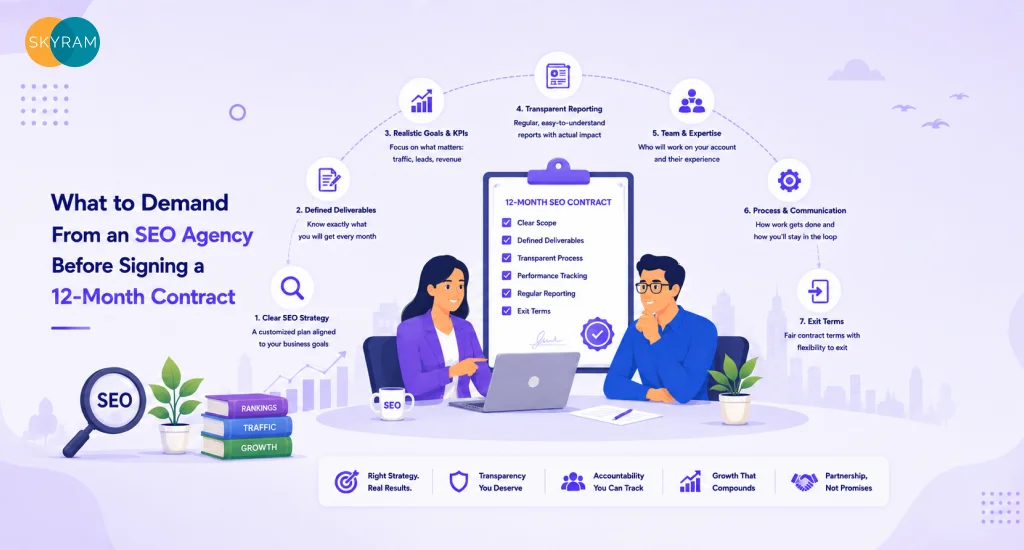
Marketing Director reviewing an SEO agency contract checklist before signing a 12 month retainer agreement

You have seen this play out before. A Marketing Director signs a 12-month SEO retainer on the strength of a pitch deck, a case study from an unrelated industry, and a confident timeline for page-one rankings. Months one through four pass. The agency produces generic blog posts on topics no one at your company approved. The technical debt on your site compounds quietly. Your crawl budget gets consumed by paginated category pages the agency never reviewed. By month six, you are staring at a contract you cannot exit without paying a penalty, trying to explain to your CMO why organic traffic has not moved.

This post exists because that scenario is preventable. Every item that should have been in writing before the ink dried is something a competent agency will agree to without friction. If they resist putting deliverables, timelines, reporting formats, and exit terms in the contract, that resistance tells you what you need to know.

Before signing a 12-month SEO contract, demand a technical audit scoped to your specific domain, a content architecture plan mapped to keyword clusters you own and gaps you need to close, a clear measurement framework tied to organic sessions and qualified leads rather than just rankings, and an explicit statement of what the agency will not do, including link schemes, AI-generated content without editorial review, and tactics that violate search engine guidelines.

The sections below give you the exact checklist, the contract clauses that separate accountability from ambiguity, and the questions that distinguish agencies that can execute from agencies that can only pitch.

The Pre-Contract Deliverables Every SEO Agency Should Provide

A credible SEO agency does not need to sign a contract before demonstrating competence. The deliverables below are pre-contract minimums. They cost the agency time, which means agencies that refuse to produce them before engagement either cannot produce them or do not intend to.

Technical Audit Scoped to Your Domain, Not a Generic Template

Demand a technical audit specific to your domain before the contract begins. Not a sample report from a previous client. Not a Screaming Frog screenshot with your URL in it. An actual technical assessment of your crawl health, index coverage, Core Web Vitals, internal linking structure, duplicate content, and canonical tag implementation.

A legitimate technical audit surfaces your site’s specific constraints. A SaaS company with a JavaScript-heavy product page architecture faces different crawl challenges than a content-heavy e-commerce site. A site that recently migrated from HTTP to HTTPS may have residual canonical conflicts. These are domain-specific findings, and any audit that does not reflect them is a template.

Ask the agency for the specific tools they use, what they prioritize in the crawl output, and how they translate technical findings into a prioritized fix list. If they cannot explain their triage logic, they will not fix the right things first.

Keyword Cluster Map Showing Current Position, Gap, and 12-Month Target

Before you agree to a content scope, require a keyword cluster map that shows where your domain currently ranks for priority terms, which clusters represent gaps where competitors rank and you do not, and what a realistic 12-month target looks like given your current domain authority.

This document does two things. It tells you whether the agency actually researched your competitive landscape, and it gives you a baseline against which to measure whether their content production is moving you toward targets that were agreed in advance. Agencies that skip this step produce content opportunistically. You end up with blog posts targeting whatever topics their writers happen to know rather than the gaps that correspond to your revenue goals.

If you are already running SEO services with another vendor or managing SEO internally, the keyword cluster map also reveals whether the new agency is going to duplicate existing content or build toward uncovered territory.

Content Architecture Plan: Pillar Pages, Cluster Posts, and Interlinking Logic

A keyword cluster map tells you what to target. A content architecture plan tells you how the content will be structured, how it will interlink, and how each piece connects to your primary service pages.

Require the agency to show you the pillar page and cluster post structure they intend to build, including which existing pages will serve as pillars, which topics will generate cluster content, and how internal links will flow between them. Ask specifically about interlinking logic. If their answer is “we’ll add related posts at the bottom,” that is not a content architecture plan. It is an afterthought.

A properly structured content plan maps to topical authority. Google rewards sites that demonstrate comprehensive, interlinked coverage of a subject. Topical authority also drives answer engine optimization outcomes, because AI systems prefer sources that cover a topic with depth and internal coherence rather than isolated posts with no structural relationship to each other.

Key Takeaway: Pre-contract deliverables are the agency’s proof of competence, not a favor to you. A technical audit, keyword cluster map, and content architecture plan are the minimum inputs required to write a contract with enforceable deliverables.

The Contract Provisions That Create Agency Accountability

Most SEO retainer agreements are written to protect the agency, not the client. The provisions below shift accountability in the right direction. A good agency signs these without negotiation.

Milestone-Based Deliverable Schedule, Not a Vague Monthly Retainer

A monthly retainer with deliverables listed as “SEO services” or “ongoing optimization” is not a contract. It is a subscription with no accountability attached.

Replace it with a milestone-based deliverable schedule that specifies what gets delivered at the end of each phase, month, or quarter. Month one should produce: technical audit report with prioritized fix list and owner assignments. Month two should produce: a defined number of pages optimized to the content architecture plan, keyword cluster targets confirmed, and reporting dashboard live. Month three and beyond should produce: published content tied to the cluster map, backlink acquisition targets if applicable, and measurable movement in tracked keyword positions.

Each deliverable should have a named owner and a completion date. When something is not delivered on schedule, the contract should specify the remedy: a credit, an extension of the contract term, or a formal cure period. Agencies with strong execution records welcome milestone specificity because it protects them from scope creep. Agencies that resist it are telling you their execution is unpredictable.

Reporting Format: What Metrics Appear in Every Report and What They Mean

Define the reporting format in the contract, not in a verbal conversation after you sign. Specify which metrics appear in every monthly report, which tool serves as the source of record for each metric, and what each metric means in plain language.

The core metrics every report should cover are: organic sessions, segmented by landing page and broken down by new versus returning visitors; qualified lead conversions from organic traffic; keyword position movement for tracked terms across the cluster map; crawl coverage and indexation rate changes; and any notable technical changes made during the period.

Notice what is not on that list: domain authority scores from third-party tools, total backlinks acquired, and “impressions” without click or conversion context. Agencies that lead reports with domain authority and backlink counts are optimizing for metrics that look impressive without being tied to revenue. Insist on organic sessions and qualified leads as the primary success indicators.

Also define reporting cadence. Monthly reports covering what changed, what was published, and what moved. Quarterly reviews covering topical authority progress, crawl health trends, and competitive position. Annual strategic reviews covering roadmap adjustments.

Exit Clause: What Happens at Month Six if Results Fall Below Agreed Benchmarks

Every 12-month SEO contract should include an exit provision triggered by underperformance. Define the benchmark: if organic sessions have not grown by an agreed percentage from baseline by month six, or if fewer than an agreed number of targeted keywords have moved into the top 30 from their starting positions, the client holds the option to exit without penalty.

An agency confident in its execution will agree to this. An agency that cannot commit to interim benchmarks does not believe in its own methodology.

The exit clause should also specify ownership of deliverables. At termination, whether by exit clause or contract end, you own all content produced, all technical documentation, all reporting data, and all logins to tools and platforms the agency set up on your behalf. Access transfer timelines should be defined: five business days from notice of termination is a reasonable standard.

Comparison Table: Weak SEO Contract Provisions vs. Accountability-Driven SEO Contract Provisions

Contract Clause Weak Provision Accountability-Driven Provision
Deliverables “Ongoing SEO services each month” Named deliverables with completion dates for each month
Success metrics “We track rankings and domain authority” Organic sessions, qualified lead conversions, and keyword position movement from agreed baselines
Reporting format Agency sends a PDF when ready Named metrics, defined source tools, and fixed cadence in the contract
Exit terms Locked for 12 months, no early exit Exit option at month six if benchmarks are not met
Deliverable ownership Implicit or unaddressed All content, data, and logins transfer to client within five business days of termination
Technical audit Provided after contract signing Required as a pre-contract deliverable before any agreement is finalized
Content scope Based on agency discretion each month Mapped to the agreed keyword cluster architecture
Link building “We build high-quality links” Specific methodology, prohibited tactics listed, and sources disclosed
AI search coverage Not mentioned Defined scope for AEO/GEO optimization included or explicitly excluded

Key Takeaway: A weak SEO contract gives the agency twelve months to explain why it did not perform. An accountability-driven contract gives you the data to have that conversation at month six, with an exit option if the evidence warrants it.

The Questions That Reveal Agency Quality Before You Sign

The pre-contract deliverables tell you what the agency produces. These questions tell you how they think.

How Do You Handle Technical SEO vs. Content SEO Prioritization for a New Client?

The correct answer involves sequencing. Technical SEO problems, crawl errors, duplicate content, slow load times, and broken internal links, block the effectiveness of any content produced on top of them. An agency that publishes content before resolving technical constraints is filling a leaky bucket.

Ask for a specific example from a recent client engagement: what technical issues did they find, how did they prioritize fixes, and in what order did they introduce content work. If they cannot describe a sequenced technical-first approach with specifics, their process is likely content-first by default, which means the technical debt your site already carries will compound, not diminish, during the engagement.

What Does Your Link Building Process Actually Involve?

Link building is the area where the gap between agency pitch and agency execution is widest. Ask for a specific description of their link acquisition methodology: what types of sites they target, how they identify link opportunities, what outreach process they use, and what they explicitly do not do.

The answer should include a clear statement of prohibited tactics: no link networks, no paid placements disclosed as editorial links, no AI-generated content passed off as original for guest post placement. If their answer emphasizes volume over quality, “we acquire 20 links per month,” without specifying the types of sites and the editorial standards applied, treat it as a red flag.

How Do You Measure Success for a Client Who Does Not Rank for Anything Yet?

This question reveals whether the agency can build and communicate a meaningful measurement framework at the start of an engagement rather than relying on visible ranking progress to justify their fees.

A strong answer describes leading indicators: crawl coverage improvements, indexed page count growth, technical fix completion rate, content production pace against the cluster map, and internal link structure improvements. These are indicators of execution quality before organic traffic moves. Trailing indicators like keyword rankings and organic sessions take three to six months to reflect the work done in the first 90 days. An agency that cannot articulate the lead indicators is either not doing the early-stage work or does not know how to measure it.

Key Takeaway: Agency quality shows up in the specificity of their answers, not the confidence of their delivery. Vague answers to precise questions indicate that the process behind the pitch is less structured than the pitch itself.

What a Healthy SEO Reporting Cadence Looks Like

A reporting cadence is not just a schedule. It is a mechanism for catching problems early and adjusting before a quarter of the contract is gone. Define it precisely before you sign.

Monthly: What Changed, What Was Published, What Moved

Every monthly report should answer three questions without ambiguity: what technical or on-page changes were made and what was the impact, what content was published and how does it map to the agreed cluster architecture, and which tracked keywords moved and by how much.

Avoid reports that lead with total impressions or domain authority trends. Those metrics are useful as context, not as lead indicators. The monthly report is operational: it tells you whether the agency did what it committed to do and whether those actions are producing measurable movement.

Quarterly: Topical Authority Progress, Crawl Health, Competitive Position

The quarterly review is strategic. It steps back from individual deliverables and evaluates whether the program is building topical authority in the areas that correspond to your highest-value buyer intent.

This is also the right cadence to review crawl health trends, not just point-in-time crawl data. A healthy SEO program shows an increasing indexed page count, a declining rate of crawl errors, and consistent improvements in Core Web Vitals scores over time. If these indicators are flat or declining at the quarter mark, the technical work either did not happen or did not stick.

The competitive position review at the quarter mark should answer: which of your target keyword clusters are your competitors gaining ground in, and what is the agency’s plan to respond? Agencies that do not monitor competitive position actively are managing your program in isolation from the market it operates in.

For organizations also investing in generative engine optimization or tracking AI Overview visibility, the quarterly review should include a citation rate snapshot across ChatGPT, Perplexity, and Google AI Overviews for your priority queries.

Annual: Strategic Review and Roadmap Adjustment

At the 12-month mark, the program should produce a complete strategic review: what the domain looked like at baseline, what changed across technical health, content architecture, and keyword coverage, what the organic traffic and qualified lead contribution of the program was over the year, and what the roadmap should look like for the next 12 months.

This review should also include a forward-looking plan for how the agency intends to handle changes in search behavior, including the continued shift toward AI-powered search results. If an agency’s annual review does not account for the AI search landscape, they are planning for 2022, not 2026.

Key Takeaway: Monthly reports are operational accountability. Quarterly reviews are strategic checkpoints. Annual reviews are the test of whether the agency can grow with the program and adapt to a changing search environment.

The Red Flags That Should Kill a Contract Before It Starts

These are not subjective concerns. Each one represents a pattern of behavior that has a well-documented relationship with contract failure.

Guaranteed Ranking Timelines

No ethical, competent SEO agency guarantees a specific ranking position by a specific date. Google’s ranking systems are not responsive to agency timelines. Any agency that guarantees page-one placement within 90 days, or promises a specific position for a specific keyword, is either misrepresenting how search engines work or planning to use tactics that produce short-term ranking gains followed by manual penalties.

Ask directly: do you guarantee specific ranking positions or timelines? The correct answer is no, paired with an explanation of what indicators they do commit to and on what timeline. If the answer is yes, walk away.

Backlink Volume as a Primary Deliverable

An agency that measures link building success by the number of links acquired per month is optimizing the wrong variable. Link quality, as measured by the topical relevance and organic authority of the linking domain, matters more than volume. A single editorial link from a respected industry publication moves the needle more than 50 links from content farms or directory sites.

Backlink volume as a primary deliverable also creates incentive structures that push agencies toward link networks, paid placements, and AI-generated content placed on low-quality sites. These tactics produce short-term domain authority gains and longer-term penalty risk. If the pitch deck leads with a monthly link quota rather than a quality standard, that is your answer.

No Mention of Technical SEO in Their Proposed Scope

Content and link building without technical SEO is a program that will underperform regardless of how well executed the non-technical components are. A site with crawl budget waste, duplicate content, or slow-loading pages neutralizes the value of every piece of content produced on top of it.

If the proposed scope does not include a technical audit in month one, a technical fix implementation timeline, and ongoing technical monitoring, ask why. The answer will tell you whether technical SEO is part of their capability or whether they intend to outsource it to a separate vendor, in which case accountability for technical work becomes ambiguous.

Key Takeaway: Ranking guarantees, backlink volume targets, and an absent technical SEO scope are each sufficient grounds to decline a contract. Together, they represent a vendor relationship that will cost you 12 months and produce no compounding asset.

Why AI Search Coverage Should Now Be a Contract Requirement, Not an Add-On

The search landscape has changed structurally. Google AI Overviews now surface on a growing share of US commercial queries. Perplexity and ChatGPT are entry points for a segment of B2B buyers, particularly at the research and shortlisting stage. An SEO program that does not address AI search visibility is optimizing for a shrinking share of the decision-making journey.

Contract language for AI search coverage should specify at minimum three things. First, what on-site structural changes the agency will implement to make content eligible for AI Overview citations, specifically: FAQ schema on service pages and blog posts, structured direct answer blocks at the top of high-intent pages, and author markup on content assets. Second, what entity signals the agency will maintain or establish, including Organization schema completeness and third-party citation consistency on G2, Clutch, and relevant directories. Third, how AI search performance will be measured and reported, including Google Search Console AI Overview impression data and manual citation tracking across priority queries.

AI search coverage should not carry a separate retainer line. It is an extension of content and technical SEO work that any competent agency can execute within a standard scope. If an agency frames AI search as an optional premium add-on, ask them to break down what additional cost it represents and why it is not included in the base technical and content scope.

The AEO and GEO disciplines are no longer experimental. A B2B company that neglects AI search coverage in its SEO contract is leaving a compounding visibility gap that grows each quarter as AI-powered search behavior becomes more prevalent among senior buyers.

For teams that want to understand the distinction between what traditional SEO, answer engine optimization, and generative engine optimization each contribute, this guide on getting cited in ChatGPT, Perplexity, and Google AI Overviews covers the mechanics in detail.

Key Takeaway: AI search coverage in 2026 is a table-stakes component of any credible SEO program. Contract language should specify the structural changes, entity signals, and measurement approach for AI search alongside traditional organic search metrics.

Frequently Asked Questions

  1. What should be included in an SEO agency contract?

An SEO agency contract should include a milestone-based deliverable schedule with named outputs and completion dates, a defined reporting format specifying which metrics appear in every report and which tools serve as the source of record, a measurement framework tied to organic sessions and qualified lead conversions rather than rankings alone, an exit clause triggered by underperformance benchmarks at the six-month mark, an explicit statement of prohibited tactics including link networks and AI-generated content without editorial review, and a clause specifying that all content, data, and platform access transfers to the client upon contract termination. Pre-contract deliverables including a domain-specific technical audit and a keyword cluster map should be required before any agreement is signed.

  1. How long should an SEO contract be?

A 12-month SEO contract is a standard engagement length and is reasonable given that organic search results typically take three to six months to reflect work done in the first quarter. However, a 12-month commitment without interim performance benchmarks and an exit provision creates an accountability gap. A well-structured 12-month contract includes a six-month performance checkpoint tied to agreed organic traffic and keyword position benchmarks, with a client exit option if those benchmarks are not met. Shorter contracts of three to six months are sometimes offered but limit the scope of technical and content work the agency can execute.

  1. What does a reasonable SEO retainer cost for a US company?

SEO retainer costs for US companies vary significantly based on market competitiveness, domain authority baseline, and the breadth of the engagement scope. Monthly retainers for mid-market B2B companies typically range from $3,000 to $15,000 per month. Enterprise-level programs in competitive verticals often exceed $20,000 per month. Retainers below $2,000 per month rarely cover both technical SEO and content production at meaningful output levels. The more useful question is not the dollar figure but what specific deliverables and resource commitments are included at the proposed price point.

  1. How can I tell if an SEO agency is using black-hat tactics?

Several indicators suggest an agency is using tactics that violate search engine guidelines. Guaranteed ranking timelines for specific keywords are the most common signal, since no ethical agency can guarantee placement positions. Backlink volume as a primary deliverable, rather than link quality and topical relevance, indicates reliance on link networks or paid placements. Sudden large increases in a site’s backlink count following the start of an engagement warrant investigation. An agency that does not disclose their link building methodology in specific terms, or that declines to provide the list of domains they have acquired links from, is likely operating in ways they expect you to object to if described accurately.

  1. What SEO metrics actually predict business outcomes?

The SEO metrics that best predict business outcomes are organic sessions segmented by landing page, which shows whether traffic growth is coming from pages relevant to your buyer intent; conversion rate from organic traffic, which ties search visibility to revenue actions; and keyword position movement for terms that correspond to buyer-intent queries rather than informational queries with no commercial relevance. Domain authority scores and total backlink counts are useful as directional indicators but are not predictive of revenue outcomes. Agencies that lead with these metrics in proposals are typically managing toward what is easy to show rather than what drives pipeline.

  1. Should AI search coverage be in an SEO contract?

Yes. AI search coverage including optimization for Google AI Overviews, Perplexity, and ChatGPT should be part of the standard SEO scope in 2026, not a premium add-on. The technical and content work required for AI search eligibility, including FAQ schema, structured direct answer blocks, author markup, and Organization schema, overlaps substantially with best-practice SEO implementation. An agency that excludes AI search from its base scope is either behind on current search behavior or pricing an upsell. The contract should specify the on-site structural changes, entity signals, and AI search measurement approach included in the standard engagement.

Talk to Skyram About SEO Strategy and Engagement

If your current SEO agency cannot provide a domain-specific technical audit before signing, a keyword cluster map tied to your actual revenue goals, or a contract with milestone-based deliverables and a six-month exit option, you are being asked to take a 12-month risk with no accountability mechanism attached.

Skyram Technologies builds SEO programs around the same pre-contract standards described in this post. Every engagement starts with a technical audit scoped to your domain, a content architecture mapped to your keyword gaps, and a reporting format that puts organic sessions and qualified leads at the center, not rankings or domain authority scores. AI search coverage, including optimization for Google AI Overviews and eligibility for AEO citations, is included in the standard scope, not positioned as a separate service tier.

If you want to understand how a well-structured SEO engagement looks before committing to a retainer, start with a strategy conversation. Book a consultation with the Skyram team and walk through your current organic performance, your keyword gap analysis, and what a milestone-based engagement would look like for your specific domain.

Microsoft Azure Cloud Services: What US Businesses Need to Know in 2026

IT team reviewing Microsoft Azure cloud services dashboard for US business infrastructure planning in 2026

Your on-premises infrastructure is costing you more than money. It’s costing you speed. While your team patches servers and fights with capacity limits, competitors running on Azure cloud services are deploying updates in minutes, absorbing traffic spikes without a second thought, and paying only for what they actually use. That gap compounds every quarter.

Azure sits at the center of most serious cloud conversations in 2026, and for good reason. Microsoft’s global network spans 60+ cloud regions, more than any other provider, and its enterprise integrations run deeper than almost anyone else in the market. But “Azure is big” is not a useful starting point for a decision-maker trying to figure out what it actually solves, what it costs to get wrong, and whether it fits how their organization operates.

This guide gives you the unfiltered picture: what Azure cloud services deliver, where they outperform alternatives, where they introduce complexity, and how US businesses are using them to solve real infrastructure, security, and scalability problems in 2026.

What Azure Cloud Services Actually Cover

Azure is not a single product. It’s a platform of over 200 services organized into categories, and most businesses only need a fraction of them. Getting clear on the categories first prevents the common mistake of buying into Azure’s breadth without a plan for depth.

Compute: The Core of Any Migration

Azure Virtual Machines (VMs) give you infrastructure-as-a-service, meaning you control the OS, the runtime, and the configuration. Azure Kubernetes Service (AKS) handles container orchestration so your teams skip the overhead of managing Kubernetes clusters from scratch. Azure App Service sits above both, letting developers deploy web apps and APIs without touching the underlying infrastructure at all.

For businesses migrating from on-prem Windows Server environments, the path to Azure is often straightforward. Microsoft’s licensing portability and Azure Hybrid Benefit mean companies running active Software Assurance agreements can significantly reduce VM costs, sometimes by 40% or more compared to standard pay-as-you-go rates.

Storage, Databases, and Data Services

Azure Blob Storage handles unstructured data at scale: backups, media files, log archives, data lake feeds. Azure SQL Database and Azure Cosmos DB cover relational and multi-model NoSQL workloads, respectively, both with built-in high availability and geo-redundancy options.

Azure Synapse Analytics matters for companies treating data as a competitive asset. It unifies data warehousing, big data processing, and analytics pipelines in one service, which cuts down on the sprawl that typically comes from stitching together separate ETL tools, data warehouses, and BI connectors.

Networking: What Makes Multi-Region Work

Azure Virtual Network (VNet) is the foundation. Everything else, load balancers, VPNs, application gateways, sits on top of it. Azure ExpressRoute connects your data centers directly to Microsoft’s network without traversing the public internet, which matters for latency-sensitive workloads and compliance requirements that prohibit data traveling over shared infrastructure.

Azure CDN and Azure Front Door handle global traffic routing. For US businesses with distributed user bases or international customers, Front Door’s intelligent routing and anycast routing capabilities translate directly to faster page loads and lower bounce rates.

Key Takeaway

Azure’s 200+ services span compute, storage, databases, networking, AI, and security. Most businesses start with a focused set of five to ten services and expand based on workload needs. Building a clear service map before migration prevents scope creep and cost overruns.

Azure Cloud Services in the USA: The Infrastructure Advantage

Azure’s US footprint is substantial. Microsoft operates multiple data center regions across the continental US, including dedicated government cloud regions (Azure Government) that meet FedRAMP High, DoD IL2/IL4/IL5, and ITAR compliance requirements. That matters directly for federal contractors, defense suppliers, healthcare organizations, and any business subject to data residency requirements.

Compliance Coverage That’s Already Built In

Regulated industries spend disproportionate time building compliance infrastructure from scratch. Azure ships with pre-built compliance controls covering HIPAA, SOC 2 Type II, PCI DSS, ISO 27001, and more. Microsoft Defender for Cloud provides continuous compliance assessment and surfaces gaps against specific regulatory frameworks, so your security team isn’t manually checking controls.

HIPAA Business Associate Agreements (BAAs) are available directly from Microsoft, which matters for any healthcare organization or business that processes protected health information. Azure’s compliance documentation is also directly usable in audit submissions, which cuts down the time your team spends compiling evidence for annual audits.

Latency and Performance for US Workloads

Proximity to compute infrastructure matters when milliseconds affect conversion rates or application responsiveness. Azure’s US regions, combined with Azure Availability Zones within those regions, allow architects to design for sub-10ms latency for most US-based users while maintaining geographic redundancy.

Azure’s peering relationships with major US ISPs also reduce the number of network hops between end users and Azure-hosted applications. For SaaS businesses, this translates to measurable performance improvements over hosting in a single on-premises data center or a colocation facility without comparable peering.

Hybrid Cloud for Businesses Not Ready to Go All-In

Not every workload belongs in the cloud, and Azure Arc acknowledges that reality. Arc extends Azure management plane capabilities to on-premises servers, VMware environments, and other cloud providers, so organizations running mixed infrastructure can apply consistent governance, security policy, and monitoring from a single control plane.

This is particularly relevant for mid-market manufacturers, financial services firms, and healthcare systems with legacy systems that can’t migrate cleanly. Azure Arc lets those organizations modernize incrementally without forcing a big-bang migration that carries significant operational risk.

Key Takeaway

Azure’s US infrastructure advantage goes beyond raw availability. Purpose-built compliance regions, ISP peering for low latency, and hybrid management via Azure Arc make it a viable platform for regulated industries and organizations with mixed on-prem and cloud environments.

Azure Deployment Models and Cost Structures at a Glance

Azure pricing is consumption-based by default, but the right model depends heavily on workload predictability. Here’s a direct comparison of the deployment options US businesses most commonly evaluate:

Azure Tier / Model Best Fit Cost Model Key Benefit for US Teams
Azure IaaS Companies migrating on-prem workloads Pay-as-you-go VMs Full infrastructure control without data center costs
Azure PaaS (App Service / AKS) Dev teams building and deploying apps Per-instance or cluster pricing Zero OS patching, built-in scaling
Azure SaaS (M365, Dynamics) Business units needing ready-made tools Per-user monthly licensing Immediate productivity; no infrastructure burden
Azure Hybrid (Arc) Regulated industries with on-prem requirements Arc management + cloud services Unified governance across on-prem and cloud
Azure Reserved Instances Predictable, always-on workloads 1 or 3-year commitment Up to 72% cost savings vs. on-demand pricing


One structural point worth understanding: Azure Reserved Instances require upfront commitment but generate significant savings for stable workloads. Spot VMs take this further, offering up to 90% cost reduction for fault-tolerant, interruptible workloads like batch processing, rendering, and non-time-sensitive data pipelines.


Key Takeaway

Matching Azure’s pricing model to your workload profile is more impactful than any feature selection. Reserved Instances and Spot VMs can cut compute costs by 40-90% compared to on-demand pricing. Most organizations benefit from a hybrid of on-demand for variable workloads and reserved capacity for predictable production systems.

Security Architecture on Azure: What’s Native vs. What You Still Own

Microsoft invests roughly $1 billion annually in cybersecurity research and engineering. That number gets cited often, but what it means operationally is that Azure ships with security capabilities that would cost millions to build and maintain independently. The shared responsibility model, though, means understanding exactly where Microsoft’s responsibility ends and yours begins.

Microsoft Entra ID: Identity at Scale

Microsoft Entra ID (formerly Azure Active Directory) handles authentication and authorization for most Azure workloads. Its Conditional Access policies let security teams enforce MFA, device compliance, and location-based access rules without building custom identity infrastructure. For organizations already using Microsoft 365, Entra ID integration is already in place.

Privileged Identity Management (PIM) solves a specific problem that causes a disproportionate number of cloud security incidents: standing privileged access. PIM enforces just-in-time elevation, meaning users request elevated permissions when needed and those permissions expire automatically. This eliminates the class of attack that exploits permanently privileged accounts.

Microsoft Defender for Cloud and Sentinel

Defender for Cloud provides cloud security posture management (CSPM) and cloud workload protection (CWPP) in one service. It continuously assesses your Azure environment against security benchmarks and highlights misconfigurations before they become incidents. The Secure Score metric gives security teams a quantified baseline and tracks improvement over time.

Microsoft Sentinel is Azure’s cloud-native SIEM and SOAR platform. It ingests signals from Azure services, Microsoft 365, on-premises systems, and third-party tools into a unified detection and response workflow. For organizations replacing legacy SIEM products, Sentinel’s pricing model, based on data ingestion volume, typically comes in significantly lower than established competitors for equivalent data volumes.

The Shared Responsibility Model in Practice

Microsoft secures the physical infrastructure, the hypervisor, and the managed service layers. Your team owns identity configuration, data classification, network security group rules, encryption key management, and application-layer security. A misconfigured storage blob with public access enabled is not Azure’s failure. It’s a configuration error on the customer side, and it happens regularly.

The practical implication: buying Azure does not mean buying security. It means buying a platform with strong security tools that require correct configuration and ongoing governance to deliver their value. Organizations that skip the security architecture work during onboarding consistently experience the kind of incidents that Azure’s tools were designed to prevent.

Key Takeaway

Azure’s native security toolchain, Entra ID, Defender for Cloud, and Sentinel, covers most enterprise security requirements without third-party products. However, the shared responsibility model places identity, data, and application security configuration squarely in the customer’s domain. Security outcomes on Azure depend on how well those controls are implemented and maintained.

Azure AI and Machine Learning Services for Business Applications

Azure OpenAI Service is the high-profile entry point, but it’s one component of a broader AI stack. Azure’s AI services span document intelligence, speech recognition, computer vision, and full custom model training, all accessible via API without requiring in-house ML expertise for most use cases.

Azure OpenAI Service: What Enterprise Access Actually Means

Unlike the public OpenAI API, Azure OpenAI Service runs within Microsoft’s infrastructure with private endpoints, regional data residency, and content filtering controls that enterprise procurement and compliance teams require. Your prompts and completions don’t train the base models. Data governance stays within your Azure tenant.

The practical use cases generating ROI in 2026 include document summarization for legal and financial services, customer support automation, internal knowledge base search using retrieval-augmented generation (RAG), and code generation integrated into development workflows. Each of these has measurable productivity impact without requiring a dedicated AI engineering team to build from scratch.

Azure Machine Learning for Custom Models

Azure ML provides a managed environment for training, versioning, and deploying custom models. For businesses with proprietary data and specific prediction problems, such as demand forecasting, churn prediction, or anomaly detection in time-series data, Azure ML offers the infrastructure without the DevOps overhead of managing GPU clusters independently.

MLflow integration and the Model Registry support proper ML lifecycle management, which matters when models move from experimentation to production and need reproducibility, version control, and monitoring baked in from the start.

Key Takeaway

Azure’s AI services provide enterprise-grade access to large language models, vision APIs, and custom ML infrastructure with compliance controls that generic API access lacks. Organizations getting the most value in 2026 are applying AI to specific, high-volume workflows rather than broad AI experimentation programs without clear business objectives.

Azure DevOps and Engineering Velocity

Azure DevOps is a full development lifecycle platform covering source control, CI/CD pipelines, work tracking, artifact management, and test planning. Azure Pipelines integrates natively with GitHub Actions, and both connect directly to AKS, Azure App Service, and Azure Container Registry for deployment targets.

CI/CD Pipeline Architecture on Azure

A production-grade CI/CD pipeline on Azure typically chains GitHub or Azure Repos for source control, Azure Pipelines for build and test automation, Azure Container Registry for image storage, and AKS or App Service for deployment. Infrastructure-as-code using Bicep or Terraform handles environment provisioning, so development, staging, and production environments are consistent and reproducible.

For teams scaling DevOps practices, the DevOps engineering services at Skyram Technologies page outlines how structured pipeline architecture reduces deployment risk and accelerates release cycles for businesses at different maturity levels.

Developer Productivity and Inner Loop Tooling

GitHub Copilot integrates directly into the development environment and reduces time spent on boilerplate code, test generation, and documentation. Microsoft’s 2023 developer productivity research found Copilot users completed tasks 55% faster in controlled studies. Real-world gains vary, but the directional impact on developer throughput is consistent across reported enterprise deployments.

Azure Load Testing lets engineering teams simulate real traffic loads against applications before production releases. This catches performance regressions before they affect users and removes the guesswork from capacity planning for anticipated traffic spikes.

Key Takeaway

Azure DevOps and GitHub Actions form a mature CI/CD ecosystem that supports the full development lifecycle without requiring third-party tooling for most enterprise use cases. The combination of pipeline automation, infrastructure-as-code, and developer productivity tools directly shortens release cycles and reduces deployment-related incidents.

Where Azure Migrations Go Wrong and How to Avoid It

Azure migrations fail more often from planning gaps than from technical limitations. The same patterns appear across industries and organization sizes.

Lift-and-Shift Without Architecture Review

Moving workloads to Azure without re-architecting for cloud-native patterns often produces results worse than the on-prem baseline: higher costs, similar or worse performance, and new operational complexity. Applications designed for fixed-capacity hardware don’t automatically benefit from cloud elasticity. They require rearchitecting to take advantage of autoscaling, managed services, and event-driven patterns.

Uncontrolled Cloud Spending

Azure’s default is consumption-based pricing with no spending limits. Without tagging policies, budget alerts, and cost center governance in place from day one, cloud bills grow faster than expected. Azure Cost Management provides the tools, but it requires active configuration and ownership. Organizations that treat cost governance as a post-migration concern rather than a launch criterion consistently overspend during the critical first six months.

Identity and Access Misconfiguration

Overly permissive role assignments, missing Conditional Access policies, and inconsistent MFA enforcement account for a significant percentage of Azure security incidents. The principle of least privilege requires deliberate implementation, not just a stated intention. Role assignments should follow a documented access matrix, and privileged roles should use PIM-enforced just-in-time elevation without exception.

Key Takeaway

The most common Azure migration failures trace back to three root causes: lifting workloads without re-architecting them, skipping cost governance until after launch, and under-investing in identity and access configuration. Addressing all three before migration begins, not after incidents surface, is the difference between a successful cloud transition and a costly rollback.

How to Evaluate Whether Azure Is the Right Fit for Your Business

Azure is not the default right answer for every organization. The evaluation should run against your specific workload mix, your team’s existing toolchain, your compliance requirements, and your three-to-five-year infrastructure trajectory.

Where Azure Has a Clear Advantage

  • Organizations running Microsoft 365 and needing deep identity integration
  • Regulated industries requiring documented compliance controls for HIPAA, FedRAMP, or PCI DSS
  • Development teams using GitHub who want tighter CI/CD pipeline integration
  • Enterprises with hybrid infrastructure that need unified governance across on-prem and cloud
  • AI workloads requiring data residency, private endpoints, and content filtering on top of LLM access

Where to Look Carefully Before Committing

  • Pure Linux workloads with no Microsoft software dependency may find AWS or GCP pricing more competitive in some configurations
  • Very small teams without in-house cloud expertise will need a managed service partner to operate Azure effectively at scale
  • Organizations with existing Google Workspace and Google Cloud investments face real integration friction when splitting between platforms


The evaluation framework that consistently produces better decisions: start with a workload inventory, classify each workload by migration complexity (rehost, re-platform, refactor), map compliance requirements to available Azure controls, model cost at 80% of projected peak usage using the Azure Pricing Calculator, and run a 30-day proof of concept on a non-critical workload before committing to a full migration plan.

Key Takeaway

Azure’s strongest advantages cluster around Microsoft ecosystem integration, compliance coverage for regulated industries, and hybrid infrastructure governance. The evaluation should be workload-specific, not platform-generic. A 30-day proof of concept on a representative workload gives decision-makers concrete data before committing migration budget.

Frequently Asked Questions

  1. What are Azure cloud services?

Azure cloud services is Microsoft’s public cloud platform, offering over 200 services including virtual machines, managed databases, Kubernetes orchestration, AI and machine learning tools, DevOps pipelines, and identity management. Organizations access these services on a pay-as-you-go or reserved-capacity basis through Microsoft’s global network of data centers, without owning or managing physical infrastructure.

  1. How do Azure cloud services differ from AWS or Google Cloud?

Azure’s primary differentiators are its Microsoft ecosystem integration, its compliance portfolio for regulated industries, and its hybrid cloud capabilities via Azure Arc. AWS has a larger service catalog and longer market history. Google Cloud has performance advantages in certain AI and analytics workloads. The right choice depends on your existing toolchain, compliance requirements, and workload profile, not vendor preference.

  1. What does Azure cloud services cost for a US business?

Azure pricing is consumption-based and varies by service, region, and commitment level. A small-to-mid-size business running web applications and databases might pay between $500 and $5,000 per month depending on scale, storage, and traffic. Enterprises with complex multi-service architectures typically spend significantly more. Azure Reserved Instances can reduce compute costs by up to 72% compared to on-demand rates for predictable workloads. The Azure Pricing Calculator provides workload-specific estimates.

  1. Is Azure compliant with HIPAA, SOC 2, and PCI DSS?

Yes. Azure provides built-in compliance controls, documentation, and audit reports for HIPAA, SOC 2 Type II, PCI DSS Level 1, ISO 27001, FedRAMP High, and dozens of other frameworks. Microsoft will sign a HIPAA Business Associate Agreement (BAA) directly. Azure Defender for Cloud continuously monitors your environment against these frameworks and surfaces gaps. Compliance in the cloud requires proper configuration; Azure provides the tools but customer configuration determines the actual compliance posture.

  1. What is Azure Arc and why does it matter for hybrid environments?

Azure Arc extends Azure’s management capabilities, including policy enforcement, monitoring, role-based access control, and security assessments, to infrastructure running outside Azure. This includes on-premises servers, VMware virtual machines, and workloads on other cloud providers. For organizations that cannot move all workloads to the cloud due to latency, data residency, or legacy system constraints, Arc provides unified governance without forcing full cloud migration.

  1. How long does it take to migrate to Azure?

Migration timelines vary significantly by scope and complexity. A single application rehost can complete in days. A full data center migration for a mid-market company typically takes three to twelve months, including assessment, planning, migration, testing, and cutover phases. Re-platform and refactor projects take longer because they involve rearchitecting applications, not just moving them. Starting with a workload inventory and complexity assessment produces a realistic timeline before committing resources.

  1. Do I need a managed service partner to run Azure effectively?

Small teams or organizations without dedicated cloud operations expertise benefit significantly from a managed service partner, at least during migration and initial stabilization. Azure’s service breadth and configuration depth require ongoing governance across security, cost management, identity, and network architecture. As internal teams build Azure expertise, the dependency on external partners typically decreases. For large-scale migrations or complex multi-region architectures, a partner with deep Azure specialization reduces risk and accelerates time-to-value.

Ready to Build a Smarter Azure Strategy?

Azure cloud services deliver real results for US businesses that approach them with a clear architecture plan, defined compliance requirements, and cost governance built in from the start. Getting those fundamentals right from day one separates migrations that generate returns quickly from projects that drag on, overspend, and underdeliver.

If your team is evaluating Azure for the first time or optimizing an existing cloud environment, Skyram Technologies works with US IT decision-makers to design, implement, and manage Azure environments built around your specific workload and compliance requirements. Whether you’re planning a migration, modernizing a legacy application, or building out a DevOps pipeline on Azure, connect with the Azure engineering team to get a structured assessment of your current infrastructure and a clear path forward.

Azure Managed Services From India: A Guide for US Companies Running Microsoft Workloads

IT director reviewing Azure cloud management dashboard supported by an Azure Managed Services India offshore team

Your Azure environment is live, your internal team is stretched, and the Microsoft workloads that matter most to your business, Active Directory, SQL Managed Instance, Azure Kubernetes Service, Azure Virtual Desktop, need consistent operational attention that your three-person cloud team cannot realistically provide at 2 AM on a Tuesday. You have seen the case for Azure Managed Services India in a few vendor decks but none of them have told you what to actually look for, what separates credible delivery from overpromised support contracts, or how to structure an engagement so your team stays in control. This guide does that.

What Azure Cloud Management India Actually Covers, and What It Often Does Not

The term ‘managed services’ is applied to a wide range of offerings, and that range matters. At one end, you get a vendor who monitors your Azure environment and sends you alerts. At the other end, you get a team that owns infrastructure operations, security posture, cost governance, incident response, and documentation, with defined SLAs for each. US enterprises running production Microsoft workloads need the second kind. They usually get pitched the first.

The distinction shows up in the scope of work document. Vague SOWs that describe ‘monitoring and management’ without specifying response times, coverage hours, escalation paths, or deliverable formats are structured to give the provider maximum flexibility and your team minimum accountability leverage. Tight SOWs specify exactly what gets managed at what SLA tier with what documentation output.

Here is what a complete Azure cloud management India engagement should cover across seven operational areas:
 

Managed Service Area What It Should Include Common Gap in Cheap Providers
Infrastructure Operations Patching, scaling, backup, DR testing, cost governance on a defined SLA Patching only; no DR testing, no cost reporting
Security and Compliance Microsoft Defender for Cloud, Sentinel SIEM, Entra ID governance, Policy enforcement Basic firewall rules; no SIEM, no identity governance
Azure DevOps / CI-CD Pipeline management, release governance, IaC drift detection CI-CD handed back to client team after initial setup
Monitoring and Alerting Azure Monitor, Log Analytics, Application Insights with defined escalation paths Alert configuration only; no documented escalation or on-call coverage
Cost Management Monthly FinOps reporting, Reserved Instance recommendations, rightsizing actions Invoice forwarding; no proactive cost analysis
Incident Response Defined P1/P2/P3 SLA, post-incident review, root cause documentation Best-effort response; no SLA, no post-mortems
Knowledge Transfer Runbooks, ADRs, architecture diagrams maintained in client systems Knowledge sits with offshore team; no documentation standards

 
The gap column in that table is not theoretical. It reflects the actual delta between what US enterprises expect when they outsource Azure operations and what many offshore providers deliver. Run through this list with every vendor you evaluate and ask for specific examples of how they deliver on each area.
 

Key Takeaway: Managed services is not a category, it is a spectrum. The scope document is the most important artifact in any vendor evaluation. If a provider cannot specify their deliverables across infrastructure, security, DevOps, monitoring, cost, incident response, and documentation, you are buying availability, not operational depth.

Why US Companies Are Choosing Azure Managed Services Offshore

The economics are straightforward. A senior Azure operations engineer in the US costs $120,000 to $150,000 annually. A 24/7 internal Azure support team covering operations, security monitoring, and incident response requires at a minimum four to five full-time engineers, because no single person covers all time zones without burning out. That’s a $600,000 to $750,000 per year internal investment before tooling, training, and overhead.

An offshore Azure support team delivering equivalent coverage, with defined SLAs, documented runbooks, and senior-level escalation paths, typically runs 40 to 60 percent of that cost. The savings are real. But cost reduction is not why the best-run US enterprises choose this model. They choose it because the operational depth available through a dedicated managed services provider is genuinely hard to replicate with an internal team of equivalent size.

The Coverage Argument

Internal Azure teams at sub-50-engineer organizations almost always have gaps. Someone covers monitoring but not security. Someone handles patching but not FinOps. The CI/CD pipeline is managed by the dev team, not the ops team, which means nobody owns the handoff. A mature offshore managed services team structures coverage across all these areas as a coordinated function rather than a set of individual job descriptions.

The Continuity Argument

When your Azure engineer leaves, and they will eventually leave, because Azure expertise commands strong market demand, your managed services provider continues operating. Runbooks, architecture documentation, incident history, and institutional knowledge remain in your systems, not in a departing employee’s head. For organizations that have survived the departure of a critical infrastructure engineer, this argument lands immediately.

The Specialization Argument

Azure’s service surface is now too broad for any single engineer to cover at senior depth. AKS networking, Azure Data Factory pipeline optimization, Sentinel threat detection rule tuning, and Cosmos DB multi-region write configuration are each of these is its own specialization. A managed services team brings multiple specialists to bear on your environment without requiring you to hire each one individually.

Key Takeaway: The cost advantage of offshore Azure managed services is real but secondary. The primary value is operational breadth and continuity, coverage across infrastructure, security, cost governance, and DevOps that internal teams at most US enterprises cannot staff consistently without significant investment.

How to Evaluate a Managed Microsoft Azure India Provider

Vendor selection for managed services is harder than hiring an individual engineer because you cannot run a technical interview with the person who will actually work on your environment. You are evaluating a team’s processes, not an individual’s skills. Here is how to do it effectively.

Demand a Working Reference From a Live US Client

Ask for two or three reference contacts at US companies with comparable Azure environments, similar workload types, similar compliance requirements, similar team size. Call them. Ask specifically: ‘Has this provider ever missed a P1 SLA? What happened? How did they respond?’ Ask what the documentation quality looks like after 12 months. Ask whether they would renew the contract. References that only come from satisfied long-term clients in marketing materials are not the same as live contacts you can call directly.

Review Their Runbook and ADR Standards

Ask to see an anonymized runbook from a current engagement. Ask what their architecture decision record template looks like. Ask where documentation lives, in your systems or theirs. A managed services provider that keeps all operational knowledge in their own systems is building dependency. A good provider documents everything in your version control, your Confluence, or your ServiceNow instance. The test: if you terminate the engagement tomorrow, can your team pick up and operate the environment independently?

Test Their Incident Response Process

Ask for a sample post-incident review from a P1 event. Not a template, an actual anonymized report from a real incident. It should include a timeline of detection, escalation, and resolution; a root cause analysis; and specific changes made to prevent recurrence. Providers without real post-incident reviews have either not handled a serious incident or have not documented the ones they have handled. Neither is acceptable for enterprise workloads.

Verify Their Microsoft Certifications and Partner Status

Look for Microsoft Solution Partner status in the Infrastructure and Cloud category. Individual team members should hold AZ-104, AZ-305, or AZ-500 credentials with recent renewal dates. Certifications alone do not prove operational capability, but their absence at a managed services provider is a credibility gap. Microsoft’s partner designation requires demonstrated deployment volume and customer success metrics, it is not self-reported.

Your evaluation should also look at how a provider integrates managed services with a broader cloud strategy. A provider who only handles day-two operations without connecting to architecture and DevOps pipeline governance leaves a gap between the infrastructure layer and the delivery layer that your team ends up managing.

Key Takeaway: Vendor evaluation for managed services requires a different process than hiring an individual. Live references, real runbook samples, actual post-incident reviews, and verified Microsoft partner status are the four non-negotiable evaluation gates before you sign an SOW.

What a Well-Structured Outsource Azure Operations Engagement Looks Like

The difference between a managed services engagement that works and one that creates friction for your team almost always comes down to how the engagement is structured at the start, not how capable the provider is. Capable providers in poorly structured engagements still underdeliver.

The Onboarding Phase: Weeks One to Four

The first four weeks should produce a current-state assessment of your Azure environment: a network topology diagram, an IAM audit, a cost baseline, a security posture review against Microsoft’s Well-Architected Framework, and an inventory of every resource in scope. This is not a discovery exercise, it is the foundation for everything that follows. If a provider skips the current-state assessment and moves straight into operations, they are managing an environment they do not understand.

By the end of week four, you should have a documented operating model: which resources the provider manages, which your team manages, what the escalation path looks like at each severity tier, and what the cadence of reporting is. Ambiguity in the operating model is where every managed services relationship eventually breaks down.

Ongoing Operations: The Monthly Rhythm

A mature Azure operations engagement runs on a defined monthly cadence. Monthly deliverables should include a cost management report with specific optimization actions taken or recommended, a security posture summary from Microsoft Defender for Cloud and Sentinel, a patching and compliance status report, and a capacity and performance review. These are not slide decks assembled the night before a QBR. They are operational artifacts produced from your Azure environment’s actual data.

Quarterly, you should receive a Well-Architected Review update showing progress against the previous quarter’s recommendations, a Reserved Instance coverage analysis, and a forward-looking capacity plan tied to your roadmap.

Escalation and Incident Response

Define severity tiers in the contract before signing. P1 is a production outage or security incident affecting business operations. P2 is a significant degradation without a full outage. P3 is non-urgent maintenance or advisory. Each tier needs a documented response time, an escalation path with named roles, and a resolution time target. Vague SLA language like ‘best effort’ or ‘within business hours’ is not an SLA, it is a disclaimer.

P1 incidents should carry a response commitment of 15 to 30 minutes, 24/7, 365 days. If a provider cannot commit to this for production workloads, they are not delivering enterprise-managed services.

Key Takeaway: Engagement structure determines outcome more than provider capability does. A current-state assessment in weeks one to four, a documented operating model, defined monthly deliverables, and tiered SLAs with named escalation paths are the structural elements that make the difference between a managed services partnership and an expensive support ticket queue.

Security and Compliance in an Azure Managed Services Offshore Model

This is where US CTOs and IT directors slow down in the evaluation, and for good reason. Handing operational access to your Azure environment to an offshore team introduces security and compliance questions that a vendor deck will not answer for you.

Access Control Architecture

Your offshore Azure support team should never operate with standing administrative access to your production environment. The correct model uses Privileged Identity Management (PIM) through Microsoft Entra ID, which grants just-in-time elevated access for specific operations, with full audit logging. Every session is recorded. Every action is attributable. If a provider cannot operate within a PIM-based access model, they are not operating at enterprise security standards.

Separate managed identities for automation workloads from human operator accounts. Require MFA for all human access. Require managed identities or workload identity federation for service accounts, no long-lived secrets stored in configuration files or environment variables.

Data Residency and Compliance

Define which data your offshore team can access and which they cannot. For workloads subject to HIPAA, PCI DSS, or SOC 2, your contract needs explicit language about data residency, data handling procedures, and the conditions under which offshore team members can access data-containing environments. In most cases, the correct architecture restricts offshore team access to infrastructure operations, compute, networking, storage configuration, while keeping data-plane access with your domestic team or automated systems.

For audit purposes, ensure your provider can produce access logs from your Azure environment on demand. Azure Monitor and Log Analytics provide this natively, if your provider cannot point you to a query that shows every privileged action taken in the past 90 days, they are not operating a defensible audit trail.

Vendor Security Assessment

Before signing, run your standard vendor security assessment against the provider. Require SOC 2 Type II certification from the provider organization itself, not just the individual engineers. Review their internal access control policies, their employee background check process, and their data handling procedures for client information. A provider that resists your security questionnaire is not a provider you should be giving Azure access to.

Key Takeaway: Security in an offshore managed services model is an architecture and contract problem, not a trust problem. PIM-based just-in-time access, defined data residency terms, full audit logging, and a SOC 2-certified provider are the technical and contractual controls that make offshore Azure operations safe for enterprise workloads.

The Metrics That Tell You Your Azure Managed Services Engagement Is Working

Too many managed services engagements get evaluated on relationship quality rather than operational outcomes. You like the team. Communication feels good. That is not the same as the engagement performing. These are the metrics that tell you whether the engagement is delivering value.

Infrastructure Health Metrics

  • Patch compliance rate: Target 95 percent or higher across all managed resources within the defined patching window. Anything below 90 percent signals process gaps.
  • Backup success rate: 100 percent of defined backup jobs completing successfully. Failures should trigger immediate alert and remediation within the P2 SLA.
  • Uptime against SLA: For production workloads, 99.9 percent minimum. Track this monthly, not quarterly, so trends surface before they become incidents.

Security Metrics

  • Microsoft Defender for Cloud secure score: Track month-over-month movement. A well-managed environment should show consistent improvement in the first six months and stable maintenance thereafter.
  • Open high-severity recommendations: Any finding rated High or Critical in Defender for Cloud should have a remediation plan within five business days. Track the backlog monthly.
  • PIM access review completion: Quarterly access reviews for all privileged roles should complete 100 percent on schedule. Missed access reviews are a compliance finding waiting to happen.

Cost Governance Metrics

  • Budget variance: Month-over-month Azure spend should stay within 10 percent of forecast unless tied to a documented business change. Unexplained variance above 10 percent requires a written explanation.
  • Reserved Instance coverage: For stable workloads running more than 12 months, target 70 to 80 percent coverage with Reserved Instances or Savings Plans. Sustained on-demand pricing for predictable workloads is a cost governance failure.
  • Optimization actions completed: Track the ratio of cost recommendations made to actions implemented. A provider who identifies savings but does not implement them is generating reports, not results.

These metrics connect directly to the broader value a full Azure cloud services engagement delivers. Infrastructure health, security posture, and cost governance are not separate functions, they interact, and a managed services team that tracks them together surfaces problems faster than one treating each domain in isolation.

Key Takeaway: Managed services performance is measurable. Define your baseline metrics at onboarding, review them monthly, and require written explanations for any metric that falls below target. An engagement that cannot be measured cannot be managed, and a provider that resists metric-based accountability is telling you something important about how they operate.

Frequently Asked Questions

  1. What does Azure Managed Services India typically include for US enterprise clients?

A complete Azure Managed Services India engagement for US enterprise clients covers infrastructure operations (patching, scaling, backup, DR), security management (Microsoft Defender for Cloud, Sentinel SIEM, Entra ID governance), DevOps pipeline oversight, monitoring and alerting with defined escalation paths, monthly cost governance reporting, incident response with tiered SLAs, and ongoing documentation of runbooks and architecture decisions. Providers that offer only monitoring and alerting without covering security posture, cost governance, and documentation are delivering a partial managed service.

  1. Is it safe to outsource Azure operations to an offshore team for regulated workloads?

Yes, with proper technical and contractual controls. For regulated workloads, HIPAA, PCI DSS, SOC 2, the offshore team’s access should be governed by Microsoft Entra ID Privileged Identity Management, which provides just-in-time elevated access with full audit logging. Data residency terms must be explicit in the contract, specifying which environments the offshore team can access and under what conditions. Require SOC 2 Type II certification from the provider organization and verify their background check and data handling processes before signing.

  1. What SLAs should I require from an offshore Azure support team for production workloads?

For production Azure workloads, require a P1 response SLA of 15 to 30 minutes, 24/7/365, with a documented escalation path and named contacts. P2 incidents, significant degradation without full outage, should carry a two-hour response commitment. P3 non-urgent requests should resolve within one business day. Any SLA language that references ‘business hours’ for P1 incidents is not an enterprise SLA. Production environments do not fail on business hours schedules.

  1. How long does it take to onboard an Azure managed services provider for an existing environment?

A properly structured onboarding takes four to six weeks for a mid-size Azure environment with 50 to 200 resources. The first two weeks cover access provisioning, environment discovery, and current-state assessment. Weeks three and four produce the documented operating model, baseline security posture review, and initial cost analysis. By week six, the provider should be operating within defined SLAs with full runbook coverage for your critical workloads. Providers who claim a one-week onboarding are skipping the current-state assessment.

  1. What Microsoft certifications should an Azure managed services provider hold?

Look for Microsoft Solution Partner status in the Infrastructure and Cloud category at the organization level. Individual engineers managing your environment should hold AZ-104 (Azure Administrator), AZ-305 (Azure Solutions Architect Expert), or AZ-500 (Azure Security Engineer) credentials renewed within the past 24 months. For security operations work, AZ-500 and SC-200 (Microsoft Security Operations Analyst) are the most relevant credentials. Certification at the organization level requires demonstrated deployment volume and customer success metrics, making it a more reliable signal than individual credentials alone.

  1. What is the difference between Azure managed services and staff augmentation for Azure?

Azure managed services means the provider takes operational ownership of defined Azure workloads, monitoring, patching, security, cost governance, incident response, under a documented SLA. Staff augmentation means you hire individual Azure engineers who work under your team’s direction and management. Managed services shifts operational accountability to the provider and provides process and tooling that scales across your environment. Staff augmentation adds capacity to your team but keeps management overhead with you. Most US enterprises with production Azure environments benefit more from managed services for day-two operations and use augmentation for specific project delivery.

  1. How should I measure whether my Azure managed services engagement is delivering value?

Track six categories of metrics monthly: infrastructure health (patch compliance rate, backup success rate, uptime against SLA), security posture (Defender for Cloud secure score movement, open high-severity recommendation backlog, PIM access review completion), cost governance (budget variance vs forecast, Reserved Instance coverage rate, optimization actions implemented vs recommended), incident performance (mean time to respond and resolve by severity tier), documentation completeness (runbooks updated, ADRs produced), and team satisfaction (measured by whether your internal team is spending less time on operational firefighting). An engagement that cannot show positive trend lines across at least four of these six categories within 90 days needs a contract review.

Ready to Talk Through Your Azure Operations Model?

US companies running production Microsoft workloads on Azure need operational depth that most internal teams cannot provide at scale, consistent security governance, documented incident response, proactive cost management, and coverage that does not depend on any single engineer’s availability. If you are evaluating whether a structured Azure managed services engagement makes sense for your environment, Skyram Technologies works with US enterprise teams to deliver Azure operations, security, and cloud strategy with accountability structures built for production workloads. Talk to the team, walk through your environment, and determine whether the fit is there.

How to Hire an Azure Developer From India for Your US Enterprise Team

US enterprise IT director reviewing code with a remote Azure developer in India during a live architecture session

Your Azure backlog is growing faster than your team can absorb it. Maybe you’re mid-migration from on-premises infrastructure to Azure, or you’re scaling a multi-tenant SaaS product and realizing your current engineers are three certifications and two years of experience behind where the architecture needs to go. Hiring domestically takes four to six months and costs $130,000 to $160,000 annually before benefits. So the decision to hire an Azure developer in India starts making serious business sense, but then you hit the vendor noise. Agencies with polished websites, generic capability decks, and no production portfolio in sight. This post gives you the framework to cut through that and make a hire that actually holds up under enterprise workloads.

Why US Enterprises Are Expanding Their Azure Talent India Pipeline

The cost argument is real, but it’s not the only argument. A senior Azure developer in the US commands $130,000 to $160,000 per year in total compensation. An equally experienced Azure developer, India-based, on a dedicated-resource engagement, typically runs 40 to 55 percent less, with no compromise on output quality when the engagement is structured correctly.

The stronger argument is availability. Azure’s service catalog now exceeds 200 products. Specialists in Azure API Management, Azure Kubernetes Service, Azure Data Factory, Azure OpenAI Service, and Cosmos DB multi-region architecture are scarce in any single domestic market. India’s enterprise tech talent pool, shaped by two decades of delivery for Fortune 500 clients, has high concentrations of engineers who have worked specifically on Microsoft-stack enterprise environments, Active Directory, SharePoint, Dynamics 365, and Azure, often across regulated industries like financial services, healthcare, and manufacturing.

There’s a timing advantage too. A well-onboarded offshore Azure developer extends your delivery window. Design feedback arrives before your team starts their day. Terraform modules get written and reviewed overnight. Sprint velocity increases without your domestic team burning out on crunch cycles. For engineering orgs under pressure to ship, that extension matters.

Key Takeaway: India’s Azure talent pipeline combines genuine cost efficiency with deep Microsoft-stack experience built on enterprise delivery for global clients. The productivity advantage is real, but only when the engagement structure supports it from day one.

What an Offshore Azure Engineer Actually Needs to Demonstrate

The Azure certification ecosystem is large and widely accessible. More than 300,000 people held an AZ-104 or AZ-204 credential as of the most recent Microsoft reporting. Certifications test service knowledge well. They do not test production judgment, architecture trade-off thinking, or incident recovery under pressure. When you hire a Microsoft Azure developer from India, the certification is the minimum screen. The production portfolio is the actual evaluation.

Certifications Worth Requiring

For developer-level work on Azure services, APIs, and application infrastructure, AZ-204 (Azure Developer Associate) is the baseline. For engineers you expect to own architecture decisions, multi-region designs, hub-and-spoke networking, identity federation, landing zone governance, require AZ-305 (Azure Solutions Architect Expert). Both certifications expire after one year without renewal, so check the date. A 2021 cert with no renewal tells you the candidate has not stayed current with Azure’s rapid service evolution.

Production Portfolio Signals

  • Multi-tier application deployments: Not a demo app. An actual enterprise workload on Azure App Service, AKS, or Azure Functions, with documented load characteristics and deployment history.
  • IaC ownership: Bicep or Terraform managing Azure resources in a versioned repository. Engineers who provision everything through the portal are not operating at production scale.
  • Azure DevOps or GitHub Actions pipelines: Real pipeline configs, not screenshots. Ask for the YAML. Ask what the deployment frequency was and what the rollback procedure looked like.
  • Entra ID and RBAC design: Microsoft Entra ID (formerly Azure Active Directory) integration, conditional access policies, managed identities instead of service principal passwords. If they haven’t touched identity in production, they haven’t touched the hard part of Azure enterprise work.
  • Cost governance examples: Specific rightsizing interventions, Reserved Instance purchases they modeled, Azure Advisor recommendations they acted on. Ask for the before-and-after spend numbers.

Ask for a sanitized architecture diagram from a completed engagement. Ask what the hardest debugging session they’ve had on Azure was and how they resolved it. Real production experience produces specific, unprompted answers. Candidates without it give you textbook definitions of services. 

Key Takeaway: Certifications are the entry screen, not the hiring criterion. The production portfolio, IaC-managed infrastructure, real pipeline configs, identity design, and documented cost work, is where you separate engineers who can perform from those who can describe performance.

The Baseline Requirements for Any Remote Azure Developer USA Engagement

Remote engagements at the developer or architect level have a different accountability structure than simple offshore execution. Define these terms before you sign anything, not after onboarding surfaces the gaps.

Overlap Hours, Non-Negotiable

Three to four hours of daily overlap with your core engineering team is the functional minimum for a developer working on architecture-adjacent tasks. For pure execution work, writing Terraform modules, building out CI pipelines, implementing service integrations, two to three hours is manageable with strong async practices. Less than two hours of overlap creates a communication lag that kills sprint velocity and forces your domestic engineers to make architectural decisions they should be consulting on.

Define the overlap window explicitly in the contract. If your team runs 9 AM to 6 PM EST, agree on whether overlap runs 8 to 11 AM or 9 AM to noon. Put it in writing. Verbal agreements on time zones evaporate in the second month.

Documentation Standards

Every architecture decision should produce an Architecture Decision Record stored in your version control system. Every PR should include enough context that a teammate can understand the intent without asking. Diagrams should live in your team’s shared tooling, not in the developer’s personal Miro board or local machine.

Azure development at enterprise scale pairs tightly with DevOps practice. If your organization runs structured DevOps pipelines, your Azure developer needs to operate inside that framework, not alongside it. Clarify this expectation during interviews.

IP and Data Handling

All work product, code, architecture diagrams, ADRs, pipeline configs, must transfer to your organization’s ownership in the contract. Non-disclosure agreements should be signed before technical discussions begin. If your workloads touch regulated data, HIPAA, SOC 2, PCI DSS, your contract needs explicit data residency language and confirmation that your offshore developer will only work with anonymized or synthetic data in non-production environments.

Key Takeaway: Overlap hours, documentation standards, and IP ownership are not negotiation items, they’re baseline requirements. Any vendor who treats these as flexible is signaling they’ve had problems with them before.

How to Run a Technical Interview for Azure Talent India Candidates

Most technical interviews for cloud developers fail because they test recall, not judgment. Azure is a judgment-heavy platform. The right evaluation surfaces how a candidate thinks through trade-offs, not whether they can recite service limits.

The Architecture Scenario

Give a realistic enterprise scenario. Something like: ‘We’re running a .NET application on-premises, processing 80,000 daily transactions, with a SQL Server backend and Active Directory for authentication. We need to migrate to Azure in 90 days with zero downtime. Walk me through your approach.’ A strong candidate asks clarifying questions first: What’s the RTO and RPO requirement? Are there compliance constraints? Is there a hard cutover date or a phased migration? Someone who starts drawing the target architecture before asking these questions is not thinking like a senior engineer.

The Cost Scenario

Present a realistic cost problem. ‘Our Azure spend is $35,000 per month. Our engineering team tells me we’re well-provisioned, but our CFO is asking questions. What do you look at first?’ The answer should follow a specific sequence: check Azure Cost Management for anomalies, review Compute Optimizer recommendations, check Reserved Instance coverage vs on-demand usage, look for orphaned resources, unattached managed disks, idle App Service plans, unused static IPs. An answer of ‘I’d look for ways to optimize resources’ tells you nothing about whether they can actually do it.

The Security and Identity Scenario

Ask: ‘We have 60 engineers across two product teams sharing an Azure subscription. We’re preparing for a SOC 2 Type II audit. How do you restructure access?’ The answer should include Microsoft Entra ID governance, role-based access control with least-privilege roles, Privileged Identity Management for just-in-time access, Azure Policy for guardrails, and a separate subscription or management group structure for production vs non-production. Anyone who doesn’t mention PIM and Azure Policy in this context has not operated in an enterprise-compliance environment.

Key Takeaway: Test judgment, not recall. Candidates who ask clarifying questions before answering an architecture scenario are demonstrating senior-level thinking. Those who jump straight to solutions without understanding constraints are showing you how they’ll behave when real problems arise.

Quick Reference: Evaluating Azure Developer India Candidates

Evaluation Axis Strong Signal Walk Away
Azure Certifications AZ-305 (Architect Expert) or AZ-204 (Developer Associate), renewed within 24 months Lapsed or entry-level only (AZ-900 as the highest cert)
Production Portfolio Live multi-tier Azure deployments with documented architecture decisions Portfolio limited to sandbox or personal projects
IaC Proficiency Bicep or Terraform on Azure; ARM templates acceptable with CDK migration experience No IaC experience; provisions resources manually via portal
DevOps Integration Azure DevOps pipelines or GitHub Actions with real deployment histories Limited to writing code; no pipeline ownership
Security Design Entra ID, RBAC, Azure Policy, Key Vault usage baked into every design Treats security as a post-build task or a separate team’s problem
Cost Governance Azure Cost Management, Reserved Instances, right-sizing history with documented savings No cost-optimization examples or awareness of Azure pricing models
Communication / Overlap 3-4 hours daily overlap with your team; ADR and design-doc practice documented Vague availability, no async documentation discipline

Engagement Models for Hiring Azure Developers Offshore

Not every team needs the same kind of Azure developer engagement. Match the model to your actual workload type and knowledge-transfer goals before committing.

Project-Based Engagement

Best for a defined scope with clear deliverables: an Azure migration, a landing zone build, a specific application modernization. You get senior expertise for a fixed timeline. The risk is that after delivery, your team inherits infrastructure they didn’t build. Mitigate this by requiring documentation deliverables, architecture diagrams, runbooks, IaC repositories, as part of the acceptance criteria, not as afterthoughts.

Dedicated Resource Model

Best for ongoing Azure development: greenfield SaaS builds, continuous infrastructure governance, or teams that need an embedded senior engineer without a full-time domestic hire. The developer attends standups, participates in sprint planning, and builds institutional knowledge over time. This model produces significantly better knowledge transfer because the developer’s context accumulates across the engagement. For teams planning to scale Azure infrastructure over 12 to 24 months, this is the right starting point.

Staff Augmentation for Specific Skill Gaps

Best for teams that have existing Azure engineers but need a specific specialization, Azure Data Factory pipeline architecture, Azure OpenAI Service integration, or AKS networking configuration, for a defined period. This model works when your internal team can absorb and maintain the work after the engagement closes. If they can’t, you’re creating dependency risk.

Before finalizing any engagement model, review what a full-service Azure practice delivers end-to-end. Understanding the full scope helps you identify exactly which piece of that you need to bring in versus what your team already covers.

Key Takeaway: The engagement model is a strategic decision, not a procurement checkbox. Dedicated resource models almost always outperform project-based engagements for teams planning to own and operate the infrastructure long-term. Choose the model that matches your knowledge-transfer intent, not just your budget.

Red Flags That Should End the Evaluation Immediately

Bad offshore Azure engagements are predictable. The warning signs appear in the first conversation. Here is what to walk away from, specifically:

  • No production portfolio with live Azure workloads: Agencies that respond to ‘show me an architecture diagram from a completed engagement’ with ‘we can’t share client work due to NDA’ have a legitimate partial answer, but should still be able to show sanitized diagrams, anonymized case studies, or public GitHub repositories. Nothing is a red flag.
  • Overpromised timelines: An engineer who commits to delivering a multi-region AKS cluster with Azure Front Door, WAF, and private endpoint networking in two weeks, before seeing your current environment, is estimating without information.
  • Portal-only provisioning: Any Azure developer at senior level should be uncomfortable managing production resources manually. If IaC is not part of their standard practice, they’re creating technical debt with every resource they touch.
  • No documentation discipline: Ask directly: ‘Walk me through how you document an architecture decision.’ Vague answers about updating a Confluence page are not documentation discipline. ADRs, versioned diagrams, and PR context notes are.
  • Single-person coverage: If the agency cannot tell you who covers when your primary developer is out sick or on leave, you’re one absence away from a blocked sprint. This question should have an immediate, specific answer.
  • Resistance to a paid trial engagement: A two-to-three-week paid trial on a scoped, real piece of work is a reasonable request. Resistance to this, from any senior-level vendor, is a signal they can’t perform under scrutiny.
Key Takeaway: Every red flag on this list is recoverable before you sign. None of them are recoverable after three months of a failing engagement. Run the evaluation rigorously and walk away early when the signals are clear.

Frequently Asked Questions

  1. What qualifications should I require when I hire an Azure developer in India?

Require a current AZ-204 (Azure Developer Associate) or AZ-305 (Azure Solutions Architect Expert) certification, renewed within the past 24 months, combined with a documented portfolio of production Azure deployments. Certifications confirm baseline service knowledge; the portfolio confirms that the engineer can apply that knowledge to real enterprise workloads. Ask specifically for IaC-managed infrastructure, live deployment pipelines, and at least one identity and access management implementation in a production environment.

  1. How many overlap hours should a remote Azure developer in the USA engagement include?

Three to four hours of daily overlap with your core engineering team is the functional minimum for developer-level work that involves architecture decisions, code reviews, and sprint participation. For pure execution work on well-defined tasks, two to three hours can work with strong async practices. Document the specific overlap window in the contract, ambiguous time zone agreements break down within the first two months of any engagement.

  1. What is the difference between an Azure developer and an Azure solutions architect?

An Azure developer builds and maintains applications and services that run on Azure, APIs, microservices, Azure Functions, AKS workloads, data pipelines. An Azure solutions architect designs the underlying infrastructure topology, account structure, networking, identity, and governance that the developer’s applications run on. For most enterprise teams, you need both functions covered. On smaller teams, a senior developer with strong IaC and architecture skills can cover both roles, but the two functions will eventually need to separate as scale and compliance requirements increase.

  1. Is it safe to hire an offshore Azure engineer for workloads that handle regulated data?

Yes, with proper contractual and technical controls. Your engagement contract should include explicit IP ownership clauses, data residency requirements, and non-disclosure terms signed before technical discussions begin. Your offshore developer should only access production data under defined conditions, and should work exclusively with anonymized or synthetic data in development and testing environments. For HIPAA, SOC 2, or PCI DSS workloads, confirm that your vendor has prior experience working within those compliance frameworks, not just awareness of them.

  1. How long does it take to onboard a remote Azure developer from India?

A structured onboarding for a dedicated resource engagement takes two to three weeks. The first week covers environment access, existing architecture review, codebase orientation, and tooling setup. The second week focuses on gap analysis and first deliverable planning. By the end of week three, a well-prepared Azure developer should be producing independent, reviewable output. Engagements that skip structured onboarding and drop the developer into active sprints from day one consistently underperform for the first two months.

  1. What should the engagement contract cover beyond the developer’s rate?

The contract should define: daily overlap hours and communication SLAs for blocking versus non-blocking requests, documentation deliverables including ADRs and architecture diagrams, IP ownership of all code and design work, data handling and confidentiality obligations, coverage protocols when the primary developer is unavailable, and a defined offboarding and knowledge transfer process. Finalizing the rate before all of these terms are settled is how you end up with a good-looking engagement that performs poorly.

  1. What Azure certifications should I prioritize for a developer handling enterprise workloads?

For developers working on Azure application services, App Service, Azure Functions, AKS, Service Bus, API Management, Cosmos DB, AZ-204 is the most relevant baseline. For engineers expected to own infrastructure design decisions, landing zone governance, and cross-service architecture, require AZ-305. Both certifications require annual renewal to remain valid. A certification earned before Microsoft’s major Azure governance updates in 2022 and 2023 reflects a different platform than what enterprise workloads run on today, recency matters.

Ready to Find the Right Azure Developer for Your Team?

Teams that get offshore Azure development right share a consistent approach: they defined their requirements in detail before starting the search, they tested for production judgment rather than certification count, and they built accountability into the engagement structure from the first conversation. If you’re at the point where you need senior Azure capability and want to see how a structured engagement works in practice, Skyram Technologies partners with US enterprise teams on Azure development, infrastructure, and cloud strategy with the technical depth and accountability structures that complex workloads require. Reach out, describe your environment, and find out whether the fit makes sense.

Hire an AWS Solutions Architect From India: What US Engineering Teams Should Demand

US engineering team reviewing architecture diagram while working with an AWS solutions architect in India via remote collaboration tools

You’re running a lean engineering org. AWS bills are climbing. Your roadmap has a multi-account migration, a Kubernetes move, or a greenfield microservices build sitting in the backlog. Your team is stretched, and hiring a full-time AWS architect at US market rates means a six-figure salary, a slow search, and three months before anyone writes a single Terraform module. So you start looking at the option to hire an AWS solutions architect in India, and you find a lot of noise. Vendor decks. Vague promises. LinkedIn profiles with certifications but no production portfolio. This post cuts through that. It tells you exactly what to demand, what to test, and what to walk away from.

Why US Engineering Teams Are Turning to AWS Architecture Outsourcing India

The math is not subtle. A mid-level AWS solutions architect in the US commands $140,000 to $180,000 annually. An equally credentialed AWS solutions architect, India-based, working on a contract or dedicated-resource model, typically runs 40 to 60 percent less, without sacrificing output quality on well-structured engagements. That cost gap is why the conversation is happening in your boardroom right now.

But cost is only the opening argument. The more compelling case is access. The AWS ecosystem has splintered into specializations, networking, security, data engineering, serverless, FinOps, and finding someone who covers multiple disciplines at a senior level is genuinely hard in any single domestic market. India’s tech talent pool, built over 20 years of offshore delivery for global enterprises, has a high concentration of architects who have delivered production-grade AWS work for US clients across SaaS, fintech, healthcare, and logistics. They have the receipts.

There’s also a structural advantage that gets overlooked: velocity. A properly onboarded offshore AWS architect can extend your working day. Design review happens while your team sleeps. Documentation gets written. Pull requests get reviewed. Architecture Decision Records land in your inbox before your morning standup. For teams under delivery pressure, that’s not trivial.

Key Takeaway: India’s AWS talent market offers genuine cost advantages and deep specialization built on two decades of enterprise delivery for US clients. The real opportunity is not just cost reduction, it’s extending your engineering capacity without the six-month hiring cycle.

What Separates a Real AWS Architect From a Resume With Logos on It

The AWS certification ecosystem is large. As of 2024, more than 400,000 people hold an AWS Certified Solutions Architect credential. The exam tests conceptual knowledge well but does not test production judgment. Plenty of certified architects have never migrated a live database, never debugged a cross-account IAM boundary issue at 2 AM, and never had to explain a $40,000 unexpected bill to a CFO.

When you hire a cloud architect from India, you need to separate the architects who have worked in production from those who have worked in test environments. The difference shows up in specifics.

Production Experience Signals

  • Multi-account architecture: Have they designed AWS Organizations with Control Tower? Have they dealt with Service Control Policies across business units? If not, they have not operated at enterprise scale.
  • IaC proficiency: Terraform and AWS CDK are the current standard. CloudFormation alone is acceptable but signals a narrower toolkit. Ask for a GitHub link or a sanitized architecture diagram from a real deployment.
  • Cost governance work: Real architects have documented FinOps interventions, a specific workload they rightsized, a Reserved Instance purchase strategy they recommended, a Savings Plan they modeled. Ask for numbers.
  • Incident experience: Ask what production incident they have owned and what the root cause was. Architects who have never been in a war room give textbook answers. Real ones give you a specific post-mortem.
  • Security design, not security as an afterthought: Least-privilege IAM, AWS KMS key rotation, GuardDuty findings, Security Hub standards, these should come up without prompting.
Key Takeaway: Certifications are a starting screen, not a qualification. The real evaluation happens when you probe for specific production deployments, cost-governance decisions, and incident ownership. Anyone who cannot give you concrete examples from real workloads is not a senior architect.

The Non-Negotiable Demands for a Remote AWS Solutions Architect Engagement

Hiring remote talent means building a different kind of accountability structure. These are not nice-to-haves. They’re the baseline for any engagement to function.

Overlap Hours and Async Communication Standards

A minimum of three to four hours of daily overlap with your core team is non-negotiable for any architect-level hire. Architecture decisions require back-and-forth. Design reviews require real conversation. If an engineer in your org needs to wait 18 hours for a response on a blocking question, the engagement breaks down fast. Define the overlap window before you sign anything. Put it in the contract.

Async communication standards matter equally. Every architecture decision should produce an Architecture Decision Record (ADR). Every design review should produce documented outcomes. Diagrams should be versioned in your repo, not floating in someone’s personal Confluence. If a candidate cannot describe their documentation practice without being prompted, that’s a signal.

Documentation and Knowledge Transfer

Knowledge concentration risk is real with offshore engagements. If your AWS architect in India goes dark or moves on, your team needs to be able to pick up where they left off. That requires architecture diagrams maintained in tools your team uses (Lucidchart, draw.io, CloudCraft), living runbooks for operational procedures, and a structured handoff protocol written into the engagement terms.

Teams that manage AWS infrastructure at scale often pair their architect with a DevOps practice, because the architecture and the pipeline are not separate concerns. Make sure your engagement covers how the two connect.

SLA on Response and Deliverable Quality

Define what a response SLA looks like. For blocking issues: four hours maximum during overlap. For non-blocking questions: same business day. For deliverables, architecture documents, Terraform modules, cost-optimization reports, define a review-and-revision cycle. Two rounds of revision on any deliverable is a reasonable standard. Open-ended revision loops are how timelines collapse.

Key Takeaway: Overlap hours, documentation standards, and defined SLAs are the operational skeleton of a successful remote AWS architect engagement. Skip any of these in the contract and you will spend the first three months negotiating them under pressure instead.

How to Evaluate an AWS Architect Offshore: The Technical Interview That Works

Most technical interviews for architects fail because they test knowledge, not judgment. AWS architecture is judgment-heavy. The right question is not ‘what is the difference between SQS and SNS?’ The right question is ‘walk me through a messaging architecture you designed and why you made that choice over the alternatives.’

The Architecture Design Exercise

Give candidates a realistic scenario. Something like: ‘You’re migrating a monolithic e-commerce application to AWS. It currently runs on-prem, handles 50,000 daily active users, and the engineering team has no AWS experience. Walk me through your first 90 days.’ A strong candidate will immediately ask clarifying questions, RTO/RPO requirements, compliance constraints, budget envelope, team maturity. A weak candidate will start drawing boxes.

The Cost Scenario

Present a real AWS bill pattern. ‘Our EC2 costs are $28,000 per month and we’re seeing 60% average CPU utilization across our fleet. What do you look at first?’ The answer should include a specific sequence: check instance families, check Reserved Instance coverage, check right-sizing recommendations in Compute Optimizer, check for unused Elastic IPs and orphaned EBS volumes. Vague answers about ‘optimizing resources’ are not acceptable.

The Security Scenario

Ask: ‘How would you design IAM for a 40-person engineering team across three product environments, dev, staging, production, with a mix of contractors and full-time employees?’ The answer should include role-based access, permission boundaries, no long-lived access keys, MFA enforcement, and SCPs if they’re operating with AWS Organizations. Anyone who doesn’t mention permission boundaries and MFA enforcement is not architecting at a professional level.

Key Takeaway: Test judgment, not recall. Give candidates realistic production scenarios and evaluate whether they ask the right clarifying questions before answering. The quality of their questions tells you more about their seniority than the quality of their initial answer.

Quick Reference: Evaluating AWS Solutions Architect Candidates From India

Criteria Strong Candidate Red Flag
AWS Certifications AWS SAP-C02 or SAA-C03 with recent recertification Cert from 5+ years ago, no renewal
Hands-On Experience 3+ production deployments: multi-account, VPC, IAM, IaC Portfolio with only dev or sandbox environments
Communication Can explain architecture trade-offs to non-technical stakeholders Avoids async communication or misses overlap hours
DevOps Integration Comfortable pairing with CI/CD, Terraform, Kubernetes pipelines Works in silos, limited knowledge of pipeline tooling
Security Posture Designs with least-privilege IAM, KMS, GuardDuty from day one Bolts security on post-build or delegates it to a separate team
Cost Governance Uses AWS Cost Explorer, Savings Plans, Compute Optimizer proactively No documented cost-optimization work in prior engagements
Engagement Model Clear SLA on async response time and documentation standards Vague SLA, no documentation protocol

Engagement Models for AWS Architecture Outsourcing India: Which One Fits

Not all engagements are structured the same way. The right model depends on your workload type, timeline, and how much institutional knowledge you want retained.

Project-Based Engagement

Best for a defined scope: a migration, an infrastructure redesign, a Well-Architected Review. You get a senior architect for a fixed timeline, with clear deliverables and a defined handoff. Risk: the architect moves off the engagement after delivery and your team inherits infrastructure they did not build. Mitigate this with aggressive documentation requirements built into the SOW.

Dedicated Resource Model

Best for ongoing work: greenfield builds, continuous architecture governance, or teams that need an embedded architect-level resource without a full-time hire. The architect operates like a team member, attends standups, participates in sprint planning, owns the architecture backlog. This model produces the best knowledge transfer because the architect’s context accumulates over time.

Advisory / Part-Time Model

Best for teams that have junior-to-mid cloud engineers and need senior validation rather than execution. An experienced AWS solutions architect in India reviews designs, signs off on critical changes, and escalates when they see architectural debt accumulating. Lower cost, but requires your internal team to have enough baseline capability to execute independently.

Whichever model you choose, the engagement should connect to your broader cloud services strategy. Review how Skyram’s AWS cloud services approach enterprise architecture work to understand what a structured engagement looks like in practice.

Key Takeaway: The engagement model is a strategic choice, not a procurement decision. Match it to your workload type and knowledge-transfer goals. Dedicated resource models almost always produce better long-term outcomes than project-based engagements for teams that plan to operate the infrastructure themselves after handoff.

Red Flags That Should End the Conversation Immediately

Most bad offshore engagements are predictable. The warning signs appear in the first conversation. Here is what to walk away from:

  • No production portfolio: If a candidate or agency cannot show you architecture diagrams, GitHub repositories, or documented case studies from production AWS environments, the experience does not exist at the level they’re claiming.
  • Overpromised timelines: An architect who tells you they can design and deploy a multi-account AWS environment in two weeks without seeing your current state is telling you what they think you want to hear.
  • No documentation process: If you ask ‘how do you document architecture decisions?’ and the answer is ‘we use Confluence’ without any specifics about templates or version control, documentation will not happen.
  • Single-engineer dependency: If an agency cannot tell you who covers when your primary architect is unavailable, you’re one resignation away from a major problem.
  • Certification-only credentialing: ‘Our team holds 12 AWS certifications’ is not a qualification. Ask what those certified architects have built. Press for specifics. If specifics don’t come, walk.
  • Resistance to a paid trial engagement: A 2-to-4-week paid trial on a scoped piece of real work is a reasonable ask. Any agency that resists this is signaling they cannot perform under scrutiny.
Key Takeaway: The warning signs are consistent across bad offshore engagements. If a vendor cannot show you production work, cannot describe their documentation process, or resists a trial engagement, move on. The cost of a failed engagement is far higher than the cost of a longer vendor search.

Frequently Asked Questions

  1. What qualifications should I require when I hire an AWS solutions architect in India?

At minimum, require a current AWS Certified Solutions Architect – Professional (SAP-C02) or Associate (SAA-C03) credential combined with a documented production deployment portfolio. Certifications confirm conceptual knowledge; the portfolio confirms execution capability. Ask specifically for multi-account AWS environments, IaC-managed infrastructure (Terraform or CDK), and at least one cost-optimization case study with documented savings.

  1. How do I verify that an AWS architect offshore has real production experience?

Ask for specific project examples: the cloud environment they designed, the scale of the workload, the tools they used, and what went wrong and why. Request sanitized architecture diagrams from a completed engagement. If they have GitHub activity, review it. Ask what their most complex IAM scenario was and how they resolved it. Architects with real production experience give specific, unprompted detail. Those without it give general answers that sound technically correct but lack operational texture.

  1. What is a fair overlap expectation for a remote AWS solutions architect?

Three to four hours of daily overlap with your core engineering team is the functional minimum for an architect-level hire. This window accommodates synchronous design reviews, architecture Q&A, and escalation for blocking issues. Less overlap than this shifts too much communication to async, which works for junior execution roles but creates risk at the design level where context is high and decisions are consequential.

  1. Is AWS architecture outsourcing in India appropriate for regulated industries like fintech or healthcare?

Yes, with proper contractual and technical controls. Ensure your engagement includes a signed BAA or appropriate data processing agreement, explicit data residency requirements, and architecture designs that default to AWS GovCloud or HIPAA-eligible service configurations. Your architect should have direct experience with compliance-driven architecture, not just awareness of it. Ask for examples from prior healthcare or financial services engagements.

  1. What is the difference between a cloud architect and a DevOps engineer, and do I need both?

A cloud architect designs the infrastructure topology, account structure, networking, and service selection. A DevOps engineer builds and maintains the delivery pipelines, monitoring systems, and operational runbooks that run on top of that infrastructure. For most product engineering teams above 10 engineers, you need both. The architect sets the foundation; the DevOps function keeps it running and deployable. On smaller teams, a senior architect with strong IaC skills can cover both, but the role boundaries will eventually need to separate as scale increases.

  1. How long does it typically take to onboard a remote AWS solutions architect?

A structured onboarding takes two to three weeks for a dedicated resource engagement. The first week covers environment access, existing architecture review, and codebase orientation. The second week focuses on gap analysis and the first design proposals. By the end of week three, a strong architect is producing independent deliverables. Engagements that skip structured onboarding, treating the architect as a task-executor from day one, consistently underperform.

  1. What should the contract cover beyond the hourly or monthly rate?

The contract should define: daily overlap hours and communication SLAs, documentation deliverables (ADRs, architecture diagrams, runbooks), IP ownership of all work product, data handling and confidentiality obligations, coverage protocols if the primary architect is unavailable, and a defined offboarding and knowledge transfer process. Rate is the last thing to negotiate. Everything else should be settled first.

Ready to Build the Right AWS Architecture Team?

US engineering teams that get offshore AWS architecture right share one thing in common: they treated the engagement as a strategic hire, not a cost play. They defined what they needed, tested for production judgment, and built contractual accountability into the engagement from day one. If you’re at the point where you know you need senior AWS architecture capability and want to evaluate what a structured engagement looks like, Skyram Technologies works with US engineering organizations to deliver cloud architecture, DevOps, and infrastructure strategy with the accountability structures your team needs. Talk to the team, describe your environment, and find out whether the fit makes sense.

SEO Services for US Businesses: The Complete 2026 Guide

Infographic overview of search engine optimization services for US businesses including technical SEO, content strategy, and link building components

Your website is live. Your product is solid. But when a potential customer types exactly what you sell into Google, your competitors show up and you do not. That is not a brand problem or a product problem. That is an organic visibility problem, and it is more common than most business owners want to admit.

Search engine optimization services exist precisely to fix this. Done properly, SEO turns a website that Google ignores into one that earns qualified traffic every single day without paying for each click. But the phrase search engine optimization services covers a wide range of activities, providers, and outcomes, and most buyers enter this market with too little context to separate what works from what sounds good in a sales pitch.

This guide gives you that context. By the end, you will understand what SEO services actually include, how they work in 2026, what makes a provider worth hiring, and how to build an organic growth program that produces real commercial results for your US business.

What Search Engine Optimization Services Actually Include

Ask ten different agencies what SEO services include and you will get ten different answers. Most of them are right, but they describe different layers of the same discipline. SEO is not one activity. It is a system of interconnected activities that, together, determine how well a page ranks for the queries that matter to your business.

Here is what a complete engagement covers:

Technical SEO

This is the foundation everything else sits on. Technical SEO addresses how Google crawls, indexes, and interprets your site. If Google cannot efficiently access your pages, your content and backlinks will not produce the rankings you expect.

Key areas include:

  • Site architecture and internal linking structure
  • Crawl budget management, especially relevant for large sites or low-authority domains
  • Core Web Vitals: Largest Contentful Paint, Interaction to Next Paint, Cumulative Layout Shift
  • Canonical tags, hreflang, and duplicate content resolution
  • Schema markup and structured data implementation
  • XML sitemap health and robots.txt configuration

On-Page SEO and Content Optimization

On-page SEO covers everything that happens within the page itself. That includes title tags, meta descriptions, heading hierarchy, keyword placement, internal links, and content structure. But in 2026, good on-page SEO also means writing content that satisfies search intent, not just content that contains the right keywords.

Google has shifted heavily toward understanding what a user actually wants from a query. A page that answers a question thoroughly, in the right format, for the right audience, outperforms a page that simply repeats a keyword fifteen times.

Authority Building and Link Acquisition

Backlinks remain one of the strongest ranking signals Google uses. An authority-building program earns links from credible, relevant websites by creating content other sites want to reference, developing relationships with publishers and journalists, and pursuing digital PR opportunities.

Not all links are equal. A single link from a trusted industry publication outweighs dozens of links from low-quality directories. Any provider still pitching link quantity over link quality is selling you an approach that carries meaningful risk.

Local and National SEO for US Markets

US businesses serving local markets need a different strategy than businesses targeting national audiences. Local SEO focuses on Google Business Profile optimization, local citations, review acquisition, and proximity-based ranking signals. National SEO focuses on topical authority, domain-wide keyword coverage, and competing for informational and transactional queries at scale.

Most small and mid-sized businesses need a blend of both, weighted toward their actual service geography.

Analytics, Reporting, and Continuous Optimization

SEO without measurement is just publishing. A proper engagement includes setting up accurate tracking through Google Search Console and GA4, defining KPIs tied to business outcomes (not just keyword positions), and running a monthly cycle of review, hypothesis, and implementation. Rankings change. Content ages. Competitors invest. The optimization cycle never really ends.

Key Takeaway: Search engine optimization services span five interconnected layers: technical infrastructure, on-page content, authority acquisition, market-specific strategy, and analytics. Buying any single layer without the others produces diminishing returns. Effective SEO programs address all five as a coordinated system.

How Google Actually Ranks Pages in 2026

Understanding Google’s ranking logic in 2026 matters because it directly shapes what SEO services should prioritize for your site. The algorithm has changed significantly over the past three years, and some widely held beliefs about SEO are no longer accurate.

The Role of Helpful Content

Google’s Helpful Content system, which began rolling out in 2022 and matured through 2024 and 2025, evaluates whether content was created primarily to serve people or primarily to rank. Sites that publish large volumes of thin, templated, or AI-generated content that adds no real insight have lost rankings significantly under these updates.

Helpful content, by Google’s definition, demonstrates first-hand experience, genuine expertise, and satisfies the user fully enough that they do not return to search results looking for a better answer. That is a high bar, and it is the bar your content operation needs to clear.

E-E-A-T: Experience, Expertise, Authoritativeness, Trustworthiness

E-E-A-T is not an algorithm but a framework Google’s quality raters use to evaluate content quality. It informs the training of ranking systems. For US businesses, this means your site needs demonstrable signals of expertise: real author profiles, accurate business information, legitimate third-party references, and content that reflects actual knowledge of the subject matter.

A company blog with no author bylines, no about page, and no external references earns very little E-E-A-T credit, regardless of how well the posts are optimized for keywords.

AI Overviews and Search Generative Experience

Google AI Overviews now appear above organic results for a significant share of queries, particularly informational ones. This changes the traffic math for some keyword types. Pages that appear as sources inside AI Overviews can still receive meaningful traffic, but the click-through dynamic is different from traditional blue links.

Answer Engine Optimization (AEO) addresses this directly. Structuring content with standalone definitional paragraphs, direct FAQ-format answers, and schema markup increases the probability your content gets cited in AI-generated responses. Agencies serious about 2026 SEO build AEO practices into every content deliverable.

Core Web Vitals Remain a Ranking Factor

Google confirmed that Core Web Vitals remain part of its Page Experience signal. Interaction to Next Paint (INP), which replaced First Input Delay in March 2024, now measures all user interactions rather than just the first one. Sites with poor INP scores, particularly those running heavy JavaScript frameworks or legacy WordPress themes with unoptimized plugins, face a real ranking disadvantage in competitive verticals.

Key Takeaway: Google in 2026 rewards content that demonstrates genuine expertise, satisfies user intent completely, and loads fast. SEO services that do not account for Helpful Content guidelines, E-E-A-T signals, and AI Overview optimization are working with an outdated model. Ask any prospective provider how they address each of these specifically.

The Three Ways US Businesses Source SEO Services (and How to Choose)

US businesses pursuing organic growth generally have three options: build an in-house SEO team, hire a freelance specialist, or work with an agency. Each model has legitimate use cases. The right choice depends on your business size, competitive landscape, budget, and internal capabilities.

Factor In-House SEO Freelance SEO SEO Agency
Skillset breadth Depends on hire Single specialty Full team coverage
Speed to launch Slow (hire/onboard) Fast Fast
Tool access Self-funded Limited Enterprise-grade
Scalability Restricted Low High
Accountability Internal Varies Contractual SLAs
Cost efficiency High fixed cost Low, limited scope Best ROI at scale

When In-House SEO Makes Sense

Building an internal team makes sense when you have enough SEO scope to justify multiple full-time roles, when your competitive environment requires proprietary strategy that you want to keep internal, or when you are in a regulated industry where outside partners face access restrictions. Most US businesses below the enterprise tier do not hit these thresholds. A single in-house SEO manager without supporting specialists in technical SEO, content, and link acquisition is typically under-resourced for anything beyond baseline optimization.

When Freelance SEO Works

Freelancers make sense for narrow, well-defined scopes: a one-time technical audit, a content refresh for a specific page cluster, or keyword research for a new product launch. They rarely make sense as a long-term growth partner because most individual practitioners specialize in one or two areas of SEO, not all five layers outlined earlier.

When to Work With an SEO Agency

An agency provides access to a full team: technical specialists, content strategists, outreach professionals, and data analysts, without the fixed overhead of hiring each role internally. For most US SMBs and growth-stage companies, this model delivers the best return on SEO investment. The key is choosing an agency with a documented process, transparent reporting, and a track record in your vertical or competitive tier.

Key Takeaway: Most US businesses get the most value from an agency model, which provides full-spectrum SEO expertise without the overhead of building an internal team. Freelancers fill specific gaps well but rarely cover the full scope a sustained ranking campaign requires.

What SEO Services in the USA Cost in 2026 (and What That Actually Buys)

Pricing is one of the most opaque aspects of SEO. The range is genuinely wide. Monthly retainers for quality SEO services in the USA typically run from $1,500 per month for small businesses with limited competition to $10,000 or more per month for enterprise programs targeting competitive national verticals.

Why the Price Range Is So Wide

SEO pricing reflects scope, competition level, content volume, and team experience. A healthcare company competing for high-intent medical queries in a major metro faces a fundamentally different challenge than a niche B2B software company targeting long-tail queries with low keyword difficulty. The work required is simply not comparable, and neither is the pricing.

Low-cost SEO engagements in the $300-$700 per month range do exist. They almost uniformly involve templated deliverables, low content volume, and link acquisition practices that carry algorithmic risk. The short-term savings rarely survive a Google algorithm update.

How to Evaluate Price Against Value

Instead of anchoring on the monthly number, ask what specific deliverables you receive each month and how those deliverables connect to ranking movement and traffic growth. Legitimate SEO services produce measurable outputs: pages optimized, content pieces published, links acquired from named domains, technical issues resolved. If a provider cannot tell you exactly what you are buying each month, that is a signal to keep looking.

Contracts and Commitment Periods

SEO produces compounding returns over time, not instant results. Realistic timeframes for meaningful ranking movement are three to six months for low-competition keywords and six to twelve months for competitive terms. Agencies that promise first-page rankings in thirty days are either targeting negligible-volume keywords or making claims they cannot support. Most credible agencies work on six or twelve-month agreements because that timeframe aligns with the realistic pace of organic growth.

Key Takeaway: Budget for SEO based on the competitive intensity of your keyword targets, not on what feels comfortable. The difference between a $2,000 per month and a $500 per month engagement is not just service volume, it is access to strategic depth, content quality, and link-building resources that directly determine how quickly you rank.

How to Evaluate an SEO Provider Before You Sign

Most SEO providers look similar at the proposal stage. The differentiators show up in the process details, the quality of their questions, and the specificity of their reporting. Here is a reliable evaluation framework for US business owners who do not want to spend six months learning they hired the wrong team.

Ask About Their Technical SEO Process

A serious SEO provider conducts a comprehensive technical audit before recommending any strategy. Ask them to walk you through what their audit covers, how they prioritize issues, and how they handle implementation when your development resources are limited. Vague answers suggest they rely on automated tools without the technical depth to interpret or act on the findings.

Review Their Content Approach

Content is where most SEO programs either win or stall. Ask specifically how they approach content briefs, whether they match content type to search intent (not just keyword volume), and how they measure content performance after publication. Providers who treat all content as blog posts, regardless of what the SERP shows, are not doing intent-based optimization.

Understand Their Link Acquisition Philosophy

This is where the risk lives. Ask for a description of their link-building methods and examples of placements they have earned for similar clients. Acceptable answers include content-led outreach, digital PR, and resource-based link acquisition. Unacceptable answers include anything involving link exchanges, private blog networks, or paid placements without disclosure.

Ask About Reporting Cadence and Metrics

Find out exactly what you will see in monthly reports and how they connect reporting metrics to your business objectives. Ranking position is a useful leading indicator, but organic traffic trends, click-through rates, and goal completions in GA4 are what translate to actual business outcomes. If reporting stops at keyword rankings, you will not have the visibility you need to make strategic decisions.

You can review how a structured digital marketing engagement is built by exploring Skyram’s digital marketing services, which provides context on how SEO integrates with paid search, social, and content within a broader growth program.

Key Takeaway: The best way to evaluate an SEO provider is to pressure-test their process, not their pitch deck. A provider with a clear technical methodology, intent-driven content approach, and transparent link acquisition practices is worth paying more for than one with a polished proposal and vague answers.

Building a Keyword Strategy That Drives Revenue, Not Just Traffic

Traffic volume is a vanity metric if the visitors have no commercial intent. A keyword strategy aligned to revenue targets starts with understanding the full funnel of queries your prospects use as they move from awareness to purchase.

Mapping Keywords to Funnel Stage

Top-of-funnel keywords capture users in research mode. These are informational queries with broad intent and high search volume. They build brand awareness and topical authority but convert slowly. Bottom-of-funnel keywords capture users who are close to a buying decision. These have lower volume but far higher conversion rates. A healthy SEO program targets both.

Examples in the B2B tech space: a top-of-funnel query might be ‘what is cloud infrastructure management?’ A bottom-of-funnel query for the same business might be ‘managed cloud services for SaaS companies.’ The second query has a fraction of the search volume but converts at a significantly higher rate. Strategies that ignore bottom-of-funnel keywords optimize for traffic reports that do not impress your board.

Keyword Difficulty and Domain Authority

Keyword Difficulty (KD) scores from tools like Ahrefs or Semrush measure how competitive a keyword is based on the authority of pages currently ranking. A new website competing for high-KD keywords without the domain authority to support them will not rank in a reasonable timeframe, regardless of content quality.

The strategic response is to start with low-to-medium KD keywords where you can rank within three to six months, build topical authority progressively, and move into higher-KD clusters as your domain earns more credibility. This is not settling for less; it is sequencing correctly.

Cluster-Based Content Strategy

Modern SEO does not target isolated keywords. It targets keyword clusters organized around topics. A pillar page covers a broad topic comprehensively. Cluster pages cover specific subtopics in depth and link back to the pillar. This architecture signals topical authority to Google and improves internal link equity distribution across the site.

If you are starting with SEO for a cloud technology or digital services business, the full range of SEO and optimization services available can give you a working model of how a cluster-based approach gets implemented in practice.

Key Takeaway: Keyword strategy drives revenue when it covers the full funnel, accounts for domain authority constraints, and organizes targets into topical clusters rather than isolated terms. Chasing high-volume keywords without the authority to rank for them is a reliable way to generate activity without generating results.

SEO Services in the USA: What the Best Programs Have in Common

After working across US markets at different competition levels, certain characteristics consistently separate SEO programs that produce compounding growth from programs that stall at marginal improvements.

Clear Ownership of Technical Debt

High-performing programs do not leave technical issues in a backlog indefinitely. They establish a clear process for surfacing issues through regular crawl audits, prioritizing by ranking impact, and getting fixes implemented. This requires either direct developer access or a working protocol with the client’s dev team. Providers who produce audit reports but cannot get fixes shipped are not delivering technical SEO; they are delivering technical documentation.

Content That Actually Serves the Reader

The best SEO content programs produce pieces that rank and that people actually read and act on. This requires understanding what the target audience already knows, what questions they need answered, and what format serves the query best. A 4,000-word comprehensive guide serves a different query than a 400-word definition or a comparison table. Getting format right is as important as getting content right.

Link Acquisition Tied to Content

The strongest link acquisition programs earn links because the content is genuinely worth linking to, not because someone emailed a thousand editors with a generic pitch. Original research, data studies, tools, and definitive guides earn editorial links organically and sustain authority over time. Link acquisition strategies that depend entirely on outreach volume rather than content quality are expensive and produce diminishing returns.

Reporting Tied to Business Metrics

The best programs connect SEO activity to revenue-adjacent metrics: organic-assisted conversions, lead quality from organic channels, and cost-per-acquisition compared to paid search. Reporting that stops at keyword positions leaves clients without the information they need to justify SEO spend internally or to make strategic decisions about where to invest next.

Key Takeaway: Consistently high-performing SEO programs share four traits: resolved technical debt, content built for real readers, editorially earned links, and reporting tied to revenue metrics. If your current program lacks any of these, that is where to focus first.

AEO and GEO: The 2026 Layer Most SEO Providers Are Still Missing

Traditional SEO optimizes for Google’s blue-link results. But a growing share of search queries now return AI-generated answers, either through Google AI Overviews or through AI chatbots like ChatGPT and Perplexity that millions of users query directly. If your content does not appear in these answers, you are invisible to a significant and growing user segment.

Answer Engine Optimization (AEO)

AEO structures content so AI systems can extract and cite it accurately. This means writing content that contains clear, self-contained answers to specific questions, using structured data markup to signal content type to AI parsers, and organizing content so a model can identify definitional paragraphs without needing surrounding context.

An AEO-optimized FAQ section does not contain vague answers that require reading the rest of the post to understand. Each answer stands alone. Each answer starts by directly addressing the question. This is a different writing discipline than traditional SEO content, and it matters more every year.

Generative Engine Optimization (GEO)

GEO extends AEO to the broader ecosystem of AI-generated responses outside of Google. Optimizing for citation in ChatGPT, Perplexity, and similar tools requires building brand authority across the web, being referenced by credible external sources, and creating content that language models encounter frequently during training and retrieval. This is a newer discipline, but providers ignoring it are not preparing clients for where search behavior is heading.

Key Takeaway: AEO and GEO are not replacements for traditional SEO; they extend it. Businesses that structure content for AI extraction now will have a compounding advantage as AI-driven search continues to capture a larger share of query volume. Ask your SEO provider specifically how they approach AEO in content deliverables.

Frequently Asked Questions

What are search engine optimization services?

Search engine optimization services are a set of activities designed to improve a website’s visibility in organic search results on engines like Google and Bing. These services typically include technical SEO audits, on-page content optimization, keyword strategy, link acquisition, and performance reporting. The goal is to increase qualified organic traffic by helping search engines understand and rank your content as highly relevant to the queries your target audience uses.

How long does it take for SEO services to show results?

Most SEO programs produce measurable ranking improvements within three to six months for low-to-medium competition keywords. High-competition keywords in saturated markets typically require six to twelve months of sustained effort before reaching the first page. Timeline depends heavily on the domain’s existing authority, the competitive intensity of the target keywords, and the volume and quality of work executed each month. Providers promising significant results in thirty days are targeting negligible-volume terms or making claims that do not hold up.

What is the difference between on-page SEO and off-page SEO?

On-page SEO refers to optimizations made directly on a website: title tags, meta descriptions, heading structure, content quality, internal linking, and structured data. Off-page SEO refers to activities outside the website that influence rankings, primarily link acquisition from other websites and brand mentions across the web. Both contribute to rankings, but on-page optimization establishes relevance while off-page signals establish authority. A complete SEO program addresses both.

How do I know if my SEO provider is doing good work?

A reliable SEO provider delivers monthly reports showing concrete activity: pages optimized, content published, links acquired from named domains, and technical issues resolved. Alongside activity metrics, reports should show movement in keyword rankings, changes in organic traffic volume and quality, and improvements in goal completions tied to organic sessions. If reports show activity but not outcomes, or outcomes but not the activities that drove them, ask for greater transparency.

What is the difference between local SEO and national SEO?

Local SEO targets users searching for businesses or services in a specific geographic area. It focuses on Google Business Profile optimization, local directory citations, proximity-based ranking signals, and review management. National SEO targets users across a broad geography without a location modifier in their search query. It focuses on topical authority, domain-wide keyword coverage, and competing for terms that draw searchers from across an entire country. Many US businesses need a strategy that incorporates both, weighted to their actual service market.

What is AEO and why does it matter for US businesses in 2026?

AEO stands for Answer Engine Optimization. It refers to structuring content so that AI-powered systems, including Google AI Overviews, ChatGPT, and Perplexity, can extract and cite it accurately in generated responses. AEO matters because a growing share of search queries now return AI-generated answers rather than traditional blue-link results. Businesses whose content appears in these answers gain visibility with users who may never click through to traditional organic results. In 2026, AEO is increasingly a standard component of professional SEO services, not an optional add-on.

Can a business do SEO without hiring an agency?

Yes, but with significant limitations. Basic on-page optimization, Google Business Profile management, and content publishing are achievable for business owners willing to invest time in learning SEO fundamentals. Technical SEO, competitive link acquisition, and keyword strategy at scale require tools and expertise that most businesses do not maintain internally. Companies that attempt to run full SEO programs without dedicated resources typically see slow progress in competitive verticals and miss opportunities that a specialist team would identify quickly.

What to Expect in Your First 90 Days of SEO Services

The first ninety days of an SEO engagement set the trajectory for everything that follows. Businesses that understand what should happen in this period are better positioned to evaluate whether their provider is executing effectively.

Days 1-30: Discovery and Foundation

A thorough onboarding process starts with understanding your business, your competitive landscape, and your current technical baseline. Expect a comprehensive technical audit, keyword research across your full service portfolio, competitor gap analysis, and a content opportunity assessment. By day thirty, you should have a clear picture of the highest-priority technical issues and the keyword clusters that represent the fastest path to ranking movement.

Days 31-60: Technical Fixes and Content Launch

Month two shifts toward execution. High-priority technical issues get implemented. The first content pieces targeting low-KD, high-intent keywords go live. Initial outreach for link acquisition begins. This is often the phase where business owners feel impatient because rankings have not moved yet. That is normal. SEO changes take time to register in Google’s index, and the work done in month two produces results in months three through six.

Days 61-90: Iteration and First Data Points

By day ninety, you should start seeing indexing changes, early ranking movement on newer content, and clear data on what is working and what needs adjustment. A strong provider uses this data to refine the strategy for the next quarter. The first ninety days are as much about calibration as execution.

Key Takeaway: The first ninety days of SEO services are a foundation phase, not a results phase. Expect deep discovery, technical remediation, and initial content deployment. Ranking movement follows in months three through six. Providers who set different expectations are either targeting very low-competition keywords or overpromising.

Common SEO Mistakes US Businesses Make (and How to Avoid Them)

Most SEO failures are not mysterious. They trace back to a small number of predictable mistakes. Recognizing these early saves months of wasted effort and budget.

Targeting Keywords Without Checking Ranking Feasibility

Many businesses decide which keywords to target based on what feels strategically important, not on whether their domain can actually rank for them competitively. A new website targeting high-KD keywords dominated by established industry players will not rank for them in year one, regardless of content quality. Start with keywords where you have a realistic path to page one, build authority, and compete for harder terms as your domain earns it.

Treating SEO as a One-Time Project

Google updates its algorithm hundreds of times per year. Competitors publish new content, earn new links, and optimize their technical infrastructure continuously. An SEO program that runs for three months and then pauses loses ground steadily. Organic search is a competitive channel and staying visible requires continuous investment.

Ignoring Technical Issues While Investing in Content

Spending budget on content production while leaving serious technical issues unresolved is a common mistake. Crawl errors, slow page speeds, duplicate content, and broken internal links suppress the rankings of every page on the site, including the new content you are paying to produce. Fix the foundation before scaling content output.

Changing Strategy Too Frequently

SEO has a longer feedback loop than paid search. A content piece published today may not reach its ranking potential for four to six months. Businesses that change strategy every sixty days based on early data never give any approach long enough to show results. Commit to a strategy for at least one quarter before drawing conclusions from the data.

Key Takeaway: The four most common SEO mistakes are: targeting keywords you cannot yet rank for, treating SEO as a one-time project, ignoring technical issues while spending on content, and changing strategy before the data matures. Each of these mistakes is avoidable with the right provider and the right expectations set at the start.

How to Measure the ROI of Search Engine Optimization Services

SEO ROI is real but takes patience to measure accurately. The businesses that capture the most value from organic search are the ones that track the right metrics from the start and maintain realistic timeframes for evaluating returns.

The Metrics That Actually Matter

Keyword rankings are a leading indicator, not an outcome metric. The metrics that connect SEO to business value are organic traffic volume from non-branded queries, organic-assisted conversions (tracked through GA4 multi-touch attribution), cost-per-lead from organic versus paid channels, and revenue attributed to organic sessions. Track all of these from month one, even if the numbers are small, so you have a baseline to measure against.

Comparing Organic to Paid Search Costs

One of the most compelling ROI arguments for SEO is the comparison to paid search. A business paying $12 per click in Google Ads for a keyword that receives five hundred organic clicks per month from SEO is saving $6,000 per month in ad spend from that single keyword. Compound this across a full keyword portfolio and the economic case for sustained SEO investment becomes very clear.

Attribution Complexity and How to Handle It

Organic search rarely operates in isolation. A user might find your site through a blog post, leave, see a retargeting ad, return through a branded search, and convert. Attribution models that credit only the last click undercount the contribution of organic search to revenue. Use GA4’s data-driven attribution model or a multi-touch model to get a more accurate picture of organic’s role in your acquisition funnel.

For a broader view of how search fits into a multi-channel acquisition strategy, it helps to understand how organic integrates with other digital channels. Skyram Technologies builds SEO programs designed to complement paid search, content marketing, and conversion optimization within a single coherent growth strategy.

Key Takeaway: Measuring SEO ROI requires tracking the right metrics from the start: organic traffic from non-branded queries, conversion rates from organic sessions, and cost-per-acquisition compared to paid channels. Businesses that measure only keyword rankings routinely underestimate the revenue contribution of their organic program.


Ready to Build Real Search Visibility?

Organic growth does not happen by accident. It takes a structured strategy, consistent execution, and expertise that spans technical SEO, content, and authority building. The team at Skyram Technologies works with US businesses to build exactly that. If you want a clearer picture of where your current SEO program stands and what it would take to move the needle, reach out and start the conversation.

How to Outsource DevOps Services to India Without Slowing Down Your US Engineering Team

A VP Engineering reviewing a split screen dashboard showing offshore DevOps team sprint progress alongside US engineering team deployment metrics

Your engineering team is shipping features. Infrastructure work sits in a backlog that never moves. Build pipelines are fragile, deployment processes are manual in places they should not be, and the two or three engineers who understand the cloud environment are bottlenecks on every release. You have looked at hiring, but the market for senior DevOps engineers is tight and expensive, and onboarding a new hire to your environment takes four months minimum.

Choosing to outsource DevOps services in the USA through an Indian delivery team solves the capacity problem without the hiring timeline. The challenge is doing it in a way that does not introduce the coordination overhead, knowledge gaps, or communication friction that have made offshore engagements notorious for slowing teams down rather than accelerating them.

This guide covers what to get right before you sign a contract, how to structure the engagement for engineering velocity rather than against it, and how to evaluate whether an offshore DevOps vendor is equipped to operate as a true extension of your team.

What Offshore DevOps Services Actually Cover

The term DevOps vendor covers a wide range of capabilities, and not every firm delivers the same scope. Before evaluating any partner, clarify what your engagement needs to include and compare that against what each vendor genuinely specializes in rather than what their website claims.

Infrastructure Provisioning and IaC

This covers building and maintaining cloud infrastructure using Terraform, Pulumi, or AWS CDK. A mature offshore DevOps team writes infrastructure-as-code that your engineers can read, modify, and extend without needing the vendor present. Vendor-specific abstractions that hide the underlying configuration are a red flag.

CI/CD Pipeline Design and Maintenance

Pipeline work includes initial architecture, build and test stage configuration, artifact management, environment promotion workflows, and ongoing maintenance as your codebase evolves. Offshore teams that treat pipeline setup as a one-time deliverable rather than an ongoing responsibility leave you holding a fragile system the moment your stack changes.

Container Orchestration and Kubernetes Management

For teams running containerized workloads, this includes cluster provisioning, Helm chart development, namespace strategy, autoscaling configuration, and upgrade management. Kubernetes operations require daily attention, making it one of the clearest cases for a dedicated offshore DevOps services engagement rather than a project-based handoff.

Observability, Monitoring, and Incident Response

Monitoring setup, alerting configuration, dashboard development, and on-call coverage during agreed overlap hours fall into this category. The practical value of DevOps outsourcing for US companies appears sharply in this area: an offshore team running overnight monitoring shifts catches issues before your engineers start their day.

Security and Compliance Engineering

This includes secrets management, cloud security posture management, IAM policy design, vulnerability scanning in pipelines, and compliance framework implementation for SOC 2, HIPAA, or PCI-DSS depending on your industry. Not every offshore DevOps team has genuine depth here. Verify before assuming.

Key TakeawayOffshore DevOps services span infrastructure, pipelines, Kubernetes, observability, and security engineering. The mistake most teams make is treating DevOps outsourcing as a single category rather than a set of distinct specializations. Define which capabilities your engagement requires before evaluating vendors, and verify each one independently rather than accepting a vendor’s general DevOps credentials at face value.

Why the US-India Model Works for Engineering Operations

The case for DevOps outsourcing to India rests on three compounding advantages that become more significant the longer an engagement runs: specialization concentration, follow-the-sun coverage, and cost-to-output ratio.

Specialization Concentration

Indian DevOps firms that serve US product companies have built practices around AWS, Azure, GCP, Kubernetes, Terraform, and the modern CI/CD toolchain because those are the dominant environments their clients run. Engineers at these firms work across dozens of client environments annually, seeing failure modes and architectural patterns that in-house teams encounter once every few years. That accumulated pattern recognition produces faster diagnosis and better architectural decisions.

Follow-the-Sun Coverage Without Paging Your Engineers

A dedicated offshore DevOps team operating in the Indian Standard Time zone covers a natural overnight shift for US-based teams. Production incidents that surface at 2 AM EST reach an engineer who is four hours into their workday rather than a groggy on-call rotation member who will miss context. Your engineers start each morning with an incident summary rather than an active fire.

Cost-to-Output Ratio at Scale

The table below compares the cost and operational profile of building DevOps capability in-house against engaging an offshore DevOps services team. The numbers reflect current market conditions for mid-to-senior DevOps engineering talent.

Factor In-House DevOps Build Offshore DevOps Vendor
Time to first pipeline 3 to 6 months (hiring + ramp) 4 to 8 weeks (dedicated team)
Cost per year (mid-senior) $130K to $180K salary + benefits $40K to $80K engagement cost
Toolchain breadth Limited to hires’ experience Multi-platform by default
Availability Business hours, PTO-dependent Overlap hours + async coverage
Knowledge continuity Lost when engineer leaves Documented + team-redundant
Compliance coverage Requires specific expertise hire Covered by specialized practice

 
The output difference compounds over time. An offshore team of three to four engineers working dedicated hours on your environment produces more throughput than a single senior in-house hire who splits attention between DevOps work and product support requests.
 

Key TakeawayThe US-India DevOps model delivers genuine engineering value through specialization depth, overnight coverage, and a cost profile that allows teams to staff DevOps functions that a single in-house hire cannot match. The follow-the-sun advantage is particularly material for teams that currently rely on on-call rotations for overnight coverage, where the human cost of 2 AM pages is real and measurable.

How to Outsource DevOps Services in the USA Without Adding Coordination Overhead

The fear behind every offshore engagement is that the coordination cost will eat the efficiency gain. That fear is grounded in real experience. Poorly structured offshore DevOps engagements do create overhead, primarily through unclear ownership, excessive approval gates, and communication channels that route everything through project managers instead of between engineers.

The solution is not better project management software. It is a deliberate operating structure built into the engagement contract before the first sprint begins.

Define Ownership Boundaries at the Infrastructure Level

Map your infrastructure into explicit ownership domains. The offshore team owns the pipeline configuration, the cloud infrastructure modules, the Kubernetes cluster management, and the monitoring stack. Your engineers own application architecture decisions, deployment approval for production, and security policy definitions. Overlap zones get explicit escalation paths rather than implicit assumptions.

Teams that skip this mapping spend the first three months of an offshore engagement negotiating every decision in real time. Teams that document ownership domains in advance spend that time shipping.

Embed Engineers, Not Ticket Systems

Offshore DevOps teams that work through a ticketing queue rather than direct engineering channels introduce a structured delay into every decision. Your DevOps lead should have direct Slack or Teams access to the offshore engineers working on your environment. Pull request reviews should come from your team, not from a program manager summarizing technical feedback.

This structure requires the offshore vendor to assign named engineers to your account rather than a rotating pool. Name assignment is a negotiable contract term. Put it in writing.

Establish Async-First Communication with Timed Synchronous Windows

Fix a daily overlap window of two to three hours where both teams are available for live calls. Outside that window, require written decisions with context included in the message, not just the conclusion. An offshore engineer who writes ‘I changed the security group rule’ in a Slack message has transferred no useful information. An engineer who writes ‘I changed the security group rule for the data tier from port 5432 open to the VPC CIDR to open only to the application subnet CIDR, because the database was reachable from the bastion host’ has transferred a full audit record.

Run Infrastructure Changes Through Your Review Process

Offshore DevOps teams that bypass your code review and change management process for infrastructure work create shadow infrastructure your team cannot audit. Require all Terraform and Helm changes to go through pull requests reviewed by at least one in-house engineer. This is not distrust of the offshore team. It is the documentation and knowledge transfer mechanism that prevents your team from being dependent on the vendor for changes they should understand.

Key TakeawayCoordination overhead in offshore DevOps engagements comes from structural decisions, not cultural or time zone differences. Define infrastructure ownership domains, require direct engineer-to-engineer communication channels, enforce async-first practices with written decisions, and route all infrastructure changes through your code review process. Teams that implement these structures before kickoff consistently report faster velocity than those that improvise coordination as the engagement runs.

Evaluating an Offshore DevOps Vendor: What to Actually Look For

The DevOps vendor market in India ranges from mature engineering practices with deep specialization to staffing firms that relabel generalist engineers as DevOps. The evaluation criteria that distinguish them are specific enough that you can apply them in a single structured call.

Technical Assessment Over Portfolio Claims

Ask for a live technical discussion with the engineer who will work on your account, not a sales call with a solution architect. Present a realistic scenario from your environment: a failing Terraform plan, a pod restart loop, a CI pipeline that passes locally but fails in the runner. Evaluate how the engineer thinks through the problem, what questions they ask, and whether their diagnosis reflects genuine hands-on experience or surface-level pattern matching.

Toolchain Depth Across Your Specific Stack

Confirm the vendor has production experience with your exact tools, not just the general category. If you run ArgoCD for GitOps and plan to add Crossplane for infrastructure provisioning, you need a team that has operated both in production, not one that has read the documentation. Request references from clients with similar stack profiles.

Documentation and Knowledge Transfer Standards

Ask to review a sample runbook, architecture decision record, and incident postmortem from a comparable engagement. A vendor that cannot produce these on request either does not create them or creates them at insufficient quality. Documentation standards are the difference between a managed DevOps outsourcing relationship that transfers knowledge back to your team and one that builds dependency.

Security Practices and Compliance Experience

If your environment carries compliance obligations, verify the vendor’s specific framework experience. SOC 2 compliance in a SaaS pipeline is a different engineering problem from HIPAA compliance in a healthcare data environment. Ask which frameworks the vendor’s engineers have implemented, in what cloud environments, and in which year. Experience from five years ago on a different cloud platform is not equivalent to current operational knowledge.

Contract Structures That Protect Your Interests

Review the IP assignment clause, data processing agreement, and access revocation terms before any technical discussion. Your Terraform modules, pipeline configurations, and infrastructure architecture are proprietary assets. The contract should assign ownership to you explicitly and require the vendor to delete access within 24 hours of engagement termination. Vendors that resist standard IP assignment clauses are telling you something about how they operate.

Key TakeawayEvaluating a DevOps vendor requires technical verification at the engineer level, not vendor-level marketing review. Live technical discussions, toolchain-specific reference checks, documentation quality review, and contract scrutiny each reveal information that a vendor presentation conceals. Run all four evaluations before shortlisting. The additional time spent on due diligence at the selection stage saves multiples in remediation during the engagement.

Structuring the Engagement for Maximum Engineering Velocity

A well-selected DevOps vendor operating under a poorly structured engagement produces disappointing results. The engagement structure determines whether the offshore team accelerates your engineering team or operates as an adjacent function that your team has to manage like an additional project.

Sprint Zero: Discovery Before Any Build Work

Reserve the first two weeks exclusively for environment discovery. The offshore team audits your current infrastructure, maps dependencies, identifies technical debt that will affect delivery timelines, and produces an architecture proposal for review. No production changes during this period. Every minute spent in discovery reduces the number of surprises that surface during the build.

Teams that skip Sprint Zero because they feel behind schedule consistently encounter the same blockers two to four weeks later, with less time to address them and more code already committed on top of them.

Phased Delivery with Engineering Review Gates

Structure delivery in phases with explicit review gates where your engineering team evaluates the offshore output before the next phase begins. Infrastructure-as-code reviewed by your team before it runs against your cloud account. Pipeline configuration reviewed before it connects to your production deployment target. Each gate is a knowledge transfer opportunity as well as a quality checkpoint.

Runbooks Written Concurrently, Not at Handoff

Require documentation to be written as the work is built, not compiled at the end of the engagement. Offshore teams that document at the end of a sprint write from memory rather than from the decisions that occurred during implementation. The resulting documentation is thinner, less accurate, and harder for your team to use when an incident occurs at 11 PM.

Dedicated Point of Contact with Technical Authority

The offshore team’s point of contact to your organization should be a senior engineer with authority to make infrastructure decisions within the defined ownership domain, not a project manager who escalates every technical question to a team lead. Similarly, your primary contact to the offshore team should be your DevOps lead or a senior engineer, not a program manager intermediary. Direct technical accountability shortens every decision cycle.

Check out our Kubernetes solution models.

Quarterly Architecture Reviews

Schedule a quarterly review where the offshore team presents the current architecture state, documents decisions made in the preceding quarter, identifies technical debt accumulated, and proposes the next quarter’s priorities. This keeps the engagement aligned with your engineering direction rather than drifting toward what is convenient for the vendor.

Key TakeawayEngagement structure is where offshore DevOps relationships succeed or fail. Sprint Zero discovery, phased delivery with engineering review gates, concurrent documentation, direct technical accountability, and quarterly architecture reviews each prevent specific failure modes. Build these into the statement of work, not as aspirational guidelines but as contractual delivery requirements with clear acceptance criteria.

Managing Risks Specific to Managed DevOps Outsourcing USA Engagements

Every offshore DevOps engagement carries risks. The teams that manage them successfully identify the specific risks relevant to their situation before they materialize and address them in the contract and operating structure.

Vendor Dependency and Lock-In

An offshore DevOps team that builds your infrastructure using proprietary tooling, undocumented configurations, or vendor-specific automation creates operational dependency that is expensive to exit. Require open-standard tooling aligned with your existing stack. Infrastructure-as-code must be written in a format your engineers can modify independently. Configurations must be fully documented and owned by your organization.

Personnel Turnover on the Offshore Team

The engineer who built your Terraform modules leaving the vendor firm is a knowledge risk if documentation standards are weak. Mitigate this by requiring architecture decision records for every significant infrastructure choice, naming multiple engineers on the offshore account rather than one, and verifying that code review processes force knowledge distribution across the team rather than concentrating it in one person.

Security Exposure from Broad Access Grants

DevOps work requires meaningful cloud access, which creates attack surface if managed poorly. Scope access to the minimum required for each phase. Use IAM roles with time-bound session tokens rather than long-lived credentials. Require the offshore team to operate through your secrets management system. Audit access logs quarterly and revoke access for completed work phases promptly.

Scope Creep in Open-Ended Support Engagements

A support retainer that starts with pipeline maintenance gradually absorbs database tuning requests, application performance debugging, and ad hoc infrastructure changes outside the original scope. Define the support boundary in writing with examples of what falls inside and outside scope. Establish a change order process for out-of-scope work. Review the scope boundary at each quarterly architecture review.

Communication Degradation Over Time

Offshore engagements that start with strong communication practices often drift toward minimal async updates as both teams settle into a rhythm. Schedule a monthly communication audit where both teams review whether decisions are documented adequately, whether async messages include sufficient context, and whether the overlap window is being used effectively. Communication quality degrades gradually rather than suddenly, making explicit review necessary.

Key TakeawayVendor dependency, personnel turnover, security exposure, scope creep, and communication degradation are predictable risks in offshore DevOps engagements. Each one has a specific mitigation that belongs in the engagement contract and operating structure. Teams that address these risks at the outset handle them as process questions rather than operational crises when they surface.

Frequently Asked Questions About Outsourcing DevOps Services

The following answers address specific decision points for CTOs and VPs of Engineering evaluating offshore DevOps partnerships.

What does it mean to outsource DevOps services in the USA to an Indian team?

Outsourcing DevOps services to an Indian team means engaging a specialized offshore firm to handle your infrastructure provisioning, CI/CD pipeline operations, Kubernetes management, monitoring, and DevOps security engineering. The offshore team works as an extension of your engineering function, operating within your toolchain, following your process standards, and communicating directly with your engineers. The distinction from traditional outsourcing is the level of technical integration: the team works inside your environment with defined ownership rather than operating on a separate infrastructure track.

How do offshore DevOps teams avoid slowing down engineering velocity?

Offshore DevOps teams avoid slowing engineering velocity when they have direct communication channels to your engineers rather than routing through project managers, when ownership domains are clearly defined so they make decisions without constant approval, and when they operate on an async-first communication model that documents decisions rather than deferring them to the next sync window. The structural setup of the engagement, not the time zone difference, is the primary determinant of whether an offshore team accelerates or slows your engineering team.

What engagement model works best for DevOps outsourcing for US companies?

A dedicated offshore DevOps team works best for US companies that need ongoing infrastructure operations, continuous pipeline maintenance, and overnight monitoring coverage. Staff augmentation works better for companies that have an existing DevOps function but need specific expertise for a migration or new platform deployment. Project-based engagements suit teams that want a specific deliverable, such as a production-grade CI/CD pipeline or a Kubernetes cluster setup, with a defined end date and complete ownership transfer. The right model depends on your current internal DevOps maturity and how much ongoing operational involvement you want to retain in-house.

How much does it cost to outsource DevOps services to India?

Offshore DevOps engagement costs vary by team size, seniority, and scope. Dedicated teams of two to four engineers typically bill between $40,000 and $80,000 annually depending on seniority level and the depth of specialization required. Project-based engagements for specific deliverables like pipeline setup or infrastructure migration are often quoted as fixed-scope contracts. The relevant comparison is not the absolute cost but the cost relative to the equivalent in-house team, which for mid-to-senior US DevOps engineers runs $130,000 to $180,000 per person annually before benefits and equity.

What security controls should I require when giving an offshore DevOps team cloud access?

Require IAM roles scoped to the minimum permissions necessary for each phase of the engagement rather than broad admin access. Use time-bound session tokens for production environment access. Require the offshore team to operate through your secrets management system rather than holding long-lived credentials directly. Enable CloudTrail or equivalent audit logging for all API activity by the offshore team’s role. Review access logs quarterly and revoke permissions for completed phases promptly. Document the access grant and revocation process in the engagement contract so it executes automatically at engagement milestones.

How do I prevent vendor dependency when outsourcing DevOps to India?

Prevent vendor dependency by requiring open-standard tooling rather than vendor-proprietary abstractions, enforcing architecture decision records for every significant infrastructure choice, maintaining in-house pull request review on all infrastructure code changes, requiring documentation to be written concurrently with implementation rather than at the end of the engagement, and ensuring at least two engineers on the offshore account are familiar with every major infrastructure component. The practical test: if the vendor firm closed tomorrow, could your team operate and modify the infrastructure independently? If not, the engagement has created dependency that the contract and documentation standards should address.

What should a DevOps vendor handoff package include at the end of a project-based engagement?

A complete handoff package should include a full infrastructure architecture diagram with component annotations, all Terraform or equivalent IaC modules in your version control system, documented IAM roles and policies with the rationale for each permission, CI/CD pipeline configuration files with inline comments, monitoring dashboards and alert configurations with threshold rationale, a runbook covering the ten most likely operational scenarios including recovery steps, incident postmortems from any issues encountered during the engagement, a recorded video walkthrough of the complete environment, and a live knowledge transfer session with your engineering team. Any engagement that does not deliver all of these by the contract end date has not completed delivery regardless of whether the infrastructure is operational.

Talk to a DevOps Specialist at Skyram Technologies

Skyram Technologies works with US engineering teams to deliver offshore DevOps services that integrate with your existing processes, toolchain, and release cadence. If your infrastructure backlog is blocking engineering velocity and you want to evaluate what a structured offshore DevOps engagement looks like for your environment, start the conversation.

Visit skyramtechnologies.com/devops/ to connect with our engineering team.

 
Explore Skyram’s DevOps services to review scope, team structure, and engagement options.

How to Outsource CI/CD Pipeline Setup to an Indian DevOps Team

A DevOps engineer reviewing a CI CD pipeline dashboard with automated build and deployment stages on a widescreen monitor

Your developers are shipping code. Your deployments are not keeping up. Build failures block releases for hours, staging environments drift from production, and no one on the team has the bandwidth to standardize the pipeline before the next sprint begins. You know what needs to happen. Finding someone to do it without hiring three senior DevOps engineers is the problem.

Choosing to outsource CI/CD pipeline setup to an offshore team resolves that gap without expanding payroll. Indian DevOps teams have spent the last decade maturing from body-shop vendors into specialized engineering practices. The right engagement gives you automated build, test, and deployment workflows designed around your stack, owned by engineers who do this full time, and handed back to your team with documentation and runbooks.

This guide walks through exactly how to structure that engagement: what to hand off, what to retain, how to evaluate a partner, and what a production-grade delivery looks like when the work is done correctly.

Why CI/CD Outsourcing to India Makes Engineering Sense

The argument for offshore CI/CD work is not about cost alone. It is about specialization depth. Building a reliable pipeline requires expertise across version control strategy, containerization, artifact management, environment parity, secrets management, and monitoring integration. Assembling that skill set in-house takes time most engineering teams cannot spare during active product development.

Indian DevOps firms have built practices around these exact competencies because the demand from global product companies created a market for it. Engineers who specialize in pipeline automation work across Jenkins, GitHub Actions, GitLab CI, CircleCI, ArgoCD, and Tekton daily. They are not generalists being reassigned to DevOps work. They are practitioners who have configured hundreds of pipelines across AWS, Azure, and GCP environments.

The time zone difference, frequently cited as a drawback, functions as a practical advantage for many teams. Your offshore CI/CD team runs build validation, integration tests, and environment health checks during your overnight hours. Issues surface in morning stand-ups with root cause already documented rather than dropped in your lap mid-sprint.

What the Cost Structure Actually Looks Like

Senior DevOps engineers in the US market command salaries between $130,000 and $180,000 annually. Offshore dedicated DevOps teams working on pipeline automation typically bill at $35 to $65 per hour depending on seniority and scope, with dedicated team arrangements often more cost-efficient than time-and-materials contracts.

The material savings come not just from rate arbitrage but from faster time-to-pipeline. An experienced offshore team sets up a production-grade CI/CD pipeline in four to eight weeks. An overloaded in-house team working on it between sprint commitments might take four to six months to reach the same result.

Key TakeawayCI/CD outsourcing to India delivers specialization depth that generalist in-house teams rarely match. Offshore DevOps engineers working full-time on pipeline automation move faster and produce more standardized output than internal teams splitting attention between product work and infrastructure. The cost advantage is real, but it compounds when you factor in delivery speed.

What to Scope Before You Sign Anything

Every failed outsourcing engagement starts the same way: the client hands over a vague requirement and expects the vendor to figure it out. CI/CD pipeline work is technical enough that ambiguity kills productivity. Before you approach any offshore team, define the following with precision.

Source Control and Branching Strategy

Document your current branching model. Trunk-based development, Gitflow, and feature-flag branching each require different pipeline trigger configurations. An offshore team building pipeline logic without understanding your branching strategy will build something that breaks the moment your developers run a hotfix.

Target Deployment Environments

Specify every environment the pipeline must serve: development, staging, UAT, production, and any customer-specific environments. Include the cloud platforms involved, whether that is AWS ECS, Kubernetes on GKE, Azure App Service, or a hybrid. Offshore teams working across a DevOps pipeline India-USA setup should receive an environment map before sprint one.

Security and Compliance Requirements

If you handle healthcare, financial, or government data, the pipeline must comply with SOC 2, HIPAA, or equivalent standards. Secrets management, audit logging, and access controls are not add-ons you negotiate after delivery. They belong in the initial scope document.

Handoff and Ownership Model

Decide upfront whether the offshore team builds and transfers or builds and retains ongoing support. A build-and-transfer model requires documentation standards, runbook delivery, and a knowledge transfer sprint. A retained support model requires SLA definitions and escalation paths. Both are valid. Leaving it undefined guarantees conflict.

Key TakeawayA precise scope document is the single biggest predictor of a successful CI/CD outsourcing engagement. Teams that invest two weeks in writing a detailed scope brief recover that time many times over in fewer revision cycles and faster delivery. Offshore DevOps teams working with clear environment maps, security requirements, and ownership definitions ship production-ready pipelines. Those working without them ship technical debt.

How to Evaluate an Offshore CI CD Team

Vendor selection for pipeline work differs from selecting a general software development team. The evaluation criteria should reflect the technical specificity of the work.

Pipeline-Specific Portfolio, Not Generic DevOps Credentials

Ask for case studies that document the specific problem the team solved, the pipeline architecture they implemented, and the measurable result. ‘Improved deployment frequency’ is not a result. ‘Reduced average deployment time from 47 minutes to 11 minutes by eliminating sequential test stages and introducing parallel execution across three environment tiers’ is a result.

Toolchain Alignment

Confirm the team has direct experience with your specific tools, not just the category. If you run GitHub Actions today and plan to migrate to Argo Workflows within 18 months, you need a team that has executed that migration before, not one that has only read the documentation. Request hands-on technical assessments or a paid discovery sprint rather than relying on resume claims.

Communication and Escalation Structure

An offshore CI/CD team that routes all questions through a project manager creates delays that compound across time zones. Look for teams that assign a dedicated technical lead with direct Slack or Teams access. Your DevOps lead should be able to have a synchronous call with the engineer who wrote the pipeline code, not an intermediary.

Engagement Model Fit

Different engagement structures serve different needs. The table below maps common models to their best use cases.

Engagement Model Best For Team Control Cost Profile
Staff Augmentation Filling specific skill gaps in an existing team High Mid-range
Dedicated Offshore Team Ongoing pipeline ownership with full DevOps scope Medium-High Efficient at scale
Project-Based Engagement One-time setup or migration with defined end state Medium Fixed or milestone-based


Key TakeawayEvaluating an offshore CI CD team on pipeline-specific evidence, not general DevOps credentials, filters out the firms that will learn on your project. Request detailed case studies, insist on toolchain alignment verification, and validate the communication structure before signing. The engagement model you choose should match your actual level of ongoing pipeline involvement, not just the lowest upfront cost.

The Outsource Pipeline Automation Delivery Process

Understanding what a structured delivery looks like helps you hold an offshore team accountable at each phase. The following sequence reflects how mature DevOps practices execute pipeline builds for US-based product companies.

Phase 1: Discovery and Audit (Weeks 1 to 2)

The offshore team audits your existing CI/CD setup, however minimal, alongside your codebase structure, test coverage, deployment targets, and team workflows. They document findings, surface blockers, and produce an architecture proposal. You review and approve before any build work begins.

Phase 2: Pipeline Architecture and Environment Setup (Weeks 2 to 4)

Engineers configure the pipeline framework: repository connections, build agents or runners, artifact registries, environment variables, and secrets management integration. For containerized workloads, this phase includes Docker build optimization, image scanning, and registry configuration. Infrastructure-as-code templates for environment parity get written in this phase, not bolted on later.

Phase 3: Stage-by-Stage Pipeline Build (Weeks 3 to 6)

The team builds each pipeline stage incrementally: code checkout, dependency installation, unit test execution, integration test execution, artifact build, container image build, security scanning, staging deployment, smoke testing, and production deployment with rollback capability. Each stage is validated against your actual codebase before moving to the next.

Phase 4: Observability and Alerting Integration

A pipeline without visibility is a pipeline you cannot trust. The offshore team connects your CI/CD system to your monitoring stack, whether that is Datadog, Prometheus, Grafana, or CloudWatch, configuring failure alerts, build duration metrics, and deployment success rate dashboards. This is standard in a production-grade engagement, not an optional add-on.

Phase 5: Handoff, Documentation, and Training (Week 6 to 8)

The final phase covers runbook delivery, a complete pipeline architecture document, a recorded walkthrough of every pipeline component, and a live knowledge transfer session with your engineering team. If the engagement includes ongoing support, SLA terms activate at this point.

A phased delivery process gives you clear checkpoints to validate progress before the offshore team advances to the next stage. Teams that skip the discovery audit and jump directly to building routinely produce pipelines that work in isolation but break against real workloads. Insist on the audit and architecture approval step regardless of how eager a vendor is to accelerate the timeline.

Key TakeawayA phased delivery process gives you clear checkpoints to validate progress before the offshore team advances to the next stage. Teams that skip the discovery audit and jump directly to building routinely produce pipelines that work in isolation but break against real workloads. Insist on the audit and architecture approval step regardless of how eager a vendor is to accelerate the timeline.

Managing a Cross-Border Continuous Integration Outsourcing Engagement

The technical work is only part of what you are managing. Cross-border DevOps engagements introduce coordination overhead that requires deliberate structure.

Overlap Hours and Async-First Communication

Establish a fixed daily overlap window of two to three hours where both teams are available synchronously. Outside that window, document decisions in writing rather than deferring them to the next sync. Offshore teams working within a continuous integration outsourcing model that enforces async-first communication move faster than those waiting for approval on every decision.

Access and Security Controls

Provide the offshore team with role-specific access scoped to what the work requires. Production environment credentials should flow through your secrets management system with audit logging, not shared directly. Code repository access should be branch-specific where possible. Review and revoke access promptly at each engagement milestone.

Progress Tracking and Code Review Integration

Integrate the offshore team into your existing project management and code review systems. Pull request reviews by your internal team on pipeline code changes keep knowledge transfer active throughout the engagement rather than concentrating it in the final handoff session. This also catches architectural decisions that conflict with internal standards before they become embedded in the pipeline.

Intellectual Property and Data Governance

Your Master Services Agreement should address code ownership, data residency, and confidentiality explicitly. Pipeline configuration files, deployment scripts, and infrastructure-as-code templates constitute proprietary engineering assets. Confirm these are assigned to your organization upon delivery, not retained by the vendor.

Key TakeawayManaging an offshore DevOps pipeline engagement requires the same discipline as managing any distributed engineering team, with additional attention to access controls, async communication structure, and IP assignment. Teams that treat the offshore partner as an external vendor rather than an integrated team extension consistently experience more friction and slower delivery. Treating them as a distributed team with clear boundaries produces better outcomes.

Risks to Anticipate and How to Mitigate Them

No offshore engagement is without risk. The teams that navigate it well anticipate the common failure modes before they materialize.

Vendor Lock-In to Proprietary Tooling

Some offshore DevOps firms build pipelines using internal templates or proprietary tooling that creates dependency on their services. Require open-standard tooling aligned with your existing tech stack. Pipeline configuration files must be fully portable and owned by your organization.

Scope Drift in Ongoing Support Engagements

A pipeline that starts as a discrete build project sometimes expands into open-ended DevOps support without corresponding contract adjustments. Define the boundaries of ongoing support engagements in writing, including what changes require a change order versus what falls within the support scope.

Knowledge Concentration Risk

If the offshore team builds the pipeline and the primary engineer responsible for it leaves the vendor firm, you face a knowledge gap that can stall operations. Require documentation standards that make the pipeline understandable to any competent DevOps engineer, not just the person who built it. Recorded walkthroughs and annotated configuration files serve as insurance against personnel turnover.

Security Misconfiguration in Automated Workflows

Automated pipelines with broad permissions create attack surface. Misconfigured CI/CD systems have been the entry point for several high-profile supply chain attacks. Require the offshore team to follow least-privilege principles for all service accounts, implement pipeline secrets scanning, and document the security model for every deployment stage.

Key TakeawayThe risks in offshore CI/CD engagements are manageable when you address them in the contract and project structure before delivery begins. Proprietary tooling, scope drift, and knowledge concentration are predictable failure modes. Teams that document mitigation for each one before signing have far fewer escalations during delivery than those that discover these issues mid-engagement.

Frequently Asked Questions About Outsourcing CI/CD Pipeline Setup

The following questions reflect common decision points for CTOs and DevOps leads evaluating offshore pipeline automation.

What does it mean to outsource CI/CD pipeline setup?

Outsourcing CI/CD pipeline setup means engaging an external engineering team to design, build, configure, and document your continuous integration and continuous delivery workflows. The scope typically covers version control triggers, automated testing stages, artifact management, environment deployment automation, and monitoring integration. The offshore team delivers a fully operational pipeline aligned to your stack and hands it off with documentation, runbooks, and a training session for your internal engineers.

How long does it take an Indian DevOps team to set up a CI/CD pipeline?

A complete CI/CD pipeline setup for a mid-sized application typically takes four to eight weeks with a dedicated offshore DevOps team. Simpler single-service pipelines with straightforward deployment targets can complete in two to three weeks. Pipelines covering multiple services, multi-region deployments, complex compliance requirements, or significant existing technical debt take eight to twelve weeks. Timeline accuracy depends heavily on the quality of the initial scope document and the speed of your internal approvals during the discovery phase.

What tools do Indian DevOps teams typically use for CI/CD pipeline automation?

Indian DevOps teams experienced in offshore pipeline automation work across the full spectrum of CI/CD tooling: GitHub Actions, GitLab CI, Jenkins, CircleCI, Bitbucket Pipelines, Argo CD, Tekton, and AWS CodePipeline are the most common. For container orchestration, Kubernetes with Helm is standard, alongside Terraform and Pulumi for infrastructure-as-code. Mature teams adapt to your existing toolchain rather than imposing their preferred tools.

How do I maintain security when an offshore team has access to my pipeline infrastructure?

Limit access to what the engagement actually requires. Use role-based access controls with audit logging for cloud environments. Provide repository access at the branch level where possible rather than full admin rights. Rotate credentials after the engagement ends and require the offshore team to use your secrets management system rather than handling credentials directly. Document every access grant and revoke each one as individual engagement phases complete.

What is the difference between a dedicated offshore DevOps team and a project-based CI/CD engagement?

A dedicated offshore DevOps team integrates into your engineering operation for ongoing pipeline maintenance, feature additions, and incident response. The team composition is stable and develops deep familiarity with your environment over time. A project-based engagement has a defined scope and end date: the team builds the pipeline, hands it off, and the relationship concludes. Project-based engagements suit organizations that want to own the pipeline internally after delivery. Dedicated teams suit organizations that want ongoing DevOps support without building the function in-house.

Which CI/CD outsourcing engagement model offers the best value for US companies?

The answer depends on your internal DevOps maturity. If you have engineers capable of maintaining a pipeline but not building one from scratch, a project-based setup engagement followed by internal ownership offers the best value. If you lack the internal DevOps capacity for ongoing pipeline operations, a dedicated offshore team provides continuous coverage at a fraction of the cost of equivalent in-house staffing. Staff augmentation works well for organizations with an existing DevOps function that needs specialized expertise for a specific migration or upgrade.

What should a CI/CD pipeline handoff package include?

A complete handoff package from an offshore DevOps team should include full pipeline architecture documentation, annotated configuration files for every pipeline stage, a runbook covering common failure scenarios and recovery procedures, a recorded video walkthrough of the pipeline end-to-end, environment variable and secrets management documentation, and at least one live knowledge transfer session with your internal team. Any pipeline delivered without this documentation requires additional time and budget to achieve independent operability.

Ready to Outsource CI/CD Pipeline Setup?

Skyram Technologies builds production-grade CI/CD pipelines for US-based engineering teams. Our DevOps specialists work across your existing stack, deliver full documentation, and transfer complete ownership to your team. If you are ready to stop letting pipeline work block your releases, start the conversation.

Visit skyramtechnologies.com/cd-pipeline/ to connect with our DevOps team.


Learn more about Skyram’s CD pipeline services and schedule a free discovery call.