How to Track Your Brand’s AI Citation Footprint Across ChatGPT, Perplexity, and Gemini

Marketing Director reviewing AI citation tracking dashboard showing brand visibility across ChatGPT, Perplexity, and Gemini

Most marketing teams have decade-deep infrastructure for tracking search rankings. They have rank trackers, SERP monitors, keyword dashboards, and weekly position reports that arrive automatically. Ask those same teams whether their brand appeared in a ChatGPT answer yesterday, or how often Perplexity cited their content this month, and the answer is almost always some version of: we don’t actually know.

That gap is getting harder to ignore. Tracking a brand’s AI citation footprint across ChatGPT, Perplexity, and Gemini requires a combination of manual query testing, emerging AI visibility monitoring tools, and referral traffic analysis from AI platforms in web analytics. Unlike traditional rank tracking, AI citation monitoring has no single standardized tool yet, making a structured manual and semi-automated tracking process essential for brands serious about measuring AEO and GEO performance.

This post is the practical measurement framework. It covers why AI citation tracking is structurally harder than traditional rank tracking, how to build a manual testing process that actually surfaces useful data, which monitoring tools are worth considering, how to read AI referral traffic in Google Analytics 4, and how to package everything into a monthly reporting cadence that stakeholders can act on.

Why AI Citation Tracking Is Harder Than Traditional Rank Tracking

No standardized SERP to monitor across AI platforms

Google Search produces a consistent, crawlable results page. A rank tracker can query the SERP, read the positions, and log them automatically. AI platforms produce generated text, not a structured list of ranked URLs. ChatGPT’s answer to a question is a synthesized paragraph that may or may not cite a source. Perplexity typically surfaces inline citations but varies the number and selection by query. Gemini embeds references differently still, and its answer interface continues to evolve. There is no equivalent of a position-one metric that a bot can reliably read and log across all three platforms simultaneously.

This is why building a GEO measurement practice requires a fundamentally different approach than the rank tracking infrastructure most marketing analytics stacks were built around. The measurement layer has to be rebuilt from the ground up.

Personalization and response variability across identical queries

Even without the interface differences, AI citation behavior adds another layer of difficulty: the same query typed on two different accounts, in two different sessions, or at two different times of day can produce different cited sources. Perplexity in particular applies personalization signals that can shift which sources appear, even for identical informational queries. ChatGPT’s browsing behavior varies based on session context. Gemini draws from different source pools depending on user location and account type.

This means a single citation check proves almost nothing on its own. A brand that appeared in one test last Tuesday may not appear in the same test run this Tuesday, and neither result is more “true” than the other. Tracking AI citation presence requires consistent, repeated testing across a defined query set to produce patterns that are actually meaningful.

Key Takeaway: AI citation tracking has no standardized SERP equivalent and no single platform-agnostic monitoring tool, making structured manual testing and documented testing cadence the foundation of any reliable measurement system.

The Manual Query Testing Methodology

Building a query set that reflects real buyer research behavior

Start with the questions your actual buyers type, not the keyword variants from a content brief. B2B buyers asking ChatGPT about vendor selection do not type “best AEO agency.” They type things like “how do I know if my content is showing up in AI answers” or “what should I look for when evaluating a generative search optimization partner.” Build a query set of 20 to 40 prompts that mirror real research behavior at each funnel stage, awareness questions about the category, comparison questions about solution types, and evaluation questions that include brand-specific intent.

Organize prompts into three tiers: core queries that represent your highest-value categories, comparison queries where competitors are likely to appear, and branded queries that test whether your brand surfaces accurately when someone asks about it directly. Run all three tiers every month and keep the query wording consistent across testing cycles so results are comparable over time.

Testing cadence and documentation standards

Weekly testing for a subset of 10 high-priority prompts works well alongside a full 40-query monthly test. Document every test in a shared tracker that logs: the platform tested, the exact prompt, the date and time of the test, whether the brand was cited, how the brand was framed if cited, which competitors appeared instead, and which specific page or URL was attributed if one was shown.

Logging competitor citations alongside your own is as valuable as tracking your own presence. A consistent pattern of a competitor appearing for queries you should own is a content gap signal, not just a competitive observation. The same principle applies to understanding how ChatGPT selects which sources to cite and what content signals give one brand a consistent edge over another.

Tracking citation frequency, position within the answer, and accuracy

Three dimensions matter for each citation event. First, frequency: how often does the brand appear across the full query set, expressed as a citation rate percentage. Second, position: is the brand cited early in the generated answer, as a primary source, or late, as a supplementary mention? Early citations carry more weight because users are more likely to act on information presented first. Third, accuracy: does the AI describe the brand, its services, and its positioning correctly? Inaccurate citations, where the model describes your brand using outdated information or misattributes a competitor’s claim to you, are a separate problem that requires different remediation than low citation frequency.

Key Takeaway: Effective manual testing tracks citation frequency, answer position, and accuracy simultaneously. Frequency alone misses the difference between a primary source citation and a passing mention at the end of a long answer.

Emerging Tools for AI Visibility Monitoring

What current AEO and GEO tracking platforms measure and where they fall short

Several dedicated tools have emerged to automate parts of the manual process above. Platforms like Profound, Otterly.ai, BrightEdge (with its AI Overview module), and SE Ranking’s AI tracking features all run pre-defined prompts across one or more AI platforms, log whether a brand appears, and track share of voice over time. These tools are genuinely useful for teams with large prompt sets that cannot be manually tested at scale.

The current limitations are worth knowing before committing budget. Most platforms cover one or two AI surfaces well and have incomplete or proxy coverage for others. Gemini coverage is notably thinner than ChatGPT and Perplexity coverage across most tools as of mid-2026, partly because Gemini’s answer interface is harder to query programmatically. Cross-platform citation comparison is still imprecise, since different platforms use different citation mechanics, and aggregating a single “share of voice” score across them flattens real differences in what a citation means on each surface.

Cost structures also vary widely. Entry-level plans on dedicated platforms typically start at a few hundred dollars per month for limited prompt sets, scaling significantly as prompt volume and platform coverage expand. For teams with tightly scoped priority queries and straightforward reporting needs, manual testing supplemented by one focused platform tool often produces better actionable data than a comprehensive platform at maximum coverage.

Comparison Table: Manual Tracking vs. Platform-Based AI Visibility Tools

Dimension Manual Query Testing Platform-Based Monitoring Tools
Coverage Any platform you can access Limited to supported platforms per tool
Cost Staff time only Monthly subscription, varies by prompt volume
Reliability Affected by session and personalization variance Automated but also subject to response variance
Data quality High, with proper documentation standards Varies by platform; Gemini coverage weakest
Competitor visibility Manually logged Often built in as a feature
Accuracy tracking Yes, reviewer can assess framing quality No, tools track citation presence not accuracy
Scalability Low, time-intensive beyond 40 prompts High, designed for large prompt libraries
Best fit Teams starting out, or validating tool output Teams with 50-plus queries and reporting at scale


The right answer for most teams is a hybrid: a defined manual testing cadence for priority queries plus a lightweight platform tool to automate coverage of a broader prompt set. Neither approach alone gives the complete picture.

Key Takeaway: No current platform fully automates AI citation tracking across all surfaces with high reliability. Manual testing for priority queries, combined with one focused monitoring tool, gives most B2B marketing teams the strongest signal-to-noise ratio for budget spent.

Using Web Analytics to Detect AI Referral Traffic

Identifying ChatGPT, Perplexity, and Gemini as traffic sources

When an AI platform cites a specific URL and a user clicks through, that click shows up in web analytics as referral traffic. In Google Analytics 4, ChatGPT referral traffic surfaces under the referral source chatgpt.com. Perplexity traffic appears under perplexity.ai. Gemini traffic is more fragmented, often appearing as google.com referral with specific path parameters, or through Android app traffic that requires custom segmentation to isolate.

Setting up a dedicated channel group in GA4 that captures all AI platform referral sources in one view is straightforward and pays dividends immediately. Use a regex condition that includes chatgpt.com, perplexity.ai, gemini.google.com, claude.ai, and copilot.microsoft.com under a single “AI Search” channel label, positioned above the generic Referral channel in your channel groupings so AI traffic does not get absorbed into the broader referral bucket and become invisible.

ChatGPT-originated clicks also sometimes carry a URL parameter utm_source=chatgpt.com that makes attribution cleaner when present. Google AI Overview clicks often append a #text= fragment to the destination URL, which can be used to identify which specific passage was cited and triggered the click. Both are worth monitoring separately if your analytics implementation supports it.

What AI referral traffic patterns reveal about citation quality

Volume from AI platforms tells you that citations are driving clicks, but the behavioral data around those visits tells you far more. If AI referral sessions show a significantly lower bounce rate and longer time-on-page than your average referral traffic, it is a strong signal that the cited content matches what the user expected to find, which means the citation is accurate and relevant. If bounce rates are high and session depth is shallow, the citation may be imprecise, pulling a user to content that does not match what the AI answer implied.

For teams running a full AEO program, AI referral traffic quality is one of the clearest indicators of whether structured content is working. Citation frequency without clicks, or citations that drive clicks that immediately bounce, both suggest the content needs structural attention regardless of how often it appears.

Key Takeaway: AI referral traffic in GA4 measures citation impact, not citation frequency. High session quality from AI sources confirms accurate, well-matched citations. High bounce rates from the same sources signal that cited content is mismatched to what the AI answer implied.

Building a Monthly AI Citation Reporting Framework

A monthly AI citation report that gives stakeholders something to act on covers four sections.

First, citation rate by platform. Express this as a percentage: of the 40 tracked prompts tested this month, the brand appeared in 14 on Perplexity, 8 on ChatGPT, and 5 on Gemini. Report month-over-month change for each platform separately, since performance on each surface moves independently.

Second, competitor citation share. For the same prompt set, which competitors appeared most frequently, and on which platforms? A competitor that consistently outperforms your brand on ChatGPT but not on Perplexity is a signal worth investigating, since it often points to a specific content structure or cross-platform presence difference rather than a general authority gap.

Third, AI referral traffic summary from GA4. Total sessions from the AI Search channel group, broken out by platform, with bounce rate, pages per session, and goal completions for context. Include month-over-month trend.

Fourth, accuracy flags. Any citations from this month’s testing where the brand was described inaccurately, attributed with incorrect information, or associated with a competitor’s claim. These require content remediation prioritized separately from frequency-gap work.

This structure connects what is happening on AI platforms to what is hitting the website, which is the data combination most Marketing Directors and Analytics Leads can present to leadership with confidence. The same reporting discipline that separates strong SEO agency engagements from weak ones applies here: leading indicators that show what is changing before revenue changes, not lagging metrics that only confirm what already happened.

Key Takeaway: A monthly AI citation report should cover citation rate by platform, competitor share for the same prompt set, AI referral traffic with behavioral quality metrics, and accuracy flags. Each section drives a different type of optimization action.

Benchmarking Your Citation Footprint Against Competitors

Benchmarking AI citation presence requires running the same prompt set for competitor brands that you run for your own. This is not about vanity comparison. It reveals which content types and which platforms a competitor has prioritized, which of their pages earn the most citations, and whether they are gaining share of voice in categories where your brand should be the primary source.

The most actionable benchmarking insight is a consistent citation advantage a competitor holds for a specific query cluster. If a competitor appears in 80 percent of product-evaluation queries on Perplexity while your brand appears in 20 percent of the same queries, the gap is probably structural, not authority-based. Look at the content the competitor has that you don’t, the format it uses, whether it is more recently updated, and whether it answers the evaluation question more directly and earlier in the page.

Benchmarking also helps set realistic goals. A brand entering an AI citation program from a low baseline in a competitive category should not expect to match established players across all platforms in 90 days. Setting platform-specific citation rate targets based on current competitor benchmarks, rather than arbitrary percentage goals, produces more credible roadmaps and more honest conversations with leadership about what meaningful progress looks like. Skyram Technologies integrates this kind of baseline-first benchmarking into every AI visibility audit, so the first 30 days of any engagement produce a defensible picture of where the brand stands before content work begins.

Key Takeaway: Competitor benchmarking for AI citations reveals structural gaps, not just share-of-voice differences. A consistent citation advantage a competitor holds for a specific query cluster almost always traces back to a specific content difference that can be addressed.

Frequently Asked Questions

  1. What is AI citation tracking and why does it matter for B2B marketing?

AI citation tracking is the practice of monitoring when and how AI platforms such as ChatGPT, Perplexity, and Gemini reference a brand’s content in their generated answers. For B2B marketing, it matters because buyers increasingly conduct early-stage vendor research through AI tools rather than traditional search, and brands that are not cited in those answers are invisible at exactly the moment shortlists are being formed. Unlike traditional rank tracking, which measures page position in a list of links, AI citation tracking measures whether a brand appears inside the synthesized answer itself.

  1. How do I find ChatGPT, Perplexity, and Gemini traffic in Google Analytics 4?

In Google Analytics 4, ChatGPT referral traffic appears under the session source chatgpt.com. Perplexity traffic appears under perplexity.ai. Gemini traffic is more fragmented and may appear under google.com referral or Android app traffic. The recommended approach is to create a custom channel group in GA4 using a regex filter that captures chatgpt.com, perplexity.ai, gemini.google.com, claude.ai, and copilot.microsoft.com under a single “AI Search” label, positioned above the generic Referral channel so AI traffic is not absorbed into the broader referral bucket.

  1. How often should I run AI citation tests for my brand?

Weekly testing for a core set of 10 high-priority prompts, combined with a full monthly test across 30 to 40 prompts, gives most marketing teams the frequency needed to spot trends without spending disproportionate time on manual testing. Prompt wording should stay consistent across cycles so results are comparable month over month. Response variability across identical queries is normal on all AI platforms, which is why patterns across multiple test cycles matter far more than any single test result.

  1. What tools exist for tracking AI brand citations automatically?

Several platforms now offer automated AI citation monitoring as of 2026, including Profound, Otterly.ai, BrightEdge with its AI Overview module, SE Ranking, and Surfer AI Tracker. Each tracks brand mentions and citation presence across supported AI surfaces, runs prompt sets automatically, and reports share of voice over time. Coverage varies by platform, with ChatGPT and Perplexity generally better supported than Gemini. These tools work best alongside, not instead of, a manual testing cadence for priority queries, since automated tools do not assess citation accuracy or the quality of how a brand is described.

  1. What is share of model and how does it differ from keyword rankings?

Share of model is the percentage of relevant AI-generated answers that include a brand citation, expressed across a defined prompt set. It differs from keyword rankings in a fundamental way: a keyword ranking tells you where a page appeared in a list of links, while share of model tells you whether a brand was included in a synthesized answer that the user may never have clicked away from. A brand can hold a strong keyword ranking and have near-zero share of model if its content is not structured for AI extraction. The two metrics measure different things and require different optimization strategies, which is why a properly structured AI content optimization program treats them as distinct workstreams.

  1. How do I know if my brand is being described inaccurately in AI answers?

Accuracy checks require human review of every citation captured during manual testing. When the brand appears in an AI answer, log not just whether it appeared but how it was described: the services attributed to it, the competitive positioning implied, and any specific claims the model made. Inaccurate citations often stem from outdated training data, inconsistent messaging across a brand’s own web presence, or a competitor’s content that the model conflated with the brand’s positioning. Addressing accuracy issues requires updating source content, strengthening entity clarity through structured data, and ensuring consistent brand messaging across all indexed properties, which overlaps directly with the technical foundation underlying any AEO strategy.

Talk to Skyram About AI Citation Tracking and Reporting

The question is not whether AI citation tracking matters. It already does. The question is whether a marketing team has a process to measure it, report it, and act on it before competitors build a citation advantage that compounds.

Skyram Technologies works with US marketing and analytics teams to establish AI citation baselines, build query testing processes, set up GA4 AI channel attribution, and design monthly reporting frameworks that give leadership a clear picture of where the brand stands across ChatGPT, Perplexity, and Gemini. The starting point is always a structured audit, not a content calendar.
Book a Strategy Consultation

The Content Structure That Gets Extracted by Perplexity vs. Ignored

Content Strategist reviewing Perplexity citation structure and extraction signals on a laptop dashboard

Content strategies built purely around Google no longer guarantee visibility anywhere else that matters. Perplexity pulls from a different retrieval model, weighs different structural signals, and quietly ignores plenty of content that ranks perfectly well on Google. If your team is applying one playbook across every search surface, Perplexity is probably the platform where that playbook is failing quietly, without a ranking drop to alert anyone.

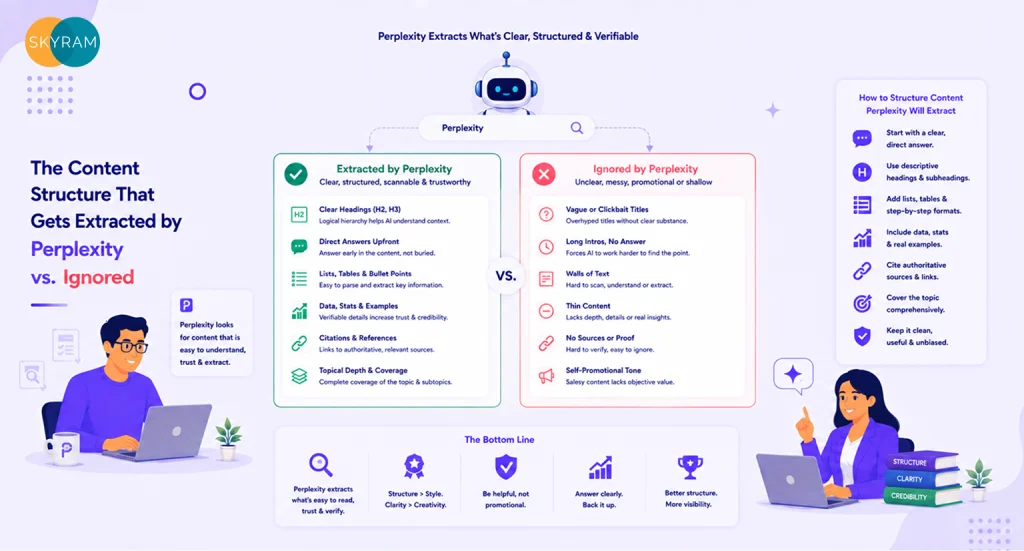
Perplexity extracts content that answers questions in clearly delineated sections with explicit source attribution potential, content using descriptive subheadings, bulleted key points, and definitive statements rather than hedged or exploratory language. Perplexity’s real-time retrieval model favors freshly updated, well-cited content over static pages, making content freshness a stronger ranking signal for Perplexity extraction than for traditional SEO.

This guide is a Perplexity-specific optimization playbook: how its retrieval model actually works, which structural elements it extracts reliably, why freshness carries more weight here than almost anywhere else, and how to test whether your content is showing up at all.

How Perplexity’s Retrieval Model Differs From Google Search

Real-time web retrieval vs. index-based ranking

Google ranks pages against a pre-built index using hundreds of weighted signals, then serves a list of links. Perplexity works closer to a live research assistant. When a query comes in, Perplexity issues search queries in real time, pulls a set of current candidate pages, reads through them, and synthesizes an answer with inline citations pointing back to specific sources. There is no equivalent of a stable “position one” on Perplexity. The sources cited for a given question can shift from one week to the next as the underlying content on the web changes.

This distinction matters practically. A page can hold a strong Google ranking for years on the strength of accumulated backlinks and domain authority, largely undisturbed. A page earning Perplexity citations has to keep proving it deserves that citation every time the model retrieves it, because the comparison set of candidate sources is being rebuilt on the fly rather than pulled from a static index.

Why content freshness carries more weight in Perplexity citations

Because Perplexity retrieves in real time rather than ranking against a fixed index, freshness functions as a much stronger trust signal here than it does in traditional SEO. A page updated last month, with a visible date and current statistics, reads as more reliable to a real-time retrieval system than a page last touched two years ago, even if the older page still holds a strong Google position. Google’s ranking algorithm tolerates static, evergreen content far more comfortably than a retrieval system that is actively trying to determine what is true right now.

This is also where the broader distinction between GEO and traditional SEO becomes concrete rather than theoretical. If you want the fuller comparison of how these two disciplines diverge, we cover it in our breakdown of GEO versus SEO for US search strategy.

Key Takeaway: Perplexity retrieves live rather than ranking against a static index, which is why content freshness functions as a stronger citation signal here than it does for traditional Google rankings.

The Structural Elements Perplexity Extracts Most Reliably

Descriptive H2/H3 subheadings that mirror query phrasing

Perplexity extracts passages, not full pages. A subheading that mirrors the actual phrasing a buyer would type or ask out loud, “How often should cornerstone content be updated,” rather than something vague like “Update Considerations,” gives the retrieval system an obvious match between the query and the section. Generic, clever, or brand-voice-heavy subheadings look good in a content review meeting and perform poorly at extraction time, because they add a translation step the model has to work through before it can confirm relevance.

Getting this right is largely the same discipline behind structuring content the way answer engines expect: question-shaped headings, followed immediately by a direct answer.

Bulleted and numbered lists as extraction-friendly formats

Lists are easier for a retrieval system to lift cleanly than dense paragraphs, because each bullet already represents a self-contained unit of information rather than a sentence that depends on the three sentences around it for context. A comparison of five vendor criteria, a numbered process with clear steps, or a checklist of requirements all extract more reliably than the same information written as flowing prose. This does not mean every section should become a list. It means content strategists should default to list formatting anywhere the underlying information is genuinely enumerable, rather than defaulting to paragraphs out of habit.

Definitive statements over hedged or speculative language

Perplexity tends to favor content that states a position clearly. “Cornerstone content should be refreshed every 60 to 90 days” extracts and cites more readily than “some experts suggest that refreshing content periodically may help maintain relevance,” even when both sentences are conveying roughly the same idea. Hedged language forces a retrieval system to work harder to determine whether a passage is actually asserting something the model can safely attribute to a source. Confident, specific, well-supported claims do that work for the model instead of leaving it to guess.

Comparison Table: Perplexity-Friendly Content Structure vs. Standard Blog Structure

Element Standard Blog Structure Perplexity-Friendly Structure
Heading style Brand-voice or clever phrasing Descriptive, question-shaped phrasing
Answer placement Answer emerges after narrative buildup Direct answer in the first sentence of each section
List usage Occasional, mostly for skimmability Default format for any enumerable information
Claim language Hedged, exploratory, “it depends” framing Definitive statements backed by specifics
Freshness signals Publish date only, rarely revisited Visible update date, refreshed on a fixed cadence
Source citation Minimal or generic attribution Specific data points with named sources
Paragraph length Long, multi-idea paragraphs Short, single-idea paragraphs per passage


This is not a wholesale rewrite of good content practice. It is a shift in priority. Standard SEO fundamentals still determine whether a page gets crawled and indexed at all, but a page can satisfy every traditional SEO checklist item and still get passed over by Perplexity if its structure was never built for a real-time extraction system.


Key Takeaway: Perplexity extracts self-contained, confidently stated passages far more reliably than narrative prose, which means content structure needs to shift toward answer-first sections and enumerable formatting, not just keyword coverage.

Why Update Frequency Matters More for Perplexity Than for Google

How often to refresh cornerstone content for continued citation eligibility

Cornerstone content, the pieces carrying your most important keyword targets and highest lifetime traffic potential, benefits from a refresh cadence closer to once a quarter for Perplexity purposes, tighter than most teams currently apply to their Google-focused evergreen content. This does not mean rewriting the entire piece every ninety days. It means revisiting statistics, confirming claims are still accurate, updating any dated references, and refreshing the visible update timestamp so both readers and retrieval systems can see the content has been actively maintained.

Content teams accustomed to a “publish and revisit annually” cadence for evergreen posts will need a separate, tighter cadence specifically for pieces they want Perplexity to keep citing.

Dating and versioning content for retrieval systems

A visible, accurate “last updated” date does real work here. It signals to both the retrieval system and the human reader that the content reflects current information rather than a snapshot from whenever it was first published. Teams sometimes leave a static publish date even after making substantive updates, which quietly undercuts the freshness signal they just worked to earn. Every meaningful update to a cornerstone page should also update that visible date, not just the underlying content.

Building this kind of update discipline systematically, across a full content calendar rather than a handful of flagship posts, is part of what a unified AI content optimization strategy is built to handle.

Key Takeaway: Cornerstone content aimed at Perplexity citations needs a tighter refresh cadence than most teams currently apply, paired with a visible, accurate update date on every substantive revision.

Testing Your Content’s Perplexity Extraction Rate

Manual query testing methodology

Start with the actual questions your buyers ask, typed directly into Perplexity the way a real prospect would phrase them, not the polished keyword variant from your content brief. Run each query, note whether your content appears as a cited source, which specific passage got extracted if it did, and which competitors or third-party sources are appearing instead. Repeat this across ten to fifteen representative queries for your priority topics, and repeat the full test monthly rather than once, since Perplexity’s live retrieval means results shift as the broader web changes, not just as your own content changes.

What to change when your content isn’t surfacing

When a query consistently surfaces competitors instead of your content, check three things in order. First, confirm the relevant section actually answers the question directly in its opening sentence, rather than building up to the answer. Second, check whether the content has been updated recently enough to compete on freshness against whatever is currently being cited. Third, look at whether the claim in question is stated definitively or hedged into vagueness, since a confidently stated competitor claim will often win the citation over a more accurate but softer one.

For teams that want a structured baseline rather than manual spot-checking across dozens of queries, Skyram’s AI visibility audit maps current extraction performance across Perplexity, ChatGPT, and Google AI Overviews before any content rework begins.

Key Takeaway: Extraction testing works best as a recurring, query-based practice, and the fix almost always traces back to answer placement, freshness, or claim confidence, not a wholesale content rewrite.

Building a Content Calendar Optimized for Perplexity Alongside Google

A content calendar built only for Google publishes, then largely leaves content alone until a ranking drop forces a revisit. A calendar built for Perplexity as well needs a second, tighter track: a refresh cadence for cornerstone content, a monthly query-testing check-in, and a production standard that defaults new content to answer-first structure and definitive language from the first draft, rather than retrofitting it later.

This is also where resourcing questions come up. If a content or SEO partner cannot walk through how they structure content specifically for real-time retrieval systems, not just for Google, that is worth flagging early. The same evaluation instincts apply here as what belongs in any SEO agency evaluation in 2026: ask for a specific methodology, not a general assurance that “we handle AI search too.”

Key Takeaway: A content calendar built for both Google and Perplexity needs a dedicated refresh cadence and query-testing rhythm layered on top of standard publishing, not a single unified schedule stretched to cover both.

Frequently Asked Questions

  1. What content structure does Perplexity extract most reliably?

Perplexity extracts content structured in clearly delineated, self-contained sections that answer a specific question directly in the opening sentence. Descriptive subheadings that mirror natural query phrasing, bulleted or numbered lists for enumerable information, and definitive statements backed by specific data all improve extraction reliability. Content that hedges its claims or buries the answer after several paragraphs of context extracts far less reliably, even when the underlying information is accurate.

  1. Does Perplexity favor fresh content over older, established pages?

Yes. Because Perplexity retrieves information in real time rather than ranking against a fixed index, freshness functions as a stronger trust signal for Perplexity citations than it typically does for traditional Google rankings. A recently updated page with a visible, accurate update date is more likely to be cited than an older page covering the same topic, even if that older page still holds a strong organic search position.

  1. How is optimizing for Perplexity different from optimizing for Google?

Optimizing for Google centers on keyword targeting, backlink authority, and technical crawlability to earn a ranking position within a static index. Optimizing for Perplexity centers on structuring individual passages so a real-time retrieval system can extract and cite them confidently, with heavier weight placed on content freshness, answer-first formatting, and definitive claim language. The two disciplines overlap substantially but are not interchangeable, and content built purely for one can underperform on the other.

  1. How often should I update cornerstone content for Perplexity citation?

Cornerstone content targeted for ongoing Perplexity citation generally benefits from a refresh cadence closer to once every 60 to 90 days, tighter than the annual or biannual refresh cycle many teams apply to evergreen Google-focused content. Refreshes should update statistics, confirm claims remain accurate, and update the visible last-updated date, since an outdated timestamp undercuts the freshness signal even after real content changes have been made.

  1. How can I test whether my content is getting extracted by Perplexity?

Test extraction by running the actual questions your target buyers ask directly in Perplexity, using natural phrasing rather than keyword-brief language, and recording whether your content appears as a cited source. Repeat this across a representative set of priority queries on a monthly basis, since Perplexity’s live retrieval model means results shift over time independent of any changes to your own content. Consistent absence across repeated tests usually points to answer placement, content freshness, or hedged claim language as the underlying cause.

Talk to Skyram About Multi-Platform AI Search Optimization

A content team that treats Google, ChatGPT, and Perplexity as one undifferentiated “AI search” bucket will keep losing visibility on the platforms where a single unified playbook does not hold up. Perplexity’s real-time retrieval model rewards specific structural choices that a Google-only content strategy simply does not prioritize.

Skyram Technologies works with US marketing and content teams to build content architecture that performs across Google, Perplexity, and ChatGPT simultaneously, rather than optimizing for one and hoping the others follow. That starts with a clear picture of where extraction is already happening and where it isn’t.

Book a Strategy Consultation

How ChatGPT Chooses Which Sources to Cite (And How to Become One)

CMO reviewing ChatGPT citation sources on a laptop showing AI answer engine visibility dashboard

Most marketing leaders can explain, in reasonable detail, how Google ranks a page. Ask the same person how ChatGPT chooses sources when it answers a question, and the explanation usually trails off somewhere around “it just knows.” That gap is becoming a real business problem. Buyers are shifting early-stage research into conversational AI tools, and a brand that does not understand the citation mechanism has no way to influence it.

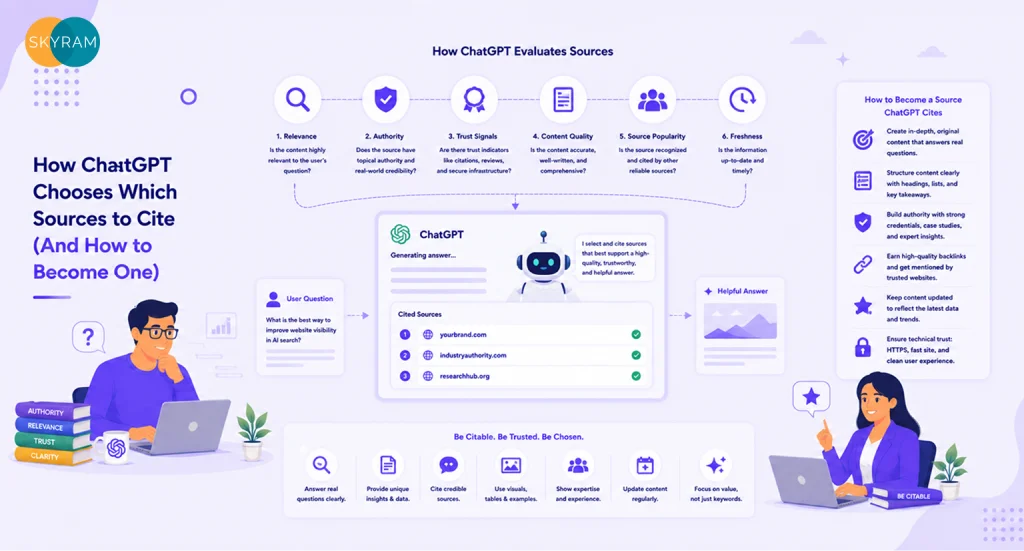
ChatGPT’s source selection for cited answers depends on training data prevalence, real-time browsing and retrieval when that capability is active, and the structural clarity of content that makes it easy to extract and paraphrase accurately. Brands become citation sources by building consistent authority signals across multiple platforms, their own site, industry publications, and structured data, rather than optimizing a single page for a single query.

This guide breaks down that mechanism in plain language, then walks through the specific moves a marketing team can make to become one of the sources ChatGPT actually cites.

How ChatGPT Actually Generates and Sources Answers

Training data influence vs. real-time browsing and retrieval

ChatGPT operates on two distinct information systems, and knowing which one is active for a given query changes what “getting cited” actually requires.

The first is training data. Everything the model learned during training gets compressed into patterns and associations, not a searchable database of documents. When a question touches something the model absorbed heavily and consistently during training, it answers from memorized patterns. Brand names, product categories, and well-established facts surface this way, without any live lookup.

The second is retrieval. When ChatGPT has browsing enabled and a query benefits from current information, the model issues search queries, pulls a set of candidate pages, reads them, and constructs an answer with inline citations back to those sources. This behaves more like a research assistant than a static encyclopedia. It is also the mechanism most directly influenced by what your content looks like today, not what it looked like when the model was last trained.

For evergreen conceptual questions, the deciding factor is often how consistently your brand appears in the patterns the model already learned. For specific, current, or comparative questions, live retrieval decides the citation, and that is where structural clarity and fresh indexing carry the most weight.

Why consistency across the web matters more than a single optimized page

A single, beautifully structured landing page rarely earns a citation on its own merit. ChatGPT’s underlying trust signals strengthen through repetition. If the same facts, the same framing, and the same brand name show up consistently across your own site, trade publications, review platforms, and structured directories, the model treats that convergence as evidence the information is reliable. One page optimized in isolation, without any corroboration elsewhere on the web, is a comparatively weak signal.

This is also where GEO and traditional SEO diverge in practice, even though they share a lot of the same groundwork. If you want the fuller comparison, we have laid out the deeper differences between GEO and SEO and where each discipline earns its keep in a 2026 search strategy.

Key Takeaway: ChatGPT’s citation behavior blends two mechanisms, memorized training patterns and live retrieval, and both reward consistency over one-off, single-page optimization.

The Content Characteristics That Make Brands Citation-Worthy

Clarity and structural extractability

AI models extract passages, not pages. A section that answers its own question in the first sentence, without three paragraphs of scene-setting first, gets lifted cleanly into a generated response. A section that buries the answer under narrative framing gets skipped, even when the underlying information is accurate and useful.

This is the same discipline behind structuring content the way answer engines expect: clear headings that map to real questions, a direct answer immediately following each heading, and supporting detail that comes after, not before, the core claim.

Depth and comprehensiveness on a specific topic

Depth here does not mean length. A twelve-hundred-word article with named examples, quantified outcomes, and a clear methodology outperforms a thirty-five-hundred-word post that circles the same three ideas without ever landing on specifics. Large language models score specificity. Vague language, hedged claims, and generic statements all reduce the odds that a section gets extracted and cited, because there is nothing concrete for the model to lift.

Building this kind of depth systematically, across a full content library rather than one flagship post, is the core of a broader AI content optimization strategy rather than a one-time rewrite.

Cross-platform consistency: your site, industry press, and third-party mentions

A brand that only exists on its own domain is easy for a model to overlook, no matter how well that domain is optimized. Citations compound when the same claims appear, in consistent form, across your site, industry publications covering your category, review or comparison sites your buyers actually read, and structured data that names your brand as a distinct entity. Each additional credible mention lowers the model’s uncertainty about whether your brand is a trustworthy source.

Comparison Table: Content Built for Google Ranking vs. Content Built for LLM Citation

Dimension Built for Google Ranking Built for LLM Citation
Primary goal Earn a top-10 position for a target keyword Provide a self-contained, quotable answer
Structural priority Keyword placement and internal linking density Answer-first paragraphs and clean heading logic
Success metric Rank position and organic sessions Citation frequency and share of AI-generated answers
Content depth approach Comprehensive coverage to hold reader attention Specific, quantified claims a model can extract cleanly
Authority signal Backlink volume and domain authority score Cross-platform consistency and clear entity identity
Update cadence Periodic refresh tied to ranking decay Continuous, since retrieval favors current information
Distribution focus Primarily on-site, supported by link building Own site plus trade press, review platforms, and forums


The two disciplines share real overlap. The traditional SEO playbook still determines whether your content gets crawled, indexed, and found at all. But a page can rank respectably on Google while remaining functionally invisible to ChatGPT’s citation layer if it was never built for extraction or corroboration.


Key Takeaway: SEO and LLM citation share a technical foundation, but a page optimized purely for ranking will not automatically get cited. The two require overlapping but distinct structural decisions.

Building the Authority Signals LLMs Actually Weigh

Digital PR and third-party mentions as citation infrastructure

Earned media, analyst mentions, and guest contributions to industry publications do more than build backlinks. They plant your brand’s name and claims in exactly the kind of third-party, corroborating sources that AI models weigh heavily when deciding whether a brand is a credible answer. The teams we work with at Skyram Technologies treat digital PR as citation infrastructure, not a separate line item sitting outside the content strategy.

Structured data and entity clarity

Schema markup tells a model what kind of content it is looking at before it reads a single sentence. FAQPage schema, Organization schema, and consistent naming of your brand as a distinct entity across every property you control all reduce the ambiguity a model has to resolve on its own. Brands with scattered, inconsistent naming across their site, directory listings, and press mentions make the model work harder to confirm identity, and uncertainty rarely resolves in your favor. This is one of the specific gaps a dedicated GEO program is built to close.

Original research and data as high-citation-value content types

Original research and proprietary data get cited at a disproportionately higher rate than summary content, because a model would rather cite the source of a fact than a secondhand restatement of it. A single well-designed survey, benchmark study, or internal dataset, published with clear methodology, can generate more citations over its lifetime than a dozen general-interest blog posts on the same topic.

Key Takeaway: Citation authority comes from a system of signals working together: third-party mentions, structured data, and original content that other sources want to reference, not from any single tactic in isolation.

What You Cannot Control (And Shouldn’t Try To)

Training data cutoffs and update cycles

The model’s baked-in knowledge only updates when a new training run happens, and that schedule sits entirely with the model provider. A brand cannot force newly published content into a model’s memorized patterns before the next training snapshot. What you can influence is how effectively live browsing and retrieval bridge that gap in the meantime, which is exactly why current, well-structured content matters even when the underlying facts have not changed.

Why gaming LLM citation behaves differently than gaming search rankings

Manipulative SEO tactics, link schemes, thin affiliate networks, keyword-stuffed pages, degrade faster against LLM citation than they ever did against search rankings. These models are trained to identify low-quality, inconsistent, or hollow content at a semantic level, not just a link-graph level. A brand that tries to shortcut its way into citations with the same tricks that once worked for rankings usually ends up flagged as unreliable instead.

Interestingly, these are close to the same red flags worth screening for when hiring any search partner, whether the mandate is traditional rankings or AI citation. An agency still pitching backlink volume as its primary lever in 2026 is not equipped for either.

Key Takeaway: Training data timing sits outside anyone’s control, and shortcuts that once worked on search rankings tend to backfire against LLM citation. Durable visibility comes from consistency, not manipulation.

How to Test and Monitor Your ChatGPT Citation Presence

Monitoring citation presence starts with the same questions your buyers actually ask, typed directly into ChatGPT with browsing enabled. Log whether your brand appears, which competitors show up instead, and how the answer frames your category. Do this across a representative set of queries, not just your top branded terms, and repeat it on a regular cadence rather than once. Citation presence shifts as content gets published, indexed, and refreshed, so a single snapshot tells you very little.

A few practical signals to track over time: whether your brand appears as a named source for informational queries in your category, whether competitors are cited more consistently than you are for the same prompts, and whether branded search volume is climbing, which often indicates buyers encountered your brand in an AI answer and followed up with a direct search.

For teams that want a structured starting point rather than manual spot-checking, Skyram’s AI visibility audit maps where your brand currently appears, and where it does not, across ChatGPT, Perplexity, and Google AI Overviews before any content work begins.

Key Takeaway: Citation monitoring works best as an ongoing practice built around real buyer queries, not a one-time check. Track presence, competitor visibility, and branded search lift together for the clearest picture.

Frequently Asked Questions

  1. How does ChatGPT decide which sources to cite?

ChatGPT decides which sources to cite based on a combination of training data prevalence and, when browsing is active, real-time retrieval of current web content. The model favors sources that answer a question clearly and directly, that appear consistently across multiple credible platforms, and that carry structural signals like clean headings and factual specificity, which make the content easier to extract and paraphrase accurately.

  1. Does ChatGPT use real-time web search or just training data?

ChatGPT uses both, depending on the query and whether browsing is enabled. Static, well-established knowledge often comes from patterns learned during training, while current events, recent statistics, and comparative or time-sensitive questions typically trigger live retrieval, where the model searches the web, reads candidate sources, and cites them directly in its response.

  1. Can I pay to get cited by ChatGPT?

No. As of 2026, there is no paid placement mechanism for organic citations within ChatGPT’s generated answers. Citations are earned through content quality, structural clarity, cross-platform authority signals, and consistency, not through advertising spend. Some AI platforms are testing separate, clearly labeled ad placements, but these are distinct from the organic citation layer this guide addresses.

  1. How is getting cited by ChatGPT different from ranking on Google?

Ranking on Google means a page appears in a list of links for a target keyword, driven heavily by backlinks, on-page keyword signals, and domain authority. Getting cited by ChatGPT means a specific passage of content gets extracted and referenced inside a generated answer, driven by structural clarity, factual specificity, and consistency of the same information across multiple credible sources. A page can rank well without ever being cited by an AI model, and vice versa.

  1. How long does it take for new content to start getting cited by ChatGPT?

Timelines vary by mechanism. Content picked up through live browsing and retrieval can appear in citations within days or weeks of publication, once it is indexed and structurally sound. Content that depends on the model’s memorized training patterns will not influence citations until the next training update, which is outside any brand’s control and typically follows a much longer cycle.

  1. What is the difference between GEO and AEO for ChatGPT citations?

Generative Engine Optimization, or GEO, focuses on the broader trust and citation footprint that earns consistent recommendations across AI platforms like ChatGPT, Perplexity, and Gemini. Answer Engine Optimization, or AEO, focuses more specifically on structuring individual content sections so they function as direct, self-contained answers. In practice, they work together: AEO shapes how a single passage gets extracted, while GEO builds the broader authority that makes a brand worth extracting from in the first place.

Talk to Skyram About Building AI Citation Authority

Understanding how ChatGPT chooses sources is only useful if it changes what your content team ships next. Most marketing organizations are still producing content built entirely for Google’s ranking algorithm, with no structural plan for how that same content performs inside an AI-generated answer.

Skyram Technologies works with US marketing teams to audit current AI citation presence, restructure existing content for extraction, and build the cross-platform authority signals that turn occasional mentions into consistent citations. The process starts with a clear baseline, not a generic content calendar.

Book a Strategy Consultation

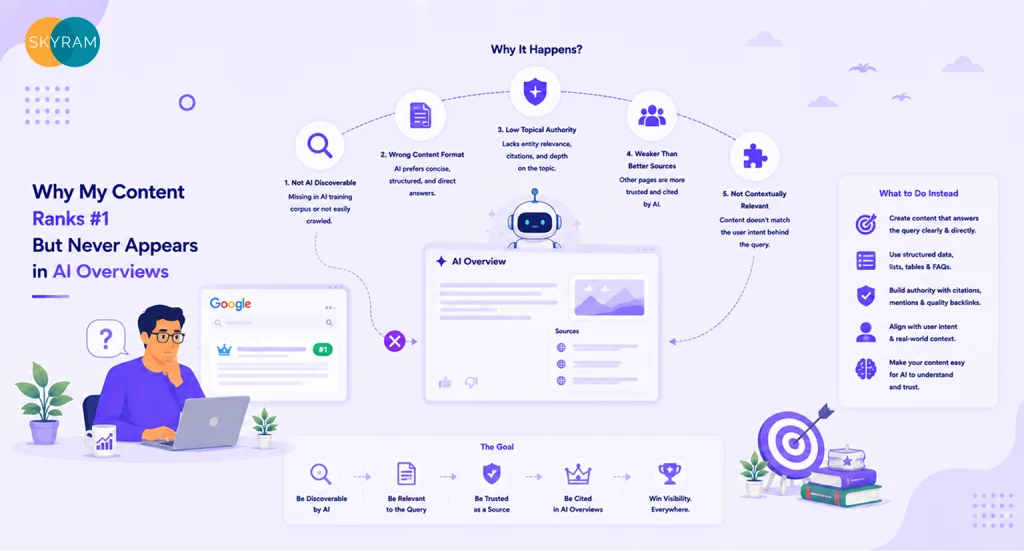
Why My Content Ranks #1 But Never Appears in AI Overviews

SEO manager reviewing an analytics dashboard showing a number one ranking page missing from the Google AI Overview box

A marketing team checks Search Console and sees their pillar page holding the number one organic position for the exact keyword they built the page around. Three months pass. Six months pass. The rank holds. Then someone runs the query manually and notices the AI Overview box sitting above the results, citing a competitor’s page ranking fourth, while the number one result gets no mention at all.

That disconnect is not a glitch, and it is not a sign the page is about to lose its ranking. It is evidence that ranking and AI Overview citation are now two separate evaluations running on the same search results page, judged by different criteria. This guide walks through why that split happens, the five most common reasons strong content gets passed over, and a diagnostic process for finding and fixing the gap without rebuilding content that is already performing well organically.

Content that ranks number one organically but doesn’t appear in AI Overviews typically fails on answer extractability, not authority. Google’s AI Overview system prioritizes content structured for direct extraction: clear question-answer pairing, concise definitions, and scannable formatting, over content that is comprehensive but requires synthesis to locate the answer. Rank position measures relevance. AI Overview inclusion measures extractability.

Rank Position vs. AI Overview Eligibility: Two Different Systems

The core misunderstanding behind this problem is treating AI Overview inclusion as a downstream effect of ranking well. It is not. Ranking gets a page into consideration. A separate set of factors then decides whether that page’s content is usable as a citation source.

What Traditional Ranking Factors Still Control

Backlink authority, keyword relevance, historical performance, content comprehensiveness, and technical health continue to determine organic rank position largely the way they always have. These factors answer the question, “Is this page a credible, relevant match for the query?” A page that ranks first has already cleared this bar convincingly, often with years of accumulated authority that a newer competitor cannot match.

None of that changes under an AI Overview evaluation. A page’s rank one status is not revoked or diminished when a competitor gets cited instead. The two systems are not competing for the same judgment. Ranking answers “does this page deserve to be here.” AI Overview citation answers a different question entirely.

What AI Overview Extraction Factors Control Instead

AI Overview citation depends on whether the generation model summarizing the query can locate a specific, self-contained answer inside the page without doing significant interpretive work. This is a content-structure question, not an authority question. A page can have outstanding backlink profiles and still lose the citation to a thinner page because the winning page states its answer in one clear sentence and the number one page states the same answer across four paragraphs of qualifying context.

This is precisely the gap our answer engine optimization work addresses for clients whose pages already rank well but show zero AI Overview presence. The fix rarely touches rank-driving factors like backlinks. It touches how the answer sits on the page.

Key Takeaway: Ranking and AI Overview citation are governed by different systems. A page’s rank one position reflects authority and relevance. Whether that same page gets cited depends entirely on how extractable its answer is, a structural property, not an authority property.

The Five Reasons High-Ranking Content Gets Skipped by AI Overviews

Most high-ranking pages that get passed over fall into one or more of five identifiable patterns. Diagnosing which pattern applies is the first step toward a fix.

The Answer Is Buried Past the First 100 Words

The most common reason. A page opens with an introduction, some context-setting, maybe a statistic or two, and only reaches its actual answer three or four paragraphs in. Google’s AI Overview system tends to weight the opening portion of a page’s relevant section heavily when deciding whether the content is usable, because that is the section most likely to contain the direct response the model needs. A correct, well-supported answer sitting past the first hundred words is functionally invisible to the extraction process, even though a human reader would find it easily by scrolling.

The Content Lacks a Clean, Quotable Definition or Direct Answer

Some pages answer a question thoroughly across an entire section without ever stating the answer as a single, standalone sentence. The information is present, but it is distributed: part of it in one paragraph, a qualifying detail in the next, a caveat somewhere after that. A generation model cannot easily stitch a citation together from scattered fragments. It needs one sentence, or a tight cluster of sentences, that states the complete answer on its own.

No Structured Data Supporting Entity or Answer Clarity

Pages missing FAQPage schema, HowTo schema, or clear Article markup give Google’s systems less confidence about what type of content they are looking at and how to parse it. This does not disqualify a page from ranking, since traditional ranking factors do not weight schema nearly as heavily. But for AI Overview eligibility, schema functions as a labeling system that reduces ambiguity. Its absence does not break eligibility outright, but it removes a signal that helps close borderline cases in the page’s favor.

Sentence Structure Requires Inference Rather Than Direct Extraction

Some content is written in a way that assumes the reader will connect ideas across sentences. “This approach works well for most cases, though the second method described below tends to perform better under specific conditions” requires a reader, or a model, to hold multiple pieces of information in mind and synthesize a conclusion. Content written for extraction states conclusions directly: “Method B outperforms Method A when X condition applies.” The information can be identical. The extractability is not.

Competing Pages Answer the Same Question More Concisely

Sometimes the content itself is fine, but a competing page simply states the same answer in fewer words, with less friction for the extraction process. AI Overview citation is comparative in this sense. The generation model is not evaluating a page against some absolute quality bar. It is selecting the best available source among the retrieved candidates for that specific query, and “best” in this context often means “most efficiently extractable,” not “most comprehensive.”

Comparison Table: Rank-Optimized Page Structure vs. AI-Overview-Optimized Page Structure

Structural Element Rank-Optimized Structure AI-Overview-Optimized Structure
Answer placement Anywhere within a comprehensive section Within the first 100 words of the relevant section
Definition format Woven into supporting narrative Stated as one standalone, quotable sentence
Schema usage Optional, often limited to Article schema FAQPage and HowTo schema layered where relevant
Sentence construction Allows inference and qualification States conclusions directly, minimal hedging
Competitive benchmark Compared on backlinks and domain authority Compared on extraction efficiency against retrieved pages
Typical fix required None, page already performs Restructure the opening of the target section


Key Takeaway: The five reasons above are diagnostic categories, not a checklist to apply blindly. Most underperforming pages show two or three of these patterns at once, which is why a structured audit matters more than a general rewrite.

How to Audit Your Existing Top-Ranking Content for AI Overview Fit

Before restructuring anything, run a specific diagnostic against the pages already holding strong rank positions but showing no AI Overview presence. This targets effort at the pages most likely to respond quickly.

The Extraction Test: Could an AI Summarize Your Answer in One Sentence?

Take the primary question your page targets and try to answer it using only a single sentence pulled directly from the page, with no editing. If no sentence on the page states the complete answer on its own, the page fails the extraction test regardless of how good the surrounding content is. This is the fastest, cheapest diagnostic available and it takes about two minutes per page.

Run this test against your top 15 to 20 pages by organic traffic that currently show no AI Overview impressions in Search Console. Pages that fail the test are your highest-priority restructuring candidates, since the fix is usually contained to a single paragraph rather than the whole page.

Restructuring Existing Content Without a Full Rewrite

Most pages that fail the extraction test do not need a full rewrite. They need a new opening sentence or two added to the top of the relevant section, stating the answer directly, followed by the existing supporting content left largely intact. This preserves the comprehensiveness and internal linking equity that earned the page its rank in the first place, while adding the extraction-friendly element that was missing.

This is the same restructuring discipline covered in our broader guide to getting cited in ChatGPT, Perplexity, and Google AI Overviews, which walks through the entity and schema layer that often needs to accompany structural changes for the citation to stick.

Key Takeaway: The one-sentence extraction test is the fastest way to identify which top-ranking pages are failing on structure rather than substance. Most fixes are additive, a new answer-first opening, not a wholesale rewrite of content that already ranks well.

What to Change First: Quick Fixes vs. Structural Rebuilds

Not every underperforming page needs the same level of effort, and treating them all the same wastes budget on pages that need a light touch while under-investing in pages that need real restructuring.

Quick fixes apply to pages that fail the extraction test but otherwise have strong content. Add a direct answer sentence to the top of the target section. Add FAQPage schema if the page already has a natural Q&A section, even an informal one. Tighten hedged sentence constructions in the immediate vicinity of the core answer. These changes typically take under an hour per page and can be rolled out across a priority list quickly.

Structural rebuilds apply to pages where the answer is genuinely diffuse across the entire piece, where no single section can be reasonably edited to contain a clean answer without disrupting the rest of the content, or where the page was never built around a specific question in the first place. These pages need the content reorganized around a clear question-answer architecture, sometimes with new subheadings added to break the topic into extractable segments. This is closer to the work our AI content optimization process handles for clients with large content libraries, where dozens of pages need triage between the two categories before any actual editing starts.

Prioritize by traffic and business value first, then by which fix category applies. A high-traffic page needing only a quick fix should move ahead of a lower-traffic page needing a full rebuild, simply because the return on effort is faster and larger.

Key Takeaway: Sort underperforming pages into quick fixes and structural rebuilds before touching any of them. Quick fixes should be batched and shipped fast. Rebuilds need dedicated planning and should be prioritized by traffic value, not urgency of discovery.

Measuring Whether Restructuring Actually Improves Citation Rate

Restructuring without measurement leaves a team unable to tell whether the changes worked or whether citation appeared for unrelated reasons. Set a baseline before making any changes.

Record, for each target page, whether an AI Overview currently appears for its primary query and whether the page is cited within it. Google Search Console’s search appearance filter for AI Overviews gives this data directly for queries already generating impressions. For queries with low or no current impression volume, run the query manually and log the result alongside the date.

After restructuring a batch of pages, re-check the same queries on a biweekly cadence rather than daily, since AI Overview citation can fluctuate short-term as Google’s retrieval pool shifts. Look for a sustained pattern over four to six weeks rather than reacting to single-day changes. A structured visibility audit run before and after a restructuring push gives a clean before-and-after comparison across the full priority list, which is more reliable than spot-checking individual pages as changes go live.

Track citation rate as a distinct metric from rank position in your reporting. A page can hold its rank one position throughout the entire process while its citation status changes independently. Reporting that conflates the two will misrepresent whether the restructuring effort is actually working.

Frequently Asked Questions

  1. Why does my page rank #1 but not show up in the AI Overview?

A page can rank first while being excluded from the AI Overview because the two are governed by separate evaluations. Rank position reflects relevance and authority signals like backlinks and content comprehensiveness. AI Overview inclusion depends on whether Google’s generation model can extract a clean, self-contained answer from the page without needing to synthesize information across multiple paragraphs. A page can be highly authoritative and still lack the extractable structure the citation process requires.

  1. How do I know if my content is failing because of structure or because of authority?

Run the extraction test: try to answer your page’s primary target question using only one unedited sentence pulled directly from the page. If no single sentence states the complete answer, the issue is structural, not authority-related, since the page is already ranking well enough to prove its authority is sufficient. Authority problems show up as low or unstable rank positions, not as a rank one page with zero AI Overview presence.

  1. Do I need to rewrite my entire page to get cited in AI Overviews?

Usually not. Most pages that rank well but lack AI Overview citation need an additive fix: a direct answer sentence added near the top of the relevant section, tightened sentence structure around that answer, and schema markup where a natural Q&A element already exists. A full structural rebuild is only necessary when the answer is genuinely spread across the entire piece with no section that can reasonably be edited to contain it.

  1. How long does it take to see AI Overview citation after restructuring a page?

Most pages that already rank well and receive regular crawl attention show citation changes within two to six weeks of a structural update, since the page does not need to earn new rank position, only be reprocessed with its new structure. Pages that are crawled less frequently due to lower traffic or fewer internal links may take longer to reflect the change.

  1. Does losing AI Overview citation mean my page is about to lose its ranking?

No. AI Overview citation and organic rank position are separate metrics that can move independently of each other. A page can hold a stable rank one position indefinitely while its AI Overview citation status changes based on structural factors, competitor content updates, or shifts in Google’s retrieval pool. Rank position should be monitored through standard Search Console ranking reports, and citation status should be monitored separately through the AI Overview search appearance filter.

Talk to Skyram About Closing Your AI Overview Visibility Gap

The gap between ranking first and getting cited is not a sign that content needs to be rebuilt from scratch. It is usually a narrow, fixable structural problem sitting inside content that is already doing most of its job well. The extraction test, the five diagnostic patterns, and the quick-fix-versus-rebuild triage above give a team enough to start closing that gap on their own.

For teams managing a large page inventory where manual auditing does not scale, Skyram Technologies runs this exact diagnostic across a full site, prioritizes pages by traffic value and fix complexity, and implements the structural changes without disturbing the ranking signals already in place. Talk to Skyram about closing your AI Overview visibility gap and get a clear picture of which pages are costing you citations right now.

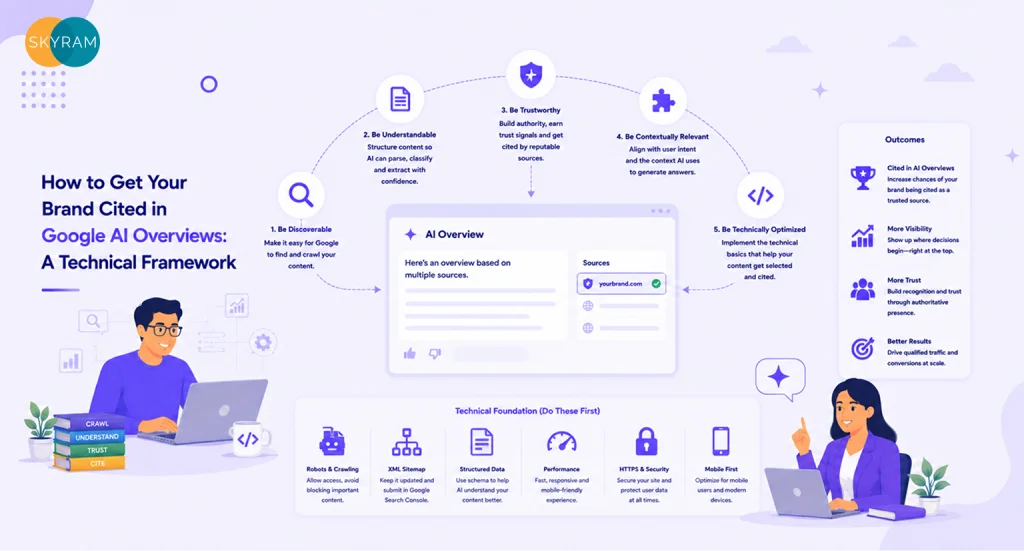
How to Get Your Brand Cited in Google AI Overviews: A Technical Framework

Marketing director reviewing a technical framework for getting brand content cited in Google AI Overviews on a laptop dashboard

Search results changed shape faster than most marketing teams adjusted their content strategy. AI Overviews now sit above the traditional blue links for a growing share of queries, and the ranking rules that determine placement inside them are not the same rules that determine organic position. A brand sitting at position three in the organic results can appear inside the AI Overview while the page holding position one does not get cited at all. That gap is not random. It reflects a separate selection process running on top of traditional search, one that rewards a different kind of content structure entirely.

Getting cited in Google AI Overviews requires structuring content around direct, self-contained answers to specific questions, implementing schema markup that clarifies entity relationships, and building topical depth that signals authority on the exact query being answered. AI Overviews pull from pages that answer questions clearly in the first few sentences, not pages that bury the answer inside narrative content.

This guide breaks down the technical framework behind that selection process. It covers how Google’s AI Overview system actually retrieves and ranks source content, the structural patterns that earn citations, the schema markup that supports eligibility, the technical prerequisites that have to be in place before any of it matters, and how to track whether your pages are actually showing up.

How Google AI Overviews Select and Cite Sources

AI Overviews do not work like the traditional ten blue links. Understanding the mechanism behind source selection is the starting point for any optimization effort, because tactics that worked for organic ranking do not automatically transfer.

The Retrieval-Augmented Generation Process Behind AI Overviews

Google AI Overviews run on a retrieval-augmented generation process, commonly shortened to RAG. Instead of generating an answer purely from the language model’s training data, the system retrieves a set of candidate pages from Google’s index that appear relevant to the query, then uses those retrieved pages as grounding context to generate the summary the user sees. The pages cited beneath the AI Overview are the sources the model actually pulled from during that retrieval step.

This matters because it means two separate processes are happening. First, traditional ranking signals still determine which pages even enter the retrieval pool. A page that cannot rank at all for a query is unlikely to be retrieved. Second, once a page is inside that retrieval pool, a different evaluation happens: does the content contain a clean, extractable answer the generation model can lift and summarize accurately? A page can rank on page one and still fail this second test if the actual answer is diluted across long paragraphs, hedged with qualifiers, or missing entirely from the sections Google’s crawlers associate with the query.

Why Rank Position and AI Overview Inclusion Are Increasingly Decoupled

The decoupling between organic rank and AI Overview citation happens because the two systems optimize for different outcomes. Traditional ranking rewards comprehensive coverage, backlink authority, and historical performance signals. AI Overview citation rewards clarity and extractability at the sentence and paragraph level. A page can have strong domain authority and still lose the citation to a lower-ranking competitor whose content answers the exact question in a cleaner, more self-contained way.

This is why marketing teams sometimes see a competitor with a thinner backlink profile earning the AI Overview citation while their own page, ranking higher, gets skipped. The content structure, not the domain strength alone, determines which page the generation model chooses to summarize from.

Key Takeaway: AI Overviews run on a retrieval-then-generate process, not a pure ranking algorithm. Getting into the retrieval pool still requires solid organic performance, but earning the actual citation depends on whether your content contains a clean, extractable answer the model can summarize with confidence.

Content Structure That Wins AI Overview Citations

Once a page qualifies for the retrieval pool, structure becomes the deciding factor in whether it gets cited. The formatting choices that follow are the highest-leverage changes a content team can make.

Direct-Answer-First Formatting vs. Narrative Lead-Ins

Content written for AI Overview citation states the answer first, then supports it. Content written in a traditional editorial style often builds context before arriving at the point, a structure that reads well for a human but creates friction for a generation model trying to extract a clean summary.

Compare the two approaches. A narrative lead-in might read: “There has been a lot of discussion recently about how brands can improve their standing in AI-powered search results, and the answer involves several interconnected factors that marketing teams need to understand.” That sentence contains no answer. A direct-answer version reads: “Brands get cited in Google AI Overviews by structuring content around self-contained answers, implementing schema markup, and building topical authority on the specific query.” The second version can be lifted and summarized without any additional processing. The first cannot.

This does not mean every page needs to abandon narrative style entirely. It means every section that targets a specific question needs to open with the answer in the first sentence, before any supporting narrative appears.

Question-Based Subheadings That Mirror Actual Search Queries

Subheadings phrased as questions perform better for AI Overview extraction than subheadings phrased as abstract topic labels. A subheading reading “What Schema Markup Does Google AI Overviews Prioritize” maps directly to how a user might phrase the search query, which makes it easier for the retrieval system to match the section to the query and for the generation model to treat that section as the direct source of the answer.

Audit existing content by pulling the actual “People Also Ask” questions and related search terms for your target keyword, then rewrite H2 and H3 subheadings to mirror that language wherever it fits naturally. This is not keyword stuffing. It is aligning your content’s internal structure with the way the query itself is phrased.

Optimal Answer Length for Extraction

Answer blocks that run 40 to 60 words tend to perform best for AI Overview extraction. Short enough to summarize cleanly, long enough to contain a complete, specific answer rather than a vague fragment. An answer under 20 words often lacks the specificity the model needs to trust it as a standalone claim. An answer running past 100 words before making its point forces the model to do more interpretive work, increasing the odds it selects a competitor’s tighter answer instead.

The discipline here is similar to what our answer engine optimization process applies across every client page: every section that targets a specific question gets a direct answer within that 40 to 60 word window before any elaboration begins.

Key Takeaway: Structure every section that targets a specific question with the answer in the first sentence, a question-based subheading that mirrors real search phrasing, and a response length in the 40 to 60 word range. This is the single highest-leverage change most content teams can make.

The Schema Markup That Supports AI Overview Eligibility

Structure gets content into a citable shape. Schema markup tells Google’s systems what that content actually is, reducing the ambiguity the retrieval and generation process has to resolve on its own.

FAQ Schema, HowTo Schema, and Article Schema Priorities

Three schema types carry the most weight for AI Overview eligibility on informational content. FAQPage schema marks up question-and-answer pairs directly, giving the generation model a pre-formatted answer block it can extract with minimal interpretation. HowTo schema serves the same function for process-based content, breaking a procedure into discrete, labeled steps that map cleanly onto how-to queries. Article schema, when it includes complete author and publisher markup, signals the content’s provenance and helps establish the credibility layer that supports citation.

Prioritize FAQPage schema on any page with a dedicated FAQ section, HowTo schema on any content walking through a sequential process, and Article schema with full author attribution on every blog post. Pages carrying two or more of these schema types consistently show stronger AI Overview inclusion rates than pages with none, because the schema removes guesswork from how the content should be parsed.

Entity Markup and Structured Data Consistency Across Your Site

Beyond content-type schema, Organization schema and consistent entity markup across the site help Google resolve who is actually publishing the content. This includes a complete sameAs array linking to verified profiles, consistent naming conventions across every page, and structured data that does not contradict itself from one page to the next. Inconsistent entity signals, such as a company name that appears one way in the footer schema and another way in the Article schema, create the kind of ambiguity that makes AI systems less confident about attributing content to a trustworthy source.

Structured data consistency is a site-wide discipline, not a page-by-page task. A single well-marked-up blog post sitting inside a site with inconsistent entity signals elsewhere will not perform as well as the same post on a site where every page reinforces the same clear entity profile.

Comparison Table: Traditional Ranking-Optimized Content vs. AI Overview-Optimized Content

Content Element Traditional Ranking Optimization AI Overview Citation Optimization
Opening structure Builds context, then narrows to the point States the direct answer in the first sentence
Ideal section length Comprehensive, often 300+ words per section 40 to 60 word answer block, then supporting depth
Heading phrasing Broad topic labels for keyword coverage Question-based, mirrors actual search phrasing
Schema priority Article schema for rich snippet eligibility FAQPage, HowTo, and Article schema combined
Depth signal Total word count and topical breadth Specificity and self-contained clarity per section
Primary success metric Organic rank position and click-through rate Citation frequency inside AI-generated summaries
Update cadence Periodic refresh tied to ranking decay Frequent updates tied to freshness windows


Key Takeaway: FAQPage, HowTo, and Article schema each remove a specific layer of ambiguity for Google’s retrieval and generation process. Site-wide entity consistency matters as much as individual page markup, since contradictory signals undermine the credibility schema is supposed to establish.

Technical Foundations That Must Be in Place First

Content structure and schema markup only matter if Google can crawl, index, and render the page in the first place. Skipping this layer is the most common reason technically sound content strategies underperform.

Crawlability and Indexation Health Checks

Before investing in content restructuring, confirm that the pages you want cited are actually indexed and crawlable without obstruction. Check for accidental noindex tags, broken canonical chains pointing to the wrong URL, and robots.txt rules that unintentionally block sections of the site. Run a fresh crawl audit specifically on your priority pages rather than assuming a general site health check from months ago still reflects current status.

Indexation depth matters too. A page that Google crawls infrequently is less likely to have its most recent updates reflected in the retrieval pool that feeds AI Overviews. Pages targeting priority AI Overview queries should sit within the site’s primary crawl path, linked from high-authority internal pages rather than buried several clicks deep.

Page Speed and Core Web Vitals as Citation Prerequisites

Core Web Vitals remain part of Google’s page experience signals, and slow-loading or layout-shifting pages compete at a disadvantage for retrieval consideration. This is not a direct AI Overview ranking factor in the way schema or answer structure are, but it functions as a gate: pages that struggle with Largest Contentful Paint or Interaction to Next Paint tend to underperform across the broader signals that determine whether a page enters the retrieval pool at all.

Treat page speed and Core Web Vitals as a prerequisite layer rather than an optimization to revisit later. A structurally excellent, fully schema-marked page sitting behind a slow, JavaScript-heavy template is starting from a technical deficit before any content work even gets evaluated. Our technical SEO work treats this foundation as the first phase of any AI Overview optimization engagement, not an afterthought layered on once content is finished.

Key Takeaway: Content and schema improvements cannot compensate for a page that Google struggles to crawl, index, or render quickly. Confirm crawlability and Core Web Vitals health before investing further budget in content restructuring.

How to Monitor Whether You’re Being Cited

Optimization without measurement leaves a marketing team guessing whether the framework is actually working. Tracking AI Overview citations requires a different approach than tracking traditional keyword rankings.

Tools and Manual Tracking Methods for AI Overview Appearances

Google Search Console now surfaces AI Overview impression and click data under the Search Results report when you filter by search appearance type. This is the most direct free method available, showing exactly which queries triggered an AI Overview that included your site and whether users clicked through from it.

Manual tracking supplements this well. Run your priority target queries directly in Google search on a biweekly cadence, record whether an AI Overview appears, and note whether your domain shows up among the cited sources. A simple spreadsheet tracking query, date, citation status, and cited URL builds a useful trend line over a few months without requiring paid tooling.

For teams managing a larger query set, paid platforms including Semrush’s AI Overview tracking module and BrightEdge’s Generative Parser automate this monitoring at scale, running scheduled checks against a full keyword list and reporting citation frequency alongside competitor comparisons. A structured AI visibility audit is a faster way to get a baseline reading across your full priority keyword set before deciding whether to invest in ongoing paid tracking.

Key Takeaway: Google Search Console’s AI Overview filter is the essential free starting point. Layer in manual biweekly query checks for your top targets, and consider paid tracking tools once your priority keyword list grows past what manual checking can reasonably cover.

Common Mistakes That Keep Strong Content Out of AI Overviews

A few recurring mistakes explain most of the gap between content that ranks well and content that gets cited. Writing a strong answer but placing it in paragraph four instead of the opening sentence is the most common one. The model retrieves and summarizes what it finds fastest, and an answer buried behind three paragraphs of setup often gets skipped in favor of a competitor’s tighter opening.

Treating schema as optional or implementing only Article schema while skipping FAQPage and HowTo markup leaves eligibility signals on the table for content that would otherwise qualify. Publishing comprehensive, long-form content without corresponding short, self-contained answer sections inside it creates pages that rank well but rarely get cited, since length and extractability are not the same quality. Neglecting technical prerequisites, particularly Core Web Vitals and crawl health, undermines otherwise strong content before the generation model ever evaluates it. And letting priority pages go stale, without periodic substantive updates, gradually reduces citation frequency even for pages that performed well when first published.

The fix for each of these is procedural, not creative. Audit existing high-potential pages against this list, prioritize the pages closest to qualifying, and work through the gaps systematically rather than rewriting everything at once.

Frequently Asked Questions

  1. What is the fastest way to get cited in Google AI Overviews?

The fastest measurable improvement typically comes from restructuring an existing, already-indexed page to open each key section with a direct 40 to 60 word answer, then adding FAQPage schema to the page’s existing FAQ content. Pages that already rank on page one for a target query but currently bury the answer inside narrative paragraphs tend to show citation improvements within four to eight weeks of restructuring, since the retrieval and indexing groundwork is already in place.

  1. Does ranking number one guarantee an AI Overview citation?

No. AI Overview citation depends on content structure and extractability, not organic rank position alone. A page ranking third or fourth with a cleaner, more self-contained answer can earn the citation over a page ranking first that buries its answer inside longer narrative content. Rank position affects whether a page enters the retrieval pool, but it does not determine which page the generation model chooses to summarize from within that pool.

  1. Which schema type matters most for AI Overview eligibility?

FAQPage schema generally provides the most direct eligibility support because it pre-labels question-and-answer pairs in a format the generation model can extract with minimal interpretation. HowTo schema provides similar value for process-based content. Article schema with complete author markup supports the credibility layer that underlies citation decisions. Most high-performing pages combine at least two of these three schema types rather than relying on a single one.

  1. How is optimizing for Google AI Overviews different from traditional SEO?

Traditional SEO optimizes primarily for rank position through backlink authority, keyword targeting, and comprehensive topical coverage. Optimizing for Google AI Overviews optimizes for extractability: whether a specific section of a page contains a clean, self-contained answer a generation model can summarize confidently. Both disciplines share a technical foundation, including crawlability and Core Web Vitals, but the content-level tactics diverge once a page is capable of ranking at all.

  1. How long does it take for schema markup changes to affect AI Overview citations?

Schema markup changes typically need to be crawled and reprocessed by Google before they influence citation eligibility, a process that generally takes two to six weeks depending on the page’s existing crawl frequency. Pages that are crawled frequently due to strong internal linking and regular traffic tend to see schema changes reflected faster than lower-priority pages that Google crawls less often.

  1. Can new content compete for AI Overview citations against established competitor pages?

Yes, if the new content is structured correctly from the first draft. AI Overview citation rewards extractability and specificity more than it rewards raw domain age or historical authority. A newly published page with a tightly structured, schema-marked answer can outcompete an older, higher-authority page that never restructured its content for extraction. The technical foundation, particularly crawlability and indexation, still needs to be solid, but content age itself is not a primary factor in the citation decision.

Talk to Skyram About AI Overview Optimization Strategy

The framework above covers what changes when content moves from ranking-optimized to citation-optimized: answer-first structure, targeted schema, technical prerequisites, and consistent monitoring. Implementing it across an entire content library, prioritizing correctly, and validating that the changes actually move citation frequency is where most internal teams run out of bandwidth.

Skyram Technologies works with US marketing teams to audit existing content against this exact framework, identify which pages are closest to qualifying for AI Overview citation, and implement the structural and schema changes at scale. If you want a clear picture of where your current content stands, talk to Skyram Technologies about an AI Overview optimization strategy built around your specific keyword priorities.

Hiring a Dedicated Development Team vs. a Staff Augmentation Partner: A Framework for US CTOs

US CTO reviewing dedicated development team vs. staff augmentation engagement models on a whiteboard

The decision lands at the worst moment. Engineering output needs to scale, a roadmap milestone is under pressure, and the CTO has to choose between two fundamentally different engagement models before the quarter closes. Dedicated development team or staff augmentation. Both involve external engineers. Both cost real money. Both carry organizational implications that extend well past the first sprint.

Most companies get this decision wrong in the same direction: they default to augmentation because it feels lower-commitment, then find themselves managing five individual contractors with no shared context, no product ownership, and no accountability structure. Others go the opposite direction, standing up a dedicated team for a three-month spike that did not justify the ramp-up cost or the transition complexity.

A dedicated development team operates as an extension of your company under a single engagement, with a fixed team composition, shared processes, and long-term roadmap ownership. Staff augmentation places individual specialists inside your existing team structure to fill specific skill gaps. The right model depends on whether you need to own a product delivery function or fill a temporary capacity gap.

This framework maps the decision variables, the model mechanics, and the triggers that tell you when to switch.

How Each Model Works in Practice

Understanding the operational mechanics of each model matters before any cost or scope comparison. The difference is not just contractual. It changes who manages, who owns outcomes, and how institutional knowledge accumulates.

Dedicated Team: Fixed Composition, Shared OKRs, Product Ownership

A dedicated development team arrives as a pre-assembled unit: typically a combination of engineers, a tech lead, and sometimes a product manager or QA specialist depending on scope. The team operates under your product roadmap and participates in your sprint ceremonies. Over time, they build context about your codebase, your customers, and your architectural decisions.

The key distinction is that the team owns delivery outcomes, not just task completion. When a feature misses a sprint goal, the team carries accountability for the remediation plan. This ownership structure changes how the external team engages with technical debt, documentation, and cross-functional dependencies. Dedicated teams optimize for the product because that is the frame of their engagement.

This model maps directly to how serious DevOps solutions and cloud engineering engagements operate at scale: a fixed team building institutional knowledge over a multi-quarter horizon, not a rotating cast of specialists solving isolated tickets.

Staff Augmentation: Individual Placement, Your Process, Your Management

Staff augmentation places one or more individual specialists into your existing team under your direct management. You provide the process, the tooling, the sprint structure, and the technical direction. The augmented engineer executes within that framework.

The accountability structure is fundamentally different. You own the outcome. The individual contributor owns the execution of assigned work. When something breaks between sprints or a technical decision produces downstream problems, the internal engineering lead carries that accountability.

This model works well when your team has a clear process, strong internal technical leadership, and a defined gap in a specific skill: a senior React engineer for a frontend rebuild, a cloud engineering specialist for a migration workstream, a DevOps engineer to instrument a CI/CD pipeline while your team stays focused on feature delivery.

Hybrid: When Teams Use Both Simultaneously and Why

High-growth engineering organizations frequently run both models in parallel. A dedicated team owns the core product platform while augmented specialists fill time-bounded gaps: a security audit, a mobile push, an infrastructure project with a defined scope and end date.

The hybrid approach works when your internal engineering leadership has the bandwidth to manage the augmented individuals separately from the dedicated team’s sprint cadence. When that bandwidth does not exist, the hybrid model produces coordination overhead that collapses both workstreams.

Key Takeaway: The model you choose determines who manages delivery outcomes, who builds institutional knowledge, and who carries accountability when something goes wrong. These are organizational questions before they are commercial ones.

The Decision Variables That Actually Matter

Most engagement model comparisons focus on cost. Cost matters, but it is a downstream output of the variables that should drive the decision: duration, management bandwidth, knowledge requirements, and IP structure.

Project Duration: 3 Months vs. 18 Months

Short-duration work, typically under six months, favors staff augmentation. The ramp-up cost of assembling a dedicated team, establishing shared processes, and building product context rarely pays back on a three-month engagement. Augmented specialists with the right technical background reach useful output faster on bounded problems.

Long-duration platform work, typically twelve months or longer, favors a dedicated team. The ramp-up cost amortizes across the engagement. The team builds the contextual depth that accelerates delivery over time and that augmented individuals, cycling in and out, cannot accumulate.

Management Bandwidth: Do You Have the Capacity to Direct Individual Contributors?

Staff augmentation places the management burden on your internal leads. Every augmented engineer needs daily direction, sprint planning participation, code review integration, and technical mentorship investment. If your VP of Engineering or tech lead carries an already full load, adding three augmented contractors multiplies their coordination overhead without multiplying their capacity.

A dedicated team shifts that management burden to the team’s internal lead. Your internal engineering leadership sets direction at the roadmap level and reviews outputs at milestone checkpoints. The day-to-day management of individual engineers happens within the external team’s structure.

Knowledge Retention Requirements

Staff augmentation creates a knowledge distribution problem. Individual contractors hold product context in their heads. When an engagement ends or a contractor transitions out, that context leaves with them unless your team has invested in documentation that most sprint cycles do not prioritize.

Dedicated teams accumulate and retain knowledge within the team structure. Team members cross-train, shared documentation stays within the engagement, and architectural decisions build on previous decisions rather than starting from scratch each time a new engineer joins the work.

IP Sensitivity and Contractual Ownership

Both models require explicit IP assignment language in the contract. The risk profile differs. With staff augmentation, you integrate external code contributions directly into your codebase from multiple individual contractors, each with a separate agreement. A gap in any one agreement creates a cloud over your IP chain of title.

With a dedicated team, IP flows from a single engagement agreement with a single partner. The chain of title is cleaner and easier to audit during due diligence for fundraising or acquisition.

Comparison Table: Dedicated Team vs. Staff Augmentation

Decision Variable Dedicated Team Staff Augmentation Model Recommendation
Project duration 12+ months Under 6 months Duration under 6 months: augmentation. Over 12 months: dedicated.
Management bandwidth Low requirement (team self-manages day-to-day) High requirement (you manage each individual) Low internal bandwidth: dedicated team.
Knowledge retention High (team builds shared context) Low (leaves with individual contractors) Long-horizon platform: dedicated team.
IP chain of title Single agreement, clean audit trail Multiple agreements, higher complexity IP sensitivity: dedicated team.
Team composition flexibility Fixed composition Highly flexible Specific skill gaps, short term: augmentation.
Ramp-up cost Higher (team formation, process alignment) Lower (individual plug-in) Tight short-term budget: augmentation.
Delivery accountability Team-level ownership You own outcomes Outcome ownership required: dedicated team.
Scaling up or down Structured renegotiation Fast adjustment per individual Volatile scope: augmentation.
Process ownership External team adapts to and adopts your process External individual integrates into your process Either model works; dedicated team builds deeper adoption.
Technical debt management Team flags and plans remediation Depends on internal lead’s bandwidth Long-horizon codebase health: dedicated team.

Key Takeaway: Duration and management bandwidth are the two variables that resolve most model decisions. Get those two right and the rest of the comparison follows.

When Dedicated Teams Outperform Augmentation

Three scenarios consistently favor a dedicated team over individual staff augmentation. Each involves sustained delivery accountability that individual contributors cannot provide.

Greenfield Product Builds

Building a new product from a blank slate requires architectural coherence across the entire stack. Individual augmented engineers, each working within their assigned scope, rarely produce coherent architecture without heavy internal oversight. A dedicated team with a shared tech lead makes unified architectural decisions from the first sprint. The web application development work builds on itself rather than accumulating inconsistencies that become expensive to remediate in later sprints.

Long-Horizon Platform Engineering

Platform engineering work, including infrastructure migration, microservices decomposition, and Kubernetes orchestration, requires deep environment knowledge that takes months to develop. Augmented specialists hired for platform work frequently spend their early weeks in context-acquisition mode, reducing their effective output window. A dedicated team with a defined infrastructure scope reaches full operational velocity faster and sustains it across a multi-quarter engagement.

When You Need a Team That Owns, Not Just Executes

Some engineering functions require ownership: someone who treats your product as a strategic asset, flags risks before they become incidents, and makes judgment calls that protect the roadmap. Staff augmentation produces execution capacity. Dedicated teams produce engineering ownership. The distinction matters most on complex, interdependent systems where a critical decision at the wrong moment can set the roadmap back by a quarter.

Key Takeaway: Greenfield builds, long-horizon infrastructure work, and complex platform engineering all require the sustained context and shared accountability that only a dedicated team structure provides.

When Staff Augmentation Beats a Dedicated Team

Three scenarios consistently favor individual augmentation over a fixed dedicated team.

Short-Term Capacity Gaps

Your existing team has a sprint backlog that exceeds capacity for one quarter. You need two more senior engineers now, and the work is well-defined. This is augmentation’s ideal scenario. You add capacity fast, the engineers integrate into your existing sprint process, and the engagement closes cleanly when the backlog clears.

Highly Specific Skill Needs That Do Not Justify a Full Team

You need a Kubernetes specialist for a cluster migration that your internal team cannot prioritize. You need a security engineer for a penetration testing cycle and remediation sprint. You need a data engineer to build a pipeline that sits outside your core product scope. These are point needs. A dedicated team built around them creates overhead that the scope does not justify.

When Your Internal Team Needs a Specialist, Not a Squad

A strong internal team with a clear tech lead sometimes just needs one more senior contributor with a specific domain depth. Adding a full dedicated team creates coordination complexity that a single augmented specialist avoids. The augmented individual plugs into your existing ceremonies, works under your existing lead’s direction, and contributes without requiring a parallel management structure.

Key Takeaway: Short duration, bounded scope, and specific skill requirements all point to augmentation. The key condition is that you have the internal management bandwidth to direct the individual contributors you bring in.

The Transition Decision: When to Convert an Augmentation Relationship to a Dedicated Team

Augmentation relationships that grow past a certain threshold start to exhibit dedicated-team problems without the dedicated-team structure. This is the transition signal.

When you consistently have three or more augmented engineers from the same partner working on the same product area, you have the headcount of a dedicated team without the team structure, the shared accountability, or the IP clarity. The management overhead on your internal leads scales with each individual rather than being absorbed within the external team.

The transition trigger typically arrives when one of three conditions appears: the engagement scope has expanded beyond its original brief and shows no sign of contracting; your internal tech lead is spending more time coordinating augmented engineers than directing product engineering; or institutional knowledge has accumulated in the augmented engineers to the point where their departure would create a serious delivery risk.

At that point, restructuring the engagement as a dedicated team with a defined team lead, shared sprint ownership, and a single engagement agreement produces better outcomes at comparable or lower cost. The engineering partnership with Skyram Technologies supports this conversion explicitly: augmentation relationships that mature into product-critical engagements can be restructured into dedicated team models without restarting the vendor relationship or losing the engineers who have already built product context.

Key Takeaway: When augmentation headcount exceeds three contributors on a single product area and the scope shows no end date, the economics and the risk profile both point toward converting to a dedicated team structure.

Contract, IP, and SLA Considerations by Model

Both models require contract discipline that most companies underinvest in at the engagement setup stage.

For staff augmentation, the critical contract elements are IP assignment, work-for-hire classification, non-solicitation terms, and confidentiality obligations that survive the engagement end. Each individual contractor agreement needs these elements. A gap in one agreement creates an IP chain-of-title problem that surfaces during funding or M&A due diligence at the worst possible moment.

For dedicated teams, the single-agreement structure simplifies IP governance, but the agreement needs to address team composition change procedures explicitly. When a team member transitions out of the engagement, what is the notice requirement, who selects the replacement, and what knowledge transfer protocol applies? Agreements that leave these questions open produce delivery disruption when team changes happen.

SLA structure differs between models. Staff augmentation SLAs typically cover availability and response time at the individual level. Dedicated team SLAs operate at the team level: sprint commitment delivery rates, defect resolution timelines, and escalation protocols for critical production incidents.

For engineering organizations running CD pipeline automation or cloud infrastructure under dedicated team management, SLAs should also cover infrastructure uptime commitments, incident response windows, and post-incident review requirements. These infrastructure SLAs need to be explicit in the engagement agreement, not assumed from the team’s delivery history.

Key Takeaway: IP assignment, team composition change procedures, and SLA structure all require explicit contract language before the engagement begins. Both models create legal complexity that is cheapest to resolve at scoping, not during a funding round or an escalation.

FAQ

  1. What is the cost difference between a dedicated development team and staff augmentation?

Staff augmentation typically costs less per engineer in the short term because there is no team formation overhead, no internal management layer within the external team, and no ramp-up investment. A dedicated team carries higher setup costs that amortize across a longer engagement. For engagements under six months, augmentation is usually more cost-efficient. For engagements over twelve months, the dedicated team model frequently costs less per delivered outcome because accumulated context reduces rework and context-switching overhead that individual augmented engineers generate through each transition.

  1. Which engagement model works better for early-stage startups?

Early-stage startups with a defined product build and limited internal engineering leadership typically perform better with a dedicated team model. The team provides its own technical leadership structure, which reduces the management burden on a founder or a single internal engineer. Startups with a strong internal CTO who needs to add capacity around a defined, time-bounded scope perform better with augmentation. The key question is whether the startup has the internal management bandwidth to direct individual contributors.

  1. How long does it take for a dedicated development team to reach full productivity?

A dedicated development team typically reaches full sprint-level productivity in four to eight weeks, depending on codebase complexity and the quality of onboarding documentation. Teams joining a greenfield engagement reach productivity faster because there is no existing system context to absorb. Teams joining a complex, legacy codebase with limited documentation may take ten to twelve weeks before their sprint output reflects their full technical capacity. Augmented individuals on well-scoped, bounded work can reach useful output faster, typically in two to three weeks, but at a narrower scope than a fully ramped team.

  1. Who owns the intellectual property created by a dedicated team or augmented staff?

IP ownership depends entirely on the contract language, not the engagement model label. In both models, IP created during the engagement should be assigned to the client company through explicit work-for-hire clauses in the agreement. Without this language, IP defaults to the creator, which creates a serious legal liability. For staff augmentation, every individual contractor needs a separate agreement with explicit IP assignment. For dedicated teams, a single master agreement covers the team, but it must include language addressing IP generated before team composition changes occur.

  1. What should you look for when evaluating a dedicated development team partner?

Evaluate on four dimensions: team formation speed and the partner’s bench depth in your required stack; evidence of long-tenure engagements in their client portfolio, which signals the team model produces sustained outcomes rather than early momentum that fades; a clear accountability structure that identifies who carries delivery ownership and escalation responsibility; and IP and SLA contract standards that the partner can demonstrate with existing clients. Partners who cannot produce references from engagements that ran beyond twelve months do not yet have evidence that their dedicated team model functions at the scale and duration your engagement may require.

  1. How do you know when to switch from staff augmentation to a dedicated team model?

The switch is warranted when three or more augmented engineers from the same partner work on the same product area with no clear scope end date, when internal engineering leads spend more time coordinating external contributors than directing product work, or when the departure of one or two augmented engineers would create a significant delivery risk because of accumulated product context. These three conditions signal that the engagement has grown beyond what augmentation is designed to support. At that point, restructuring into a dedicated team with explicit team-level ownership, a defined tech lead, and a consolidated engagement agreement produces better delivery outcomes and reduces organizational risk.

Ready to Choose the Right Engagement Model for Your Engineering Team?

The dedicated team vs. staff augmentation decision determines how your engineering organization scales for the next twelve to twenty-four months. Getting it wrong in either direction creates cost, delivery risk, and organizational complexity that is expensive to unwind.

The web development team at Skyram Technologies works with US engineering leaders across both models. Whether the immediate need is a dedicated product engineering team, a specialist placement to fill a defined capacity gap, or a structured transition from augmentation to dedicated team ownership, the conversation starts with mapping your actual decision variables rather than defaulting to a model that fits the wrong problem.

Talk to Skyram About the Right Engagement Model

What to Look for When Hiring an SEO Agency in 2026 (Beyond Rankings)

Marketing Director reviewing SEO agency evaluation framework on laptop showing AI search visibility dashboard (1)

Marketing Directors have spent the last decade evaluating SEO agencies on the same three metrics: keyword rankings, organic traffic growth, and domain authority. Those metrics made sense when Google’s ten blue links determined what a buyer read next. In 2026, they tell an incomplete story.

AI-generated answers now absorb a significant share of queries before a single link gets clicked. Research from Bain and Company found that approximately 60 percent of Google searches now end without a click. Gartner projected traditional search engine volume declining by 25 percent by 2026 as AI-powered tools handle more queries. A buyer researching “best B2B marketing automation tools” or “how to migrate to cloud infrastructure” is increasingly reading a synthesized answer from Google AI Overviews, Perplexity, or ChatGPT, not scrolling through ranked pages.

An agency that can get you to position three on Google but leaves your brand invisible in AI-generated answers has solved half the problem. The evaluation criteria your RFP uses should reflect the full landscape, and most don’t.

This guide gives Marketing Directors and CMOs a 2026-ready framework for assessing SEO agency capability, the five questions that separate strong agencies from average ones, and the red flags that should end a pitch conversation early.

The Old Evaluation Criteria That No Longer Tells the Whole Story

The legacy RFP checklist served a purpose. It filtered out agencies that were guessing from agencies that at least had a process. But the signals it relied on have become lagging, not leading, indicators of actual search performance.

Why Rank Position Alone Misses AI Overview and AEO Exposure

A keyword ranking tells you where your page appeared in the list of links Google served. It does not tell you whether your content was cited in the AI-generated answer block that appeared above those links. It does not tell you whether Perplexity recommended your brand when a buyer asked a relevant question. It does not tell you how often ChatGPT surfaces your expertise as a reference when a prospect is shortlisting vendors.

Position one on Google for a query that now generates an AI Overview with 40 percent of clicks absorbed means your actual traffic exposure is significantly lower than the ranking number implies. Agencies that report keyword rankings without reporting AI Overview citation rates are showing you the position while hiding the performance.

Domain Authority as a Lagging, Not Leading, Indicator

Domain authority is a third-party metric that estimates how well a domain might rank based on its backlink profile. It is backward-looking, aggregated, and easy to inflate through link-building campaigns that add volume without adding relevance. In 2026, AI systems evaluate content quality, entity clarity, structured data, and topical depth when deciding what to cite. A site with a domain authority of 35 that has exceptional structured content on a specific topic will outperform a domain authority 70 site with shallow, keyword-stuffed pages in AI-generated answer extraction.

Domain authority remains a useful baseline for competitive benchmarking. It is not a proxy for whether your content will appear in AI Overviews or be cited by Perplexity.

The Backlink Volume Metric That Stopped Moving the Needle

Backlink volume was the bedrock of off-page SEO for fifteen years. High-volume link acquisition campaigns still have a place in a technical SEO strategy, but they do not tell you whether your content is citation-ready for AI answer engines. A thousand backlinks from low-authority directories move domain metrics without improving the structured-content signals that determine AI extraction. Any agency leading with backlink count as its primary value proof has not updated its model.

Key Takeaway: Rank position, domain authority, and backlink volume are still worth tracking as inputs. They are not sufficient outputs. An agency that treats them as the primary deliverables is optimizing for last decade’s search landscape.

The 2026 SEO Agency Evaluation Framework

Strong agencies in 2026 operate across four capability domains simultaneously. Competence in one does not substitute for gaps in the others.

Technical SEO Depth: Crawl Budget, Core Web Vitals, Schema Implementation

Technical SEO remains the foundation. But the definition of technical competence has expanded. Crawl budget management matters more as AI crawlers and traditional search bots compete for access to your pages. Core Web Vitals affect both ranking signal and user experience quality that AI systems use as a trust proxy. Schema implementation has moved from optional to mandatory: FAQPage schema, HowTo schema, Speakable schema, and Organization schema each create structured signals that AI answer engines read directly when deciding whether to cite a page.

An agency should be able to walk you through its schema implementation approach by content type, explain how it audits and prioritizes crawl budget for sites at your authority baseline, and show you how Core Web Vitals improvements have affected client visibility in AI Overviews specifically, not just in traditional organic traffic.

Content Architecture: Topical Clusters, Not Keyword Lists

A keyword list is a tactic. A topical authority architecture is a strategy. In 2026, AI systems evaluate whether a site demonstrates genuine, comprehensive expertise on a subject, not whether individual pages contain target keywords. Agencies that still deliver monthly keyword lists without a topical cluster map are working in an older model.

Strong agencies build pillar-and-cluster architectures that cover a topic with depth, establish the site as an authoritative entity on the subject, and create internal linking structures that signal topical coherence to both crawlers and AI systems. The question to ask: can the agency show you a published content architecture it built for a comparable B2B company and walk you through how topical authority accumulated over six to twelve months?

AEO and GEO Capability: Structured Content, Citation Strategy, LLM Footprint

This is where most agencies are still catching up. Answer engine optimization is the practice of structuring content so AI systems can directly extract answers and cite your brand. Generative engine optimization covers the broader strategy of earning AI-system trust and repeated citation across platforms including Perplexity, ChatGPT, and Gemini.

A capable agency tracks citation frequency across AI platforms, understands which content types get extracted versus ignored, builds FAQPage schema and Speakable schema correctly, and has a documented approach to building your LLM footprint: the body of structured content across your site and third-party sources that AI systems pull from when generating answers.

Ask any agency you evaluate: what is your current citation rate tracking methodology? What content structures do you use to improve LLM extraction probability? If the answer involves only traditional on-page SEO tactics, you are looking at an agency that has added AEO language to its pitch deck without the capability to back it.

Reporting Clarity: Leading Indicators vs. Vanity Metrics

Good reporting tells you what is changing before traffic and revenue change. Vanity metrics tell you what happened last month without indicating what will happen next. A 2026 SEO reporting framework should include AI Overview citation rate, topical authority progression, crawl health trends, schema coverage percentage by content type, organic click-through rate by page cluster, and conversion path attribution from organic, not just organic traffic totals and keyword position averages.

Any agency that cannot articulate the difference between leading and lagging indicators in its reporting structure is delivering dashboards, not insight.

Key Takeaway: Evaluate agencies on four simultaneous capabilities: technical SEO depth, topical content architecture, AEO and GEO competency, and reporting quality. These are not a menu to choose from. They are minimum requirements in 2026.

Comparison Table: Legacy SEO Agency Evaluation vs. 2026 Evaluation Framework


Evaluation Dimension Legacy Criteria 2026 Criteria
Performance Metric Keyword ranking position AI Overview citation rate + ranking position
Authority Signal Domain authority score Topical authority + entity clarity + schema coverage
Off-Page Strategy Backlink volume Backlink quality + third-party citation footprint for LLM trust
Content Strategy Keyword list execution Topical cluster architecture + structured content for AI extraction
AI Search Capability Not typically evaluated AEO and GEO capability required
Reporting Output Monthly ranking and traffic reports Leading indicators: citation rate, crawl health, CTR by cluster
Technical Benchmark Site speed and mobile optimization Core Web Vitals + crawl budget management + schema implementation
Engagement Model Retainer with monthly deliverables Milestone-based with defined AEO and SEO outputs


Five Questions That Separate Strong SEO Agencies From Average Ones

Most pitch decks look similar. The divergence happens when you ask specific questions that require operational answers rather than marketing language.

  1. Can you show me a client whose AI Overview citation rate improved, and explain what you changed to produce that result?

This question separates agencies with AEO capability from those with AEO positioning. A client example requires a before-and-after measurement, a documented content change, and a causal explanation. Generic answers about “content quality” and “relevance” confirm the agency does not have this capability yet.

  1. How do you build and map a topical cluster for a B2B company entering a competitive category?

Strong agencies answer this with a specific methodology: how they identify topic gaps, how they sequence content production to build authority progressively, how they define pillar pages versus supporting content, and how they measure topical authority accumulation over time. Weak agencies describe content calendars.

  1. What schema types do you implement by default for B2B service pages, and how do you validate implementation?

The expected answer covers FAQPage, HowTo, Organization, and Speakable schema as relevant types, along with a validation process using Google’s Rich Results Test and Search Console monitoring. An agency that defaults to “we add schema where applicable” without specifying types has schema as a checkbox, not a capability.

  1. How do you manage crawl budget for a site at our domain authority and content volume?

This question targets technical SEO depth. A strong answer covers how the agency audits and restricts crawl access to low-value pages, how it structures sitemaps to prioritize crawl access for high-value content, and how it monitors crawl frequency in Google Search Console. This matters particularly for sites with large page counts, thin archive pages, or legacy URL structures.

  1. What does your reporting look like in month one versus month six, and what decisions should those reports drive?

Framing the question around decisions rather than data surfaces whether the agency produces reports that inform strategy or reports that justify retainers. A strong answer describes how early reporting focuses on technical health and crawl baselines, how mid-engagement reporting shifts toward content velocity and topical authority signals, and how later-stage reporting connects organic search to pipeline metrics.

Key Takeaway: Ask operational questions, not strategic ones. Any agency can articulate a good strategy. The five questions above require documented proof, specific methodology, and the ability to connect reporting to decisions.

Red Flags to Walk Away From in Any SEO Agency Pitch

Some signals in an agency pitch should end the conversation regardless of the pricing, the case study portfolio, or the size of the team.

Guaranteed Rankings Language

No agency can guarantee a specific keyword ranking position. Search rankings depend on algorithm changes, competitor behavior, content quality signals, and dozens of variables outside any agency’s control. An agency that uses guaranteed rankings language is either using it to close contracts it cannot fulfill or targeting keywords with no competitive value that make the guarantee trivially achievable. Both scenarios are problems.

No Mention of AI Search or Answer Engine Optimization

In 2026, an SEO agency that presents a strategy without addressing AI Overview visibility, AEO services, or citation strategy across AI platforms has not updated its model. This is not a niche concern or an advanced add-on. AI-generated answers affect click distribution on virtually every informational and commercial query a B2B brand targets. An agency that does not proactively address this in a pitch is either unaware of the landscape shift or has not built the capability to address it.

Backlink-First Strategy With No Content Architecture

A pitch that leads with backlink acquisition volume and treats content as a secondary deliverable is describing a 2018 SEO program. Backlinks remain a ranking signal, but they do not substitute for topical authority, structured content, or schema implementation. An agency whose primary differentiation is “we get you links” is offering one input in a multi-input system and calling it a strategy.

Key Takeaway: Walk away from guaranteed rankings language, any agency that ignores AI search in its pitch, and any agency whose primary offer is backlink volume without a content architecture to support it.

How to Structure the Engagement for Accountability

The contract structure shapes the incentive structure. Monthly retainers without defined deliverable milestones create situations where activity is measured rather than outcomes.

Milestone-Based Deliverables vs. Monthly Retainer Drift

A milestone-based engagement defines specific outputs at specific intervals: technical audit completion and prioritized recommendations by day 30, topical cluster architecture delivered by day 45, first content batch with schema implementation by day 60, and AI Overview baseline citation measurement by day 90. This structure gives both sides clear criteria for evaluating progress and creates natural conversation points for adjusting scope based on what is working.

Monthly retainers can work, but only when they include defined deliverable expectations per period. A retainer that funds ongoing activity without specifying what that activity produces is difficult to evaluate until results either materialize or don’t after six to twelve months.

What a Healthy SEO Reporting Cadence Actually Includes

A reporting cadence worth paying for includes a weekly technical health check covering crawl errors, indexation changes, and Core Web Vitals alerts; a bi-weekly content performance review covering click-through rate by cluster, AI Overview appearance rate, and topical coverage gaps; and a monthly strategic review connecting organic search performance to pipeline data, identifying which content clusters are producing qualified traffic and which are producing volume without conversion.

Review the agency’s actual report format before signing a contract. Ask them to show you a real anonymized report from a current client. A report that contains only keyword rankings, traffic totals, and backlink counts is a dashboard. A report that contains citation trends, crawl budget analysis, and pipeline attribution is a strategic instrument.

Key Takeaway: Define deliverable milestones in the contract and review actual report formats before signing. Structure and reporting quality predict engagement quality more reliably than pitch presentation quality.

Why Some Companies Outperform on SEO by Combining Organic Search With AI Search Strategy

The highest-performing organic search programs in 2026 treat SEO and AI search as a single system, not two parallel tracks. The reason is structural: the content that ranks well in traditional search and the content that gets cited in AI-generated answers are increasingly the same content, built to the same specifications.

Structured content that answers a specific question directly, cites data, uses clear heading hierarchy, and carries proper schema markup performs well on both surfaces simultaneously. A topical cluster architecture that covers a subject comprehensively creates the topical authority signals that both Google’s ranking algorithm and AI systems use to assess whether a source deserves citation.

Companies that separate their SEO program from their AI search strategy and run them as independent workstreams create duplicated effort and miss the compounding benefits of treating them as one architecture. The agencies that deliver the most durable organic search growth in 2026 are building structured content for generative search from the first draft, not retrofitting AI readiness onto content that was built only for crawler indexation.

The organic search programs that outperform do a few specific things consistently: they build content at the topical cluster level rather than the keyword level, they implement schema across every content type from day one, they track AI citation rates alongside traditional ranking positions, and they measure engagement quality and conversion path from organic, not just traffic volume.

For B2B brands where the buying cycle is long and research-intensive, being present in AI-generated answers during the early research phase is not optional visibility. It is where the shortlist gets built. Decision-makers at the companies you are trying to reach are opening ChatGPT and Perplexity to understand the category before they ever visit a vendor website. Brands that are present in those answers shape the evaluation criteria. Brands that are absent let competitors do it for them.

Skyram Technologies works with US marketing teams to deliver integrated SEO and AEO strategy that addresses both surfaces in a single content architecture, from technical crawl health and schema implementation through topical cluster development, citation strategy, and AI Overview optimization. The approach is diagnostic first: identify the highest-value gaps before producing content volume.

Key Takeaway: Treat SEO and AI search as one system, not two workstreams. The content architecture, schema standards, and topical authority signals that improve traditional ranking performance are the same ones that improve AI citation rates. Separate programs duplicate effort and miss compounding returns.

Frequently Asked Questions

  1. What should I look for when hiring an SEO agency in 2026?

In 2026, the evaluation criteria for hiring an SEO agency extend beyond keyword rankings to include AEO capability, topical authority architecture, schema implementation, and AI Overview citation strategy. A strong SEO agency should demonstrate competence in technical SEO, content cluster development, structured content for AI extraction, and reporting that tracks leading indicators rather than vanity metrics. The agency should address both traditional search ranking and AI search visibility in its proposed strategy, with documented methodology for each.

  1. How do I know if an SEO agency has real AEO capability?

To assess genuine AEO capability, ask the agency to show a client example where AI Overview citation rate improved, explain what content changes produced the result, and describe their schema implementation approach by content type. Agencies with real AEO capability track citation frequency across platforms, build FAQPage and Speakable schema correctly, and have a documented process for mapping topical authority to LLM extraction probability. Agencies that use AEO language without these specifics have positioned the service without building the delivery infrastructure.

  1. What red flags should I watch for when evaluating SEO agencies?

The three most significant red flags in an SEO agency pitch are guaranteed rankings language, no mention of AI search or answer engine optimization in the proposed strategy, and a backlink-first approach that treats content as secondary. Guaranteed rankings are not achievable and signal either a closing tactic or keyword targeting with no competitive value. Absence of AI search strategy means the agency has not updated its model for 2026 conditions. A backlink-first approach addresses one input in a multi-input system and ignores the structured content and schema signals that determine performance on both traditional and AI search surfaces.

  1. How is SEO agency reporting different in 2026 compared to previous years?

A 2026 SEO reporting framework includes AI Overview citation rate, topical authority progression, crawl health trends, schema coverage by content type, organic click-through rate by content cluster, and conversion path attribution from organic. Previous-generation reports focused on keyword ranking positions, monthly traffic totals, and domain authority changes. The difference is between leading indicators that inform strategy changes before results materialize versus lagging indicators that confirm what already happened. Any agency whose reports do not include AI citation metrics and schema coverage data is using a pre-2024 reporting framework.

  1. What is the difference between SEO, AEO, and GEO, and do I need all three?

SEO optimizes for crawler-based search engine rankings on platforms like Google and Bing. AEO, or answer engine optimization, structures content so AI systems can extract and cite direct answers in AI Overviews, voice results, and featured snippets. GEO, or generative engine optimization, builds the broader trust and citation footprint that makes AI platforms like ChatGPT, Perplexity, and Gemini recommend a brand consistently across relevant queries. In 2026, B2B companies need all three working as an integrated system because buyers use traditional search, AI Overviews, and conversational AI tools at different stages of the same research journey. A strategy that addresses only one surface leaves buyers underserved at the stages where they are actually making shortlisting decisions.

  1. How long does it take to see results from a properly run SEO engagement in 2026?

For a site entering a competitive B2B category, initial traction on lower-difficulty keywords and technical improvements typically appears within 60 to 90 days. Measurable topical authority gains and AI Overview citation rate improvements generally require three to six months of consistent content development and schema implementation. High-authority keyword positions, particularly those with keyword difficulty above 60, typically require six to twelve months of sustained effort. AEO results tend to move faster than traditional rankings for structured, question-based content with proper schema: citation appearances in AI Overviews can occur within weeks of publishing correctly formatted content on topics with clear demand. Setting expectations around three distinct timeframes, technical quick wins in the first 60 days, topical authority in months three through six, and competitive authority through month twelve, is a marker of an agency that understands how search performance actually accumulates.

Talk to Skyram About SEO and AEO Strategy for Your Brand

Most SEO RFPs are built for 2020 conditions. The agency you hire will shape your organic search presence and your AI search visibility simultaneously. Getting the evaluation right matters more in 2026 than it did five years ago, because the gap between agencies that have updated their model and agencies that haven’t is wider than it has ever been.

If you are working through the agency selection process and want a direct conversation about what a combined SEO services and AEO engagement looks like at your stage, your current technical baseline, and your target keyword set, the strategy team can walk through your specific situation without a template pitch.

Book a Strategy Consultation

How to Hire a Web Design Agency for a B2B SaaS Product (Without Getting a Brochure Site)

B2B SaaS CEO reviewing web design agency proposals for conversion focused website redesign

A SaaS CEO approves a six-month redesign. The agency delivers on time. The new site looks sharp, loads fast, and earns genuine compliments from the team. Then the first 90 days go by. Demo requests stay flat. Qualified traffic bounces at the same rate as before. The pipeline doesn’t move.

This pattern repeats across B2B SaaS companies every year. The site looks like a SaaS company. It works like a brochure.

B2B SaaS companies that hire web design agencies without specifying conversion architecture, product-led growth flow requirements, and buyer journey mapping typically receive visually polished sites that generate no pipeline. The distinction between a brochure site and a B2B SaaS product site is structural, not aesthetic, it lives in the navigation logic, CTA hierarchy, and how the site handles different buyer stages simultaneously.

This post gives you the briefing framework, evaluation criteria, and questions that separate the agencies who understand SaaS from the ones who will hand you something beautiful and functionally broken.

What Makes a B2B SaaS Site Structurally Different From a Brochure Site

Most web design agencies know how to build a good-looking website. Fewer know how to build one that handles the B2B SaaS buying process, which is nonlinear, multi-stakeholder, and research-heavy before any sales conversation happens.

Buyer Journey Mapping vs. Page Hierarchy

A brochure site organizes itself around the company. Services, About, Contact. The visitor has to orient themselves and figure out where they fit. A B2B SaaS site organizes around the buyer. Every page exists to move a specific type of visitor one step closer to a conversion event: a demo request, a free trial, a content download, or a sales conversation.

Buyer journey mapping determines which pages exist, what content they carry, and how they connect to each other. A site without this foundation will look professional but behave like a dead end.

Multi-Persona Navigation: ICP, Champion, and Economic Buyer

B2B SaaS purchases rarely involve a single decision-maker. The end user evaluating your product day-to-day, the technical champion validating security and architecture, and the economic buyer signing the contract all want different things from your site. A well-structured SaaS site handles all three simultaneously, without requiring any of them to search for what they need.

Agencies that build brochure sites treat visitors as a single audience. SaaS-ready agencies design navigation and content structures that route different personas to relevant proof points, integration documentation, and conversion paths without cluttering the experience.

Conversion Architecture: Where CTAs Belong and Why

Conversion architecture is not about putting a “Book a Demo” button in the header. It covers the full hierarchy: which CTAs appear at which scroll depth, how secondary CTAs serve visitors who are not ready to convert, where social proof reinforces the conversion moment, and how the site guides visitors from awareness into consideration without forcing a sales interaction they did not request.

This structure connects directly to the web design and development services brief you give your agency. Agencies that skip it during scoping will not build it into the site.

Key Takeaway: A B2B SaaS site is a revenue infrastructure layer, not a digital brochure. The difference shows up in how the site handles navigation logic, multi-persona routing, and conversion hierarchy, not in how it looks.

What to Include in Your Web Design Agency Brief

Most agency briefs fail because they describe the desired output rather than the underlying business problem. A brief that says “modern, clean design with clear CTAs” gives an agency nothing structural to work with. A brief that defines your ICP, your conversion goals by page type, and your integration requirements gives an agency the raw material to build something that works.

ICP Definition and Persona-Specific Messaging Requirements

Start with who you are actually selling to. Define your ideal customer profile: company size, industry, technical maturity, internal structure. Then define the specific personas who interact with your site at each stage of the buying process. Your brief should specify which page or section targets which persona, what that persona needs to see to move forward, and what a conversion looks like for each one.

Agencies cannot make these decisions for you. When they try, they default to generic SaaS messaging that applies to everyone and convinces no one.

Conversion Goals by Page Type

Every page in your site architecture should carry a defined conversion goal. The homepage goal may differ from a product feature page goal, which differs from a pricing page or case study goal. Document these before the design process begins. If the agency does not ask for this information during discovery, that tells you something important about how they approach SaaS projects.

Integration Requirements: CRM, Marketing Automation, Analytics

A SaaS website that does not connect cleanly to your CRM, marketing automation platform, and analytics stack creates operational problems immediately after launch. Your brief needs to specify every required integration: HubSpot or Salesforce for CRM, Marketo or Pardot or ActiveCampaign for automation, GA4 for analytics, plus any product analytics tools that need to track trial or demo conversion events. Consider also whether you need a CMS development approach that allows your marketing team to publish and update content independently of the development team.

Performance Benchmarks: Core Web Vitals, Load Time Targets

B2B SaaS buyers are technical. Slow load times and poor Core Web Vitals scores destroy credibility before a single word of copy lands. Specify performance benchmarks in the brief: target LCP under 2.5 seconds, CLS under 0.1, FID under 100ms. Require the agency to confirm they will build to these standards and explain their testing methodology.

Key Takeaway: A strong agency brief converts business logic into design constraints. ICP definition, conversion goals, integration requirements, and performance benchmarks all belong in the brief before any wireframe gets drawn.

How to Evaluate Web Design Agencies on B2B SaaS Fit

Portfolio reviews are necessary but insufficient. The most important evaluation criteria sit behind the work: how the agency thinks about information architecture, how they handle post-launch iteration, and whether they can explain the structural reasoning behind the design decisions in the portfolio.

Portfolio Review: What to Look for Beyond Aesthetics

When reviewing a portfolio for SaaS fit, look specifically at the navigation structure, the CTA hierarchy, and whether the site architecture reflects the buyer journey or just the company org chart. Pull out the sites in their portfolio that serve B2B buyers. Click through them. Where does a skeptical VP of Engineering land when they arrive at the homepage? Does the site route them to technical documentation, integration details, and security information, or does it ask them to book a demo before they have enough information to say yes?

Agencies with genuine SaaS experience build sites where every scroll depth has a purpose. General digital agencies build sites that look like their other clients’ sites with the colors changed.

How They Approach Information Architecture and User Flow

Ask the agency to walk you through the information architecture they would recommend for a SaaS product in your category. Their answer reveals everything. A SaaS-capable agency asks about your sales cycle length, your average deal size, the number of stakeholders in a typical decision, and whether you sell product-led or sales-led. A brochure-site agency describes page types and color palettes.

A strong web application development partner approaches information architecture from user behavior data first and design preference second. This is the filter that separates the agencies worth shortlisting.

Their Testing and Iteration Process Post-Launch

The site you launch on day one is not the optimized version. Conversion rate optimization, A/B testing, heatmap analysis, and funnel audit work all happen after launch. Ask every agency how they support this work. Do they hand off and disappear? Do they offer a post-launch retainer? Do they instrument the site for testing as part of the build? Agencies that build for conversion treat launch as the beginning of the optimization cycle, not the finish line.

Comparison Table: Brochure-Site Agency vs. B2B SaaS-Fit Agency


Evaluation Criteria Brochure-Site Agency B2B SaaS-Fit Agency
Discovery process Asks about brand preferences and competitors Asks about ICP, sales cycle, conversion goals, and buyer personas
Information architecture Organized around company sections Organized around buyer journey stages
CTA strategy One primary CTA throughout Tiered CTAs matched to buyer readiness
Multi-persona navigation Single audience design Routes ICP, champion, and economic buyer separately
Integration planning Addressed at handoff Specified in brief and built into the architecture
Post-launch support Project closes at launch Ongoing iteration, testing, and optimization
Performance benchmarks Addressed if asked Documented in the brief and tested before delivery
SaaS-specific experience General web experience B2B SaaS portfolio with documented conversion outcomes

Key Takeaway: Evaluating agencies on SaaS fit requires going beyond the visual portfolio into their discovery process, information architecture thinking, and post-launch methodology. The questions they ask you during scoping tell you more than the work they show you.

The Questions Most SaaS Companies Forget to Ask Before Signing

These questions rarely appear in RFPs. They are the ones that separate strong engagements from expensive regrets.

“Can you walk us through a specific case where a site you built measurably improved demo request volume or free trial conversion rate?” A portfolio piece without a conversion outcome is a design exercise, not evidence of SaaS capability.

“What does your process look like for mapping buyer journey stages to page architecture before any design work begins?” If they do not have a structured answer, the answer is that they skip this step.

“How do you handle conflicting priorities between visual brand expression and conversion-first page structure?” Every SaaS redesign hits this tension. How the agency navigates it tells you whether they prioritize your pipeline or their portfolio.

“What analytics and heatmapping instrumentation do you build into the site at launch?” A web development partner who does not instrument for post-launch learning is handing you a finished product with no feedback loop.

“If our sales team identifies a messaging issue with a specific page three months after launch, what does the change process look like?” The answer to this question reveals the real scope of the engagement and whether the CMS infrastructure supports your marketing team’s independence.

“Have you worked with a SaaS product that had a product-led growth motion alongside a sales-assisted track? How did you structure the site to serve both?” This is a differentiating question. Most agencies have not solved this problem. The ones who have built it before know exactly what it requires.

“Who owns the conversion rate optimization work after launch, and is that explicitly in scope?” This question makes implicit assumptions explicit. If it is not in scope, you need to plan for it separately.

Key Takeaway: The questions you ask before signing determine the quality of the engagement you get. Forget to ask about conversion instrumentation, CMS independence, and post-launch ownership, and you will negotiate those gaps after the contract is signed.

Common Scope Gaps That Cause Post-Launch Redesigns

Most post-launch regrets trace back to scope items that were assumed but never documented.

The most common gap is CMS content independence. A marketing team that cannot publish a new landing page, update a product feature description, or launch a campaign page without filing a development ticket has a fundamentally broken operational model. Document CMS editorial requirements explicitly and confirm the agency builds to them.

The second gap is analytics instrumentation. GA4 needs event tracking configured for every conversion point. Demo request form submissions, free trial button clicks, content downloads, and pricing page visits all need to fire trackable events. Sites that go live without this instrumentation leave the marketing team flying blind for months while events get backfilled.

The third gap is responsive design depth. Mobile-responsive and mobile-optimized are not the same thing. B2B buyers increasingly research on mobile before converting on desktop. A site that is technically responsive but functionally degraded on smaller screens loses buyers at the research stage.

The fourth gap is SEO migration planning. If an existing site is being redesigned, every redirect, canonical tag, and metadata element needs to transfer correctly. Sites that relaunch without a documented migration plan lose organic traffic and SEO equity built over months or years. This gap is entirely preventable and consistently overlooked.

Key Takeaway: Scope gaps that cause post-launch redesigns are not technical surprises. They are planning failures. CMS independence, analytics instrumentation, responsive depth, and SEO migration all need explicit documentation before the project begins.

When to Engage a Specialized SaaS Web Design Partner vs. a Full-Service Agency

The honest answer is that most general digital agencies can build a visually credible SaaS website. Fewer can build one that functions as a conversion asset across a complex B2B buying cycle.

A specialized SaaS web design partner makes sense when your average contract value justifies a long sales cycle, when your site needs to serve multiple distinct buyer personas simultaneously, when you run a product-led growth motion that requires the site to route trial users differently from enterprise prospects, or when your previous site failed to generate pipeline despite good traffic.

A full-service agency makes sense when your primary need is brand expression, when your sales process is relationship-led and your site serves primarily as a credibility anchor, or when you need integrated creative work across web, paid media, and content under a single vendor relationship.

The risk of defaulting to a full-service general agency for a complex SaaS site is not that they will do bad work. The risk is that they will do competent work that solves the wrong problem. A site that wins a design award and does not move pipeline is an expensive failure.

Teams at Skyram Technologies approach web design and development for B2B SaaS products through the lens of conversion architecture first and visual design second. The brief, the information architecture, the CTA hierarchy, and the post-launch iteration structure all take shape before a single pixel gets moved.

For SaaS companies that also need answer engine optimization alongside their site redesign, integrating structured content and schema markup into the build from the start produces compound returns that retroactive optimization cannot replicate.

Key Takeaway: The specialization question is not about agency size. It is about whether the agency’s process reflects B2B SaaS buying behavior or generic web design best practice. The briefing and evaluation steps in this guide give you the diagnostic to tell the difference before you sign.

FAQ

  1. What should a B2B SaaS website redesign cost?

A B2B SaaS website redesign that includes discovery, information architecture, conversion-focused design, CMS build, integration setup, and post-launch instrumentation typically ranges from $25,000 to $150,000 depending on scope complexity, the number of personas the site must serve, and the depth of CRM and analytics integration required. Brochure-style SaaS redesigns from general agencies often come in lower but exclude the structural work that drives pipeline. The cost of a site that does not generate demos or trials is the real benchmark, not the project invoice.

  1. What is the difference between a brochure website and a B2B SaaS website?

A brochure website organizes content around the company: services, about, contact. A B2B SaaS website organizes content around the buyer: it routes different personas to relevant proof points, handles multiple stages of the buying cycle simultaneously, and maps every page to a specific conversion goal. The structural difference lives in the navigation logic, the CTA hierarchy, and how the site handles a skeptical technical evaluator differently from an economic buyer or an end user. Visual design is secondary to this architecture.

  1. What should you look for in a web design agency portfolio for SaaS?

Look for evidence that the sites in the portfolio were built around buyer behavior rather than brand aesthetics. Click through the SaaS sites they have built and trace the journey of a skeptical mid-funnel buyer: where do they land, what do they see, how does the site route them toward a conversion event without forcing a premature sales interaction? Strong SaaS portfolios show CTA hierarchy, persona-specific navigation, and content structures that reflect the sales cycle. Weak ones show beautiful pages that end at the footer.

  1. Can a general web design agency build a B2B SaaS website?

A general web design agency can build a visually professional B2B SaaS website. The gap appears in conversion architecture, buyer journey mapping, multi-persona navigation, and post-launch optimization capability. General agencies default to their established design process, which produces sites organized around brand expression. A SaaS site built without a structured buyer journey framework looks correct but behaves like a brochure. The question is not whether a general agency can produce the deliverable, but whether the deliverable generates pipeline.

  1. How long does a B2B SaaS website redesign take?

A B2B SaaS website redesign that includes discovery, information architecture, wireframing, design, development, integration, QA, and launch typically takes 12 to 20 weeks from brief to go-live. Projects that compress this timeline by skipping discovery or information architecture phases tend to require significant post-launch rework. SaaS sites with complex persona structures, PLG flows, or deep CRM integration requirements run toward the longer end. The post-launch optimization phase, which includes A/B testing, conversion rate work, and analytics review, runs as an ongoing program beyond the initial engagement.

Ready to Build a SaaS Website That Generates Pipeline?

Most SaaS redesigns fail because the brief describes how the site should look, not how it should work. The structural decisions, buyer journey mapping, CTA hierarchy, multi-persona navigation, CMS independence, and conversion instrumentation all belong in the brief before a single wireframe gets drawn.

The web design team at Skyram Technologies works through these decisions at the architecture stage, not the revision stage. If you have a SaaS site that looks right but does not move pipeline, or you are planning a redesign and want to build the conversion structure in from the start, the conversation starts here.

Talk to Skyram About Your SaaS Website

How to Find and Hire a React Developer Without Burning 3 Months on Interviews

CTO reviewing React developer evaluation process on laptop to compress a 12 week hiring timeline (1)

Your product roadmap has a milestone tied to a React build. The sprint plan is locked. The design handoff is done. And then someone runs the numbers on your hiring timeline.

Twelve weeks. That is the realistic window for sourcing, screening, interviewing, extending an offer, and getting a React developer through notice period and onboarding into your codebase. For a startup or scale-up running two-week sprints, that is six sprints of slippage before a single component ships.

This post is not a guide on writing a better job description. It is a process fix, a concrete look at where React developer searches break down, what a faster evaluation model actually looks like, and when staff augmentation makes more sense than a traditional hire. If your roadmap cannot absorb a quarter of runway waiting on a single engineering hire, you need a different process, not more patience.

Finding and hiring a React developer typically takes 8–14 weeks through standard recruitment channels in the US market. Companies that reduce this to 2–4 weeks do so by replacing sequential interview stages with parallel technical evaluation, defining component-level scope before the search begins, and engaging staff augmentation partners with pre-vetted React talent pools rather than starting from a cold job posting.

Why React Developer Searches Take So Long (And Where the Process Breaks)

The 12-week hire cycle is not one big problem. It is four smaller ones stacked on top of each other. Understanding which stage is adding time to your search tells you where to intervene.

The Resume-to-Screen Ratio Problem for Frontend Roles

React is one of the most commonly listed frontend skills in the US job market. That sounds like an advantage until you realize it inflates your applicant pool with candidates who list React on a resume because they once used Create React App for a tutorial project. Senior React engineers with real component architecture experience, people who have managed state across a complex SPA, designed a reusable UI library, or optimized rendering performance in a production environment, represent a much smaller subset of that pool.

The result: your recruiter screens 200 applicants to surface 20 worth a technical phone screen, of which 5 pass to a take-home, of which 2 are worth a panel interview. That funnel collapse is not a sourcing failure. It is a signal-quality failure. You are using resume review as your primary filter for a skill that every junior developer claims.

Why Generic Technical Tests Filter on Trivia, Not Component Thinking

Most React technical screens still rely on algorithm questions that have no relationship to production frontend work. Asking a React developer to reverse a linked list or implement a binary search tree tells you whether they prepared for LeetCode. It tells you almost nothing about whether they can design a composable, performant component hierarchy, manage complex async state, or write code another engineer wants to review.

The developer who aces your algorithm screen may spend their first month writing unreadable component trees with prop drilling six levels deep. The developer who finds LeetCode prep tedious may be shipping exactly the kind of clean, documented, maintainable code your frontend design and development quality standards require. Generic tests filter the wrong variable, which is why your hire-to-regret ratio stays high even when you think your bar is high.

The Offer-to-Acceptance Gap and Competing Offers

Senior React developers in the US market carry multiple offers simultaneously. The average time between a verbal offer and signed acceptance has compressed from a week to 48–72 hours at the senior level, because candidates simply do not wait. If your offer approval process requires three rounds of internal sign-off, or your comp band has no flexibility to respond to a competing number, you will lose the candidates who passed your screen. Frequently, you will lose them to companies running a faster process, not a better one.

Key Takeaway: The timeline problem in React hiring lives in three specific stages, a signal-weak resume screen, a technical test that measures the wrong things, and an offer process that moves slower than the candidate’s other conversations. Fixing one without the others compresses the timeline slightly. Fixing all three is what gets you to the 2–4 week range.

What to Define Before You Post a Single Job Ad

The single most common cause of a slow React search is a vague job definition. Posting a React developer role without component-level clarity is the recruiting equivalent of saying you want to build something without a blueprint. You attract the wrong candidates, screen for the wrong signals, and spend your onboarding period discovering the misalignment you created at the start.

Component Scope: What Are They Actually Building?

Before you write the job description, answer this question in technical language: what React components does this person own? A dashboard with complex filtering and real-time data? A multi-step checkout flow? A component library consumed by three product teams? These are different engineering problems requiring different experience profiles.

A developer hired to maintain and extend an existing React codebase needs strong pattern recognition and refactoring discipline. A developer hired to build new product surfaces from a design system needs composability thinking and strong Figma-to-code translation. Treating these as one job produces a candidate pool that fits neither requirement particularly well. Connecting this work to your existing web application development roadmap before you start the search gives every downstream hiring step a clear filter.

Stack Compatibility: Next.js, TypeScript, State Management Requirements

React is a library, not a stack. A developer who has worked exclusively in client-side React SPAs using Redux will face a meaningful learning curve on a Next.js App Router codebase using Zustand and React Query. That learning curve is not disqualifying, but it is a real ramp time you need to account for.

Nail down these specifics before you screen: server-side vs. client-side rendering requirements, TypeScript strictness level, state management library, testing framework (Jest, Vitest, Playwright), and your CI/CD pipeline configuration. A developer who has worked in this exact stack before contributes meaningfully within the first two weeks. A developer who needs to learn three of these simultaneously is productive in weeks six or seven. When your roadmap milestone is in sprint three, that distinction matters.

Collaboration Model: Embedded vs. Project-Based

Define how this person works before you define who they are. Do they need to attend daily standups in your engineers’ time zones? Will they work alongside your backend team or operate as the sole frontend function? Do you need them to own code review, or will a senior engineer review their PRs?

These questions shape whether a full-time hire is the right model at all, or whether a project-scoped engagement through a web development partner better matches what you actually need.

Key Takeaway: Defining component scope, stack specifics, and collaboration model before you open the search removes the most common sources of misalignment. Job posts that include these details attract smaller, better-matched applicant pools and reduce screening time by 40–60%.

The Faster Evaluation Path: What Actually Predicts React Performance

The best signal of how a React developer performs in production is not their algorithm score. It is how they think about component design, how they give and receive feedback on code, and whether they can communicate technical decisions clearly to non-engineers. These are the things that predict velocity, not the ability to implement a red-black tree in 20 minutes.

Component Architecture Review Over LeetCode

Replace the algorithm screen with a component architecture review. Give the candidate a real scenario from your product, not a toy problem, and ask them to walk you through how they would structure the component tree, manage state, and handle edge cases. You are not looking for a single correct answer. You are watching how they think: do they ask clarifying questions about user behavior before they design? Do they reason about performance implications before over-engineering? Do they name things in ways that make the code readable to the next engineer who touches it?

A 45-minute architecture discussion surfaces more signal than a 3-hour LeetCode session for frontend roles. It also tells you something about how this person collaborates, which is the next thing you need to evaluate.

Code Review Simulation: How Do They Give and Receive Feedback?

Give the candidate a 50-100 line React component with three or four deliberate issues, a prop drilling pattern that could be replaced with context, a missing key prop in a mapped list, an effect with an incomplete dependency array, an inline function that recreates on every render. Ask them to review it as if it were submitted by a junior engineer on their team.

This exercise is diagnostic on two dimensions. First, it tells you whether they can spot real-world React issues, the kind that cause subtle bugs and performance degradation in production. Second, it tells you how they communicate feedback, do they describe the issue and explain the correction, or do they just flag that something is wrong? How a developer reviews code predicts how they write it and how they integrate into a collaborative engineering culture.

Async Communication Quality as a Leading Indicator

For any team running distributed or hybrid engineering, written communication quality matters more than most hiring processes test for. Before or after the technical interview, send the candidate a realistic technical decision via email or Slack, something like “we are debating whether to implement virtualization on this list component or paginate server-side, what is your recommendation?” Give them 24 hours and a 200-word limit.

How they answer tells you whether they can operate without hand-holding, document their thinking, and make a recommendation rather than just listing tradeoffs with no position. These skills determine how much engineering management overhead this hire creates. A React developer who communicates clearly and makes decisions independently reduces your sprint planning burden significantly.

Traditional Hire Process vs. Fast-Track Evaluation Model

Dimension Traditional Hire Process Fast-Track Evaluation Model
Timeline to offer 8–14 weeks 2–4 weeks
Primary technical screen LeetCode / algorithm test Component architecture review
Code quality signal Indirect (test performance) Direct (code review simulation)
Collaboration signal References only Async communication exercise
Candidate dropout risk High (long process = competing offers) Lower (condensed, respectful of their time)
Sourcing start point Cold job posting Pre-vetted pool or partner network
Offer stage speed 5–10 business days internal approval 24–48 hours

Key Takeaway: Compressing your evaluation to architecture review, code critique, and async communication quality gives you more predictive signal in less time. Candidates experience a faster, more respectful process, which itself improves offer acceptance rates.

Staff Augmentation as the 2-Week Alternative to a 12-Week Hire

When your build timeline cannot absorb a 12-week search, staff augmentation through a partner with pre-vetted React talent is the fastest path to productivity. Instead of starting from a cold posting and running a full evaluation funnel, you engage a partner who presents two or three pre-screened developers within days, you conduct a focused technical conversation and a component review, and the developer integrates into your team within the same week.

The productivity timeline difference is material. A full-time hire typically reaches meaningful output three to four weeks after their start date, after equipment provisioning, access setup, codebase onboarding, and early sprint acclimation. An augmented developer from a structured partner program reaches the same output faster because the onboarding workflow is standardized and the technical screen already happened before you met them.

This model suits product teams that need capacity for a defined build, a v2 feature set, a component library migration, a checkout flow rebuild, where the work has a clear scope and a defined endpoint. It is not a permanent alternative to building internal React capability. But it is the right answer when the roadmap milestone exists in sprint three and the traditional hire process would miss it by four months.

When to Hire Full-Time vs. When to Augment for a Specific Build

The right model depends on four variables: build duration, build scope clarity, internal team depth, and how much of this React work recurs after the initial delivery.

Hire full-time when React is a permanent, expanding function in your product, when you are adding product surfaces every quarter, when you have a design system to maintain and grow, and when you need a developer who accumulates institutional knowledge about your codebase over years, not weeks. A full-time hire builds judgment about your system that a project-scoped engagement cannot replicate. If React work is ongoing and open-ended, the recruitment investment is worth absorbing.

Augment when the scope is bounded and the timeline is tight. A six-week sprint to rebuild a dashboard. A three-month engagement to migrate from class components to hooks across a legacy codebase. A two-month contract to ship a new checkout flow before a campaign launch. These are builds where you know what done looks like, you can define the handoff clearly, and you do not need someone to grow into the role, you need someone who can execute from day one.

A hybrid model also works for teams at the scale-up stage. Maintain one or two internal React leads who own architecture decisions and code standards, then augment with a specialist through a custom web development partner for high-volume delivery periods. This keeps your core team lean and your delivery capacity elastic without the ongoing fixed cost of a full team.

Key Takeaway: Full-time hiring makes sense for open-ended, recurring React work where institutional knowledge compounds over time. Staff augmentation makes sense when scope is bounded, the timeline is fixed, and speed to productivity matters more than long-term cultural fit.

Onboarding a React Developer Into an Existing Codebase

The onboarding failure mode for React developers follows a predictable pattern: the developer spends three weeks trying to understand patterns and conventions that were never documented, asks the same questions the last person asked, and ships their first PR with architectural choices that require a round of significant revision. This costs everyone time and sets a frustrating tone for the engagement.

The fix is documentation that exists before the developer joins, not documentation you create because they asked for it. Your onboarding package for a React developer should include a component hierarchy overview, where state lives, what the top-level layout components are, which components are shared versus page-specific. It should include a state management guide that explains why your team chose the solution you chose and how it is implemented. It should include a PR checklist covering your naming conventions, testing requirements, and accessibility standards. And it should include a codebase tour, a recorded walkthrough, a Loom video, or a structured pairing session in week one.

The first PR is your most diagnostic signal. Structure the first week so they submit something real, a bug fix, a small feature addition, a component refactor, by day five. The review conversation on that PR tells you more about integration quality than any interview question. Give the feedback explicitly and watch how they incorporate it.

For teams integrating a React developer into an existing web application architecture, establishing clear ownership boundaries early prevents the pattern where augmented or new developers make well-intentioned changes to shared utilities that break other team members’ work. Define the scope of their ownership in the first standup, review it at the end of week one, and adjust as they demonstrate competence.

Key Takeaway: Onboarding quality determines whether a React developer contributes in week two or week six. Documentation, a structured first-week task, and an explicit first-PR review are the three levers that compress this gap.

Frequently Asked Questions

  1. What is the average time to hire a React developer in the US?

Hiring a React developer through standard US recruitment channels takes 8 to 14 weeks on average, accounting for job posting, application review, technical screening, interviews, offer negotiation, and notice period. Companies that compress this to 2 to 4 weeks do so by replacing sequential interview stages with parallel technical evaluation, sourcing from pre-vetted talent networks rather than cold postings, and running offer approvals in 24 to 48 hours rather than over multiple internal cycles.

  1. How do I evaluate a React developer’s technical skills without a take-home test?

The most predictive evaluation approach for React roles is a live component architecture discussion paired with a code review simulation. Present a real product scenario and ask the candidate to walk through how they would structure the component tree, manage state, and handle edge cases. Then give them a short React component with deliberate issues and ask them to review it as they would in a real pull request. This gives you signal on both technical judgment and communication quality, the two things that most predict production performance, without requiring a multi-day take-home assignment.

  1. What is the difference between hiring a React developer full-time and using staff augmentation?

A full-time hire builds institutional knowledge over months and years, owns architecture decisions long-term, and accumulates the kind of deep codebase understanding that compounds in value over time. Staff augmentation delivers a pre-vetted React developer into your team within days, suited for bounded-scope builds where speed to productivity matters more than long-term institutional fit. The right model depends on whether your React work is open-ended and recurring or scoped and time-bound.

  1. What React skills should I prioritize when hiring for a SaaS product team?

For SaaS product teams, the highest-value React skills are component composability, state management proficiency (particularly with React Query, Zustand, or Redux Toolkit depending on your stack), performance optimization for data-heavy UI, TypeScript fluency, and the ability to work within an existing design system. Algorithmic problem-solving, while a common interview focus, predicts almost nothing about production SaaS frontend performance. Prioritize engineers who have shipped features on real products with real users, can navigate an existing codebase without extensive hand-holding, and communicate technical decisions clearly in writing.

  1. How do I onboard a React developer into an existing codebase quickly?

Prepare the following before the developer’s first day: a component hierarchy document explaining how your application is structured at the top level, a state management guide explaining what library you use and why, a PR checklist covering naming conventions, testing requirements, and accessibility standards, and a recorded codebase walkthrough of 20 to 30 minutes. Assign a real, scoped task in week one, a bug fix or small feature, and conduct an explicit review on the first PR. This structure gets a new React developer to meaningful output in week two rather than week four.

Talk to Skyram About React Development Resources

If your team has a React build on the roadmap and a hire cycle that does not fit the timeline, a structured conversation about your scope, your stack, and your delivery window is the right starting point.

The web development team at Skyram Technologies works with US product teams on React builds through both project-based and dedicated team models, component library development, SPA builds, dashboard and data-visualization surfaces, and full-product frontend delivery. No template proposals. A direct conversation about what you are building and whether the model fits.

Book a Consultation

How to Hire an Azure Developer for a US Team: A Practical Checklist

IT Director reviewing Azure developer checklist on laptop in US enterprise engineering environment

Most IT Directors spend three to six weeks screening Azure developer candidates, run them through technical rounds, check certifications, and extend an offer, only to discover within the first ninety days that the engineer cannot navigate production deployments without handholding. The certification was real. The production competence was not.

This checklist exists because that failure pattern is common and avoidable. Hiring an Azure developer for a US team requires verifying Microsoft certification tier, hands-on experience with Azure-native services relevant to your stack, and a clear understanding of time zone overlap, communication cadence, and code review integration into your existing sprint workflow. Most failed Azure developer hires trace back to evaluating certification without validating production deployment experience.

What follows is the screen that fixes this, twelve pre-hire criteria, a certification signal guide, offshore engagement tradeoffs, and a thirty-day onboarding benchmark. Work through it before you make an offer.

What Azure Development Skills Actually Matter for Your Stack

Before running a single interview, you need a clear internal definition of which Azure services your next hire will actually touch in production. Without that definition, you end up screening for general cloud knowledge rather than the specific service depth your architecture requires.

Azure App Service, AKS, and Functions, Core vs. Peripheral

The Azure service catalog contains over 200 products. What matters to your hire decision is the eight to twelve services that your workloads depend on. For most US engineering teams running production applications on Azure, the core layer is Azure App Service for web application hosting, Azure Kubernetes Service for container orchestration, Azure Functions for serverless event-driven compute, and Azure SQL or Cosmos DB for data persistence.

Peripheral services, Logic Apps, Event Grid, Service Bus, matter for integrations and messaging architectures but represent secondary evaluation criteria unless your workload specifically depends on them. Define your core service requirements before writing the job description. A developer who is exceptionally strong in AKS and Azure DevOps pipelines is a different hire than one whose strength is Functions and API Management. Both are Azure developers. Neither replaces the other.

Azure DevOps vs. GitHub Actions in Azure Environments

Azure DevOps and GitHub Actions both deliver CI/CD pipeline automation on Azure, but they serve different team structures and toolchain philosophies. Azure DevOps is tighter to Microsoft’s enterprise ecosystem and integrates deeply with Azure Boards, Repos, and Artifacts. GitHub Actions suits teams that already run their source control on GitHub and prefer a YAML-native, marketplace-extensible approach to pipeline configuration.

Your Azure developer candidate needs hands-on production experience with whichever system your team runs, not just theoretical familiarity with both. Ask for specific pipeline configurations they have built, what their branching strategy was, and how they handled rollback procedures for failed deployments. Generic answers are a red flag.

Identity Management: Entra ID, RBAC, and Managed Identities

Identity and access management is where enterprise Azure environments separate developers who have worked in real production from those who have only worked in sandbox accounts. Microsoft Entra ID (formerly Azure Active Directory), role-based access control, and managed identities represent the security and governance layer that most enterprise Azure workloads require.

A developer who cannot explain how they have implemented RBAC at the resource group level, configured conditional access policies in Entra ID, or replaced service principal credentials with managed identities has not operated in enterprise Azure at production scale. This is not an advanced certification topic, it is a day-one production requirement for US teams with compliance obligations. Screen for it explicitly.

The Certification Check, What It Tells You and What It Doesn’t

Microsoft’s Azure certification ecosystem spans foundational to expert tiers. Understanding what each level signals, and what it cannot tell you, is what keeps certification from becoming a false proxy for hiring decisions.

AZ-900 vs. AZ-204 vs. AZ-305: What Each Level Signals

AZ-900 (Azure Fundamentals) confirms that a candidate understands cloud computing concepts and Azure service categories at a baseline level. It does not confirm development capability. It is a prerequisite indicator, not a hiring criterion for a developer role.

AZ-204 (Azure Developer Associate) tests design and implementation of Azure solutions including compute, storage, security, and monitoring. Passing AZ-204 confirms a candidate can apply Azure services in application development scenarios. For developer-level roles, this is the minimum certification bar worth screening for.

AZ-305 (Azure Solutions Architect Expert) tests design of Azure infrastructure and end-to-end solution architecture. Holding AZ-305 signals architectural thinking and the ability to design systems that span multiple Azure services, relevant for senior developer roles with architecture ownership, and essential for any developer who will be making infrastructure decisions autonomously.

Azure Certification Levels vs. Actual Hiring Signal Strength

Certification Level What It Tests Hiring Signal for Developer Role
AZ-900 Foundational Cloud concepts, Azure services overview Low, confirms awareness, not capability
AZ-104 Associate Azure administration and resource management Medium, relevant for cloud admins, peripheral for developers
AZ-204 Associate Azure application development and integration High, minimum bar for developer screening
AZ-305 Expert Azure architecture design and solution planning Very High, validates senior-level architecture judgment
AZ-400 Expert DevOps engineering with Azure and GitHub High for DevOps-heavy roles, tests CI/CD and IaC proficiency

How to Verify Real Deployment Experience Beyond Certifications

Certifications confirm knowledge of how Azure services work in theory. They do not confirm that a candidate has deployed those services under production conditions, managed failures, or made architectural trade-off decisions in real environments.

Four verification methods work consistently:

First, ask for a sanitized architecture diagram from a completed production engagement. Walk through the diagram with the candidate, ask what alternatives they considered, why they chose that architecture, and what they would change in retrospect.

Second, request IaC artifacts. Engineers operating at production scale manage Azure infrastructure through Terraform, Bicep, or ARM templates, not through the portal. Ask for code samples and review the structure of the configurations.

Third, review deployment pipeline history. Real pipelines have failure handling, environment-specific configurations, approval gates, and rollback paths. Ask what the deployment frequency was on their last production system and what a failed deployment recovery looked like.

Fourth, probe incident response. Ask what their most significant Azure production incident was, how they detected it, and what the resolution timeline looked like. Experienced Azure developers have clear answers. Candidates without real production exposure give vague, generic responses.

The Pre-Hire Checklist (12 Points)

Work through each checkpoint before extending an offer. Skip points at your own risk, the ones that appear administrative are often the most predictive.

  1. Azure service stack match: Confirm the candidate has hands-on production experience with the specific Azure services your team depends on, not general cloud familiarity.
  2. Certification verification: Confirm current AZ-204 minimum, renewed within twenty-four months. Expired certifications indicate a developer who has not kept pace with Azure service updates.
  3. IaC proficiency: Confirm Terraform, Bicep, or ARM template experience with actual code review. Portal-click infrastructure provisioning is not production-grade.
  4. CI/CD pipeline ownership: Confirm Azure DevOps or GitHub Actions experience matching your team’s current toolchain. Ask for specific pipeline examples with YAML evidence.
  5. Entra ID and RBAC implementation: Confirm the candidate has implemented production-grade identity configurations, not just read the documentation.
  6. Architecture reasoning: Give a real scenario from your environment. Evaluate whether the candidate asks clarifying questions, offers trade-off analysis, and connects their approach to your specific constraints.
  7. Incident response approach: Ask for a specific incident example, how they detected it, how they communicated during the outage, and how they documented the post-mortem.
  8. Documentation habits: Ask what documentation artifacts they produce during and after a deployment. Teams that cannot produce clear runbooks and deployment logs create long-term operational risk.
  9. Sprint integration method: Ask how they have integrated into sprints at previous teams, what their PR review cadence looked like, how they handled blocked work, and how they communicated blockers.
  10. Code review engagement: Ask how they approach pull request reviews, both as reviewer and author. Strong developers treat code review as a technical communication function, not an approval checkbox.
  11. Time zone availability: Confirm real availability for daily overlap during your core engineering hours. Vague commitments on availability are a downstream communication problem.
  12. Reference check on production experience: Contact a reference who can speak specifically to the candidate’s production Azure work, not their personal qualities. Ask the reference what Azure services the candidate owned in production and whether they would rehire them for the same type of role.

Time Zone and Collaboration Protocol Requirements

Time zone mismatch is the most commonly underestimated risk in Azure developer hiring, particularly when engaging offshore talent or distributed contractors. The problem is not the time difference. The problem is ambiguous collaboration expectations that neither side addresses before the engagement starts.

Minimum Overlap Expectations for Async vs. Real-Time Models

For asynchronous-primary models, where your Azure developer works largely independently on scoped tasks with a defined handoff rhythm, two to three hours of daily overlap is a workable floor. This model suits infrastructure work, IaC development, and scheduled deployment tasks that do not require real-time coordination.

For real-time collaboration models, where your Azure developer participates in sprint ceremonies, attends live stand-ups, joins PR review sessions, and handles ad-hoc debugging alongside your team, a minimum of four hours of overlap with your core engineering hours is required. Below that threshold, the collaboration friction compounds across every sprint cycle.

State the expected overlap window explicitly in your engagement contract or job description. Candidates who push back on specific overlap requirements before the engagement begins are flagging a conflict that will not resolve itself once work starts.

Sprint Integration and Code Review Cadence

Your Azure developer’s integration into your sprint cadence should be treated with the same deliberateness as any other team member onboarding. Define upfront: which ceremonies they attend (daily stand-up, sprint planning, retrospective, sprint review), what their PR review SLA is, who is their primary technical contact, and how they flag blockers.

Teams that assume sprint integration will self-organize consistently underestimate the coordination overhead. Establish a written collaboration protocol during the pre-hire or pre-engagement phase, not after the developer’s first week. Azure DevOps Boards and GitHub Projects both provide the structure to track sprint integration visibility, your primary criterion is whether the developer has used structured sprint tooling before.

Offshore Azure Developer Engagement vs. Local Hire: Tradeoffs by Use Case

The decision between engaging an offshore Azure developer and hiring locally is not a simple cost calculation. It is a function of your workload type, required collaboration intensity, and timeline.

Local hiring gives you maximum collaboration ease, shared time zone, and reduced onboarding friction for roles that require daily ad-hoc communication with non-engineering stakeholders. It is the right default for Azure developers who will serve as the sole cloud engineer on a team, own incident response responsibilities autonomously, or interface heavily with compliance and legal functions. The tradeoff is a longer recruitment cycle, typically four to six months for a senior Azure hire at competitive market rates, and higher sustained compensation cost.

Offshore Azure cloud engagement delivers the same certification-level and technical depth at materially lower total cost, with faster time-to-start for scoped engagements. It fits well for augmented capacity models where your team already has cloud engineering ownership but needs execution bandwidth, particularly for migration projects, greenfield Azure builds, or sustained infrastructure operations work that can run on an async-primary collaboration model.

The use cases where offshore engagement consistently outperforms local hiring expectations: multi-month Azure migration projects with defined scope, AKS cluster buildouts paired with cloud engineering depth, IaC library development, and Azure DevOps pipeline optimization work. These are discrete, documentable deliverables that do not require the same real-time coordination density as core product engineering.

Where local hiring remains the stronger choice: Azure developers who serve as the primary cloud decision-maker in a small team, roles with a regulatory requirement for domestic staffing, and engineering environments where the Azure developer’s work is tightly coupled to non-technical departments with no tolerance for communication latency.

Engineering teams at Skyram Technologies run on an overlap-first engagement model, core hours aligned to US time zones, sprint integration from day one, and Azure production experience across Entra ID, AKS, and DevOps pipelines that holds up under real enterprise workloads. The engagement structure fits the scoped-augmentation and offshore-delivery use cases described above.

What the First 30 Days Should Look Like

The first thirty days of an Azure developer engagement are a diagnostic as much as a contribution period. If you have screened correctly, the developer arrives capable. What the first thirty days tell you is whether they can integrate, with your codebase, your deployment process, your team’s communication norms, and your Azure environment’s specific configuration.

Week one should produce: environment access confirmed, Azure subscription and resource group permissions configured, a walking tour of the current infrastructure architecture documented by the developer (not delivered to them), and attendance at all sprint ceremonies.

Week two should produce: the first PR submitted for review, initial observations on the existing IaC structure or deployment pipeline documented, and at least one live discussion between the developer and their primary technical counterpart on the architecture of an upcoming task.

Week three and four should produce: at least one independently owned task completed through to deployment, a clear opinion from the developer on one aspect of the current Azure environment that needs improvement, and a documented understanding of the incident escalation path.

If week three arrives and the developer has not submitted an independent PR or offered a single substantive technical opinion, the hire has a problem. Either the screening missed a competence gap, or the onboarding structure is not providing enough autonomy to surface it. Either way, address it at the thirty-day mark, not at ninety.

Strong DevOps engagement models define these milestones explicitly in the onboarding plan before the developer starts. Thirty-day accountability structures are not micromanagement. They are the evidence collection mechanism that tells you whether your hiring decision was correct.

Frequently Asked Questions

  1. What certifications should I require when hiring an Azure developer for a US team?

Require a current AZ-204 (Azure Developer Associate) certification as the minimum for developer-level roles, renewed within the past twenty-four months. For senior roles with architecture ownership, AZ-305 (Azure Solutions Architect Expert) is the appropriate bar. Certifications confirm service knowledge but do not confirm production deployment experience, require a portfolio of production Azure work alongside any certification screen. Expired certifications are a reliable indicator that a developer has not kept pace with Azure’s service evolution.

  1. How many hours of time zone overlap should I require from an Azure developer?

For async-primary collaboration models involving scoped infrastructure or IaC work, a minimum of two to three hours of daily overlap with your core engineering hours is a workable floor. For real-time collaboration models involving sprint participation, live PR reviews, and ad-hoc debugging, four hours of overlap is the functional minimum. State the required overlap window explicitly in the engagement agreement, vague availability commitments become downstream sprint problems.

  1. What is the difference between hiring a local Azure developer and engaging an offshore Azure engineer?

Local hiring delivers easier ad-hoc collaboration, shared time zone, and reduced communication latency for roles requiring daily interaction with non-engineering stakeholders. Offshore engagement delivers equivalent technical depth at lower total cost with faster time-to-start for scoped deliverables, well-suited for migration projects, AKS buildouts, and DevOps pipeline work on async collaboration models. The decision turns on workload type and required collaboration intensity, not on technical capability.

  1. How do I verify that an Azure developer has real production experience and not just certification knowledge?

Ask for a sanitized architecture diagram from a completed production engagement and walk through the trade-off reasoning. Request IaC artifacts, Terraform, Bicep, or ARM templates, and review the code structure. Ask for specific CI/CD pipeline examples with YAML evidence and a deployment failure recovery story. Finally, contact a technical reference who can speak specifically to the candidate’s production Azure service ownership. Candidates without genuine production experience give vague, generalized answers to all four of these queries.

  1. What Azure skills are most commonly missing in developer candidates who pass the certification screen?

The three most common gaps are Entra ID and RBAC implementation in production environments, infrastructure-as-code discipline (candidates who have managed Azure through the portal rather than code), and incident response experience. Most AZ-204-certified developers can describe these capabilities theoretically. Fewer have implemented Entra ID conditional access policies, designed RBAC structures at the resource group level, or led a production incident recovery on a live Azure environment. Probe all three explicitly in the technical screen.

Ready to Talk Through Your Azure Developer Engagement?

If you are working through the decision between a direct hire and a structured Azure engagement model, or you have a migration, AKS buildout, or DevOps pipeline project that needs certified Azure depth without the four-to-six month recruitment timeline, the Azure solutions team can walk through your environment, your stack requirements, and which engagement structure fits your delivery timeline.

Book an Azure Consultation