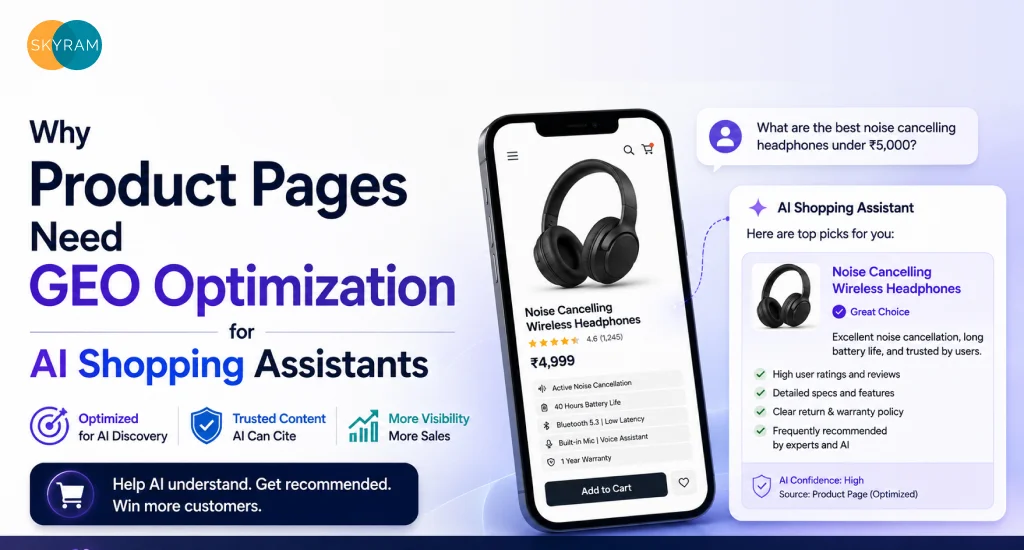
Why Product Pages Need GEO Optimization for AI Shopping Assistants

GEO Optimization for AI Shopping Assistants

Something changed in how US shoppers find products. A growing share of buyers no longer open Google and scan a list of links. They ask ChatGPT what the best option is for their situation, and they get a direct answer with a recommendation and a reason. They ask Perplexity to compare two products and get a structured breakdown pulled from across the web. They let Google’s AI Overviews summarize the top-rated options in a category, and they act on that summary rather than clicking through to individual pages.

Product pages need GEO optimization for AI shopping assistants because tools like ChatGPT’s shopping features, Google’s AI Overviews for product queries, and emerging AI-powered comparison agents pull structured product data, specification clarity, and review sentiment to generate purchase recommendations. Product pages without clean structured data and clearly extractable specifications risk being excluded from AI-generated shopping recommendations entirely.

This post is the early-mover guide for e-commerce directors and CMOs who want to prepare their product catalog for AI-driven discovery before the shift reaches full mainstream adoption. The brands that get this right in 2026 will be the ones with an entrenched citation advantage when AI shopping behavior becomes the default for their category.

How AI Shopping Assistants Generate Product Recommendations

Understanding the mechanics behind AI product recommendations is the first requirement for optimizing against them. These systems do not browse your store the way a human does. They extract structured signals from specific sources, weight them against user intent, and generate a recommendation based on what the data supports.

Structured Product Data as the Primary Input

AI shopping assistants, whether native to ChatGPT, embedded in Google’s AI Overviews, or built into emerging comparison agents, pull product information from three primary sources. The first is structured data embedded in the page itself: Product schema markup that declares price, availability, brand, GTIN, and aggregate rating in a format machines can read without interpretation. The second is indexed page content, where the AI’s underlying model or retrieval layer reads the visible text on a product page to extract specifications, materials, dimensions, compatibility, and use case information. The third is aggregated third-party data, including merchant feeds submitted to Google Merchant Center, product listings on major platforms, and review aggregators.

Pages that serve all three of these input types cleanly get processed and recommended with high confidence. Pages that serve only one or two, perhaps they have rich visible content but missing or malformed Product schema, create gaps that push the AI system toward a competitor with better-structured data. In a category where ten brands sell comparable products, the AI assistant will recommend the brands whose pages are most structured and most interpretable, not necessarily the brands with the best products.

The practical implication is that generative engine optimization for product pages is not primarily a content quality problem. It is a data architecture problem. Your product page may be beautifully written and visually compelling, and still invisible to AI shopping tools because the underlying structured data is incomplete.

Review Sentiment and Rating Aggregation in AI Recommendation Logic

AI shopping assistants weight review sentiment as heavily as specification data when generating recommendations. This is by design. The buyer who asks ChatGPT “what’s the best [category] for [use case]?” is asking for a judgment, not just a product listing. The AI uses review signals to form that judgment.

The signals that matter most are not simply star ratings. Aggregate rating displayed in Product schema, review count, and the recency of reviews all contribute. But AI systems with retrieval capabilities also process the content of reviews, pulling out recurring phrases that appear in multiple reviews for the same product: “durable,” “runs small,” “excellent customer service,” “difficult to assemble.” These thematic signals inform the qualitative summary the AI generates alongside the product recommendation.

This creates a specific optimization challenge. A product page that carries a 4.8-star average across six reviews is less reliable as an AI recommendation source than a product page with a 4.5-star average across 340 reviews. Volume and recency generate confidence. Brands that have actively managed their review ecosystem on both their own site and on platform retailers are better positioned for AI shopping recommendation inclusion than brands where review generation has been passive.

Key Takeaway: AI shopping assistants treat structured product data and review signals as the two primary recommendation inputs. Pages that serve both cleanly, with complete Product schema and robust, recent review data, get included in AI recommendations at significantly higher rates than pages missing either signal.

The Product Page Elements AI Shopping Assistants Depend On

Knowing which specific page elements AI tools actually process sets the optimization priority list. There are three that matter most, and most product pages in the US market are underoptimized on at least two of them.

Product Schema Markup: Price, Availability, Specifications, Reviews

Product schema implemented in JSON-LD is the single highest-impact technical change available for AI shopping readiness. The schema type and its properties give AI extraction systems a pre-labeled data map of your product page. Without it, the AI has to infer product data from unstructured page content, which introduces ambiguity and reduces confidence in the extracted information.

The properties that drive AI shopping recommendation inclusion are price (with currency), availability (in stock, out of stock, preorder), brand, name, description, aggregateRating with ratingValue and reviewCount, and product identifiers including GTIN, MPN, or SKU. Each missing property is a gap in the signal chain. AI systems that encounter a product schema block missing aggregateRating will either omit review context from their recommendation or pull rating data from a less reliable source, introducing potential inaccuracies that reflect poorly on your brand.

Beyond the core Product schema, Offer schema with price and availability data at the variant level helps AI tools handle products with multiple sizes, colors, or configurations accurately. Without offer-level schema, an AI tool may recommend your product and cite a price that applies to only one variant, creating a misaligned expectation for the buyer.

Clear, Comparable Specification Formatting

AI shopping assistants generate comparison answers. When a buyer asks “compare [Product A] vs [Product B],” the AI draws from the specification data on each product page and places it side by side. Pages where specifications are embedded in prose paragraphs, locked inside JavaScript-rendered tables, or inconsistently formatted across a product catalog make this extraction unreliable.

The format that AI tools extract most consistently is a clearly labeled specification table: a simple HTML table with attribute names in the left column and values in the right column, rendered in the page’s static HTML rather than loaded dynamically through JavaScript. Attributes like dimensions, weight, material, compatibility, power requirements, warranty duration, and certifications should be present in a consistent structure across every product in a category. When the attribute names and structure are consistent, an AI tool can compare products across your catalog accurately. When they differ from product to product, comparison queries return incomplete or mismatched data.

This matters beyond just AI shopping tools. The SEO services fundamentals that make specification tables crawlable and indexable by traditional search engines are the same fundamentals that make them extractable by AI. Clean HTML structure, stable URL architecture, and fast-loading pages contribute to both.

Review Volume and Sentiment Consistency Across Platforms

AI tools that use retrieval to supplement their training data pull review signals from multiple sources simultaneously. A buyer researching a product on ChatGPT may receive a recommendation synthesized from product page reviews, retailer platform reviews, and editorial review content from third-party sites. This means a product page with excellent on-site reviews but poor or thin reviews on Amazon or major retailer platforms can receive a mixed or lower-confidence AI recommendation.

Review consistency across platforms is a signal that most e-commerce teams have not yet tracked as a GEO optimization variable. The question to ask is whether the sentiment and volume picture is consistent across your own site, your retailer platform presence, and the third-party review sites that AI tools prioritize when generating synthesis. Significant divergence between platforms, for example a 4.7 on your site and a 3.2 on a major retailer, creates contradictory signals that lower AI recommendation confidence.

Key Takeaway: Product schema completeness, specification table structure, and cross-platform review consistency are the three mechanical pillars of AI shopping readiness. Most product pages have meaningful gaps in at least one of these areas, and addressing them before competitors do represents a genuine first-mover advantage.

Comparison Table: Standard Product Page vs. AI-Shopping-Optimized Product Page

Page Element Standard Product Page AI-Shopping-Optimized Product Page
Schema markup Basic Product schema or none Full Product + Offer schema: price, availability, GTIN, aggregateRating, reviewCount
Specification format Prose description or inconsistent formatting Static HTML specification table, consistent attribute labels across catalog
Review signals On-site reviews only On-site reviews plus cross-platform review management; recent, high-volume, sentiment-consistent
Comparison content Features list or bullet points Side-by-side spec tables with direct competitor comparison language
Use-case framing Generic product description Specific use-case scenarios matching buyer intent queries
Price and availability Visible on page In Product schema and Offer schema at variant level
Image alt text Basic or missing Keyword-rich alt text describing product from specification angle
Page loading method JS-rendered specification tables Static HTML tables crawlable by bots without JavaScript execution

Building Comparison-Ready Product Content

The second layer of GEO optimization for product pages goes beyond schema and specification structure. It addresses how the content itself is written and framed to match the way AI shopping assistants answer buyer questions.

Specification Tables Formatted for AI Extraction

The specification table is the most citation-friendly content element on a product page. When an AI shopping assistant is asked to compare products, it looks for a structured data surface it can parse directly, and a well-formatted HTML specification table is exactly that surface.

Building comparison-ready specification tables means standardizing attribute names across your entire product catalog, not just within a single product. If one product lists “weight” and another lists “product weight” and a third lists “net weight,” an AI comparison engine will struggle to align the attributes across products. The attribute name must be identical and the value must follow a consistent format, including units, across every product in the category.

For categories where buyers routinely make comparisons, build a dedicated comparison table directly into the product page content, not just into a separate comparison tool. A product page for a Bluetooth speaker that includes a table comparing it against two competitor models on five to seven key attributes, using publicly available specifications, gives AI tools a structured, already-synthesized comparison surface. This dramatically increases the likelihood that the page content gets cited when a buyer asks a comparison question that includes your product.

Use-Case Framing That Helps AI Assistants Match Products to Buyer Intent

The largest gap between standard product pages and AI-optimized product pages is use-case framing. Most product pages describe what a product is. AI shopping assistants answer questions about what a product is best for, what kind of buyer it suits, and whether it fits a specific situation. Those two things require different content.

A standard power bank product page describes capacity, charging speed, dimensions, and compatibility. An AI-optimized version of the same page includes a section that explicitly frames the product for specific use cases: “suited for travelers who need to charge a laptop plus two phones overnight,” “optimal for day hikers who want to charge a GPS device and phone without adding more than 200 grams to pack weight.” These framed use-case statements match the natural language query patterns buyers use with AI tools. When ChatGPT receives “what’s the best power bank for backpacking with a laptop,” it looks for content that explicitly addresses that scenario. Generic specification content rarely surfaces as the cited source for those queries.

Apply this logic to every high-priority product in your catalog. Identify the three to five most common buyer intent scenarios for the product, and write one paragraph per scenario that describes the product through that lens. This content serves double duty: it improves the page for human readers who identify with a specific use case, and it creates the structured, intent-matched content surfaces that AI shopping tools extract when answering buyer questions. This is where AI content optimization services produce the most direct and measurable lift for e-commerce catalog pages.

Key Takeaway: Specification tables with consistent attribute naming across your catalog, and use-case framing that explicitly addresses the buyer intent scenarios your customers actually use, are the two content-layer changes that move the needle most for AI shopping recommendation inclusion.

How to Audit Your Product Catalog for AI Shopping Readiness

An AI shopping readiness audit gives you a prioritized action list rather than a vague sense that optimization is needed. Run it across your top 50 to 100 highest-revenue product pages first, then extend across the full catalog.

The audit covers six checkpoints for each product page.

First, validate your Product schema using Google’s Rich Results Test. Confirm that name, description, image, brand, offers with price and priceCurrency and availability, and aggregateRating with ratingValue and reviewCount are all present and error-free. Any property flagged as missing or malformed is a priority fix.

Second, check specification formatting. Open the product page with JavaScript disabled in your browser. If the specification table disappears or becomes unreadable, it is rendered dynamically and cannot be extracted by AI tools or crawlers that do not execute JavaScript. Static HTML rendering is required.

Third, audit specification attribute consistency. Pull the specification data for ten products in the same category and check whether the same attribute appears under the same label across all ten. Any inconsistency in naming convention reduces AI comparison accuracy for that attribute.

Fourth, review your on-site review volume and recency. Products with fewer than 20 reviews or with no reviews posted in the past 90 days are lower-confidence AI recommendation candidates than products with active, recent review streams. Identify products that need a review-generation push.

Fifth, check cross-platform review alignment. Search your top product names on the retailer platforms and review sites your category buyers use. Compare aggregate ratings across platforms. A divergence of more than one full star between your own site and a major platform is a signal worth investigating.

Sixth, search for your top products in ChatGPT and Perplexity using the buyer intent queries most common in your category. Record which products appear, which competitors are cited, and what specification data the AI summary includes. This manual step reveals which pages the AI tools are already extracting from and which pages are absent from the recommendation set. For a fuller picture of how AEO services apply to structured content auditing more broadly, the same extraction-readiness logic extends from product pages to every content type on an e-commerce site.

The audit output is a prioritized action list across three tiers: schema fixes that can be implemented in days, specification table restructuring that requires engineering coordination, and content additions, including use-case sections and comparison tables, that require content production capacity. Work through them in that order.

Key Takeaway: A six-point readiness audit run on your highest-revenue product pages produces a concrete, prioritized action list rather than a general optimization mandate. Schema validation and JavaScript rendering checks come first because they are binary, high-impact fixes that unblock everything else.

What Early Data Shows About AI-Driven Shopping Referral Behavior

The measurement infrastructure for AI shopping referral is still developing, but the early behavioral patterns from 2025 and 2026 contain signals worth building strategy around now.

Referral sessions from AI shopping platforms, including Perplexity, Bing Copilot, and ChatGPT with browsing, show consistent behavioral differences from traditional organic traffic. Session depth is higher. Users arriving from an AI shopping recommendation visit more product pages per session than users arriving from a traditional Google search result. This pattern makes sense: the AI recommendation arrives with context, so the buyer already understands the product category and is in evaluation mode rather than discovery mode. They are comparing the recommended product against alternatives, not starting from scratch.

Conversion intent is higher, but conversion rates do not always reflect that intent immediately. AI-influenced shopping research often results in a delayed purchase rather than a session-level conversion. A buyer who receives an AI recommendation may visit the product page, evaluate it, and return directly or through a branded search two to four days later to complete the purchase. This delayed attribution pattern is the same one that makes AEO and GEO investment difficult to measure with standard last-click analytics, and it has a direct counterpart in AI-driven e-commerce.

The practical implication for e-commerce teams is that AI shopping referral traffic should be segmented and tracked separately from traditional organic, with session quality metrics, including pages per session, scroll depth, and product page views per session, weighted alongside conversion rate. High session quality from a low-conversion segment is a leading indicator of AI-influenced purchasing intent that completes through a different attribution path.

Understanding how this referral behavior connects to the full GEO vs SEO comparison is useful context for e-commerce teams building the internal business case for GEO investment alongside their existing SEO program. The two disciplines are complementary, not competing, and the product page is the surface where they converge most directly.

Key Takeaway: AI shopping referral sessions show higher engagement depth than traditional organic sessions. Conversion attribution is delayed, often completing through branded search two to four days after the initial AI-referred visit. Measuring session quality rather than session-level conversion rate gives a more accurate picture of AI shopping referral value.

Frequently Asked Questions

1: What is GEO optimization for product pages, and why does it matter for e-commerce brands?

GEO optimization for product pages is the practice of structuring e-commerce product data, schema markup, specification content, and review signals so that AI-powered shopping assistants can accurately extract, synthesize, and cite the product in AI-generated purchase recommendations. It matters for e-commerce brands because tools like ChatGPT’s shopping features, Google’s AI Overviews for product queries, and Perplexity generate product recommendations based on structured data quality and specification clarity rather than traditional ranking signals. Product pages without complete Product schema, static HTML specification tables, and robust cross-platform review signals are systematically excluded from these AI-generated recommendations, regardless of their traditional organic search performance.

2: What product schema properties are most important for AI shopping assistant inclusion?

The Product schema properties most critical for AI shopping assistant inclusion are name, description, brand, offers (with price, priceCurrency, and availability), aggregateRating (with ratingValue and reviewCount), and product identifiers including GTIN or MPN. These properties give AI extraction systems a pre-labeled data map of the product so the recommendation can be generated with high confidence and accuracy. Missing aggregateRating causes the AI to omit review sentiment from its recommendation or pull data from less reliable sources. Missing offers data prevents accurate price citation, which reduces the utility of the recommendation for the buyer. All schema should be implemented in JSON-LD and validated using Google’s Rich Results Test before deployment.

3: How do AI shopping assistants compare products, and how should brands optimize for comparison queries?

AI shopping assistants generate comparison responses by extracting specification data from multiple product pages simultaneously and aligning comparable attributes in a side-by-side synthesis. To optimize for comparison queries, brands need consistent specification attribute naming across their entire product catalog (so “weight,” not “product weight” on one page and “net weight” on another), static HTML specification tables that render without JavaScript execution, and dedicated comparison content on high-priority product pages that directly addresses the most common comparison scenarios buyers use in AI queries. Brands that publish a structured comparison table on the product page itself, comparing the product against key alternatives using publicly available specifications, provide AI tools with a pre-synthesized comparison surface that is significantly more likely to be cited than prose-based product descriptions.

4: Does review volume on retailer platforms affect whether a product appears in AI shopping recommendations?

Yes, review volume and consistency across retailer platforms significantly affects AI shopping recommendation inclusion. AI tools with retrieval capabilities synthesize review signals from multiple sources simultaneously, including the brand’s own site, major retailer platforms, and editorial review content. A product with strong on-site reviews but thin or negative reviews on major retail platforms receives a mixed signal profile that reduces AI recommendation confidence. E-commerce brands should treat review generation and cross-platform review management as a GEO optimization variable, not just a conversion rate variable. Products that need to appear consistently in AI shopping recommendations need active, recent review activity on both owned properties and the major retailer platforms where AI tools index review data.

5: How do e-commerce brands measure whether GEO optimization is improving AI shopping visibility?

E-commerce brands measure GEO optimization impact on AI shopping visibility using a combination of manual citation audits, analytics segmentation, and structured data validation. Manual citation audits involve running the top buyer intent queries in your product category through ChatGPT, Perplexity, and Google with AI Overviews enabled on a monthly basis, recording which products and brands are cited in recommendations. Analytics segmentation involves creating a dedicated channel group in GA4 for referral traffic from AI platform domains, including perplexity.ai and bing.com/chat, and tracking session quality metrics separately. Structured data validation involves running product pages through Google’s Rich Results Test and Search Console to confirm schema is error-free and being processed correctly. Together, these three measurement streams give e-commerce teams a credible early-stage picture of AI shopping visibility improvement without requiring third-party tools that do not yet cover all AI shopping platforms comprehensively.

Talk to Skyram About E-Commerce GEO and Product Page Optimization

The window for first-mover advantage in AI shopping optimization is open now. The brands that complete product schema audits, restructure specification tables for machine readability, and build use-case framing into their top-revenue pages in 2026 will have an entrenched citation advantage by the time AI-assisted shopping becomes the default behavior in their category.

Skyram Technologies works with US e-commerce teams to audit product catalog GEO readiness, identify schema gaps and specification formatting issues across high-priority pages, and implement the structured content changes that drive AI shopping recommendation inclusion. The engagement starts with a catalog audit that tells you exactly where your pages stand against the six readiness checkpoints, which pages have the highest recommendation potential, and what changes would unlock that potential fastest.

If your e-commerce development roadmap does not yet include a GEO readiness layer, the time to add it is before your competitors do.

Book a consultation with the Skyram team to start with a product page GEO audit scoped to your highest-revenue catalog pages.
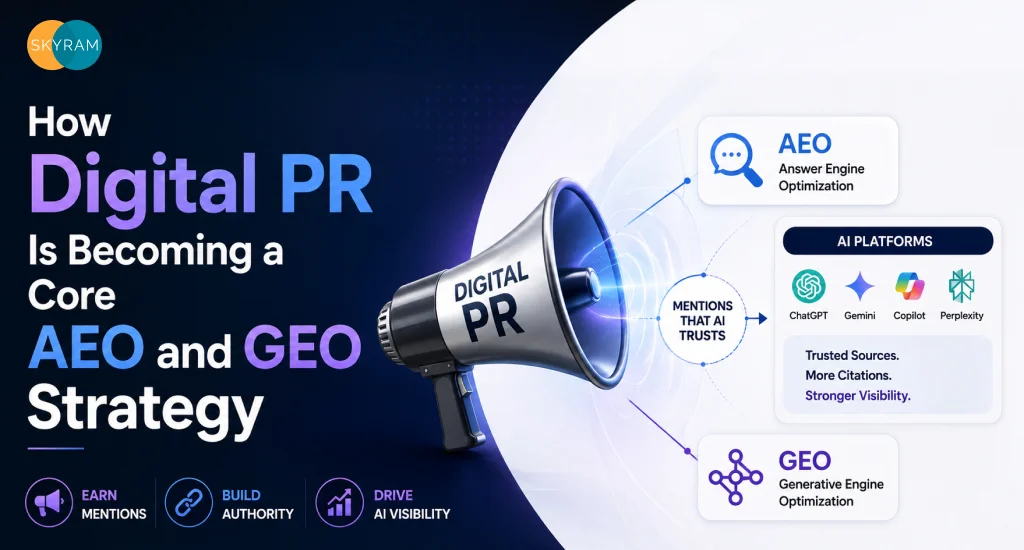
How Digital PR Is Becoming a Core AEO and GEO Strategy

How Digital PR Is Becoming a Core AEO and GEO Strategy

Digital PR is becoming a core AEO and GEO strategy because AI systems weigh third-party mentions, authoritative publication citations, and cross-source corroboration heavily when determining which brands to cite. Traditional link building focused primarily on domain authority for ranking purposes. GEO-focused digital PR focuses on building the kind of distributed, authoritative brand presence that AI systems recognize as trustworthy across multiple independent sources.

For most of the last decade, digital PR and technical SEO sat in separate departments, ran on separate budgets, and answered to separate metrics. PR chased media placements and brand awareness. SEO chased rankings and organic traffic. The two teams coordinated occasionally, usually around a product launch, but they rarely shared a single measurement framework.

AI search has collapsed that separation. When ChatGPT, Perplexity, or Google AI Overviews decide which brand to cite in response to a buyer’s question, they are not just reading your website. They are cross-referencing what independent, credible sources say about you across the open web. A brand with a technically flawless website and zero third-party validation looks thin to an AI system compared to a brand with moderate on-site optimization and consistent, corroborated coverage across trade publications, industry analysts, and expert commentary.

This is the strategic case for treating digital PR as core AEO and GEO infrastructure, not a separate workstream that happens to produce backlinks as a side effect.

Why AI Systems Weight Third-Party Mentions So Heavily

Large language models are trained to be skeptical of self-description. Every brand’s own website says the brand is the best, the most trusted, the industry leader. AI systems have learned, correctly, that owned content is inherently biased. What they cannot easily fabricate or game as consistently is a pattern of independent sources describing the same brand the same way.

Cross-source corroboration as a trust signal

When a claim about your company appears on your own site, an AI system treats it as one data point from an interested party. When the same claim, or a closely related one, also appears in a trade publication, an analyst report, and a journalist’s article, the AI system treats that as corroborated fact. This is the mechanism behind cross-source corroboration, and it functions similarly to how a human researcher would triangulate a claim before trusting it.

For a CMO building an AEO and GEO strategy, this means the goal is no longer just ranking your own content. The goal is engineering a distributed footprint of independent mentions that all point toward the same core facts about your brand: what you do, who you serve, and why you are credible in your category.

The difference between owned content authority and earned mention authority

Owned content authority is what your website says about itself. It is fully within your control, fully optimized, and fully suspect from an AI system’s perspective because you wrote it. Earned mention authority is what other credible sources say about you without your direct editorial control. It carries more weight precisely because it is harder to manufacture.

A single strong owned page on AEO services tells an AI system what you claim about your own capability. A journalist citing your CEO as a source on an industry trend, or a trade publication referencing your original research, tells the AI system that a third party independently found you credible enough to include. Both matter. Only one scales into cross-source trust.

Key Takeaway: AI citation behavior depends on triangulating claims across independent sources. Owned content establishes what you say about yourself. Earned digital PR mentions establish that others believe it too, and that second signal is what AI systems weight more heavily when deciding who to cite.

The Digital PR Tactics That Directly Support AI Citation

Not every PR tactic produces GEO value at the same rate. Some tactics are built almost entirely around traditional link equity and brand awareness, with AI citation as an incidental benefit. Others are structured specifically to generate the kind of corroborated, quotable, citable content that AI systems extract and reuse.

Original research and data-driven press outreach

Original research is the single highest-leverage digital PR asset for GEO. When your company publishes a proprietary survey, benchmark study, or dataset, and that data gets picked up by trade publications, you create a citation trail that AI systems can trace back to a primary source. This is different from a generic thought leadership article, because original data creates something no other source can replicate: the actual numbers.

AI systems favor content with specific, sourced statistics over vague generalizations. A press release built around “78 percent of mid-market SaaS companies report difficulty measuring AI search visibility” generates far more downstream citation potential than a press release announcing a product feature, because the statistic itself becomes reusable, quotable, and independently verifiable across every publication that covers it.

Expert commentary and journalist source relationships

Building relationships with journalists and industry publications so that your executives become go-to sources for commentary creates a recurring citation pattern rather than a one-time spike. Services like HARO successor platforms, direct journalist outreach, and ongoing relationships with beat reporters in your category generate a steady drip of earned mentions over time.

This matters for GEO because AI systems do not just look for one strong mention. They look for consistency over time. An executive quoted once in a major publication is a data point. An executive quoted repeatedly across multiple publications over a year builds the kind of sustained authority signal that shows up when an AI system is evaluating source credibility for a query in your category.

Industry publication guest content and citation building

Contributing bylined articles to respected industry publications serves a dual purpose. It places your brand’s expertise in a venue the AI system already trusts as an authoritative source in your category, and it typically includes a natural citation or link back to your site. The publication’s existing domain trust transfers some credibility to the claims you make, which is a different mechanism than backlink equity in traditional SEO.

The strongest guest content for GEO purposes answers a specific, well-defined question definitively, in a format the AI system can extract cleanly. A generic “trends to watch” article performs worse than a piece that stakes out a clear, well-supported position on a specific industry question, because the clear position is what gets pulled into a synthesized AI answer.

Comparison Table: Traditional Digital PR Goals vs. GEO-Focused Digital PR Goals

Dimension Traditional Digital PR Goals GEO-Focused Digital PR Goals
Primary Metric Backlink volume and domain authority Citation reinforcement across independent sources
Coverage Type One-time announcement placements Recurring expert commentary and sustained presence
Content Format General thought leadership Data-driven, quotable, specific claims
Success Signal Referral traffic and link equity Entity consistency across the open web
Measurement Window Immediate post-placement traffic spike Citation frequency tracked over months
Publication Selection Highest domain authority available Publications AI systems already treat as trusted sources
Story Angle Company news and product updates Original research and category-defining commentary


Key Takeaway: Original research, sustained journalist relationships, and targeted guest contributions outperform generic press placements for GEO purposes because they generate specific, corroborated, and repeatable claims that AI systems can trace across multiple independent sources.

Building a Digital PR Program Aligned to GEO Objectives

A digital PR program built for GEO looks different from a traditional media relations calendar. It prioritizes depth and consistency in a defined set of publications over broad, shallow coverage across dozens of outlets that AI systems may not weight heavily.

Story angles that generate genuine, citable third-party coverage

The strongest story angles for GEO-aligned digital PR share a common trait: they contain a claim specific enough that a journalist can quote it directly without paraphrasing away its precision. Category-defining research, contrarian but well-supported industry positions, and named case studies with measurable outcomes all generate more citable coverage than generic company announcements.

A CMO planning a quarterly PR calendar should map each planned story to a specific query pattern the target buyer might type into an AI system. If a story does not answer a real question a buyer is likely to ask, it is unlikely to generate the kind of citable coverage that supports GEO strategy beyond a short-term traffic spike.

Measuring digital PR impact on AI citation frequency, not just backlink volume

The reporting shift required here is significant. Traditional PR reporting tracks placements, domain authority of the placement, and referral traffic. GEO-aligned PR reporting adds a new layer: tracking how often your brand appears as a cited source when relevant queries are run against ChatGPT, Perplexity, Google AI Overviews, and Gemini.

This requires running a consistent set of category-relevant prompts against each platform on a regular cadence and logging whether your brand appears, how it is described, and which sources the AI system references when it does. A press placement that never gets absorbed into AI citation patterns has traditional SEO value but limited GEO value. A press placement that shows up repeatedly as a cited source across multiple platforms is doing exactly the job digital PR is now being asked to do.

Key Takeaway: Plan digital PR story angles around the specific questions buyers ask AI systems, and measure success through AI citation frequency tracking alongside traditional placement metrics. Backlink volume alone no longer captures the full value of an earned media placement.

How to Prioritize Publications and Platforms for Maximum AI Citation Value

Not every publication carries equal weight with AI systems. Large language models are trained disproportionately on certain categories of source, and understanding which categories your AI systems already trust in your industry changes how you prioritize outreach.

Publications with a long, consistent publishing history in your specific category tend to carry more citation weight than a general business outlet running a one-off feature. Trade publications that AI systems already reference frequently for category-specific queries are worth disproportionate PR investment, even if their general domain authority is lower than a major national outlet. Test this directly: run several category-relevant prompts against Perplexity or ChatGPT and note which publications and source types appear repeatedly in the citations. That pattern tells you where to concentrate outreach effort.

Wikipedia presence, when accurate and properly sourced, functions as a meta-layer of corroboration that AI systems reference heavily, since it aggregates citations from exactly the kind of independent sources digital PR is built to generate. Analyst firms and research organizations carry similar weight, because their citations already sit inside training data as high-trust sources. A digital PR program that earns a genuine analyst mention or a properly sourced reference in an industry-standard resource is investing in a higher-leverage citation than a dozen minor blog mentions.

Skyram Technologies approaches this prioritization by first auditing which sources already appear when a brand’s target queries are run against major AI platforms, then building outreach plans around the specific publications and analyst relationships that show up in those citation patterns rather than defaulting to a generic media list. This diagnostic-first approach matters because the publications that move the needle for AI citation are not always the same ones that generate the most traditional referral traffic, and a program built without checking current citation patterns first tends to waste outreach effort on outlets that AI systems weight lightly in your specific category.

Key Takeaway: Prioritize publications and analyst relationships that already appear in AI citation results for your category’s query patterns, rather than defaulting to general domain authority as the selection criteria. A smaller, well-targeted publication list often outperforms a broad, generic media list for GEO purposes.

Frequently Asked Questions

  1. Is digital PR part of AEO and GEO strategy, or a separate discipline?

Digital PR has become a core component of AEO and GEO strategy because AI systems rely on cross-source corroboration to determine which brands to cite. A brand’s own optimized content establishes what it claims about itself, while digital PR generates the independent, third-party validation that AI systems weight more heavily when assessing credibility. Treating digital PR and AEO or GEO as separate workstreams creates gaps that a combined strategy closes.

  1. How is GEO-focused digital PR different from traditional digital PR?

Traditional digital PR measures success through backlink volume, domain authority, and referral traffic from press placements. GEO-focused digital PR measures success through citation reinforcement and entity consistency, tracking how often and how accurately a brand appears as a cited source when AI platforms respond to relevant buyer queries. The tactics overlap, but the prioritization and reporting frameworks differ significantly.

  1. What type of PR content performs best for AI citation?

Original research with specific, sourced statistics performs best for AI citation because it creates a reusable, quotable data point that multiple publications can reference independently. Expert commentary tied to a clearly defined position, rather than generic trend commentary, also performs well because AI systems extract specific claims more reliably than vague generalizations.

  1. Does digital PR replace traditional SEO link building for AI search visibility?

Digital PR does not replace traditional SEO link building, it complements it within a combined strategy. Traditional link building still supports domain authority and crawler-based ranking signals. Digital PR adds the cross-source corroboration layer that AI systems specifically look for when deciding whether a brand’s claims are independently verified rather than self-reported.

  1. How do I measure whether digital PR is improving my AI citation rate?

Measuring AI citation impact requires running a consistent set of category-relevant prompts against ChatGPT, Perplexity, Google AI Overviews, and Gemini on a regular schedule, then logging whether your brand appears, how it is described, and which sources the AI system cites alongside it. Comparing this citation frequency before and after a digital PR campaign shows whether the coverage is being absorbed into AI-generated answers, which is a different measurement than tracking referral traffic or backlink counts.

  1. How long does it take for digital PR coverage to influence AI citation patterns?

AI citation patterns typically shift over a period of weeks to a few months after sustained digital PR coverage, depending on how frequently the relevant AI platforms crawl and retrain on updated web content. A single placement rarely moves citation patterns on its own. Consistent coverage across multiple credible sources over several months tends to produce a measurable shift in how often a brand appears as a cited source for its core category queries.

Talk to Skyram About Digital PR as Part of Your AEO and GEO Strategy

If your AEO and GEO program is built entirely around on-site content and technical optimization, you are likely missing the cross-source corroboration signal that increasingly determines whether AI systems trust your brand enough to cite it. Digital PR closes that gap, but only when it is planned and measured against citation frequency rather than legacy placement metrics.

Skyram Technologies works with US marketing teams to build AEO and GEO strategies that integrate digital PR as a measured citation-building channel, starting with a diagnostic audit of your current AI citation footprint before recommending outreach targets or story angles.

Book a Strategy Consultation

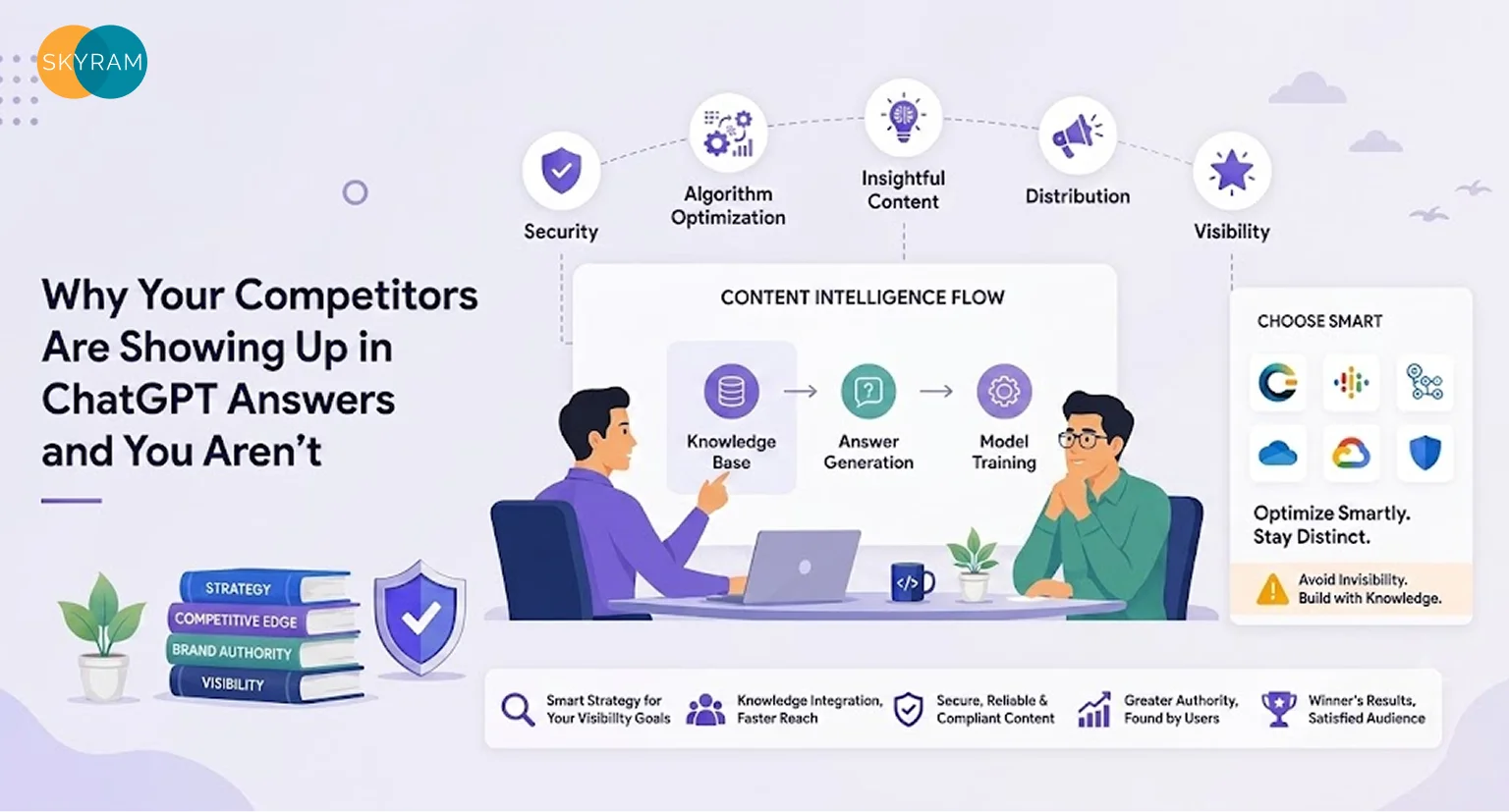
Why Your Competitors Are Showing Up in ChatGPT Answers and You Aren’t

CMO comparing competitor brand citations against their own company's absence in a ChatGPT answer screen

You type a question into ChatGPT that your company should own the answer to. Something like “best managed cloud services for mid-market SaaS” or “top DevOps consulting firms for Series B startups.” The answer comes back clean and confident, complete with named brands. Your competitor is one of them. You are not.

This is not a fluke, and it is not a sign that your product is worse. Competitors appearing in ChatGPT answers while your brand doesn’t typically comes down to three factors: stronger third-party citation presence across authoritative sources, more structurally extractable content on the specific queries buyers are asking, and greater consistency of brand mentions across the web that reinforce entity recognition. Closing this gap requires a competitive AI visibility audit, not just more content production.

For a CMO or marketing director, this is a genuinely uncomfortable problem. Your team might be producing more content than the competitor who keeps showing up. You might have a bigger budget, a better product, and stronger case studies. None of that matters to a large language model that has never been told, in a format it can parse, that you exist as a credible answer to the question being asked. This post walks through exactly why this gap forms, how to diagnose it for your own brand, and what it takes to close it.

The Competitive AI Visibility Audit: Where to Start

Before fixing anything, you need a clear picture of where you currently stand against the competitors who are winning citations. Guessing at this is a waste of time. AI answers change based on exact phrasing, and a general sense that “we’re behind” does not tell your team what to fix first.

Building a Query Set That Reflects Real Buyer Research

Start by writing down the actual questions your buyers type into ChatGPT, Perplexity, or Google before they talk to sales. These are rarely branded searches. They sound like “best [category] for [use case],” “how to choose a [service] provider,” or “[competitor] vs [competitor] for [specific need].” Pull these from your sales team’s discovery calls, your support tickets, and your existing keyword research. Aim for twenty to thirty queries that represent the real decision-making journey, not just the terms your SEO team already ranks for.

This step matters more than it looks. Many marketing teams audit AI visibility using their own branded terms, which tells them nothing, since a branded query almost always returns the brand itself. The queries that matter are the unbranded, comparison, and evaluation-stage questions where competitors are winning the citation and you are not even in the conversation.

Documenting Which Competitors Appear and in What Context

Run each query through ChatGPT, Perplexity, and Google’s AI Overview, and log the results in a simple spreadsheet: which competitor appeared, what specific claim or capability got cited, and which source the AI referenced to support that citation. Patterns emerge quickly. You will likely see the same two or three competitors recurring across multiple queries, and you will likely see the same handful of third-party sources, review sites, or industry publications feeding those citations repeatedly.

This documentation step is the foundation of everything that follows. Without it, you are optimizing based on assumption rather than evidence, and you risk fixing problems that were never actually holding your visibility back.

The Three Most Common Reasons Competitors Win AI Citations

Once you have the audit data in front of you, the pattern usually traces back to one or more of three root causes. Understanding which one applies to your situation determines where your team should spend the next quarter of effort.

Stronger Third-Party Mention Density Across Authoritative Sources

Large language models do not just read your website. They weight what independent, credible sources say about you far more heavily than what you say about yourself. If a competitor has been mentioned in trade publications, cited in industry reports, listed in comparison roundups, or referenced in analyst content, that mention density builds a pattern the model recognizes as a signal of relevance and trust.

A brand with zero or minimal third-party coverage looks, from the model’s perspective, like it may not exist in any meaningful, verifiable way, regardless of how strong the actual product or service is. This is often the single biggest gap for companies that have invested heavily in owned content but have never built a digital PR or earned-mention strategy.

More Extractable Content Structure on the Specific Queries Being Asked

Even when a brand does have decent content addressing a topic, AI systems need to be able to pull a clean, self-contained answer from it. Content buried in long paragraphs without clear structure, content that answers a question only after three paragraphs of preamble, or content that never directly states the answer at all, gets skipped in favor of a competitor’s page that states the answer plainly in the first sentence of a section.

This is a structural problem, not a quality problem. Two companies can have equally accurate information, and the one with better extractability wins the citation almost every time. AI models are pattern-matching for clear question-answer relationships, and content that makes them work harder to find the answer gets deprioritized.

Greater Brand Entity Consistency Across the Web

Entity consistency means your brand name, your core service description, and your positioning statement appear the same way across your website, your social profiles, your directory listings, your press mentions, and any third-party content about you. When these descriptions conflict, or when your brand shows up under slightly different names or unclear categorization across the web, AI models have a harder time confidently identifying you as a coherent, citable entity for a given query category.

Competitors who have kept their entity signals clean and consistent, even unintentionally, get recognized more reliably than brands whose digital footprint is fragmented or inconsistent.

Key Takeaway: The gap between you and a competitor showing up in ChatGPT rarely comes down to a single cause. It is usually a combination of thin third-party mention density, content that buries the answer instead of leading with it, and inconsistent entity signals across your digital footprint. A proper audit tells you which of the three is doing the most damage in your specific case.

Comparison Table: Your Current AI Visibility Profile vs. Competitor AI Visibility Profile

Audit Dimension Your Current Profile Competitor Profile Winning Citations
Third-party mentions on target topics Sparse or none, mostly owned content Multiple mentions across trade sites, reviews, or press
Content answer structure Answer buried in paragraph three or later Direct answer in first forty to sixty words of the section
FAQ presence on key pages Missing or generic Present, self-contained, matches real query phrasing
Entity name and description consistency Varies across site, listings, and social Consistent name, description, and category across the web
Schema markup on relevant pages Minimal or absent FAQPage, Article, and Organization schema implemented
Citation frequency across query set Zero to one out of twenty test queries Five or more out of twenty test queries

How to Close the Citation Gap

Once you know which of the three causes is driving your specific gap, the fix follows a fairly predictable sequence. None of it happens overnight, but each piece compounds with the others.

Digital PR and Third-Party Mention Building

If your audit shows thin third-party presence, the priority is earning mentions from credible, relevant sources: trade publications in your industry, comparison and roundup articles, guest contributions to respected outlets, and analyst or research citations where applicable. This is not the same as traditional link building focused purely on domain authority. The goal here is being mentioned by name, in context, on the topics your buyers are actually asking AI systems about.

This work takes longer to show results than content restructuring, typically three to six months before new mentions start feeding into AI training and retrieval patterns in a measurable way. Start it early, because it compounds.

Content Restructuring for Extractability on Contested Queries

For the queries where a competitor is winning and you have relevant content but poor structure, the fix is rewriting for extractability rather than starting from scratch. Move the direct answer to the first sentence of each section. Add a genuinely useful FAQ section with questions phrased the way real buyers phrase them, and answers that stand alone without requiring the reader to have read the rest of the page. Implement FAQPage and Article schema so AI crawlers can classify the content type before parsing a single sentence.

Skyram Technologies applies this exact framework across client content audits: every priority page gets evaluated against the specific query set the client’s buyers are actually using, not a generic keyword list, because generic optimization rarely closes a competitor-specific citation gap.

Entity Consistency Cleanup Across Your Web Presence

Audit every place your brand name, description, and category appear: your website, your Google Business Profile, your social bios, your directory listings, and any bylines or press mentions you control. Standardize the wording. This sounds minor, but inconsistent entity signals are one of the more common, and more overlooked, reasons a technically strong brand still underperforms in AI citation frequency compared to a competitor with a cleaner, simpler footprint.

Key Takeaway: Closing the citation gap requires work across three fronts simultaneously: earning third-party mentions, restructuring content for extraction, and cleaning up entity consistency. Teams that only fix one of the three usually see partial, disappointing movement, because AI citation likelihood is a compounding function of all three signals together.

How Long It Takes to See Movement After Closing the Gap

Realistic timelines matter here, because AI visibility work does not behave like a paid campaign with next-day results. Content restructuring on pages that are already indexed and getting some traffic can show citation improvement within four to eight weeks. Digital PR and third-party mention building typically takes three to six months before the new mentions have been crawled, indexed, and factored into how models retrieve and rank sources for your target queries. Entity consistency cleanup tends to show the fastest, though often the least dramatic, improvement, usually within a few weeks of the changes propagating across search engines and AI retrieval systems.

Brands that treat this as a one-time project rather than an ongoing practice tend to see an initial lift followed by stagnation, because competitors are not standing still either. The companies making consistent gains are the ones running this as a continuous cycle: audit, fix, remeasure, adjust.

Monitoring Competitive AI Visibility on an Ongoing Basis

AI visibility is not a set-and-forget metric. Model behavior shifts, competitors publish new content, and third-party coverage changes month to month. Rerun your core query set on a monthly or quarterly cadence and track three things consistently: which brands appear for each query, what specific claims get cited, and which sources are feeding those citations.

Set up a simple internal dashboard, even a shared spreadsheet that works at first, that tracks citation frequency over time rather than a single snapshot. A one-time audit tells you where you stand today. Ongoing monitoring shows whether your investment is moving the needle and surfaces new competitors entering the citation pool before they become entrenched.

Running your own free check is a fast way to get a baseline before committing to a larger program. You can check your AI visibility now to see where your brand currently stands against the query set your buyers are actually using.

Key Takeaway: Competitive AI visibility is a moving target, not a fixed report. Building a recurring monitoring cadence into your marketing operations is what separates brands that close the gap permanently from brands that see a temporary bump and slide back within a quarter.

Frequently Asked Questions

  1. Why is my competitor showing up in ChatGPT answers when my company isn’t?

A competitor typically appears in ChatGPT answers because they have stronger third-party mention density across credible sources, content structured to directly answer the specific query being asked, and more consistent brand entity signals across the web. ChatGPT and similar AI systems favor sources they can confidently identify and extract a clear answer from, so a brand with thin external coverage or poorly structured content gets skipped even if its underlying product or service is comparable or stronger.

  1. How do I check if my brand shows up in AI search results?

Test a set of twenty to thirty real buyer queries, including comparison and evaluation-stage questions, directly in ChatGPT, Perplexity, and Google’s AI Overview, and record which brands appear for each one. A single branded search of your own company name will not reveal the gap, since AI systems typically return the brand itself for a direct name search. The meaningful test uses the unbranded, category-level questions your prospects actually ask before they know which vendor they will choose.

  1. What is a competitive AI visibility audit?

A competitive AI visibility audit is a structured process that tests a defined set of buyer-intent queries across major AI platforms, documents which competitors are cited and why, and identifies the specific gaps in third-party mentions, content structure, and entity consistency that explain the difference. It produces a prioritized action plan rather than a general observation that visibility is low, which makes it possible to fix the specific causes instead of guessing at broad content production.

  1. Does publishing more blog content fix an AI visibility gap with competitors?

Publishing more content alone rarely closes an AI visibility gap if the underlying causes are third-party mention scarcity or poor content structure, since additional volume does not address either issue. Content that is not restructured for direct, extractable answers, and that is not supported by external credibility signals, tends to underperform in AI citation frequency regardless of how much of it exists. Volume helps only once the structural and authority gaps have been addressed.

  1. How long does it take to start appearing in ChatGPT answers after fixing these issues?

Content restructuring on already-indexed pages can produce citation improvement within four to eight weeks, while earning new third-party mentions through digital PR typically takes three to six months before those mentions are crawled and factored into AI retrieval patterns. Entity consistency cleanup tends to show results the fastest, often within a few weeks, though the effect is usually smaller on its own compared to combining it with the other two fixes.

Ready to Close the Gap With Your Competitors?

If your competitors keep showing up in ChatGPT and Perplexity answers while your brand stays invisible, the fix starts with knowing exactly why, not with producing more content and hoping it works. Skyram Technologies runs competitive AI visibility audits that test your real buyer queries against your top competitors, then builds a prioritized plan across digital PR, content restructuring, and entity consistency to close the specific gap your audit reveals.

Talk to Skyram Technologies about closing your competitive AI visibility gap, or explore how our answer engine optimization and generative engine optimization services fit into a broader search engine optimization strategy built to earn AI citations, not just rankings.

How to Track Your Brand’s AI Citation Footprint Across ChatGPT, Perplexity, and Gemini

Marketing Director reviewing AI citation tracking dashboard showing brand visibility across ChatGPT, Perplexity, and Gemini

Most marketing teams have decade-deep infrastructure for tracking search rankings. They have rank trackers, SERP monitors, keyword dashboards, and weekly position reports that arrive automatically. Ask those same teams whether their brand appeared in a ChatGPT answer yesterday, or how often Perplexity cited their content this month, and the answer is almost always some version of: we don’t actually know.

That gap is getting harder to ignore. Tracking a brand’s AI citation footprint across ChatGPT, Perplexity, and Gemini requires a combination of manual query testing, emerging AI visibility monitoring tools, and referral traffic analysis from AI platforms in web analytics. Unlike traditional rank tracking, AI citation monitoring has no single standardized tool yet, making a structured manual and semi-automated tracking process essential for brands serious about measuring AEO and GEO performance.

This post is the practical measurement framework. It covers why AI citation tracking is structurally harder than traditional rank tracking, how to build a manual testing process that actually surfaces useful data, which monitoring tools are worth considering, how to read AI referral traffic in Google Analytics 4, and how to package everything into a monthly reporting cadence that stakeholders can act on.

Why AI Citation Tracking Is Harder Than Traditional Rank Tracking

No standardized SERP to monitor across AI platforms

Google Search produces a consistent, crawlable results page. A rank tracker can query the SERP, read the positions, and log them automatically. AI platforms produce generated text, not a structured list of ranked URLs. ChatGPT’s answer to a question is a synthesized paragraph that may or may not cite a source. Perplexity typically surfaces inline citations but varies the number and selection by query. Gemini embeds references differently still, and its answer interface continues to evolve. There is no equivalent of a position-one metric that a bot can reliably read and log across all three platforms simultaneously.

This is why building a GEO measurement practice requires a fundamentally different approach than the rank tracking infrastructure most marketing analytics stacks were built around. The measurement layer has to be rebuilt from the ground up.

Personalization and response variability across identical queries

Even without the interface differences, AI citation behavior adds another layer of difficulty: the same query typed on two different accounts, in two different sessions, or at two different times of day can produce different cited sources. Perplexity in particular applies personalization signals that can shift which sources appear, even for identical informational queries. ChatGPT’s browsing behavior varies based on session context. Gemini draws from different source pools depending on user location and account type.

This means a single citation check proves almost nothing on its own. A brand that appeared in one test last Tuesday may not appear in the same test run this Tuesday, and neither result is more “true” than the other. Tracking AI citation presence requires consistent, repeated testing across a defined query set to produce patterns that are actually meaningful.

Key Takeaway: AI citation tracking has no standardized SERP equivalent and no single platform-agnostic monitoring tool, making structured manual testing and documented testing cadence the foundation of any reliable measurement system.

The Manual Query Testing Methodology

Building a query set that reflects real buyer research behavior

Start with the questions your actual buyers type, not the keyword variants from a content brief. B2B buyers asking ChatGPT about vendor selection do not type “best AEO agency.” They type things like “how do I know if my content is showing up in AI answers” or “what should I look for when evaluating a generative search optimization partner.” Build a query set of 20 to 40 prompts that mirror real research behavior at each funnel stage, awareness questions about the category, comparison questions about solution types, and evaluation questions that include brand-specific intent.

Organize prompts into three tiers: core queries that represent your highest-value categories, comparison queries where competitors are likely to appear, and branded queries that test whether your brand surfaces accurately when someone asks about it directly. Run all three tiers every month and keep the query wording consistent across testing cycles so results are comparable over time.

Testing cadence and documentation standards

Weekly testing for a subset of 10 high-priority prompts works well alongside a full 40-query monthly test. Document every test in a shared tracker that logs: the platform tested, the exact prompt, the date and time of the test, whether the brand was cited, how the brand was framed if cited, which competitors appeared instead, and which specific page or URL was attributed if one was shown.

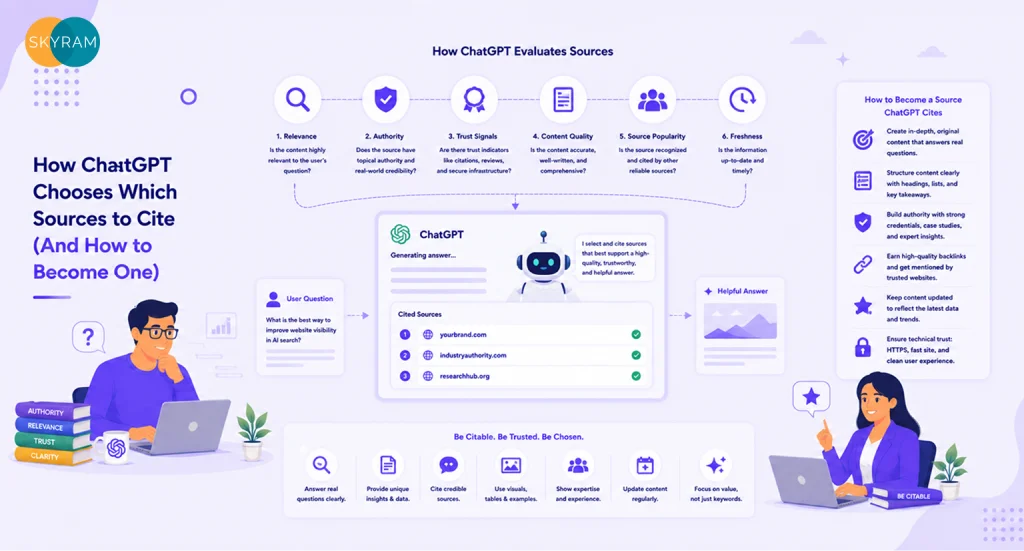
Logging competitor citations alongside your own is as valuable as tracking your own presence. A consistent pattern of a competitor appearing for queries you should own is a content gap signal, not just a competitive observation. The same principle applies to understanding how ChatGPT selects which sources to cite and what content signals give one brand a consistent edge over another.

Tracking citation frequency, position within the answer, and accuracy

Three dimensions matter for each citation event. First, frequency: how often does the brand appear across the full query set, expressed as a citation rate percentage. Second, position: is the brand cited early in the generated answer, as a primary source, or late, as a supplementary mention? Early citations carry more weight because users are more likely to act on information presented first. Third, accuracy: does the AI describe the brand, its services, and its positioning correctly? Inaccurate citations, where the model describes your brand using outdated information or misattributes a competitor’s claim to you, are a separate problem that requires different remediation than low citation frequency.

Key Takeaway: Effective manual testing tracks citation frequency, answer position, and accuracy simultaneously. Frequency alone misses the difference between a primary source citation and a passing mention at the end of a long answer.

Emerging Tools for AI Visibility Monitoring

What current AEO and GEO tracking platforms measure and where they fall short

Several dedicated tools have emerged to automate parts of the manual process above. Platforms like Profound, Otterly.ai, BrightEdge (with its AI Overview module), and SE Ranking’s AI tracking features all run pre-defined prompts across one or more AI platforms, log whether a brand appears, and track share of voice over time. These tools are genuinely useful for teams with large prompt sets that cannot be manually tested at scale.

The current limitations are worth knowing before committing budget. Most platforms cover one or two AI surfaces well and have incomplete or proxy coverage for others. Gemini coverage is notably thinner than ChatGPT and Perplexity coverage across most tools as of mid-2026, partly because Gemini’s answer interface is harder to query programmatically. Cross-platform citation comparison is still imprecise, since different platforms use different citation mechanics, and aggregating a single “share of voice” score across them flattens real differences in what a citation means on each surface.

Cost structures also vary widely. Entry-level plans on dedicated platforms typically start at a few hundred dollars per month for limited prompt sets, scaling significantly as prompt volume and platform coverage expand. For teams with tightly scoped priority queries and straightforward reporting needs, manual testing supplemented by one focused platform tool often produces better actionable data than a comprehensive platform at maximum coverage.

Comparison Table: Manual Tracking vs. Platform-Based AI Visibility Tools

Dimension Manual Query Testing Platform-Based Monitoring Tools
Coverage Any platform you can access Limited to supported platforms per tool
Cost Staff time only Monthly subscription, varies by prompt volume
Reliability Affected by session and personalization variance Automated but also subject to response variance
Data quality High, with proper documentation standards Varies by platform; Gemini coverage weakest
Competitor visibility Manually logged Often built in as a feature
Accuracy tracking Yes, reviewer can assess framing quality No, tools track citation presence not accuracy
Scalability Low, time-intensive beyond 40 prompts High, designed for large prompt libraries
Best fit Teams starting out, or validating tool output Teams with 50-plus queries and reporting at scale


The right answer for most teams is a hybrid: a defined manual testing cadence for priority queries plus a lightweight platform tool to automate coverage of a broader prompt set. Neither approach alone gives the complete picture.

Key Takeaway: No current platform fully automates AI citation tracking across all surfaces with high reliability. Manual testing for priority queries, combined with one focused monitoring tool, gives most B2B marketing teams the strongest signal-to-noise ratio for budget spent.

Using Web Analytics to Detect AI Referral Traffic

Identifying ChatGPT, Perplexity, and Gemini as traffic sources

When an AI platform cites a specific URL and a user clicks through, that click shows up in web analytics as referral traffic. In Google Analytics 4, ChatGPT referral traffic surfaces under the referral source chatgpt.com. Perplexity traffic appears under perplexity.ai. Gemini traffic is more fragmented, often appearing as google.com referral with specific path parameters, or through Android app traffic that requires custom segmentation to isolate.

Setting up a dedicated channel group in GA4 that captures all AI platform referral sources in one view is straightforward and pays dividends immediately. Use a regex condition that includes chatgpt.com, perplexity.ai, gemini.google.com, claude.ai, and copilot.microsoft.com under a single “AI Search” channel label, positioned above the generic Referral channel in your channel groupings so AI traffic does not get absorbed into the broader referral bucket and become invisible.

ChatGPT-originated clicks also sometimes carry a URL parameter utm_source=chatgpt.com that makes attribution cleaner when present. Google AI Overview clicks often append a #text= fragment to the destination URL, which can be used to identify which specific passage was cited and triggered the click. Both are worth monitoring separately if your analytics implementation supports it.

What AI referral traffic patterns reveal about citation quality

Volume from AI platforms tells you that citations are driving clicks, but the behavioral data around those visits tells you far more. If AI referral sessions show a significantly lower bounce rate and longer time-on-page than your average referral traffic, it is a strong signal that the cited content matches what the user expected to find, which means the citation is accurate and relevant. If bounce rates are high and session depth is shallow, the citation may be imprecise, pulling a user to content that does not match what the AI answer implied.

For teams running a full AEO program, AI referral traffic quality is one of the clearest indicators of whether structured content is working. Citation frequency without clicks, or citations that drive clicks that immediately bounce, both suggest the content needs structural attention regardless of how often it appears.

Key Takeaway: AI referral traffic in GA4 measures citation impact, not citation frequency. High session quality from AI sources confirms accurate, well-matched citations. High bounce rates from the same sources signal that cited content is mismatched to what the AI answer implied.

Building a Monthly AI Citation Reporting Framework

A monthly AI citation report that gives stakeholders something to act on covers four sections.

First, citation rate by platform. Express this as a percentage: of the 40 tracked prompts tested this month, the brand appeared in 14 on Perplexity, 8 on ChatGPT, and 5 on Gemini. Report month-over-month change for each platform separately, since performance on each surface moves independently.

Second, competitor citation share. For the same prompt set, which competitors appeared most frequently, and on which platforms? A competitor that consistently outperforms your brand on ChatGPT but not on Perplexity is a signal worth investigating, since it often points to a specific content structure or cross-platform presence difference rather than a general authority gap.

Third, AI referral traffic summary from GA4. Total sessions from the AI Search channel group, broken out by platform, with bounce rate, pages per session, and goal completions for context. Include month-over-month trend.

Fourth, accuracy flags. Any citations from this month’s testing where the brand was described inaccurately, attributed with incorrect information, or associated with a competitor’s claim. These require content remediation prioritized separately from frequency-gap work.

This structure connects what is happening on AI platforms to what is hitting the website, which is the data combination most Marketing Directors and Analytics Leads can present to leadership with confidence. The same reporting discipline that separates strong SEO agency engagements from weak ones applies here: leading indicators that show what is changing before revenue changes, not lagging metrics that only confirm what already happened.

Key Takeaway: A monthly AI citation report should cover citation rate by platform, competitor share for the same prompt set, AI referral traffic with behavioral quality metrics, and accuracy flags. Each section drives a different type of optimization action.

Benchmarking Your Citation Footprint Against Competitors

Benchmarking AI citation presence requires running the same prompt set for competitor brands that you run for your own. This is not about vanity comparison. It reveals which content types and which platforms a competitor has prioritized, which of their pages earn the most citations, and whether they are gaining share of voice in categories where your brand should be the primary source.

The most actionable benchmarking insight is a consistent citation advantage a competitor holds for a specific query cluster. If a competitor appears in 80 percent of product-evaluation queries on Perplexity while your brand appears in 20 percent of the same queries, the gap is probably structural, not authority-based. Look at the content the competitor has that you don’t, the format it uses, whether it is more recently updated, and whether it answers the evaluation question more directly and earlier in the page.

Benchmarking also helps set realistic goals. A brand entering an AI citation program from a low baseline in a competitive category should not expect to match established players across all platforms in 90 days. Setting platform-specific citation rate targets based on current competitor benchmarks, rather than arbitrary percentage goals, produces more credible roadmaps and more honest conversations with leadership about what meaningful progress looks like. Skyram Technologies integrates this kind of baseline-first benchmarking into every AI visibility audit, so the first 30 days of any engagement produce a defensible picture of where the brand stands before content work begins.

Key Takeaway: Competitor benchmarking for AI citations reveals structural gaps, not just share-of-voice differences. A consistent citation advantage a competitor holds for a specific query cluster almost always traces back to a specific content difference that can be addressed.

Frequently Asked Questions

  1. What is AI citation tracking and why does it matter for B2B marketing?

AI citation tracking is the practice of monitoring when and how AI platforms such as ChatGPT, Perplexity, and Gemini reference a brand’s content in their generated answers. For B2B marketing, it matters because buyers increasingly conduct early-stage vendor research through AI tools rather than traditional search, and brands that are not cited in those answers are invisible at exactly the moment shortlists are being formed. Unlike traditional rank tracking, which measures page position in a list of links, AI citation tracking measures whether a brand appears inside the synthesized answer itself.

  1. How do I find ChatGPT, Perplexity, and Gemini traffic in Google Analytics 4?

In Google Analytics 4, ChatGPT referral traffic appears under the session source chatgpt.com. Perplexity traffic appears under perplexity.ai. Gemini traffic is more fragmented and may appear under google.com referral or Android app traffic. The recommended approach is to create a custom channel group in GA4 using a regex filter that captures chatgpt.com, perplexity.ai, gemini.google.com, claude.ai, and copilot.microsoft.com under a single “AI Search” label, positioned above the generic Referral channel so AI traffic is not absorbed into the broader referral bucket.

  1. How often should I run AI citation tests for my brand?

Weekly testing for a core set of 10 high-priority prompts, combined with a full monthly test across 30 to 40 prompts, gives most marketing teams the frequency needed to spot trends without spending disproportionate time on manual testing. Prompt wording should stay consistent across cycles so results are comparable month over month. Response variability across identical queries is normal on all AI platforms, which is why patterns across multiple test cycles matter far more than any single test result.

  1. What tools exist for tracking AI brand citations automatically?

Several platforms now offer automated AI citation monitoring as of 2026, including Profound, Otterly.ai, BrightEdge with its AI Overview module, SE Ranking, and Surfer AI Tracker. Each tracks brand mentions and citation presence across supported AI surfaces, runs prompt sets automatically, and reports share of voice over time. Coverage varies by platform, with ChatGPT and Perplexity generally better supported than Gemini. These tools work best alongside, not instead of, a manual testing cadence for priority queries, since automated tools do not assess citation accuracy or the quality of how a brand is described.

  1. What is share of model and how does it differ from keyword rankings?

Share of model is the percentage of relevant AI-generated answers that include a brand citation, expressed across a defined prompt set. It differs from keyword rankings in a fundamental way: a keyword ranking tells you where a page appeared in a list of links, while share of model tells you whether a brand was included in a synthesized answer that the user may never have clicked away from. A brand can hold a strong keyword ranking and have near-zero share of model if its content is not structured for AI extraction. The two metrics measure different things and require different optimization strategies, which is why a properly structured AI content optimization program treats them as distinct workstreams.

  1. How do I know if my brand is being described inaccurately in AI answers?

Accuracy checks require human review of every citation captured during manual testing. When the brand appears in an AI answer, log not just whether it appeared but how it was described: the services attributed to it, the competitive positioning implied, and any specific claims the model made. Inaccurate citations often stem from outdated training data, inconsistent messaging across a brand’s own web presence, or a competitor’s content that the model conflated with the brand’s positioning. Addressing accuracy issues requires updating source content, strengthening entity clarity through structured data, and ensuring consistent brand messaging across all indexed properties, which overlaps directly with the technical foundation underlying any AEO strategy.

Talk to Skyram About AI Citation Tracking and Reporting

The question is not whether AI citation tracking matters. It already does. The question is whether a marketing team has a process to measure it, report it, and act on it before competitors build a citation advantage that compounds.

Skyram Technologies works with US marketing and analytics teams to establish AI citation baselines, build query testing processes, set up GA4 AI channel attribution, and design monthly reporting frameworks that give leadership a clear picture of where the brand stands across ChatGPT, Perplexity, and Gemini. The starting point is always a structured audit, not a content calendar.

Book a Strategy Consultation

The Content Structure That Gets Extracted by Perplexity vs. Ignored

Content Strategist reviewing Perplexity citation structure and extraction signals on a laptop dashboard

Content strategies built purely around Google no longer guarantee visibility anywhere else that matters. Perplexity pulls from a different retrieval model, weighs different structural signals, and quietly ignores plenty of content that ranks perfectly well on Google. If your team is applying one playbook across every search surface, Perplexity is probably the platform where that playbook is failing quietly, without a ranking drop to alert anyone.

Perplexity extracts content that answers questions in clearly delineated sections with explicit source attribution potential, content using descriptive subheadings, bulleted key points, and definitive statements rather than hedged or exploratory language. Perplexity’s real-time retrieval model favors freshly updated, well-cited content over static pages, making content freshness a stronger ranking signal for Perplexity extraction than for traditional SEO.

This guide is a Perplexity-specific optimization playbook: how its retrieval model actually works, which structural elements it extracts reliably, why freshness carries more weight here than almost anywhere else, and how to test whether your content is showing up at all.

How Perplexity’s Retrieval Model Differs From Google Search

Real-time web retrieval vs. index-based ranking

Google ranks pages against a pre-built index using hundreds of weighted signals, then serves a list of links. Perplexity works closer to a live research assistant. When a query comes in, Perplexity issues search queries in real time, pulls a set of current candidate pages, reads through them, and synthesizes an answer with inline citations pointing back to specific sources. There is no equivalent of a stable “position one” on Perplexity. The sources cited for a given question can shift from one week to the next as the underlying content on the web changes.

This distinction matters practically. A page can hold a strong Google ranking for years on the strength of accumulated backlinks and domain authority, largely undisturbed. A page earning Perplexity citations has to keep proving it deserves that citation every time the model retrieves it, because the comparison set of candidate sources is being rebuilt on the fly rather than pulled from a static index.

Why content freshness carries more weight in Perplexity citations

Because Perplexity retrieves in real time rather than ranking against a fixed index, freshness functions as a much stronger trust signal here than it does in traditional SEO. A page updated last month, with a visible date and current statistics, reads as more reliable to a real-time retrieval system than a page last touched two years ago, even if the older page still holds a strong Google position. Google’s ranking algorithm tolerates static, evergreen content far more comfortably than a retrieval system that is actively trying to determine what is true right now.

This is also where the broader distinction between GEO and traditional SEO becomes concrete rather than theoretical. If you want the fuller comparison of how these two disciplines diverge, we cover it in our breakdown of GEO versus SEO for US search strategy.

Key Takeaway: Perplexity retrieves live rather than ranking against a static index, which is why content freshness functions as a stronger citation signal here than it does for traditional Google rankings.

The Structural Elements Perplexity Extracts Most Reliably

Descriptive H2/H3 subheadings that mirror query phrasing

Perplexity extracts passages, not full pages. A subheading that mirrors the actual phrasing a buyer would type or ask out loud, “How often should cornerstone content be updated,” rather than something vague like “Update Considerations,” gives the retrieval system an obvious match between the query and the section. Generic, clever, or brand-voice-heavy subheadings look good in a content review meeting and perform poorly at extraction time, because they add a translation step the model has to work through before it can confirm relevance.

Getting this right is largely the same discipline behind structuring content the way answer engines expect: question-shaped headings, followed immediately by a direct answer.

Bulleted and numbered lists as extraction-friendly formats

Lists are easier for a retrieval system to lift cleanly than dense paragraphs, because each bullet already represents a self-contained unit of information rather than a sentence that depends on the three sentences around it for context. A comparison of five vendor criteria, a numbered process with clear steps, or a checklist of requirements all extract more reliably than the same information written as flowing prose. This does not mean every section should become a list. It means content strategists should default to list formatting anywhere the underlying information is genuinely enumerable, rather than defaulting to paragraphs out of habit.

Definitive statements over hedged or speculative language

Perplexity tends to favor content that states a position clearly. “Cornerstone content should be refreshed every 60 to 90 days” extracts and cites more readily than “some experts suggest that refreshing content periodically may help maintain relevance,” even when both sentences are conveying roughly the same idea. Hedged language forces a retrieval system to work harder to determine whether a passage is actually asserting something the model can safely attribute to a source. Confident, specific, well-supported claims do that work for the model instead of leaving it to guess.

Comparison Table: Perplexity-Friendly Content Structure vs. Standard Blog Structure

Element Standard Blog Structure Perplexity-Friendly Structure
Heading style Brand-voice or clever phrasing Descriptive, question-shaped phrasing
Answer placement Answer emerges after narrative buildup Direct answer in the first sentence of each section
List usage Occasional, mostly for skimmability Default format for any enumerable information
Claim language Hedged, exploratory, “it depends” framing Definitive statements backed by specifics
Freshness signals Publish date only, rarely revisited Visible update date, refreshed on a fixed cadence
Source citation Minimal or generic attribution Specific data points with named sources
Paragraph length Long, multi-idea paragraphs Short, single-idea paragraphs per passage


This is not a wholesale rewrite of good content practice. It is a shift in priority. Standard SEO fundamentals still determine whether a page gets crawled and indexed at all, but a page can satisfy every traditional SEO checklist item and still get passed over by Perplexity if its structure was never built for a real-time extraction system.


Key Takeaway: Perplexity extracts self-contained, confidently stated passages far more reliably than narrative prose, which means content structure needs to shift toward answer-first sections and enumerable formatting, not just keyword coverage.

Why Update Frequency Matters More for Perplexity Than for Google

How often to refresh cornerstone content for continued citation eligibility

Cornerstone content, the pieces carrying your most important keyword targets and highest lifetime traffic potential, benefits from a refresh cadence closer to once a quarter for Perplexity purposes, tighter than most teams currently apply to their Google-focused evergreen content. This does not mean rewriting the entire piece every ninety days. It means revisiting statistics, confirming claims are still accurate, updating any dated references, and refreshing the visible update timestamp so both readers and retrieval systems can see the content has been actively maintained.

Content teams accustomed to a “publish and revisit annually” cadence for evergreen posts will need a separate, tighter cadence specifically for pieces they want Perplexity to keep citing.

Dating and versioning content for retrieval systems

A visible, accurate “last updated” date does real work here. It signals to both the retrieval system and the human reader that the content reflects current information rather than a snapshot from whenever it was first published. Teams sometimes leave a static publish date even after making substantive updates, which quietly undercuts the freshness signal they just worked to earn. Every meaningful update to a cornerstone page should also update that visible date, not just the underlying content.

Building this kind of update discipline systematically, across a full content calendar rather than a handful of flagship posts, is part of what a unified AI content optimization strategy is built to handle.

Key Takeaway: Cornerstone content aimed at Perplexity citations needs a tighter refresh cadence than most teams currently apply, paired with a visible, accurate update date on every substantive revision.

Testing Your Content’s Perplexity Extraction Rate

Manual query testing methodology

Start with the actual questions your buyers ask, typed directly into Perplexity the way a real prospect would phrase them, not the polished keyword variant from your content brief. Run each query, note whether your content appears as a cited source, which specific passage got extracted if it did, and which competitors or third-party sources are appearing instead. Repeat this across ten to fifteen representative queries for your priority topics, and repeat the full test monthly rather than once, since Perplexity’s live retrieval means results shift as the broader web changes, not just as your own content changes.

What to change when your content isn’t surfacing

When a query consistently surfaces competitors instead of your content, check three things in order. First, confirm the relevant section actually answers the question directly in its opening sentence, rather than building up to the answer. Second, check whether the content has been updated recently enough to compete on freshness against whatever is currently being cited. Third, look at whether the claim in question is stated definitively or hedged into vagueness, since a confidently stated competitor claim will often win the citation over a more accurate but softer one.

For teams that want a structured baseline rather than manual spot-checking across dozens of queries, Skyram’s AI visibility audit maps current extraction performance across Perplexity, ChatGPT, and Google AI Overviews before any content rework begins.

Key Takeaway: Extraction testing works best as a recurring, query-based practice, and the fix almost always traces back to answer placement, freshness, or claim confidence, not a wholesale content rewrite.

Building a Content Calendar Optimized for Perplexity Alongside Google

A content calendar built only for Google publishes, then largely leaves content alone until a ranking drop forces a revisit. A calendar built for Perplexity as well needs a second, tighter track: a refresh cadence for cornerstone content, a monthly query-testing check-in, and a production standard that defaults new content to answer-first structure and definitive language from the first draft, rather than retrofitting it later.

This is also where resourcing questions come up. If a content or SEO partner cannot walk through how they structure content specifically for real-time retrieval systems, not just for Google, that is worth flagging early. The same evaluation instincts apply here as what belongs in any SEO agency evaluation in 2026: ask for a specific methodology, not a general assurance that “we handle AI search too.”

Key Takeaway: A content calendar built for both Google and Perplexity needs a dedicated refresh cadence and query-testing rhythm layered on top of standard publishing, not a single unified schedule stretched to cover both.

Frequently Asked Questions

  1. What content structure does Perplexity extract most reliably?

Perplexity extracts content structured in clearly delineated, self-contained sections that answer a specific question directly in the opening sentence. Descriptive subheadings that mirror natural query phrasing, bulleted or numbered lists for enumerable information, and definitive statements backed by specific data all improve extraction reliability. Content that hedges its claims or buries the answer after several paragraphs of context extracts far less reliably, even when the underlying information is accurate.

  1. Does Perplexity favor fresh content over older, established pages?

Yes. Because Perplexity retrieves information in real time rather than ranking against a fixed index, freshness functions as a stronger trust signal for Perplexity citations than it typically does for traditional Google rankings. A recently updated page with a visible, accurate update date is more likely to be cited than an older page covering the same topic, even if that older page still holds a strong organic search position.

  1. How is optimizing for Perplexity different from optimizing for Google?

Optimizing for Google centers on keyword targeting, backlink authority, and technical crawlability to earn a ranking position within a static index. Optimizing for Perplexity centers on structuring individual passages so a real-time retrieval system can extract and cite them confidently, with heavier weight placed on content freshness, answer-first formatting, and definitive claim language. The two disciplines overlap substantially but are not interchangeable, and content built purely for one can underperform on the other.

  1. How often should I update cornerstone content for Perplexity citation?

Cornerstone content targeted for ongoing Perplexity citation generally benefits from a refresh cadence closer to once every 60 to 90 days, tighter than the annual or biannual refresh cycle many teams apply to evergreen Google-focused content. Refreshes should update statistics, confirm claims remain accurate, and update the visible last-updated date, since an outdated timestamp undercuts the freshness signal even after real content changes have been made.

  1. How can I test whether my content is getting extracted by Perplexity?

Test extraction by running the actual questions your target buyers ask directly in Perplexity, using natural phrasing rather than keyword-brief language, and recording whether your content appears as a cited source. Repeat this across a representative set of priority queries on a monthly basis, since Perplexity’s live retrieval model means results shift over time independent of any changes to your own content. Consistent absence across repeated tests usually points to answer placement, content freshness, or hedged claim language as the underlying cause.

Talk to Skyram About Multi-Platform AI Search Optimization

A content team that treats Google, ChatGPT, and Perplexity as one undifferentiated “AI search” bucket will keep losing visibility on the platforms where a single unified playbook does not hold up. Perplexity’s real-time retrieval model rewards specific structural choices that a Google-only content strategy simply does not prioritize.

Skyram Technologies works with US marketing and content teams to build content architecture that performs across Google, Perplexity, and ChatGPT simultaneously, rather than optimizing for one and hoping the others follow. That starts with a clear picture of where extraction is already happening and where it isn’t.

Book a Strategy Consultation

How ChatGPT Chooses Which Sources to Cite (And How to Become One)

CMO reviewing ChatGPT citation sources on a laptop showing AI answer engine visibility dashboard

Most marketing leaders can explain, in reasonable detail, how Google ranks a page. Ask the same person how ChatGPT chooses sources when it answers a question, and the explanation usually trails off somewhere around “it just knows.” That gap is becoming a real business problem. Buyers are shifting early-stage research into conversational AI tools, and a brand that does not understand the citation mechanism has no way to influence it.

ChatGPT’s source selection for cited answers depends on training data prevalence, real-time browsing and retrieval when that capability is active, and the structural clarity of content that makes it easy to extract and paraphrase accurately. Brands become citation sources by building consistent authority signals across multiple platforms, their own site, industry publications, and structured data, rather than optimizing a single page for a single query.

This guide breaks down that mechanism in plain language, then walks through the specific moves a marketing team can make to become one of the sources ChatGPT actually cites.

How ChatGPT Actually Generates and Sources Answers

Training data influence vs. real-time browsing and retrieval

ChatGPT operates on two distinct information systems, and knowing which one is active for a given query changes what “getting cited” actually requires.

The first is training data. Everything the model learned during training gets compressed into patterns and associations, not a searchable database of documents. When a question touches something the model absorbed heavily and consistently during training, it answers from memorized patterns. Brand names, product categories, and well-established facts surface this way, without any live lookup.

The second is retrieval. When ChatGPT has browsing enabled and a query benefits from current information, the model issues search queries, pulls a set of candidate pages, reads them, and constructs an answer with inline citations back to those sources. This behaves more like a research assistant than a static encyclopedia. It is also the mechanism most directly influenced by what your content looks like today, not what it looked like when the model was last trained.

For evergreen conceptual questions, the deciding factor is often how consistently your brand appears in the patterns the model already learned. For specific, current, or comparative questions, live retrieval decides the citation, and that is where structural clarity and fresh indexing carry the most weight.

Why consistency across the web matters more than a single optimized page

A single, beautifully structured landing page rarely earns a citation on its own merit. ChatGPT’s underlying trust signals strengthen through repetition. If the same facts, the same framing, and the same brand name show up consistently across your own site, trade publications, review platforms, and structured directories, the model treats that convergence as evidence the information is reliable. One page optimized in isolation, without any corroboration elsewhere on the web, is a comparatively weak signal.

This is also where GEO and traditional SEO diverge in practice, even though they share a lot of the same groundwork. If you want the fuller comparison, we have laid out the deeper differences between GEO and SEO and where each discipline earns its keep in a 2026 search strategy.

Key Takeaway: ChatGPT’s citation behavior blends two mechanisms, memorized training patterns and live retrieval, and both reward consistency over one-off, single-page optimization.

The Content Characteristics That Make Brands Citation-Worthy

Clarity and structural extractability

AI models extract passages, not pages. A section that answers its own question in the first sentence, without three paragraphs of scene-setting first, gets lifted cleanly into a generated response. A section that buries the answer under narrative framing gets skipped, even when the underlying information is accurate and useful.

This is the same discipline behind structuring content the way answer engines expect: clear headings that map to real questions, a direct answer immediately following each heading, and supporting detail that comes after, not before, the core claim.

Depth and comprehensiveness on a specific topic

Depth here does not mean length. A twelve-hundred-word article with named examples, quantified outcomes, and a clear methodology outperforms a thirty-five-hundred-word post that circles the same three ideas without ever landing on specifics. Large language models score specificity. Vague language, hedged claims, and generic statements all reduce the odds that a section gets extracted and cited, because there is nothing concrete for the model to lift.

Building this kind of depth systematically, across a full content library rather than one flagship post, is the core of a broader AI content optimization strategy rather than a one-time rewrite.

Cross-platform consistency: your site, industry press, and third-party mentions

A brand that only exists on its own domain is easy for a model to overlook, no matter how well that domain is optimized. Citations compound when the same claims appear, in consistent form, across your site, industry publications covering your category, review or comparison sites your buyers actually read, and structured data that names your brand as a distinct entity. Each additional credible mention lowers the model’s uncertainty about whether your brand is a trustworthy source.

Comparison Table: Content Built for Google Ranking vs. Content Built for LLM Citation

Dimension Built for Google Ranking Built for LLM Citation
Primary goal Earn a top-10 position for a target keyword Provide a self-contained, quotable answer
Structural priority Keyword placement and internal linking density Answer-first paragraphs and clean heading logic
Success metric Rank position and organic sessions Citation frequency and share of AI-generated answers
Content depth approach Comprehensive coverage to hold reader attention Specific, quantified claims a model can extract cleanly
Authority signal Backlink volume and domain authority score Cross-platform consistency and clear entity identity
Update cadence Periodic refresh tied to ranking decay Continuous, since retrieval favors current information
Distribution focus Primarily on-site, supported by link building Own site plus trade press, review platforms, and forums


The two disciplines share real overlap. The traditional SEO playbook still determines whether your content gets crawled, indexed, and found at all. But a page can rank respectably on Google while remaining functionally invisible to ChatGPT’s citation layer if it was never built for extraction or corroboration.


Key Takeaway: SEO and LLM citation share a technical foundation, but a page optimized purely for ranking will not automatically get cited. The two require overlapping but distinct structural decisions.

Building the Authority Signals LLMs Actually Weigh

Digital PR and third-party mentions as citation infrastructure

Earned media, analyst mentions, and guest contributions to industry publications do more than build backlinks. They plant your brand’s name and claims in exactly the kind of third-party, corroborating sources that AI models weigh heavily when deciding whether a brand is a credible answer. The teams we work with at Skyram Technologies treat digital PR as citation infrastructure, not a separate line item sitting outside the content strategy.

Structured data and entity clarity

Schema markup tells a model what kind of content it is looking at before it reads a single sentence. FAQPage schema, Organization schema, and consistent naming of your brand as a distinct entity across every property you control all reduce the ambiguity a model has to resolve on its own. Brands with scattered, inconsistent naming across their site, directory listings, and press mentions make the model work harder to confirm identity, and uncertainty rarely resolves in your favor. This is one of the specific gaps a dedicated GEO program is built to close.

Original research and data as high-citation-value content types

Original research and proprietary data get cited at a disproportionately higher rate than summary content, because a model would rather cite the source of a fact than a secondhand restatement of it. A single well-designed survey, benchmark study, or internal dataset, published with clear methodology, can generate more citations over its lifetime than a dozen general-interest blog posts on the same topic.

Key Takeaway: Citation authority comes from a system of signals working together: third-party mentions, structured data, and original content that other sources want to reference, not from any single tactic in isolation.

What You Cannot Control (And Shouldn’t Try To)

Training data cutoffs and update cycles

The model’s baked-in knowledge only updates when a new training run happens, and that schedule sits entirely with the model provider. A brand cannot force newly published content into a model’s memorized patterns before the next training snapshot. What you can influence is how effectively live browsing and retrieval bridge that gap in the meantime, which is exactly why current, well-structured content matters even when the underlying facts have not changed.

Why gaming LLM citation behaves differently than gaming search rankings

Manipulative SEO tactics, link schemes, thin affiliate networks, keyword-stuffed pages, degrade faster against LLM citation than they ever did against search rankings. These models are trained to identify low-quality, inconsistent, or hollow content at a semantic level, not just a link-graph level. A brand that tries to shortcut its way into citations with the same tricks that once worked for rankings usually ends up flagged as unreliable instead.

Interestingly, these are close to the same red flags worth screening for when hiring any search partner, whether the mandate is traditional rankings or AI citation. An agency still pitching backlink volume as its primary lever in 2026 is not equipped for either.

Key Takeaway: Training data timing sits outside anyone’s control, and shortcuts that once worked on search rankings tend to backfire against LLM citation. Durable visibility comes from consistency, not manipulation.

How to Test and Monitor Your ChatGPT Citation Presence

Monitoring citation presence starts with the same questions your buyers actually ask, typed directly into ChatGPT with browsing enabled. Log whether your brand appears, which competitors show up instead, and how the answer frames your category. Do this across a representative set of queries, not just your top branded terms, and repeat it on a regular cadence rather than once. Citation presence shifts as content gets published, indexed, and refreshed, so a single snapshot tells you very little.

A few practical signals to track over time: whether your brand appears as a named source for informational queries in your category, whether competitors are cited more consistently than you are for the same prompts, and whether branded search volume is climbing, which often indicates buyers encountered your brand in an AI answer and followed up with a direct search.

For teams that want a structured starting point rather than manual spot-checking, Skyram’s AI visibility audit maps where your brand currently appears, and where it does not, across ChatGPT, Perplexity, and Google AI Overviews before any content work begins.

Key Takeaway: Citation monitoring works best as an ongoing practice built around real buyer queries, not a one-time check. Track presence, competitor visibility, and branded search lift together for the clearest picture.

Frequently Asked Questions

  1. How does ChatGPT decide which sources to cite?

ChatGPT decides which sources to cite based on a combination of training data prevalence and, when browsing is active, real-time retrieval of current web content. The model favors sources that answer a question clearly and directly, that appear consistently across multiple credible platforms, and that carry structural signals like clean headings and factual specificity, which make the content easier to extract and paraphrase accurately.

  1. Does ChatGPT use real-time web search or just training data?

ChatGPT uses both, depending on the query and whether browsing is enabled. Static, well-established knowledge often comes from patterns learned during training, while current events, recent statistics, and comparative or time-sensitive questions typically trigger live retrieval, where the model searches the web, reads candidate sources, and cites them directly in its response.

  1. Can I pay to get cited by ChatGPT?

No. As of 2026, there is no paid placement mechanism for organic citations within ChatGPT’s generated answers. Citations are earned through content quality, structural clarity, cross-platform authority signals, and consistency, not through advertising spend. Some AI platforms are testing separate, clearly labeled ad placements, but these are distinct from the organic citation layer this guide addresses.

  1. How is getting cited by ChatGPT different from ranking on Google?

Ranking on Google means a page appears in a list of links for a target keyword, driven heavily by backlinks, on-page keyword signals, and domain authority. Getting cited by ChatGPT means a specific passage of content gets extracted and referenced inside a generated answer, driven by structural clarity, factual specificity, and consistency of the same information across multiple credible sources. A page can rank well without ever being cited by an AI model, and vice versa.

  1. How long does it take for new content to start getting cited by ChatGPT?

Timelines vary by mechanism. Content picked up through live browsing and retrieval can appear in citations within days or weeks of publication, once it is indexed and structurally sound. Content that depends on the model’s memorized training patterns will not influence citations until the next training update, which is outside any brand’s control and typically follows a much longer cycle.

  1. What is the difference between GEO and AEO for ChatGPT citations?

Generative Engine Optimization, or GEO, focuses on the broader trust and citation footprint that earns consistent recommendations across AI platforms like ChatGPT, Perplexity, and Gemini. Answer Engine Optimization, or AEO, focuses more specifically on structuring individual content sections so they function as direct, self-contained answers. In practice, they work together: AEO shapes how a single passage gets extracted, while GEO builds the broader authority that makes a brand worth extracting from in the first place.

Talk to Skyram About Building AI Citation Authority

Understanding how ChatGPT chooses sources is only useful if it changes what your content team ships next. Most marketing organizations are still producing content built entirely for Google’s ranking algorithm, with no structural plan for how that same content performs inside an AI-generated answer.

Skyram Technologies works with US marketing teams to audit current AI citation presence, restructure existing content for extraction, and build the cross-platform authority signals that turn occasional mentions into consistent citations. The process starts with a clear baseline, not a generic content calendar.

Book a Strategy Consultation

How to Evaluate a GEO Agency Before Your Brand Gets Left Out of AI Search Results

CMO reviewing a GEO agency evaluation framework on a whiteboard showing AI citation footprint and citation frequency metrics

The shift has already happened. Your buyers are not waiting for Google’s blue links anymore. They open ChatGPT, Perplexity, or Google AI Overviews, ask a question about your category, and receive a synthesized answer that names three or four vendors. If your brand is not in that answer, you do not get considered. You do not even get evaluated against. You simply do not exist in that moment of intent.

What makes this urgent for CMOs is the compounding nature of absence. The brands being cited in AI-generated answers today are building a citation footprint that grows with each passing month. The brands absent today are falling further behind as competitors accumulate the entity signals, structured content, and third-party citations that AI systems use to select their sources.

Evaluating a GEO agency before your brand gets displaced in AI search results means checking three things: their ability to audit your current AI citation footprint across ChatGPT, Perplexity, and Google AI Overviews; their structured content methodology for improving LLM extraction; and their measurement framework for tracking citation frequency over time. GEO agencies that cannot show you your current AI visibility baseline before the engagement starts cannot credibly promise to improve it.

This guide gives CMOs and VP Marketing leads the framework to separate agencies that actually deliver GEO from the much larger group that has added the term to their service pages without the capability to back it up.

What a GEO Agency Is Actually Responsible For

Before you evaluate an agency’s capability, you need a clear picture of what a genuine GEO program delivers. Most agency pitches blur GEO into SEO. A precise understanding of GEO responsibilities lets you ask questions that expose whether their scope matches what the discipline actually requires.

AI Citation Audit: Mapping Where You Appear and Where Competitors Do

The first deliverable of any real GEO engagement is an AI citation audit that documents your brand’s current presence across the platforms your buyers use. This is not a keyword ranking report. It is a systematic record of which queries produce AI-generated answers in your category, whether your brand appears in those answers, which competitors are cited instead, and from what content those citations originate.

A citation audit tells you two things simultaneously: where you are absent and why. An agency that delivers this audit before you sign has demonstrated they can actually execute the foundational GEO diagnostic. An agency that skips it and moves straight to a content proposal has shown you their process starts with production, not understanding.

Content Restructuring for LLM Extraction: What Formats AI Answers Prefer to Cite

AI systems do not cite content at random. They extract from pages that are structured for extraction: direct answer blocks in the first 60 words of a section, FAQPage schema marking up question-and-answer pairs, Article schema with author attribution, and entity consistency across the domain. A GEO agency’s content responsibility is to restructure existing pages and produce new content to these standards.

The relevant question here is not whether they “create content.” Every agency creates content. The question is whether their content production follows the structural logic that makes content eligible for AI citation rather than just ranking in traditional search results. Those are different structural requirements, and most content shops are optimizing only for the latter.

Entity Optimization: Building Your Brand’s Knowledge Graph Presence Across Authoritative Sources

AI systems build their understanding of your brand from multiple corroborating sources. Your website is one. Your Google Knowledge Panel is another. G2 and Clutch profiles, LinkedIn presence, industry publication mentions, and consistent Name/Address/Phone signals across directories all contribute to what search engineers call entity clarity. When these sources agree about who you are and what you do, AI systems cite you with confidence. When they conflict or are sparse, you get deprioritized.

A GEO agency’s entity optimization work includes auditing your current entity signals, identifying conflicts and gaps, and building the off-site citation footprint that gives AI systems enough corroborating evidence to name you reliably. This is distinct from link building. It is closer to reputation management at a machine-readable level.

Citation Monitoring: Tracking AI Answer Presence Over Time

GEO is not a one-time project. The competitive landscape in AI-generated answers shifts continuously as competitors publish new content, as platform extraction logic evolves, and as content ages out of the freshness window that Perplexity and Google AI Overviews apply when selecting sources. A GEO agency’s monitoring responsibility is to track your citation rate monthly, identify when competitors gain ground on specific queries, and adjust content and entity strategy accordingly.

Citation monitoring requires tools and a documented methodology. The agency should be running your priority queries across ChatGPT, Perplexity, Gemini, and Google AI Overviews on a defined schedule, recording citation outcomes, and reporting against the baseline established at the start of the engagement. If they have no tool or methodology for this, they are not doing GEO. They are producing content and hoping.

Key Takeaway: A genuine GEO agency is responsible for four distinct functions: an AI citation audit, structured content production for LLM extraction, entity optimization across authoritative sources, and ongoing citation monitoring. An agency that cannot describe all four in concrete operational terms is not offering GEO, regardless of what their service page says.

The Five Evaluation Criteria That Separate Real GEO Agencies From Rebranded SEO Shops

These five criteria are the difference between a GEO agency that compounds your AI search presence and one that produces deliverables that would have been identical if GEO had never been invented.

Can They Show Your Current AI Citation Footprint Before You Sign?

This is the single most revealing test in a GEO agency evaluation. Before any contract is signed, a genuine GEO agency should be able to pull up your current citation presence across your priority queries on ChatGPT, Perplexity, and Google AI Overviews. Not a keyword ranking screenshot. Not a domain authority score. An actual record of which AI-generated answers in your category mention your brand and which mention your competitors.

Ask for this in the first meeting. If the agency cannot produce it or offers to conduct this analysis only after you sign, they are telling you that the baseline measurement capability they would need to demonstrate improvement against does not exist in their current workflow. That gap is disqualifying. Improvement without a baseline is not a measurement. It is a claim.

Do They Measure Citation Frequency or Just Traditional Organic Rankings?

Citation frequency is the core GEO metric. It measures how often your brand appears as a cited source in AI-generated answers for a defined set of priority queries over a defined time period. It is tracked per platform, per query category, and per competitor. It moves independently of traditional keyword rankings and cannot be inferred from a Semrush or Ahrefs dashboard.

Ask the agency to show you a sample citation frequency report from an existing client. The report should distinguish between citation frequency on Perplexity, ChatGPT, and Google AI Overviews separately, because the extraction logic differs across platforms. A report that blends all AI results into a single metric is not granular enough to drive meaningful optimization decisions.

Agencies that lead with domain authority improvements, backlink counts, and organic traffic as their primary GEO success metrics are measuring SEO. That is a legitimate service. It is not GEO.

Do They Produce Structured Content or Just Recommend It?

There is a large class of “GEO consultants” who will audit your site, produce a detailed recommendation report, and leave execution to your internal team. That is a consultant model and it has its place. But if you are evaluating a GEO agency for a retained engagement, the agency must produce structured content directly, not just advise on it.

Ask for a content sample from a recent GEO engagement, anonymized if necessary. The sample should demonstrate: a direct answer block in the first 60 words of the opening section, FAQPage schema implemented on the published version, Article schema with author attribution, and entity references consistent with the client’s Organization schema. If the sample looks like a standard SEO blog post with no structural differences, the agency is producing SEO content under a GEO label.

Understanding what GEO-structured content looks like in practice before the evaluation meeting lets you make that comparison accurately rather than relying on the agency’s description of it.

How Do They Approach Entity Optimization and Brand Mention Building?

Entity optimization is where most agencies claiming GEO capability show their actual limit. Ask them to describe their entity optimization methodology in specific terms: what sources they audit, what conflicts they resolve, what off-site citation channels they build, and how they verify that entity signals are consistent across platforms.

A strong answer describes a systematic audit of Organization schema, Google Business Profile, G2 and Clutch profiles, LinkedIn presence, and third-party publication mentions. It describes a process for normalizing inconsistencies, a plan for building new citations in category-relevant sources, and a timeline for when entity improvements typically reflect in AI citation behavior.

A weak answer describes “building backlinks” or “improving your online presence.” Those are SEO activities. Entity optimization for GEO is more specific, more technical, and more focused on machine-readable signals than on PageRank.

What Does a GEO Report Look Like vs. an SEO Report?

Request a sample GEO report before you sign. A GEO report and an SEO report should look meaningfully different. If they are identical except for the cover page, the agency is delivering SEO.

A genuine GEO report includes: citation frequency by query category and by platform, competitive citation share for the same queries, AI Overview impression data from Google Search Console filtered by appearance type, referral traffic from identified AI platforms in GA4 (chat.openai.com, perplexity.ai), and qualitative notes on which content formats and schema implementations are producing citation gains versus which are not.

An SEO report includes: keyword position changes, organic traffic by landing page, backlink acquisition, Core Web Vitals scores, and indexed page counts. These are useful metrics. They are not GEO metrics. An agency that cannot separate them cannot claim to be running a distinct GEO program.

Comparison Table: Rebranded SEO Shop vs. Genuine GEO Agency

Evaluation Marker Rebranded SEO Shop Genuine GEO Agency
Pre-sign baseline audit Offers SEO audit; no AI citation data Delivers AI citation footprint report before contract
Primary KPI Keyword rankings, organic traffic Citation frequency across ChatGPT, Perplexity, Google AI Overviews
Content structure Standard blog posts, keyword-optimized Direct answer blocks, FAQPage schema, Article schema with author markup
Entity optimization Link building, directory submissions Organization schema, entity consistency audit, off-site citation network
Reporting format Rankings and traffic dashboard Citation frequency by platform, competitive citation share, AI referral traffic
Measurement tool Semrush, Ahrefs, GA4 organic data Profound, Otterly.ai, GA4 AI referral channel, Google Search Console AI filters
Content sample quality Indistinguishable from SEO content Structurally optimized for LLM extraction with verifiable schema
Competitor benchmarking Share of voice in traditional search Citation share in AI-generated answers by query category

Key Takeaway: The fastest way to identify a rebranded SEO shop is to ask for a pre-sign AI citation footprint report and a sample GEO report from an existing client. If either is absent or looks identical to an SEO deliverable, the evaluation is over.

The Questions to Ask in Every GEO Agency Pitch

These questions are designed to produce specific answers that distinguish agencies with genuine GEO depth from those operating on surface familiarity. Vague answers to precise operational questions indicate the process behind the pitch is less developed than the pitch itself.

“Walk me through how you would audit our current AI citation footprint before the engagement starts. Which platforms, which query types, and what methodology?” The answer should name specific platforms (ChatGPT, Perplexity, Gemini, Google AI Overviews), describe a query selection methodology tied to your category’s buyer intent, and explain how they document citation outcomes across a defined query set. Anything less specific than that is a workaround.

“Show me a citation frequency report from an existing client. What does the data look like month over month?” You are looking for per-platform, per-query-category citation frequency data tracked over at least three months. If the agency is new to GEO, they should have tracked their own brand’s citation presence as a proof of capability.

“What structured content formats do you use for LLM extraction, and can you show me a sample that is live and indexed?” You want to see a published, live page with verifiable FAQPage schema and a direct answer block in the first section. If the sample is a draft or a template, the agency has not produced GEO content at scale yet.

“How do you approach entity optimization and what specific off-site citation channels do you build?” Strong answers reference G2, Clutch, LinkedIn thought leadership, and category-relevant publications. They describe a process, not a list of channels.

“What does month three look like if our citation rate has not moved? What changes and why?” This reveals whether the agency has a diagnostic framework for underperformance or whether they will explain static citation rates as “SEO takes time.” GEO optimization decisions should be driven by platform-specific data, and the agency should be able to name the levers they pull when a specific platform is not responding.

Key Takeaway: The pitch meeting is the evaluation. An agency that cannot answer these five questions with operational specificity during the pitch will not answer them with operational specificity during the engagement.

Red Flags That End the Evaluation Immediately

These are not concerns that merit follow-up questions. Each one is sufficient grounds to end the evaluation.

No Mention of LLM Retrieval Logic or Citation Frequency Tracking

If an agency pitches a GEO program without referencing how large language models retrieve and select content for AI-generated answers, they are not designing their work around the actual mechanism they claim to optimize for. LLM retrieval logic, including how platforms weight content freshness, entity clarity, answer-block structure, and off-site citation signals, is the technical foundation of every GEO decision. An agency that cannot articulate this in the pitch meeting does not understand the domain.

Similarly, if citation frequency is not mentioned as a primary metric before you ask, assume it is not in their measurement framework. Agencies that default to ranking and traffic metrics to measure GEO results are not running a GEO program. They are running an SEO program with a different name on the proposal.

GEO Deliverables That Look Identical to Content Marketing Deliverables

Request the scope of work in writing before the pitch concludes. Review the deliverable list. If the list describes blog posts, social media content, email newsletters, and editorial calendars without any mention of FAQPage schema, structured answer blocks, entity optimization, or citation monitoring, you are looking at a content marketing retainer with “GEO” added to the header.

GEO deliverables have specific structural characteristics that distinguish them from content marketing output. If the deliverable list does not reflect those characteristics, the content produced will not achieve GEO outcomes regardless of volume or quality.

No AI Answer Monitoring Tool or Methodology in Their Stack

Ask directly: what tool or methodology do you use to track citation frequency across AI platforms? If the answer is Google Search Console and GA4, that covers Google AI Overviews and referral traffic but misses Perplexity and ChatGPT citation data entirely. A complete monitoring stack should include at least one purpose-built AI visibility tool, Profound, Otterly.ai, or a comparable platform, alongside Google Search Console AI Overview filters.

If the agency has no purpose-built monitoring tool and no documented manual testing methodology to compensate, they are running a GEO program with no way to measure whether it works. That is a budget risk, not an investment.

Key Takeaway: Three immediate disqualifiers: no LLM retrieval logic in the pitch, GEO deliverables indistinguishable from content marketing, and no AI citation monitoring tool in their stack. Any one of these ends the evaluation.

How to Structure a GEO Agency Engagement for Accountability

Even a strong agency needs a contract structure that creates accountability. These three structural elements protect your investment regardless of the agency’s capability level.

Baseline Audit as a Mandatory First Deliverable

The engagement should not begin with content production. It should begin with a baseline AI citation audit that documents your current presence across priority queries on all major AI platforms. This baseline becomes the measurement point against which all subsequent progress is evaluated.

Define the baseline deliverable explicitly in the contract: a report showing citation frequency by query category and by platform, a competitor citation share comparison for the same queries, and a prioritized list of structural gaps that the agency’s content and entity work will address. The baseline audit is the agency’s first opportunity to demonstrate that their diagnostic capability matches their pitch. If it does not meet the standard described above, address that before content production begins.

As your understanding of how GEO services work in practice develops alongside the engagement, this baseline becomes the anchor for every strategic conversation about where to invest next.

Citation Frequency as the Primary KPI, Not Keyword Rankings

Define the primary KPI in the contract as citation frequency for a named set of priority queries across named platforms. Secondary metrics can include AI Overview impression data from Google Search Console, referral traffic from AI platforms in GA4, and competitive citation share. Keyword rankings and organic traffic are useful supplementary data but should not be the primary success indicators for a GEO engagement.

This contractual distinction matters because it prevents the agency from reporting SEO progress as GEO success. An organic traffic increase does not confirm that your GEO program is working. A citation frequency increase for priority queries on Perplexity and ChatGPT does. The KPI definition is what keeps those two signals separate in your reporting.

90-Day Review Cadence with Competitive Citation Benchmarking

Build a 90-day review cadence into the engagement structure. At each 90-day mark, the agency should produce a competitive citation benchmarking report: your citation frequency trend against the baseline, compared to the citation frequency trend of your three primary competitors across the same query set.

This comparison answers the question that monthly reports cannot: are you gaining ground, holding steady, or falling further behind relative to competitors? Citation frequency in isolation is less useful than citation frequency relative to the competitive set. The 90-day cadence also creates a natural checkpoint for strategic adjustment, which is critical given how quickly AI platform extraction logic evolves.

For teams using the GEO vs AEO framework to prioritize investment, this cadence also provides the data needed to decide whether to increase GEO investment, add AEO-specific work on top of it, or adjust the balance between the two disciplines based on where citation gains are actually materializing.

Key Takeaway: Three contractual elements create GEO agency accountability: a baseline citation audit as the first deliverable, citation frequency as the primary KPI rather than keyword rankings, and a 90-day competitive benchmarking cadence.

Why Acting Early on GEO Agency Selection Matters More Than It Did for SEO

SEO allowed late movers to catch up. A brand that ignored SEO for three years could, with enough investment, close most of the gap within 12 to 18 months. The mechanism that made catch-up possible was that Google’s ranking algorithm evaluated current content and current backlinks. Past dominance did not permanently entrench a competitor. Present optimization quality could close the distance.

GEO works differently because AI systems are trained on and weighted toward content that has accumulated citations and entity signals over time. A brand that has appeared consistently in AI-generated answers for two years has built training data associations that newer entrants cannot instantly replicate. The association between your brand name and your category’s core queries, once established in AI systems’ internal representations, is self-reinforcing. Brands cited today get cited again next month. Brands absent today face an increasingly difficult re-entry problem.

The second timing factor is the competitive window. Most markets still have a limited number of brands that have invested in genuine GEO programs rather than rebranded SEO. The brands that establish a strong AI citation footprint in the next 12 months will occupy positions in AI-generated answers that their competitors will struggle to displace. This is analogous to the first-mover advantage in search engine optimization in 2004 to 2008, but the compounding is faster because AI systems update their knowledge representations more continuously than search crawlers built domain authority signals.

Understanding the SEO foundation required before GEO investment compounds is the precondition that makes this timing argument actionable rather than abstract. GEO citation gains stack on top of organic authority. Brands that have built that foundation are already positioned for faster GEO returns.

Alongside answer engine optimization for direct AI answer placement, a GEO program running on an established content foundation is the most defensible position in AI search that a B2B brand can build right now.

Key Takeaway: GEO advantage compounds over time in a way that SEO advantage did not. Brands building AI citation footprints today are establishing positions that become progressively harder for late movers to challenge. The evaluation framework above exists to ensure the agency you hire actually knows how to build that footprint rather than billing you for content production under a GEO label.

Frequently Asked Questions

  1. What does a GEO agency actually do?

A GEO agency improves a brand’s visibility in AI-generated answers across platforms including ChatGPT, Perplexity, Google AI Overviews, and Gemini. The work involves four core functions: an AI citation audit that maps current brand presence and competitor citations across priority queries; structured content production that follows the answer-block and schema formats AI systems extract from; entity optimization that builds consistent brand signals across G2, Clutch, LinkedIn, industry publications, and other authoritative third-party sources; and ongoing citation monitoring that tracks citation frequency by platform and query category over time. A GEO agency is distinct from a content marketing agency or a rebranded SEO shop in that all four functions are present and measured against citation frequency rather than keyword rankings.

  1. How do I know if a GEO agency is legitimate or just an SEO agency with rebranded services?

Three tests identify a rebranded SEO shop claiming GEO capability. First, ask the agency to produce your current AI citation footprint before you sign. A legitimate GEO agency can do this; a rebranded SEO shop cannot. Second, request a sample GEO report from an existing client. A genuine GEO report shows citation frequency by platform and competitive citation share for priority queries. An SEO report shows keyword rankings and organic traffic. If the sample report looks like the latter, the agency is delivering SEO. Third, ask what tool they use to monitor citation frequency across ChatGPT and Perplexity. Legitimate GEO agencies use purpose-built AI visibility tools such as Profound or Otterly.ai alongside Google Search Console. Agencies without these tools have no reliable way to measure GEO performance.

  1. How long does it take to see results from a GEO program?

GEO results follow a staged timeline. Schema implementation and structured content restructuring on existing indexed pages can produce AI Overview citation improvements within four to eight weeks for pages that already receive organic traffic. Entity optimization improvements, including consistent Organization schema and off-site citation building, typically take 60 to 90 days to reflect in AI citation behavior. New content built to GEO structural standards usually requires eight to sixteen weeks to accumulate the crawl frequency, indexing depth, and freshness signals needed for consistent AI-generated answer citations. Perplexity tends to respond faster than ChatGPT because it performs real-time web retrieval; ChatGPT citation depends more heavily on training data accumulation. A realistic expectation for measurable citation frequency improvement across priority queries is 90 days from baseline, with sustained compounding over six to twelve months.

  1. What metrics should a GEO agency report on?

A GEO agency’s primary reporting metric should be citation frequency: how often the brand appears as a cited source in AI-generated answers for a defined set of priority queries, tracked per platform across ChatGPT, Perplexity, Gemini, and Google AI Overviews. Secondary metrics include competitive citation share for the same query set, AI Overview impression data filtered by appearance type in Google Search Console, referral traffic from AI platforms tracked as a distinct GA4 referral channel, and branded search volume lift as a lagging indicator of increased AI citation exposure. Keyword rankings and organic traffic are useful supplementary metrics but should not be reported as GEO success indicators, because improving traditional search performance and improving AI citation frequency are distinct outcomes that can move in opposite directions.

  1. What is the difference between GEO and AEO?

GEO (Generative Engine Optimization) and AEO (Answer Engine Optimization) are closely related disciplines that are often used interchangeably, but they target different surfaces. AEO focuses on getting content surfaced in direct-answer formats including Google AI Overviews, featured snippets, and Bing Copilot answers, primarily through FAQ schema, structured answer blocks, and entity markup on existing pages. GEO focuses more broadly on getting a brand named and cited in responses generated by large language models including ChatGPT and Perplexity, which requires off-site citation building, entity consistency across multiple authoritative sources, and LLM-specific content formats in addition to on-site structural work. In practice, a complete AI search visibility program addresses both, with AEO work serving as the on-site structural foundation and GEO work building the off-site entity and citation network on top of it.

Talk to Skyram About GEO Strategy and AI Search Visibility

If your brand is not appearing in AI-generated answers for your core category queries, the first question to answer is whether the gap is structural or competitive. A structural gap means your content is not formatted for AI extraction. A competitive gap means competitors have built stronger entity signals and citation footprints. Most brands have both, in different proportions across different query clusters.

Skyram Technologies builds GEO programs that start with a citation audit scoped to your specific domain and priority query set. The audit tells you exactly where you stand against competitors in AI-generated answers before any content production begins. From that baseline, the program addresses structural content gaps, entity signal inconsistencies, and citation frequency monitoring in a structured sequence, with AEO optimization layered in where on-site extraction improvements compound the off-site citation work.

If you want to understand how the process works in practice and what a citation baseline reveals about your current position, book a strategy call with the Skyram team and walk through your priority queries, your competitive citation landscape, and what a 90-day GEO roadmap looks like for your specific situation.