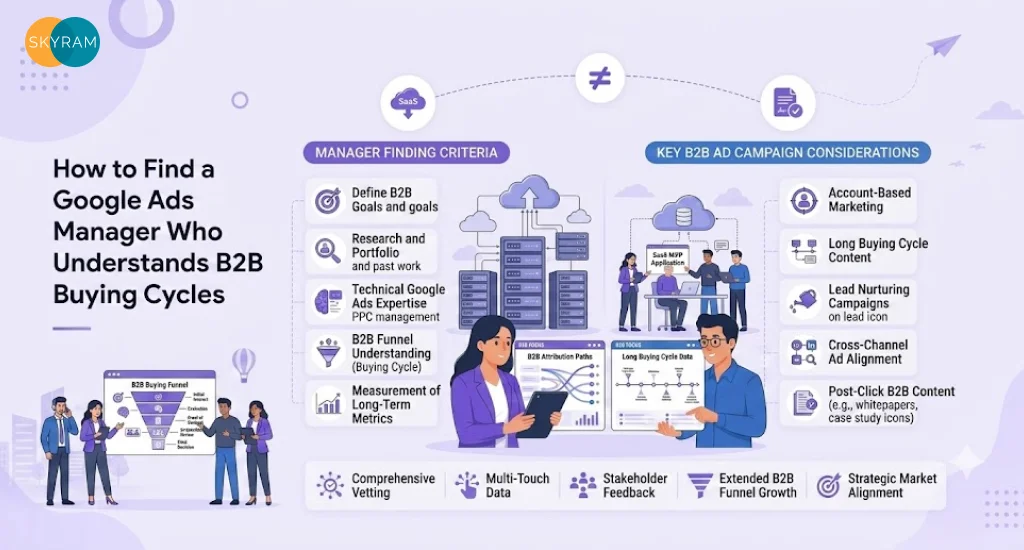
How to Find a Google Ads Manager Who Understands B2B Buying Cycles

How to Find a Google Ads Manager

Finding a Google Ads manager who understands B2B buying cycles means identifying someone who structures campaigns around awareness, consideration, and decision-stage intent separately, not someone who applies a single bidding strategy across all keyword types. B2B buying cycles average 6 to 12 months. A Google Ads manager who has only run B2C campaigns will optimize for immediate conversion signals that do not exist in enterprise buying behavior.

Here is how the failure typically plays out. A CMO brings in a Google Ads manager with genuinely impressive numbers. Their portfolio shows strong CTR improvements, efficient CPCs, and conversion rates that held up under scrutiny. What the portfolio does not show is that every result came from ecommerce and direct-response B2C accounts, where a buyer searches, clicks, and purchases within the same session. Within 90 days of taking over the B2B account, the campaigns are generating high form-fill volume from early-stage researchers who downloaded a whitepaper and will not be ready to buy for six to eight months. Meanwhile, high-intent decision-stage queries from buyers who are actively shortlisting vendors get ignored because the search terms look low-volume and the manager does not recognize them as the most valuable clicks in the account.

This post is the evaluation guide that CMOs and marketing directors need before putting their Google Ads budget behind a manager whose experience does not match the environment they will be working in. It covers what B2B paid search management actually requires, the questions that separate B2B-capable managers from B2C-trained ones, the red flags to watch for in portfolios and interviews, and how to structure the attribution infrastructure that makes any Google Ads engagement measurable against real pipeline.

How B2B Google Ads Management Differs From B2C

The surface-level mechanics of Google Ads are identical across B2B and B2C. Both environments use keyword targeting, bidding strategies, ad copy, and Quality Score. The structural differences sit underneath those mechanics, in how campaigns are organized, what they optimize toward, and how success gets measured over time.

Keyword Intent Stratification Across a 6 to 12 Month Buying Cycle

In B2C ecommerce, keyword intent is relatively flat. Most searches cluster around informational (“what is the best running shoe for flat feet”) and transactional (“buy Hoka Clifton 9 size 11”). The gap between those two intents is measured in days or hours. A buyer researches Monday and purchases Wednesday.

B2B keyword intent spans a much longer timeline and requires deliberate stratification. An enterprise software buyer might search “what is revenue operations software” in January, then “top revenue operations platforms for mid-market SaaS” in March, then “Clari vs Gong comparison” in May, then “Clari pricing and contract terms” in June. Each of those queries represents a different intent stage, a different readiness level, and should trigger a different ad, a different landing page, and a different offer.

A B2B Google Ads manager who understands this architecture builds separate campaigns for each intent layer and sets different conversion objectives and bid strategies across them. Bottom-funnel campaigns targeting decision-stage queries like “best B2B CRM for manufacturing companies” optimize toward demo requests. Middle-funnel campaigns targeting category-awareness terms optimize toward gated content downloads or webinar registrations, measured as micro-conversions, not primary goals. Top-funnel campaigns for problem-awareness queries are managed to engagement signals and brand lift, not direct conversions.

A manager who came up in B2C will compress all of this into one or two campaign types with a single conversion objective and wonder why the lead quality from the high-volume keywords is so poor.

Negative Keyword Strategy for Research-Stage vs. Decision-Stage Queries

Negative keyword management in B2B is substantially more nuanced than in B2C. The stakes are higher because each click costs more and the margin for irrelevance is narrower. In B2B paid search, showing your enterprise software ad to a college student writing a research paper is wasteful at $8 per click. Showing it to an IT Director actively shortlisting vendors is worth $80 per click.

The distinction between those two audiences often comes down to the search terms they use. Research-stage queries frequently include modifiers like “what is,” “how does,” “definition of,” “examples of,” “introduction to,” and “for beginners.” A B2B-experienced manager builds an extensive negative keyword list that filters out research-stage intent from bottom-funnel campaigns, directing those queries toward appropriate upper-funnel campaigns or blocking them entirely if the audience does not match.

Decision-stage negative keyword strategy is equally important. When running competitor conquest campaigns, you need negatives that prevent your ads from showing to people searching for competitor support, competitor login pages, or competitor job openings. Those clicks are expensive and convert at near-zero rates for acquisition purposes. Managers who do not audit search term reports weekly miss these patterns and let budget drain through irrelevant matches continuously.

Bidding Strategy Selection When Conversion Signals Are Sparse and Delayed

Smart bidding in Google Ads works by learning from conversion data. The algorithm needs enough conversion events to identify patterns and predict which future clicks are likely to convert. The standard threshold for stable smart bidding performance is approximately 30 conversions per campaign per month. In B2C ecommerce with transaction volume running in the hundreds, this is trivially achievable. In B2B with a 90-day sales cycle and monthly SQL volume in the single digits, it is a genuine technical constraint.

A B2B-experienced Google Ads manager knows how to navigate this problem. They know to set up micro-conversions, meaningful engagement events like content downloads, video completions, scrolling depth on high-value pages, and time-on-site thresholds, as early optimization signals while the primary conversion data develops. They know to use Maximize Clicks or Manual CPC in new campaigns rather than forcing Target CPA on a dataset too thin to support it. They know that switching to smart bidding before the data is ready produces erratic spend behavior and inflated CPAs that a less experienced manager will misattribute to a poor audience or wrong keyword.

This technical judgment about when automation helps and when it hurts is one of the clearest differentiators between a B2B-capable Google Ads manager and one who is applying a B2C playbook to an environment where it does not fit.

Key Takeaway: B2B Google Ads management requires campaign architecture that mirrors a 6 to 12 month buying cycle, negative keyword discipline that separates research intent from purchase intent, and bidding strategy judgment that accounts for sparse and delayed conversion signals. A manager who does not work this way in B2C accounts will not discover how to do it on the job inside your budget.

The Evaluation Framework for a B2B Google Ads Manager

The interview for a B2B Google Ads manager should function more like a working session than a credentials review. Certifications are table stakes. What you need to surface is how they think about campaign architecture, attribution, and audience design in environments where the feedback loop between ad click and revenue is months long.

1. Campaign Audit Exercise: What Is Wrong with This Search Campaign Structure?

Present the candidate with a simplified version of a flawed B2B search campaign structure and ask them to diagnose it. A well-designed audit exercise might show a single Search campaign with a single ad group, broad match keywords across all intent levels, Target CPA bidding set to a CPA derived from form fills rather than SQLs, and a single landing page for all traffic.

A B2B-capable manager will identify multiple structural problems without prompting. They will call out the intent mixing (decision-stage and research-stage queries in the same campaign bidding at the same CPA). They will question the conversion event choice: if the CPA is based on form fills but the form fills include unqualified research downloads, the algorithm is learning from the wrong signal. They will note the absence of negative keywords and the risks that come with running broad match without them in a B2B account. They will propose a restructure that separates intent layers into distinct campaigns with appropriate conversion objectives for each.

A manager who cannot diagnose a flawed structure in 15 minutes cannot build a sound one from scratch in 90 days.

2. Attribution Question: How Do You Measure Google Ads Contribution in a 90-Day Sales Cycle?

This question surfaces the candidate’s attribution infrastructure knowledge. A strong answer describes their approach to offline conversion import: CRM pipeline events pushed back into Google Ads so that MQL-to-SQL progressions and opportunity creation events become the optimization target rather than raw form fills. They will discuss multi-touch attribution and what model they prefer for assigning value across a long cycle. They will mention GA4 integration, conversion window settings appropriate for a 90-day sales process, and how they communicate attribution limitations to leadership.

A weak answer describes last-click attribution as if it solves the B2B measurement problem. Last-click attribution in a 90-day multi-touch cycle systematically undervalues upper-funnel campaigns that introduce buyers to your brand and systematically over-rewards the final touchpoint before form submission. A manager who does not recognize this will misallocate budget toward bottom-funnel campaigns and starve the awareness layer that feeds pipeline months later.

3. Audience Design: How Would You Structure Remarketing for a Buying Committee?

B2B purchases involve an average of six to ten stakeholders. Remarketing in this context is not about showing an ad to a single user who visited your pricing page. It is about maintaining brand presence across multiple people at the same company who are each conducting independent research and comparing notes internally.

A B2B-experienced manager designs remarketing audiences that account for this. They segment by page visited and stage implied: visitors who hit product or solution pages (higher intent) versus visitors who hit blog posts (earlier stage) should be served different messages and different offers. They use Customer Match to upload company domain lists and target signed-in Google users from those accounts. They adjust remarketing window lengths to match the actual evaluation cycle, setting 90-day or 180-day windows rather than defaulting to 30 days. They understand that the goal is coordinated presence across a committee, not repeated exposure to one individual.

4. B2C Google Ads Profile vs. B2B-Capable Google Ads Manager: Side-by-Side

B2C Google Ads Profile B2B-Capable Google Ads Manager
Campaign Structure Unified campaigns with single conversion objective Intent-layered: awareness, consideration, decision, retargeting
Keyword Strategy Match types optimized for volume and conversion rate Intent stratification with aggressive negative keyword development
Bidding Approach Target ROAS or Target CPA from day one Micro-conversions in early stages; smart bidding introduced once data supports it
Conversion Events Transactions or form fills Form fills plus offline CRM events (SQL, opportunity created, closed-won)
Measurement Framework Last-click, platform-reported ROAS Multi-touch attribution, CRM integration, 90-day conversion windows
Remarketing Design Individual user based on browse and purchase behavior Company-level and committee-aware audience segmentation
Reporting Focus CTR, CPC, ROAS by campaign Cost-per-SQL, cost-per-opportunity, pipeline velocity by campaign
Sales Team Relationship Minimal; marketing owns the handoff Required for lead scoring alignment and quality feedback loops

Key Takeaway: Evaluating a Google Ads manager for B2B requires working exercises, not credential checks. The campaign audit, the attribution question, and the audience design question will reveal faster than any portfolio review whether the candidate thinks in B2B terms or is translating B2C expertise into B2B vocabulary without the substance to back it.

Red Flags in Google Ads Manager Portfolios for B2B Buyers

Before the interview, the portfolio review narrows the field. These are the patterns that should raise immediate concern.

Only B2C or Ecommerce Case Studies in Their Portfolio

A portfolio composed entirely of ecommerce and direct-response B2C case studies is not automatically disqualifying, but it requires a pointed explanation from the candidate. Their results in those environments are real. The question is whether they understand that those environments produced their results through mechanisms that do not transfer to B2B.

If they cannot describe, unprompted, what they would need to change about their approach for B2B, they have not thought carefully about the difference. If they describe B2B paid search as fundamentally similar to ecommerce but “with longer cycles,” they have recognized the symptom without understanding the structural implications.

Reporting Built Entirely Around CPC and CTR with No Pipeline Attribution

A portfolio built on CPC improvements and CTR gains is a B2C reporting portfolio. These are legitimate performance indicators in environments where the click correlates tightly with downstream revenue. In B2B, a lower CPC often means you attracted cheaper but less qualified traffic. A higher CTR on a broad keyword can mean your ad copy is compelling to the wrong audience.

The absence of pipeline attribution in case study reporting tells you what the manager was asked to be accountable for in previous engagements. If no client ever required them to connect campaign performance to SQL volume or cost-per-opportunity, they have not built the muscle for that measurement. They will default to the reporting they know how to produce, which will not satisfy a CMO asking where pipeline is coming from.

No Mention of Negative Keyword Strategy or Search Term Auditing

Search term audits are the baseline quality control for any Google Ads account. Negative keyword lists are the output of that auditing, and in B2B they require ongoing weekly attention because match types in Google Ads continue to expand in ways that pull in unexpected query variants.

A manager who does not mention negative keyword development when describing their process has either never managed a B2B account where this distinction matters, or they are not operating at the level of detail that B2B paid search requires. Either conclusion is a reason to keep looking.

Key Takeaway: Portfolio red flags reveal the environment a Google Ads manager was built to serve. B2C-only case studies, reporting centered on CTR and CPC, and silence on negative keyword strategy are all signals that the candidate has not yet navigated the specific technical demands of B2B paid search. Spotting these patterns before the interview saves significant evaluation time.

In-House Google Ads Manager vs. Agency: Which Fits B2B Better

The decision between an in-house hire and a paid search agency for B2B is not primarily about cost. It is about feedback loop speed, context depth, and who owns the institutional knowledge about your buyers.

An in-house Google Ads manager builds deep product and buyer knowledge over time. They participate in sales calls. They hear which objections kill deals. They understand the nuance between a qualified lead and a form fill that looks qualified on paper. That context produces better keyword decisions, better ad copy, and better offer alignment. The disadvantage is that a single in-house manager carries the whole account, and their technical breadth is limited to what one person can master across platforms.

An agency brings a team with multi-platform depth and exposure to a broader range of B2B account structures. They have seen more failure modes and more optimization patterns than any single in-house hire. The risk is that account management gets distributed across multiple people with varying B2B experience levels, and strategic context about your buyers stays at the surface unless you invest heavily in onboarding and ongoing briefing.

For B2B companies spending under $30,000 per month in paid search, a specialized paid search agency typically delivers more technical depth than an in-house hire at equivalent cost. Above $100,000 per month, an in-house lead managing the strategy with agency support for execution often produces better results because the buyer context compounds internally over time.

What matters most is not the model but the B2B-specific expertise of whoever is making the campaign architecture decisions. A weak in-house hire and a B2C-trained agency both produce the same outcome: a well-reported account that does not feed pipeline. Whether you hire in-house or engage an agency, run the same evaluation framework and ask the same questions about attribution, intent stratification, and committee-level remarketing.

The complete PPC management guide covers the in-house versus agency decision in detail from a platform management perspective, including how to evaluate agency onboarding processes and what a properly structured audit looks like before any spend changes.

Key Takeaway: The in-house versus agency decision is secondary to the B2B expertise question. Both models can produce strong pipeline results and both can fail for the same structural reasons. Evaluate the individual or team doing the work against the same criteria regardless of engagement model.

How to Set Up Attribution Infrastructure Before Your Google Ads Manager Starts

Attribution infrastructure is not the Google Ads manager’s problem to solve after they take over the account. It is a prerequisite that the marketing operations function needs to build before paid search strategy can be evaluated against meaningful outcomes. Asking a Google Ads manager to improve pipeline performance inside a broken attribution environment is asking them to navigate without a map.

The minimum viable attribution stack for a B2B Google Ads program has four components.

The first is conversion tracking that goes beyond form fills. Every significant engagement event should be tracked: whitepaper downloads, demo requests, webinar registrations, pricing page visits above a time threshold, and any chatbot interactions that qualify as a sales conversation. Each event should be classified by its proximity to purchase intent and assigned different conversion values in Google Ads.

The second is CRM integration through offline conversion import. When a lead becomes an MQL and then an SQL in your CRM, those transitions should push back to Google Ads as conversion events tied to the original click through Google Click Identifier (GCLID) matching. This connects the bidding algorithms to the outcomes that actually matter, rather than letting them optimize toward form fills that may never reach the sales team.

The third is GA4 setup with proper B2B goal configuration. GA4 should track the same events as Google Ads and allow you to build audience segments based on behavioral signals: users who visited three or more solution pages, users who spent more than four minutes on the pricing page, users who visited from a target company domain. These audiences feed back into Google Ads for remarketing and Customer Match targeting.

The fourth is a conversion window setting that matches your actual sales cycle. Google Ads defaults to 30-day conversion windows. A B2B company with a 90-day average sales cycle is leaving months of attribution credit on the table. Setting a 90-day click-through window ensures that the algorithm receives credit for deals that take time to develop, and that your reporting reflects the full contribution of campaigns that introduced buyers early in their evaluation.

Teams at Skyram Technologies approach this infrastructure setup as the first milestone of any paid search engagement, before any campaign optimization work begins, because without clean attribution, every subsequent optimization decision is built on unreliable data.

Key Takeaway: Attribution infrastructure is a marketing operations responsibility, not a Google Ads manager deliverable. Set up offline conversion import, CRM integration, GA4 goal configuration, and appropriate conversion window settings before evaluating any paid search performance. Without this stack, you are measuring the wrong outcomes and making budget decisions based on data that does not connect to revenue.

What 90-Day Success Looks Like for a B2B Google Ads Engagement

The 90-day window for evaluating a new Google Ads manager or agency in a B2B context should not produce a clean pipeline verdict. It should produce a clean infrastructure verdict: is the technical foundation in place to generate meaningful data over the following six months?

In the first 30 days, a B2B-capable manager conducts a full account audit: conversion tracking integrity, negative keyword gaps, campaign structure mismatches between intent and bidding strategy, Quality Score distribution, audience configuration, and attribution window settings. They produce a prioritized fix list with estimated impact, not a generic scorecard. They implement the highest-priority technical fixes before making any significant bid or budget changes.

Between days 30 and 60, the manager executes structural changes: separating intent layers into distinct campaigns, building out negative keyword lists from search term report analysis, configuring micro-conversion events to give smart bidding early optimization signals, and setting up audience segments for remarketing that reflect the B2B evaluation cycle rather than standard 30-day retargeting windows.

Between days 60 and 90, the manager begins to see early data from the restructured campaigns and makes tactical adjustments. Micro-conversion rates by campaign and keyword cluster start to show which intent layers are generating real engagement versus wasted spend. The search term reports begin to confirm whether the negative keyword strategy is holding. Early offline conversion data from the CRM, if the integration is working, starts to show which campaigns are generating contacts that survive lead qualification.

At the 90-day mark, the right success metric is not SQL volume from paid, which is too early to judge in a long sales cycle. The right metric is whether the account is technically sound, whether the attribution infrastructure is producing data you can trust, and whether the manager can show you a clear hypothesis about which campaigns are building pipeline and why.

That conversation, grounded in data rather than platform metrics, is how you distinguish a B2B-capable Google Ads manager from one who is producing good-looking reports that do not connect to the outcomes you actually care about. If you also want to understand how paid search integrates with organic and AI-layer visibility, the SEO services overview and generative engine optimization resources clarify where each channel contributes across the B2B evaluation funnel.

Key Takeaway: Ninety days is enough time to evaluate the technical quality of a B2B Google Ads engagement, not enough time to evaluate pipeline contribution. Define 90-day success as a clean attribution infrastructure, a structurally sound account, and a data-backed hypothesis about campaign-to-pipeline connection. Hold pipeline evaluation to the 6-month mark, aligned with your actual sales cycle.

Frequently Asked Questions

  1. What should a Google Ads manager know about B2B marketing?

A Google Ads manager working in B2B should understand how buying cycles affect campaign architecture, attribution, and bid strategy in ways that do not apply to B2C accounts. Specifically, they should know how to structure campaigns around separate intent layers (awareness, consideration, and decision), how to use offline conversion import to connect CRM pipeline events back to Google Ads bidding algorithms, how to build negative keyword lists that protect high-intent campaigns from research-stage query bleed, and how to set conversion windows that reflect a 90-day or longer sales cycle rather than defaulting to 30 days. A B2B Google Ads manager should also understand that the primary success metric is cost-per-SQL or cost-per-opportunity, not cost-per-click or cost-per-form-fill, and that their reporting should speak the language of pipeline contribution rather than ad platform metrics.

  1. How is B2B Google Ads management different from B2C Google Ads management?

B2B Google Ads management differs from B2C management in three foundational ways. First, the buying timeline: B2C purchases often complete within hours of a click, while B2B purchases take 6 to 12 months and require campaigns that serve buyers at different readiness levels simultaneously. Second, the audience structure: B2C targets individuals based on demographics and interest signals, while B2B must account for buying committees of 6 to 10 people at the same company, each researching independently. Third, the measurement framework: B2C optimizes toward transactions tracked in real time, while B2B requires multi-touch attribution, offline conversion import from the CRM, and conversion windows that match the length of the actual sales cycle. A manager trained exclusively in B2C will apply fast-cycle optimization logic to a slow-cycle environment and optimize toward metrics that do not predict revenue.

  1. How do I evaluate a Google Ads agency for B2B lead generation?

When evaluating a Google Ads agency for B2B lead generation, look for four signals. First, case studies from B2B accounts with reporting that shows cost-per-SQL or cost-per-opportunity, not just CTR and CPC. Second, a clear description of how they set up offline conversion import to connect Google Ads performance to CRM pipeline data. Third, a process for intent stratification: how they structure different campaigns for different stages of a B2B buying cycle rather than running all traffic through one campaign type. Fourth, a remarketing strategy that accounts for buying committees rather than individual users. Agencies that cannot describe these four elements in concrete operational terms are applying B2C expertise to a B2B brief.

  1. What is offline conversion import in Google Ads and why does it matter for B2B?

Offline conversion import in Google Ads is a process that connects CRM pipeline events, such as a lead becoming an SQL or an opportunity being created, back to the original ad click that generated that contact. It works by capturing a Google Click Identifier (GCLID) from the initial ad click, storing it in the CRM, and then uploading that GCLID with the downstream conversion event when it occurs. For B2B, this matters because the most valuable conversion events happen weeks or months after the initial ad click, well outside the window that Google Ads can observe through standard pixel tracking. Without offline conversion import, Google Ads bidding algorithms optimize toward form fills, and lead quality suffers because the algorithm has no signal about which form fills actually become qualified pipeline.

  1. How long does it take to see results from a B2B Google Ads campaign?

B2B Google Ads campaigns typically require 60 to 90 days to establish a clean technical foundation and begin generating reliable early signals, and 4 to 6 months before meaningful pipeline attribution data is available for evaluation. The first 30 days should focus on account structure, tracking integrity, and negative keyword development. The next 60 days generate micro-conversion data that indicates which intent layers are producing qualified engagement. Pipeline data becomes statistically meaningful only after enough leads have had time to progress through the full qualification cycle. Organizations that evaluate B2B Google Ads performance at 30 or 60 days and make budget decisions based on that data are measuring before the feedback loop has closed, which leads to premature campaign cuts and missed pipeline contribution.

Work with Google Ads Managers Who Think in Pipeline, Not Platform Metrics

The difference between a Google Ads manager who understands B2B and one who does not is not visible in their certifications or their general performance numbers. It surfaces in how they structure campaigns, how they measure success, and whether they can connect ad spend to pipeline in an environment where the path from click to closed deal takes six months.

Skyram Technologies builds B2B Google Ads programs around proper attribution infrastructure, intent-stratified campaign architecture, and reporting that CMOs and VPs of Sales can both read without translation. If your current paid search program generates traffic without feeding pipeline, the problem is structural and addressable.

Schedule a strategy session to discuss what a pipeline-first Google Ads engagement looks like for your B2B demand generation program.
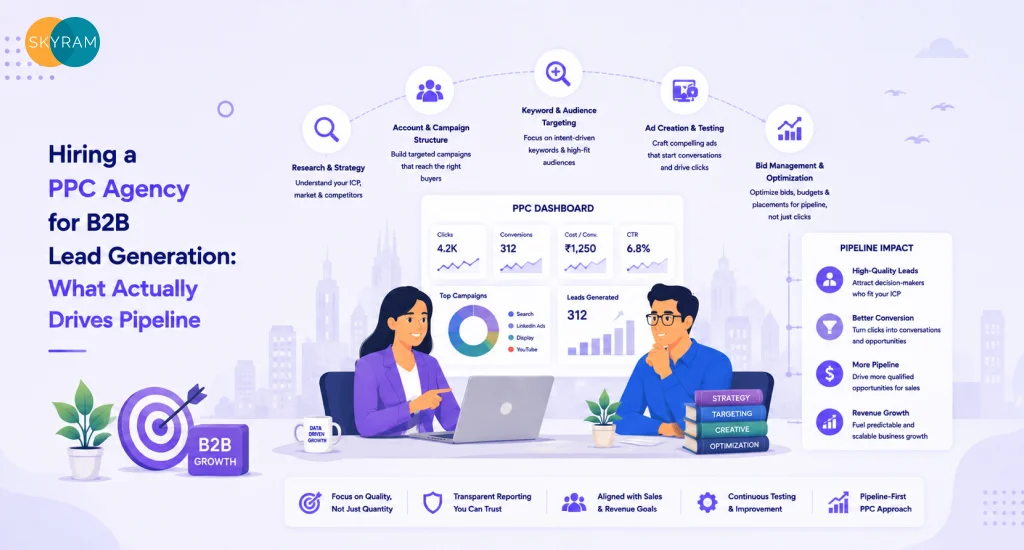
Hiring a PPC Agency for B2B Lead Generation: What Actually Drives Pipeline

Hiring a PPC Agency for B2B Lead Generation

Hiring a PPC agency for B2B lead generation requires evaluating their understanding of long buying cycles, multi-touch attribution, and the difference between form fills and qualified pipeline. B2B PPC performance measured on click-through rate and cost-per-click tells you almost nothing about revenue impact. Agencies that drive B2B pipeline optimize for SQLs and pipeline velocity, not impressions and traffic volume.

Here is the scenario that plays out across B2B marketing teams more often than anyone wants to admit. The demand gen lead brings in a PPC agency for B2B campaigns. Month one report lands: CTR is up 38 percent. Cost-per-click dropped by 22 percent. The agency is thrilled. The sales team, however, is not booking more discovery calls. SQLs are flat. The CRM is filling up with forms from companies that are nowhere near the ICP, from titles that have no budget authority, and from people who downloaded a whitepaper with no intent to ever buy.

The agency optimized the metrics they knew how to move. Not the ones that mattered.

This post is the evaluation guide that demand gen leaders and marketing directors need before they sign an agency contract. It covers what B2B PPC architecture actually looks like, the five questions that reveal whether an agency genuinely understands B2B buying behavior, how to structure accountability around revenue outcomes, and when to combine paid search with organic strategy for full-funnel coverage.

Why Most PPC Agencies Are Optimized for the Wrong B2B Metrics

The core problem with most PPC agencies evaluating themselves against B2B KPIs is that they were trained on B2C performance signals. Retail and ecommerce campaigns produce purchase events within hours of a click. The feedback loop is tight, the signal is clear, and optimization toward conversions works because “conversion” actually maps to revenue.

B2B is structurally different. A qualified B2B buyer might click a LinkedIn ad in January, visit the site twice more in February via organic search, attend a webinar in March, and finally request a demo in April after a colleague forwards a case study. That ad click in January contributed to a closed deal. A CTR-optimized campaign would never surface that relationship.

CTR and CPC as Vanity Metrics in Long-Cycle B2B Buying

Click-through rate measures how many people clicked your ad. It tells you nothing about whether those people had the budget, authority, or need to purchase. In B2B with average sales cycles of 3 to 12 months, a high CTR from poorly qualified audiences accelerates your cost-per-SQL, burns your sales team’s time, and produces pipeline reports that look fine until leadership asks why revenue is not following.

Cost-per-click is even less informative. A lower CPC often means you shifted bidding toward broader match terms or lower-competition placements that attract researchers and students rather than decision-makers. An agency celebrating CPC reduction while your sales team flags lead quality problems has misaligned priorities.

The agencies that understand B2B measure cost-per-SQL, cost-per-opportunity, and pipeline contribution by channel. Those are the metrics that connect paid campaigns to revenue. If an agency’s standard reporting deck does not include those columns, that tells you everything about how they will manage your account.

Form Fills vs. SQLs: Where the Conversion Gap Actually Lives

Every agency will optimize toward your conversion events. The question is whether your conversion events are the right ones. Most B2B teams set form submissions as their primary conversion, then wonder why their cost-per-lead looks manageable while qualified pipeline growth is stagnant.

The conversion gap lives between the form fill and the SQL. A prospect fills out a gated whitepaper download. That registers as a conversion. That person has no buying intent today. They are in research mode. Six months from now, maybe three percent of that cohort becomes an SQL. An agency optimizing toward form fills has just built a system that efficiently delivers people who are nowhere near a buying decision.

Solving this requires connecting your CRM data back to campaign performance through offline conversion imports. When a lead becomes an SQL, that event gets pushed back into Google Ads or LinkedIn as a conversion signal. Now your bidding algorithms are optimizing toward the behavior that actually precedes revenue, not the behavior that precedes inbox noise.

How Agency Reporting Obscures Pipeline Contribution

Standard agency reporting packs in the metrics that look like progress: impressions served, clicks generated, CTR improved, quality score increased. These are real signals that good things are happening in the account. They are not evidence that pipeline is growing.

Pipeline contribution requires a different data layer. You need to know which campaigns and keywords are generating contacts that eventually became opportunities, what the average time lag is between first paid touch and opportunity creation, and what your cost-per-opportunity looks like by campaign type, by offer, and by channel.

Most agencies cannot produce that reporting because they do not have CRM access and they have not set up the offline conversion tracking infrastructure that makes it possible. Insisting on this data architecture before signing is one of the most important steps a demand gen leader can take.

Key Takeaway: B2B PPC performance measured on CTR and CPC tells you almost nothing about revenue impact. Insist on reporting that connects campaign spend to SQL volume, cost-per-opportunity, and pipeline contribution before you evaluate whether an agency is actually performing.

What B2B PPC Campaign Architecture Actually Looks Like

A B2B demand gen PPC program is not a single campaign targeting people who search for your product. It is a layered system designed to reach buyers at different stages of awareness and move them through a buying process that happens over months, not days.

Intent-Layer Targeting: In-Market vs. Awareness vs. Retargeting

A properly architected B2B paid program runs three distinct intent layers simultaneously, each with its own offer, landing page, and measurement approach.

The bottom layer targets in-market buyers who know they have a problem and are actively evaluating solutions. These are high-intent keyword campaigns around terms like “B2B lead generation software” or “demand gen agency” with conversion objectives tied to demo requests or consultation bookings. Cost-per-click is highest here, conversion rates are highest, and sales cycle from this entry point is shortest.

The middle layer targets buyers who are aware of the category but not yet actively shopping. LinkedIn Sponsored Content with educational resources, thought leadership, or comparison content performs well here. The goal is not an immediate demo request. The goal is a documented touch that keeps your brand in the consideration set when the evaluation period begins.

The top layer runs retargeting against people who have already engaged with your content, visited key pages, or opened prior emails. These audiences convert at 3 to 5 times the rate of cold traffic because you are serving ads to people who already know who you are. A B2B agency that is not running structured retargeting is leaving the highest-efficiency segment of your funnel unmeasured.

Account-Based Targeting and How It Differs from B2C Audience Construction

B2C audience construction focuses on demographic and behavioral signals: age, interests, purchase history, lookalike models built from past customers. B2B account-based targeting starts from a different place entirely. You define the companies you want to reach first, then build targeting that serves ads to the people within those companies who participate in the buying decision.

LinkedIn’s company targeting combined with job title and seniority filters is the most precise tool available for this. You can serve ads exclusively to VPs of Marketing and Directors of Demand Generation at SaaS companies with 200 to 2,000 employees that are located in the US. That specificity means higher CPCs, but it also means every impression has a realistic chance of reaching someone in your actual ICP.

Google Ads Customer Match and account lists let you upload company domains and match them against signed-in users, then layer those company signals on top of keyword intent. It is less precise than LinkedIn but dramatically cheaper per impression, and effective for the bottom-of-funnel layer where someone from a target account is actively searching for your category.

Landing Page and Offer Design for B2B Buying Committees, Not Individual Buyers

B2B purchases involve an average of 6 to 10 stakeholders depending on deal size and industry. A landing page designed to convert a single motivated individual fails in this environment because no single person makes the decision. Your paid traffic lands on a page, and within 60 seconds that person is asking: can I forward this to my team? Does this pass the internal credibility test? Does this contain the proof that will hold up in a business case presentation?

Your offer architecture needs to account for that social proof requirement. Case studies with named companies and specific ROI figures convert better than generic outcome statements. ROI calculators that produce shareable outputs give individual champions something to put in front of a CFO. Audit offers and benchmark reports are easy to justify internally because they produce information, not an immediate sales engagement.

An agency that sends your LinkedIn traffic to a generic contact form is not thinking about the committee dynamics that govern B2B buying. That mismatch between ad targeting precision and landing page design is where a significant portion of your budget disappears.

B2C-Optimized vs. B2B Pipeline-Focused PPC Agency: Side-by-Side

B2C-Optimized PPC Agency B2B Pipeline-Focused PPC Agency
Campaign Structure Single-funnel, conversion-focused Intent-layered: awareness, retargeting, in-market
Audience Construction Demographic and interest-based Company, title, seniority, buying committee
Primary KPIs CTR, CPC, cost-per-lead Cost-per-SQL, cost-per-opportunity, pipeline velocity
Measurement Framework Last-click attribution Multi-touch, offline conversion import, CRM integration
Reporting Cadence Monthly PDF with platform metrics Weekly tactical, monthly pipeline review, quarterly strategy
Offer Strategy Single CTA (buy, sign up, trial) Staged offers by intent level (resource, audit, demo, call)
Sales Alignment None required Required for lead scoring, qualification handoff, feedback loop
Landing Page Approach Individual conversion optimization Committee-ready: social proof, shareable assets, credibility signals

Key Takeaway: B2B PPC architecture is fundamentally different from B2C. A pipeline-focused agency builds layered campaigns that match offer to intent, targets buying committees rather than individuals, and measures outputs that actually connect to revenue, not just activity.

The Five Questions That Reveal Whether a PPC Agency Understands B2B

These are not gotcha questions. They are the baseline competency checks that separate agencies that have genuinely managed B2B pipeline programs from agencies that have read about them.

1. How Do You Attribute Pipeline to Paid Campaigns Across a 90-Day Sales Cycle?

This question forces the agency to explain their attribution infrastructure. A strong answer describes their offline conversion import process: how CRM data is connected to ad platforms so that MQL-to-SQL progressions feed back into bidding optimization. It describes their position on multi-touch attribution and which model they use for evaluating channel contribution over a long cycle.

A weak answer talks about last-click attribution or mentions “closed loop reporting” without explaining how the loop actually closes. If an agency cannot describe the technical process by which a deal closed in your CRM connects back to the keyword and campaign that first brought that buyer into your funnel, they are reporting on ad activity, not pipeline contribution.

2. How Do You Approach Targeting a Buying Committee vs. a Single Decision-Maker?

This question surfaces whether the agency thinks about B2B audience construction at all. A strong answer discusses persona segmentation within the same target accounts, separate creative tracks for technical evaluators versus financial approvers, and offer architecture designed for different stakeholder concerns within the same deal.

A weak answer describes job title targeting as if serving one ad to one person completes the committee engagement problem. B2B agencies who have worked real enterprise deals understand that the VP of Marketing who sees your ad is not the person who signs the check or configures the tool. Each of those people needs to encounter your brand and your proof points at some point in the evaluation window.

3. What Is Your Strategy When a Campaign Drives Traffic but Sales Says the Leads Are Not Qualified?

This question tests the agency’s ability to diagnose a structural problem rather than defend their metrics. A strong answer proposes a multi-step investigation: reviewing the search terms triggering ads, auditing the audience signals on LinkedIn, analyzing the company profile of form fills versus actual SQLs, adjusting the offer to attract higher-intent prospects, and installing a lead scoring layer that gates MQL-to-SQL handoff.

A weak answer suggests running more volume to improve conversion rate. If an agency responds to lead quality problems by recommending more spend, they are not aligned with your pipeline outcomes. They are aligned with their management fee tied to budget.

4. What Offer Architecture Do You Recommend for Our Funnel Stage?

A B2B-experienced agency thinks about this in terms of where the buyer is in their awareness journey. They will ask about average deal size, sales cycle length, and how your sales team prefers to initiate discovery. Then they will recommend offers that match: awareness-stage content for cold audiences, audit and benchmark offers for middle-funnel intent, demo requests and consultation bookings for in-market buyers.

An agency that immediately recommends a demo request CTA for all traffic regardless of audience temperature has not thought seriously about B2B buyer behavior.

5. How Do You Handle Campaign Optimization When Conversion Data Is Sparse?

B2B campaigns often struggle with low conversion volume in early months because the pipeline cycle is long and SQLs accumulate slowly. A skilled agency knows how to use micro-conversion events (whitepaper downloads, video completions, time-on-page thresholds) as early optimization signals while the higher-quality conversion data develops. They know how to structure campaign types and bidding strategies to perform in low-volume environments rather than requiring 50 conversions per campaign per month before smart bidding is stable.

Key Takeaway: These five questions identify whether a prospective PPC agency has genuinely managed B2B pipeline programs or has managed B2C campaigns and applied surface-level B2B vocabulary to the same playbook. The answers reveal attribution infrastructure, committee thinking, diagnostic discipline, and technical competency simultaneously.

Campaign Types That Drive B2B Pipeline vs. Those That Just Drive Traffic

Not all paid campaign types are equal contributors to pipeline in a B2B context. Here is how the major campaign types break down by their actual pipeline value:

Google Search: In-Market Demand Capture. When B2B buyers are actively evaluating vendors in your category, Google Search captures that intent precisely. Terms with commercial intent (“B2B demand gen agency,” “LinkedIn ads for SaaS,” “PPC agency for software companies”) produce direct pipeline at the bottom of the funnel. This is the highest-efficiency campaign type for pipeline-per-dollar in mature accounts.

LinkedIn Sponsored Content: Upper-Funnel Awareness. LinkedIn reaches buying committees by company, title, and seniority with content-first formats. Thought leadership content, benchmark reports, and educational assets perform here. Conversion rates are low but audience precision is high, and the people who engage are inside your actual ICP.

LinkedIn Lead Gen Forms: Middle-Funnel Offer. Pre-filled forms that capture contact data from LinkedIn profiles reduce friction for resource downloads and webinar registrations. These produce MQLs at reasonable volume, but require strong lead scoring to prevent the pipeline-fill problem described earlier.

Google Display and YouTube: Brand Reinforcement. These formats keep your brand in the consideration set for buyers who have already shown some intent. They function best as retargeting vehicles rather than cold prospecting tools for B2B. Measuring them on direct conversion metrics misunderstands their role in a multi-touch cycle.

Competitor and Alternative Conquesting. Search campaigns targeting competitor brand terms and “alternative to X” keyword clusters capture buyers who are actively evaluating your direct competition. These campaigns deliver some of the most qualified traffic available because the person has already made the decision to invest. They are often underutilized in B2B paid programs.

Branded Keyword Defense. Running branded keyword campaigns protects your organic SERP real estate from competitors who bid on your name and ensures that high-intent buyers searching for you directly land on your page, not a competitor comparison site. This is table stakes, not optional.

Key Takeaway: In B2B, campaign type selection is as strategic as keyword selection. Google Search captures in-market demand. LinkedIn reaches the committee. Retargeting closes the loop on in-funnel engagement. Agencies that treat all campaign types with the same conversion objective are misapplying the tools they have.

How to Structure Agency Accountability Around Revenue Outcomes

Hiring a PPC agency without structuring accountability correctly is how you end up in the scenario described at the start of this post: great metrics, no pipeline. Accountability structures need to be built into the engagement from day one, not bolted on after frustration accumulates.

OKRs and Reporting Frameworks Tied to SQL Volume, Not Vanity Metrics

The engagement objectives need to be written in the language of pipeline. That means the primary success metric is SQL volume from paid channels, secondary metrics are cost-per-SQL and cost-per-opportunity, and tactical metrics like CTR and CPC are treated as diagnostic indicators rather than proof of performance.

A monthly reporting cadence should include: pipeline generated from paid by campaign type, lead quality score from sales team feedback (on a defined scale), MQL-to-SQL conversion rate from paid channels versus organic versus direct, and cost-per-opportunity by campaign. If those four data points are not in the report, the report is not connected to your business outcomes.

You also need a defined lead scoring framework agreed upon with sales before the first campaign launches. Without shared definitions of MQL and SQL, every conversation about lead quality becomes subjective and adversarial. A lead scoring matrix that uses firmographic, behavioral, and engagement signals to automate the handoff removes that friction.

Milestone-Based Retainer Structure That Aligns Incentives

Standard monthly retainers pay the same fee regardless of whether the account improved or declined. A milestone-based structure ties a portion of the retainer to specific pipeline metrics achieved within defined windows.

A practical structure: a base retainer covers account management and reporting. A performance component activates when SQL volume from paid channels hits defined monthly thresholds. Milestones reset quarterly so the agency is not penalized for market seasonality, but they are rewarded for sustained pipeline contribution.

This structure does not work if attribution is not clean. The agency needs to have visibility into CRM data and the technical infrastructure to connect campaign performance to downstream revenue events. Setting up that infrastructure is a prerequisite to making performance incentives meaningful.

Agencies willing to engage with a milestone-based structure are making an implicit statement about their confidence in their process. Agencies that resist it entirely and insist on flat retainers regardless of outcomes are telling you something about their relationship with accountability.

Key Takeaway: Accountability structures need to be built into the agency contract before work begins. Define success in the language of pipeline, agree on lead scoring with sales, and structure retainers to create shared incentives around SQL volume and cost-per-opportunity.

When to Combine SEO and PPC for Full-Funnel B2B Coverage

Paid search and organic search solve different problems in a B2B marketing program. Running them in isolation produces two underperforming channels. Running them as integrated strategy produces a compounding system where each channel makes the other more effective.

The most immediate integration value comes from keyword intelligence sharing. PPC campaigns generate conversion data on specific search terms within weeks. You learn which queries convert at the highest rate with the lowest cost before committing to the months-long content investment that organic ranking requires. That PPC keyword data becomes the prioritization input for your B2B SEO strategy, compressing the research phase significantly.

The second integration value is coordinated SERP coverage. For high-commercial-intent queries where your target buyers are actively searching, owning both the paid position and an organic position on the same page significantly increases click probability. Research consistently shows that brands appearing in both positions increase total SERP traffic share by 15 to 25 percent compared to organic or paid alone. The cannibalization concern that leads some teams to suppress paid when they rank organically is mostly unsupported when you measure actual contribution.

The third integration dynamic is content performance feedback. Paid campaigns can test messaging, offers, and angles against real traffic in 30 days. High-performing paid ad copy is validated proof that the same angle will resonate in organic content. You are not guessing which blog post headline will get clicked. You have conversion data from split-tested ad copy that already told you the answer.

For B2B programs that want visibility across Google, AI platforms, and voice search in addition to traditional paid channels, answer engine optimization and generative engine optimization round out the full-funnel picture. When a senior buyer asks Perplexity or ChatGPT which demand gen agency to evaluate, organic and AI-layer visibility determines whether your brand is in that initial consideration set before any paid search even enters the picture.

Teams at Skyram Technologies approach this integration as a data-sharing architecture problem, not just a channel coordination question. When paid keyword data, organic ranking data, AI citation tracking, and CRM pipeline data feed into a shared reporting environment, the marketing team and the sales team can see the same pipeline picture with the same attribution logic applied across all channels. That alignment is what separates demand gen programs that compound over time from programs that require constant justification.

Reviewing the complete PPC management guide gives additional context on how platform-level management strategy connects to the B2B pipeline objectives described throughout this post.

Key Takeaway: Integrating SEO and PPC in a B2B program produces more than the sum of the parts. PPC keyword data accelerates organic content prioritization. Coordinated SERP coverage increases total click share. Content performance data from paid ad testing removes guesswork from organic content strategy. A full-funnel program also layers in AEO and GEO to cover the AI platform channels where B2B evaluation increasingly begins.

Frequently Asked Questions

  1. What should I look for when hiring a PPC agency for B2B lead generation?

When hiring a PPC agency for B2B lead generation, the most important factors to evaluate are: their ability to set up offline conversion tracking that connects CRM pipeline data back to campaign performance, their experience with account-based targeting on LinkedIn and Google, their approach to offer architecture for multi-stakeholder buying committees, and whether their standard reporting includes cost-per-SQL and cost-per-opportunity rather than only CTR and CPC. Agencies that understand B2B structure campaigns around intent layers, not a single conversion objective, and they align optimization with sales-qualified pipeline outcomes rather than form fill volume.

  1. How is B2B PPC different from B2C PPC?

B2B PPC differs from B2C PPC in three fundamental ways: the buying timeline, the buying committee, and the measurement framework. B2C purchases often complete within hours of a click. B2B purchases involve 3 to 12 month cycles with 6 to 10 stakeholders. B2C PPC optimizes toward immediate transactions. B2B PPC must optimize toward early-funnel signals, multi-touch attribution, and downstream SQL events that may occur months after the first paid impression. B2C audience construction uses demographics and interests. B2B audience construction uses company, job title, seniority, and intent signals to reach specific members of a buying committee at named accounts.

  1. How long does B2B PPC take to show pipeline results?

B2B PPC typically takes 60 to 90 days before meaningful pipeline data is available for evaluation. The first 30 days establish tracking infrastructure, build out negative keyword lists, and accumulate enough conversion data for smart bidding algorithms to begin optimizing. SQL volume from paid campaigns usually becomes measurable in month 2 or 3, depending on the length of the sales cycle and how quickly MQLs progress through the qualification process. Teams that evaluate B2B PPC performance at 30 days and draw conclusions about channel viability are measuring before the feedback loop has had time to close.

  1. What PPC channels work best for B2B lead generation?

The most effective PPC channels for B2B lead generation are Google Search for in-market demand capture, LinkedIn Sponsored Content for buying committee awareness, and LinkedIn Lead Gen Forms for mid-funnel offer delivery. Google Search targets active buyers searching for solutions in your category. LinkedIn reaches specific job titles at specific companies with content-first formats that build trust before requesting a sales engagement. Retargeting across both platforms captures buyers who have already engaged with your content and converts at 3 to 5 times the rate of cold traffic. The right channel mix depends on deal size, sales cycle length, and the maturity of your brand within the target market.

  1. How do I measure ROI from a B2B PPC agency?

ROI from a B2B PPC agency is measured by tracking four connected metrics: SQL volume from paid channels month over month, cost-per-SQL by campaign type and offer, cost-per-opportunity for deals that entered the pipeline from a paid touchpoint, and pipeline-to-close rate from paid-sourced opportunities compared to other channels. These metrics require CRM integration and offline conversion import infrastructure to be accurate. Agencies that can only report on ad platform data (CTR, CPC, form fills) cannot provide ROI measurement in the B2B sense because they are missing the CRM layer where the actual revenue events are recorded.

Work with a Team That Optimizes for Pipeline, Not Impressions

If your current PPC program is generating clicks but your sales team cannot trace those clicks to closed deals, the problem is usually architectural. The campaign structure, the offer, the attribution layer, or the agency incentives are misaligned with the pipeline outcomes that your business actually needs.

Skyram Technologies builds B2B paid programs that connect ad spend to sales-qualified pipeline through proper attribution infrastructure, intent-layered campaign architecture, and reporting frameworks that your sales team and your CFO can both read.

Schedule a strategy conversation to discuss what a pipeline-first PPC engagement looks like for your demand gen program.

SEO for Wedding Photographers- Tips to get more clients for your business

Photography is a game of impressions, and appearing on the first page of your target audience search query can help you stand out in the crowd. If you are a wedding photographer then SEO is a great tool to get found by wedding clients on the internet. That’s why SEO for wedding photographers is the best marketing toolkit that you can use to grow your clientele. As you normally use Google to search for a product or service so do your customers. So when your target audience is looking for a wedding photographer for their special day, they are most probably using Google. This means if you want to attract your target audience to your wedding photography business, you need to appear at the top of the search queries on Google. This is where SEO comes in. With the help of the right SEO strategy, you can attract high-quality leads to your business.

Finding clients through word-of-mouth and social media is a great marketing strategy. There is also a third way to attract more clients to your business that will not pinch your pocket- SEO. A fully optimised website for your wedding photography business can be a great marketing channel to attract high-quality leads to your business. Now you must be wondering if this is a too technical and time-consuming task. You don’t have to worry we are here to help you out. We will provide you valuable tips that will take your website from the unseen depths of the internet to the number 1 page on Google. How? Keep reading.

So what is SEO for wedding photographers?

SEO stands for search engine optimisation, which is a process of improving certain aspects of your website to get a higher ranking on search engine query results. SEO is extremely important for your business because the higher you rank for the targeted keywords in the Google search results, the more visitors will land on your website, which will finally lead to more customers. In simple terms, SEO for photographers will help you appear sooner in your client’s eyes in Google search results. So if you are a wedding photographer based anywhere on the globe, you will obviously want to appear at the top of the search results when people search for wedding photographers in your area.

Is SEO really important for your wedding photography business?

The answer is yes. The market for wedding photography is highly competitive. Even if you are a talented photographer, it is difficult to make a mark in the market with social media and word-of-mouth. SEO can help you get found by potential customers who are looking for wedding photographers in your area. By ranking higher in the SERPs, you will get more eyes on your website. More eyes mean more inquiries which can lead to more bookings.

Just like you need a great camera to take stunning photographs of your client, you will also need a robust SEO strategy to attract more clients to your website. Today more than 70% of consumers use Google to search for new products, services or businesses. Today in this current economy, the internet is the best way to market your service or product to a larger audience to boost your reach and revenue. With the help of SEO, you can share engaging and informative content with your potential customer to help them on their special day and inspire them to hire you as their wedding photographer. If you need more reasons, you should know that SEO for wedding photographers is very cost-effective and easy to implement.

Now as a photographer, you might not have the time or know the proper SEO techniques to boost your business on digital platforms to get more revenue. Don’t worry we understand and we will help you. We are a digital marketing company that can provide you with tailor-made strategies to meet your marketing needs and goals.

What changes you should make to improve SEO for your wedding photography website?

Now SEO is not just building a website for your wedding photography business. It’s much more than that. To get a better ranking on Google search results, you need to look into several aspects of your website. Although SEO for photographers might seem daunting at first, we will make it easier for you. To appear on the first page of SERPs follow these invaluable tips to enhance your website.

  1. Find the SEO keywords for your wedding photography business- Ranking for the keyword that is relevant to your business is extremely crucial. Even if you have a great website and your content doesn’t have the keywords your target audience is using during a Google search, they won’t be able to find your service. So understanding the buyer persona is very important to find the target keywords for your business.

To find the relevant keywords for your business, you have to look for the words or phrases your target audience is using while they are searching for your service ( for example “ wedding photographer in Kolkata). The best way to do this is by using a tool like Google Keyword Planner. To use this, just put a keyword related to your business and it will give you the list of all related keywords along with their competition and search volume. From this, you can choose the keyword with good search volumes and low competition and include them in your content.

  1. Create optimised content for your photography website- When it comes to content, Google lives by a phrase- content is considered content if it’s helpful to visitors otherwise it is spam. Your website should be filled with a gorgeous portfolio of your photography along with optimised content that will help attract visitors to your site. A website with beautiful photos and no content will never rank on SERPs. So at least you should add 300 words to your blog post to ensure they rank on Google search queries. The content should be very simple so that your client easily understands what you are conveying to them and make sure to include the targeted keywords in the content.

While you are creating content for your website, remember you are writing for your clients and not just for Google. So write content in a way that is useful for your clients. For example, you can describe how your services are different from other wedding photographers and how users can benefit from you. It is one best SEO for wedding photographers strategy to engage potential customers. Be sure to create original content and not plagiarise from other websites. Otherwise, Google will penalise it and your website’s ranking will drop.

  1. Use Local SEO for your wedding photography business- If you are a wedding photographer and cater to a particular geographical then we strongly recommend you use local SEO. To attract more local customers for your brick-and-mortar wedding photography business local SEO is the answer. The process of local SEO involves optimising a business website for local keywords. For example, if you are a wedding photographer in Kolkata, local SEO will help to get a better ranking in SERP results, when people in Kolkata search for “wedding photographer in Kolkata”.

To start with, enlist your business in Google Maps Listing and Google My Business Listing. It will allow your target audience to find your service on Google. Listing your business in these listings will ensure you get found when users search for wedding photographers in your area( for instance when users search for a wedding photographer in Kolkata near me or wedding photographer in Kolkata). To enlist your business in Google listing you have to put in information about your business, update your phone number and address, optimise it with relevant keywords, add your business hours and website, add an option for online booking appointments and add your address to Google Maps. This way the local SEO for wedding photographers will be able to attract more local traffic to your business.

  1. Use appropriate title tags and meta descriptions for your business- Both title tags and meta descriptions are important aspects of your website content and crucial for ranking in Google search results. The meta description and the title tags should have targeted keywords that are relevant to the contents of the webpage. This helps the search engine to understand what the website is about and index it accordingly for the relevant keywords or phrases. Title tags basically, give users an insight into the content of a webpage and shows how it is relevant to the particular search query, whereas Meta description is a short summary so users can have a quick idea of your content.

These two are the main primary piece of information, used by potential customers to decide which webpage they should click. So it is vital to use engaging and relevant titles and meta descriptions to attract quality leads that convert. When you are writing a title and meta description for your content, remember your target audience is your ultimate goal and not just Google. Some ways to improve the title tags and meta description are- include action verbs in the title tags and meta descriptions like “ Book now”, “Find out our secrets”, “Keep reading”, “read more”, and others, use capitalisation to put emphasis on certain words, use unique punctuations and characters like “Free!!!”, ~ “Call and Book today”~ and others. These tips for SEO for photographers might seem too pitchy but tweaking the title tags and meta description will catch the attention of users and that is your goal.

  1. Downsize your image to increase the page load speed of the website- As a wedding photographer, images are the main aspect of your business. But Google penalises slow-loading websites. Having to downsize images to increase site loading can be a tough pill to swallow. But it is what it is. So you have to maintain a balance between showcasing your work and enhancing the user experience of potential customers. Visitors don’t want want to wait too long for a website to load. When this happens your potential customers will go over to your competitor’s site. Even if you have the most beautiful images, your visitors won’t be able to see them due to a bad user experience.

The ideal page loading time for a website is 5 seconds or less. The faster your site loads, the better your ranking in the SERPs. Cut the size of the web pages to improve the load speed of your website. Do this by cutting the size of the images before uploading them on your website. Ideally, the size of an image on a website should be below 1MB. However, if you are not satisfied with the quality, you can use images sized between 2MB and 3 MB. There are various tools of SEO for wedding photographers in the market that you can use like Kraken.io to optimise the images without compromising on the quality.

  1. Make your website mobile-friendly- As more internet browsing is happening on the phone, it is important to make your website mobile friendly. At one time, Google did not use to care whether your site is mobile-friendly or not. But as mobile search grew exponentially over the years, Google now considers mobile-friendliness as one of the ranking factors. So if your website is not mobile-friendly, you need to make it happen.

As most of the searches, these days occur on a mobile device, Google aims to serve websites that provide better user experiences to mobile users. So you have to design your website that caters to both desktop and mobile users. For guidance and recommendation, you can check Mobile friendly test and webmaster Mobile Guide to improve your mobile site. However, remember at the end of the day intent of the search query is the main factor in getting a better ranking. So along with mobile-friendly design, you also have to generate relevant content for your users to get a better ranking in SERPs.

  1. Index your website- The Google Bots that crawl your website determines the ranking of your website and are one of the important aspects of SEO for photographers. Their job is to discover and organise content on the internet and show content to the users that are relevant to their needs. If the bots are unable to crawl your website properly, or can’t reach some pages of your website, those pages will not be indexed in Google. If some pages of your website are not crawled by the bots, they will not get analysed and won’t show up on the search results.

Your website’s structure plays an important role in how Google bots crawl your website and index it. So make sure to have a clear hierarchy on your website that is easy to navigate. You can do this by using descriptive meta descriptions, header tags and URLs to make it easier for Google crawlers to understand your website. Also, make sure the website loads quickly, is mobile-friendly and has secure HTTP connections.

So is SEO for Wedding photographers worth the hype

Absolutely yes. With the right effort, SEO can work wonders for your wedding photography business. These above tips are proven strategies that can help you get a better ranking on SERPs. It is time to take advantage of an optimised website to attract more clients to your business. If you are looking for an SEO agency that has experience in your niche, look no further. Here at Skyram Technologies, we have the best team of SEO for wedding photographers that can meet your business needs and goals. Contact us to know more about how our wedding photography SEO services can help your business grow.