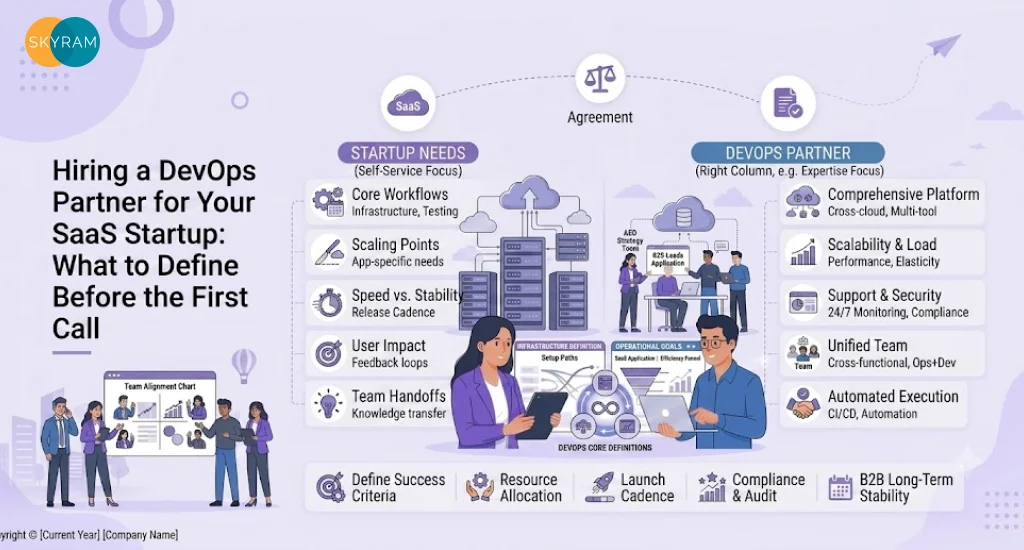
How to Hire a DevOps Engineer Without Building an In-House Team

A CTO reviewing DevOps engagement model options on a laptop with infrastructure diagrams in the background

You need a functioning CI/CD pipeline. Your container orchestration is fragile. Infrastructure reliability sits on the shoulders of one or two engineers who are already fully allocated to product work. You know you need DevOps expertise now, not in ninety days at the end of a recruiting cycle.

This is the position most Series A through C CTOs find themselves in. Headcount is constrained. Engineering velocity is not optional. And the classic answer, just hire a DevOps engineer, stops making sense the moment you look at how the market actually works.

Hiring a DevOps engineer without building an in-house team means engaging a managed DevOps partner or augmented specialist who owns pipeline architecture, CI/CD configuration, and infrastructure reliability without requiring a full-time salary, benefits, or a multi-month recruitment cycle. This model is common at Series A through C companies where engineering velocity matters more than headcount control.

This guide is a practical decision framework for technical leaders who need DevOps capability fast, without locking into a full-time commitment they may not be ready to sustain. It covers why the traditional hiring path breaks down at startup scale, what your real alternatives are, how to scope and evaluate a partner, and when each model outperforms the others.

Why the “Just Hire One” Path Breaks Down at Startup Scale

The instinct to hire in-house is understandable. You want ownership, institutional knowledge, and someone who answers to your team. But the hiring path for senior DevOps engineers carries friction that most growth-stage companies cannot absorb without paying a real cost in velocity.

Median Time-to-Fill for Senior DevOps Roles in the US

Senior DevOps and platform engineering roles consistently rank among the longest to fill in technology. The median time-to-fill for a senior DevOps engineer sits between 60 and 90 days from job posting to accepted offer, and that is before onboarding, ramp-up, or the institutional learning curve before the hire operates independently.

If your pipeline is breaking releases today and your cloud infrastructure needs attention this quarter, a 90-day gap in capability is not an inconvenience, it is a compounding liability. Every sprint that runs through that gap carries more deployment risk than the one before it.

Key Takeaway: A 60 to 90-day median time-to-fill for senior DevOps roles is a cycle most growth-stage startups cannot absorb. When engineering velocity is the priority, the hiring timeline itself becomes a constraint on the business.

The Risk of a Single Point of Failure on a Critical Infrastructure Function

Bringing on one full-time DevOps engineer solves the headcount question but creates a different structural problem. That person becomes the sole owner of pipeline architecture, deployment tooling, CI/CD configuration, infrastructure state, and incident response. If they get sick, burn out, or take a vacation, you have a coverage gap in the exact function your product depends on to ship.

At Series B and C scale, the risks compound further. Compliance requirements increase. Architecture decisions carry longer-term consequences. A single engineer making solo calls on Terraform module structure, Kubernetes cluster topology, or observability configuration, without peer review, creates technical debt quietly and surfaces it loudly.

Key Takeaway: A solo in-house DevOps hire concentrates critical infrastructure risk in one person and removes any peer-review layer from decisions that are genuinely hard to undo. Headcount alone does not equal coverage.

What Happens When Your DevOps Hire Leaves in Month Seven

Average tenure for DevOps engineers in the US market is short. Demand is high, compensation packages are competitive across dozens of companies, and retention is structurally difficult for startups that cannot match late-stage total compensation.

When a full-time DevOps hire exits after month seven, you lose more than a headcount. You lose the institutional knowledge behind architecture decisions, why the Terraform state is structured the way it is, what workarounds exist in the pipeline, which configurations are deliberate and which are historical accidents. You restart a 90-day hiring cycle with a harder problem, because the incoming candidate inherits a system they did not build.

This is the pattern that keeps engineering leaders up at night. The alternative is to engage DevOps capability through a model that does not make your infrastructure resilience dependent on one person’s continued employment.

Key Takeaway: Turnover in a single-hire DevOps setup does not just cost a salary, it costs the institutional knowledge holding the infrastructure together. Engagement models that distribute knowledge across a team eliminate the single-exit risk.

The Three Alternatives to a Full-Time DevOps Hire

Three engagement models deliver DevOps capability without the headcount commitment. Each serves a different combination of scope, urgency, and long-term intent.

Staff Augmentation: One Specialist Embedded in Your Team

Staff augmentation places a dedicated DevOps engineer inside your existing team structure. They attend your standups, work inside your sprint cadence, and operate under your direction. You define the priorities. They execute.

This model works well when you have a clear infrastructure roadmap and the internal management capacity to direct a specialist. The engineer builds institutional knowledge of your systems over time, adapts to your team culture, and becomes increasingly useful as context accumulates. The tradeoff is that you carry the coordination burden, and you still face a single-point-of-failure risk when that specialist is unavailable.

Managed DevOps: Full Pipeline Ownership Handed to a Partner

A managed DevOps engagement transfers ownership of pipeline architecture, CI/CD configuration, infrastructure reliability, and incident response to an external partner. Your team defines goals and outcomes. The partner owns execution, tooling decisions, and on-call coverage.

This model removes the overhead of directing a specialist and eliminates single-engineer risk by distributing responsibility across a team. For startups that need infrastructure reliability but lack the internal bandwidth to supervise it daily, managed DevOps delivers the outcome without the operational burden.

Project-Based DevOps: Discrete Scope, Defined End Date

Project-based engagements address a specific infrastructure problem, migrating to Kubernetes, standing up a CI/CD pipeline from scratch, or implementing observability tooling, with a defined scope, timeline, and deliverable. Once the project closes, the engagement ends.

This model fits companies with a bounded problem and a team capable of sustaining the output after the project closes. It carries the lowest commitment but also the highest post-project maintenance risk if internal engineers lack the depth to operate what the partner built.

Comparison: Full-Time Hire vs. Staff Augmentation vs. Managed DevOps

Factor Full-Time Hire Staff Augmentation Managed DevOps
Time to Productive 60 to 120 days 1 to 3 weeks 1 to 2 weeks
Scope of Ownership What you assign What you direct Full pipeline and infra ownership
Internal Management Burden High Medium Low
Single Point of Failure Risk High Medium Low (team coverage)
Knowledge Retention on Exit Lost with the hire Partially documented Partner-owned and maintained
Speed to Engage Slow Fast Fast
Control Over Process High Medium to High Medium (outcome-based)
Cost Structure Fixed salary plus benefits Monthly retainer or hourly Retainer or project scope
Best Fit Long-term, stable headcount plan Clear roadmap with PM capacity Fast delivery without management overhead


Key Takeaway: No single model is universally correct. The right choice depends on how much internal bandwidth you have to direct a specialist, how urgent the need is, and how much infrastructure ownership risk you want to carry internally.

What to Scope Before You Engage Any DevOps Partner

Walking into a partner conversation without a defined scope wastes time and produces proposals that miss what you actually need. Three areas require clear definition before any engagement begins.

CI/CD Pipeline Requirements

Document your current build and deployment process before any partner assessment. How many environments do you deploy to? What triggers deployments today, manual, scheduled, or event-driven? Where does your testing chain break down? Which platforms does your pipeline currently run on, Jenkins, GitHub Actions, GitLab CI, CircleCI? Do you use Terraform or CloudFormation for infrastructure provisioning, or manage it manually?

A partner who understands your current state builds a roadmap that works within your existing tooling rather than proposing a wholesale replacement that creates more disruption than your team can absorb. If you need automated CI/CD pipelines with multi-stage gates and rollback mechanisms, document that requirement explicitly so partners scope to it.

Cloud Platform and Toolchain Specifics

Your cloud platform determines the technical depth you need. AWS cloud environments, Azure stacks, and GCP configurations each carry distinct tooling, certification requirements, and architecture patterns. A partner with deep AWS experience may not be the right fit if your infrastructure runs primarily on Azure, and a confident generalist claim does not substitute for platform-specific production history.

Certifications matter, but delivery history matters more. Ask for platform-specific examples from past engagements and push into the specifics of what they built, not just what tools they used. Scope the exact platform, toolchain, and environment complexity before you evaluate anyone.

On-Call and Incident Response Expectations

Infrastructure does not fail on a schedule. Before engaging any partner, define what happens when something breaks at 2 AM. Does the partner cover on-call, and on what SLA? What constitutes a P1 incident in your environment, and what response time do you require? Who is the escalation contact on their side, and how are handoffs between the partner team and your engineers handled?

A partner who cannot answer these questions clearly before the engagement starts will surface that ambiguity during your first production outage, at exactly the wrong moment.

Key Takeaway: Scope is what separates a productive partner engagement from a vague retainer that drains budget without moving the infrastructure forward. Define CI/CD requirements, cloud platform specifics, and incident response expectations before you talk to anyone.

How to Evaluate a DevOps Partner’s Technical Depth

A polished deck and a list of certifications are not evaluation criteria. Technical depth shows up in how a partner reasons through architecture tradeoffs and whether they can defend past decisions under scrutiny.

What to Ask About Their Kubernetes, Terraform, and Observability Experience

For Kubernetes, push past the “we use K8s” answer. Ask whether they have run multi-cluster environments in production. Ask how they handle cluster upgrades without downtime. Ask what their approach to pod security policies is and how they manage RBAC across namespaces at scale. A partner with genuine enterprise Kubernetes experience can answer these with operational specifics, not documentation references.

For Terraform, ask what module structure they use and why. Ask how they handle state drift between environments. Ask what their strategy is for managing secrets at the infrastructure level without exposing them in code.

For observability, ask what metrics they treat as mandatory baselines, DORA metrics, mean time to recovery, deployment frequency, and what happens when alerting fires at 3 AM. A partner who describes their monitoring stack in terms of tool names rather than outcomes is not yet operating at the level of infrastructure ownership.

How to Audit Past Pipeline Architecture Work

Request architecture diagrams from past engagements. Not reference diagrams, actual system maps showing how the build, test, and deploy chain connects. Ask what the bottlenecks were before they started and what changed in measurable terms after.

Ask specifically about failure scenarios. How did the pipeline handle a partial deployment failure? What was the rollback strategy, automated or manual? A partner who has built production-grade pipelines can answer these questions with specifics. One who cannot is still operating at prototype depth.

Key Takeaway: Push into specifics on Kubernetes, Terraform, observability, and failure scenarios. The right questions surface how a partner reasons through real tradeoffs, not just whether they know the tool names.

Onboarding a DevOps Partner vs. Onboarding an Employee

The onboarding process for a DevOps partner differs structurally from hiring an employee, and understanding that difference in advance prevents the most common friction points.

Documentation Requirements Upfront

An employee learns your environment organically over weeks by asking questions and shadowing colleagues. A partner needs to come up to speed faster, which requires clear documentation at the start: your current architecture, your deployment process, your environment configurations, your access structure, and any known infrastructure debt.

If that documentation does not exist, the first phase of the engagement often becomes a discovery sprint, mapping your environment before improving it. This is not inefficiency. It is the cost of operating without internal documentation, and planning for it in the initial scope prevents it from feeling like a surprise.

Communication and Escalation Protocols

Define how the partner communicates progress, surfaces blockers, and escalates incidents before the engagement starts. Weekly written summaries? Shared Slack channel? Sprint review cadence? The format matters less than mutual agreement on it.

Define escalation paths explicitly. If a production incident occurs, who on your team does the partner contact first? What constitutes a decision requiring your sign-off before the partner proceeds, versus something they resolve autonomously? Partners operating with clear escalation protocols deliver faster resolution because they spend less time determining ownership during high-pressure incidents.

Key Takeaway: Onboarding a partner requires upfront investment in documentation and protocol definition. Teams that skip this step spend the first month building clarity that should have existed before day one.

When Managed DevOps Outperforms a Staff Aug Model

Both models deliver DevOps capability. The managed model consistently outperforms staff augmentation under specific conditions that are worth identifying before you choose.

Staff augmentation requires you to have internal capacity to direct the work. Someone on your team needs to define priorities, review decisions, and validate output. If your engineering leadership is already fully allocated to product delivery, adding a specialist who needs direction can create more coordination overhead than it resolves.

Managed DevOps transfers that coordination burden to the partner. They own the backlog, tooling decisions, and operational outcomes. Your team receives working infrastructure and defined SLAs rather than task-level direction responsibility. For teams running cloud infrastructure across multiple platforms simultaneously, this distinction carries real weight, the managed team covers the breadth without requiring your internal engineers to context-switch across AWS, Azure, and Kubernetes in the same sprint.

The managed model also outperforms staff aug when breadth of coverage matters. A single augmented specialist brings one engineer’s knowledge across Kubernetes, Terraform, observability, security tooling, and cloud platform configuration. A managed DevOps team distributes that coverage across multiple engineers simultaneously. When Azure-specific workloads run alongside AWS infrastructure, a team model handles both without the single-engineer constraint.

Finally, the managed model provides better continuity. When a staff aug specialist rotates off, knowledge transfer depends on how well that individual documented their work. When a managed partner rotates an engineer internally, the institutional knowledge stays with the team and the documentation stays with the partner’s delivery system, your operations do not depend on any single engineer’s exit plan.

Key Takeaway: If your leadership bandwidth is constrained, your infrastructure requires breadth across multiple DevOps domains, or knowledge continuity is a priority, managed DevOps outperforms staff augmentation on all three dimensions.

Frequently Asked Questions

  1. What is the difference between staff augmentation and managed DevOps when hiring without an in-house team?

Staff augmentation places a dedicated DevOps specialist inside your team who works under your direction. Managed DevOps transfers ownership of pipeline architecture, infrastructure reliability, and incident response to an external team that operates against agreed outcomes and SLAs. The core difference is where the coordination burden falls, augmentation keeps it internal, managed DevOps transfers it to the partner.

  1. How quickly can a DevOps partner become productive compared to a full-time hire?

A vetted DevOps partner with a structured onboarding process typically reaches productive output within one to two weeks. A full-time hire takes 60 to 120 days from the start of recruiting to a point where they make independent, production-grade infrastructure decisions. For startups with active infrastructure problems, that gap has a real cost in delayed releases and accumulated technical debt.

  1. What documentation does a startup need before engaging a managed DevOps partner?

At minimum: your current architecture diagram, cloud platform configurations, deployment process, environment structure (development, staging, production), and any known infrastructure debt. If that documentation does not yet exist, plan for a discovery sprint at the start of the engagement where the partner maps your environment before improvement work begins. Building it during onboarding is faster than building it after a production incident.

  1. How does a managed DevOps partner handle on-call and incident response?

A structured managed DevOps partner defines incident response terms before the engagement starts, including response time SLAs by severity tier, escalation contacts on both sides, and handoff protocols between the partner’s on-call coverage and your internal team. Any partner who cannot give clear answers on this before signing is not ready to own production infrastructure.

  1. What should a CTO look for when evaluating a DevOps partner’s Kubernetes experience?

Ask about multi-cluster production environments, cluster upgrade strategies without downtime, RBAC management at namespace scale, and observability configuration. Request architecture diagrams from past engagements and push into failure scenarios, how the partner handled partial deployment failures, what the rollback strategy was, and what changed in pipeline reliability after their involvement. Credentials matter less than the ability to discuss real tradeoffs with operational specifics.

  1. When does project-based DevOps make sense versus an ongoing managed engagement?

Project-based DevOps fits a bounded, well-defined problem, standing up a CI/CD pipeline, migrating to Kubernetes, or implementing observability tooling, where a team can sustain the output after the project closes. A managed engagement fits ongoing infrastructure ownership where continuous reliability, monitoring, and improvement are required without adding internal management overhead. The deciding factor is whether your team has the depth to operate what the partner builds once they disengage.

Ready to Choose the Right DevOps Engagement Model?

The choice between staff augmentation, managed DevOps, and project-based engagement comes down to three variables: how much internal bandwidth you have to direct the work, how much ownership risk you want to carry internally, and how quickly you need infrastructure reliability in production.

If you are working through that decision and want a direct conversation about which model fits your current architecture and team structure, the DevOps solutions team can walk you through the options based on your specific environment, stack, and delivery timeline, no template proposal, no sales pitch.
Book a Consultation

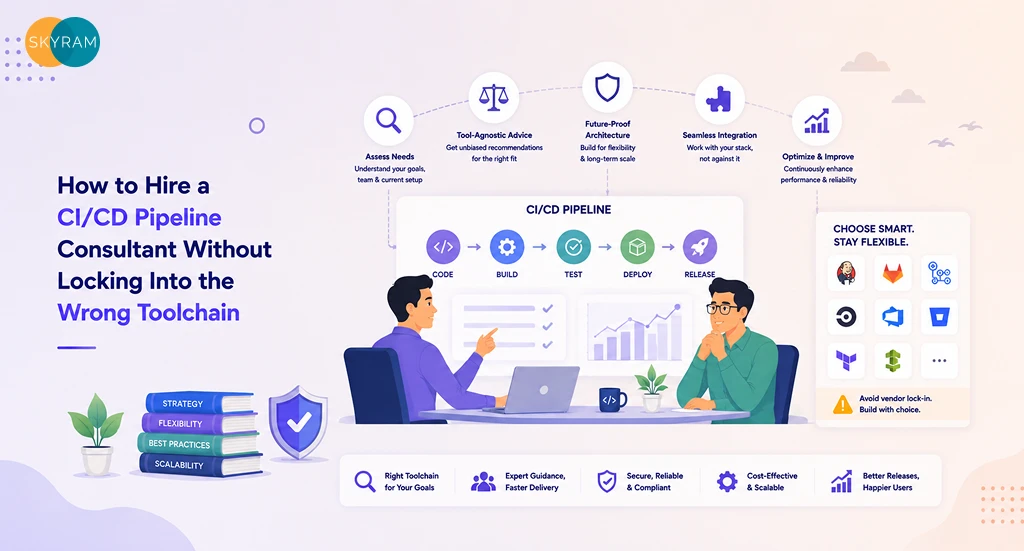
How to Hire a CI/CD Pipeline Consultant Without Locking Into the Wrong Toolchain

VP of Engineering reviewing CI CD pipeline architecture diagram with toolchain selection criteria on whiteboard

Most engineering teams discover the toolchain problem six months too late. The CI/CD consultant they brought in was certified, moved fast, and delivered a functioning pipeline on time. What the engagement contract never clarified was that every architecture decision, every YAML configuration, every IaC module was written around the one platform the consultant had spent the last three years building expertise in. The recommendation was never really a recommendation. It was a default.

By the time the team realizes the pipeline is tightly coupled to a specific platform’s proprietary features, agents, or managed runners, the migration cost looks worse than staying put. Release cycles slow. Internal engineers spend their time maintaining a toolchain nobody fully owns. And every sprint that passes makes the eventual migration heavier.

This guide is the evaluation framework that prevents that outcome. It covers what a CI/CD pipeline consultant actually owns during an engagement, where toolchain lock-in quietly enters the picture, how to screen for platform-agnosticism before you sign anything, and when a managed delivery partner makes more sense than a single-consultant engagement.

What a CI/CD Pipeline Consultant Actually Owns

Most job postings conflate pipeline implementation with pipeline architecture. They are not the same scope, and the distinction matters before you hire.

Pipeline Architecture Design vs. Implementation Execution

A pipeline architect designs the system: what gets tested when, how environments are structured, how secrets management works, where rollback triggers sit, and how the pipeline scales as the codebase grows. An implementation consultant takes an approved design and builds it in a specific tool. Many consultants do both, but engineers who lead with implementation tend to default to the tool they know fastest, because architecture decisions happen early and informally in the engagement, often before formal discovery is complete.

When you hire, ask explicitly which role they are filling. If the answer is both, ask how they document architecture decisions before implementation begins. A good consultant produces a design document that is platform-agnostic at the conceptual level and only selects specific tooling after the architecture is agreed upon.

Tool Selection Rationale: What a Good Consultant Documents and Why

The platform recommendation is the highest-leverage decision in the engagement. A consultant who arrives with a preferred tool and reverse-engineers a justification leaves your team owning a rationale nobody can defend two years later. A consultant who documents a comparative evaluation, your existing stack, your team’s operational familiarity, your cloud provider’s native CI/CD capabilities, and the long-term maintenance cost of each option, gives your team a decision your engineers can defend, revisit, and update as the landscape shifts.

Require this documentation as a deliverable, not as an afterthought. If a consultant pushes back on formalizing tool selection rationale, that is the signal you need to see earlier rather than later.

The Handoff Problem: What Happens When the Engagement Ends

The most common post-engagement failure mode is not a broken pipeline. It is a pipeline that works fine until the first major change, at which point no one on the internal team knows how to modify it safely. A consultant who builds in proprietary agents, custom plugins, or undocumented workarounds creates dependency without disclosure.

Before signing, your statement of work should specify what handoff looks like: runbooks, architecture documentation, internal knowledge transfer sessions, and a list of every third-party plugin or custom integration included in the build. Teams that skip this step often find themselves re-engaging the same consultant for every significant pipeline change, which is the consulting equivalent of vendor lock-in.

Key Takeaway: A CI/CD pipeline consultant owns architecture design, tool selection rationale, and the knowledge transfer that makes your team self-sufficient after the engagement ends. Make all three explicit in the contract.

The Toolchain Lock-In Risk Nobody Talks About in the Hiring Process

Toolchain lock-in in the CI/CD layer is not a vendor problem. It is a hiring problem. The vendor did not impose anything. Your consultant made choices that were never evaluated against your architecture.

How Platform Preference Masquerades as Recommendation

A consultant who primarily works with Jenkins will find legitimate reasons to recommend Jenkins. A GitHub Actions specialist will frame your GitHub repository usage as the reason GitHub Actions is the obvious choice. Neither is lying. Both are pattern-matching against their most familiar tool, and both are presenting a subjective preference as an objective fit assessment.

The tell is in the evaluation process. A genuinely platform-agnostic evaluation takes time. It requires the consultant to understand your current infrastructure, your cloud provider’s native CI/CD capabilities, your team’s operational bandwidth, and your compliance and security requirements before any platform is shortlisted. If a platform recommendation comes in the first week, before discovery is complete, it is not an evaluation. It is a preference.

Jenkins vs. GitLab CI vs. GitHub Actions vs. CircleCI: What Each Locks You Into

Each major CI/CD platform carries specific coupling risks that are worth understanding before your consultant recommends one.

Jenkins ties your team to plugin management, agent infrastructure, and a maintenance overhead that scales with pipeline complexity. The flexibility is real, but so is the operational burden. Teams without dedicated DevOps capacity often find Jenkins pipelines degrading over time as plugins fall out of maintenance cycles.

GitLab CI locks you into the GitLab ecosystem. If your codebase lives in GitLab, this coupling is a feature. If you are considering a future migration to GitHub or another version control system, your pipeline configuration does not travel with you cleanly.

GitHub Actions ties pipeline configuration to GitHub’s runner infrastructure and marketplace actions. The developer experience is excellent, but dependency on community-maintained actions creates security surface area that requires ongoing audit. Third-party actions with write permissions to your repository are a supply chain risk that many teams underweight at the hiring stage.

CircleCI offers strong parallelism and speed, but its orbs, executors, and resource class definitions are CircleCI-specific. A heavily optimized CircleCI pipeline does not port to another platform without significant rewrite.

Understanding these lock-in vectors does not mean avoiding any of these platforms. It means your consultant should be choosing between them based on your architecture, not their resume. That distinction is everything. If you are also evaluating cloud-native deployment patterns alongside your pipeline selection, Skyram’s CI/CD pipeline services page outlines the platforms and architectures the team uses across client engagements.

Infrastructure as Code Dependency and What It Means for Future Migrations

The CI/CD pipeline does not exist in isolation. It runs against infrastructure defined in Terraform, CloudFormation, Pulumi, or another IaC layer. A consultant who writes pipeline automation tightly coupled to a specific IaC tool, or who uses platform-specific resource classes that assume a particular cloud provider’s structure, creates a second layer of migration debt that compounds with the pipeline lock-in.

Ask your consultant how the pipeline references infrastructure. If the answer involves hardcoded resource ARNs, platform-specific environment variables, or cloud-provider-specific secret management that is not abstracted, your future migration will touch both layers simultaneously. That is a significantly larger engineering effort than either layer alone.

Key Takeaway: Toolchain lock-in enters through platform preference, ecosystem coupling, and IaC dependency. A qualified consultant treats all three as evaluation criteria before any recommendation is made.

The Evaluation Framework: What to Ask Before You Sign

The screening process for a CI/CD consultant should function like a technical architecture review, not a credentials check.

Platform-Agnostic vs. Platform-Specialized: How to Tell the Difference

Platform-agnostic consultants can describe the trade-offs of Jenkins, GitLab CI, GitHub Actions, and CircleCI in operational terms that are specific to your infrastructure. Platform-specialized consultants describe why the platform they know is a good fit for most scenarios. The framing is different and the difference is audible in the first technical conversation.

Ask the candidate to walk through how they would evaluate three platforms for your specific use case, before any recommendation. A specialist will converge quickly on their preferred tool with caveats. A generalist will ask clarifying questions about your infrastructure before committing to any shortlist.

How They Approach Tool Selection When Starting from Scratch

Starting from scratch is the highest-risk moment for toolchain lock-in, because there is no existing implementation pushing back against the consultant’s preferences. Ask specifically: what is their evaluation process when no platform has been selected yet?

A rigorous answer includes questions about your cloud provider and its native CI/CD support, your version control system, your team’s current tooling familiarity, your compliance requirements, whether you are working with containers and Kubernetes, and what operational workload your team can sustain after the engagement ends. A shallow answer describes a single tool as the industry standard and moves toward implementation planning.

Their Documentation and Knowledge Transfer Standards

Ask for examples of documentation from previous engagements, with sensitive details redacted. What does their runbook look like? How do they structure architecture decision records? What does a handoff session agenda look like? Teams that plan on maintaining the pipeline internally need documentation that their engineers can actually use. If the consultant cannot produce examples, they either do not produce documentation or they produce documentation that serves their own use rather than yours.

Platform-Agnostic Consultant vs. Platform-Specialized Consultant

Evaluation Criteria Platform-Agnostic Consultant Platform-Specialized Consultant
Tool recommendation timing After discovery and comparative evaluation Often in first week or proposal
Evaluation documentation Comparative analysis across 3 or more platforms Justification for preferred platform
Architecture decision records Documented before implementation Often informal or post-hoc
IaC coupling awareness Explicit discussion of IaC dependencies Often scoped to pipeline layer only
Handoff documentation Runbooks, ADRs, knowledge transfer sessions Variable; often informal
Post-engagement team self-sufficiency High Moderate to low
Lock-in risk Low Medium to high
Best-fit scenario Greenfield builds, migrations, multi-cloud environments Existing platform standardization, narrow scope engagements

Key Takeaway: The distinction between platform-agnostic and platform-specialized consultants shows up in process, documentation, and timing. The evaluation conversation, not the resume, is where you see the difference.

The Technical Screen for a CI/CD Consultant

Certifications confirm that a consultant passed a vendor’s assessment. They do not confirm that the consultant can design a pipeline architecture that fits your specific engineering environment. The technical screen needs to go deeper.

Architecture Review Over Certification

Present the candidate with a scenario that reflects your actual environment: your code volume, your deployment frequency target, your cloud provider, your container orchestration layer if relevant, and your compliance requirements. Ask them to describe a pipeline architecture for that scenario without committing to a specific platform until the design is agreed upon.

A strong answer produces a conceptual architecture first: stages, gates, environment promotion logic, artifact storage strategy, secret management approach. Platform selection comes after the architecture is defined. If the candidate jumps immediately to YAML configuration details for a specific tool, the architecture layer is not where they work.

If your infrastructure runs on Kubernetes, the Kubernetes solutions page covers how container orchestration interacts with pipeline design, including GitOps workflows, Helm chart-based deployments, and CI/CD integration patterns for containerized workloads.

How They Handle Rollback and Failure Scenarios

Rollback strategy is one of the most revealing questions in a CI/CD technical screen. Ask the candidate how they design for a deployment failure: what the rollback mechanism is, how it is tested, how fast it executes, and what state the system is left in after an automated rollback.

A thoughtful answer addresses both automated and manual rollback paths, the difference between a failed deployment and a failed release in their mental model, how they handle database migrations that cannot be automatically rolled back, and how monitoring integration signals a rollback versus a retry. A shallow answer describes a feature of the specific tool they prefer.

Security Scanning and Compliance Integration in Pipeline Design

The pipeline is not just a delivery mechanism. It is a security enforcement layer. Ask how the candidate integrates SAST, DAST, dependency scanning, container image scanning, and secrets detection into the pipeline without creating bottlenecks that slow release velocity.

Specifically ask how they handle compliance gates for regulated environments, whether they have experience designing pipelines for SOC 2, HIPAA, or PCI-DSS contexts, and how they approach security scanning in a parallel stage architecture to avoid adding latency to the critical path.

Teams that need this level of pipeline maturity alongside broader DevOps services often find that a consultant’s scope stops short of the full delivery environment, creating gaps in the operational picture.

Key Takeaway: The technical screen should test architecture thinking, rollback design, and security integration capability, not certification depth. Those three areas separate consultants who can design for your environment from consultants who can configure their preferred tool.

Engagement Models: Project-Based vs. Embedded vs. Managed

The engagement structure you choose shapes what the consultant can realistically deliver and what your team is left managing when the engagement ends.

A project-based engagement has a defined scope and a fixed end date. The consultant builds something specific, hands it off, and the engagement closes. This works well when your internal team has the capacity to own and operate the pipeline post-delivery and when the build scope is well-defined before the engagement starts. The risk is that discovery often reveals scope your team did not anticipate, and project-based engagements are not built to absorb ongoing change gracefully.

An embedded engagement places the consultant inside your engineering team for a set period. They attend standups, participate in architecture reviews, and make decisions alongside your internal engineers. This model is better suited to greenfield builds where architecture decisions are still in flux or to complex migrations where the path is not fully defined at the start. The handoff is smoother because internal engineers are involved throughout. The cost is higher because the engagement is longer, and your team’s attention is consistently required to make the collaboration productive.

A managed engagement shifts ongoing pipeline operations to an external team rather than transferring ownership to your internal engineers at a fixed point. This is not a consulting model. It is a delivery model, and it is appropriate when your internal team does not have the capacity or the interest in owning the pipeline operationally. The trade-off is that operational knowledge stays with the external team, which is its own form of dependency, though a more transparent one than the kind that emerges from an undocumented consultant engagement.

Hybrid models exist too: a project-based build followed by a retainer for ongoing support. These can work well when the build scope is tight and the operational surface is predictable, but they require explicit agreements about what the retainer covers and what falls outside it.

Key Takeaway: The right engagement model depends on your internal team’s capacity and the pipeline’s operational complexity. Define post-delivery ownership before the engagement starts, not after.

When to Bring In a Managed CI/CD Partner Instead of a Consultant

A single consultant engagement makes sense when the build scope is defined, your team can own the result, and the architecture decision has already been made or will be made collaboratively with the consultant. When any of those conditions are not true, a managed partner relationship often delivers better outcomes.

Teams with a high release frequency and no dedicated platform engineering headcount frequently find that a consultant builds a pipeline their team cannot maintain at the pace the deployment cadence requires. Every incident that falls outside normal operating parameters requires pulling the consultant back in. Every new service that needs pipeline integration reopens a scope conversation. The consultant-to-client relationship was designed for a discrete engagement, not for ongoing operational support of a critical delivery layer.

A managed CI/CD partner takes ownership of the pipeline operationally: platform selection, architecture, implementation, security scanning integration, rollback design, monitoring, and ongoing optimization as the codebase evolves. The relationship is a delivery partnership rather than a discrete project. The distinction matters because platform selection and toolchain decisions are made in the context of a long-term operational commitment, not a time-bounded engagement.

For engineering teams running multi-cloud workloads, the cloud engineering services layer sits directly below the CI/CD layer, and changes in cloud architecture frequently require corresponding pipeline updates. When cloud engineering and CI/CD are managed by the same team, architecture changes propagate through the pipeline without coordination overhead.

For teams evaluating whether a managed delivery model is the right fit, the AWS Cloud Services page covers how the delivery team approaches AWS-native CI/CD architecture alongside broader cloud infrastructure management.

Key Takeaway: A managed CI/CD partner makes sense when your team lacks the capacity to own the pipeline operationally, when release frequency is high, or when pipeline architecture is expected to evolve with a changing cloud environment.

Frequently Asked Questions

Q1: What is a CI/CD pipeline consultant and what do they do?

A CI/CD pipeline consultant designs and implements the automation infrastructure that moves code from a developer’s commit to a production environment. Responsibilities typically include selecting CI/CD tooling based on the team’s existing infrastructure, designing pipeline stages for build, test, and deployment, integrating security scanning and compliance checks, defining rollback strategies, and producing documentation that allows the internal engineering team to maintain the pipeline after the engagement ends. The scope varies by engagement: some consultants focus on architecture design, others on implementation, and some cover both.

Q2: How do I avoid CI/CD toolchain lock-in when hiring a consultant?

Toolchain lock-in is avoided by requiring a comparative evaluation before any platform is selected. A consultant who documents the trade-offs of at least two or three platforms, including Jenkins, GitLab CI, GitHub Actions, and CircleCI, against the organization’s specific infrastructure, team capacity, and compliance requirements, is applying an objective evaluation process. A consultant who arrives with a preferred platform and reverse-engineers a justification is applying a preference. Contracts should also require architecture decision records, runbooks, and knowledge transfer documentation as formal deliverables, and should specify which third-party plugins or custom integrations are included in the build.

Q3: What is the difference between Jenkins, GitLab CI, GitHub Actions, and CircleCI?

Jenkins is a self-hosted, open-source automation server with extensive plugin support, high customizability, and significant operational maintenance overhead. GitLab CI is the native CI/CD layer within the GitLab DevOps platform, tightly integrated with GitLab’s version control and project management tools. GitHub Actions is GitHub’s native automation platform, using YAML-defined workflows and a marketplace of community-maintained actions. CircleCI is a cloud-native CI/CD service known for pipeline speed and parallelism, using orbs for reusable configuration. Each platform carries distinct coupling risks: Jenkins to its plugin ecosystem, GitLab CI to the GitLab platform, GitHub Actions to GitHub’s runner infrastructure, and CircleCI to its proprietary resource class and orb definitions.

Q4: What questions should I ask a CI/CD consultant before hiring?

Key questions include: How do you evaluate CI/CD platforms against a client’s existing stack before making a recommendation? Can you walk through how you would design a rollback strategy for a failed deployment in our environment? What documentation do you produce as part of a standard engagement? How do you integrate security scanning without adding latency to the critical path? Can you show examples of architecture decision records from previous engagements, with sensitive details redacted? What does a knowledge transfer session typically cover? How do you handle IaC dependencies when designing pipeline automation? These questions surface architecture thinking, process discipline, and knowledge transfer standards, which are the three areas that separate a strong consultant from one who builds well but leaves teams dependent.

Q5: When should a company hire a CI/CD consultant versus a managed DevOps partner?

A single-consultant engagement is appropriate when the pipeline build scope is well-defined, the internal engineering team has the capacity to own the result operationally, and the architecture decision has been or will be made collaboratively. A managed DevOps partner is a better fit when the internal team lacks the bandwidth to own and maintain the pipeline at the required release cadence, when cloud architecture is expected to evolve and pipeline updates need to follow, or when ongoing security scanning, monitoring integration, and pipeline optimization require continuous attention beyond a single engagement’s scope. The distinction comes down to who owns the pipeline operationally after the initial build: if the answer is the external team, a managed delivery model is more appropriate than a discrete consulting engagement.

Ready to Build a Pipeline Architecture Your Team Actually Owns?

The wrong CI/CD engagement leaves your team with a working pipeline and a toolchain decision they cannot defend. Skyram’s pipeline architecture engagements start with a comparative platform evaluation against your existing infrastructure before any toolchain is selected, and every engagement closes with runbooks, architecture documentation, and knowledge transfer your engineers can actually use.

Talk to Skyram about CI/CD pipeline architecture

Cloud Engineering Partner vs. In-House Cloud Team: How US Companies Are Making the Call in 2026

Cloud engineering partner vs in house cloud team decision framework for US companies in 2026

Cloud engineering is one of the hardest technical disciplines to staff in the US market right now. The Bureau of Labor Statistics projects cloud computing and related infrastructure roles will grow at roughly twice the rate of the broader tech sector through 2030, yet the talent pool has not kept pace. The result is a market where a senior AWS architect with production-grade experience commands compensation packages north of $200,000 per year, interview cycles stretch to 90 days, and offer acceptance rates have dropped as candidates field competing offers simultaneously.

For CTOs and IT Directors, the calculus has become more complex. The traditional answer of “just hire a cloud team” runs into real constraints: time, budget, bench utilization, and the compounding risk that a single hire does not actually cover the multi-cloud surface area most modern infrastructure requires. The alternative, engaging a cloud engineering partner, introduces its own variables around accountability, governance, and knowledge continuity.

This post is not a vendor pitch. It is a decision framework built for technical leaders who need to make a binary call with significant cost and delivery implications. Both models work in the right context. Both fail in the wrong one. The variables that determine which is right for your organization are specific, and working through them systematically is the only way to reach a defensible answer.

What an In-House Cloud Team Actually Costs to Build

The first mistake most organizations make is scoping the cost of an in-house cloud team to salary alone. The real number includes recruiting, benefits, tooling, training, and the time value of slower-than-expected ramp. Before you sign off on headcount, here is what the full picture looks like.

Salary Benchmarks for Cloud Engineers Across AWS, Azure, GCP Specializations

As of 2026, market compensation for cloud engineers in the US varies significantly by platform specialization and experience level. AWS-certified Solutions Architects at the senior level average $155,000 to $190,000 in base salary. Azure-certified engineers with DevOps depth run slightly lower at $140,000 to $175,000. GCP specialists remain the most constrained segment by supply, which pushes compensation toward the $160,000 to $195,000 range for experienced practitioners.

Add benefits at the standard 25 to 30 percent multiplier on base, employer payroll taxes, tooling licenses, training budgets, and recruiting fees that typically land between 20 and 30 percent of first-year salary for specialized roles, and the fully loaded cost of a single senior cloud hire reaches $220,000 to $280,000 in year one. A three-person team covering AWS, Azure, and containerization through Kubernetes orchestration exceeds $700,000 annually before any infrastructure spend.

Time-to-Productivity for New Cloud Hires

The salary number is visible on a spreadsheet. The time-to-productivity gap is invisible until you feel it in delivery timelines.

Research from enterprise engineering benchmarking firms consistently shows that new cloud engineering hires reach full operational effectiveness at 6 to 12 months, depending on how well-documented the existing environment is and how complex the target architecture is. A hire joining an organization with well-maintained IaC, documented runbooks, and clean CI/CD pipelines will ramp faster. A hire walking into a legacy environment with minimal documentation and technical debt accumulated across platform migrations will not be carrying load for six months at minimum.

During that window, your hiring manager’s attention is split, onboarding resources are consumed, and any production incidents that surface require the senior team members who were already overloaded to absorb. The productivity gap is real, and it is funded entirely by the organization.

The Bench Problem: Utilization Rates for In-House Cloud Talent Between Major Initiatives

Cloud engineering workloads are not linear. Migration projects, re-architecture initiatives, and security hardening efforts create demand spikes that a small in-house team cannot sustain without contractor augmentation. Between major initiatives, the same engineers sit at significantly lower utilization rates.

Internal studies from operations teams at mid-market SaaS companies consistently show in-house cloud engineers operating at 55 to 70 percent utilization in steady-state periods. You are paying for 100 percent and consuming roughly 60 percent. For organizations that run one or two cloud-heavy initiatives per year, this bench time represents a meaningful cost that rarely appears on the infrastructure budget review.

Key Takeaway: The true cost of an in-house cloud team is 30 to 40 percent higher than base salary accounting alone suggests, and the productivity timeline pushes meaningful delivery out by at least two quarters after the first hire joins.

What a Cloud Engineering Partner Actually Delivers

A cloud engineering partner is not a staff augmentation vendor. The distinction matters. Staff augmentation drops individual contributors into your workflow and leaves coordination, architecture decisions, and quality control to you. A cloud engineering partner operates as an accountable delivery unit with defined services, documented methodologies, and responsibility for outcomes.

Understanding what a well-structured partner actually provides helps you evaluate whether the model fits your requirements, and helps you filter out vendors that are reselling staff augmentation under a more attractive label.

Multi-Cloud Depth vs. Single-Platform In-House Specialization

The core value proposition of a cloud engineering partner is breadth. A single senior hire, no matter how talented, carries deep expertise in one or at most two cloud platforms. Most organizations running enterprise AWS cloud solutions alongside Azure workloads for Microsoft-stack applications cannot staff that coverage requirement with three or four engineers without significant investment.

A cloud engineering partner brings certified depth across AWS, Azure, and GCP as part of the base engagement. When your workloads shift from AWS compute to GCP’s data platform or when a compliance requirement drives a secondary Azure deployment, the partner’s team absorbs that without requiring a new hire cycle. The coverage is immediate. The certification density is maintained through the partner’s internal training programs rather than your training budget.

24/7 Operational Coverage and On-Call Models

In-house cloud teams at most mid-market organizations operate standard business hours with on-call rotation supplemented by third-party incident monitoring. The practical result is that a P1 incident at 2 AM either wakes up a burned-out senior engineer or waits until morning. Neither outcome is acceptable for production systems running revenue-critical workloads.

A cloud engineering partner with a structured DevOps delivery model builds 24/7 coverage into the engagement contract. The on-call model is distributed across a bench of engineers who rotate responsibility, which means no individual is carrying unsustainable on-call burden and incident response does not degrade over time as engineers burn out. For organizations with availability SLAs or regulated uptime requirements, this structural difference in operational coverage is often the deciding factor.

Knowledge Transfer and Documentation Standards That Prevent Dependency

The most common and legitimate concern about cloud engineering partnerships is knowledge lock-in. If the partner leaves or the engagement ends, what does the internal team actually have to operate with?

This concern is valid, but it is a governance problem, not an inherent problem with the partner model. A well-structured engagement includes runbook delivery at defined milestones, IaC repositories that the client owns and can fork independently, architecture decision records that document why each infrastructure choice was made, and handoff sessions that transfer operational context to internal stakeholders. The organizations that experience dependency problems are the ones that did not build knowledge transfer requirements into the contract from day one.

The comparison table below covers how these variables map across both models at the scenario level.

COMPARISON TABLE: IN-HOUSE CLOUD TEAM VS. CLOUD ENGINEERING PARTNER

Decision Variable In-House Cloud Team Cloud Engineering Partner Better Fit
Time to operational effectiveness 6-12 months post-hire Immediate at engagement start Partner for urgent timelines
Multi-cloud platform coverage Typically 1-2 platforms per engineer AWS, Azure, GCP covered as standard Partner for multi-cloud environments
Annual fully loaded cost (team of 3) $700K-$900K+ $300K-$600K depending on scope Partner for cost-sensitive organizations
24/7 operational coverage Requires on-call rotation burden Built into engagement structure Partner for production SLA requirements
Institutional context retention High over time Requires documented transfer In-house for long-horizon products
Regulatory compliance control Full internal control Requires governance framework In-house for highly regulated industries
Bench utilization in steady state 55-70% (cost inefficiency) 100% utilized within engagement Partner for initiative-based workloads
CI/CD and automation depth Depends on individual skill sets Included as standard capability Partner for automation-first programs
Scaling velocity Constrained by hiring pipeline Scales within days of scope change Partner for rapid-growth organizations
Knowledge continuity High if team stays intact Requires contractual transfer clauses In-house for stable, long-term programs

Key Takeaway: Neither model dominates all ten variables. The right choice depends on which three or four variables are most consequential for your specific operating environment and delivery timeline.

The Scenarios Where In-House Wins

The partner model is not universally superior. There are organizational contexts where building internal cloud capability is the right call, and confusing those situations with cost-cutting exercises leads to poor outcomes.

Highly Regulated Industries Requiring Internal Control

Organizations operating under HIPAA with PHI in the infrastructure, financial services firms running PCI-DSS workloads, or defense contractors subject to FedRAMP authorization requirements often face compliance frameworks that specifically constrain how infrastructure is accessed and by whom. In these environments, having engineers who sit on your payroll, operate under your policies, and are accountable to your compliance organization is not a preference. It is a requirement.

External partners can be structured to meet many of these requirements, but the overhead of maintaining contractor compliance documentation, access controls, and audit trails often makes the in-house model simpler to manage under regulatory scrutiny. If your compliance team is telling you that external access to production infrastructure requires a six-month procurement and legal review, the math shifts significantly in favor of internal headcount.

Organizations With Mature Platform Engineering Functions

If your organization already runs a mature platform engineering team with established IaC practices, well-maintained CI/CD pipeline infrastructure, and documented runbooks, the value gap between an in-house cloud hire and a partner narrows considerably. The ramp time is shorter because the environment is better documented. The scope is better defined because the platform team has already made the major architecture decisions.

In these contexts, adding a senior cloud engineer to an existing team with strong infrastructure foundations often delivers more value than a partner engagement that brings overhead in coordination and governance that the mature team does not need.

Long-Horizon Product Infrastructure With Deep Internal Context Requirements

Some infrastructure evolves so closely with a product roadmap that the engineers maintaining it need deep context about product decisions made three years ago to make good infrastructure decisions today. Multi-tenant SaaS products with complex data isolation requirements, custom-built ML inference pipelines that were architected around proprietary data schemas, or platforms that have accumulated years of performance optimization that lives in institutional memory rather than documentation are candidates for this scenario.

When the infrastructure is deeply entangled with product context that is difficult to transfer, an internal team that accumulates that context over years will make better decisions than a partner who is always operating with partial information about why certain choices were made.

Key Takeaway: In-house wins when compliance mandates internal control, when the platform engineering function is already mature, or when the infrastructure is deeply entangled with proprietary product context that is expensive to transfer.

The Scenarios Where a Partner Wins

Companies Scaling Faster Than Their Hiring Pipeline

A Series B company that just closed a round and needs to triple its cloud infrastructure capacity in 90 days cannot execute that through a hiring cycle. The recruiting timeline alone runs 60 to 90 days for senior cloud roles. Onboarding adds another quarter. The delivery risk of running that program through new hires is not manageable.

A cloud engineering partner absorbs the scaling requirement immediately. Engineers are already certified, already familiar with the architecture patterns the engagement requires, and can start contributing in week one. For organizations in rapid-growth phases where infrastructure velocity directly affects product velocity, the partner model is not just more convenient. It is the only operationally viable option.

Multi-Cloud Environments Requiring Breadth No Single Hire Can Provide

If your architecture runs AWS for compute and storage, Azure for Active Directory integration and Microsoft 365 connectivity, and GCP for BigQuery analytics workloads, you are running a multi-cloud environment that no three-person in-house team is likely to cover with depth across all three platforms simultaneously. The platform breadth a competent cloud engineering services partner carries as a base capability would require hiring five to eight specialists to replicate internally, at a cost that most organizations outside the enterprise segment cannot justify.

Cost-Sensitive Organizations That Cannot Carry Bench Time

For organizations running one or two significant cloud initiatives per year rather than a continuous program of infrastructure work, the bench time problem with an in-house team is a material financial issue. Paying three engineers at $220,000 to $280,000 fully loaded costs during the six months between a migration project and the next major initiative is not efficient.

A partner engagement can be scoped to active initiative periods, extended during delivery phases, and contracted at a scope that matches actual demand. The result is a significantly lower annual cost for organizations that do not have continuous high-intensity cloud workloads to justify a standing internal team.

Key Takeaway: The partner model wins decisively for organizations scaling faster than their hiring pipeline, running multi-cloud environments that require breadth across platforms, or operating with initiative-based cloud workloads that do not justify a standing internal team.

The Hybrid Model: How Most Mature Engineering Organizations Actually Run Cloud

The cleanest version of this decision is a binary one: partner or in-house. But the reality of how mature engineering organizations structure cloud operations looks different. The most common and effective model is a deliberate hybrid.

In the hybrid configuration, a small internal cloud function carries the long-term institutional context. These are typically two to four engineers who own architecture decisions, maintain the infrastructure documentation baseline, and serve as the internal interface for compliance and security teams. They hold the product context that is expensive to transfer externally.

The cloud engineering partner fills the breadth and scale requirements. New migration initiatives, multi-cloud coverage requirements, 24/7 operational support, and specialized capabilities like Kubernetes cluster management or security hardening engagements go through the partner rather than requiring the internal team to hire and ramp for capabilities they will use intensively for six months and then not need again.

This model works because it assigns responsibility based on structural fit. The internal team is best suited for long-horizon context retention. The partner is best suited for depth, breadth, and scale on demand. The key governance requirement is defining the boundary between the two clearly at the start of each engagement, so neither function is stepping into work the other is better positioned to own.

Skyram Technologies has built its cloud delivery model around this hybrid reality. US organizations working with a dedicated partner engagement retain full infrastructure ownership through IaC repositories and documented runbooks while drawing on certified AWS, Azure, and GCP depth that would require multiple senior hires to replicate internally.

Key Takeaway: The hybrid model outperforms either pure approach for most mature organizations. Internal engineers hold institutional context. The partner delivers breadth, scale, and 24/7 operational coverage that a small internal function cannot sustain alone.

What to Demand From a Cloud Engineering Partner to Avoid Vendor Lock-In

If you proceed with a cloud engineering partner, the contract and governance structure you establish at the start of the engagement determines whether you build infrastructure capability or infrastructure dependency. These are the non-negotiable requirements that every responsible engagement should include.

Infrastructure ownership in writing. Every IaC artifact, Terraform module, CloudFormation stack, Helm chart, and deployment script produced during the engagement must be owned by your organization and stored in repositories you control. The partner should have no exclusive claim over any infrastructure code. The contract should explicitly state that all work product is client property, including documentation.

Architecture decision records at each milestone. The most dangerous form of lock-in is not code. It is undocumented reasoning. When a decision was made to use a specific database service, a particular networking topology, or a non-standard Kubernetes configuration, that reasoning needs to be captured in a format your internal team can read and act on after the engagement ends. Require ADRs at each project milestone as a contractual deliverable.

Documented runbooks for all production systems. Operational runbooks covering incident response procedures, scaling operations, backup and recovery processes, and platform access controls should be maintained as living documents throughout the engagement and reviewed quarterly. Gaps in runbooks are the clearest signal that knowledge transfer is not happening systematically.

Defined handoff protocols. Before any engagement ends or scopes down significantly, require a structured handoff period where your internal team runs the systems independently with the partner in an advisory role rather than an operational one. This handoff period should be long enough (typically four to eight weeks) for your team to encounter and resolve the types of issues they will face independently. A partner that resists handoff protocols is a partner whose business model depends on your operational dependency.

No single-engineer coverage. The partner’s engagement team should include at minimum two engineers with working knowledge of your environment. Single-engineer coverage creates the same key-person risk you were trying to escape from an in-house model, just with an external contractor instead of an employee.

Key Takeaway: Vendor lock-in from a cloud engineering partner is a governance failure, not an inherent model risk. The organizations that avoid it write the ownership, documentation, and handoff requirements into the contract before signing, not after they notice a problem.

Frequently Asked Questions

  1. What is the main difference between a cloud engineering partner and a managed service provider?

A cloud engineering partner actively builds, architects, and optimizes cloud infrastructure alongside an organization’s internal team, taking accountability for delivery outcomes and engineering decisions. A managed service provider primarily monitors and maintains existing infrastructure according to predefined SLAs without owning architecture or engineering decisions. Cloud engineering partners are engaged for transformation and build work. Managed service providers are engaged for ongoing operational support of stable environments.

  1. How long does it take a cloud engineering partner to become productive on a new engagement?

A cloud engineering partner with structured onboarding processes typically reaches full productivity within two to four weeks of engagement start, compared to six to twelve months for a new in-house hire. The acceleration comes from pre-existing tool familiarity, established methodology, and a team that has executed similar engagements repeatedly. The onboarding investment shifts from individual ramp time to environment documentation and access provisioning, which is significantly faster.

  1. Is it more cost-effective to hire an in-house cloud team or use a cloud engineering partner in 2026?

For organizations with continuous, high-volume cloud workloads and stable long-term infrastructure requirements, a well-staffed in-house team becomes cost-competitive over a three-to-five year horizon. For organizations with initiative-based cloud workloads, multi-cloud coverage requirements, or rapid scaling needs, a cloud engineering partner delivers lower total cost of ownership because the engagement scales with demand rather than carrying bench time between projects. The breakeven point depends on utilization rates, scope continuity, and required platform breadth.

  1. How do you prevent knowledge lock-in when working with a cloud engineering partner?

Knowledge lock-in prevention requires contractual structure, not trust. Organizations should require client ownership of all IaC repositories and deployment artifacts, architecture decision records at each project milestone, operational runbooks maintained as living documents throughout the engagement, and a formal handoff period before any scope reduction. The contract should also prohibit the partner from using proprietary tooling that cannot be independently operated by the client team after the engagement ends.

  1. What cloud certifications should a cloud engineering partner’s team hold?

A credible cloud engineering partner should maintain current certifications across the platforms they claim to support. For AWS, look for AWS Solutions Architect Professional and AWS DevOps Engineer Professional credentials. For Azure, Microsoft Certified Azure Solutions Architect Expert and Azure DevOps Engineer Expert are the relevant benchmarks. For GCP, the Professional Cloud Architect and Professional DevOps Engineer certifications indicate genuine platform depth. Certification counts alone are insufficient. Ask for specific engineers’ credentials and verify that the engineers on your engagement, not just the partner’s broader team, hold the relevant certifications.

  1. When should a company consider the hybrid model instead of choosing one approach exclusively?

The hybrid model is appropriate when an organization has both long-horizon infrastructure requirements that benefit from internal institutional context and short-to-medium-term initiative needs that require depth or scale the internal team cannot provide alone. A common trigger is when an internal team of two to four engineers manages a stable core infrastructure but faces a major migration, multi-cloud expansion, or compliance-driven re-architecture that would require them to either hire six months in advance or delay the initiative by a full planning cycle. The hybrid model handles the initiative-based demand through the partner while the internal team retains ownership of the long-term infrastructure baseline.

Talk to Skyram About Cloud Engineering Partnership Models

The decision between a cloud engineering partner and an in-house cloud team is not a one-time strategic call. It is a decision you revisit as your infrastructure complexity, growth rate, and compliance requirements evolve. Getting it wrong in either direction costs more than the initial budget impact suggests.

Skyram Technologies works with US organizations across SaaS, e-commerce, manufacturing, and enterprise technology to design cloud delivery models that match actual operational requirements. Whether the right answer is a full partner engagement, hybrid model support, or advisory services alongside an existing internal team, the conversation starts with understanding your current environment and delivery constraints.

Book a consultation with Skyram’s cloud engineering team to discuss what partnership model makes sense for your organization in 2026.

How to Hire a GCP Engineer for a Data-Heavy SaaS Product

CTO reviewing GCP engineer evaluation criteria for a data heavy SaaS product architecture

The candidate pool for cloud engineers is large. The candidate pool for GCP engineers who can architect a Pub/Sub-to-Dataflow streaming pipeline, tune BigQuery partition pruning, manage slot reservation costs at query scale, and wire a Vertex AI endpoint into a production SaaS application is substantially smaller than most CTOs expect when they open a requisition.

AWS commands roughly 31% of the global cloud market. Azure sits near 25%. GCP holds around 12%. That market share gap is not just a commercial metric. It directly shapes where engineering talent concentrates. Most engineers who entered cloud over the past decade learned AWS first, Azure second, and GCP only when a specific project demanded it. The result is a hiring environment where “cloud engineer” and “GCP engineer with BigQuery and data pipeline depth” describe very different candidate populations, and conflating the two leads to expensive, misaligned hires.

Hiring a GCP engineer for a data-heavy SaaS product requires verifying hands-on experience with BigQuery, Cloud Dataflow, Pub/Sub, and Vertex AI, not just general Google Cloud certification. SaaS products that process large data volumes at scale need GCP engineers who understand streaming pipeline architecture, cost management at query scale, and how to integrate Google’s AI and ML services into production application layers.

This guide is written for CTOs and Data Engineering Leads at SaaS companies processing significant data volumes who need a tighter hiring framework before the offer conversation begins.

Why GCP Engineer Hiring Is Different From AWS or Azure

The Data-Native Architecture Difference: BigQuery, Dataflow, Pub/Sub

Google did not build GCP as an infrastructure platform with data services added on later. Data infrastructure is native to the platform’s design. BigQuery is a fully managed, serverless data warehouse capable of querying petabytes in seconds without infrastructure provisioning. Cloud Dataflow handles stream and batch data processing using the Apache Beam model. Pub/Sub provides real-time messaging at scale. Vertex AI brings model training and deployment into the same environment where the data lives, with Feature Store connecting data pipelines directly to the model layer.

This native integration is the architectural advantage that makes GCP compelling for data-heavy SaaS products. It also means that a GCP engineer without direct hands-on experience with these specific services is not the right hire for a data-intensive application. General familiarity with Compute Engine and Cloud Run does not translate to the data pipeline competency your SaaS product requires.

An engineer who built GKE clusters and managed Cloud Run deployments but has never touched a Dataflow pipeline or tuned a BigQuery partitioned table is a GCP generalist. That profile fills many infrastructure roles well. It does not fill the role your SaaS data layer needs.

Where GCP Skills Are Clustered vs. Where AWS and Azure Dominate

GCP skills concentrate in specific engineering environments: companies that built their data infrastructure natively on Google Cloud, teams running machine learning workloads that benefit from Vertex AI and TensorFlow integration, and organizations that migrated from on-premises Hadoop environments and landed on Dataproc. Outside those environments, GCP depth is rare.

AWS and Azure talent distributes far more widely because both platforms have longer enterprise sales histories, larger partner ecosystems, and broader job market demand over the past fifteen years. A CTO searching for a GCP engineer with BigQuery and Dataflow depth is operating in a smaller absolute talent pool than one searching for a comparable AWS or Azure specialist. That constraint means the evaluation process needs to be tighter and the sourcing strategy needs to go beyond standard job boards.

Why GCP Certification Alone Is a Weak Hiring Signal for Data Workloads

Google’s Professional Data Engineer certification covers BigQuery, Dataflow, Pub/Sub, and related services at a conceptual level. It tests knowledge of when to use which service and how those services interconnect in reference architectures. It does not test the ability to design a real-time event pipeline for ten million daily events, manage BigQuery costs under on-demand versus slot reservation models, or structure IAM for a multi-tenant SaaS environment with strict tenant isolation requirements.

Certification confirms a candidate studied for and passed an exam. It does not confirm they have operated these systems under production pressure. Many engineers hold the Professional Data Engineer certification after a few months of preparation without having run a single Dataflow job in a live environment. For a data-heavy SaaS product, certification is a useful baseline signal. It cannot substitute for the technical screen described later in this guide.

Key Takeaway: GCP hiring is structurally harder than AWS or Azure hiring because the talent pool is smaller and more concentrated. Certification is a floor, not a filter. The evaluation needs to go deeper.

The GCP Skill Set That Actually Matters for SaaS Data Workloads

Streaming vs. Batch Pipeline Architecture

A data-heavy SaaS product typically needs both streaming and batch pipeline capabilities, and the skill requirements differ meaningfully between them. Streaming pipelines process events in real time through Pub/Sub into Dataflow, enabling live dashboards, fraud detection triggers, and behavioral analytics. Batch pipelines process historical data through scheduled Dataflow jobs or BigQuery scheduled queries, enabling reporting, model retraining, and large-scale aggregations.

The right GCP engineer for a SaaS data product understands when to use each model, how to build pipelines that can operate in both modes as requirements change, and how to manage the operational complexity of running both reliably in production. Candidates who have only operated batch workloads will struggle when your product needs to process a user behavior event within 200 milliseconds. Candidates who have only built streaming pipelines may not understand how to structure cost-efficient batch aggregations at scale. Screen for both directions explicitly.

Vertex AI and ML Integration Requirements

If your SaaS product includes any predictive features, recommendation systems, anomaly detection, or natural language processing components, the GCP engineer you hire needs to understand Vertex AI’s model training and deployment workflow beyond the conceptual level.

Strong candidates can describe how they have moved a model from development into a Vertex AI endpoint, how they handle model versioning and rollback, and how they monitor model performance drift in production. They should also understand how Vertex AI integrates with BigQuery ML for in-database model training and how Feature Store manages feature pipelines shared across multiple models in production.

This integration layer is where many GCP engineers with infrastructure backgrounds stop short. If your product roadmap involves machine learning in production, build Vertex AI proficiency directly into your technical evaluation framework rather than treating it as a nice-to-have.

Cost Management at BigQuery Query Scale

BigQuery pricing operates on two models. On-demand pricing charges per terabyte queried. Slot reservations commit to a fixed compute capacity at a predictable cost regardless of query volume. At low query volumes, on-demand is economical. As query volume grows, especially with poorly written queries that scan entire tables instead of using partition pruning or clustering, costs escalate quickly.

A GCP engineer experienced with data-heavy SaaS products understands how to design table schemas that minimize bytes scanned, how to implement partition expiration policies that control storage costs, and when to recommend moving from on-demand to slot reservations based on actual usage patterns. They should be able to read the BigQuery information schema to surface the costliest queries and optimize them before the invoice reflects the problem.

Cost discipline at BigQuery scale is a technical skill with a direct business impact. Screen for it directly rather than assuming it comes with general GCP familiarity.

Comparison Table: GCP Generalist Profile vs. Data-Focused GCP Engineer Profile

Dimension GCP Generalist Data-Focused GCP Engineer
Primary experience Compute Engine, GKE, Cloud Run BigQuery, Dataflow, Pub/Sub, Vertex AI
Pipeline experience Basic Cloud Build / CI automation Streaming and batch pipeline design and operation
BigQuery depth Familiar with running queries Schema design, partition tuning, cost optimization
ML/AI integration Aware Vertex AI exists Has deployed and monitored Vertex AI endpoints in production
Cost management General cloud billing awareness BigQuery slot vs. on-demand modeling and optimization
IAM approach Standard project-level roles Multi-tenant, service account design for SaaS isolation
SaaS data fit Infrastructure and DevOps roles Direct fit for data layer ownership in SaaS products

Key Takeaway: A GCP generalist can manage compute infrastructure reliably. A data-focused GCP engineer can own your data pipeline architecture, query cost envelope, and ML production integration. These are different roles with different evaluation criteria.

The Technical Evaluation Framework for GCP Data Engineers

Architecture Scenario: Design a Real-Time Event Pipeline for 10M Daily Events

The most reliable signal in a GCP data engineering screen is not credential review. It is watching a candidate reason through an architecture problem under realistic constraints.

Present this scenario: your SaaS product ingests ten million behavioral events per day from web and mobile clients. Events need to be processed in near real time for a live analytics dashboard and stored in a format optimized for historical reporting. Walk through the architecture you would design on GCP, including how you would handle late-arriving events, schema evolution, and pipeline monitoring.

Strong candidates move through Pub/Sub as the ingestion layer, Dataflow with windowing logic to handle late arrivals, BigQuery as the storage and query layer with partitioned and clustered tables, and Cloud Monitoring with custom metrics for pipeline health. They ask about expected event payload size, acceptable latency for dashboard updates, and whether schema changes require backward compatibility with existing stored data.

Weak candidates describe the components at a high level without explaining the design decisions behind each choice. They do not ask clarifying questions about latency or schema requirements, and they do not address what happens when the pipeline falls behind under burst load.

This scenario surfaces experience depth more accurately than any resume line item. Run it before the offer conversation, not after. Teams that need this kind of pipeline architecture built and operated within a broader GCP engineering engagement will recognize how quickly this evaluation separates production-ready engineers from theoretical ones.

Cost Optimization: How They Approach BigQuery Slot Reservation vs. On-Demand

Follow the pipeline scenario with a direct cost question: how would you decide whether to use BigQuery on-demand pricing or slot reservations for this workload?

The correct answer involves analyzing actual query patterns before making a recommendation. A candidate who immediately defaults to reservations without modeling current query volume, scan rates, and cost trajectory is guessing. A candidate who walks through how to use the BigQuery information schema to surface query costs, how to project the break-even point between on-demand and reservation pricing at different usage levels, and how to configure slot auto-scaling for variable workloads is demonstrating genuine operational depth.

This question also reveals whether a candidate treats infrastructure cost as a product concern or as someone else’s problem. In a data-heavy SaaS context, BigQuery costs can become a significant line item within months. An engineer who treats cost management as outside their scope is not the right fit for a product at scale.

Security and IAM Design for Multi-Tenant SaaS

Multi-tenant SaaS applications require strict data isolation between customers. In GCP, this isolation happens through IAM design, VPC Service Controls, and how BigQuery datasets are organized and permissioned across tenants.

Ask candidates to describe how they would structure GCP IAM for a SaaS application where each customer’s data must be isolated and customer-specific service accounts must not have access to other tenants’ datasets. Strong candidates describe a project-per-tenant model or a dataset-per-tenant model within a shared project, explain how service account impersonation works at the query level, and reference VPC Service Controls as an additional boundary for sensitive or regulated workloads. They also understand how authorized views in BigQuery allow row-level data sharing without exposing underlying tables to tenant-level service accounts.

Candidates who cannot articulate the difference between project-level roles and dataset-level permissions in BigQuery, or who have never worked with VPC Service Controls, will create security gaps in a multi-tenant environment that are expensive and disruptive to remediate after the architecture is in production. For teams running containerized workloads alongside their data layer, the Kubernetes solutions page covers how GKE and data pipeline architecture interact in production SaaS environments.

Key Takeaway: Three questions cut through resume noise faster than any screening filter: the pipeline architecture scenario, the BigQuery cost model question, and the multi-tenant IAM design. Use all three before any offer conversation begins.

Where to Find GCP Engineers With Data Pipeline Depth

Why Job Boards Surface Generalists, Not Specialists

Standard job boards optimize for volume. A GCP engineer posting on LinkedIn or Indeed generates applications from every candidate who has used Google Cloud in any capacity, including engineers who completed a single GKE lab during a certification prep course. The filtering burden falls entirely on the hiring team, and without a tight technical screen in place, it is straightforward to advance candidates who look strong on paper but lack the BigQuery and Dataflow depth the role requires.

If you post a generic cloud engineer role noting GCP as preferred, you receive AWS engineers willing to learn GCP. If you post a GCP data engineer role with specific service requirements listed, you narrow the pool considerably but still need to verify depth through direct technical evaluation.

Referral networks inside GCP-native engineering communities produce better-qualified candidate pipelines than open job board postings. Engaging in Google Cloud community groups, data engineering Slack communities, and GCP-focused conference tracks surfaces engineers who self-identify as GCP practitioners rather than generalists who happen to be available. Internal DevOps teams that have run GCP engagements can also surface referrals that never appear on job boards.

Offshore GCP Engineering Partners vs. Freelance Marketplaces

For SaaS companies that need sustained GCP data engineering capacity without the timeline or overhead of a direct hire, two external options come up frequently: offshore engineering partners and freelance marketplaces. These options are not equivalent and the distinction matters for a data-heavy product.

Freelance marketplaces surface individual contractors with variable depth, limited accountability for long-term outcomes, and no team continuity when a project scope extends or a pipeline requires ongoing optimization. For a discrete, well-scoped task, a strong freelancer can deliver. For ongoing data pipeline architecture, cost optimization, and ML integration across a growing SaaS product, contractor continuity risk is real.

Offshore engineering partners with GCP specialization offer team continuity, defined SLAs, and accountability for outcomes across an engagement rather than a task. The evaluation criteria are similar to the direct hire evaluation: verify BigQuery and Dataflow depth specifically, not general cloud capability. Partners who position themselves as multi-cloud generalists frequently lack the GCP data pipeline depth a data-heavy product requires. Evaluate the team’s specific GCP experience the same way you would evaluate a direct hire candidate, using the technical scenarios above rather than taking a portfolio at face value.

Key Takeaway: Job boards surface volume. GCP data pipeline specialists come through community networks, referrals, and vetted engineering partners. The sourcing strategy determines the quality of the candidate pool before the evaluation process begins.

Onboarding a GCP Engineer Into an Existing SaaS Architecture

A strong GCP hire needs structured onboarding into your existing data architecture before they can make sound technical decisions. Without it, even a technically capable engineer optimizes for the wrong constraints in the first sixty days.

The onboarding sequence for a GCP data engineer joining a data-heavy SaaS product should cover four areas in order. First, the current data model: how data flows from ingestion through transformation and into the query layer, including any technical debt or known schema inconsistencies the team has been living with. Second, the cost environment: current BigQuery usage patterns, monthly cost trends, and any known query performance issues that are already affecting the bill. Third, the multi-tenant isolation model: exactly how tenant data is separated today and where that isolation breaks down or creates operational friction. Fourth, the CI/CD pipeline that governs data infrastructure changes: how Dataflow jobs are deployed, how BigQuery schema changes are managed, and how pipeline failures are detected and escalated.

An engineer who goes into production without this context makes decisions based on what they built at their previous company, not what your product actually needs. The cost of that misalignment compounds over the first quarter and is hard to reverse once architectural patterns are established.

For teams that also run complex CI/CD automation alongside their data pipelines, the CD pipeline services page covers how deployment automation integrates with cloud data infrastructure in production SaaS environments.

Key Takeaway: Structured onboarding into the data model, cost environment, multi-tenant isolation design, and deployment pipeline is not optional. The first sixty days set the architectural patterns the engineer will follow for the duration of their tenure.

When a Managed GCP Partner Outperforms a Single Hire

A single GCP engineer hire makes sense when your data pipeline architecture is well-defined, your query volume is predictable, your ML integration requirements are stable, and your internal team has the bandwidth to support the hire operationally and technically.

When any of those conditions are not true, a managed GCP partner frequently delivers better outcomes than a single hire for several structural reasons.

A single engineer carries concentration risk. If that engineer leaves, the BigQuery schema design knowledge, the Dataflow pipeline logic, the slot reservation configuration, and the Vertex AI integration context all leave with them. For a data-heavy SaaS product, that concentration risk is not hypothetical. The GCP data engineering talent market is competitive, and retention at the individual contributor level is a real operational variable.

A managed GCP partner brings team continuity. Knowledge is distributed across the engagement team rather than concentrated in a single person. When a team member rotates, the architectural context stays with the team. This matters more for data pipeline work than for most engineering domains because the pipeline design decisions compound over time and are difficult to reconstruct from code alone without the reasoning behind them.

A managed partner also provides breadth that a single hire cannot. A data-heavy SaaS product’s GCP footprint typically spans data engineering, infrastructure management, security and IAM design, and increasingly ML production operations. A single engineer with depth in BigQuery and Dataflow may lack the breadth to own infrastructure security posture, manage GKE clusters running adjacent services, and optimize Vertex AI deployment costs simultaneously. A partner team covers that breadth without requiring the product to hire four specialists sequentially.

For teams evaluating this model, the cloud engineering services page outlines how a managed GCP engagement structure differs from a staff augmentation model, including how architecture ownership is maintained across the engagement. Teams also considering multi-cloud architecture alongside their GCP data layer will find relevant context on the AWS Cloud Services page covering how cross-cloud engineering is managed within a single delivery team.

Key Takeaway: A managed GCP partner outperforms a single hire when pipeline architecture is evolving, when ML integration requirements are growing, or when concentration risk at the individual engineer level is a business concern. Evaluate the model against your actual operational conditions, not the abstract preference for headcount.

Frequently Asked Questions

1: What skills should a GCP engineer have for a data-heavy SaaS product?

A GCP engineer hired for a data-heavy SaaS product should demonstrate hands-on production experience with BigQuery, Cloud Dataflow, Pub/Sub, and Vertex AI. General Google Cloud infrastructure skills, including Compute Engine and GKE, are foundational but insufficient on their own. The most critical competencies are streaming and batch pipeline architecture using Dataflow and the Apache Beam model, BigQuery schema design with partition pruning and clustering for cost-efficient querying, multi-tenant IAM design with dataset-level isolation, and Vertex AI endpoint deployment and monitoring for production ML workloads. Cost management at BigQuery query scale, specifically the ability to model on-demand versus slot reservation trade-offs, is a practical skill that distinguishes experienced data pipeline engineers from those who have only worked with smaller data volumes.

2: Is Google Cloud certification enough to hire a GCP data engineer?

Google Cloud certification, including the Professional Data Engineer credential, is not sufficient on its own to evaluate a GCP engineer for a data-heavy SaaS product. The certification tests conceptual knowledge of when to use GCP services and how they interconnect in reference architectures. It does not test the ability to design a production streaming pipeline for millions of daily events, optimize BigQuery query costs at scale, or structure IAM for strict multi-tenant data isolation. Certification confirms study and exam preparation. Hands-on production experience with BigQuery, Dataflow, Pub/Sub, and Vertex AI under real operational conditions is the signal that matters for a data-heavy application. Technical evaluation through architecture scenario questions is the most reliable way to verify that depth.

3: What is the difference between Cloud Dataflow and BigQuery for SaaS data pipelines?

Cloud Dataflow and BigQuery serve different functions in a GCP data pipeline architecture. Dataflow is a managed stream and batch data processing service built on the Apache Beam model. It handles the transformation, filtering, aggregation, and routing of data as it moves from ingestion through to storage. BigQuery is a serverless data warehouse designed for running analytical SQL queries across large datasets. In a typical data-heavy SaaS pipeline, Pub/Sub ingests events in real time, Dataflow processes and transforms those events, and BigQuery stores the processed data for querying and reporting. The two services are complementary rather than interchangeable, and a GCP engineer for a data-heavy product needs production depth in both.

4: How much does it cost to run BigQuery at scale and how do engineers manage it?

BigQuery costs at scale depend on the pricing model selected and the quality of the query and schema design. On-demand pricing charges approximately five dollars per terabyte queried. Slot reservations provide a fixed compute capacity commitment at a predictable monthly cost, which becomes more economical as query volume grows. Engineers manage BigQuery costs by designing table schemas with partition pruning and clustering to minimize bytes scanned per query, using the BigQuery information schema to identify and optimize the costliest queries, implementing partition expiration policies to control storage costs, and modeling the break-even point between on-demand and slot reservation pricing based on actual usage patterns. Poor query design on a large dataset can generate substantial unexpected costs within a single billing cycle, which is why cost management is treated as a core technical skill for GCP data engineering roles in data-heavy SaaS environments.

5: When should a SaaS company use a managed GCP partner instead of hiring a GCP engineer directly?

A managed GCP partner is a better fit than a direct hire when the data pipeline architecture is actively evolving and requires ongoing architectural decisions rather than steady-state operation, when ML integration requirements are growing and require breadth across BigQuery, Dataflow, and Vertex AI simultaneously, when the GCP data engineering workload requires more capacity than a single engineer can absorb, or when concentration risk at the individual contributor level is a business concern. A direct hire is appropriate when the pipeline architecture is stable and well-documented, when the internal engineering team has sufficient context to support and manage the hire operationally, and when the scope of GCP work is narrow enough for a single engineer to own end to end. The concentration risk factor is frequently underweighted in the direct hire decision. GCP data engineering talent is competitive to retain, and losing a single engineer who owns undocumented pipeline architecture creates recovery costs that a managed team model avoids structurally.

Ready to Build a GCP Data Architecture Your Product Can Grow Into?

The wrong GCP hire costs more than the salary. It costs the months spent discovering the mismatch, the pipeline technical debt that accumulates without the right expertise in place, and the BigQuery costs that compound before anyone notices the query patterns are wrong.

Skyram’s GCP engineering engagements start with a data architecture assessment specific to your SaaS product’s actual workload before any pipeline design decisions are made, and every engagement is structured around long-term ownership rather than short-term delivery.

Talk to Skyram about GCP engineering for your SaaS product

Hiring a DevOps Partner for Your SaaS Startup: What to Define Before the First Call

Hiring a DevOps Partner for Your SaaS Startup

You get on a discovery call with a DevOps partner. Thirty minutes in, they are still asking you which cloud provider you use. An hour later, they need to schedule a second call because you could not answer questions about your deployment frequency, your current monitoring setup, or who handles on-call when something breaks at 2 AM.

Three weeks and five back-and-forth emails later, the actual engagement has not started. The onboarding document they sent you is forty percent questions you should have been able to answer before you picked up the phone.

This is the most common failure mode in DevOps partner engagements, and it is entirely avoidable.

SaaS startups that hire a DevOps partner without defining their current infrastructure state, deployment frequency goals, cloud platform requirements, and on-call expectations before the first conversation waste the first two to four weeks of an engagement on discovery that should have been internal homework. The most successful DevOps partner engagements start with a CTO who can hand over a clear infrastructure brief, not a vague request to “set up DevOps.”

This post gives you that brief. Work through it before you contact anyone, and you will compress the path from first conversation to productive engagement by weeks.

The Internal Audit to Run Before You Talk to Any DevOps Partner

Before you evaluate a single partner, you need a current and honest picture of your own infrastructure. Skipping this step does not save time. It transfers that time to the partner’s discovery phase, where you pay for it twice over.

1. Current infrastructure state: what exists, what’s documented, what isn’t

Start with an honest inventory. List every environment you run (production, staging, development), the services deployed in each, and how those services communicate. Note which parts have infrastructure-as-code coverage and which have been stood up manually over time and never documented.

Most early-stage SaaS teams will find that the ratio of documented to undocumented infrastructure skews heavily toward the latter. That is not a disqualifier for engaging a partner. It is simply information a good partner needs to scope the work accurately. If you walk into the first call without knowing this ratio yourself, you will spend the first three weeks paying someone to figure it out alongside you.

Document whether you have a cloud configuration in version control, whether your secrets are managed centrally or scattered across .env files, and whether your infrastructure can be torn down and rebuilt from code or whether it is a collection of manually configured resources that only one engineer fully understands. Connecting this work to a broader cloud engineering conversation down the line will be far easier if you have this baseline ready.

2. Deployment frequency: how often do you ship, and what breaks the process today?

Deployment frequency is one of the most revealing metrics in any DevOps engagement. Before you talk to a partner, pull your actual numbers. How often does code reach production per week? Per sprint? Are you doing it manually or through some form of automation? What is your rollback process when something goes wrong?

More important than the number itself is the friction behind it. Ask your engineering team directly: what breaks the deployment process most often? The answers are typically a short and painful list: flaky test suites that cause false failures, manual steps that require a senior engineer to be available, no staging environment that accurately mirrors production, or a CI/CD pipeline that was cobbled together two years ago and never maintained.

Your partner cannot fix problems you have not named. Write these down before the call and bring them as a list, not as a vague complaint that deployments feel slow.

3. Cloud platform and toolchain: what are you on, and what’s non-negotiable?

Define your cloud footprint before the engagement starts. Are you on AWS, GCP, Azure, or a mix? Do you have any multi-cloud dependencies locked in through pricing agreements or compliance requirements? Are there services you are not willing to migrate away from because an engineering decision three years ago built a product dependency on them?

Every SaaS startup has some combination of hard constraints and preferences. A good DevOps partner needs to know which is which. If you are deep into AWS cloud services and have no intention of moving, that is a hard constraint. If you have a vague preference for Terraform over Ansible but no existing code in either, that is a preference they can push back on with good reason.

Write out your toolchain clearly: your source control platform, your current CI/CD tool if any, your observability stack, your container orchestration setup if you have one, and any security or compliance tooling already in place.

The Four Scope Decisions That Define Your DevOps Engagement

Once your internal audit is done, you need to make four scope decisions before you talk to anyone. These are not questions for the partner. These are answers you need to arrive with.

1. CI/CD pipeline ownership: build from scratch or optimize what exists?

Be honest about the state of your current pipeline. If you have one, does it actually work reliably, or does it exist on paper while your team deploys manually whenever the automation fails? There is a meaningful difference between a partner engagement scoped to build a CI/CD pipeline from zero and one scoped to optimize, extend, or repair something that already exists.

Partners price and staff these very differently. Arriving without clarity on this decision leads to a proposal that does not match your actual problem, which leads to renegotiation after the contract is signed.

2. Monitoring and alerting: what’s in place and what’s missing?

List what you currently observe about your system. Do you have application performance monitoring? Error tracking? Infrastructure-level alerting? Log aggregation in a queryable format? Or are you running on the assumption that if something breaks badly enough, a user will tell you?

Startups typically fall into two camps here. The first has a partial observability setup, something like Datadog or Sentry, but no alert routing, no runbooks, and no clear owner when an alert fires. The second has nothing and relies entirely on reactive incident response. Your partner needs to know which camp you are in before scoping the monitoring component of the engagement.

3. On-call and incident response: what do you need from a partner at 2 AM?

This is the question most SaaS founders underestimate in the scoping phase. On-call expectations are a contract decision, not a technical one, and they need to be in the room before any technical discussions happen.

Do you expect your DevOps partner to be reachable during a production outage? What SLA do you need on incident acknowledgment? Who owns the incident bridge? Who has access to roll back a deployment at 3 AM on a Sunday? If you are working with a managed DevOps setup, these terms need to be written into the contract from day one, not assumed.

Partners who are not asked these questions up front will not volunteer them. You will discover the gap at the worst possible time.

4. Security and compliance: SOC 2, HIPAA, or baseline cloud security hygiene?

If your SaaS product handles health data, financial data, or enterprise customer data, your compliance requirements directly shape the DevOps engagement scope. SOC 2 Type II readiness requires specific controls around access logging, secrets management, vulnerability scanning, and audit trails. HIPAA requires encryption standards and data segregation. Arriving at the first call without knowing where you are against these requirements means your partner cannot scope for them.

Even if you are pre-compliance, define your target state. Do you plan to pursue SOC 2 in the next 12 months? Are enterprise customers already asking for it? That roadmap belongs in the brief.

Comparison Table: Under-Scoped vs. Well-Defined DevOps Brief

Area Under-Scoped Brief Well-Defined Brief
Infrastructure state “We have some things on AWS” Current environment inventory, documented vs. undocumented split, IaC coverage
Deployment frequency “We deploy pretty often” Actual deploy frequency, manual vs. automated steps, known friction points
Pipeline status “We have a CI/CD thing” Tool name, reliability history, what works and what does not
Cloud platform “Mostly AWS” Specific services, hard constraints, pricing agreements, migration non-negotiables
Monitoring “We use some tools” Tool list, alert routing status, runbook existence, observability gaps
On-call expectations Never discussed SLA requirements, incident response ownership, contact protocol written into scope
Compliance “We’ll deal with it later” Current compliance posture, target certifications, timeline
First 30 days result 2 to 4 weeks of discovery, delayed start Week 1 starts with scoped work, first deliverable by end of Week 2

Key Takeaway: The quality of your DevOps brief determines how quickly productive work begins. A vague brief does not save you preparation time. It transfers that time into the partner’s paid discovery phase.

The Engagement Model Decision: Managed DevOps vs. Staff Augmentation vs. Project-Based

Before you write a single line of an RFP, decide which engagement model fits your current stage. This decision shapes everything from how you evaluate candidates to how you structure contracts and measure outcomes.

Managed DevOps means your partner takes ongoing ownership of infrastructure operations. They own the monitoring, respond to incidents within a defined SLA, and maintain your environments on an ongoing basis. This model works well for early-stage SaaS teams that have no dedicated infrastructure person internally and need someone accountable for uptime and reliability.

Staff augmentation means you embed a DevOps engineer or architect into your team temporarily. They work alongside your engineers, contribute to daily operations, and transfer knowledge as they go. This works when you have a clear technical backlog and need execution capacity, not strategic ownership.

Project-based engagement means you define a specific deliverable, a pipeline build, a Kubernetes migration, an observability implementation, and engage a partner to deliver that specific scope on a fixed timeline. This works when your internal team can own the output after delivery and you do not need ongoing managed support.

Most early-stage SaaS teams underestimate how much ongoing operational support they actually need. The impulse is to scope a project, take delivery, and move on. The reality is that Kubernetes cluster management, pipeline maintenance, and security patching require continuous attention. Know which model you actually need before you start evaluating partners, because each model attracts different providers and carries different pricing structures.

What to Include in Your DevOps Partner RFP or Brief

A strong RFP does two things simultaneously. It tells partners exactly what you need, and it filters out partners who cannot honestly deliver it. A weak RFP attracts proposals that sound similar, making evaluation nearly impossible.

Infrastructure documentation requirements

Specify what documentation you expect as a deliverable, not just as a byproduct of the work. Architecture diagrams for all environments, runbooks for common operational procedures, secrets management documentation, and a post-engagement handover package. Partners who balk at documentation requirements will create the same undocumented environment you are trying to fix.

Communication and escalation protocol expectations

Define response time expectations upfront. How quickly do you need acknowledgment on a production incident? Who is the named point of contact on the partner side? What is the escalation path if the named contact is unavailable? These specifics belong in the RFP, not in a side conversation after the contract is signed.

Deliverable timeline and milestone structure

Avoid open-ended engagement timelines. Structure the work around milestones with acceptance criteria, so both parties agree on what done looks like at each stage. A well-structured milestone plan protects you from engagement drift, where a three-month project becomes a six-month engagement because neither party defined completion clearly.

How to Evaluate a DevOps Partner’s SaaS Startup Track Record

A partner’s capability on paper is not the same as their capability for your specific context. SaaS startup infrastructure has distinct characteristics that not every DevOps partner has worked with: multi-tenant data isolation requirements, feature flag infrastructure, continuous deployment into a live customer environment, and the operational reality of an engineering team that is also building the product while managing infrastructure.

1. What stage of company have they worked with?

Ask directly whether they have worked with companies at your revenue stage, your team size, and your infrastructure complexity. A partner who has delivered for 500-person Series C companies with dedicated SRE teams is not automatically equipped to work effectively with a 12-person team where the founding CTO is also the on-call engineer. The operational assumptions are completely different.

2. How do they handle the “we have no documentation” situation?

Every SaaS startup has some version of this situation. The reliable test is to ask the partner how they approach it. A strong partner will describe a structured discovery process that they own, not one that depends on your team reconstructing the history of every infrastructure decision you ever made. They should be able to start from an environment access and produce a working baseline inventory. If their response is to tell you that you need to document things before they can start, you have found a partner who is not equipped for your context.

3. What’s their knowledge transfer process when the engagement ends?

Knowledge transfer is the most commonly neglected part of DevOps partner engagements. Ask specifically: what does your team know how to do independently when this engagement is over? What documentation will exist? What training sessions are included? What is the handover process?

Partners who cannot answer this specifically are partners who will make themselves hard to replace, intentionally or not.

The First 30 Days With a DevOps Partner: What Good Looks Like

The first 30 days of a DevOps engagement are a reliable signal for how the rest of the relationship will perform. A well-scoped engagement, started by a CTO who did their internal homework before the first call, should produce the following outcomes in the first month.

By the end of Week 1, your partner should have completed a full environment audit, documented what exists, identified the three to five most critical gaps, and agreed with your team on which gaps the engagement will address in priority order.

By the end of Week 2, the first deliverable should be in progress. Whether that is a pipeline build, a monitoring implementation, or an infrastructure documentation package, something tangible should be underway, not still in planning.

By the end of Week 3, you should have a working communication rhythm: a defined standup cadence, a shared tracking tool, and a clear escalation path you have already tested at least once with a low-stakes question.

By the end of Week 30, you should be able to answer clearly: what works now that did not before, what has been handed off to your team, and what the partner is still responsible for going forward.

If none of those milestones are visible at Day 30, something went wrong in the scoping phase. The most common cause is that the brief going into the engagement was not specific enough to allow either party to hold the other accountable. That is the problem this guide exists to solve.

Frequently Asked Questions

  1. What should a SaaS startup define before hiring a DevOps partner?

A SaaS startup should define its current infrastructure state, deployment frequency and known friction points, cloud platform requirements and non-negotiable constraints, monitoring and observability gaps, on-call and incident response expectations, and any compliance requirements such as SOC 2 or HIPAA before engaging a DevOps partner. Startups that complete this internal scoping exercise before the first call reduce the partner’s discovery phase from two to four weeks to a matter of days, allowing productive work to begin significantly faster.

What is the difference between managed DevOps and staff augmentation for a SaaS company?

Managed DevOps means the partner takes ongoing operational ownership of the startup’s infrastructure, including monitoring, incident response, and environment maintenance under a defined SLA. Staff augmentation means a DevOps engineer embeds into the startup’s team to execute a defined backlog alongside internal engineers, with the expectation that the startup’s team owns operations after the engagement. Early-stage SaaS companies with no dedicated infrastructure person typically benefit more from a managed DevOps model, while companies with existing DevOps capacity and a specific delivery gap tend to benefit more from staff augmentation.

  1. How do I evaluate a DevOps partner’s experience with SaaS startups specifically?

Ask the partner directly about the stage, team size, and infrastructure complexity of the SaaS companies they have worked with previously. Request case studies from companies at a similar revenue and headcount stage. Ask specifically how they handle engagements where infrastructure documentation is minimal or nonexistent, since this is a near-universal condition in early-stage SaaS environments. A credible partner will describe a structured discovery process they own rather than one that depends on the startup providing a clean infrastructure history.

  1. What should be included in a DevOps partner RFP for a SaaS startup?

A DevOps partner RFP for a SaaS startup should include a current infrastructure summary, the specific engagement model being requested (managed, staff augmentation, or project-based), a description of the problems being solved rather than a list of tools to be implemented, compliance requirements if applicable, documentation deliverables required at the end of the engagement, communication and escalation protocol expectations, and a milestone structure with acceptance criteria for each phase. RFPs that specify outcomes rather than only activities attract proposals that are easier to evaluate and hold accountable.

  1. How long does it take for a DevOps partner engagement to produce results for a SaaS startup?

A well-scoped DevOps partner engagement where the startup completed internal scoping homework before the first call should produce a tangible deliverable within the first two weeks. An under-scoped engagement where the first two to four weeks are consumed by partner-side discovery typically produces the first tangible output in Week 5 or Week 6. The most consistent predictor of fast time-to-value is the specificity of the brief the startup brings to the first conversation, not the size or reputation of the partner.

Talk to Skyram About DevOps Engagement for Your SaaS Startup

If you have done your internal homework and are ready to have a first conversation that skips the basics and goes straight to the work, Skyram Technologies is structured for exactly that. Our DevOps team works with SaaS startups across the US on managed infrastructure, CI/CD pipeline builds, and cloud architecture engagements. We start with your infrastructure brief, not with a 40-question discovery form.

Book a conversation with our DevOps team and come with the brief you built from this guide. The first call will be more productive than most SaaS teams have in three.