Your Business Deserves Better Infrastructure: Here Are 10 Reasons AWS Cloud Is the Answer in 2026

blog img1

What happens when your business grows faster than your infrastructure can handle?

Most businesses do not realize their infrastructure is holding them back until growth starts exposing the cracks. Systems slow down. IT costs rise unexpectedly. Scaling becomes complicated. Security feels reactive instead of proactive. What once felt “good enough” quietly becomes a limitation.

That is exactly why so many US businesses are moving toward AWS in 2026. Not because cloud migration is trendy, but because modern businesses need infrastructure that can scale, adapt, and support long-term growth without creating operational chaos.

The Problem Every Growing US Business Faces Right Now

You built your business on a foundation that made sense five years ago. On-premises servers, fixed IT contracts, storage hardware that costs a fortune to upgrade, and a disaster recovery plan that exists mostly on paper. It worked. Until it didn’t.

In 2026, the gap between businesses running on legacy infrastructure and those running on the cloud is no longer a gap. It’s a canyon. Companies still managing their own physical servers are spending 30 to 40% more on IT operations than their cloud-native competitors, according to Flexera’s State of the Cloud report. And they’re doing it for less performance, less security, and far less flexibility.

If your servers are your bottleneck, your servers are your problem.

Amazon Web Services is not a buzzword. It is, by measurable distance, the world’s leading cloud platform: 31% of the global cloud infrastructure market as of Q1 2026. More than 1 million active customers. Services spanning compute, storage, AI, databases, analytics, security, and everything in between.

The question isn’t whether AWS is proven. The question is: what’s the cost of staying where you are?

Here are the 10 most compelling reasons US businesses are making the move to AWS in 2026, and why it matters for yours.

What Is AWS Cloud, and Why Does It Dominate?

AWS (Amazon Web Services) is a comprehensive cloud computing platform that gives businesses on-demand access to computing power, storage, databases, machine learning tools, networking, and hundreds of other services, all delivered over the internet, all billed by actual usage.

Launched in 2006, AWS has spent two decades building the most mature, reliable, and feature-rich cloud ecosystem on the planet. It now operates across 39 geographic regions and 123 availability zones globally, giving businesses redundancy and reach that no on-premises setup can realistically replicate. 

For US businesses specifically, AWS offers domestic data residency options, strong HIPAA and SOC 2 compliance frameworks, FedRAMP authorization for government-adjacent sectors, and deep integrations with the tools American businesses already use.

Quick Definition: AWS Cloud is a pay-as-you-go infrastructure platform that replaces physical IT hardware with on-demand cloud services, giving businesses elasticity, security, and global reach without capital expenditure.

The 10 Benefits of Moving Your Business to AWS Cloud in 2026

For US businesses, AWS is no longer just an IT upgrade. It is a faster, more scalable, and more resilient way to build, operate, and grow in an increasingly digital economy. 

1. Dramatic Cost Reduction Without Sacrificing Performance

The upfront cost of owning and maintaining physical servers is significant: hardware purchase, power consumption, cooling systems, IT staff, maintenance contracts, and scheduled upgrades. AWS eliminates most of that.

With AWS, you pay for what you use. Scale up during peak demand. Scale back during quiet periods. No idle hardware sitting in a server room burning electricity.

When you compare the two side by side, the gap is clear:

Cost Category Traditional On-Premises AWS Cloud
Hardware Purchase High upfront CapEx None
IT Maintenance Staff Full-time overhead Reduced significantly
Disaster Recovery Setup Costly secondary site Built-in, low cost
Scaling Infrastructure Long procurement cycles Minutes
Energy and Cooling Ongoing operational cost Eliminated


Gartner estimates that organizations migrating to cloud infrastructure reduce total IT costs by 20 to 40% on average, with the largest savings coming from reduced hardware and staffing overhead.

2. Unmatched Scalability for Businesses at Every Stage

A retail business handling 500 transactions a day doesn’t need the same infrastructure as one handling 50,000. But when Black Friday arrives, it does.

AWS Auto Scaling lets your infrastructure expand automatically when demand spikes and contract when it eases. This means no over-provisioning for peak moments that only happen a few times a year, and no under-performance when those moments arrive.

For US businesses in growth mode, this is transformative. You can launch in one state, scale nationally, and expand internationally, all without a single new server purchase.

3. Enterprise-Grade Security Built into Every Layer

One of the most persistent myths about cloud computing is that it’s less secure than on-premises. The reality is the opposite, particularly with AWS.

AWS supports 143 security standards and compliance certifications globally. Its shared responsibility model means AWS secures the underlying cloud infrastructure, including physical facilities, networking, and hardware, while you remain responsible for securing your data, applications, identities, and access controls. 

For US businesses, AWS provides:

  • HIPAA eligibility for healthcare data
  • SOC 1, SOC 2, and SOC 3 compliance
  • FedRAMP authorization for government-related workloads
  • PCI DSS compliance for payment data
  • Advanced identity management through AWS IAM

The average cost of a data breach in the US reached $9.48 million in 2023, according to IBM’s Cost of a Data Breach Report. AWS’s layered security architecture significantly reduces that exposure.

4. Business Continuity and Disaster Recovery That Actually Works

When your on-premises server fails, your business stops. Recovery depends on how well your backup plan was designed, how recently it ran, and how fast your IT team can respond. That’s a lot of variables.

AWS makes disaster recovery a native capability, not an afterthought. With services like AWS Backup, Multi-AZ deployments, and Amazon S3 redundancy across multiple availability zones, your data is protected even when individual infrastructure components fail.

Recovery time objectives (RTOs) that used to take hours or days on traditional infrastructure can be reduced to minutes on AWS. For US businesses in regulated industries, financial services, healthcare, and legal, this isn’t a feature. It’s a requirement.


5. Global Reach with Local Performance

Your customers don’t all live in the same city. Some of them are across the country. Some are in Canada, Europe, or Latin America. AWS operates 33 regions globally, with multiple US-specific regions including US East (Northern Virginia), US East (Ohio), US West (Oregon), and US West (Northern California).

Amazon CloudFront, AWS’s content delivery network, ensures your applications and content load fast regardless of where your users are located. For US businesses expanding internationally, this is the difference between a product that works globally and one that frustrates users the moment they cross a border.

6. Access to AI, Machine Learning, and Advanced Analytics

Here is where AWS separates itself from basic cloud storage. AWS offers more than 200 fully featured services, and a growing portion of them are AI and machine learning capabilities that, just five years ago, were only accessible to companies with dedicated data science teams.

Services like Amazon SageMaker (ML model building and deployment), Amazon Rekognition (image and video analysis), Amazon Comprehend (natural language processing), and Amazon Bedrock (generative AI integration) give US businesses access to enterprise-grade AI at a fraction of what it would cost to build in-house.

In 2026, businesses using AI-powered cloud tools are making faster decisions, personalizing customer experiences at scale, and automating processes that used to require human hours. This is not a future trend. It is a present competitive reality.

7. Faster Development and Deployment Cycles

If your development team is spending time managing infrastructure instead of building products, you’re paying for the wrong things.

AWS DevOps services, including AWS CodePipeline, AWS CodeBuild, AWS CodeDeploy, and AWS Elastic Beanstalk, enable continuous integration and continuous delivery (CI/CD) workflows that significantly reduce time to market. Infrastructure as Code using AWS CloudFormation or AWS CDK means environments can be replicated in minutes, not days.

For US tech companies, SaaS businesses, and digital-first brands, the ability to ship features faster and roll back safely is a direct competitive advantage.

8. Seamless Integration with Existing Tools and Ecosystems

Businesses worry that moving to AWS means rebuilding their entire tech stack from scratch. In most cases, the opposite is true.

AWS integrates natively with Microsoft Active Directory, Salesforce, SAP, Oracle, GitHub, Slack, and hundreds of other enterprise tools. AWS Marketplace lists more than 12,000 software listings from thousands of independent vendors, making it straightforward to find, buy, and deploy software that works with your AWS environment.

For US businesses running mixed environments, AWS hybrid cloud solutions like AWS Outposts and AWS Direct Connect bridge on-premises infrastructure with cloud services, allowing a phased, non-disruptive migration.

9. Regulatory Compliance Made Manageable

Compliance is one of the heaviest operational burdens for US businesses in regulated sectors. Healthcare providers, financial institutions, legal firms, and government contractors all face layers of regulation that their IT infrastructure must satisfy.

AWS’s compliance programs are not bolt-ons. They are embedded into the platform architecture. AWS Artifact provides on-demand access to compliance reports. AWS Config and AWS Security Hub automate compliance monitoring and alert you to deviations in real time.

This means your compliance posture is continuously maintained, not reviewed annually with fingers crossed.

10. A Predictable, Transparent Cost Model

Unpredictable IT costs are one of the top operational frustrations for US business finance teams. Traditional infrastructure involves capital expenditure spikes, surprise maintenance costs, and renewal cycles that require large, lumpy budget allocations.

AWS flips this model entirely. Pay-as-you-go pricing means costs track directly to usage. AWS Cost Explorer gives real-time visibility into where every dollar is going. AWS Savings Plans and Reserved Instances let you lock in discounts of up to 72% on predictable workloads.

Finance teams love it. CFOs can actually budget IT costs the way they budget headcount: with confidence and precision.

How to Evaluate If AWS Cloud Is Right for Your Business

Not every AWS migration is the same. The right approach depends on where you’re starting from and where you want to go. Here is a practical framework:

Step 1: Audit your current infrastructure. Identify every server, database, and application you run, what it costs, and what it delivers.

Step 2: Define your business priorities. Is your primary driver cost reduction? Scalability? Compliance? Speed of development? Each priority maps to different AWS services.

Step 3: Assess migration complexity. Some workloads lift and shift to AWS easily. Others require refactoring. A cloud partner can map this out in a proper discovery engagement.

Step 4: Plan for people, not just technology. Migrations succeed when teams understand the new environment. Training and change management are not optional.

Step 5: Choose the right partner. AWS Partner Network (APN) consultants have proven expertise in specific AWS services and industries. The right partner reduces risk, compresses timelines, and helps you avoid common pitfalls.

Skyram Technologies: Your AWS Cloud Migration Partner

Businesses across the US are moving to AWS, but moving well requires more than flipping a switch. The difference between a smooth migration and a costly one is almost always the partner you choose.

At Skyram Technologies, we have spent 12+ years helping businesses across India, the USA, Europe, Australia, and the Middle East build and scale their digital infrastructure. Our cloud and IT solutions team works with Microsoft Azure and Google Cloud Platform at enterprise scale, bringing that same depth of infrastructure expertise to AWS engagements.

We don’t approach cloud migrations with templates. We begin with a thorough discovery of your current environment, your compliance requirements, your team’s capabilities, and your business goals. From there, we design a migration strategy that fits your specific context, not a generic playbook.

For US businesses, we understand the regulatory landscape: HIPAA, SOC 2, PCI DSS, FedRAMP. We know how to architect AWS environments that satisfy these requirements from day one, not as retrofits.

Our 400+ clients span SMEs and growth-stage companies that need real solutions, delivered with transparency, clear timelines, and measurable outcomes. If you’re evaluating AWS and want a partner who takes ownership beyond deployment, let’s have a conversation.

The Cloud Window Is Open, But Not Forever

The businesses that migrated to AWS in 2020 and 2021 have spent four years building infrastructure advantages, machine learning capabilities, and operational efficiencies that their slower-moving competitors are still trying to close. The businesses moving in 2026 still have time to close that gap.

But the window is not open indefinitely. As AI-native competitors continue to build on cloud infrastructure, as data volumes grow exponentially, and as customer expectations for performance and reliability rise, the cost of delayed migration grows with every quarter.

AWS Cloud is not a future investment. It is a present-day operational imperative for US businesses that want to grow faster, operate leaner, and compete on capability rather than just price.

Your infrastructure should be working for your business, not against it.

Ready to Migrate? Let’s Build Your Cloud Strategy Together

Moving to AWS is one of the highest-leverage infrastructure decisions your business can make in 2026. Skyram Technologies can help you do it right from discovery and planning through migration and optimization.

Download our Free Cloud Benefits Guide or connect with Skyram Technologies today to start your AWS migration conversation.

Frequently Asked Questions (FAQ)

1. What are the biggest cost benefits of AWS cloud services for US businesses?

AWS eliminates capital expenditure on hardware, reduces IT staffing overhead, and provides pay-as-you-go pricing that tracks directly to usage. Most businesses report 20 to 40% reductions in total IT costs after a well-executed AWS migration.

2. How long does an AWS cloud migration typically take for a mid-sized business?

Migration timelines vary by workload complexity. A straightforward lift-and-shift for a mid-sized business typically takes 8 to 16 weeks. Refactoring legacy applications or managing regulatory compliance requirements can extend this to six months or more.

3. How does Skyram Technologies approach AWS cloud migrations for US clients?

Skyram Technologies begins every engagement with a detailed infrastructure audit and goal-setting session. We design a migration roadmap specific to your business, manage the technical execution, and provide post-migration optimization support to ensure you get the full benefit of your AWS environment.

4. Is AWS cloud secure enough for regulated US industries like healthcare and finance?

Yes. AWS maintains HIPAA eligibility, SOC 1/2/3 compliance, PCI DSS certification, and FedRAMP authorization, making it a compliant choice for healthcare, financial services, legal, and government-adjacent businesses in the United States.
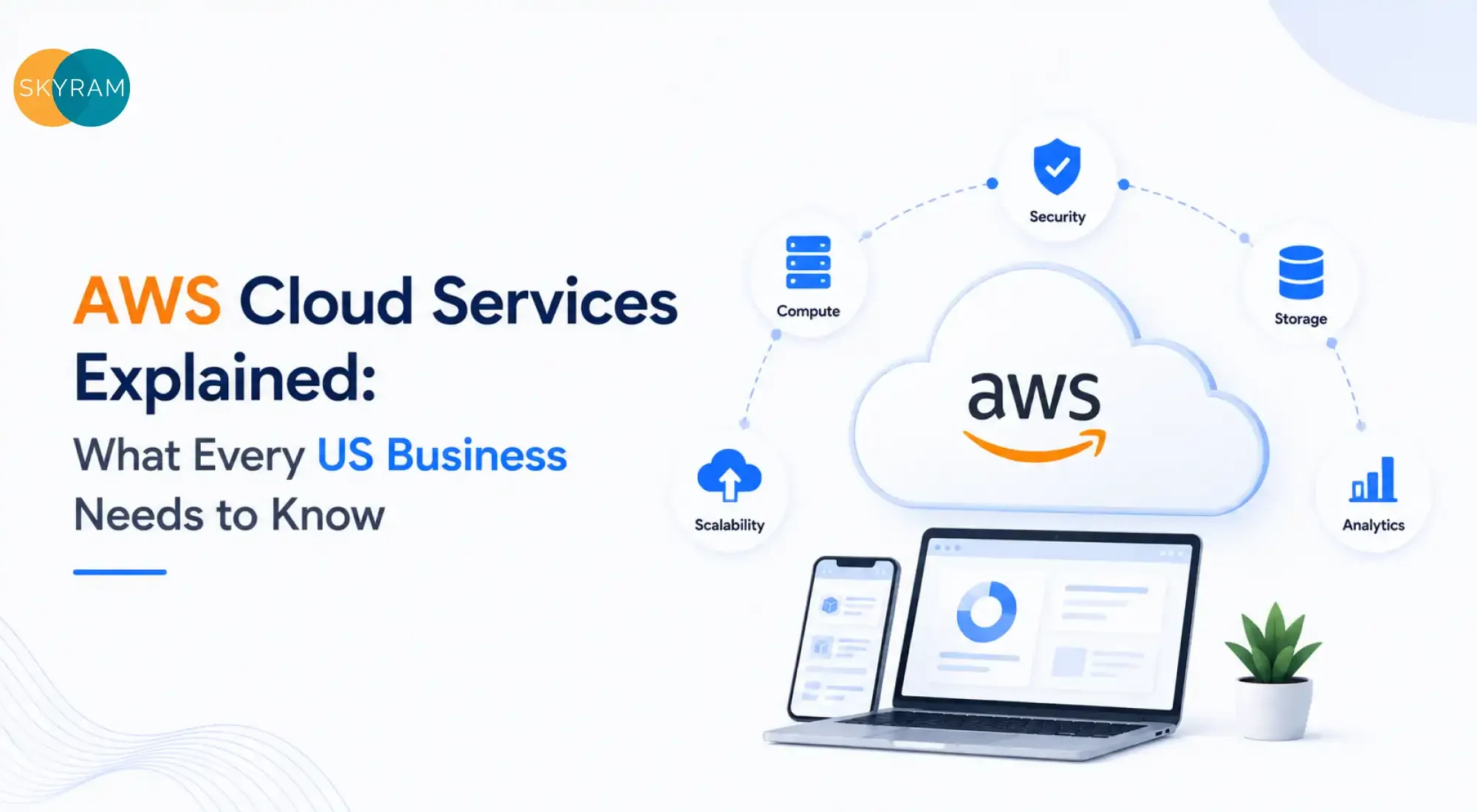
AWS Cloud Services Explained: What Every US Business Needs to Know

blog img2

Cloud used to sound like a big-company project. Today, it is a practical business decision for growing companies that need flexibility, better uptime, tighter security, and fewer infrastructure headaches. If you run a small or mid-sized business in the US, understanding  AWS cloud services can help you make smarter technology decisions without getting buried in technical jargon.

Amazon Web Services, better known as AWS, is Amazon’s cloud platform. It offers more than 200 services across computing, storage, databases, networking, analytics, security, and AI. Businesses use these services on demand, usually with pay-as-you-go pricing, instead of buying and maintaining all their own hardware upfront.

That matters because many businesses are trying to do more with leaner teams. They need systems that can scale fast, protect customer data, support remote work, and keep costs aligned with actual usage. AWS is often part of that conversation because it combines broad service coverage with mature infrastructure and a large partner ecosystem.

What AWS Cloud Services Actually Mean

At a simple level, AWS cloud services let you rent technology resources over the internet. Instead of buying servers, storage devices, backup systems, and database hardware, you use AWS resources when you need them. That shifts much of your IT from fixed capital spending to more flexible operating costs.

Think of AWS like a utility model for IT. You do not build a power plant to run your office, and you usually do not need to build a full server room to run your applications either. You tap into cloud infrastructure as needed, then scale usage up or down as business conditions change.

For US SMB and mid-market leaders, the business value usually shows up in five areas: speed, scalability, resilience, security, and cost control. Those benefits look different from one company to another, but the pattern is consistent. Companies use AWS to launch faster, recover quicker, and reduce the friction of managing aging systems.

Why US Businesses Are Paying Attention

Cloud adoption is no longer limited to enterprise giants. One widely cited market roundup noted that 57% of SMB workloads and 56% of SMB data were already in public clouds in 2022, with more planned to move after that. That trend shows how the cloud has become a mainstream operating model for smaller companies, not just a future-state idea.

AWS is also the largest cloud infrastructure provider by market share. Multiple industry summaries place AWS at roughly 32% to 33% of the global cloud infrastructure market, ahead of Microsoft Azure and Google Cloud. For many business owners, that leadership signals maturity, service breadth, and long-term platform stability.

Cost is another major factor. AWS states that businesses running on AWS Cloud save an average of 31% compared with on-premises infrastructure, while AWS pricing is designed around pay-as-you-go consumption for most services. That does not mean every workload is automatically cheaper, but it does explain why the cloud is a strong option when cost flexibility matters.

The Core AWS Service Categories

One reason AWS can feel overwhelming is its size. The platform covers a very wide range of services. The easiest way to understand it is by grouping services into the business jobs they handle.

Compute

Compute services power your applications. Amazon EC2 gives you virtual servers. AWS Lambda lets you run code without managing servers at all. These services matter when you need websites, portals, internal systems, or APIs to stay available while demand rises and falls.

Storage

Storage services help you keep and retrieve files, backups, media, and archives. Amazon S3 is one of AWS’s best-known services because it is widely used for file storage, backups, and application data. For many businesses, this is the first step into  AWS cloud services in the USA  because storage needs are easy to understand and quick to modernize.

Databases

Database services support the information behind your applications. Amazon RDS helps run managed relational databases, while DynamoDB supports highly scalable NoSQL workloads. These tools reduce the overhead of patching, provisioning, and maintaining database infrastructure manually.

Networking and Delivery

AWS also provides networking, content delivery, and traffic management tools. Services like Amazon VPC, Route 53, and CloudFront help businesses create secure networks, manage DNS, and deliver content quickly to users. This matters when user experience, uptime, and application performance affect revenue.

Security and Identity

Security on AWS is not a single feature. It is a set of services and controls that work together. Tools such as IAM, AWS Key Management Service, AWS Shield, GuardDuty, and Security Hub help businesses manage access, encryption, threat detection, and overall security posture.

Analytics and AI

As businesses collect more data, AWS analytics and AI services become more relevant. Services in this category help teams analyze trends, process data at scale, build dashboards, and experiment with machine learning or generative AI. Not every SMB starts here, but many grow into these capabilities once their foundation is stable.

What Business Problems AWS Solves

Most companies do not buy cloud because they want cloud. They buy it because they want fewer outages, easier growth, more reliable backups, faster launches, and less time spent babysitting infrastructure. 

AWS cloud services are valuable when they map clearly to those business outcomes:

  • A growing ecommerce brand needs its site to handle holiday traffic spikes without crashing.
  • A professional services firm wants secure remote access to business systems for distributed teams.
  • A healthcare or finance business needs stronger backup, recovery, and access controls.
  • A SaaS company wants faster product releases and a better path to automation.
  • A manufacturer wants centralized data storage and better visibility across locations.
  • A mid-market company wants to retire aging hardware before it becomes a downtime risk.

When these needs show up together, cloud becomes less of a technical upgrade and more of a business model shift. AWS allows companies to add resources when demand rises, reduce them when it drops, and adopt managed services that remove routine infrastructure work from internal teams.

How Pricing Works

AWS pricing is one of the platform’s biggest advantages and one of the biggest sources of confusion. The broad rule is simple: most AWS services use pay-as-you-go pricing. You pay for what you consume, for as long as you consume it, without traditional long-term licensing structures for most services.

That model gives businesses flexibility, but it also requires discipline. Cloud costs can drift when teams overprovision resources, leave environments running, transfer too much data, or fail to monitor usage closely. Industry reporting also shows that cloud waste remains a serious challenge, which is why cost governance matters from day one.

For SMBs and mid-market companies, smart cost control usually comes down to a few habits:

  • Choose the right service type for each workload.
  • Use managed services where they reduce labor and maintenance overhead.
  • Set budgets, alerts, and tagging rules early.
  • Rightsize compute resources instead of buying for peak demand all year.
  • Use reserved pricing or Savings Plans when usage is predictable.
  • Review storage classes so infrequently used data is not sitting in premium tiers.

AWS also offers pricing tools such as the AWS Pricing Calculator and native cost management features. Those tools help estimate likely spend before migration and monitor costs after workloads go live. That is especially useful for companies comparing cloud against server refresh investments or colocation contracts.

AWS vs On-Premises Infrastructure

For many owners, the real question is not whether AWS is impressive. It is whether AWS is better than keeping things in-house. The answer depends on workload design, regulatory needs, technical debt, and team capacity, but the tradeoffs are easier to understand side by side.

Area On-Premises AWS Cloud
Upfront cost High hardware and setup expense Lower upfront cost, usage-based spend
Scalability Slow, limited by purchased capacity Fast, elastic, on-demand
Maintenance Internal team handles patching and hardware Much can be reduced with managed services
Disaster recovery Often expensive and complex Built with broader backup and recovery options
Deployment speed Weeks or months Minutes or hours for many services
Innovation access Depends on the internal stack Broad access to analytics, AI, automation, and global services


This is where AWS cloud services in the USA often become compelling for midsize businesses. They let companies move away from hardware refresh cycles and toward a more adaptable IT model. That can be a major advantage when business demand changes quickly, hiring is tight, or leadership wants technology to support growth instead of slowing it down.

Security, Compliance, and Trust

Security is one of the first topics business owners raise, and for good reason. Moving to the cloud does not remove responsibility for security. It changes how security is managed through what AWS calls a shared responsibility model. AWS secures the cloud infrastructure, while customers secure what they run in the cloud, including identity settings, data policies, workloads, and configurations.

For business leaders, the key takeaway is not that the cloud is automatically secure. It is that AWS gives you access to mature security capabilities that are often hard to replicate with small internal teams. Encryption, identity controls, logging, backups, network isolation, and threat detection can all be built into your environment from the start.

That matters because cloud risk is often tied to configuration, not just technology choice. Reports on cloud security consistently show that companies need stronger governance, clearer ownership, and better visibility. In practice, that means setting access controls carefully, enabling logging, reviewing permissions often, and aligning your architecture with your compliance obligations.

Reliability and Disaster Recovery

Downtime hurts revenue, operations, and customer trust. AWS helps businesses improve resilience through regional infrastructure, availability zones, backup services, and architecture patterns designed for redundancy. Instead of relying on one physical server or one office location, you can spread workloads across fault-tolerant environments.

This is especially relevant for companies that have grown around legacy systems. When backups are manual, recovery plans are outdated, or production systems rely on aging hardware, the risk of extended outages goes up. AWS gives companies more ways to design for recovery, automate backups, and restore critical services faster.

Even so, resilience is not automatic. Businesses still need to define recovery objectives, document failover plans, test backup restoration, and choose the right architecture. The platform makes resilience possible, but planning makes it real.

Speed and Innovation

Cloud often changes the pace of business more than the technology itself. When teams can provision infrastructure in minutes instead of waiting weeks for hardware, they can test ideas faster. That speed affects product launches, internal apps, data projects, and customer-facing improvements.

This is one reason cloud is tied so closely to digital transformation. AWS gives businesses access to services they may never build alone, from managed databases to analytics pipelines to AI tools. Instead of stitching together everything from scratch, they can assemble services that match their stage of growth.

For SMBs, that means smaller teams can deliver more. For mid-market organizations, it often means IT can spend less time on maintenance and more time on modernization, automation, and new business initiatives. The shift is not just technical. It changes how fast teams can respond to market opportunities.

Common AWS Use Cases for SMBs

You do not need a huge digital operation to get value from AWS. Many businesses start small, then expand over time. These are some of the most common use cases where AWS cloud services make sense for SMB and mid-market teams.

  • Website and application hosting, especially when traffic fluctuates.
  • Backup, archive, and disaster recovery modernization.
  • Virtual desktops and secure remote work infrastructure.
  • Database modernization and application replatforming.
  • File storage consolidation across offices or departments.
  • Analytics, dashboards, and centralized reporting.
  • DevOps automation, CI/CD pipelines, and faster software delivery.
  • Security monitoring, logging, and access management improvements.

The smartest approach is usually to begin with a clear business case instead of a giant migration plan. That could be backup modernization, one customer-facing app, or a development environment. Early wins create clarity, reduce risk, and help leadership understand where the cloud delivers measurable value.

Migration Doesn’t Have to Mean Moving Everything

A common misconception is that adopting AWS means moving every system at once. It does not. Most companies move in phases. They start with the workloads that offer the clearest payoff, the lowest risk, or the biggest operational pain points.

Some applications can be rehosted quickly. Others need replatforming or deeper modernization. Some may stay on-premises for a period of time because of technical, financial, or regulatory reasons. A successful cloud strategy does not force everything into one model. It prioritizes what should move, what should wait, and what should be redesigned.

For many companies, the best path is hybrid for a while. That gives teams time to modernize without disrupting the business. It also lets leadership compare outcomes across workloads instead of betting everything on one large transformation.

A Practical Adoption Framework

If you are exploring AWS cloud services in the USA, it helps to think in stages rather than features. Business owners do not need to memorize service names first. They need a clear process for deciding whether the cloud fits their goals and where to begin.

  1. Clarify business outcomes, such as lower downtime, faster launches, better backup, stronger security, or lower infrastructure overhead.
  2. Assess current systems, including dependencies, performance issues, licensing costs, and end-of-life hardware risks.
  3. Prioritize workloads by business value and migration complexity.
  4. Estimate costs in the cloud and compare them with current and future on-premises spend.
  5. Design security, access controls, backup policies, and governance before launch.
  6. Migrate in phases, validate performance, then optimize usage and costs over time.

This step-by-step approach reduces surprises. It also keeps the cloud aligned with financial and operational goals. That matters because successful cloud adoption is rarely about technology alone. It depends on planning, ownership, and execution quality.

What to Ask Before Choosing AWS

AWS is powerful, but it is not automatically the right answer for every workload. Business leaders should ask practical questions before moving forward.

  • What business problem are we solving first?
  • Which workloads are expensive, fragile, or hard to scale today?
  • What compliance, data residency, or security requirements do we have?
  • Do we have the internal skills to manage cloud well, or do we need support?
  • How will we track usage, budgets, and return on investment?
  • Which systems should stay where they are for now?

These questions prevent the cloud from becoming a vague modernization project. They bring the conversation back to value, risk, and operational fit. That is exactly where it should be for owner-led and growth-stage businesses.

Statistics US Business Leaders Should Know

A few numbers help explain why cloud is now a core business conversation, not a niche IT topic.

Statistic What it suggests
AWS offers 200+ services Broad platform coverage for different business needs
AWS market share sits around 32% to 33% AWS remains the largest cloud infrastructure provider
57% of SMB workloads were in public cloud in 2022 Cloud is already mainstream for smaller businesses
AWS says businesses save an average of 31% vs on-premises Cost flexibility is a major adoption driver
82% of organizations say cloud spend is a main challenge Governance and optimization matter as much as migration


The lesson is simple. Cloud delivers real business value, but an unmanaged cloud can create waste and complexity. The businesses that win are not the ones that move fastest without a plan. They are the ones that match the right workloads, controls, and operating model to their goals.

Skyram Technologies: Addressing Cloud Queries with Clarity

If all of this feels useful but a little too broad, that is normal. At Skyram Technologies, we help businesses turn cloud questions into practical next steps. We look at your current environment, your business priorities, your security expectations, and your cost concerns, then map them to a realistic adoption path.

We do not treat cloud like a one-size-fits-all checklist. At Skyram Technologies, we focus on what matters to your business first, whether that is migration planning, cost visibility, infrastructure modernization, DevOps readiness, backup strategy, or stronger security controls.

The goal is simple: help you use AWS cloud services with clarity, not guesswork.

If you are evaluating options, we can help you understand where AWS fits, where it does not, and what a smart first phase should look like. That way, your team can move forward with better visibility, stronger alignment, and fewer expensive detours.

Cloud Is the Future: The Future Demands You Act Now

For US SMB and mid-market owners, AWS is not just a technology platform. It is a way to build a more flexible, resilient, and scalable operating foundation. The real advantage is not having access to hundreds of cloud tools. It is knowing which ones solve the right business problems at the right time.

That is why the smartest cloud strategy is usually focused, phased, and business-led. Start with the workloads that matter most. Build in governance early. Treat cost, security, and resilience as part of the design, not as afterthoughts. Done well, AWS cloud services in the USA can help your business move faster and operate with more confidence.

Book your Free AWS Cloud Readiness Assessment with Skyram Technologies and make AWS cloud services work harder for your business.

FAQs

1. What are AWS cloud services in simple terms?
AWS cloud services are on-demand technology tools from Amazon. They include servers, storage, databases, security, analytics, and more, so businesses can run systems without owning all the infrastructure.

2. Is AWS only for large enterprises?
No. Many small and mid-sized businesses use AWS for hosting, backups, storage, disaster recovery, and application delivery because they can start small and scale as needs grow.

3. Can AWS reduce IT costs for US businesses?
It can, especially when it replaces aging hardware, overbuilt infrastructure, or manual maintenance. Savings depend on workload design, usage control, and whether resources are actively optimized.

4. How secure are AWS cloud services?
AWS provides strong infrastructure security tools, but customers still need proper setup. Identity controls, encryption, backups, monitoring, and configuration management all play a role in staying secure.

 5. What is the best first step before moving to AWS?
Start with a readiness assessment. Review your current systems, costs, risks, security needs, and business goals, then prioritize the workloads that offer the clearest value first.

Why should you employ a digital marketing company in Kolkata for Real Estate?

Digital marketing has proven to be a boon to businesses all around the world. Businesses of all scales and all industries have adopted digital marketing and seen a positive impact on the growth of the business. Real estate is not any different and one can benefit in so many different ways by employing a digital marketing company in Kolkata to assist them in the online growth of the business.

One of the most significant and wealthy industries around the world has always been the real estate sector. Hiring a digital marketing agency Kolkata to assist in building a strong digital presence using the best digital marketing strategies could help in the growth of the real estate agencies even quicker and easier. There is no reason why you should not incorporate digital marketing techniques into your business if you are from the real estate industry. Skyram Technologies is one of the leading digital marketing company in Kolkata that can help you become one of the top names in the real estate sector.

Reasons for employing a digital marketing agency Kolkata for Real Estate

Real estate is one of the most important and highly booming industries all around the world. With the increasing population over the past years and the growing demand for properties, the real estate sector has turned into one of the most important and lucrative sectors in the business world.

You can find numerous real estate agencies these days in almost every corner of the city owing to the highly booming sector. And although there is a high demand for real estate, there is also a lot of competition in the market. Incorporating digital marketing strategies into your real estate business by hiring a digital marketing company in Kolkata can be very beneficial to your company at such times.

Technology has greatly advanced over the past few years or decades. Mobile phones and the internet have been one of the best developments that have changed a lot of things all around the world. The internet has made everything a lot easier and it is one of the first things that people look up to before doing most things. This is one of the main reasons why employing a digital marketing agency Kolkata is important and beneficial for not only real estate but for almost every business today.

Most people do their bit of searching on the internet for buying real estate these days. This calls for the need for a realtor to create an efficient web marketing strategy by hiring an efficient digital marketing company in Kolkata if they want to reach out to their intended market.

As already discussed, like in all other businesses, competition among realtors is getting more and more intense. Incorporating digital marketing strategies into your business by employing a digital marketing agency Kolkata is not an option but a necessity if you want to stay ahead of the competition today. Given below are the top reasons why you should consider incorporating digital marketing techniques by hiring a digital marketing company in Kolkata for your business:

  • Digital marketing is crucial for real estate companies for several reasons, however, one of the most significant reasons why you should consider hiring a digital marketing agency Kolkata for incorporating digital marketing into your business is to increase your audience reach. Real estate companies may connect with prospective buyers and sellers anywhere in the world by using digital channels including an official website that is well-designed, media platforms such as Twitter, Instagram, Linkedin, etc, email marketing, and so on. This not only enables businesses to reach a wider audience but also enables them to get in touch with more potential clients.
  • Another important reason why a real estate agent should utilize digital marketing is the impact an innovative digital campaign has on business. Every business needs to create a comprehensive marketing strategy that attracts online readers to its website and enables them to discover more about the organization and its brand. When you employ a digital marketing company in Kolkata, they can help you create unique and effective digital marketing strategies for your business.

The main reason behind creating most digital marketing strategies is to increase brand identification and spread global brand awareness. Hiring a digital marketing agency Kolkata will help you to market the brand while also increasing public knowledge of the business. It will also contribute to increasing website traffic, which will help promote the company’s operations to people who might not have otherwise looked at it.

  • Mobile and video marketing are one of the most important marketing tools used today. It has been established that these strategies are incredibly effective in the modern world and it is only when you embrace digital marketing into your business that you can make the most out of it.

Combining video marketing with mobile marketing is a great decision in today’s technologically advanced world.Additionally, search engines always rank video content so, this is why if you work in real estate you must consider hiring a digital marketing company in Kolkata to help you create unique and engaging mobile and video marketing strategies for the business.

  • Another reason why you should consider incorporating digital marketing into your business is to enhance your customer’s digital experience. Prospective buyers can virtually browse the real estate market and have a more engaging buying experience thanks to online marketing.

When you hire a digital marketing agency Kolkata for handling your digital marketing initiatives, they make use of data-driven solutions to offer specialized recommendations and reduce the number of possibilities accessible for estate research based on customer inquiries, seen photographs, clicks, and scrolling. This makes it easy for buyers to look through thousands of properties and hundreds of neighborhoods. Furthermore, real estate agencies can more easily allow purchasers to experience the look and feel of the property without moving a muscle thanks to virtual home tours, a well-liked real estate digital marketing trend by hiring a good digital marketing company in Kolkata for it.

  • Another reason why you, as a realtor should consider implementing digital marketing strategies into your business is to evaluate your performance easily. A digital marketing agency Kolkata can help you keep a track of where your customers are coming from, which plans to put into action, what elements of their campaign work, what elements do not, and so on. Among other digital marketing strategies, pay-per-click (PPC) advertising enables one to assess the efficacy and performance of their advertisements. So when you invest in a digital marketing company in Kolkata for your real estate business, you will be able to easily evaluate your performance and work on making your business a leading name in the real estate sector.
  • An important reason why realtors should invest in digital marketing is that it helps in effectively and strategically targeting a large audience and in growing the business. The great majority of people use internet platforms. So digital marketing can be very advantageous to property owners, particularly for rental properties. Most individuals are not aware that rental homes and digital marketing have histories that are much longer than their own. Companies in the real estate industry need to be aware of potential commercial tactics for grabbing the attention of online users. You could hire a digital marketing agency Kolkata to help you create effective strategies for your digital initiatives.

Given above were some of the top reasons to help you understand the significance of digital marketing and how a digital marketing company in Kolkata can help in growing your real estate business to great heights. If you are looking for a digital marketing agency in Kolkata that can help you with online marketing, you should consider consulting Skyram Technologies for it as it is one of the best digital marketing companies in Kolkata that is trusted by real estate agents from around the country.

Conclusion

Nowadays, everything is done online, including searching for and buying properties. An important factor in the real estate sector’s success in digital marketing. Realtors must have a robust online presence in order to draw in potential clients.

Digital marketing is the ideal answer for you if you want to grow your company or interact with more potential clients. Skyram Technologies is one of the best digital marketing company in Kolkata for real estate. With years of experience as a leading digital marketing company, Skyram has helped hundreds of real estate agencies or realtors in creating unique marketing strategies and thus build a strong online presence for their business.

If you are looking for a digital marketing agency Kolkata for your real estate business then Skyram Technologies is the right place for you. Contact Skyram Technologies now and make the most out of digital marketing for your business!