SEO Services for US Businesses: The Complete 2026 Guide

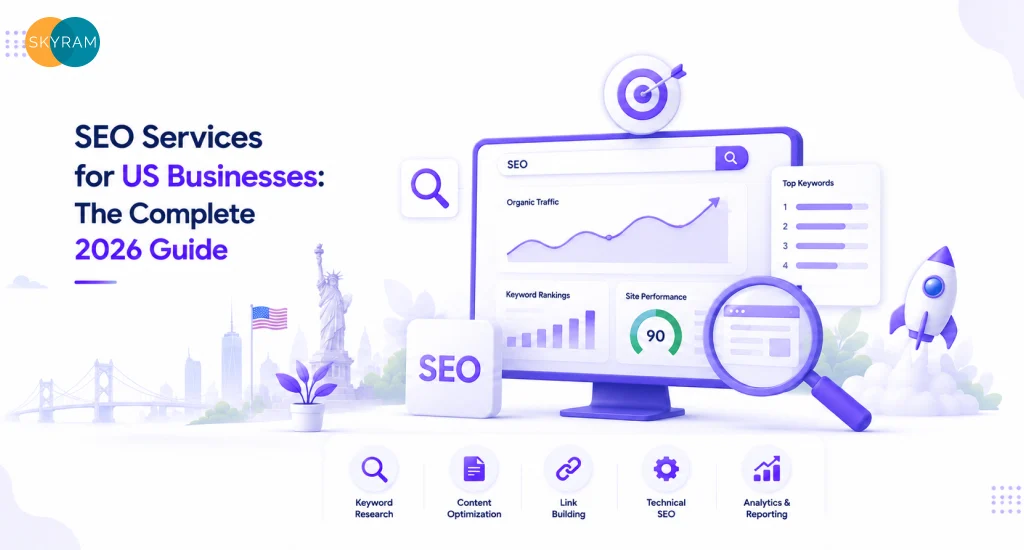
Infographic overview of search engine optimization services for US businesses including technical SEO, content strategy, and link building components

Your website is live. Your product is solid. But when a potential customer types exactly what you sell into Google, your competitors show up and you do not. That is not a brand problem or a product problem. That is an organic visibility problem, and it is more common than most business owners want to admit.

Search engine optimization services exist precisely to fix this. Done properly, SEO turns a website that Google ignores into one that earns qualified traffic every single day without paying for each click. But the phrase search engine optimization services covers a wide range of activities, providers, and outcomes, and most buyers enter this market with too little context to separate what works from what sounds good in a sales pitch.

This guide gives you that context. By the end, you will understand what SEO services actually include, how they work in 2026, what makes a provider worth hiring, and how to build an organic growth program that produces real commercial results for your US business.

What Search Engine Optimization Services Actually Include

Ask ten different agencies what SEO services include and you will get ten different answers. Most of them are right, but they describe different layers of the same discipline. SEO is not one activity. It is a system of interconnected activities that, together, determine how well a page ranks for the queries that matter to your business.

Here is what a complete engagement covers:

Technical SEO

This is the foundation everything else sits on. Technical SEO addresses how Google crawls, indexes, and interprets your site. If Google cannot efficiently access your pages, your content and backlinks will not produce the rankings you expect.

Key areas include:

  • Site architecture and internal linking structure
  • Crawl budget management, especially relevant for large sites or low-authority domains
  • Core Web Vitals: Largest Contentful Paint, Interaction to Next Paint, Cumulative Layout Shift
  • Canonical tags, hreflang, and duplicate content resolution
  • Schema markup and structured data implementation
  • XML sitemap health and robots.txt configuration

On-Page SEO and Content Optimization

On-page SEO covers everything that happens within the page itself. That includes title tags, meta descriptions, heading hierarchy, keyword placement, internal links, and content structure. But in 2026, good on-page SEO also means writing content that satisfies search intent, not just content that contains the right keywords.

Google has shifted heavily toward understanding what a user actually wants from a query. A page that answers a question thoroughly, in the right format, for the right audience, outperforms a page that simply repeats a keyword fifteen times.

Authority Building and Link Acquisition

Backlinks remain one of the strongest ranking signals Google uses. An authority-building program earns links from credible, relevant websites by creating content other sites want to reference, developing relationships with publishers and journalists, and pursuing digital PR opportunities.

Not all links are equal. A single link from a trusted industry publication outweighs dozens of links from low-quality directories. Any provider still pitching link quantity over link quality is selling you an approach that carries meaningful risk.

Local and National SEO for US Markets

US businesses serving local markets need a different strategy than businesses targeting national audiences. Local SEO focuses on Google Business Profile optimization, local citations, review acquisition, and proximity-based ranking signals. National SEO focuses on topical authority, domain-wide keyword coverage, and competing for informational and transactional queries at scale.

Most small and mid-sized businesses need a blend of both, weighted toward their actual service geography.

Analytics, Reporting, and Continuous Optimization

SEO without measurement is just publishing. A proper engagement includes setting up accurate tracking through Google Search Console and GA4, defining KPIs tied to business outcomes (not just keyword positions), and running a monthly cycle of review, hypothesis, and implementation. Rankings change. Content ages. Competitors invest. The optimization cycle never really ends.

Key Takeaway: Search engine optimization services span five interconnected layers: technical infrastructure, on-page content, authority acquisition, market-specific strategy, and analytics. Buying any single layer without the others produces diminishing returns. Effective SEO programs address all five as a coordinated system.

How Google Actually Ranks Pages in 2026

Understanding Google’s ranking logic in 2026 matters because it directly shapes what SEO services should prioritize for your site. The algorithm has changed significantly over the past three years, and some widely held beliefs about SEO are no longer accurate.

The Role of Helpful Content

Google’s Helpful Content system, which began rolling out in 2022 and matured through 2024 and 2025, evaluates whether content was created primarily to serve people or primarily to rank. Sites that publish large volumes of thin, templated, or AI-generated content that adds no real insight have lost rankings significantly under these updates.

Helpful content, by Google’s definition, demonstrates first-hand experience, genuine expertise, and satisfies the user fully enough that they do not return to search results looking for a better answer. That is a high bar, and it is the bar your content operation needs to clear.

E-E-A-T: Experience, Expertise, Authoritativeness, Trustworthiness

E-E-A-T is not an algorithm but a framework Google’s quality raters use to evaluate content quality. It informs the training of ranking systems. For US businesses, this means your site needs demonstrable signals of expertise: real author profiles, accurate business information, legitimate third-party references, and content that reflects actual knowledge of the subject matter.

A company blog with no author bylines, no about page, and no external references earns very little E-E-A-T credit, regardless of how well the posts are optimized for keywords.

AI Overviews and Search Generative Experience

Google AI Overviews now appear above organic results for a significant share of queries, particularly informational ones. This changes the traffic math for some keyword types. Pages that appear as sources inside AI Overviews can still receive meaningful traffic, but the click-through dynamic is different from traditional blue links.

Answer Engine Optimization (AEO) addresses this directly. Structuring content with standalone definitional paragraphs, direct FAQ-format answers, and schema markup increases the probability your content gets cited in AI-generated responses. Agencies serious about 2026 SEO build AEO practices into every content deliverable.

Core Web Vitals Remain a Ranking Factor

Google confirmed that Core Web Vitals remain part of its Page Experience signal. Interaction to Next Paint (INP), which replaced First Input Delay in March 2024, now measures all user interactions rather than just the first one. Sites with poor INP scores, particularly those running heavy JavaScript frameworks or legacy WordPress themes with unoptimized plugins, face a real ranking disadvantage in competitive verticals.

Key Takeaway: Google in 2026 rewards content that demonstrates genuine expertise, satisfies user intent completely, and loads fast. SEO services that do not account for Helpful Content guidelines, E-E-A-T signals, and AI Overview optimization are working with an outdated model. Ask any prospective provider how they address each of these specifically.

The Three Ways US Businesses Source SEO Services (and How to Choose)

US businesses pursuing organic growth generally have three options: build an in-house SEO team, hire a freelance specialist, or work with an agency. Each model has legitimate use cases. The right choice depends on your business size, competitive landscape, budget, and internal capabilities.

Factor In-House SEO Freelance SEO SEO Agency
Skillset breadth Depends on hire Single specialty Full team coverage
Speed to launch Slow (hire/onboard) Fast Fast
Tool access Self-funded Limited Enterprise-grade
Scalability Restricted Low High
Accountability Internal Varies Contractual SLAs
Cost efficiency High fixed cost Low, limited scope Best ROI at scale

When In-House SEO Makes Sense

Building an internal team makes sense when you have enough SEO scope to justify multiple full-time roles, when your competitive environment requires proprietary strategy that you want to keep internal, or when you are in a regulated industry where outside partners face access restrictions. Most US businesses below the enterprise tier do not hit these thresholds. A single in-house SEO manager without supporting specialists in technical SEO, content, and link acquisition is typically under-resourced for anything beyond baseline optimization.

When Freelance SEO Works

Freelancers make sense for narrow, well-defined scopes: a one-time technical audit, a content refresh for a specific page cluster, or keyword research for a new product launch. They rarely make sense as a long-term growth partner because most individual practitioners specialize in one or two areas of SEO, not all five layers outlined earlier.

When to Work With an SEO Agency

An agency provides access to a full team: technical specialists, content strategists, outreach professionals, and data analysts, without the fixed overhead of hiring each role internally. For most US SMBs and growth-stage companies, this model delivers the best return on SEO investment. The key is choosing an agency with a documented process, transparent reporting, and a track record in your vertical or competitive tier.

Key Takeaway: Most US businesses get the most value from an agency model, which provides full-spectrum SEO expertise without the overhead of building an internal team. Freelancers fill specific gaps well but rarely cover the full scope a sustained ranking campaign requires.

What SEO Services in the USA Cost in 2026 (and What That Actually Buys)

Pricing is one of the most opaque aspects of SEO. The range is genuinely wide. Monthly retainers for quality SEO services in the USA typically run from $1,500 per month for small businesses with limited competition to $10,000 or more per month for enterprise programs targeting competitive national verticals.

Why the Price Range Is So Wide

SEO pricing reflects scope, competition level, content volume, and team experience. A healthcare company competing for high-intent medical queries in a major metro faces a fundamentally different challenge than a niche B2B software company targeting long-tail queries with low keyword difficulty. The work required is simply not comparable, and neither is the pricing.

Low-cost SEO engagements in the $300-$700 per month range do exist. They almost uniformly involve templated deliverables, low content volume, and link acquisition practices that carry algorithmic risk. The short-term savings rarely survive a Google algorithm update.

How to Evaluate Price Against Value

Instead of anchoring on the monthly number, ask what specific deliverables you receive each month and how those deliverables connect to ranking movement and traffic growth. Legitimate SEO services produce measurable outputs: pages optimized, content pieces published, links acquired from named domains, technical issues resolved. If a provider cannot tell you exactly what you are buying each month, that is a signal to keep looking.

Contracts and Commitment Periods

SEO produces compounding returns over time, not instant results. Realistic timeframes for meaningful ranking movement are three to six months for low-competition keywords and six to twelve months for competitive terms. Agencies that promise first-page rankings in thirty days are either targeting negligible-volume keywords or making claims they cannot support. Most credible agencies work on six or twelve-month agreements because that timeframe aligns with the realistic pace of organic growth.

Key Takeaway: Budget for SEO based on the competitive intensity of your keyword targets, not on what feels comfortable. The difference between a $2,000 per month and a $500 per month engagement is not just service volume, it is access to strategic depth, content quality, and link-building resources that directly determine how quickly you rank.

How to Evaluate an SEO Provider Before You Sign

Most SEO providers look similar at the proposal stage. The differentiators show up in the process details, the quality of their questions, and the specificity of their reporting. Here is a reliable evaluation framework for US business owners who do not want to spend six months learning they hired the wrong team.

Ask About Their Technical SEO Process

A serious SEO provider conducts a comprehensive technical audit before recommending any strategy. Ask them to walk you through what their audit covers, how they prioritize issues, and how they handle implementation when your development resources are limited. Vague answers suggest they rely on automated tools without the technical depth to interpret or act on the findings.

Review Their Content Approach

Content is where most SEO programs either win or stall. Ask specifically how they approach content briefs, whether they match content type to search intent (not just keyword volume), and how they measure content performance after publication. Providers who treat all content as blog posts, regardless of what the SERP shows, are not doing intent-based optimization.

Understand Their Link Acquisition Philosophy

This is where the risk lives. Ask for a description of their link-building methods and examples of placements they have earned for similar clients. Acceptable answers include content-led outreach, digital PR, and resource-based link acquisition. Unacceptable answers include anything involving link exchanges, private blog networks, or paid placements without disclosure.

Ask About Reporting Cadence and Metrics

Find out exactly what you will see in monthly reports and how they connect reporting metrics to your business objectives. Ranking position is a useful leading indicator, but organic traffic trends, click-through rates, and goal completions in GA4 are what translate to actual business outcomes. If reporting stops at keyword rankings, you will not have the visibility you need to make strategic decisions.

You can review how a structured digital marketing engagement is built by exploring Skyram’s digital marketing services, which provides context on how SEO integrates with paid search, social, and content within a broader growth program.

Key Takeaway: The best way to evaluate an SEO provider is to pressure-test their process, not their pitch deck. A provider with a clear technical methodology, intent-driven content approach, and transparent link acquisition practices is worth paying more for than one with a polished proposal and vague answers.

Building a Keyword Strategy That Drives Revenue, Not Just Traffic

Traffic volume is a vanity metric if the visitors have no commercial intent. A keyword strategy aligned to revenue targets starts with understanding the full funnel of queries your prospects use as they move from awareness to purchase.

Mapping Keywords to Funnel Stage

Top-of-funnel keywords capture users in research mode. These are informational queries with broad intent and high search volume. They build brand awareness and topical authority but convert slowly. Bottom-of-funnel keywords capture users who are close to a buying decision. These have lower volume but far higher conversion rates. A healthy SEO program targets both.

Examples in the B2B tech space: a top-of-funnel query might be ‘what is cloud infrastructure management?’ A bottom-of-funnel query for the same business might be ‘managed cloud services for SaaS companies.’ The second query has a fraction of the search volume but converts at a significantly higher rate. Strategies that ignore bottom-of-funnel keywords optimize for traffic reports that do not impress your board.

Keyword Difficulty and Domain Authority

Keyword Difficulty (KD) scores from tools like Ahrefs or Semrush measure how competitive a keyword is based on the authority of pages currently ranking. A new website competing for high-KD keywords without the domain authority to support them will not rank in a reasonable timeframe, regardless of content quality.

The strategic response is to start with low-to-medium KD keywords where you can rank within three to six months, build topical authority progressively, and move into higher-KD clusters as your domain earns more credibility. This is not settling for less; it is sequencing correctly.

Cluster-Based Content Strategy

Modern SEO does not target isolated keywords. It targets keyword clusters organized around topics. A pillar page covers a broad topic comprehensively. Cluster pages cover specific subtopics in depth and link back to the pillar. This architecture signals topical authority to Google and improves internal link equity distribution across the site.

If you are starting with SEO for a cloud technology or digital services business, the full range of SEO and optimization services available can give you a working model of how a cluster-based approach gets implemented in practice.

Key Takeaway: Keyword strategy drives revenue when it covers the full funnel, accounts for domain authority constraints, and organizes targets into topical clusters rather than isolated terms. Chasing high-volume keywords without the authority to rank for them is a reliable way to generate activity without generating results.

SEO Services in the USA: What the Best Programs Have in Common

After working across US markets at different competition levels, certain characteristics consistently separate SEO programs that produce compounding growth from programs that stall at marginal improvements.

Clear Ownership of Technical Debt

High-performing programs do not leave technical issues in a backlog indefinitely. They establish a clear process for surfacing issues through regular crawl audits, prioritizing by ranking impact, and getting fixes implemented. This requires either direct developer access or a working protocol with the client’s dev team. Providers who produce audit reports but cannot get fixes shipped are not delivering technical SEO; they are delivering technical documentation.

Content That Actually Serves the Reader

The best SEO content programs produce pieces that rank and that people actually read and act on. This requires understanding what the target audience already knows, what questions they need answered, and what format serves the query best. A 4,000-word comprehensive guide serves a different query than a 400-word definition or a comparison table. Getting format right is as important as getting content right.

Link Acquisition Tied to Content

The strongest link acquisition programs earn links because the content is genuinely worth linking to, not because someone emailed a thousand editors with a generic pitch. Original research, data studies, tools, and definitive guides earn editorial links organically and sustain authority over time. Link acquisition strategies that depend entirely on outreach volume rather than content quality are expensive and produce diminishing returns.

Reporting Tied to Business Metrics

The best programs connect SEO activity to revenue-adjacent metrics: organic-assisted conversions, lead quality from organic channels, and cost-per-acquisition compared to paid search. Reporting that stops at keyword positions leaves clients without the information they need to justify SEO spend internally or to make strategic decisions about where to invest next.

Key Takeaway: Consistently high-performing SEO programs share four traits: resolved technical debt, content built for real readers, editorially earned links, and reporting tied to revenue metrics. If your current program lacks any of these, that is where to focus first.

AEO and GEO: The 2026 Layer Most SEO Providers Are Still Missing

Traditional SEO optimizes for Google’s blue-link results. But a growing share of search queries now return AI-generated answers, either through Google AI Overviews or through AI chatbots like ChatGPT and Perplexity that millions of users query directly. If your content does not appear in these answers, you are invisible to a significant and growing user segment.

Answer Engine Optimization (AEO)

AEO structures content so AI systems can extract and cite it accurately. This means writing content that contains clear, self-contained answers to specific questions, using structured data markup to signal content type to AI parsers, and organizing content so a model can identify definitional paragraphs without needing surrounding context.

An AEO-optimized FAQ section does not contain vague answers that require reading the rest of the post to understand. Each answer stands alone. Each answer starts by directly addressing the question. This is a different writing discipline than traditional SEO content, and it matters more every year.

Generative Engine Optimization (GEO)

GEO extends AEO to the broader ecosystem of AI-generated responses outside of Google. Optimizing for citation in ChatGPT, Perplexity, and similar tools requires building brand authority across the web, being referenced by credible external sources, and creating content that language models encounter frequently during training and retrieval. This is a newer discipline, but providers ignoring it are not preparing clients for where search behavior is heading.

Key Takeaway: AEO and GEO are not replacements for traditional SEO; they extend it. Businesses that structure content for AI extraction now will have a compounding advantage as AI-driven search continues to capture a larger share of query volume. Ask your SEO provider specifically how they approach AEO in content deliverables.

Frequently Asked Questions

What are search engine optimization services?

Search engine optimization services are a set of activities designed to improve a website’s visibility in organic search results on engines like Google and Bing. These services typically include technical SEO audits, on-page content optimization, keyword strategy, link acquisition, and performance reporting. The goal is to increase qualified organic traffic by helping search engines understand and rank your content as highly relevant to the queries your target audience uses.

How long does it take for SEO services to show results?

Most SEO programs produce measurable ranking improvements within three to six months for low-to-medium competition keywords. High-competition keywords in saturated markets typically require six to twelve months of sustained effort before reaching the first page. Timeline depends heavily on the domain’s existing authority, the competitive intensity of the target keywords, and the volume and quality of work executed each month. Providers promising significant results in thirty days are targeting negligible-volume terms or making claims that do not hold up.

What is the difference between on-page SEO and off-page SEO?

On-page SEO refers to optimizations made directly on a website: title tags, meta descriptions, heading structure, content quality, internal linking, and structured data. Off-page SEO refers to activities outside the website that influence rankings, primarily link acquisition from other websites and brand mentions across the web. Both contribute to rankings, but on-page optimization establishes relevance while off-page signals establish authority. A complete SEO program addresses both.

How do I know if my SEO provider is doing good work?

A reliable SEO provider delivers monthly reports showing concrete activity: pages optimized, content published, links acquired from named domains, and technical issues resolved. Alongside activity metrics, reports should show movement in keyword rankings, changes in organic traffic volume and quality, and improvements in goal completions tied to organic sessions. If reports show activity but not outcomes, or outcomes but not the activities that drove them, ask for greater transparency.

What is the difference between local SEO and national SEO?

Local SEO targets users searching for businesses or services in a specific geographic area. It focuses on Google Business Profile optimization, local directory citations, proximity-based ranking signals, and review management. National SEO targets users across a broad geography without a location modifier in their search query. It focuses on topical authority, domain-wide keyword coverage, and competing for terms that draw searchers from across an entire country. Many US businesses need a strategy that incorporates both, weighted to their actual service market.

What is AEO and why does it matter for US businesses in 2026?

AEO stands for Answer Engine Optimization. It refers to structuring content so that AI-powered systems, including Google AI Overviews, ChatGPT, and Perplexity, can extract and cite it accurately in generated responses. AEO matters because a growing share of search queries now return AI-generated answers rather than traditional blue-link results. Businesses whose content appears in these answers gain visibility with users who may never click through to traditional organic results. In 2026, AEO is increasingly a standard component of professional SEO services, not an optional add-on.

Can a business do SEO without hiring an agency?

Yes, but with significant limitations. Basic on-page optimization, Google Business Profile management, and content publishing are achievable for business owners willing to invest time in learning SEO fundamentals. Technical SEO, competitive link acquisition, and keyword strategy at scale require tools and expertise that most businesses do not maintain internally. Companies that attempt to run full SEO programs without dedicated resources typically see slow progress in competitive verticals and miss opportunities that a specialist team would identify quickly.

What to Expect in Your First 90 Days of SEO Services

The first ninety days of an SEO engagement set the trajectory for everything that follows. Businesses that understand what should happen in this period are better positioned to evaluate whether their provider is executing effectively.

Days 1-30: Discovery and Foundation

A thorough onboarding process starts with understanding your business, your competitive landscape, and your current technical baseline. Expect a comprehensive technical audit, keyword research across your full service portfolio, competitor gap analysis, and a content opportunity assessment. By day thirty, you should have a clear picture of the highest-priority technical issues and the keyword clusters that represent the fastest path to ranking movement.

Days 31-60: Technical Fixes and Content Launch

Month two shifts toward execution. High-priority technical issues get implemented. The first content pieces targeting low-KD, high-intent keywords go live. Initial outreach for link acquisition begins. This is often the phase where business owners feel impatient because rankings have not moved yet. That is normal. SEO changes take time to register in Google’s index, and the work done in month two produces results in months three through six.

Days 61-90: Iteration and First Data Points

By day ninety, you should start seeing indexing changes, early ranking movement on newer content, and clear data on what is working and what needs adjustment. A strong provider uses this data to refine the strategy for the next quarter. The first ninety days are as much about calibration as execution.

Key Takeaway: The first ninety days of SEO services are a foundation phase, not a results phase. Expect deep discovery, technical remediation, and initial content deployment. Ranking movement follows in months three through six. Providers who set different expectations are either targeting very low-competition keywords or overpromising.

Common SEO Mistakes US Businesses Make (and How to Avoid Them)

Most SEO failures are not mysterious. They trace back to a small number of predictable mistakes. Recognizing these early saves months of wasted effort and budget.

Targeting Keywords Without Checking Ranking Feasibility

Many businesses decide which keywords to target based on what feels strategically important, not on whether their domain can actually rank for them competitively. A new website targeting high-KD keywords dominated by established industry players will not rank for them in year one, regardless of content quality. Start with keywords where you have a realistic path to page one, build authority, and compete for harder terms as your domain earns it.

Treating SEO as a One-Time Project

Google updates its algorithm hundreds of times per year. Competitors publish new content, earn new links, and optimize their technical infrastructure continuously. An SEO program that runs for three months and then pauses loses ground steadily. Organic search is a competitive channel and staying visible requires continuous investment.

Ignoring Technical Issues While Investing in Content

Spending budget on content production while leaving serious technical issues unresolved is a common mistake. Crawl errors, slow page speeds, duplicate content, and broken internal links suppress the rankings of every page on the site, including the new content you are paying to produce. Fix the foundation before scaling content output.

Changing Strategy Too Frequently

SEO has a longer feedback loop than paid search. A content piece published today may not reach its ranking potential for four to six months. Businesses that change strategy every sixty days based on early data never give any approach long enough to show results. Commit to a strategy for at least one quarter before drawing conclusions from the data.

Key Takeaway: The four most common SEO mistakes are: targeting keywords you cannot yet rank for, treating SEO as a one-time project, ignoring technical issues while spending on content, and changing strategy before the data matures. Each of these mistakes is avoidable with the right provider and the right expectations set at the start.

How to Measure the ROI of Search Engine Optimization Services

SEO ROI is real but takes patience to measure accurately. The businesses that capture the most value from organic search are the ones that track the right metrics from the start and maintain realistic timeframes for evaluating returns.

The Metrics That Actually Matter

Keyword rankings are a leading indicator, not an outcome metric. The metrics that connect SEO to business value are organic traffic volume from non-branded queries, organic-assisted conversions (tracked through GA4 multi-touch attribution), cost-per-lead from organic versus paid channels, and revenue attributed to organic sessions. Track all of these from month one, even if the numbers are small, so you have a baseline to measure against.

Comparing Organic to Paid Search Costs

One of the most compelling ROI arguments for SEO is the comparison to paid search. A business paying $12 per click in Google Ads for a keyword that receives five hundred organic clicks per month from SEO is saving $6,000 per month in ad spend from that single keyword. Compound this across a full keyword portfolio and the economic case for sustained SEO investment becomes very clear.

Attribution Complexity and How to Handle It

Organic search rarely operates in isolation. A user might find your site through a blog post, leave, see a retargeting ad, return through a branded search, and convert. Attribution models that credit only the last click undercount the contribution of organic search to revenue. Use GA4’s data-driven attribution model or a multi-touch model to get a more accurate picture of organic’s role in your acquisition funnel.

For a broader view of how search fits into a multi-channel acquisition strategy, it helps to understand how organic integrates with other digital channels. Skyram Technologies builds SEO programs designed to complement paid search, content marketing, and conversion optimization within a single coherent growth strategy.

Key Takeaway: Measuring SEO ROI requires tracking the right metrics from the start: organic traffic from non-branded queries, conversion rates from organic sessions, and cost-per-acquisition compared to paid channels. Businesses that measure only keyword rankings routinely underestimate the revenue contribution of their organic program.


Ready to Build Real Search Visibility?

Organic growth does not happen by accident. It takes a structured strategy, consistent execution, and expertise that spans technical SEO, content, and authority building. The team at Skyram Technologies works with US businesses to build exactly that. If you want a clearer picture of where your current SEO program stands and what it would take to move the needle, reach out and start the conversation.

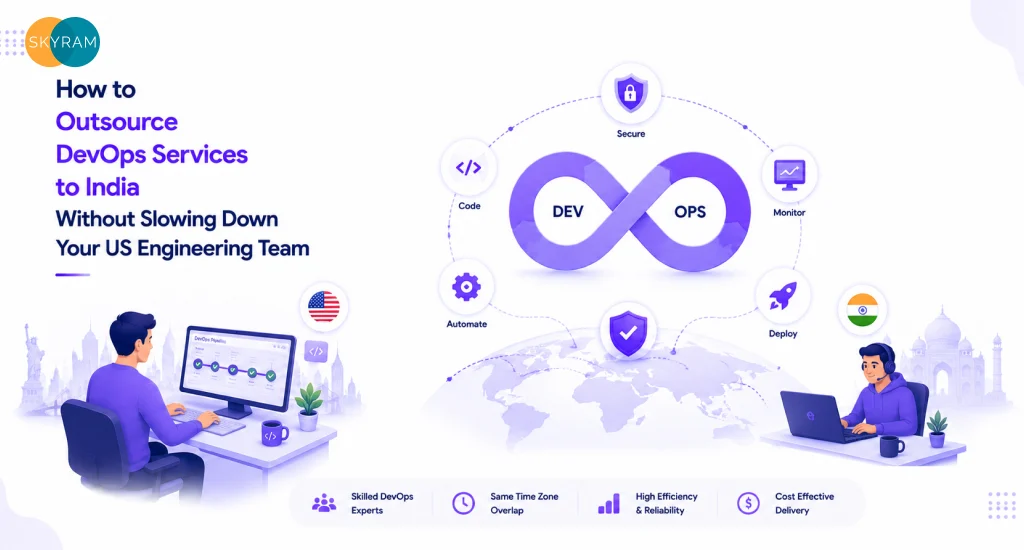
How to Outsource DevOps Services to India Without Slowing Down Your US Engineering Team

A VP Engineering reviewing a split screen dashboard showing offshore DevOps team sprint progress alongside US engineering team deployment metrics

Your engineering team is shipping features. Infrastructure work sits in a backlog that never moves. Build pipelines are fragile, deployment processes are manual in places they should not be, and the two or three engineers who understand the cloud environment are bottlenecks on every release. You have looked at hiring, but the market for senior DevOps engineers is tight and expensive, and onboarding a new hire to your environment takes four months minimum.

Choosing to outsource DevOps services in the USA through an Indian delivery team solves the capacity problem without the hiring timeline. The challenge is doing it in a way that does not introduce the coordination overhead, knowledge gaps, or communication friction that have made offshore engagements notorious for slowing teams down rather than accelerating them.

This guide covers what to get right before you sign a contract, how to structure the engagement for engineering velocity rather than against it, and how to evaluate whether an offshore DevOps vendor is equipped to operate as a true extension of your team.

What Offshore DevOps Services Actually Cover

The term DevOps vendor covers a wide range of capabilities, and not every firm delivers the same scope. Before evaluating any partner, clarify what your engagement needs to include and compare that against what each vendor genuinely specializes in rather than what their website claims.

Infrastructure Provisioning and IaC

This covers building and maintaining cloud infrastructure using Terraform, Pulumi, or AWS CDK. A mature offshore DevOps team writes infrastructure-as-code that your engineers can read, modify, and extend without needing the vendor present. Vendor-specific abstractions that hide the underlying configuration are a red flag.

CI/CD Pipeline Design and Maintenance

Pipeline work includes initial architecture, build and test stage configuration, artifact management, environment promotion workflows, and ongoing maintenance as your codebase evolves. Offshore teams that treat pipeline setup as a one-time deliverable rather than an ongoing responsibility leave you holding a fragile system the moment your stack changes.

Container Orchestration and Kubernetes Management

For teams running containerized workloads, this includes cluster provisioning, Helm chart development, namespace strategy, autoscaling configuration, and upgrade management. Kubernetes operations require daily attention, making it one of the clearest cases for a dedicated offshore DevOps services engagement rather than a project-based handoff.

Observability, Monitoring, and Incident Response

Monitoring setup, alerting configuration, dashboard development, and on-call coverage during agreed overlap hours fall into this category. The practical value of DevOps outsourcing for US companies appears sharply in this area: an offshore team running overnight monitoring shifts catches issues before your engineers start their day.

Security and Compliance Engineering

This includes secrets management, cloud security posture management, IAM policy design, vulnerability scanning in pipelines, and compliance framework implementation for SOC 2, HIPAA, or PCI-DSS depending on your industry. Not every offshore DevOps team has genuine depth here. Verify before assuming.

Key TakeawayOffshore DevOps services span infrastructure, pipelines, Kubernetes, observability, and security engineering. The mistake most teams make is treating DevOps outsourcing as a single category rather than a set of distinct specializations. Define which capabilities your engagement requires before evaluating vendors, and verify each one independently rather than accepting a vendor’s general DevOps credentials at face value.

Why the US-India Model Works for Engineering Operations

The case for DevOps outsourcing to India rests on three compounding advantages that become more significant the longer an engagement runs: specialization concentration, follow-the-sun coverage, and cost-to-output ratio.

Specialization Concentration

Indian DevOps firms that serve US product companies have built practices around AWS, Azure, GCP, Kubernetes, Terraform, and the modern CI/CD toolchain because those are the dominant environments their clients run. Engineers at these firms work across dozens of client environments annually, seeing failure modes and architectural patterns that in-house teams encounter once every few years. That accumulated pattern recognition produces faster diagnosis and better architectural decisions.

Follow-the-Sun Coverage Without Paging Your Engineers

A dedicated offshore DevOps team operating in the Indian Standard Time zone covers a natural overnight shift for US-based teams. Production incidents that surface at 2 AM EST reach an engineer who is four hours into their workday rather than a groggy on-call rotation member who will miss context. Your engineers start each morning with an incident summary rather than an active fire.

Cost-to-Output Ratio at Scale

The table below compares the cost and operational profile of building DevOps capability in-house against engaging an offshore DevOps services team. The numbers reflect current market conditions for mid-to-senior DevOps engineering talent.

Factor In-House DevOps Build Offshore DevOps Vendor
Time to first pipeline 3 to 6 months (hiring + ramp) 4 to 8 weeks (dedicated team)
Cost per year (mid-senior) $130K to $180K salary + benefits $40K to $80K engagement cost
Toolchain breadth Limited to hires’ experience Multi-platform by default
Availability Business hours, PTO-dependent Overlap hours + async coverage
Knowledge continuity Lost when engineer leaves Documented + team-redundant
Compliance coverage Requires specific expertise hire Covered by specialized practice

 
The output difference compounds over time. An offshore team of three to four engineers working dedicated hours on your environment produces more throughput than a single senior in-house hire who splits attention between DevOps work and product support requests.
 

Key TakeawayThe US-India DevOps model delivers genuine engineering value through specialization depth, overnight coverage, and a cost profile that allows teams to staff DevOps functions that a single in-house hire cannot match. The follow-the-sun advantage is particularly material for teams that currently rely on on-call rotations for overnight coverage, where the human cost of 2 AM pages is real and measurable.

How to Outsource DevOps Services in the USA Without Adding Coordination Overhead

The fear behind every offshore engagement is that the coordination cost will eat the efficiency gain. That fear is grounded in real experience. Poorly structured offshore DevOps engagements do create overhead, primarily through unclear ownership, excessive approval gates, and communication channels that route everything through project managers instead of between engineers.

The solution is not better project management software. It is a deliberate operating structure built into the engagement contract before the first sprint begins.

Define Ownership Boundaries at the Infrastructure Level

Map your infrastructure into explicit ownership domains. The offshore team owns the pipeline configuration, the cloud infrastructure modules, the Kubernetes cluster management, and the monitoring stack. Your engineers own application architecture decisions, deployment approval for production, and security policy definitions. Overlap zones get explicit escalation paths rather than implicit assumptions.

Teams that skip this mapping spend the first three months of an offshore engagement negotiating every decision in real time. Teams that document ownership domains in advance spend that time shipping.

Embed Engineers, Not Ticket Systems

Offshore DevOps teams that work through a ticketing queue rather than direct engineering channels introduce a structured delay into every decision. Your DevOps lead should have direct Slack or Teams access to the offshore engineers working on your environment. Pull request reviews should come from your team, not from a program manager summarizing technical feedback.

This structure requires the offshore vendor to assign named engineers to your account rather than a rotating pool. Name assignment is a negotiable contract term. Put it in writing.

Establish Async-First Communication with Timed Synchronous Windows

Fix a daily overlap window of two to three hours where both teams are available for live calls. Outside that window, require written decisions with context included in the message, not just the conclusion. An offshore engineer who writes ‘I changed the security group rule’ in a Slack message has transferred no useful information. An engineer who writes ‘I changed the security group rule for the data tier from port 5432 open to the VPC CIDR to open only to the application subnet CIDR, because the database was reachable from the bastion host’ has transferred a full audit record.

Run Infrastructure Changes Through Your Review Process

Offshore DevOps teams that bypass your code review and change management process for infrastructure work create shadow infrastructure your team cannot audit. Require all Terraform and Helm changes to go through pull requests reviewed by at least one in-house engineer. This is not distrust of the offshore team. It is the documentation and knowledge transfer mechanism that prevents your team from being dependent on the vendor for changes they should understand.

Key TakeawayCoordination overhead in offshore DevOps engagements comes from structural decisions, not cultural or time zone differences. Define infrastructure ownership domains, require direct engineer-to-engineer communication channels, enforce async-first practices with written decisions, and route all infrastructure changes through your code review process. Teams that implement these structures before kickoff consistently report faster velocity than those that improvise coordination as the engagement runs.

Evaluating an Offshore DevOps Vendor: What to Actually Look For

The DevOps vendor market in India ranges from mature engineering practices with deep specialization to staffing firms that relabel generalist engineers as DevOps. The evaluation criteria that distinguish them are specific enough that you can apply them in a single structured call.

Technical Assessment Over Portfolio Claims

Ask for a live technical discussion with the engineer who will work on your account, not a sales call with a solution architect. Present a realistic scenario from your environment: a failing Terraform plan, a pod restart loop, a CI pipeline that passes locally but fails in the runner. Evaluate how the engineer thinks through the problem, what questions they ask, and whether their diagnosis reflects genuine hands-on experience or surface-level pattern matching.

Toolchain Depth Across Your Specific Stack

Confirm the vendor has production experience with your exact tools, not just the general category. If you run ArgoCD for GitOps and plan to add Crossplane for infrastructure provisioning, you need a team that has operated both in production, not one that has read the documentation. Request references from clients with similar stack profiles.

Documentation and Knowledge Transfer Standards

Ask to review a sample runbook, architecture decision record, and incident postmortem from a comparable engagement. A vendor that cannot produce these on request either does not create them or creates them at insufficient quality. Documentation standards are the difference between a managed DevOps outsourcing relationship that transfers knowledge back to your team and one that builds dependency.

Security Practices and Compliance Experience

If your environment carries compliance obligations, verify the vendor’s specific framework experience. SOC 2 compliance in a SaaS pipeline is a different engineering problem from HIPAA compliance in a healthcare data environment. Ask which frameworks the vendor’s engineers have implemented, in what cloud environments, and in which year. Experience from five years ago on a different cloud platform is not equivalent to current operational knowledge.

Contract Structures That Protect Your Interests

Review the IP assignment clause, data processing agreement, and access revocation terms before any technical discussion. Your Terraform modules, pipeline configurations, and infrastructure architecture are proprietary assets. The contract should assign ownership to you explicitly and require the vendor to delete access within 24 hours of engagement termination. Vendors that resist standard IP assignment clauses are telling you something about how they operate.

Key TakeawayEvaluating a DevOps vendor requires technical verification at the engineer level, not vendor-level marketing review. Live technical discussions, toolchain-specific reference checks, documentation quality review, and contract scrutiny each reveal information that a vendor presentation conceals. Run all four evaluations before shortlisting. The additional time spent on due diligence at the selection stage saves multiples in remediation during the engagement.

Structuring the Engagement for Maximum Engineering Velocity

A well-selected DevOps vendor operating under a poorly structured engagement produces disappointing results. The engagement structure determines whether the offshore team accelerates your engineering team or operates as an adjacent function that your team has to manage like an additional project.

Sprint Zero: Discovery Before Any Build Work

Reserve the first two weeks exclusively for environment discovery. The offshore team audits your current infrastructure, maps dependencies, identifies technical debt that will affect delivery timelines, and produces an architecture proposal for review. No production changes during this period. Every minute spent in discovery reduces the number of surprises that surface during the build.

Teams that skip Sprint Zero because they feel behind schedule consistently encounter the same blockers two to four weeks later, with less time to address them and more code already committed on top of them.

Phased Delivery with Engineering Review Gates

Structure delivery in phases with explicit review gates where your engineering team evaluates the offshore output before the next phase begins. Infrastructure-as-code reviewed by your team before it runs against your cloud account. Pipeline configuration reviewed before it connects to your production deployment target. Each gate is a knowledge transfer opportunity as well as a quality checkpoint.

Runbooks Written Concurrently, Not at Handoff

Require documentation to be written as the work is built, not compiled at the end of the engagement. Offshore teams that document at the end of a sprint write from memory rather than from the decisions that occurred during implementation. The resulting documentation is thinner, less accurate, and harder for your team to use when an incident occurs at 11 PM.

Dedicated Point of Contact with Technical Authority

The offshore team’s point of contact to your organization should be a senior engineer with authority to make infrastructure decisions within the defined ownership domain, not a project manager who escalates every technical question to a team lead. Similarly, your primary contact to the offshore team should be your DevOps lead or a senior engineer, not a program manager intermediary. Direct technical accountability shortens every decision cycle.

Check out our Kubernetes solution models.

Quarterly Architecture Reviews

Schedule a quarterly review where the offshore team presents the current architecture state, documents decisions made in the preceding quarter, identifies technical debt accumulated, and proposes the next quarter’s priorities. This keeps the engagement aligned with your engineering direction rather than drifting toward what is convenient for the vendor.

Key TakeawayEngagement structure is where offshore DevOps relationships succeed or fail. Sprint Zero discovery, phased delivery with engineering review gates, concurrent documentation, direct technical accountability, and quarterly architecture reviews each prevent specific failure modes. Build these into the statement of work, not as aspirational guidelines but as contractual delivery requirements with clear acceptance criteria.

Managing Risks Specific to Managed DevOps Outsourcing USA Engagements

Every offshore DevOps engagement carries risks. The teams that manage them successfully identify the specific risks relevant to their situation before they materialize and address them in the contract and operating structure.

Vendor Dependency and Lock-In

An offshore DevOps team that builds your infrastructure using proprietary tooling, undocumented configurations, or vendor-specific automation creates operational dependency that is expensive to exit. Require open-standard tooling aligned with your existing stack. Infrastructure-as-code must be written in a format your engineers can modify independently. Configurations must be fully documented and owned by your organization.

Personnel Turnover on the Offshore Team

The engineer who built your Terraform modules leaving the vendor firm is a knowledge risk if documentation standards are weak. Mitigate this by requiring architecture decision records for every significant infrastructure choice, naming multiple engineers on the offshore account rather than one, and verifying that code review processes force knowledge distribution across the team rather than concentrating it in one person.

Security Exposure from Broad Access Grants

DevOps work requires meaningful cloud access, which creates attack surface if managed poorly. Scope access to the minimum required for each phase. Use IAM roles with time-bound session tokens rather than long-lived credentials. Require the offshore team to operate through your secrets management system. Audit access logs quarterly and revoke access for completed work phases promptly.

Scope Creep in Open-Ended Support Engagements

A support retainer that starts with pipeline maintenance gradually absorbs database tuning requests, application performance debugging, and ad hoc infrastructure changes outside the original scope. Define the support boundary in writing with examples of what falls inside and outside scope. Establish a change order process for out-of-scope work. Review the scope boundary at each quarterly architecture review.

Communication Degradation Over Time

Offshore engagements that start with strong communication practices often drift toward minimal async updates as both teams settle into a rhythm. Schedule a monthly communication audit where both teams review whether decisions are documented adequately, whether async messages include sufficient context, and whether the overlap window is being used effectively. Communication quality degrades gradually rather than suddenly, making explicit review necessary.

Key TakeawayVendor dependency, personnel turnover, security exposure, scope creep, and communication degradation are predictable risks in offshore DevOps engagements. Each one has a specific mitigation that belongs in the engagement contract and operating structure. Teams that address these risks at the outset handle them as process questions rather than operational crises when they surface.

Frequently Asked Questions About Outsourcing DevOps Services

The following answers address specific decision points for CTOs and VPs of Engineering evaluating offshore DevOps partnerships.

What does it mean to outsource DevOps services in the USA to an Indian team?

Outsourcing DevOps services to an Indian team means engaging a specialized offshore firm to handle your infrastructure provisioning, CI/CD pipeline operations, Kubernetes management, monitoring, and DevOps security engineering. The offshore team works as an extension of your engineering function, operating within your toolchain, following your process standards, and communicating directly with your engineers. The distinction from traditional outsourcing is the level of technical integration: the team works inside your environment with defined ownership rather than operating on a separate infrastructure track.

How do offshore DevOps teams avoid slowing down engineering velocity?

Offshore DevOps teams avoid slowing engineering velocity when they have direct communication channels to your engineers rather than routing through project managers, when ownership domains are clearly defined so they make decisions without constant approval, and when they operate on an async-first communication model that documents decisions rather than deferring them to the next sync window. The structural setup of the engagement, not the time zone difference, is the primary determinant of whether an offshore team accelerates or slows your engineering team.

What engagement model works best for DevOps outsourcing for US companies?

A dedicated offshore DevOps team works best for US companies that need ongoing infrastructure operations, continuous pipeline maintenance, and overnight monitoring coverage. Staff augmentation works better for companies that have an existing DevOps function but need specific expertise for a migration or new platform deployment. Project-based engagements suit teams that want a specific deliverable, such as a production-grade CI/CD pipeline or a Kubernetes cluster setup, with a defined end date and complete ownership transfer. The right model depends on your current internal DevOps maturity and how much ongoing operational involvement you want to retain in-house.

How much does it cost to outsource DevOps services to India?

Offshore DevOps engagement costs vary by team size, seniority, and scope. Dedicated teams of two to four engineers typically bill between $40,000 and $80,000 annually depending on seniority level and the depth of specialization required. Project-based engagements for specific deliverables like pipeline setup or infrastructure migration are often quoted as fixed-scope contracts. The relevant comparison is not the absolute cost but the cost relative to the equivalent in-house team, which for mid-to-senior US DevOps engineers runs $130,000 to $180,000 per person annually before benefits and equity.

What security controls should I require when giving an offshore DevOps team cloud access?

Require IAM roles scoped to the minimum permissions necessary for each phase of the engagement rather than broad admin access. Use time-bound session tokens for production environment access. Require the offshore team to operate through your secrets management system rather than holding long-lived credentials directly. Enable CloudTrail or equivalent audit logging for all API activity by the offshore team’s role. Review access logs quarterly and revoke permissions for completed phases promptly. Document the access grant and revocation process in the engagement contract so it executes automatically at engagement milestones.

How do I prevent vendor dependency when outsourcing DevOps to India?

Prevent vendor dependency by requiring open-standard tooling rather than vendor-proprietary abstractions, enforcing architecture decision records for every significant infrastructure choice, maintaining in-house pull request review on all infrastructure code changes, requiring documentation to be written concurrently with implementation rather than at the end of the engagement, and ensuring at least two engineers on the offshore account are familiar with every major infrastructure component. The practical test: if the vendor firm closed tomorrow, could your team operate and modify the infrastructure independently? If not, the engagement has created dependency that the contract and documentation standards should address.

What should a DevOps vendor handoff package include at the end of a project-based engagement?

A complete handoff package should include a full infrastructure architecture diagram with component annotations, all Terraform or equivalent IaC modules in your version control system, documented IAM roles and policies with the rationale for each permission, CI/CD pipeline configuration files with inline comments, monitoring dashboards and alert configurations with threshold rationale, a runbook covering the ten most likely operational scenarios including recovery steps, incident postmortems from any issues encountered during the engagement, a recorded video walkthrough of the complete environment, and a live knowledge transfer session with your engineering team. Any engagement that does not deliver all of these by the contract end date has not completed delivery regardless of whether the infrastructure is operational.

Talk to a DevOps Specialist at Skyram Technologies

Skyram Technologies works with US engineering teams to deliver offshore DevOps services that integrate with your existing processes, toolchain, and release cadence. If your infrastructure backlog is blocking engineering velocity and you want to evaluate what a structured offshore DevOps engagement looks like for your environment, start the conversation.

Visit skyramtechnologies.com/devops/ to connect with our engineering team.

 
Explore Skyram’s DevOps services to review scope, team structure, and engagement options.

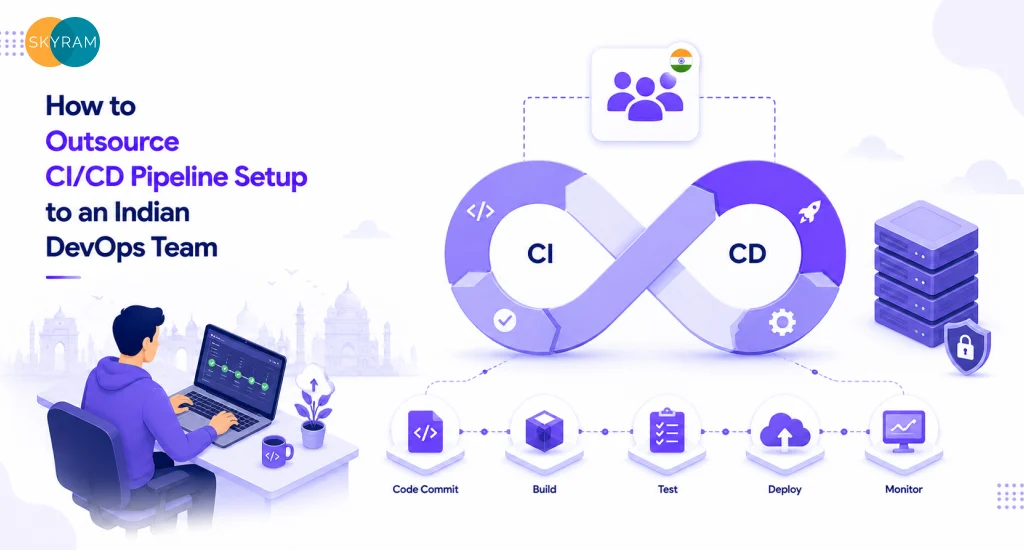
How to Outsource CI/CD Pipeline Setup to an Indian DevOps Team

A DevOps engineer reviewing a CI CD pipeline dashboard with automated build and deployment stages on a widescreen monitor

Your developers are shipping code. Your deployments are not keeping up. Build failures block releases for hours, staging environments drift from production, and no one on the team has the bandwidth to standardize the pipeline before the next sprint begins. You know what needs to happen. Finding someone to do it without hiring three senior DevOps engineers is the problem.

Choosing to outsource CI/CD pipeline setup to an offshore team resolves that gap without expanding payroll. Indian DevOps teams have spent the last decade maturing from body-shop vendors into specialized engineering practices. The right engagement gives you automated build, test, and deployment workflows designed around your stack, owned by engineers who do this full time, and handed back to your team with documentation and runbooks.

This guide walks through exactly how to structure that engagement: what to hand off, what to retain, how to evaluate a partner, and what a production-grade delivery looks like when the work is done correctly.

Why CI/CD Outsourcing to India Makes Engineering Sense

The argument for offshore CI/CD work is not about cost alone. It is about specialization depth. Building a reliable pipeline requires expertise across version control strategy, containerization, artifact management, environment parity, secrets management, and monitoring integration. Assembling that skill set in-house takes time most engineering teams cannot spare during active product development.

Indian DevOps firms have built practices around these exact competencies because the demand from global product companies created a market for it. Engineers who specialize in pipeline automation work across Jenkins, GitHub Actions, GitLab CI, CircleCI, ArgoCD, and Tekton daily. They are not generalists being reassigned to DevOps work. They are practitioners who have configured hundreds of pipelines across AWS, Azure, and GCP environments.

The time zone difference, frequently cited as a drawback, functions as a practical advantage for many teams. Your offshore CI/CD team runs build validation, integration tests, and environment health checks during your overnight hours. Issues surface in morning stand-ups with root cause already documented rather than dropped in your lap mid-sprint.

What the Cost Structure Actually Looks Like

Senior DevOps engineers in the US market command salaries between $130,000 and $180,000 annually. Offshore dedicated DevOps teams working on pipeline automation typically bill at $35 to $65 per hour depending on seniority and scope, with dedicated team arrangements often more cost-efficient than time-and-materials contracts.

The material savings come not just from rate arbitrage but from faster time-to-pipeline. An experienced offshore team sets up a production-grade CI/CD pipeline in four to eight weeks. An overloaded in-house team working on it between sprint commitments might take four to six months to reach the same result.

Key TakeawayCI/CD outsourcing to India delivers specialization depth that generalist in-house teams rarely match. Offshore DevOps engineers working full-time on pipeline automation move faster and produce more standardized output than internal teams splitting attention between product work and infrastructure. The cost advantage is real, but it compounds when you factor in delivery speed.

What to Scope Before You Sign Anything

Every failed outsourcing engagement starts the same way: the client hands over a vague requirement and expects the vendor to figure it out. CI/CD pipeline work is technical enough that ambiguity kills productivity. Before you approach any offshore team, define the following with precision.

Source Control and Branching Strategy

Document your current branching model. Trunk-based development, Gitflow, and feature-flag branching each require different pipeline trigger configurations. An offshore team building pipeline logic without understanding your branching strategy will build something that breaks the moment your developers run a hotfix.

Target Deployment Environments

Specify every environment the pipeline must serve: development, staging, UAT, production, and any customer-specific environments. Include the cloud platforms involved, whether that is AWS ECS, Kubernetes on GKE, Azure App Service, or a hybrid. Offshore teams working across a DevOps pipeline India-USA setup should receive an environment map before sprint one.

Security and Compliance Requirements

If you handle healthcare, financial, or government data, the pipeline must comply with SOC 2, HIPAA, or equivalent standards. Secrets management, audit logging, and access controls are not add-ons you negotiate after delivery. They belong in the initial scope document.

Handoff and Ownership Model

Decide upfront whether the offshore team builds and transfers or builds and retains ongoing support. A build-and-transfer model requires documentation standards, runbook delivery, and a knowledge transfer sprint. A retained support model requires SLA definitions and escalation paths. Both are valid. Leaving it undefined guarantees conflict.

Key TakeawayA precise scope document is the single biggest predictor of a successful CI/CD outsourcing engagement. Teams that invest two weeks in writing a detailed scope brief recover that time many times over in fewer revision cycles and faster delivery. Offshore DevOps teams working with clear environment maps, security requirements, and ownership definitions ship production-ready pipelines. Those working without them ship technical debt.

How to Evaluate an Offshore CI CD Team

Vendor selection for pipeline work differs from selecting a general software development team. The evaluation criteria should reflect the technical specificity of the work.

Pipeline-Specific Portfolio, Not Generic DevOps Credentials

Ask for case studies that document the specific problem the team solved, the pipeline architecture they implemented, and the measurable result. ‘Improved deployment frequency’ is not a result. ‘Reduced average deployment time from 47 minutes to 11 minutes by eliminating sequential test stages and introducing parallel execution across three environment tiers’ is a result.

Toolchain Alignment

Confirm the team has direct experience with your specific tools, not just the category. If you run GitHub Actions today and plan to migrate to Argo Workflows within 18 months, you need a team that has executed that migration before, not one that has only read the documentation. Request hands-on technical assessments or a paid discovery sprint rather than relying on resume claims.

Communication and Escalation Structure

An offshore CI/CD team that routes all questions through a project manager creates delays that compound across time zones. Look for teams that assign a dedicated technical lead with direct Slack or Teams access. Your DevOps lead should be able to have a synchronous call with the engineer who wrote the pipeline code, not an intermediary.

Engagement Model Fit

Different engagement structures serve different needs. The table below maps common models to their best use cases.

Engagement Model Best For Team Control Cost Profile
Staff Augmentation Filling specific skill gaps in an existing team High Mid-range
Dedicated Offshore Team Ongoing pipeline ownership with full DevOps scope Medium-High Efficient at scale
Project-Based Engagement One-time setup or migration with defined end state Medium Fixed or milestone-based


Key TakeawayEvaluating an offshore CI CD team on pipeline-specific evidence, not general DevOps credentials, filters out the firms that will learn on your project. Request detailed case studies, insist on toolchain alignment verification, and validate the communication structure before signing. The engagement model you choose should match your actual level of ongoing pipeline involvement, not just the lowest upfront cost.

The Outsource Pipeline Automation Delivery Process

Understanding what a structured delivery looks like helps you hold an offshore team accountable at each phase. The following sequence reflects how mature DevOps practices execute pipeline builds for US-based product companies.

Phase 1: Discovery and Audit (Weeks 1 to 2)

The offshore team audits your existing CI/CD setup, however minimal, alongside your codebase structure, test coverage, deployment targets, and team workflows. They document findings, surface blockers, and produce an architecture proposal. You review and approve before any build work begins.

Phase 2: Pipeline Architecture and Environment Setup (Weeks 2 to 4)

Engineers configure the pipeline framework: repository connections, build agents or runners, artifact registries, environment variables, and secrets management integration. For containerized workloads, this phase includes Docker build optimization, image scanning, and registry configuration. Infrastructure-as-code templates for environment parity get written in this phase, not bolted on later.

Phase 3: Stage-by-Stage Pipeline Build (Weeks 3 to 6)

The team builds each pipeline stage incrementally: code checkout, dependency installation, unit test execution, integration test execution, artifact build, container image build, security scanning, staging deployment, smoke testing, and production deployment with rollback capability. Each stage is validated against your actual codebase before moving to the next.

Phase 4: Observability and Alerting Integration

A pipeline without visibility is a pipeline you cannot trust. The offshore team connects your CI/CD system to your monitoring stack, whether that is Datadog, Prometheus, Grafana, or CloudWatch, configuring failure alerts, build duration metrics, and deployment success rate dashboards. This is standard in a production-grade engagement, not an optional add-on.

Phase 5: Handoff, Documentation, and Training (Week 6 to 8)

The final phase covers runbook delivery, a complete pipeline architecture document, a recorded walkthrough of every pipeline component, and a live knowledge transfer session with your engineering team. If the engagement includes ongoing support, SLA terms activate at this point.

A phased delivery process gives you clear checkpoints to validate progress before the offshore team advances to the next stage. Teams that skip the discovery audit and jump directly to building routinely produce pipelines that work in isolation but break against real workloads. Insist on the audit and architecture approval step regardless of how eager a vendor is to accelerate the timeline.

Key TakeawayA phased delivery process gives you clear checkpoints to validate progress before the offshore team advances to the next stage. Teams that skip the discovery audit and jump directly to building routinely produce pipelines that work in isolation but break against real workloads. Insist on the audit and architecture approval step regardless of how eager a vendor is to accelerate the timeline.

Managing a Cross-Border Continuous Integration Outsourcing Engagement

The technical work is only part of what you are managing. Cross-border DevOps engagements introduce coordination overhead that requires deliberate structure.

Overlap Hours and Async-First Communication

Establish a fixed daily overlap window of two to three hours where both teams are available synchronously. Outside that window, document decisions in writing rather than deferring them to the next sync. Offshore teams working within a continuous integration outsourcing model that enforces async-first communication move faster than those waiting for approval on every decision.

Access and Security Controls

Provide the offshore team with role-specific access scoped to what the work requires. Production environment credentials should flow through your secrets management system with audit logging, not shared directly. Code repository access should be branch-specific where possible. Review and revoke access promptly at each engagement milestone.

Progress Tracking and Code Review Integration

Integrate the offshore team into your existing project management and code review systems. Pull request reviews by your internal team on pipeline code changes keep knowledge transfer active throughout the engagement rather than concentrating it in the final handoff session. This also catches architectural decisions that conflict with internal standards before they become embedded in the pipeline.

Intellectual Property and Data Governance

Your Master Services Agreement should address code ownership, data residency, and confidentiality explicitly. Pipeline configuration files, deployment scripts, and infrastructure-as-code templates constitute proprietary engineering assets. Confirm these are assigned to your organization upon delivery, not retained by the vendor.

Key TakeawayManaging an offshore DevOps pipeline engagement requires the same discipline as managing any distributed engineering team, with additional attention to access controls, async communication structure, and IP assignment. Teams that treat the offshore partner as an external vendor rather than an integrated team extension consistently experience more friction and slower delivery. Treating them as a distributed team with clear boundaries produces better outcomes.

Risks to Anticipate and How to Mitigate Them

No offshore engagement is without risk. The teams that navigate it well anticipate the common failure modes before they materialize.

Vendor Lock-In to Proprietary Tooling

Some offshore DevOps firms build pipelines using internal templates or proprietary tooling that creates dependency on their services. Require open-standard tooling aligned with your existing tech stack. Pipeline configuration files must be fully portable and owned by your organization.

Scope Drift in Ongoing Support Engagements

A pipeline that starts as a discrete build project sometimes expands into open-ended DevOps support without corresponding contract adjustments. Define the boundaries of ongoing support engagements in writing, including what changes require a change order versus what falls within the support scope.

Knowledge Concentration Risk

If the offshore team builds the pipeline and the primary engineer responsible for it leaves the vendor firm, you face a knowledge gap that can stall operations. Require documentation standards that make the pipeline understandable to any competent DevOps engineer, not just the person who built it. Recorded walkthroughs and annotated configuration files serve as insurance against personnel turnover.

Security Misconfiguration in Automated Workflows

Automated pipelines with broad permissions create attack surface. Misconfigured CI/CD systems have been the entry point for several high-profile supply chain attacks. Require the offshore team to follow least-privilege principles for all service accounts, implement pipeline secrets scanning, and document the security model for every deployment stage.

Key TakeawayThe risks in offshore CI/CD engagements are manageable when you address them in the contract and project structure before delivery begins. Proprietary tooling, scope drift, and knowledge concentration are predictable failure modes. Teams that document mitigation for each one before signing have far fewer escalations during delivery than those that discover these issues mid-engagement.

Frequently Asked Questions About Outsourcing CI/CD Pipeline Setup

The following questions reflect common decision points for CTOs and DevOps leads evaluating offshore pipeline automation.

What does it mean to outsource CI/CD pipeline setup?

Outsourcing CI/CD pipeline setup means engaging an external engineering team to design, build, configure, and document your continuous integration and continuous delivery workflows. The scope typically covers version control triggers, automated testing stages, artifact management, environment deployment automation, and monitoring integration. The offshore team delivers a fully operational pipeline aligned to your stack and hands it off with documentation, runbooks, and a training session for your internal engineers.

How long does it take an Indian DevOps team to set up a CI/CD pipeline?

A complete CI/CD pipeline setup for a mid-sized application typically takes four to eight weeks with a dedicated offshore DevOps team. Simpler single-service pipelines with straightforward deployment targets can complete in two to three weeks. Pipelines covering multiple services, multi-region deployments, complex compliance requirements, or significant existing technical debt take eight to twelve weeks. Timeline accuracy depends heavily on the quality of the initial scope document and the speed of your internal approvals during the discovery phase.

What tools do Indian DevOps teams typically use for CI/CD pipeline automation?

Indian DevOps teams experienced in offshore pipeline automation work across the full spectrum of CI/CD tooling: GitHub Actions, GitLab CI, Jenkins, CircleCI, Bitbucket Pipelines, Argo CD, Tekton, and AWS CodePipeline are the most common. For container orchestration, Kubernetes with Helm is standard, alongside Terraform and Pulumi for infrastructure-as-code. Mature teams adapt to your existing toolchain rather than imposing their preferred tools.

How do I maintain security when an offshore team has access to my pipeline infrastructure?

Limit access to what the engagement actually requires. Use role-based access controls with audit logging for cloud environments. Provide repository access at the branch level where possible rather than full admin rights. Rotate credentials after the engagement ends and require the offshore team to use your secrets management system rather than handling credentials directly. Document every access grant and revoke each one as individual engagement phases complete.

What is the difference between a dedicated offshore DevOps team and a project-based CI/CD engagement?

A dedicated offshore DevOps team integrates into your engineering operation for ongoing pipeline maintenance, feature additions, and incident response. The team composition is stable and develops deep familiarity with your environment over time. A project-based engagement has a defined scope and end date: the team builds the pipeline, hands it off, and the relationship concludes. Project-based engagements suit organizations that want to own the pipeline internally after delivery. Dedicated teams suit organizations that want ongoing DevOps support without building the function in-house.

Which CI/CD outsourcing engagement model offers the best value for US companies?

The answer depends on your internal DevOps maturity. If you have engineers capable of maintaining a pipeline but not building one from scratch, a project-based setup engagement followed by internal ownership offers the best value. If you lack the internal DevOps capacity for ongoing pipeline operations, a dedicated offshore team provides continuous coverage at a fraction of the cost of equivalent in-house staffing. Staff augmentation works well for organizations with an existing DevOps function that needs specialized expertise for a specific migration or upgrade.

What should a CI/CD pipeline handoff package include?

A complete handoff package from an offshore DevOps team should include full pipeline architecture documentation, annotated configuration files for every pipeline stage, a runbook covering common failure scenarios and recovery procedures, a recorded video walkthrough of the pipeline end-to-end, environment variable and secrets management documentation, and at least one live knowledge transfer session with your internal team. Any pipeline delivered without this documentation requires additional time and budget to achieve independent operability.

Ready to Outsource CI/CD Pipeline Setup?

Skyram Technologies builds production-grade CI/CD pipelines for US-based engineering teams. Our DevOps specialists work across your existing stack, deliver full documentation, and transfer complete ownership to your team. If you are ready to stop letting pipeline work block your releases, start the conversation.

Visit skyramtechnologies.com/cd-pipeline/ to connect with our DevOps team.


Learn more about Skyram’s CD pipeline services and schedule a free discovery call.

AI Content Optimization Services: Future-Proofing US Marketing for Generative Search

Abstract graphic showing AI content signals being processed into search rankings, representing AI content optimization services for US marketers

Your traffic analytics changed sometime in the past twelve months. Pages that ranked steadily for years started dropping. Some lost featured snippets to AI Overviews. Others got absorbed into generative summaries without any click through to your site. The culprit is not a Google algorithm update in the traditional sense. It is a structural shift in how search engines consume, evaluate, and surface content.

AI content optimization services exist to address exactly this problem. They reformat, restructure, and re-signal your content so that both human readers and large language models can extract, trust, and cite it. For US content managers and CMOs watching organic traffic metrics flatten, this is where the strategic response starts.

What AI Content Optimization Actually Means in 2026

The term gets used loosely, so a precise definition matters. AI content optimization is the practice of structuring and signaling digital content so that AI-powered search systems, including Google’s AI Overviews, Bing Copilot, and retrieval-augmented generation (RAG) models, can accurately parse, summarize, and attribute it.

This is meaningfully different from traditional SEO. Traditional SEO optimized for crawlers that scored signals like keyword frequency, backlink authority, and on-page structure. Generative search engines work differently. They ingest content to understand it at a semantic level, identify source credibility, and decide whether a page is worth citing in a generated answer or surfacing directly.

Three Core Layers of AI Content Optimization

Effective optimization works across three distinct layers:

  • Semantic structure: Using clear definitional paragraphs, consistent entity references, and schema markup so AI models can map your content to specific topics and queries.
  • Answer-first formatting: Placing direct answers within the first 40 to 60 words of a section so that AI extraction picks up the response before context degrades.
  • Authority signaling: Using author attribution, citation links, and factual specificity to score high on the E-E-A-T signals that generative models use to determine source trustworthiness.

Brands that treat these as optional upgrades are already ceding ground to competitors who treat them as baseline requirements.

Key Takeaway: AI content optimization is not an extension of traditional SEO. It is a distinct practice focused on making content legible and credible to generative search systems. Ignoring the structural differences between these two approaches will produce content that ranks for neither humans nor machines effectively.

Why US Brands Need AI Content Optimization Services Now

US search behavior is shifting faster than most marketing teams have acknowledged internally. According to data from SparkToro and Semrush published in 2024, zero-click searches now account for more than 60% of Google searches in the United States. A significant and growing share of those zero-click outcomes arrive because an AI Overview or featured snippet answered the query without the user needing to visit any website.

For B2B companies, this means the top-of-funnel content pipeline that drove awareness and lead entry points now faces a structural disruption. A well-optimized pillar post that once pulled 3,000 monthly visits may now generate a fraction of that because the AI Overview pulls the answer directly and the user never clicks.

The B2B Stakes Are Higher Than They Look

Enterprise buyers in the US increasingly start product and vendor research through AI-assisted search. They ask a question. They get a synthesized answer that references two or three authoritative sources. If your brand is not one of those cited sources, you are invisible at exactly the moment the buyer is forming their initial shortlist.

Vendors who invest in AI content optimization services and USA-focused strategies right now have a compounding advantage. The models that generate AI Overviews pull from indexed content that already exists. Getting your content into that citation pool before competitors do is a timing advantage that is genuinely difficult to reverse later.

Key Takeaway: The US search landscape is not trending toward AI-influenced results. It has already arrived. Content teams that have not restructured their assets for generative search are losing top-of-funnel visibility right now, not at some future inflection point.

Core Components of a High-Performance AI Content Optimization Strategy

The brands getting cited in AI Overviews share specific structural and technical characteristics across their content. These are not random. They reflect how large language models are trained to identify credible, extractable answers.

Generative Engine Optimization (GEO)

GEO is the practice of optimizing content specifically for AI-driven search engines rather than traditional blue-link results. The key signals include entity density (how clearly and frequently your content references named concepts, organizations, and products), source consistency (whether your content contradicts itself or other credible sources), and structural predictability (whether AI models can identify the question-answer pattern reliably within each section).

A GEO-optimized page answers a question within the opening sentence of each key section. It does not bury the answer after three paragraphs of context. That structural discipline is what separates content that gets cited from content that gets skipped.

Answer Engine Optimization (AEO)

AEO focuses on the voice search and direct-answer use cases where the AI system needs to surface a single, authoritative response. For B2B content, AEO-optimized sections are self-contained: they define the term, explain its significance, and quantify the impact without requiring the reader or the AI model to pull context from another section.

FAQ sections built for AEO follow a strict pattern: each question mirrors the exact phrasing a user would type or speak, and each answer is complete in 40 to 80 words without referencing content elsewhere on the page.

Schema Markup and Structured Data

JSON-LD schema remains one of the highest-impact technical signals available. FAQPage schema, HowTo schema, and Article schema with author and publisher markup tell search systems what type of content they are processing before they parse a single sentence. Pages without schema make AI models work harder to classify content correctly, and that extra uncertainty often means the content gets deprioritized.

Content Depth Calibration

Depth means specific, not long. A 1,200-word article that answers a question with named examples, quantified outcomes, and clear methodology beats a 3,500-word post that circles the same ideas repeatedly. AI models score specificity. Vague language, hedged claims, and unsupported generalizations all depress the likelihood that content gets cited.

Key Takeaway: A strong AI content optimization strategy integrates GEO, AEO, structured data, and content depth calibration as a unified system. Optimizing only one layer while ignoring others leaves measurable gaps in search visibility that compound over time.

How AI Content Optimization Services Differ Across Providers

Not every provider offering AI content optimization delivers the same scope or methodology. The differences matter for budget allocation and expected outcomes.

Audit-Only vs. Full-Service Optimization

Audit-only providers diagnose gaps: missing schema, thin content, poor semantic structure, keyword cannibalization. They produce recommendations but leave execution to your internal team. Full-service providers audit, rewrite, restructure, and implement, then track performance against defined metrics. For teams that lack the bandwidth or technical depth to execute complex structural changes at scale, audit-only rarely moves the needle.

AI-Assisted Content Production

Some providers use AI writing tools to generate first drafts at high volume, then apply optimization frameworks before delivery. Others treat AI as a research and analysis tool while keeping the actual writing human. Neither model is categorically superior. The quality of the prompt engineering, editorial oversight, and post-generation optimization determines output quality, not the presence or absence of AI in the production pipeline.

Technical SEO Integration

Content optimization without technical SEO integration consistently underperforms. Page speed, Core Web Vitals, mobile usability, and crawl accessibility all affect whether your optimized content gets indexed correctly. Providers who treat content and technical SEO as separate workstreams tend to create situations where beautifully structured content sits behind crawl barriers or loads too slowly to rank.

Key Takeaway: Provider selection for AI content optimization services should prioritize full-service execution, transparent methodology, and integrated technical SEO support. Providers who operate in isolation from technical teams or who rely entirely on AI-generated output without editorial rigor will produce inconsistent results.

Building an AI-Ready Content Architecture from Scratch

US marketing teams who are starting from zero with generative search optimization face a sequencing challenge. Everything cannot happen at once, and the wrong sequencing wastes budget on content that cannot perform until foundational issues get fixed.

Phase 1: Technical Baseline

Before restructuring any content, confirm that your site can be indexed accurately. Run a crawl audit. Fix redirect chains, broken internal links, and canonicalization errors. Verify that Core Web Vitals meet current thresholds across both desktop and mobile. Schema implementation starts here too: site-level Organization and WebSite schema, then page-level markup as content gets optimized.

Phase 2: Keyword Cluster Prioritization

Not all keyword clusters have equal potential in generative search. Informational queries with clear answer structures get featured in AI Overviews far more often than navigational or commercial queries. Map your existing content against informational intent first. These pages represent the fastest path to AI Overview citations and the strongest return on initial optimization investment.

Phase 3: Content Restructuring

Each priority page gets restructured using the GEO and AEO principles described above. This means rewriting opening paragraphs to lead with answers, adding structured FAQ sections, implementing schema, and tightening entity references throughout. For long-form pillar posts, this often means splitting one sprawling article into a tightly organized pillar plus multiple supporting cluster posts that each answer a specific question with depth.

Phase 4: New Content Production

Once the existing archive is optimized and indexed, new content production scales up against the remaining keyword targets. Each new post gets built to the optimized standard from the first draft rather than needing a retroactive fix. This phase is where volume compounds: a strong technical and structural foundation means each new post starts with a higher baseline probability of getting cited. 

Key Takeaway: AI-ready content architecture is a phased investment, not a one-time project. Teams that try to skip the technical baseline phase and go straight to content production end up republishing optimized content on a foundation that limits its indexing and citation potential.

Measuring the ROI of AI Content Optimization

ROI measurement for AI content optimization services requires different metrics than traditional SEO tracking. Click-through rates and raw organic traffic tell only part of the story when a growing share of search value comes from brand citations in AI Overviews rather than direct clicks.

Metrics That Matter Now

  • AI Overview citation frequency: Track how often your brand or specific pages appear as cited sources in AI Overviews for target queries. Tools like BrightEdge and SE Ranking have added AI Overview tracking to their reporting suites.
  • Share of voice in generative results: Monitor what percentage of relevant AI-generated answers in your category reference your content versus competitor content.
  • Branded search lift: As your content gets cited more frequently in AI Overviews, expect measurable increases in branded search queries. Users who see your brand attributed as a source often follow up with a direct branded search.
  • Lead quality and conversion rate from organic: If content is properly structured for TOFU and MOFU intent, leads arriving from organic should convert at higher rates than before because they arrive with more contextual knowledge about your solution.

Do not abandon traditional metrics entirely. Keyword rankings, organic sessions, and bounce rate still provide useful diagnostic signals. The goal is to build a reporting framework that captures both traditional search performance and emerging generative search visibility.

Key Takeaway: ROI measurement for AI content optimization must expand beyond clicks and rankings to include AI Overview citation tracking and branded search lift. Teams that evaluate this investment using only traditional SEO metrics will systematically undercount the value being generated.

Frequently Asked Questions 

1. What are AI content optimization services?

AI content optimization services are professional services that restructure, reformat, and re-signal website content to improve its visibility and citation frequency in AI-powered search results, including Google AI Overviews, Bing Copilot, and answer engine interfaces. The work typically includes semantic restructuring, schema implementation, FAQ optimization, and content depth calibration to make content legible and credible to large language models.

2. How do AI content optimization services differ from traditional SEO?

Traditional SEO optimizes content for crawler-based ranking algorithms that score signals like keyword frequency, backlink volume, and page authority. AI content optimization targets generative search systems that process content semantically, assessing whether it contains complete, credible, and extractable answers to user queries. The structural requirements are different: generative search rewards answer-first formatting, entity clarity, and source credibility signals that traditional SEO does not prioritize in the same way.

3. Which US industries benefit most from AI content optimization services?

B2B technology, professional services, healthcare, financial services, and legal sectors see the highest lift from AI content optimization because their buyers conduct extensive research through AI-assisted search before contacting vendors. These industries also have high-value long-tail queries with clear informational intent, which are exactly the query types that AI Overviews favor. However, any sector where buyers research online before converting benefits from this approach.

4. How long does it take to see results from AI content optimization?

Structural changes to existing content can produce AI Overview citation improvements within four to eight weeks for pages that are already indexed and receiving some organic traffic. New content built to the optimized standard typically takes eight to sixteen weeks to accumulate the crawl frequency and index depth needed for consistent AI Overview citations. Technical SEO fixes like schema implementation and Core Web Vitals improvements tend to produce faster indexing gains that accelerate subsequent content performance.

5. What is the role of AEO in AI content optimization?

Answer Engine Optimization (AEO) is the specific practice of structuring content to perform in direct-answer and voice search interfaces where AI systems need to surface a single, concise, authoritative response. Within a broader AI content optimization strategy, AEO handles FAQ architecture, definitional paragraph construction, and the answer-first formatting that makes content extractable by AI Overviews. It works alongside GEO, which targets AI-driven search engines more broadly, and traditional SEO, which addresses crawler-based ranking signals.

6. Do I need to replace all my existing content to benefit from AI content optimization services?

No. A strategic audit identifies which existing pages have the highest potential for AI Overview citations based on current traffic, keyword intent, and structural gaps. High-potential pages get restructured and enhanced rather than replaced. Thin or duplicate pages may get consolidated or retired. Completely new content is only justified for keyword clusters where no existing asset can be cost-effectively upgraded. The most efficient approach layers optimization across existing high-value content first before scaling new production.

7. How do AI content optimization services usa providers handle schema implementation?

Reputable providers implement schema at two levels: site-wide organizational markup that establishes brand identity and publisher authority, and page-level schema that classifies each content type accurately, including Article, FAQPage, HowTo, and Product schemas where relevant. Schema gets added via JSON-LD in the page head, validated against Google’s Rich Results Test, and monitored through Search Console for errors. For enterprise sites, schema implementation typically connects to the CMS templating layer so new pages inherit correct markup automatically.

Ready to Make Your Content Visible to Generative Search?

The gap between brands that appear in AI Overviews and those that do not will widen over the next eighteen months. Content that is not structured for generative search will continue losing share of voice to competitors who invested in the right optimization framework earlier.

Skyram Technologies works with US marketing teams to audit existing content, implement GEO and AEO frameworks, and build scalable production systems that generate AI-ready content from the first draft. The process is diagnostic first: we identify exactly which pages have the highest citation potential and what structural changes would activate that potential fastest.

Start with a content audit or explore our AEO services to understand how your content performs against generative search benchmarks. Contact Skyram Technologies to schedule a consultation with our content strategy team.

Talk to Skyram Technologies about AI content optimization for your US marketing strategy. No templates, no generic audits, just a structured assessment of where your content stands and what it takes to get cited.

PPC Management Services: The Complete Guide for US Businesses in 2026

PPC Management Services Complete US Guide 2026

Your Google Ads account is spending money every day. But if your cost per lead has been climbing for the past two quarters, your quality scores have flatlined, or your campaigns are delivering clicks that never convert, something is structurally wrong. Most US businesses discover this problem after the damage is already done.

Professional PPC management services exist to prevent exactly that. They cover everything from platform strategy and campaign architecture to daily bid adjustments, negative keyword maintenance, and conversion rate optimization. Done right, they turn paid search from a cost center into a predictable growth channel.

This guide walks you through what PPC management services include, how they work across Google, Meta, and LinkedIn, what separates strong management from mediocre, and how to evaluate whether your current setup is actually performing. The team at Skyram Technologies built this resource for US marketing managers and business owners who want clarity, not vendor pitches.

Here is what you will learn:

  • What PPC management services are and what they actually cover
  • Which platforms matter most for US businesses in 2026
  • How bid strategy, targeting, and tracking work together
  • What professional management costs in measurable outcomes
  • How to evaluate your current PPC partner or agency
  • What to look for when choosing a new PPC management provider

What Are PPC Management Services? A Clear Definition

PPC management services are defined as the ongoing, professional oversight of pay-per-click advertising campaigns across platforms such as Google Ads, Microsoft Advertising, Meta Ads, and LinkedIn Campaign Manager. The service encompasses account setup, keyword research, campaign architecture, audience targeting, ad creative development, bid strategy, and continuous performance optimization aimed at improving return on ad spend (ROAS).

When businesses run PPC campaigns without dedicated management, accounts tend to drift. Budgets shift toward broad match keywords that attract irrelevant traffic. Negative keyword lists stop growing. Ad copy goes stale. Bid adjustments never happen. The result is a slow erosion of performance that rarely triggers an alarm until cost per acquisition crosses a threshold that hurts.

Managed PPC is different. A team or specialist actively works the account on a scheduled cadence, typically daily monitoring with weekly optimizations and monthly strategic reviews. The goal is not just to keep campaigns running but to compound improvements over time so that every dollar spent works harder than the one before it.

Core Components of PPC Management

A complete PPC management engagement typically covers these operational areas:

  • Campaign architecture: Account structure, campaign types (Search, Performance Max, Display, Shopping), and ad group organization
  • Keyword strategy: Research, match type selection, negative keyword development, and expansion based on search term reports
  • Bid management: Manual, enhanced CPC, Target CPA, Target ROAS, and portfolio bid strategies using Google Ads and SA360
  • Ad creative and copy: Responsive search ads (RSAs), image assets, call assets, sitelink extensions, and structured snippets
  • Audience and targeting: Customer match, in-market segments, remarketing lists for search ads (RLSA), and demographic layering
  • Conversion tracking: Google Tag Manager implementation, GA4 integration, and offline conversion import
  • Reporting: Weekly performance dashboards, monthly strategic reports, and attribution analysis
Key Takeaway:

PPC management services go well beyond campaign setup. They are an active, ongoing discipline that requires daily attention, data analysis, and iterative optimization to sustain performance as competition and platform algorithms evolve.

Which PPC Platforms Matter Most for US Businesses in 2026?

Choosing where to advertise is the first strategic decision in any PPC program. The right platform depends on your audience, your sales cycle, and whether your buyers are actively searching for a solution or need to be made aware one exists. Here is how the major platforms break down for US businesses.

Google Ads: The Foundation for Search Intent

Google controls roughly 89% of the US search market. For any business where buyers actively search for products or services, Google Search campaigns are non-negotiable. In 2026, Google Ads management also means navigating Performance Max campaigns, which use machine learning to serve ads across Search, Shopping, Display, YouTube, Discover, and Gmail from a single campaign.

Performance Max has changed how paid search management works. Rather than manually controlling placements, advertisers now supply asset groups (headlines, images, videos, audience signals) and let Google’s automation handle allocation. Skilled management means knowing how to structure asset groups, set strong audience signals, and interpret Insights reports to improve inputs.

Microsoft Advertising: Underused and High-Value

Microsoft Advertising (Bing) reaches a US audience with slightly higher household incomes and a stronger B2B presence than Google. CPCs are consistently lower, competition is lighter, and import from Google Ads takes under 30 minutes. Many US advertisers ignore it entirely, which means your ads often face significantly less competition there.

Meta Ads: Upper-Funnel Demand Generation

Meta Ads (Facebook and Instagram) operate on interest and behavior targeting rather than search intent. They excel at building brand awareness, retargeting site visitors, and driving demand for products that benefit from visual demonstration. For B2C brands and some B2B SaaS products with broad audiences, Meta Ads are a critical channel for full-funnel PPC campaign management.

LinkedIn Ads: B2B Precision Targeting

LinkedIn Campaign Manager allows targeting by job title, seniority, company size, industry, and skills. CPCs are the highest of any major platform, but the audience precision justifies it for high-value B2B sales cycles. LinkedIn is particularly effective for Sponsored Content (native feed ads) and Lead Gen Forms that pre-fill user data from profile information.

Platform Best For Avg. CPC Range (US) Targeting Strength
Google Search Active buyer intent $1 – $8+ Keyword, audience, location
Google Performance Max Full-funnel automation $0.50 – $5+ AI-driven, asset-based
Microsoft Advertising B2B, cost-efficient reach $0.50 – $4 Similar to Google Ads
Meta Ads Awareness, retargeting $0.30 – $2 Interest, behavior, lookalike
LinkedIn Ads B2B lead generation $5 – $15+ Job title, company, seniority


Key Takeaway:

Most US businesses need at least two platforms in their paid search strategy. Start with Google Search for intent-based demand capture, then layer in Meta or LinkedIn based on your audience profile and funnel strategy.

How PPC Bid Strategy and Budget Allocation Actually Work

Bid strategy is where paid search management becomes genuinely technical. Choosing the wrong strategy for your conversion volume, or misapplying automated bidding, is one of the most common sources of wasted spend in US accounts.

Manual vs. Automated Bidding: When Each Works

Manual CPC gives you full control over keyword-level bids. It works well in accounts with lower conversion volume (under 30 conversions per campaign per month) where smart bidding algorithms lack sufficient data to optimize reliably. The tradeoff is that manual bidding requires daily attention and deep knowledge of auction dynamics.

Smart bidding strategies (Target CPA, Target ROAS, Maximize Conversions, Maximize Conversion Value) use Google’s machine learning to set bids in real time based on hundreds of auction-time signals: device, location, time of day, search query, user history, and more. These strategies outperform manual bidding in accounts with sufficient conversion data, but they require a learning period (typically 2-4 weeks) and careful target setting.

Budget Allocation Across Campaigns

Professional PPC management uses a budget allocation framework based on funnel stage, historical performance, and business priority:

  • Bottom-funnel campaigns (brand search, competitor conquest, high-intent non-brand) receive the highest CPAs because they convert at the highest rates.
  • Middle-funnel campaigns (category terms, solution-aware searches) receive moderate budgets with a focus on lead quality over volume.
  • Upper-funnel campaigns (awareness display, discovery, YouTube) are managed to impression share and view-through conversion metrics rather than direct ROAS.

The Role of Quality Score in Bid Efficiency

Quality Score (1-10 in Google Ads) measures expected click-through rate, ad relevance, and landing page experience. A Quality Score of 8 vs. 4 on the same keyword can reduce your effective CPC by 40-50% while improving ad rank. This is why bid strategy optimization cannot be separated from ad copy and landing page work. They are parts of the same performance equation.

Key Takeaway:

Automated bidding outperforms manual bidding when you have data. In new campaigns, focus on accumulating conversion volume at a stable target before switching strategies. Never set a Target ROAS higher than your account historically delivers.

Audience Targeting and the Keyword Strategy Behind High-ROI PPC

Effective Google Ads management is not just about which keywords you bid on. It is about understanding the full targeting ecosystem: match types, audiences, locations, devices, and dayparting. A campaign targeting the same keyword with different audience overlays will produce dramatically different results.

Keyword Match Types in 2026

Google Ads currently offers three effective match types, each with different behavior:

  • Broad match: Triggers for related queries based on intent signals, not just word matching. With smart bidding, broad match can surface unexpected high-converting queries. Without smart bidding, it creates significant wasted spend.
  • Phrase match: Shows ads for queries that include the meaning of your keyword. More controlled than broad, less restrictive than exact.
  • Exact match: Triggers only for queries that share the same meaning or intent as your keyword. Highest control, lowest reach.

Most well-managed accounts use a combination of all three, segmented into separate ad groups so you can control bids, messaging, and budgets at each level of specificity.

Negative Keywords: The Most Undervalued Optimization

Negative keyword lists prevent your ads from showing on irrelevant queries. A well-maintained negative list typically reduces wasted spend by 15-30% in accounts that were running without one. Search term report analysis, run weekly or bi-weekly, is how professional PPC campaign management teams identify new negatives systematically.

Audience Layering for Precision Targeting

RLSA (Remarketing Lists for Search Ads) and Customer Match allow you to adjust bids and messaging based on audience membership:

  • Bid up for past site visitors who viewed high-value pages but did not convert
  • Suppress ads for existing customers on acquisition campaigns
  • Create separate campaigns for your most valuable customer segments with dedicated budgets
  • Layer in-market audiences with observation mode to gather conversion data before making bid adjustments
Key Takeaway:

Keyword targeting and audience targeting work together. The same keyword bid on by a returning site visitor should be treated differently than the same keyword bid on by a cold searcher. Account structure must reflect this reality.

Conversion Tracking, Attribution, and Reporting That Actually Measures PPC Performance

You cannot optimize what you cannot measure. This sounds obvious, but conversion tracking errors are present in the majority of Google Ads accounts audited by experienced agencies. Broken tracking means your smart bidding algorithms are learning from incomplete data, which degrades the quality of every automated decision the platform makes.

Setting Up Reliable Conversion Tracking

A complete tracking implementation for US businesses should include:

  • Google Ads conversion actions: Form submissions, phone calls (60-second minimum), purchases, and key page views tracked via Google Tag Manager
  • GA4 integration: Linking GA4 to Google Ads for audience imports, cross-channel attribution, and funnel analysis
  • Offline conversion import: For B2B businesses, uploading CRM data to tie closed deals back to specific keywords and campaigns
  • Enhanced conversions: Hashed first-party data (email, name, phone) sent with conversion events to improve match rates and attribution accuracy

Understanding Attribution Models

Google Ads defaults to data-driven attribution (DDA), which uses machine learning to assign fractional credit across touchpoints. For most accounts with sufficient data, DDA is the most accurate model. Last-click attribution, still used by many accounts, systematically over-credits bottom-funnel keywords and under-credits upper-funnel discovery ads.

Switching to DDA while keeping conversion window settings appropriate for your sales cycle (typically 30-90 days for B2B) gives smart bidding algorithms better input data and usually improves campaign performance over a 6-8 week period.

Reporting Metrics That Matter

Metric What It Measures Target Benchmark
ROAS Revenue per dollar spent 4x+ for most ecommerce
Cost per Conversion (CPA) Cost to generate one lead or sale Below target CPA set at brief
Impression Share % of eligible auctions where your ad appeared >70% for brand campaigns
Search Lost IS (Budget) Impressions lost due to budget <10% for priority campaigns
Quality Score (1-10) Relevance of keyword, ad, and landing page 7+ for core keywords
Conversion Rate Conversions / clicks Benchmark to your industry average


Key Takeaway:

If your tracking is broken, no amount of bid optimization will fix your campaigns. Tracking integrity is the first thing a professional PPC audit should verify. Everything else builds on it.

How to Evaluate Your Current PPC Management Services

Not all PPC management is equal. An account can look busy (lots of campaigns, regular ad copy changes, weekly reports) while still underperforming. Here is a framework for objectively assessing whether your current setup is working.

Signs Your PPC Account Needs Attention

  • Cost per lead has increased by more than 20% over the past 6 months without a clear market explanation
  • More than 15% of your Google Ads spend is going to broad match keywords you have not deliberately chosen
  • Your negative keyword list has fewer than 100 terms in a mature account
  • You have no RLSA campaigns or audience bid modifiers
  • Conversion tracking shows high volume but your CRM shows very few qualified leads
  • Your agency reports on impressions and clicks but never on cost per qualified lead or ROAS
  • You have Performance Max campaigns with no asset groups differentiated by audience signal

Questions to Ask Your PPC Agency or Manager

These questions separate skilled PPC management from basic account babysitting:

  • “What was our impression share loss to rank last month, and what is the fix?”
  • “Can you show me our top 10 search terms by spend and their conversion rates?”
  • “How are you structuring our audience signals in Performance Max?”
  • “What did you change in the last 30 days, and what was the measurable impact?”
  • “Are we running enhanced conversions? Is offline conversion data uploaded?”

PPC Audit: The Starting Point for Any Engagement

A proper PPC audit reviews account structure, conversion tracking integrity, keyword and match type strategy, negative keyword lists, Quality Scores, bid strategies, landing page alignment, audience targeting, and attribution settings. It should produce a prioritized list of specific fixes with estimated impact, not a generic scorecard.

Key Takeaway:

Frequency of changes is not the same as quality of management. Evaluate your PPC partner on cost per qualified lead trends, conversion rate improvements, and whether they proactively identify and fix structural problems.

How to Choose the Right PPC Management Services Provider in the USA

Selecting a PPC management service provider in the USA is a decision with significant financial stakes. A weak agency or freelancer can cost you more in wasted ad spend than their management fee in months. Here is what to prioritize.

Criteria for Evaluating PPC Agencies

Criteria What to Look For Red Flags
Certifications Google Ads certified, Premier Partner status No certifications or expired
Industry experience Case studies in your vertical or comparable B2B/B2C Only generic results
Reporting transparency Access to your own ad accounts, regular detailed reports Reports only PDFs, no account access
Account ownership You own the ad accounts Agency retains account control
Tracking setup GA4, GTM, enhanced conversions as standard Relies only on Google Ads pixel
Strategic input Monthly strategy reviews, proactive recommendations Reactive only, executes your directions
Communication Named account manager, defined response SLA Account rotates between juniors

In-House vs. Agency vs. Freelancer

Each model has genuine tradeoffs for US businesses:

  • In-house: Best for companies spending $150K+ per month who need daily cross-department integration. Requires a competitive salary, tools budget, and ongoing training.
  • Agency: Best for companies spending $10K-$150K per month who want a team with multi-platform expertise and platform relationships. Costs less than a full-time hire at mid-tier spend levels.
  • Freelancer: Best for companies spending under $10K per month or for single-platform specialist work. Quality varies significantly; requires more oversight.

What a PPC Onboarding Process Should Look Like

A structured onboarding from a professional provider includes:

  • Account audit within the first 10 business days
  • Tracking audit and fixes before any spend changes
  • 30-60-90 day roadmap with clear milestones
  • Baseline KPI setting using historical data
  • Audience and keyword research aligned to your buyer personas
  • Ad copy and landing page review with specific recommendations
Key Takeaway:

Choose a provider who insists on tracking accuracy before optimizing for performance. Any agency that launches campaigns before confirming conversion tracking is intact is prioritizing speed over quality.

PPC Management Services Trends US Businesses Need to Know in 2026

The paid search landscape in the US has shifted meaningfully in the past 24 months. Here are the developments that should shape how your team thinks about PPC strategy this year.

AI-Powered Campaign Management Is Now Standard

Google’s automation now touches every part of the ad serving process. Performance Max, broad match with smart bidding, RSA ad selection, and automated assets are all AI-driven. The management discipline has shifted from manual micro-optimization to systems thinking: how to structure inputs (assets, audiences, conversion data) so automation produces better outputs.

This does not mean human oversight is less important. It means oversight has moved upstream. You manage the brief, the assets, and the goals. Google’s systems execute. The quality of your inputs determines the quality of your results.

First-Party Data Is Now a Competitive Advantage

With third-party cookie deprecation well underway and privacy regulations tightening in many US states, advertisers with strong first-party data infrastructure have a measurable advantage. Customer Match, enhanced conversions, and offline conversion import all rely on first-party data. Building that infrastructure now means better targeting accuracy and attribution stability as the industry’s tracking landscape continues to change.

Search Generative Experience and Its Impact on Paid Search

Google’s AI Overviews and Search Generative Experience (SGE) features are changing how some search results pages look. Early data suggests that paid ads continue to maintain strong click volumes because they appear before and alongside AI-generated answers. However, branded and informational queries may see reduced paid search click volume over time as AI summaries resolve intent without a click.

For pay-per-click advertising practitioners, the near-term implication is to monitor CTR trends by query type and ensure paid budgets remain focused on transactional and high-commercial-intent queries where AI summaries are least likely to satisfy intent.

Attribution and Measurement Are Getting Harder, Not Easier

iOS privacy changes, GA4’s session modeling, and cross-device behavior mean that a meaningful percentage of conversions in any US account are modeled rather than observed. Professional management means understanding which numbers are measured and which are estimated, and making budgeting decisions that account for that uncertainty.

Key Takeaway:

In 2026, PPC management requires as much expertise in data architecture and automation strategy as it does in platform execution. Agencies and managers who understand first-party data, attribution modeling, and AI-driven campaign inputs will outperform those still optimizing manually.

Frequently Asked Questions About PPC Management Services

Q1: What do PPC management services include?

PPC management services include the full lifecycle of paid advertising account management: keyword research and strategy, campaign and ad group setup, ad copy creation and testing, bid strategy configuration (including automated bidding such as Target CPA and Target ROAS), negative keyword development, audience targeting and remarketing setup, conversion tracking implementation, landing page performance analysis, and regular reporting. Professional PPC management also includes strategic account reviews, budget allocation recommendations, and ongoing testing of new platform features. The scope varies by provider but typically covers all major platforms where a business runs paid ads, including Google Ads, Microsoft Advertising, Meta Ads, and LinkedIn Campaign Manager.

Q2: How is PPC management different from running ads yourself?

Self-managed PPC typically involves setting up campaigns based on platform suggestions, setting a budget, and letting campaigns run with minimal changes. Professional PPC management involves systematic bid optimization, ongoing search term analysis to expand negatives and identify new opportunities, Quality Score improvement work, audience segmentation, conversion tracking audits, and multi-platform strategy. The difference shows up most clearly over 6-12 months: self-managed accounts tend to see performance erode as competition increases and algorithms change, while professionally managed accounts improve incrementally because someone is actively working the account on a defined cadence.

Q3: What results should I expect from PPC management services?

Realistic expectations depend on your industry, current account maturity, and competitive landscape. In a new account or one being rebuilt from a weak foundation, expect the first 60-90 days to focus on establishing tracking accuracy, building out negative keyword lists, and stabilizing conversion data. Performance improvements typically become measurable in months 2-4. In a mature, well-structured account, professional management should maintain or improve ROAS quarter over quarter while expanding reach where budget allows. Specific benchmarks to track include cost per conversion, conversion rate, impression share, and ROAS, compared against a rolling 90-day baseline.

Q4: How do I know if my PPC campaigns are performing well?

Evaluating PPC performance requires comparing your account metrics against both your own historical performance and your industry benchmarks. Key signals of a well-performing account include stable or declining cost per conversion over time, conversion rates above industry averages (Google’s own benchmark reports break these out by vertical), impression share above 70% for brand campaigns, Quality Scores of 7 or higher on core keywords, and a low percentage of spend going to irrelevant search terms. If your agency is reporting on impressions and clicks but not on cost per qualified lead or pipeline contribution, you are looking at vanity metrics rather than performance indicators.

Q5: What is the difference between paid search management and PPC management?

Paid search management specifically refers to the management of text-based ads that appear in search engine results pages (Google, Bing) in response to user queries. PPC management is a broader term that encompasses paid search plus all other pay-per-click channels, including display advertising, social media advertising (Meta, LinkedIn, TikTok), YouTube ads, and Shopping ads. In practice, most providers who offer PPC management services in the USA include both paid search and social advertising. When evaluating a provider, confirm which platforms are included in the scope of management and whether each platform has dedicated specialists.

Q6: How long does it take to see results from PPC management?

PPC can produce results faster than any other digital marketing channel because you are buying immediate traffic to targeted landing pages. Initial results (first conversions, baseline data) often appear within the first week of launching a properly structured campaign. However, optimization toward your target CPA or ROAS typically takes 60-90 days, as smart bidding algorithms need a learning period of 2-4 weeks per campaign and account structure adjustments need time to show statistical significance. B2B campaigns with longer sales cycles require 3-6 months to generate enough pipeline data to accurately measure ROAS. Set 90-day benchmarks rather than evaluating success at 30 days.

Conclusion: What Effective PPC Management Services Deliver

Effective PPC management services deliver three things consistently: tracking accuracy so you know what is actually working, account structure that makes platform automation smarter, and ongoing optimization that compounds performance gains over time.

For US businesses evaluating their options in 2026, those three criteria are the filter to apply. The platform landscape has changed. AI-driven automation is standard. First-party data is a competitive moat. But the fundamentals have not changed: clean tracking, disciplined account management, and a strategic approach to bidding and audiences still determine who wins at auction.

Whether you are auditing your current PPC management services provider or starting fresh, this guide gives you the framework to ask the right questions and recognize good work when you see it. Skyram Technologies works with US businesses across these exact challenges every day.


Ready to Stop Wasting Ad Budget?

Most US businesses overspend on PPC by 20-40% due to poor account structure, weak negative keyword lists, and zero bid automation. Skyram Technologies audits your entire Google Ads and Meta account, finds the waste, and rebuilds the strategy.

Our team at Skyram delivers a full audit, a prioritized fix list, and a 90-day roadmap during your free PPC consultation.

Claim Your Free PPC Audit Today

Visit skyramtechnologies.com or schedule a free consultation today

What Is Generative Engine Optimization (GEO) and Why US Marketers Must Act Now

What Is Generative Engine Optimization (GEO) Skyram Technologies

Your organic traffic numbers look fine on paper. Rankings are holding. Sessions are steady. But something changed in the last twelve months: a growing share of your potential customers are getting answers from ChatGPT, Google’s AI Overviews, Gemini, and Perplexity, and your brand is not in those answers.

That gap is what generative engine optimization (GEO) was built to close. Generative engine optimization is the discipline of structuring content so that AI-powered answer engines cite, quote, and recommend your brand when a user asks a relevant question. It sits alongside traditional SEO, not against it, but it demands different tactics, different content formats, and a different way of measuring success.

In this post you will learn exactly what GEO is, how it differs from traditional SEO, which US marketers are most at risk from ignoring it, and what a practical GEO program looks like. Our team at Skyram Technologies has been monitoring these shifts closely, and the window for early-mover advantage is still open, but not indefinitely.

What Is Generative Engine Optimization (GEO)?

Generative engine optimization is defined as the practice of optimizing digital content to appear as cited sources, quoted passages, or recommended brands inside AI-generated responses produced by large language model (LLM)-powered platforms such as ChatGPT, Google AI Overviews, Microsoft Copilot, Perplexity, and Claude.

Traditional SEO earns you a blue link on a results page. GEO earns you a mention, or a direct quote, inside the answer itself. That distinction matters enormously. AI Overviews now appear on roughly 47% of US Google searches, according to BrightEdge’s 2024 tracking data. When an AI generates an answer, it draws from sources it considers authoritative, well-structured, and semantically clear. If your content does not meet those criteria, you are invisible to a massive and growing share of search traffic.

The core GEO signals are entity authority (does the web consistently associate your brand with a topic?), content clarity (can an LLM extract a clean, accurate answer from your page?), citation patterns (are credible third-party sources referencing your content?), and structural formatting (do you use definition-first paragraphs, FAQ schemas, and direct-answer prose?).

Key Takeaway:GEO is not a replacement for SEO, it is the next layer. Every piece of content you optimize for GEO also becomes a stronger SEO asset, because the same clarity that AI engines reward is also rewarded by Google’s traditional ranking algorithm.

GEO vs. Traditional SEO: What Actually Changes

The simplest way to understand the difference is to look at the output. SEO optimization produces a ranked URL. GEO optimization produces a cited passage inside a generated answer. The table below breaks down the operational differences:

Dimension Traditional SEO GEO
Optimizes for Google / Bing algorithms ChatGPT, Gemini, Perplexity, AI Overviews
Signal type Backlinks, keywords, Core Web Vitals Entity authority, citation patterns, semantic depth
Result format Blue-link SERP listings Prose answers, cited sources, featured passages
Measurement Keyword rank, organic CTR Brand mention rate, AI citation frequency
Typical timeline 3–6 months to rank 4–8 weeks to appear in AI answers (early movers)
Content format Keyword-dense pages Definition-first, FAQ-structured, entity-rich prose


The practical implication: your content team needs to write for two audiences simultaneously, the human reader and the LLM that will summarize your page for that human. Writing for LLMs does not mean keyword stuffing or robotic prose. It means structuring information so the key claim is stated clearly in the first sentence of a section, definitions appear before elaborations, and FAQ sections contain standalone answers that make sense without surrounding context.

The Entity Graph Shift

Google’s Knowledge Graph and LLM training data both rely on entity relationships, the idea that “Skyram Technologies” is an entity associated with “GEO services,” “cloud consulting,” and “US digital marketing.” Building that entity association is a core GEO task. It requires consistent NAP data, Wikipedia-style structured content, schema markup, and third-party brand mentions across credible publications.

Latency of Results

Traditional SEO rewards patience, new content typically takes 3–6 months to rank. GEO results move faster for early movers. A well-structured piece of content targeting a specific AI query can appear in AI Overviews or Perplexity answers within weeks of indexing, because LLMs and retrieval systems prioritize freshness and authority simultaneously. That window favors brands who act now, before the space gets crowded.

Key Takeaway: The technical overhead of GEO is lower than many marketers expect. The biggest lift is editorial: rewriting existing content to be definition-first, self-contained, and entity-rich, not rebuilding your site architecture.

GEO vs. Traditional SEO: What Actually Changes

The simplest way to understand the difference is to look at the output. SEO optimization produces a ranked URL. GEO optimization produces a cited passage inside a generated answer. The table below breaks down the operational differences:

Dimension Traditional SEO GEO
Optimizes for Google / Bing algorithms ChatGPT, Gemini, Perplexity, AI Overviews
Signal type Backlinks, keywords, Core Web Vitals Entity authority, citation patterns, semantic depth
Result format Blue-link SERP listings Prose answers, cited sources, featured passages
Measurement Keyword rank, organic CTR Brand mention rate, AI citation frequency
Typical timeline 3–6 months to rank 4–8 weeks to appear in AI answers (early movers)
Content format Keyword-dense pages Definition-first, FAQ-structured, entity-rich prose

 
The practical implication: your content team needs to write for two audiences simultaneously, the human reader and the LLM that will summarize your page for that human. Writing for LLMs does not mean keyword stuffing or robotic prose. It means structuring information so the key claim is stated clearly in the first sentence of a section, definitions appear before elaborations, and FAQ sections contain standalone answers that make sense without surrounding context.

The Entity Graph Shift

Google’s Knowledge Graph and LLM training data both rely on entity relationships, the idea that “Skyram Technologies” is an entity associated with “GEO services,” “cloud consulting,” and “US digital marketing.” Building that entity association is a core GEO task. It requires consistent NAP data, Wikipedia-style structured content, schema markup, and third-party brand mentions across credible publications.

Latency of Results

Traditional SEO rewards patience, new content typically takes 3–6 months to rank. GEO results move faster for early movers. A well-structured piece of content targeting a specific AI query can appear in AI Overviews or Perplexity answers within weeks of indexing, because LLMs and retrieval systems prioritize freshness and authority simultaneously. That window favors brands who act now, before the space gets crowded.

Key Takeaway: The technical overhead of GEO is lower than many marketers expect. The biggest lift is editorial: rewriting existing content to be definition-first, self-contained, and entity-rich, not rebuilding your site architecture.

Why US Marketers Face Specific GEO Pressure

The US market is where AI search adoption is moving fastest. Google rolled out AI Overviews to all US users in May 2024, before any other market. ChatGPT’s US user base surpassed 100 million monthly active users in late 2023. Perplexity’s funding rounds and enterprise integrations are US-centric. The competitive pressure to appear in AI answers is higher here than anywhere else right now.

B2B Buyers Are Researching Differently

Gartner’s 2024 buyer research found that 75% of B2B buyers now use AI tools during the vendor research phase, specifically to generate shortlists, compare vendors, and understand service categories. If your service page is not the source an LLM draws from when a VP asks “what is the best cloud consulting firm for mid-market companies in the US,” you are not on that shortlist.

This is the highest-stakes GEO use case for agencies, consultancies, and B2B SaaS brands: the moment when a real decision-maker delegates initial vendor research to an AI assistant. Your content needs to be the authoritative source that gets cited in that moment.

Zero-Click Is Not a New Problem, But It Got Bigger

Zero-click searches (queries that get answered on the SERP without a click) are not new. Featured snippets have existed since 2014. But AI Overviews dramatically expand zero-click coverage. Sistrix data from Q1 2025 shows AI Overviews appearing on queries that previously generated no featured snippet, meaning a new category of traffic that used to flow to your site is now being absorbed by AI-generated summaries. GEO is how you ensure your brand still receives attribution even when the click does not happen.

Key Takeaway: US B2B marketers who ignore GEO are not just missing traffic, they are missing the moment their brand gets evaluated by AI-assisted buyers. That’s a pipeline problem, not just a traffic problem.

Core Generative Engine Optimization Tactics That Work in 2025

GEO is still a maturing discipline, but several tactics consistently improve citation rates across AI platforms. Here is what your content and SEO teams should be doing now.

1. Definition-First Content Architecture

Every page targeting a GEO query should open its primary section with a clean, standalone definition. The format is: “[Topic] is defined as [concise definition].” LLMs are trained to extract definitional passages as authoritative answers. If your definition is clear and accurate, it is the one that gets cited.

2. FAQ Schema with Self-Contained Answers

Each FAQ answer must make sense in isolation, no pronoun references to surrounding content, no “as mentioned above.” When Perplexity or ChatGPT pulls an FAQ answer into a generated response, it often strips the surrounding context. Your answer needs to stand alone. Mark up FAQ sections with FAQ Page schema so Google can parse them for both traditional rich results and AI Overview sourcing.

3. Entity Signals Across the Web

GEO authority is partly off-page. If your brand appears in credible third-party sources, industry publications, partner sites, case study references, LinkedIn articles, press releases on Business Wire or PR Newswire, LLMs are more likely to treat you as a trusted entity. This is not just about backlinks; it is about consistent entity association. Your brand name should appear alongside your target topic keywords across multiple independent sources.

4. Structured Data Beyond FAQ

Beyond FAQ Page schema, consider Article, HowTo, BreadcrumbList, and Organization schema on relevant pages. Google uses structured data to populate AI Overviews more reliably. Organization schema in particular, with sameAs properties linking your brand to Crunchbase, LinkedIn, and Wikipedia, strengthens entity recognition across LLM knowledge graphs.

5. Conversational Keyword Targeting

AI search queries are longer and more conversational than traditional search queries. Instead of targeting “GEO services USA,” also target full-question queries: “what is generative engine optimization and how does it work,” “how do I get my brand cited in ChatGPT answers,” “difference between SEO and GEO.” Use tools like AlsoAsked, Perplexity’s own search suggestions, and ChatGPT autocomplete to surface the exact phrasing your buyers use.

Key Takeaway: You do not need to rebuild your site to implement GEO. Start by auditing your 10 most important service and landing pages for definition-first structure, FAQ schema, and entity consistency. Those changes alone can produce measurable citation improvements within 60 days.

How to Measure GEO Performance

Measurement is the biggest operational gap in most GEO programs. Traditional SEO has Semrush, Ahrefs, and Google Search Console. GEO is still catching up on tooling, but several measurement approaches are practical today.

  • Tool-based: AI Brand Mention Tracking
  • Use Profound, Evertune, or Semrush’s AI Toolkit (beta) to monitor how frequently your brand appears in AI-generated answers for target queries. These platforms let you track citation rate, sentiment, and position within generated responses.
  • Manual Sampling:
  • Run a set of 20–30 priority queries through ChatGPT, Gemini, and Perplexity weekly. Log whether your brand is mentioned, cited, or quoted. This is low-tech but high-signal, especially early in your GEO program.
  • AI Overview Impressions via GSC:
  • Google Search Console now surfaces queries where your page was shown as a source in an AI Overview. Monitor this segment separately from standard organic impressions, it is a direct signal of GEO performance on Google.
  • Share of Voice in AI Answers:
  • Track what percentage of queries in your topic cluster return your brand vs. competitors. This is the GEO equivalent of keyword ranking. If a competitor appears in 60% of AI answers for your target queries and you appear in 10%, you have a clear benchmark to work toward.
Key Takeaway: Set a GEO measurement cadence before you launch optimization work. Without a baseline, you cannot demonstrate ROI. Even a simple weekly manual sampling log creates the before/after data that justifies ongoing investment.

What a GEO Program Looks Like: Getting Started Without Starting Over

A common misconception is that GEO requires a full content overhaul. It does not. The fastest path to GEO impact is a targeted audit of your highest-value existing content, followed by structured rewrites and schema additions.

Phase 1: GEO Content Audit (Weeks 1–2)

Identify the 15–25 pages on your site that target your most valuable queries. For each page, score it on four criteria: Does it open with a clear definition? Does it include FAQ schema with standalone answers? Does it have entity-consistent brand mentions across the web? Does it use direct-answer prose for key claims? Score each criterion 0 or 1. Any page scoring below 3 is a GEO optimization candidate.

Phase 2: Content Rewrites and Schema Addition (Weeks 3–6)

Rewrite introduction sections to lead with definitions. Add or restructure FAQ sections so every answer is self-contained. Implement FAQ Page, Article, and Organization schema using your CMS or a tag manager. This phase does not require new content, it restructures what you already have.

Phase 3: Entity Building (Ongoing)

Launch a systematic campaign to build off-page entity signals: contributed articles to industry publications, press releases on wire services, podcast appearances, partner co-marketing, and LinkedIn content that consistently associates your brand with your target topic cluster. This is slower work, but it builds the entity authority that LLMs reward most heavily for competitive queries.

Phase 4: Measurement and Iteration (Monthly)

Run your AI citation audits monthly. Track GSC AI Overview impressions weekly. Adjust content based on which pages are getting cited and what answer format AI platforms appear to prefer. GEO is iterative, not a one-time project.

For US companies exploring generative engine optimization services in the USA, working with a specialist partner accelerates this process significantly, particularly for Phase 1 audits and schema implementation, where technical expertise reduces the time to first results.

Key Takeaway: Most US brands can achieve meaningful GEO visibility with a focused 6–8 week sprint on their existing content. The investment is editorial and technical, not architectural.

Which US Industries Have the Most to Gain from GEO Right Now

GEO impact is not uniform across industries. The highest-return GEO opportunities in the US market right now are concentrated in categories where AI search is actively changing buyer behavior.

  • B2B Technology and SaaS:
  • Procurement and IT buyers use AI assistants to shortlist vendors, compare features, and understand pricing models. GEO is a direct pipeline lever here.
  • Professional Services (consulting, legal, financial):
  • High-trust, high-consideration purchases where buyers research extensively before reaching out. Being the cited source in a “what should I look for in a [service type]” query is worth multiple cold outreach campaigns.
  • Digital Marketing and Agency Services:
  • Marketing buyers are themselves sophisticated search users who ask AI tools for vendor recommendations. Agencies that optimize for GEO also demonstrate the capability to their prospects in the act of doing it.
  • Healthcare and MedTech:
  • Clinician and administrator research increasingly starts with AI-generated summaries. Authoritative, schema-rich content from healthcare brands gets disproportionate citation in medical and health queries.
Industry note: If your buyers are already using AI tools in their workflow, and in the US, 75%+ of B2B buyers are, GEO is not optional. It is where the first impression happens.
Key Takeaway: The brands winning in AI-driven search are not necessarily the largest, they are the most structurally clear and semantically authoritative. That is an advantage mid-market US companies can build quickly.

Frequently Asked Questions

Q1: What is generative engine optimization and how is it different from SEO?

Generative engine optimization (GEO) is the practice of structuring content so that AI-powered platforms, such as ChatGPT, Google AI Overviews, Perplexity, and Microsoft Copilot, cite or reference your brand when generating answers to user queries. Traditional SEO focuses on earning high rankings on search engine results pages (SERPs) through keyword optimization, backlinks, and technical site performance. GEO focuses on earning direct citations inside AI-generated responses, which increasingly appear before or instead of traditional SERP listings. Both disciplines are complementary: content optimized for GEO (clear definitions, FAQ schemas, entity authority) also tends to perform better in traditional search.

Q2: Do I need to stop doing SEO to focus on GEO?

No. SEO and GEO share the same content foundation and reinforce each other. Definition-first writing, structured FAQ sections, authoritative backlinks, and strong Core Web Vitals help both traditional rankings and AI citation rates. The practical change is additive: your existing SEO program should incorporate GEO-specific elements, primarily content structure, FAQ schema, and entity signals, rather than replacing what already works. Think of GEO as an additional optimization layer on top of your existing SEO investment, not a pivot away from it.

Q3: How long does it take to see results from a GEO program?

GEO results can appear faster than traditional SEO rankings. Well-structured content targeting specific AI query patterns can begin appearing in AI Overviews and Perplexity results within 4–8 weeks of indexing for early movers in low-competition topic areas. However, entity authority, the off-page signal that drives consistent AI citation for competitive queries, builds over 3–6 months through third-party mentions, schema implementation, and content depth. A realistic expectation for a focused GEO program is early citation wins within 60 days and sustained competitive visibility within 6 months.

Q4: What tools are available for GEO tracking and measurement?

The GEO measurement toolset is growing rapidly. Dedicated platforms include Profound (AI brand monitoring), Evertune (citation tracking across LLMs), and Search Atlas (which added AI visibility scoring in 2024). Semrush released an AI Toolkit beta in late 2024 that tracks brand appearance in AI Overviews. Google Search Console now surfaces AI Overview impression data for pages cited as sources. For teams without budget for dedicated tools, a structured manual sampling process, running priority queries through ChatGPT, Gemini, and Perplexity weekly and logging citation rates, provides sufficient baseline data to demonstrate program performance.

Q5: Is GEO relevant for local or small business marketing?

Yes, and the opportunity is particularly strong for local and regional US businesses. AI assistants are increasingly answering “near me” and location-specific queries with generated recommendations that draw from local citations, Google Business Profile data, and structured content. A local service business with well-maintained GBP listings, consistent NAP data, and FAQ-structured service pages is well-positioned to appear in AI-generated local recommendations, a format that is replacing the traditional local pack for a growing share of mobile queries. 

Q6: How much does a GEO program typically cost for a US company?

GEO investment ranges widely depending on scope. An initial audit and content optimization sprint for 15–25 existing pages, covering content rewrites, schema implementation, and entity signal review, typically costs between $3,000 and $8,000 as a one-time engagement. Ongoing GEO management, including monthly citation audits, entity building, and content updates, typically runs $1,500 to $4,000 per month for mid-market US companies. Enterprise programs with larger content libraries and competitive topic clusters can run significantly higher. These figures reflect generative engine optimization services in the USA market rates as of 2025.

Conclusion: The GEO Window Is Open, For Now

Three things define whether your GEO program will succeed: the clarity of your content structure, the depth of your entity authority, and the speed at which you act. AI search adoption in the US is not slowing down. Google AI Overviews, ChatGPT, and Perplexity are becoming the default research layer for a growing share of B2B and B2C buyers. The brands that appear in those answers will capture attention, credibility, and pipeline at a moment when competitors are still treating this as a future problem.

Generative engine optimization is not complicated, but it does require deliberate effort and a structured approach. The good news: most of the work builds on assets you already have. Your existing content, properly restructured and enriched with schema and entity signals, is the foundation of a strong GEO program.

The window for early-mover advantage in US AI search is still open. It will not be open indefinitely.

Ready to Claim Your Spot in AI-Generated Answers?

Our team at Skyram Technologies offers a GEO Readiness Assessment designed specifically for US marketing teams, a structured audit of your top pages, entity signals, and schema implementation, with a prioritized action plan for appearing in AI-generated answers.

The assessment covers your current citation rate across ChatGPT, Gemini, and Perplexity; a content structure scorecard for your 10 highest-priority pages; and a 60-day GEO sprint roadmap with schema, content, and entity-building recommendations.

► Request your GEO Readiness Assessment now and find out exactly where your brand stands in AI-driven search.

Visit skyramtechnologies.com/geo or schedule a free consultation today.

AWS vs On-Premise Infrastructure: Which Is Better for US Enterprises?

AWS vs On Premise What's Better

If you’re a CTO or IT director, you’ve probably had this debate at least once in the last year. Do you keep investing in your on-premise setup, or do you finally make the move to AWS cloud services in the USA? It’s not a small decision, and the answer isn’t one-size-fits-all.

Both options have their merits. But as enterprise workloads get more complex and business demands shift faster, the question isn’t just about cost anymore. It’s about agility, security, compliance, and where your team’s time is best spent.

Let’s break it down properly.

The State of Cloud Adoption in the US

Before we get into the comparison, here’s some context worth knowing.

As of 2025, 94% of enterprises report using cloud services in some form. Only 5% of companies intend to revert to on-premises infrastructure. AWS leads the global cloud infrastructure market with a 28% share in Q1 2026, ahead of Azure (21%) and Google Cloud (14%). And global cloud infrastructure spending hit $129 billion in just Q1 2026, growing 35% year over year.

These numbers don’t exist in a vacuum. They reflect the direction most US enterprises are moving in, and for good reason.

What On-Premise Infrastructure Actually Means Today

On-premise (or on-prem) infrastructure means your servers, storage, and networking hardware all live within your own facility or a co-location data center. Your IT team manages everything: hardware procurement, configuration, maintenance, upgrades, and physical security.

For a long time, this was the default. You owned your stack, you controlled your data, and you knew exactly where everything was.

The challenge is that this model comes with real trade-offs in a fast-moving digital environment. You’re managing capital-heavy assets, dealing with upgrade cycles, and absorbing the full cost of idle capacity. For enterprises with predictable, stable workloads, on-prem can still make strong financial sense. But for growing, dynamic organizations, it starts to show its limitations quickly.

Understanding AWS Cloud Services in the US

AWS cloud services in the USA cover a massive surface area: compute (EC2), storage (S3), databases (RDS, DynamoDB), machine learning (SageMaker), security tools, DevOps automation, analytics, and hundreds of other managed services.

The core value proposition is straightforward. You don’t own the hardware; you rent capacity as you need it. AWS runs the infrastructure, you focus on your applications and business logic. Everything from failover to physical security to hardware refresh is handled by Amazon.

US enterprises across healthcare, finance, retail, and government are leveraging AWS not just to cut costs, but to move faster, build more resilient systems, and access capabilities that would take years to build in-house.

AWS vs On-Premise: A Direct Comparison

Here’s how the two options stack up across the dimensions that matter most to enterprise IT leaders.

Factor AWS Cloud On-Premise
Upfront Cost Low (pay-as-you-go) High (CapEx for hardware, licensing)
Operational Cost Variable; 51% lower than on-prem on average Predictable but fixed and ongoing
Scalability Near-instant, on demand Limited by physical hardware capacity
Security Control Shared responsibility model; enterprise-grade tools Full internal control
Compliance AWS supports HIPAA, SOC 2, FedRAMP, and PCI DSS Full internal control; better for some regulated workloads
Maintenance Managed by AWS Managed by your internal team
Disaster Recovery Built-in multi-region redundancy Requires additional investment
Innovation Access Immediate access to AI/ML, analytics, serverless Requires separate procurement and deployment
Downtime Risk 69% reduction in unplanned downtime vs on-prem Dependent on internal SLAs and redundancy

Cost: Where the Numbers Get Interesting

Cost is usually the first conversation, but it’s rarely straightforward.

On the cloud side, IDC research shows AWS delivers 51% lower operational costs than on-premise setups. Over three years, AWS demonstrates 52% lower total costs, driven mainly by eliminating overprovisioning and avoiding hardware refresh cycles. 

Customers who migrate to AWS through the Migration Acceleration Program report an average of 31% infrastructure savings, and IT infrastructure management becomes 62% more efficient after migration.

On the on-prem side, stable workloads with predictable, high utilization can actually be more cost-effective over the long run. One scenario found that for 1,000 VMs with 150 TB bandwidth, a managed private cloud costs $16,288 per month compared to $60,450 for a public cloud. The annual difference? Nearly $530,000. 

For sustained, high-compute tasks like continuous generative AI workloads, on-prem often reaches a breakeven point within 12 to 22 months and becomes significantly cheaper after that.

Key Cost Takeaway

  • Cloud wins for variable, bursty, or unpredictable workloads
  • On-prem wins for sustained, high-utilization, predictable workloads (especially AI/ML at scale)
  • Hybrid wins when you have both types of workloads

AWS also offers Reserved Instances and Savings Plans that can reduce compute costs by up to 72% compared to on-demand pricing, closing the gap significantly for longer-term commitments.

Scalability: Where Cloud Has a Clear Edge

If your business experiences growth spurts, seasonal peaks, or variable demand, on-prem will always struggle to keep up. You’re either over-provisioned (wasting money) or under-provisioned (hurting performance).

AWS cloud services in the USA solve this directly. You can scale compute up in minutes during a product launch or traffic spike, then scale back down when demand normalizes. You’re never paying for idle hardware, and you’re never caught short.

For US enterprises building modern applications, launching new products, or running distributed teams across time zones, this elasticity is a genuine competitive advantage. Cloud computing platforms are projected to grow at a CAGR of 14.1% from 2023 to 2030, largely because enterprises recognize that static infrastructure simply can’t match the pace of digital business.

Security: More Nuanced Than You’d Think

This is where the conversation gets more nuanced. Both options can be secure. The real question is: secure in what context?

On-premise gives you granular control. You decide who accesses what, where data physically lives, and how security policies are enforced at the hardware level. For organizations in highly regulated verticals, that level of control can be essential.

AWS, however, operates on a shared responsibility model. Amazon secures the underlying infrastructure, data centers, and global network. You’re responsible for securing your data, access controls, and application configuration. AWS supports a wide range of compliance frameworks, including HIPAA for healthcare, FINRA for financial services, SOC 2, FedRAMP for government, and PCI DSS for payment data.

The key risk on the cloud side isn’t the platform itself, but misconfiguration. Improperly set access policies and exposed storage buckets are far more common causes of cloud breaches than AWS platform vulnerabilities. With proper configuration and the right expertise in place, cloud security is enterprise-grade.

Compliance Considerations for US Enterprises

Industry Key Regulation AWS Support
Healthcare HIPAA AWS offers HIPAA-eligible services
Financial Services FINRA, SOX AWS supports financial compliance frameworks
Government/Defense FedRAMP, NIST 800-171 AWS GovCloud regions are available
E-commerce PCI DSS AWS is PCI DSS Level 1 certified
General Enterprise SOC 2 AWS SOC 2 Type II certified

Operational Resilience and Downtime

Unplanned downtime is expensive. For US enterprises, even an hour of system downtime can translate into millions in lost revenue, especially in e-commerce, financial services, or SaaS.

Customers moving from on-premises to AWS see a 69% reduction in unplanned downtime. AWS achieves this through multi-AZ deployments, auto-scaling, health checks, and global redundancy built into the platform. On-prem systems can achieve high availability, too, but it requires additional hardware, manual configuration, and a dedicated team to maintain them.

With on-prem, your disaster recovery plan is only as good as your last budget cycle and your team’s bandwidth. With AWS, multi-region failover is a configuration setting away.

Innovation Velocity: The Hidden Advantage of Cloud

Here’s something that doesn’t get talked about enough in the AWS vs on-prem debate: the speed at which you can innovate.

AWS offers over 200 fully featured services. Need to add an AI-powered search? There’s a service for that. Need to run serverless functions at a global scale? Done. Need to spin up a new analytics pipeline for your data team? You’re looking at hours, not months.

On-prem requires procurement, provisioning, testing, and deployment for every new capability. The feedback loop is long. For US enterprise IT teams already stretched thin, that lag has a real cost in missed opportunities and slower product cycles.

Cloud gives your team the ability to experiment without the overhead of infrastructure management, and that translates directly to competitive speed.

When On-Premise Still Makes Sense

To be fair, there are use cases where on-premises is the right call.

  • Highly regulated, air-gapped environments where data sovereignty is non-negotiable
  • Sustained, high-utilization workloads that run continuously at near full capacity (especially large-scale AI/ML inference)
  • Legacy applications that are tightly coupled to proprietary hardware and cannot easily be refactored
  • Organizations with significant existing CapEx where the hardware has not yet been fully amortized

In these cases, a full cloud migration may not deliver the expected ROI. A hybrid or phased approach often makes more strategic sense.

The Hybrid Angle: Not Either/Or

Many US enterprises aren’t making a binary choice. The most pragmatic approach is often a hybrid model: run latency-sensitive, compliance-critical, or high-steady-state workloads on-prem, while running dynamic, scalable, or AI-driven workloads on AWS.

This lets you get the cost predictability of on-prem for what you already own, while gaining the agility of AWS cloud services in the USA for what you’re building next. AWS itself supports hybrid architectures through AWS Outposts, Direct Connect, and a range of hybrid networking tools.

The cloud migration market is projected to grow from $232.51 billion in 2024 to $806.41 billion by 2029, reflecting that enterprises are moving toward cloud, but doing it strategically, not all at once.

How Skyram Technologies Powers Your Cloud Decision

At Skyram Technologies, we know that no two enterprises have the same infrastructure challenge. We work with IT leaders to assess their current stack, model the true total cost of ownership, and build a migration or optimization roadmap that actually fits their business, not a generic template.

Whether you’re evaluating a full migration to AWS cloud services in the USA, looking at a hybrid architecture, or trying to optimize what you already have in the cloud, we bring the technical depth and strategic clarity to make it happen right. Our team has hands-on experience across AWS services, from EC2 and S3 to EKS, RDS, and SageMaker, so we can meet you wherever you are in your cloud journey.

We help you skip the guesswork and get to a clear, defensible answer for your board and your team.

So, Which Is Better for US Enterprises?

There’s no universal answer, but there is a framework.

If your workloads are variable, your team is scaling, you need compliance flexibility, and you want to move fast: AWS cloud services in the USA will almost always come out ahead. The 51% cost reduction, 69% drop in unplanned downtime, and immediate access to cutting-edge services make a compelling case.

If your workloads are stable, high-utilization, and deeply tied to regulatory environments with strict data residency requirements, on-prem or a hybrid model may serve you better, at least for now.

The enterprises winning this decade aren’t choosing sides. They’re choosing the right tool for each workload and building an infrastructure strategy flexible enough to evolve. That’s the real question to be asking.

Stop guessing. Schedule a Cloud Consultation with Skyram Technologies and get a clear, tailored roadmap for your AWS cloud services journey.

Frequently Asked Questions

Q1: What is the main cost difference between AWS and on-premises for US enterprises?

AWS typically delivers 51% lower operational costs over three years by eliminating hardware CapEx, reducing idle capacity, and lowering IT management overhead compared to on-premise setups.

Q2: Is AWS secure enough for healthcare or financial enterprises in the US?

Yes. AWS supports HIPAA-eligible services for healthcare and complies with FINRA, SOC 2, and PCI DSS for financial services, making it suitable for heavily regulated US industries.

Q3: When does on-premise infrastructure make more financial sense than AWS?

On-premise solutions are often more cost-effective for sustained, high-utilization workloads that run continuously, especially for large-scale AI/ML inference, where hardware costs are amortized over time.

Q4: Can US enterprises use both AWS and on-premise infrastructure together?

Yes. A hybrid model is a common and strategic choice, utilizing on-premises infrastructure for stable or compliance-sensitive workloads while leveraging AWS for scalable, dynamic, or innovative applications.

Q5: How long does it take to migrate from on-premise to AWS?

Migration timelines vary by complexity. A structured approach using frameworks like the AWS Migration Acceleration Program (MAP) can significantly reduce risk and accelerate the process through defined assess, mobilize, and migrate phases.

Your Business Deserves Better Infrastructure: Here Are 10 Reasons AWS Cloud Is the Answer in 2026

blog img1

What happens when your business grows faster than your infrastructure can handle?

Most businesses do not realize their infrastructure is holding them back until growth starts exposing the cracks. Systems slow down. IT costs rise unexpectedly. Scaling becomes complicated. Security feels reactive instead of proactive. What once felt “good enough” quietly becomes a limitation.

That is exactly why so many US businesses are moving toward AWS in 2026. Not because cloud migration is trendy, but because modern businesses need infrastructure that can scale, adapt, and support long-term growth without creating operational chaos.

The Problem Every Growing US Business Faces Right Now

You built your business on a foundation that made sense five years ago. On-premises servers, fixed IT contracts, storage hardware that costs a fortune to upgrade, and a disaster recovery plan that exists mostly on paper. It worked. Until it didn’t.

In 2026, the gap between businesses running on legacy infrastructure and those running on the cloud is no longer a gap. It’s a canyon. Companies still managing their own physical servers are spending 30 to 40% more on IT operations than their cloud-native competitors, according to Flexera’s State of the Cloud report. And they’re doing it for less performance, less security, and far less flexibility.

If your servers are your bottleneck, your servers are your problem.

Amazon Web Services is not a buzzword. It is, by measurable distance, the world’s leading cloud platform: 31% of the global cloud infrastructure market as of Q1 2026. More than 1 million active customers. Services spanning compute, storage, AI, databases, analytics, security, and everything in between.

The question isn’t whether AWS is proven. The question is: what’s the cost of staying where you are?

Here are the 10 most compelling reasons US businesses are making the move to AWS in 2026, and why it matters for yours.

What Is AWS Cloud, and Why Does It Dominate?

AWS (Amazon Web Services) is a comprehensive cloud computing platform that gives businesses on-demand access to computing power, storage, databases, machine learning tools, networking, and hundreds of other services, all delivered over the internet, all billed by actual usage.

Launched in 2006, AWS has spent two decades building the most mature, reliable, and feature-rich cloud ecosystem on the planet. It now operates across 39 geographic regions and 123 availability zones globally, giving businesses redundancy and reach that no on-premises setup can realistically replicate. 

For US businesses specifically, AWS offers domestic data residency options, strong HIPAA and SOC 2 compliance frameworks, FedRAMP authorization for government-adjacent sectors, and deep integrations with the tools American businesses already use.

Quick Definition: AWS Cloud is a pay-as-you-go infrastructure platform that replaces physical IT hardware with on-demand cloud services, giving businesses elasticity, security, and global reach without capital expenditure.

The 10 Benefits of Moving Your Business to AWS Cloud in 2026

For US businesses, AWS is no longer just an IT upgrade. It is a faster, more scalable, and more resilient way to build, operate, and grow in an increasingly digital economy. 

1. Dramatic Cost Reduction Without Sacrificing Performance

The upfront cost of owning and maintaining physical servers is significant: hardware purchase, power consumption, cooling systems, IT staff, maintenance contracts, and scheduled upgrades. AWS eliminates most of that.

With AWS, you pay for what you use. Scale up during peak demand. Scale back during quiet periods. No idle hardware sitting in a server room burning electricity.

When you compare the two side by side, the gap is clear:

Cost Category Traditional On-Premises AWS Cloud
Hardware Purchase High upfront CapEx None
IT Maintenance Staff Full-time overhead Reduced significantly
Disaster Recovery Setup Costly secondary site Built-in, low cost
Scaling Infrastructure Long procurement cycles Minutes
Energy and Cooling Ongoing operational cost Eliminated


Gartner estimates that organizations migrating to cloud infrastructure reduce total IT costs by 20 to 40% on average, with the largest savings coming from reduced hardware and staffing overhead.

2. Unmatched Scalability for Businesses at Every Stage

A retail business handling 500 transactions a day doesn’t need the same infrastructure as one handling 50,000. But when Black Friday arrives, it does.

AWS Auto Scaling lets your infrastructure expand automatically when demand spikes and contract when it eases. This means no over-provisioning for peak moments that only happen a few times a year, and no under-performance when those moments arrive.

For US businesses in growth mode, this is transformative. You can launch in one state, scale nationally, and expand internationally, all without a single new server purchase.

3. Enterprise-Grade Security Built into Every Layer

One of the most persistent myths about cloud computing is that it’s less secure than on-premises. The reality is the opposite, particularly with AWS.

AWS supports 143 security standards and compliance certifications globally. Its shared responsibility model means AWS secures the underlying cloud infrastructure, including physical facilities, networking, and hardware, while you remain responsible for securing your data, applications, identities, and access controls. 

For US businesses, AWS provides:

  • HIPAA eligibility for healthcare data
  • SOC 1, SOC 2, and SOC 3 compliance
  • FedRAMP authorization for government-related workloads
  • PCI DSS compliance for payment data
  • Advanced identity management through AWS IAM

The average cost of a data breach in the US reached $9.48 million in 2023, according to IBM’s Cost of a Data Breach Report. AWS’s layered security architecture significantly reduces that exposure.

4. Business Continuity and Disaster Recovery That Actually Works

When your on-premises server fails, your business stops. Recovery depends on how well your backup plan was designed, how recently it ran, and how fast your IT team can respond. That’s a lot of variables.

AWS makes disaster recovery a native capability, not an afterthought. With services like AWS Backup, Multi-AZ deployments, and Amazon S3 redundancy across multiple availability zones, your data is protected even when individual infrastructure components fail.

Recovery time objectives (RTOs) that used to take hours or days on traditional infrastructure can be reduced to minutes on AWS. For US businesses in regulated industries, financial services, healthcare, and legal, this isn’t a feature. It’s a requirement.


5. Global Reach with Local Performance

Your customers don’t all live in the same city. Some of them are across the country. Some are in Canada, Europe, or Latin America. AWS operates 33 regions globally, with multiple US-specific regions including US East (Northern Virginia), US East (Ohio), US West (Oregon), and US West (Northern California).

Amazon CloudFront, AWS’s content delivery network, ensures your applications and content load fast regardless of where your users are located. For US businesses expanding internationally, this is the difference between a product that works globally and one that frustrates users the moment they cross a border.

6. Access to AI, Machine Learning, and Advanced Analytics

Here is where AWS separates itself from basic cloud storage. AWS offers more than 200 fully featured services, and a growing portion of them are AI and machine learning capabilities that, just five years ago, were only accessible to companies with dedicated data science teams.

Services like Amazon SageMaker (ML model building and deployment), Amazon Rekognition (image and video analysis), Amazon Comprehend (natural language processing), and Amazon Bedrock (generative AI integration) give US businesses access to enterprise-grade AI at a fraction of what it would cost to build in-house.

In 2026, businesses using AI-powered cloud tools are making faster decisions, personalizing customer experiences at scale, and automating processes that used to require human hours. This is not a future trend. It is a present competitive reality.

7. Faster Development and Deployment Cycles

If your development team is spending time managing infrastructure instead of building products, you’re paying for the wrong things.

AWS DevOps services, including AWS CodePipeline, AWS CodeBuild, AWS CodeDeploy, and AWS Elastic Beanstalk, enable continuous integration and continuous delivery (CI/CD) workflows that significantly reduce time to market. Infrastructure as Code using AWS CloudFormation or AWS CDK means environments can be replicated in minutes, not days.

For US tech companies, SaaS businesses, and digital-first brands, the ability to ship features faster and roll back safely is a direct competitive advantage.

8. Seamless Integration with Existing Tools and Ecosystems

Businesses worry that moving to AWS means rebuilding their entire tech stack from scratch. In most cases, the opposite is true.

AWS integrates natively with Microsoft Active Directory, Salesforce, SAP, Oracle, GitHub, Slack, and hundreds of other enterprise tools. AWS Marketplace lists more than 12,000 software listings from thousands of independent vendors, making it straightforward to find, buy, and deploy software that works with your AWS environment.

For US businesses running mixed environments, AWS hybrid cloud solutions like AWS Outposts and AWS Direct Connect bridge on-premises infrastructure with cloud services, allowing a phased, non-disruptive migration.

9. Regulatory Compliance Made Manageable

Compliance is one of the heaviest operational burdens for US businesses in regulated sectors. Healthcare providers, financial institutions, legal firms, and government contractors all face layers of regulation that their IT infrastructure must satisfy.

AWS’s compliance programs are not bolt-ons. They are embedded into the platform architecture. AWS Artifact provides on-demand access to compliance reports. AWS Config and AWS Security Hub automate compliance monitoring and alert you to deviations in real time.

This means your compliance posture is continuously maintained, not reviewed annually with fingers crossed.

10. A Predictable, Transparent Cost Model

Unpredictable IT costs are one of the top operational frustrations for US business finance teams. Traditional infrastructure involves capital expenditure spikes, surprise maintenance costs, and renewal cycles that require large, lumpy budget allocations.

AWS flips this model entirely. Pay-as-you-go pricing means costs track directly to usage. AWS Cost Explorer gives real-time visibility into where every dollar is going. AWS Savings Plans and Reserved Instances let you lock in discounts of up to 72% on predictable workloads.

Finance teams love it. CFOs can actually budget IT costs the way they budget headcount: with confidence and precision.

How to Evaluate If AWS Cloud Is Right for Your Business

Not every AWS migration is the same. The right approach depends on where you’re starting from and where you want to go. Here is a practical framework:

Step 1: Audit your current infrastructure. Identify every server, database, and application you run, what it costs, and what it delivers.

Step 2: Define your business priorities. Is your primary driver cost reduction? Scalability? Compliance? Speed of development? Each priority maps to different AWS services.

Step 3: Assess migration complexity. Some workloads lift and shift to AWS easily. Others require refactoring. A cloud partner can map this out in a proper discovery engagement.

Step 4: Plan for people, not just technology. Migrations succeed when teams understand the new environment. Training and change management are not optional.

Step 5: Choose the right partner. AWS Partner Network (APN) consultants have proven expertise in specific AWS services and industries. The right partner reduces risk, compresses timelines, and helps you avoid common pitfalls.

Skyram Technologies: Your AWS Cloud Migration Partner

Businesses across the US are moving to AWS, but moving well requires more than flipping a switch. The difference between a smooth migration and a costly one is almost always the partner you choose.

At Skyram Technologies, we have spent 12+ years helping businesses across India, the USA, Europe, Australia, and the Middle East build and scale their digital infrastructure. Our cloud and IT solutions team works with Microsoft Azure and Google Cloud Platform at enterprise scale, bringing that same depth of infrastructure expertise to AWS engagements.

We don’t approach cloud migrations with templates. We begin with a thorough discovery of your current environment, your compliance requirements, your team’s capabilities, and your business goals. From there, we design a migration strategy that fits your specific context, not a generic playbook.

For US businesses, we understand the regulatory landscape: HIPAA, SOC 2, PCI DSS, FedRAMP. We know how to architect AWS environments that satisfy these requirements from day one, not as retrofits.

Our 400+ clients span SMEs and growth-stage companies that need real solutions, delivered with transparency, clear timelines, and measurable outcomes. If you’re evaluating AWS and want a partner who takes ownership beyond deployment, let’s have a conversation.

The Cloud Window Is Open, But Not Forever

The businesses that migrated to AWS in 2020 and 2021 have spent four years building infrastructure advantages, machine learning capabilities, and operational efficiencies that their slower-moving competitors are still trying to close. The businesses moving in 2026 still have time to close that gap.

But the window is not open indefinitely. As AI-native competitors continue to build on cloud infrastructure, as data volumes grow exponentially, and as customer expectations for performance and reliability rise, the cost of delayed migration grows with every quarter.

AWS Cloud is not a future investment. It is a present-day operational imperative for US businesses that want to grow faster, operate leaner, and compete on capability rather than just price.

Your infrastructure should be working for your business, not against it.

Ready to Migrate? Let’s Build Your Cloud Strategy Together

Moving to AWS is one of the highest-leverage infrastructure decisions your business can make in 2026. Skyram Technologies can help you do it right from discovery and planning through migration and optimization.

Download our Free Cloud Benefits Guide or connect with Skyram Technologies today to start your AWS migration conversation.

Frequently Asked Questions (FAQ)

1. What are the biggest cost benefits of AWS cloud services for US businesses?

AWS eliminates capital expenditure on hardware, reduces IT staffing overhead, and provides pay-as-you-go pricing that tracks directly to usage. Most businesses report 20 to 40% reductions in total IT costs after a well-executed AWS migration.

2. How long does an AWS cloud migration typically take for a mid-sized business?

Migration timelines vary by workload complexity. A straightforward lift-and-shift for a mid-sized business typically takes 8 to 16 weeks. Refactoring legacy applications or managing regulatory compliance requirements can extend this to six months or more.

3. How does Skyram Technologies approach AWS cloud migrations for US clients?

Skyram Technologies begins every engagement with a detailed infrastructure audit and goal-setting session. We design a migration roadmap specific to your business, manage the technical execution, and provide post-migration optimization support to ensure you get the full benefit of your AWS environment.

4. Is AWS cloud secure enough for regulated US industries like healthcare and finance?

Yes. AWS maintains HIPAA eligibility, SOC 1/2/3 compliance, PCI DSS certification, and FedRAMP authorization, making it a compliant choice for healthcare, financial services, legal, and government-adjacent businesses in the United States.