How to Structure Comparison Content So AI Engines Cite You Over Competitors

Content strategist reviewing a comparison content framework built for AI citation on a laptop screen

A content strategist builds a comparison page ranking her company’s own platform above three named competitors. The page is thorough, accurate, and backed by real product data. Rankings climb within weeks. But when a prospective buyer asks ChatGPT the same question the page answers, the response cites a third-party review site instead, even though that source is thinner and less current. This is the trust paradox sitting at the center of comparison content strategy: the harder a brand argues that it is better than the competition, the more an AI engine reads that argument as bias rather than expertise.

Structuring comparison content so AI engines cite a brand over competitors requires balanced, fact-based comparison tables, transparent methodology for any claims or rankings, and specific use-case framing that helps AI systems match the content to the exact query being asked. AI engines favor comparison content that reads as credible and even-handed over content that is overtly self-promotional, even when the comparison ultimately favors the publishing brand.

This guide breaks down the specific structural choices, from methodology disclosure to use-case framing, that separate comparison content large language models treat as a citable reference from comparison content they route around in favor of a “neutral” third party.

Why AI Engines Are Skeptical of Self-Published Comparison Content

Every large language model powering ChatGPT, Perplexity, Gemini, or Google’s AI Overviews has to solve the same problem before it cites anything: which sources can be trusted enough to quote in a generated answer. A vendor comparing itself to competitors sits in an inherently conflicted position, and retrieval systems are built to notice that. The same trust mechanics that shape Generative Engine Optimization as a whole apply directly to comparison content, since a citation is ultimately a trust decision made in milliseconds.

How LLMs assess bias and credibility in comparative claims

Modern answer engines rely on retrieval-augmented generation, meaning they pull passages from several sources and cross-reference them before composing a response. When a query involves a comparison, the retrieval layer typically checks whether multiple independent sources agree on the same facts. A claim that only appears on the comparing vendor’s own site, phrased in a way that consistently favors that vendor, is a weaker citation candidate than a claim that shows up across several sources with consistent framing, even if the vendor’s page is accurate.

This is not a judgment about honesty. It is a mechanical consequence of how these systems score source reliability. Content that reads as promotional, using phrases like “the clear leader” or “the only real choice,” gives the model less confidence that the underlying facts are neutral, so it looks elsewhere for corroboration, often to review aggregators, analyst reports, or trade publications that have no stake in the outcome. The E-E-A-T signals that influence whether AI engines cite a page at all follow the same pattern: expertise and trustworthiness are judged partly by how a source handles information that does not favor itself.

The difference between fact-based comparison and promotional framing

Fact-based comparison content states what a product does, what it costs, what its limitations are, and lets the reader draw conclusions. Promotional framing states conclusions directly, then backfills them with selectively chosen support. The difference is often just a few words. “Vendor A processes up to 50,000 records per hour on the standard tier, compared to 12,000 for Vendor B” is a fact-based, verifiable, extractable claim. “Vendor A is dramatically faster and more powerful than Vendor B” is a promotional claim that offers nothing for a retrieval system to quote with confidence.

AI engines are not allergic to a brand winning a comparison. They are allergic to comparisons that read as arguments rather than reports. A page can favor its own product in nearly every category and still earn citations, provided every favorable claim is specific, sourced, and checkable against public information.

Key takeaway: AI engines treat self-published comparisons as a conflicted source by default. The way to overcome that default is not to soften the conclusions, but to make every claim specific enough and sourced enough that it can be verified independently of who published it.

The Structural Elements That Build Comparison Content Credibility

Credibility in comparison content is a structural property, not a tone. Three elements consistently separate comparison pages that earn AI citations from ones that do not: disclosed methodology, balanced treatment of competitors, and specificity in every claim.

Transparent methodology and criteria disclosure

Comparison content that gets cited almost always tells the reader, and by extension the retrieval system, exactly how the comparison was built. That means naming the evaluation criteria before the results, explaining where the data came from (vendor documentation, published pricing pages, direct testing, third-party benchmarks), and noting the date the comparison was last verified. A short methodology note near the top of the page, something like “Pricing and feature data below were pulled directly from each vendor’s public pricing page and verified in [month, year],” does more for citation eligibility than almost any other single change.

This matters because AI systems are specifically trained to reduce hallucination risk by favoring sources that show their work. A comparison that discloses its criteria is functionally behaving like a research methodology section, which is exactly the kind of structure retrieval systems are built to trust.

Balanced treatment of competitor strengths, not just weaknesses

A comparison page that lists only weaknesses for competitors and only strengths for the publishing brand reads as an advertisement, and AI systems are increasingly good at detecting that pattern. Genuinely balanced comparison content names at least one real strength or fair use case for every competitor included, even the ones the content ultimately does not recommend. A CRM company comparing itself to a lightweight competitor might honestly note that the competitor is the better fit for a five-person sales team on a tight budget, while still making the case that its own platform is the better fit for a scaling mid-market team. That kind of honesty is not a concession. It is a credibility signal that makes every other claim on the page more trustworthy by association.

Specific, verifiable claims over vague superiority statements

Every claim in a comparison should answer the question: could a reader check this? “Better customer support” is not verifiable. “24/7 live chat support with a published average first-response time under three minutes, compared to business-hours-only email support” is verifiable, specific, and exactly the kind of sentence an AI engine can lift and attribute with confidence. Numbers, dates, named features, and direct quotes from public documentation all raise the extractability of a claim. Adjectives without evidence lower it.

Self-promotional comparison content AI-citation-worthy comparison content
Conclusions stated first, evidence added later or omitted Evidence and criteria stated first, conclusions follow logically
No disclosed methodology or data source Methodology, data sources, and verification date disclosed near the top
Competitors described only by their weaknesses Competitors credited with at least one genuine strength or best-fit use case
Vague superiority language (“the best,” “unmatched,” “industry-leading”) Specific, checkable claims with numbers, dates, and named features
Single comparison table covering every possible buyer Comparison broken into buyer scenarios or use cases with distinct recommendations
Rarely or never updated after publication Refreshed on a set cadence with a visible last-updated date


Key takeaway: Structure is what makes a comparison page trustworthy to a retrieval system, not the outcome of the comparison. Disclosed methodology, real credit given to competitors, and specific verifiable claims can all coexist with a page that ultimately recommends the publishing brand’s own product.

Use-Case-Specific Comparison Framing That Matches Real Queries

Generic comparison pages try to answer every possible buyer’s question at once, which makes them harder for AI systems to match to any single query. The comparison content that gets cited most consistently is framed around the specific scenario a real buyer is searching for.

“Best for X” framing that mirrors actual buyer research language

Buyers rarely search “Vendor A vs Vendor B.” They search “best project management tool for a remote engineering team” or “which CRM works best for a five-person agency.” Comparison content structured around these exact phrases, with dedicated sections like “Best for small teams on a budget” or “Best for enterprise compliance requirements,” gives an AI engine a much closer semantic match to the actual query, and a much easier passage to extract and quote directly in an answer. This is the same logic behind Answer Engine Optimization more broadly: matching content structure to the way people actually phrase questions increases the odds of being the source an engine reaches for.

Structuring comparisons around buyer scenarios, not just feature lists

A feature-by-feature table is useful, but a comparison organized around three or four realistic buyer scenarios, each with a short recommendation and the reasoning behind it, gives an AI system a self-contained, citable unit of content for each scenario. Instead of one large table a model has to interpret as a whole, it gets several small, complete answers it can quote individually. A B2B SaaS comparison page might include distinct sections for a startup evaluating cost, a mid-market team evaluating integrations, and an enterprise buyer evaluating security certifications, with each section standing on its own as a direct answer to a specific query.

Key takeaway: Comparison content earns more citations when it is broken into scenario-specific sections that mirror real buyer research language, rather than a single generic table trying to serve every reader at once.

How to Test Whether Your Comparison Content Gets Cited

Publishing a well-structured comparison page is only half the work. Confirming it is actually being surfaced requires running the same queries a buyer would ask directly through ChatGPT, Perplexity, Gemini, and Google’s AI Mode, then documenting which sources get cited for each one. A free AI visibility audit is a fast way to get a baseline reading before building out a full tracking process. A simple tracking sheet with the query, the date, the engine, and the cited sources reveals patterns quickly: whether a brand’s comparison content is appearing at all, which competitors are being cited instead, and which specific claims from a page are being pulled into generated answers.

This kind of manual query testing pairs well with monitoring how a page performs once it starts appearing in AI-generated answers rather than traditional rankings, since the two often diverge in ways that standard search engine optimization rank tracking will not catch. It is also worth watching whether a comparison page is surfacing in Google’s AI Overview differently than it surfaces in a traditional featured snippet, since the two formats reward slightly different structural choices.

At Skyram Technologies, comparison content built for AEO and GEO engagements is tested against a fixed set of buyer-language queries before and after publication, with citation frequency tracked by engine so a client can see exactly which structural changes moved the needle.

Key takeaway: Citation testing has to be active, not assumed. Running the same buyer queries a real prospect would type, across every major AI engine, on a regular schedule is the only reliable way to know whether comparison content is actually being cited.

Updating Comparison Content as the Competitive Landscape Shifts

AI engines weight freshness heavily when a query involves pricing, features, or competitive positioning, all of which change often enough that a comparison page from a year ago can quietly become an outdated citation risk. A comparison page that is not maintained does not just lose ranking position. It starts producing incorrect information that an AI system might cite verbatim.

A sustainable update cadence includes a scheduled review, at minimum quarterly for fast-moving categories like SaaS or AI tools, checking competitor pricing pages and feature announcements directly rather than relying on memory or outdated internal notes. Every update should refresh the visible “last verified” date near the methodology disclosure, since that date is itself a trust signal an AI system can weigh. Structured data updates matter here too. Keeping schema markup current alongside the visible content ensures that both the human-readable comparison and the machine-readable version stay aligned, which reduces the risk of an AI engine surfacing a stale claim that the page itself has already corrected.

Comparison content that is treated as a living document, reviewed on a set schedule and updated with visible timestamps, tends to hold its citation position even as competitors update their own claims. Comparison content published once and never revisited tends to lose that position quietly, without any clear signal pointing to why.

Key takeaway: Comparison content needs the same update discipline as pricing pages, because AI engines penalize stale competitive claims by simply stopping citation rather than by any visible warning.

Frequently Asked Questions

  1. What makes AI engines cite comparison content over competitor pages?

AI engines cite comparison content that discloses its methodology, credits competitors with genuine strengths, and backs every claim with specific, checkable details rather than vague superiority language. Content that reads as a balanced report rather than a sales argument is treated as a more reliable source for a generated answer, regardless of which brand published it.

  1. Does comparison content need to be negative about competitors to earn a citation?

No. Comparison content does not need to criticize competitors to be cited, and content that only lists competitor weaknesses is actually less likely to earn a citation because it reads as one-sided. Naming a genuine strength or best-fit use case for each competitor increases the credibility of the entire page in the eyes of both readers and retrieval systems.

  1. How often should comparison content be updated for AI citation?

Comparison content in fast-moving categories should be reviewed at least quarterly, with pricing, features, and competitive claims re-verified directly against current public sources each time. A visible last-updated or last-verified date should accompany every revision, since AI engines weight freshness signals when selecting between multiple sources covering the same comparison.

  1. Can self-published comparison content ever outrank independent review sites in AI answers?

Yes. Self-published comparison content can be cited over independent review sites when it offers more specific, better-sourced, and more current information than the third-party alternative. AI engines prioritize extractable, verifiable claims over source independence alone, so a vendor page with disclosed methodology and precise data can outperform a generic aggregator listing.

  1. What is the biggest structural mistake in comparison content that keeps it from being cited?

The most common structural mistake is stating conclusions before evidence, using unverifiable superiority language instead of specific facts. A comparison page built around phrases like “the best solution on the market” without supporting data gives an AI engine nothing concrete to extract, so it looks elsewhere for a source it can quote with confidence.

Ready to Turn Comparison Content Into AI Citations?

Comparison pages that win citations are built differently than comparison pages built to persuade. If your comparison content is ranking but not being cited in ChatGPT, Perplexity, or Google AI Overviews, talk to Skyram about comparison content strategy for AI citation and get a structural review of what is holding your pages back from the answer layer.

Why AI Overviews Are Cannibalizing Organic Click-Through Rates (And What to Do About It)

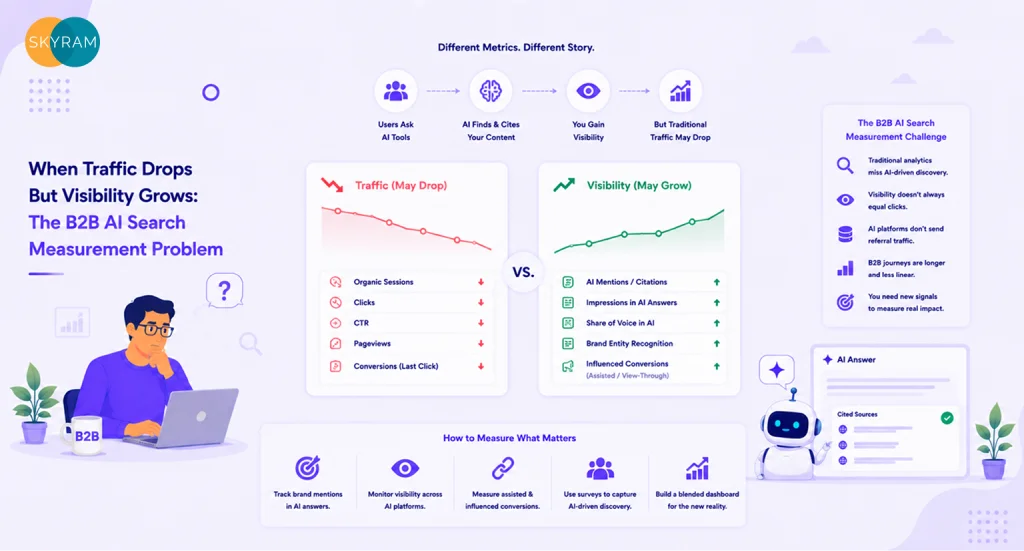
CMO reviewing organic CTR decline chart in Google Search Console showing AI Overview query impact across informational content categories

Open your Google Search Console today and pull organic CTR for your top informational queries over the past 12 months. For most marketing teams, the trend line is unmistakable: impressions are holding or growing, but clicks are declining. The gap between the two is not a reporting anomaly or a seasonal dip. It is the footprint of AI Overviews consuming queries that used to send users to your pages.

AI Overviews are reducing organic click-through rates by answering user queries directly within the search results page, eliminating the need to click through to a source site for many informational queries. Brands can offset this by shifting content strategy toward queries less susceptible to AI Overview interception, optimizing for citation within the AI Overview itself, and building demand generation strategies that do not depend solely on organic click volume.

This post is the strategic response framework for CMOs and SEO Managers who are watching traffic metrics flatten and need a defensible plan for what comes next, not a reassurance that the problem will correct itself, because the data says it will not.

The Data Behind AI Overview Click-Through Rate Suppression

The CTR suppression effect from AI Overviews is not theoretical. It is documented across multiple independent research programs, and the magnitude is large enough to require a strategic response rather than a monitoring posture.

Ahrefs analyzed approximately 300,000 keywords comparing December 2023 data against December 2025 data and found that AI Overviews reduce the click-through rate for top-ranking pages by an average of 34.5%. Seer Interactive’s analysis of over 10,000 keywords found organic CTR dropping from 1.41% to 0.64% year-over-year for queries where AI Overviews are present, with some segments showing suppression of up to 70%. Pew Research, studying 68,879 real searches from 900 US adults, found that only 8% of users whose searches triggered an AI Overview clicked on a linked source, compared with 15% who clicked when no AI Overview was present: a near-doubling of click suppression rate. Authoritas found that pages previously ranking at position one could lose approximately 79% of their organic traffic when AI Overviews appear above them.

Google has disputed some of these findings in public statements, arguing that click quality is improving even as volume declines. For a CMO whose revenue model depends on organic traffic volume, that argument does not resolve the strategic problem.

Which Query Categories Are Most Affected

The suppression effect is not uniform. It concentrates on specific query types, and understanding which categories are most affected is the starting point for any intelligent strategic response.

Informational queries with direct, factual answers are the most severely affected. Queries like “what is [term],” “how does [process] work,” “definition of [concept],” and “what are the benefits of [topic]” are exactly the query types AI Overviews were designed to answer in full, on the SERP, without requiring a click. If your content library is built primarily on definitional and explanatory content optimized for informational keywords, your exposure to CTR suppression is disproportionately high.

“How-to” queries with step-by-step procedural answers are the second most affected category. When AI Overviews can reproduce the steps of a process in a summary block, users have little incentive to click through to the full article. A page that previously drew substantial organic traffic from “how to [do X]” searches may now generate strong impressions with sharply reduced click volume, because the AI Overview answered the procedural question before the user needed to visit the page.

Queries with well-established consensus answers: statistics, timelines, lists of names or dates, regulatory status, and comparison summaries are also highly susceptible. When the answer is widely corroborated across sources, AI Overviews generate it with high confidence, and users accept it without clicking through.

How Suppression Varies by Industry and Content Type

CTR suppression varies by vertical. Industries where queries tend toward technical depth, regulatory specificity, or decision-critical complexity see lower AI Overview suppression rates. A query like “which cloud architecture is most suitable for a fintech company with PCI compliance requirements” is unlikely to be answered satisfactorily in an AI Overview summary block. A query like “what is cloud computing” is answered completely in the Overview and generates no click incentive.

B2B content in complex categories including cloud infrastructure, DevOps, and enterprise software is partially protected by the depth and specificity of the queries that matter commercially. Buyers researching vendor selection criteria, integration requirements, and technical specifications tend to generate longer-form questions that AI Overviews cannot fully resolve without a click. This is a meaningful distinction for marketing teams deciding where to concentrate content investment going forward.

E-commerce and product category content is a more mixed picture. Comparison queries like “best [product category] for [use case]” increasingly receive AI Overview treatment, but the purchase commitment involved in commercial queries creates enough residual click incentive that suppression is less severe than for purely informational content.

Healthcare, legal, and financial content operates under a different suppression dynamic. Google applies greater caution about generating AI Overviews for queries in these categories because of the accuracy and liability implications of incorrect AI-generated answers. The suppression effect exists but is less aggressive in these verticals than in general informational content.

Key Takeaway: AI Overview CTR suppression concentrates on informational, definitional, procedural, and consensus-answer queries. It is less severe for technically complex queries, decision-stage commercial content, and regulated verticals. The first strategic step is identifying what share of your existing content library falls into high-suppression versus low-suppression query categories.

The Strategic Shift: From Traffic Volume to Citation Value

The response to AI Overview CTR suppression that most SEO teams initially reach for is to try to recover click volume by outranking the AI Overview. That approach misunderstands the structural nature of the problem. AI Overviews are not a ranking penalty. They are a user interface change that sits above your ranking and intercepts the click before it reaches your content. Ranking higher does not remove the Overview. Appearing inside it does.

Reframing Success Around AI Overview Citation, Not Just Click Volume

A brand that is cited inside an AI Overview is in a fundamentally different position from a brand that ranks below one. Research from multiple sources consistently shows that users who click a citation link from within an AI Overview demonstrate significantly higher intent than average organic visitors: they have already received a summary of the answer and are clicking through specifically to engage with the source. AI-cited clicks arrive with context and intent that average organic clicks do not carry.

This means the strategic reframe is not simply accepting less traffic. It is pursuing a different kind of traffic that converts at a different rate. An AI Overview citation for a high-intent informational query can deliver fewer but higher-quality visits than an organic position-one ranking for the same query used to deliver.

Measuring success in this environment requires a new metric layer alongside traditional CTR tracking. Citation frequency across AI Overviews for your target query set, share of voice in AI-generated answers in your category, and the conversion rate of AI-referred traffic as a distinct segment all belong in the reporting framework that replaces pure click volume as the primary success signal. The AI visibility audit provides the baseline measurement infrastructure for this shift, establishing citation frequency and share-of-voice metrics before the optimization work begins.

Optimizing for AI Overview citation requires the same structural content signals that drive answer engine optimization more broadly: direct-answer lead paragraphs, FAQPage schema, factual density supported by citable sources, and clear attribution that AI extraction systems can process. A page structured for AI extraction has a materially higher citation rate than a page structured only for traditional organic ranking, even when both rank in the top three positions.

Which Queries Still Reward Traditional Click-Through Optimization

Not every query category has been disrupted equally, and the queries that AI Overviews do not satisfactorily answer remain the territory where traditional CTR optimization produces its strongest returns.

Original research and proprietary data are the clearest example. AI Overviews cite sources but cannot reproduce your original research in full. A page built around a dataset, survey, or analysis that is not available elsewhere creates a pull-through click incentive that the Overview summary cannot eliminate. The Overview may reference the research, which increases its credibility and generates a higher-intent click for the full methodology and findings.

Decision-stage commercial queries retain strong click-through rates because the stakes of getting the answer wrong from an AI summary are high enough that buyers choose to click through and verify. A buyer evaluating a software platform, a vendor relationship, or a strategic technology investment will not make the decision based on an AI Overview summary. They need to read the full comparison, contact the vendor, or book a consultation. This is where generative engine optimization content designed for the research and evaluation stage continues to generate genuine click-through value.

Long-form, deeply structured content that goes well beyond what any single AI Overview block can reproduce also retains click-through value. A 3,500-word buyer’s guide for a complex purchasing decision cannot be summarized without losing material value. The AI Overview points toward the guide; it does not replace it.

Key Takeaway: The strategic reframe is not simply defending existing click volume. It requires two parallel tracks: optimizing for AI Overview citation frequency on affected queries, and concentrating traditional click-through optimization effort on the query categories that AI Overviews cannot satisfactorily answer.

Comparison Table: Query Types by AI Overview CTR Impact

Query Type AI Overview CTR Impact Strategic Response Still Worth Click Optimization?
Definitional / “what is X” Severe: Overview answers completely Optimize for citation within the Overview No: redirect effort to citation
How-to / procedural (simple steps) Severe: steps reproduced in summary Optimize for citation; add depth AI can’t summarize Marginal: add depth beyond the steps
Comparison: general category High: Overview generates generic comparison Publish original, specific comparison with proprietary framing Partially: brand-specific comparisons retain clicks
Statistics and data summaries High: AI cites aggregate data Publish original research AI must cite and credit Yes: original data creates pull-through
Decision-stage evaluation queries Low to moderate: complexity limits full summary Traditional click optimization plus GEO content depth Yes: high conversion value, click-through incentive strong
Technical deep-dive content Low: AI cannot fully summarize technical depth Continue building depth; optimize for citation Yes: technical depth protects click volume
Local service and “near me” queries Moderate: varies by query specificity Optimize Google Business Profile and local AEO signals Yes: purchase intent creates click-through incentive
Original research and proprietary data Low: AI cites but cannot reproduce Prioritize original research investment Yes: only the source can provide the full data

Content Strategy Adjustments to Offset Click-Through Decline

Understanding which queries are most affected by AI Overview suppression is the diagnostic step. The content strategy adjustments that follow from that diagnosis are where the actual recovery work happens.

Shifting Toward Transactional and Comparison Queries Less Prone to AI Summarization

The content audit that follows the query category analysis should produce a clear priority list for content investment reallocation. Content serving high-suppression informational queries should be evaluated for whether the primary strategic value is now citation (appearing inside the AI Overview) rather than click-through. If the page is already being cited by AI Overviews, that citation value should be measured and reported alongside the declining click volume. If the page is not being cited, the content structure needs to be updated for direct-answer extractability.

New content investment should shift proportionally toward the query types where click-through value remains intact: technical evaluation guides, vendor comparison content with original criteria frameworks, original research reports, and buyer intent content that serves the decision stage rather than the awareness stage.

The search engine optimization fundamentals that made these content types valuable for traditional organic traffic, including comprehensive coverage of the topic, strong authority signals, and technically sound page structure, remain the foundation. The difference is that the overlay for AI search visibility adds structured data, direct-answer framing, and citation-ready content architecture as additional layers.

Building Content Depth That AI Overviews Cannot Fully Summarize in a Snippet

The most durable defense against AI Overview CTR suppression is content that is genuinely too valuable and too dense to be consumed entirely in an Overview snippet. This is not a word count argument. A 5,000-word post that says nothing a 500-word post does not say is not protected from AI summarization by its length. A 2,500-word post that contains a proprietary framework, original data, specific client examples, or a diagnostic methodology that requires full reading to apply properly is protected because the click-through is necessary to get the value.

The content depth strategy has four components. First, build original analytical frameworks: structured approaches to a problem that carry your brand’s intellectual property and cannot be reproduced without attribution. Second, invest in primary research: surveys, data analyses, benchmarking studies, or case study compilations that produce data not available elsewhere. Third, develop interactive and tool-based content: calculators, diagnostic assessments, and configuration guides that require the user to engage with the page rather than read a summary of it. Fourth, produce content that requires ongoing reference: glossaries, playbooks, and strategic guides that users save and return to rather than consuming once and discarding.

For brands that have built their organic presence primarily on informational content and are now facing suppression on that base, the AI content optimization services work that restructures existing content for both traditional and AI search performance applies directly here. Existing content can often be upgraded from its current state to a citation-optimized, depth-protected format without a full rewrite, which is a faster path to recovery than rebuilding the content library from scratch.

Key Takeaway: Content strategy adjustment requires two simultaneous moves: restructuring existing high-suppression informational content for AI Overview citation, and reallocating new content investment toward query types where click-through value remains strong. Original research, proprietary frameworks, and decision-stage evaluation content are the priorities.

Demand Generation Strategies That Reduce Organic Click Dependency

No content or technical strategy fully eliminates AI Overview CTR suppression for informational queries. The structural shift is a feature of how AI Overviews work, not a problem that optimization alone resolves. Building demand generation channels that operate independently of organic click volume is the hedge that makes the organic CTR decline a manageable business problem rather than an existential one.

Email, Community, and Direct Channel Investment as a Hedge

Email is the most direct hedge against organic CTR decline because it delivers content to an audience that has explicitly opted in to receive it, without any intermediary search engine or AI platform making a routing decision. A marketing team that has built a substantial email list of qualified subscribers can maintain content consumption and brand engagement even as organic clicks from Google decline. Every organic visitor who converts to an email subscriber represents a relationship that is insulated from AI Overview interception going forward.

Community channels serve a similar function. A brand that has cultivated an engaged audience on LinkedIn, an industry-specific forum, or a Slack community creates a demand generation channel that does not depend on search engine routing. Content published in these channels reaches the audience directly. The audience that chooses to follow a brand on LinkedIn has already established the brand awareness that AI Overview CTR suppression prevents for cold organic visitors, and they will engage with content directly rather than encountering it through a search query.

Podcast and video content creates demand generation channels where AI Overviews cannot intercept the value. A listener who follows a branded podcast is receiving content through a channel Google’s AI Overview has no mechanism to summarize or intercept. Long-form audio and video content builds authority and audience loyalty in formats where the CTR suppression problem simply does not apply.

Direct paid media investment in branded and high-intent commercial queries supplements organic reach while organic CTR is suppressed. Paid search retains its click-through mechanism independently of AI Overviews for many commercial and transactional queries, and the period of organic CTR decline is a reasonable time to evaluate whether increasing paid investment on the queries most affected by suppression produces an acceptable cost-per-acquisition.

Understanding how the full picture of AI search, including both the citation opportunity within AI Overviews and the broader shift toward conversational AI discovery, connects to your channel strategy is the context the GEO vs SEO comparison addresses directly. The two disciplines are not competing priorities. They are complementary responses to the same structural shift, and building the demand generation infrastructure now means the channel mix does not depend on a single organic search assumption that AI Overviews are actively disrupting.

Key Takeaway: Organic click dependency is the strategic vulnerability that AI Overview suppression exposes. Email list building, community engagement, and channel diversification into podcast, video, and paid media each reduce the proportion of revenue-generating activity that runs through a click-through path that AI Overviews now intercept.

How to Communicate This Shift to Leadership Without Sounding Like an Excuse

Every CMO and SEO Manager facing AI Overview CTR suppression will eventually need to explain declining click metrics to a CFO, a CEO, or a board that remembers when organic traffic trended upward and wants to know why it stopped. The framing of that conversation determines whether the strategic response gets funded or whether the team spends six months defending metrics instead of addressing the problem.

The mistake is leading with the data decline before providing the context for it. A slide showing organic click volume trending down with no explanation signals underperformance. A slide showing the same trend line alongside AI Overview impression data, citation frequency metrics, and the conversion rate of AI-referred traffic tells a different story: search behavior has structurally changed, the brand is adapting its measurement framework to reflect that change, and the quality indicators for AI-influenced traffic are directionally positive even as raw click volume softens.

Translate the strategic shift into business language before presenting it. Leadership does not need to understand what an AI Overview is. They need to understand that the mechanism that brought users from a search query to a company page has changed, that the brand is adapting its approach to the new mechanism, and that the adaptation requires both measurement recalibration and content investment reallocation. Present the new success metrics alongside the old ones for at least two quarters before removing the traditional metrics entirely: this demonstrates continuity of rigor rather than metric substitution to mask underperformance.

Present a three-part framework: here is what changed (AI Overviews), here is what the data shows about our position in the new environment (citation frequency and AI-referred traffic quality), and here is where we are investing to strengthen that position (content depth, query reallocation, demand generation channel investment). That structure is fundable. “Organic traffic is down because of Google changes” is not.

Skyram Technologies works with marketing leadership teams to build the reporting infrastructure that makes this communication credible: citation tracking baselines, AI-referred traffic segmentation in GA4, and the before-after content investment reallocation plan that gives leadership a clear view of where the budget is going and what outcomes it is designed to produce.

Key Takeaway: The leadership communication challenge is a framing problem, not a data problem. Lead with structural context before presenting the decline metric. Present citation frequency and AI-referred traffic quality as the new success indicators alongside the traditional metrics. Package the response as an investment plan with specific outcomes, not as an explanation for a trend the team did not cause.

Frequently Asked Questions

1: How much do AI Overviews reduce organic click-through rates?

AI Overviews reduce organic click-through rates significantly across informational query categories, with multiple independent studies documenting the effect. Ahrefs analysis of approximately 300,000 keywords found an average CTR reduction of 34.5% for top-ranking pages when AI Overviews are present. Seer Interactive’s research found organic CTR declining from 1.41% to 0.64% year-over-year for AI Overview queries. Pew Research found that users seeing an AI Overview clicked through to linked sources at a rate of 8% versus 15% for searches without an AI Overview. Authoritas estimated that pages previously ranking at position one could lose approximately 79% of their organic traffic when an AI Overview appears above them. The suppression effect is most severe for definitional, procedural, and consensus-answer queries, and least severe for technically complex, decision-stage commercial content and original research.

2: Which types of content are most affected by AI Overview CTR cannibalization?

Informational content with direct, factual answers is most affected by AI Overview CTR suppression. Definitional queries (“what is X”), procedural how-to queries with simple step sequences, consensus-answer queries involving statistics or timelines, and broad comparison queries all receive heavy AI Overview treatment that answers the query fully on the SERP without requiring a click. Decision-stage commercial content, technical evaluation guides, original research reports, and content containing proprietary frameworks or methodologies are significantly less affected because AI Overviews cannot reproduce their full value in a summary block. Local service queries and purchase-intent transactional content retain stronger click-through rates because the commercial commitment involved creates a residual incentive to click through and verify.

3: Can optimizing for AI Overview citation offset the organic CTR decline?

Optimizing for AI Overview citation partially offsets organic CTR decline by converting the existing Overview from a click suppressor into a referral source. Research shows that clicks arriving from within an AI Overview citation carry significantly higher intent than average organic clicks, because the user has already received a summary and is clicking through specifically to engage with the cited source. The offset is not a full recovery of previous click volume, but it redirects search query value through a different path. For queries where AI Overviews consistently appear, citation optimization is a higher-return investment than trying to recover the pre-Overview click volume, because the underlying user behavior has changed and the click-through mechanism has been structurally altered by the SERP format change.

4: What content strategy changes help brands respond to AI Overview CTR suppression?

Brands responding to AI Overview CTR suppression should make two simultaneous content strategy adjustments. First, restructure existing informational content for AI Overview citation eligibility: add direct-answer lead paragraphs to each major section, implement FAQPage schema, and ensure factual claims are supported by verifiable sources. Second, reallocate new content investment toward query types that AI Overviews cannot fully answer: original research with proprietary data, decision-stage evaluation guides, technical deep-dive content, and interactive tools that require page engagement rather than information retrieval. Proprietary frameworks, case study content, and buyer’s guides structured for the evaluation stage all retain strong click-through incentives because the value they provide cannot be reproduced in an Overview summary.

5: How should SEO teams measure success when organic CTR is declining due to AI Overviews?

SEO teams should expand their measurement framework to include AI Overview citation frequency alongside traditional organic CTR metrics. The updated measurement approach covers four dimensions: citation frequency across target queries (how often the brand or specific pages appear as cited sources in AI Overviews); AI-referred traffic quality (the session quality and conversion rate of traffic arriving from AI Overview citation links, segmented separately from general organic in GA4); share of voice in AI-generated answers within the category (the percentage of relevant AI responses that include the brand versus competitors); and search impression volume for queries where AI Overviews appear (to distinguish the impression-versus-click gap attributable to AI Overview interception). These metrics should be presented alongside traditional organic CTR data for at least two quarters to demonstrate adaptation rather than metric substitution.

6: How can brands reduce dependence on organic click-through rates as AI Overviews expand?

Brands reduce dependence on organic click-through rates by investing in demand generation channels that operate independently of search engine routing decisions. Email list building creates a subscriber relationship that delivers content directly to an opted-in audience without search engine intermediation. LinkedIn and community channel investment builds an audience that the brand can reach directly with content rather than waiting for search queries to route users to pages. Podcast and video content creates engagement channels where AI Overview interception does not apply. Original research and proprietary data publishing creates pull-through click incentives that AI Overviews amplify rather than suppress, because the Overview cites the research but cannot fully replace it. Paid search investment on high-intent commercial queries supplements organic reach during the period of informational query suppression. Together these channels reduce the proportion of brand awareness and content consumption that runs through the organic click path that AI Overviews are systematically intercepting.

Talk to Skyram About Adapting Your Content Strategy to AI Overview Impact

Most marketing teams are in one of two positions: watching CTR decline with no clear framework for what comes next, or aware of the problem but unable to build the measurement infrastructure and content reallocation plan that would make the strategic response credible to leadership.

Skyram Technologies works with US marketing teams to build the complete AI Overview response program: baseline citation audit across your target query set, GA4 segmentation for AI-referred traffic quality measurement, content audit identifying which pages face high versus low AI Overview suppression exposure, and the content investment reallocation plan that moves budget toward citation optimization and click-protected content types.

The goal is a reporting framework that makes the shift legible to finance, and a content strategy that grows AI citation share even as informational query click volume softens.

Book a consultation with the Skyram team to start with a query-level AI Overview exposure audit that tells you exactly which pages are most at risk and which content investments will produce the strongest citation and traffic recovery.

The Author Bio and Byline Signals That Improve AI Citation Likelihood

The Author Bio and Byline Signals That Improve AI Citation Likelihood

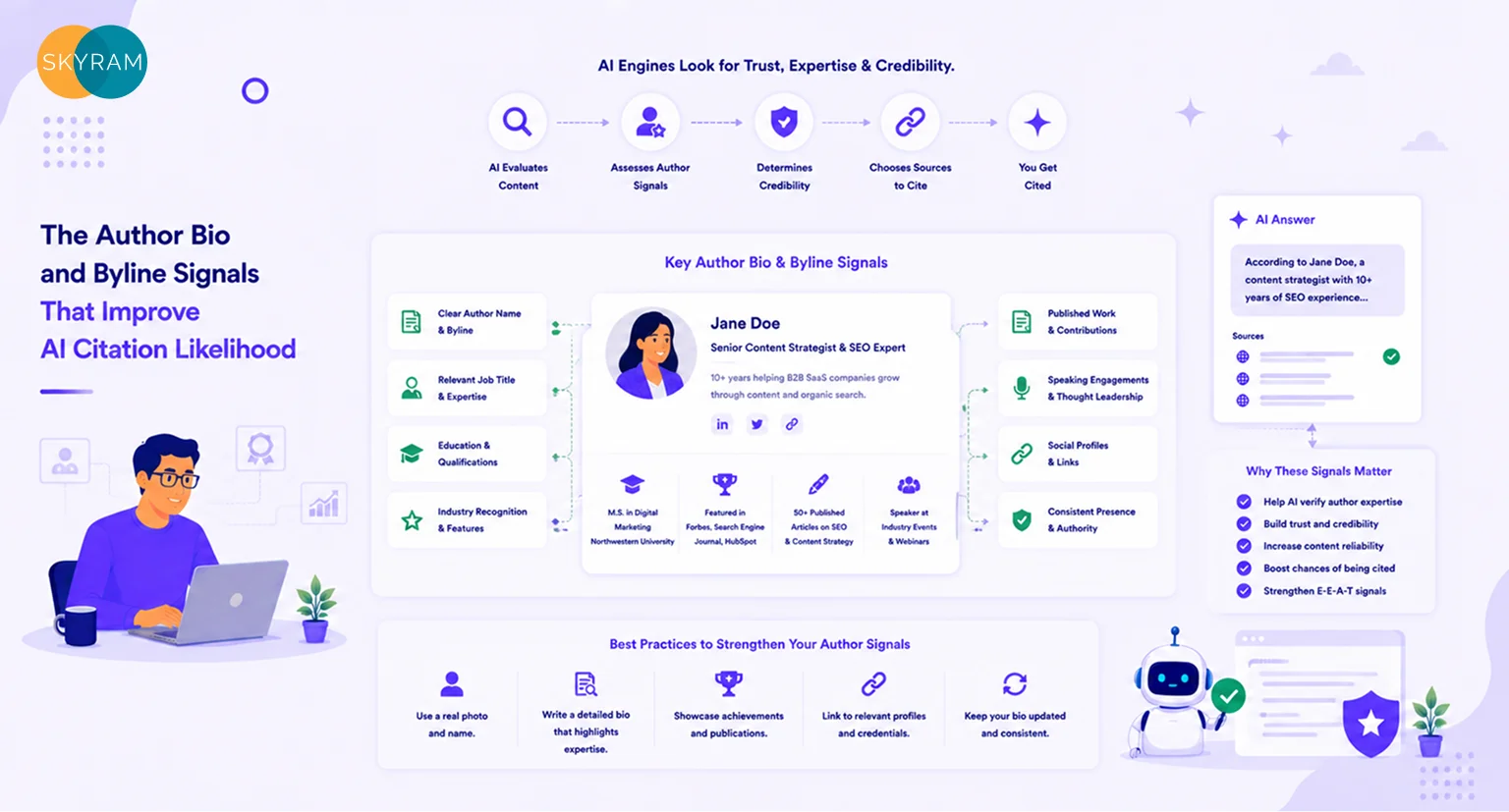
Author bio and byline signals improve AI citation likelihood by establishing verifiable expertise behind content. Credentials, professional history, published work history, and cross-platform presence give AI systems something to corroborate. Content published without named authorship or with thin, unverifiable bios consistently underperforms in AI citation rates compared to content with substantive, checkable author credentials.

Most content teams treat the author bio box as a formality. They add a name, maybe a job title, and move on. The bio section feels low-stakes compared to the headline, the keyword strategy, or the schema implementation. That prioritization is backwards.

AI systems, particularly those powering Google AI Overviews, ChatGPT, Perplexity, and Gemini, do not evaluate content in isolation. They evaluate the source of the content. When an AI system processes a well-structured article on a technical subject, it does not only look at what the article says. It looks at who wrote it, whether that person exists outside of this single page, what their verifiable history looks like, and whether the same individual has been referenced by other credible sources in the same domain.

A byline attached to a strong, verifiable author profile functions as a trust multiplier. A missing byline, or one pointing to a thin or anonymous author page, functions as a friction signal. The difference in citation likelihood between these two states is measurable and correctable. This guide gives Content Managers and Marketing Directors the framework to fix it.

Why Byline Depth Matters to AI Citation Systems

The relationship between bylines and AI citation behavior sits inside a broader framework that Google refers to as E-E-A-T: Experience, Expertise, Authoritativeness, and Trustworthiness. While E-E-A-T originated as a quality rater guideline for human evaluators, the signals it describes map closely to what large language models look for when deciding whether to treat a source as citable.

Verifiable expertise as a trust signal

An AI system encountering a piece of content needs to make a fast credibility assessment. It looks for signals that can be independently verified rather than simply asserted. An author bio that states “Jane Smith is a digital marketing strategist with 12 years of experience, previously at HubSpot and Salesforce, contributor to Search Engine Land and MarTech” is verifiable. Each element can be cross-referenced against a LinkedIn profile, a publication archive, a company history. An author bio that says “Jane Smith is a content writer” is not.

The distinction matters because AI citation behavior rewards verifiability. A claim that can be checked against multiple independent sources carries more weight than a claim that exists only within the document itself. The same logic applies to author identity. An author whose credentials can be traced across platforms, publications, and professional histories creates a verifiable human entity that AI systems can attach to the content and factor into their trust assessment.

The gap between anonymous brand content and named-author content in citation rates

Anonymous brand content, published under “Team Skyram” or “Editorial Staff” or left without any byline, provides no entity for an AI system to evaluate. The content exists as a floating document without a traceable human source. This does not mean the content will never be cited. But it means the content is competing at a disadvantage against otherwise equivalent content that carries a named, verifiable author.

The gap widens in topic areas where expertise is expected. A technical article on AEO strategy written by an anonymous brand team carries less citation weight than the same article attributed to an identifiable practitioner with a track record in the field. The article’s structure and factual quality may be identical. The author signal is not, and AI systems notice that difference.

Key Takeaway: AI systems treat named, verifiable authors as a trust signal that amplifies the citation potential of well-structured content. Anonymity removes a verification layer that AI systems actively use when assessing whether a source is safe to cite.

What a High-Signal Author Bio Actually Includes

A high-signal author bio is not long. It is specific, verifiable, and consistent across every platform where the author’s name appears. The components that matter are distinct from the components that merely fill space.

Credentials, professional history, and relevant expertise markers

Credentials worth including are those that can be independently verified: named employer history (particularly recognizable companies or institutions), specific roles held, named publications the author has contributed to, and any certifications or formal qualifications relevant to the content’s subject matter. Vague claims (“years of experience,” “passionate about marketing”) contribute nothing to AI verifiability and can actually create a mismatch between what the bio claims and what an AI system can find elsewhere.

Relevant expertise markers are domain-specific. A bio for an author writing about generative engine optimization should name specific areas of practice within that domain: entity optimization, structured data strategy, AI content audits, or whatever the author has actually worked on. Broad labels like “SEO expert” or “digital marketing professional” are common enough to be meaningless. Specific labels that match the content topic signal that the author is actually qualified to address the subject.

Links to verifiable professional profiles and published work

Every high-signal author bio should link out to at least two external verification points. A LinkedIn profile is the baseline. A publication history on recognized industry sites is better. A combination of both, alongside a Google Scholar profile for research-oriented authors or a speaker profile on a conference site, builds the cross-platform author entity that AI systems can triangulate.

These outbound links serve a dual function. They give human readers somewhere to evaluate the author’s credentials. More importantly for citation purposes, they create a connected entity graph that AI systems can trace. An author whose name resolves to a consistent, verifiable identity across LinkedIn, an industry publication archive, and the brand site is a named entity the AI can recognize and trust. An author page with no outbound links is a dead end for any system trying to verify the claim.

Consistency across every piece of content the author publishes

Consistency is the most underrated component of author authority. An author bio that says one thing on the brand site and something slightly different on a guest publication creates a mismatch that undermines the entity signal. The author name format, job title, credentials listed, and the framing of expertise should be identical across every platform where the byline appears.

This applies within a single site as well. If an author bio is updated to add a new credential or adjust a job title, every existing post attributed to that author should reflect the same updated information. Outdated bios create temporal inconsistency. An AI system encountering five articles from the same author with three different bios has to resolve that inconsistency. The safer default, from the system’s perspective, is reduced trust.

Comparison Table: Thin Author Bio vs. High-Signal Author Bio

Component Thin Author Bio High-Signal Author Bio
Author identification “Brand Team” or first name only Full name, title, and company affiliation
Experience claim “X years of experience” Named employer history with specific roles
Expertise markers “Expert in digital marketing” Named specializations matching the content topic
External verification No links to other profiles Links to LinkedIn, publication archive, speaker page
Published work history Not mentioned Named publications and byline links
Cross-platform consistency Different bio per platform Identical credentials across all appearances
Update practice Bio not updated with career changes Bio kept current across all attributed content
AI citation impact Low; author entity cannot be verified High; author entity is traceable and corroborated

Key Takeaway: A high-signal author bio is specific, outbound-linked, and consistent. Generic claims, anonymous attribution, and bios that differ across platforms actively reduce the verifiability that AI systems weight when making citation decisions.

Building Author Authority Across Platforms

On-site bio quality is necessary but not sufficient. The author entity needs to exist and be corroborated outside the brand domain. AI systems do not restrict their verification check to the page they are evaluating. They look at the open web, and the open web needs to reflect the same author identity in a recognizable, consistent pattern.

LinkedIn, industry publications, and speaking engagement consistency

LinkedIn is the most universally checked professional verification point. An author page on a brand site that links to a LinkedIn profile with 400 connections, a complete work history, and regular content activity reads very differently to an AI system than one linking to a sparse profile with minimal history. The LinkedIn profile does not need to be a content production hub. It needs to be complete, accurate, and consistent with the brand bio.

Industry publication bylines are the highest-leverage external signal available. A byline on Search Engine Journal, MarTech, or a recognized trade publication specific to the author’s domain places the author’s identity in a context that AI systems already treat as a trusted source. The byline creates a connection between a trusted domain and the author’s name, which transfers credibility in a way that the brand site alone cannot replicate.

Speaking engagement listings, panel contributions, and podcast guest appearances are secondary but meaningful signals. A speaker profile on a conference site, or a podcast episode description that names the author and their credentials, creates additional external verification points for the author entity. For niche B2B topics, these signals can be surprisingly influential because AI systems recognize the author’s name appearing in contexts where credibility is independently vetted.

Cross-referencing author identity across your site and external mentions

Beyond building external presence, the brand site itself needs to surface and organize author identity in a way that AI crawlers can parse efficiently. An author archive page, accessible via a consistent URL pattern, collects all content attributed to a specific author in one place. This architecture creates an entity hub that AI systems can use as a reference point when evaluating the author’s body of work.

AuthorPage schema, implemented in JSON-LD on the author archive page, labels the page explicitly as an author profile, connects it to the author’s name as an entity, and links to the external profiles that verify the author’s credentials. This schema implementation is to author authority what FAQPage schema is to AI content optimization: it does not replace the underlying quality signal, but it dramatically reduces the friction for an AI system trying to locate and assess that signal.

Key Takeaway: Author authority that only exists on the brand site is incomplete. Building external verification through LinkedIn, industry publication bylines, and speaking engagement profiles creates the cross-platform author entity that AI systems look for when assessing whether content is cited by a credible, identifiable source.

How to Roll Out Named Authorship Across Existing Anonymous Content

Most B2B content archives contain a significant volume of posts published under generic brand attribution. Retroactively converting this content to named authorship is a practical project with measurable citation impact, but it requires care to avoid creating the inconsistencies that undermine the author entity signal.

Start with the highest-traffic and highest-potential pages rather than attempting a full archive conversion at once. Run a content audit to identify which posts currently generate organic traffic or hold ranking positions relevant to AI-heavy query patterns: informational queries, how-to searches, and definitional content. These pages sit closest to the AI Overview and featured snippet surfaces that benefit most from strong author signals.

Match authors to content based on genuine expertise overlap rather than convenience. An author arbitrarily assigned to existing posts to fill in the byline gap creates the mismatch AI systems detect. The author’s actual professional history should be demonstrably connected to the topic of the content they are attributed to.

Update the bio simultaneously with the byline attribution. An author name added to a post without a substantive bio attached to the author page provides only half the signal. The bio quality matters as much as the attribution itself.

Once the author archive pages are built and bios are populated, implement AuthorPage and Person schema across both the author archive page and each attributed post. This creates a structured data layer that explicitly signals the author entity and its connection to the specific content assets, which is particularly useful for AI systems navigating a large content archive.

Key Takeaway: Retroactive named authorship works best when it starts with high-value pages, matches authors to content based on genuine expertise, and couples the byline update with a complete, schema-supported author page rather than a name-drop without verification infrastructure behind it.

Handling Author Attribution for Agency-Produced or Ghost-Written Content

Agency-produced and ghost-written content creates an attribution question that most content teams either avoid addressing or handle inconsistently, both of which create problems for the author authority signal.

The most defensible approach for ghost-written content is named expert authorship with genuine editorial involvement. This means the named author reviews the content before publication, has the opportunity to revise claims or add personal perspective, and would recognize the published piece as representative of their professional viewpoint. Under this model, the named author is not taking credit for writing they had no part in. They are taking responsibility for content they have reviewed, validated, and stand behind.

The alternative, attributing content to an author who has had no contact with the piece, creates a brittle arrangement. If the author’s name is checked against published work and the content quality or positions taken do not match what that person publicly advocates elsewhere, the mismatch damages rather than supports the author entity signal.

For content produced by an agency under the client brand, the cleanest arrangement is editorial ownership: the client’s subject matter expert contributes the strategic direction, reviews the draft, and provides the genuine expertise that the content claims to represent. The agency contributes the production quality. The named author contributes the credibility and verification footprint that makes the content citable.

Skyram Technologies structures content programs this way when working with US marketing teams on SEO and GEO strategy: the client’s internal experts supply the expertise markers and review authority, and the production team builds the content architecture and optimization layer. The result is content that carries genuine named-author credibility rather than a byline that AI systems cannot verify.

Key Takeaway: Ghost-written content attributed to a named expert requires genuine editorial involvement from that expert to function as a credible author signal. A byline attached to content the named author did not review creates verifiability mismatches that AI systems detect and discount.

Frequently Asked Questions

1.Does an author bio actually affect AI citation likelihood? 

Yes. Author bio depth and verifiability directly affect how AI systems assess whether content is citable. AI systems evaluate E-E-A-T signals when deciding which sources to cite in generated answers. A named author with a verifiable professional history, links to external profiles, and a consistent presence across platforms creates a stronger trust signal than anonymous or thinly attributed content. Content with substantive, checkable author credentials consistently outperforms anonymously published content of equivalent structural quality in AI citation rates.

  1. What information should an author bio include to help with AI citation?

An author bio that improves AI citation likelihood should include the author’s full name and current job title, verifiable employer history with named organizations, specific expertise areas relevant to the content topic, links to a LinkedIn profile and any industry publication bylines, and a brief description of published work history. Every element should be independently verifiable rather than self-asserted. Vague claims such as “experienced professional” or “industry expert” add no verification value and should be replaced with specific, named credentials.

  1. Does it matter if author bios differ between the brand site and external platforms?

Yes, inconsistency across platforms undermines the author entity signal. AI systems cross-reference the open web when assessing author credibility. If an author’s bio on the brand site describes different credentials or uses a different name format than the same author’s LinkedIn profile or guest publication bylines, the system encounters a verification mismatch. The safest practice is to standardize the author name format, job title, and key credentials across every platform and update all appearances when that information changes.

  1. How should ghost-written content be attributed for maximum AI citation value?

Ghost-written content should be attributed to a named expert who has genuinely reviewed the content and has verifiable credentials in the topic area the content covers. The expert does not need to have written the content themselves, but they must have editorial involvement sufficient to stand behind the published claims. A byline attached to content the named author has never seen creates a brittle attribution that AI systems can detect when the author’s other published work does not align with the attributed content’s positions or expertise level.

  1. Is an author page on a website enough, or do authors need external profiles too?

An author page on the brand site alone is not sufficient for strong AI citation signals. The brand site is an owned, interested party from an AI system’s perspective. External verification through LinkedIn, industry publication bylines, speaking engagement listings, or recognized directory profiles creates the cross-platform corroboration that AI systems weight when assessing author credibility. An author who exists only on the brand domain has no independent verification trail. An author whose identity resolves consistently across multiple credible external sources is a named entity the AI can recognize and trust.

Talk to Skyram About Author Authority and E-E-A-T Strategy

The author bio is not a checkbox. It is part of the citation infrastructure that determines whether well-built content gets credited by AI systems or passed over for sources that present stronger verifiability signals.

Skyram Technologies builds AEO and content authority programs for US marketing teams that treat author entity development as a structured program, covering bio standardization, AuthorPage schema implementation, cross-platform consistency audits, and editorial frameworks for agency-produced content. The starting point is always a diagnostic: an audit of your current author signal quality across your highest-value content before any attribution changes are made.

Book a Strategy Consultation

The FAQ Content Format That AI Answer Engines Prefer to Cite

Content manager reviewing a structured FAQ section formatted for AI answer engine citation and extraction

Most FAQ sections are written as an afterthought. A product page goes live, someone adds five or six Q&A pairs at the bottom to capture a few long-tail keywords, and the answers reference “our platform,” “we offer,” and “as mentioned above” throughout. The writing team moves on. The FAQ section sits there collecting dust, contributing nothing to AI citation, because every single answer requires the surrounding page context to make sense.

The FAQ content format that AI answer engines prefer to cite pairs a clearly stated question with a self-contained, third-person answer that does not rely on surrounding context to make sense. Answers written in first person, dependent on preceding paragraphs, or hedged with qualifiers extract poorly. AI systems favor FAQ content structured so each question-answer pair functions as an independent, quotable unit.

This guide is the format correction. It explains why most FAQ sections fail at extraction, what the extractable structure actually looks like, how to source questions from real query patterns, and how to audit and rewrite existing FAQ sections that are currently delivering nothing to your answer engine optimization performance.

Why Most FAQ Sections Fail at AI Extraction

The failure is almost never a topic problem. The topics are usually fine. The failure is structural: the FAQ was written to read within the page, not to be pulled out of it. AI systems do not read pages the way humans do. They extract. And content that only works in context does not extract.

Context-Dependent Answers That Do Not Stand Alone

The most common extraction failure is the answer that references something earlier on the page. Phrases like “as described in the section above,” “our tool handles this automatically,” or “the process works as follows” assume the reader has consumed the preceding content. An AI system pulling that answer to respond to a standalone query does not have that preceding content. The extracted answer is incomplete, and an incomplete answer is not a citable answer.

The test for context dependency is simple: copy the question and the answer into a blank document with nothing else around them. Read the answer cold, with no knowledge of the rest of the page. If the answer makes complete sense, it passes. If it references something unnamed, assumes prior knowledge, or leaves a gap that only context fills, it fails. Most FAQ sections fail this test on the majority of their answers.

First-Person or Brand-Centric Phrasing That Does Not Translate to Third-Person AI Responses

When an AI system cites a source to answer a user query, it paraphrases or quotes the source in third person. The AI says “according to [source], [claim].” An answer that begins with “We make it easy to…” or “Our software automatically…” creates a translation problem. The AI either has to awkwardly convert first-person claims into third-person attribution, which introduces inaccuracy, or it skips the source in favor of one that is already phrased in a way that maps directly to an extractable, third-person citation.

This is not a minor stylistic preference. It is a structural requirement. FAQ answers written as “Skyram does X” may perform better than FAQ answers written as “We do X,” but both underperform compared to answers written as “X is achieved by [method], [definition], [outcome]” with no brand subject at the center of the sentence.

Vague or Hedged Answers That Do Not Give AI Systems a Confident Citation

Hedged answers and vague answers are the same problem from two different angles. A hedged answer is one that avoids committing to a position: “it depends on your specific use case,” “results may vary,” “consult a specialist before making decisions.” A vague answer is one that uses general language where specific language was possible: “this can improve performance” instead of “this typically reduces page load time by thirty to fifty percent in tested conditions.”

AI systems are building answers for users who asked a specific question. A hedged or vague source answer does not satisfy that specific question, so the AI looks for a more definitive source. If your FAQ answers are consistently hedged or consistently vague, your FAQ section is contributing zero to your AI content optimization citation footprint even though it is sitting right there on the page, indexed and crawled.

Key Takeaway: FAQ sections fail at AI extraction for three structural reasons: answers reference context that is not present when the answer is extracted, first-person phrasing does not translate to third-person AI citation, and vague or hedged language fails to satisfy the specific query. All three are format problems, and all three are fixable without changing the topic coverage of the section at all.

The Self-Contained Answer Structure That Extracts Cleanly

The format that works is not complicated. It requires discipline more than creativity. Each answer follows a consistent pattern: state the direct answer first, provide the essential supporting information in the same answer, and close without referencing anything external to the answer itself.

Third-Person, Declarative Answer Construction

The opening sentence of each FAQ answer should function as a complete, standalone response to the question. It should be declarative rather than exploratory: it states what is true, not what might be true depending on conditions. It should be in third person, referring to the subject of the question rather than to the author or brand.

For a question like “What is FAQPage schema?”, the correct opening is: “FAQPage schema is a structured data markup type that signals to search engines and AI systems that a page contains question-and-answer content, enabling them to extract and display individual question-answer pairs as rich results.” Every word in that sentence contributes to the answer. There is no preamble, no self-reference, no hedge. A less effective opening would be: “Great question. We use FAQPage schema on all of our client pages because we believe it helps Google understand the content better.” That answer requires the reader to know who “we” is, references a belief rather than a fact, and buries the definition entirely.

Optimal Answer Length for Direct Extraction

The optimal length for an FAQ answer built for AI citation is between forty and eighty words. Below forty words, most answers lack enough detail to satisfy the query fully. Above eighty words, most answers either start repeating themselves or begin referencing context outside the answer, which reintroduces the dependency problem.

The forty-to-eighty word range is not a rigid rule. Some definitional questions require fewer words because the definition itself is short. Some process questions require more because the process has steps that cannot be condensed further. The useful constraint is this: if an answer is over a hundred words, it almost certainly contains content that belongs elsewhere on the page rather than in the FAQ. Either the question is too broad for an FAQ answer, or the answer is doing supplementary explanation work that should happen in the body copy.

How to Phrase Questions to Mirror Actual Search and Prompt Behavior

The question phrasing determines which queries the FAQ answer can compete for. A question phrased as a topic label, “FAQPage schema,” will not match queries phrased as complete questions: “what is FAQPage schema” or “how does FAQPage schema work.” A question phrased with business jargon will not match the plain-language questions buyers actually type.

The reliable approach is to start with the exact phrasing from Google’s People Also Ask results, Perplexity’s related queries, or the questions that surface when you type the topic into ChatGPT and read what related questions it generates. Take the phrasing as close to verbatim as possible, then verify that it reads naturally as a heading. Avoid manufacturing questions that sound like FAQ filler: “why choose us for X?” or “what makes our X different?” Those are marketing prompts, not real buyer questions, and they do not match any query an AI system is trying to answer.

Comparison Table: Standard FAQ Format vs. AI-Extraction-Optimized FAQ Format

Dimension Standard FAQ Format AI-Extraction-Optimized Format
Opening sentence Introductory or self-referential Direct declarative answer to the question
Person and voice First person (“we,” “our”) Third person (subject-focused)
Context dependency References surrounding page content Fully self-contained, no external references
Answer length Variable, often over 150 words Forty to eighty words, tightly bounded
Hedging Frequent (“it depends,” “may vary”) Specific and committed where facts allow
Question phrasing Topic labels or marketing prompts Mirrors real search and prompt query phrasing
Schema implementation Absent or inconsistent FAQPage schema applied to every Q&A pair
AI citation likelihood Low to none Significantly higher


Key Takeaway: The self-contained answer format is not a writing style preference. It is a technical requirement for AI extraction. Every element, third-person construction, forty-to-eighty word length, declarative opening, query-mirrored question phrasing, is the result of how AI systems pull, attribute, and present sourced answers. Deviating from any of these elements reduces extraction likelihood proportionally.

Sourcing FAQ Questions From Real Query Patterns

A structurally perfect FAQ answer still fails if it answers a question nobody is asking. Question sourcing is as important as answer structure, and most FAQ sections get this step completely wrong by generating questions internally rather than pulling them from actual user behavior.

Google’s People Also Ask and Related Search Data

Google’s People Also Ask (PAA) box is the most accessible source of real buyer questions for any topic. It shows exactly how users phrase their queries, which is often meaningfully different from how brands internally describe the same topic. The PAA questions for any primary keyword represent questions that have demonstrated enough search demand that Google identifies them as related to the primary query. They are almost always better FAQ question candidates than anything generated in a brainstorm session.

The related searches section at the bottom of Google results adds a second layer: these are the adjacent queries users move to after searching the primary term. Between PAA and related searches, a single keyword can typically generate ten to twenty real buyer questions with confirmed search demand.

AI Platform Prompt Pattern Research

Beyond Google, the actual queries people type into ChatGPT, Perplexity, and Gemini represent a distinct category of question phrasing. AI platform queries tend to be longer, more conversational, and more specific than traditional search queries. A user who types “SEO services” into Google might type “what should I look for when hiring an SEO agency for a SaaS company” into ChatGPT.

To surface these patterns, type the core topic into each platform and note the follow-up questions the AI generates, the related questions it surfaces, and the questions users in public prompt communities use to explore the topic. These conversational phrasings should feed directly into FAQ question construction, because they represent exactly the query types for which AI systems are looking for cited sources when they compose answers.

Pairing this research with a structured generative engine optimization approach ensures the FAQ questions you build match the retrieval patterns that actually matter across all major AI platforms.

Sales and Support Team Query Intelligence

The most underused source of FAQ questions is the team that talks to buyers and users every day. Sales calls, support tickets, and onboarding conversations contain the exact questions real people ask in their own words, before any marketing polish has been applied to the phrasing. These are the questions that reveal genuine buyer confusion, the gaps between what the product does and what buyers assume it does, and the edge-case concerns that never make it into standard content planning.

A thirty-minute review of support ticket subject lines or a brief conversation with two or three account executives will typically surface five to ten high-value FAQ questions that no keyword tool would have surfaced, because they reflect the implicit questions behind observable user behavior rather than explicit search queries.

Key Takeaway: Real FAQ questions come from real buyer behavior, not from internal brainstorming. Google’s People Also Ask results, AI platform prompt patterns, and sales and support team query intelligence are the three sources that consistently produce the highest-value questions for AI-citation-optimized FAQ sections, because they reflect how actual users phrase actual queries on the platforms where your FAQ answers need to compete.

Where FAQ Content Belongs on the Page for Maximum Extraction

Placement affects extraction likelihood in two ways: it determines how prominently the FAQ content sits in the page’s information hierarchy for AI crawlers, and it determines whether the FAQ is preceded by enough topical content to signal relevance before the Q&A pairs begin.

The placement that extracts best is at the bottom of the primary content block, after the main body copy has established the topic context, but before any sidebar content, navigation elements, or unrelated page sections. This placement ensures that when an AI system scans the page, it encounters the topic context first, then the structured Q&A pairs, in an order that reinforces the connection between the two.

Placing FAQ content above the fold or in sidebars typically reduces extraction reliability because the AI system has less preceding context to use when interpreting what the question-answer pairs are about. Placing FAQ content below footers or inside collapsed accordion components with JavaScript rendering dependencies reduces extraction reliability even further, because the content may not be accessible to the crawler at all.

On pages where the primary goal is AI citation, FAQPage schema should be applied to every question-answer pair in the section, implemented in JSON-LD in the page head. The schema provides the structural signal that tells AI crawlers exactly what type of content they are parsing before they read a single word, which reduces classification uncertainty and increases the probability that the content is treated as an authoritative answer source. This is one of the most direct technical interventions available for improving a page’s AEO performance without changing the content itself.

Key Takeaway: FAQ sections extract most reliably when placed after main body content but before page footer elements, paired with FAQPage schema implemented in JSON-LD. Content inside collapsed accordion components or rendered by JavaScript may not be accessible to AI crawlers at all, making those structural choices a silent citation liability.

Auditing and Rewriting Existing FAQ Sections

Most websites have FAQ sections that were written before AI extraction was a consideration, which means they are underperforming against a standard that has changed significantly. Auditing and rewriting them is typically faster than building new content, and the citation impact per hour of work is higher than almost any other content optimization activity.

The audit starts with the context dependency test described earlier: copy each Q&A pair into a blank document and read each answer cold. Mark any answer that references the surrounding page, uses first-person phrasing, relies on defined terms that appear elsewhere on the page, or hedges instead of committing to a specific answer. This typically marks sixty to seventy percent of answers in an unoptimized FAQ section as requiring a rewrite.

For each marked answer, the rewrite follows a four-step process. First, identify the single most important fact or definition the answer should communicate. Second, write an opening sentence that states that fact or definition in third-person, declarative language. Third, add one to two supporting sentences that provide the essential context without exceeding eighty words total. Fourth, verify that the result passes the cold-read test: read it again with no surrounding context and confirm it answers the question completely.

Running an AI visibility audit before starting the FAQ rewrite lets you identify exactly which queries you are currently failing to appear for, which tells you which sections of the FAQ to prioritize first rather than working through the page in order. The audit data also provides the before-and-after baseline needed to measure whether the rewrite actually produced citation improvements after the updated content is indexed.

Key Takeaway: Auditing existing FAQ sections for context dependency, first-person phrasing, and vague answers typically identifies sixty to seventy percent of answers as rewrite candidates. The rewrite process is fast: state the key fact first in third-person declarative language, add supporting context within eighty words, and verify the answer passes the cold-read test. Running an AI visibility audit before starting gives you the prioritization data to focus the rewrite where it will have the most citation impact.

Frequently Asked Questions

  1. What is the best FAQ format for AI answer engines to cite?

The best FAQ format for AI answer engines to cite pairs a complete, declarative question with a self-contained answer written in third person that opens with a direct statement of the answer in the first sentence. Each answer should fall between forty and eighty words, contain no references to surrounding page content, and be written so it makes complete sense when read in isolation. FAQPage schema implemented in JSON-LD should accompany every question-answer pair to signal the content type to AI crawlers before they parse the content.

  1. Why do AI systems like ChatGPT and Perplexity not cite my FAQ section?

AI systems do not cite FAQ sections when the answers are context-dependent, meaning they reference other page content; when the phrasing is first-person and cannot be directly attributed in third person; or when the answers are hedged with qualifiers like “it depends” that prevent the AI from presenting them as a confident, specific response to the user’s query. The most common fix is rewriting answers to be self-contained, declarative, and third-person, paired with FAQPage schema implementation to signal the structured content type to the crawlers that feed AI retrieval systems.

  1. What is FAQPage schema and does it improve AI citation?

FAQPage schema is a structured data markup type implemented in JSON-LD that signals to search engines and AI crawlers that a page contains question-and-answer content formatted for direct extraction. Implementing FAQPage schema does not guarantee AI citation on its own, but it reduces the classification uncertainty AI systems face when deciding whether a content block is an authoritative Q&A source or general prose. Combined with well-structured, self-contained answers, FAQPage schema consistently improves the rate at which FAQ content is extracted for AI Overviews, featured snippets, and AI-generated answers across platforms like ChatGPT and Perplexity.

  1. How long should FAQ answers be for AI extraction?

FAQ answers optimized for AI extraction should be between forty and eighty words. This range is long enough to fully answer the question with appropriate context and specific detail, and short enough to remain self-contained and prevent the answer from depending on surrounding page content. Answers under forty words often lack sufficient specificity to satisfy the user’s query fully. Answers over one hundred words frequently introduce context dependencies or begin to repeat information that belongs in the main body copy rather than the FAQ section.

  1. How do I find the right questions to include in an AI-optimized FAQ section?

The right questions for an AI-optimized FAQ section come from three sources: Google’s People Also Ask results for the primary keyword, which show real buyer query phrasing with confirmed search demand; AI platform prompt pattern research conducted by querying ChatGPT, Perplexity, and Gemini with the core topic and observing the questions they generate or surface; and sales and support team intelligence gathered from ticket subject lines and recorded call notes, which surface the implicit questions behind real buyer behavior. Avoid generating questions internally through brainstorming, since questions that do not reflect real query patterns will not match any retrieval intent and will not earn citations regardless of answer quality.

Ready to Turn Your FAQ Sections Into Citation Assets?

If your FAQ sections are currently written for readers rather than for extraction, the rewrite effort is smaller than most content teams expect, and the citation impact is larger. The format changes are structural, not creative: third-person phrasing, self-contained answers, query-mirrored question phrasing, and FAQPage schema implementation.

Skyram Technologies applies this exact framework as part of a full AEO content audit and optimization service, covering FAQ structure, schema implementation, answer-length calibration, and question sourcing from real buyer query patterns. If you want a clearer picture of where your current content stands against AI extraction benchmarks, book a consultation with our team, and we will walk through your highest-priority pages first.

How B2B SaaS Companies Are Winning Brand Mentions in AI-Generated Answers

B2B SaaS marketing team reviewing a dashboard showing brand citation frequency across ChatGPT, Perplexity, and Google AI Overviews

SaaS buyers do not start product research by visiting vendor websites the way they did five years ago. A growing portion of that research now begins with a question typed into ChatGPT, Perplexity, or Google’s AI Overview: “what is the best project management software for remote teams,” “top CRM tools for early-stage SaaS startups,” or “which platform handles subscription billing better, X or Y.” The AI systems answering those questions cite sources. They name brands. They make recommendations. And the brands that appear consistently in those answers are not simply the ones with the biggest ad budgets or the highest domain authority scores.

B2B SaaS companies win brand mentions in AI-generated answers by combining structured comparison content, original research and benchmark data, and consistent category-defining language across their site and third-party publications. AI systems favor citing sources that provide specific, verifiable data points over sources that make general claims, making original data production a disproportionately effective GEO strategy for SaaS brands.

The brands building that kind of content infrastructure are winning category ownership in AI search before most of their competitors have even noticed the shift is happening. This post breaks down exactly how they are doing it, which content formats produce the most citations, and what a SaaS marketing team can start building right now to take its position in AI-generated answers before those positions harden.

The Category-Ownership Content That AI Engines Cite Most

Not all content earns AI citations. The format of what you publish, not just the topic, determines whether an AI system can extract and present your brand as an authoritative source when a buyer asks a relevant question. Three content types consistently outperform everything else in citation frequency for B2B SaaS companies.

“Best For” and Use-Case-Specific Comparison Content

AI systems answering “best X for Y” queries need sources that map specific product capabilities to specific use cases. A generic feature list page does not answer that question. A page that explicitly addresses “best subscription billing platform for usage-based pricing models” or “best customer success software for SaaS teams under fifty seats” gives the AI system exactly the structured claim it needs to cite your brand in the right context.

The most cited content in this category tends to share three structural characteristics: it states the “best for” conclusion clearly in the first paragraph rather than building to it slowly, it explains the specific differentiator that makes the product suited to that use case rather than just asserting it, and it addresses at least one limitation alongside the strength so the content reads as objective rather than promotional.

That last point matters more than it looks. AI systems trained on human feedback have learned that purely promotional content is less reliable than content that acknowledges trade-offs. A comparison page that says “this tool is excellent for X but requires more setup time than alternatives” signals credibility in a way that “the best all-in-one solution” never does.

Original Benchmark and Performance Data

Original research is the single most extractable content type for AI citation purposes. When a SaaS company publishes a benchmark report, a customer survey with specific percentage figures, or a measured performance study comparing their approach to a category average, they create a data point that no competitor can replicate with the same source attribution. Every time an AI system cites that data to answer a relevant question, it names the brand that produced it.

The data does not have to come from a massive sample. A survey of two hundred customers on a specific behavior pattern, a performance benchmark across a defined set of conditions, or a tracked comparison of before-and-after metrics from a sample of user accounts all qualify as original, citable data. What matters is that the data point is specific, verifiable in principle, and directly answers a question buyers are asking. Data that is vague, unsourced, or circular (“ninety-five percent of our customers say they are satisfied”) does not earn citations because it cannot be independently verified and does not add information the AI system can use.

This is a meaningful insight for SaaS marketing teams that have been skeptical about the ROI of research content. The citation return from one well-structured benchmark report often exceeds the citation return from ten generic blog posts covering the same topic space, because the blog posts compete with thousands of similar pages while the benchmark creates a data asset only you own.

Category-Defining Language Consistency Across Owned and Earned Content

AI systems build entity understanding, their model of what a brand is, does, and serves, from aggregated signals across your entire web presence. When your homepage, your product pages, your blog posts, your G2 profile, and your press mentions all describe your product using different language for the same capability, the AI model carries an ambiguous understanding of what your brand actually is. That ambiguity translates directly into lower citation frequency for the specific queries you want to own.

The SaaS brands winning consistent AI mentions tend to use tightly controlled category language: the same two or three phrases appear repeatedly across owned and earned surfaces to describe what they do, who they serve, and what problem they solve. This is not keyword stuffing. It is entity reinforcement, the practice of building a consistent, recognizable description of your brand so that AI retrieval systems can confidently place you in the right answer context.

Key Takeaway: “Best for” comparison content, original benchmark data, and consistent category language are the three content types that most reliably produce B2B SaaS brand mentions in AI-generated answers. Teams that build all three are compounding their citation advantage; teams that build only one or two are leaving significant citation potential unused.

Why Original Research Outperforms General Claims in AI Citation

The gap in citation likelihood between a page that makes a general claim and a page that supports a specific claim with original data is substantial, and understanding why it exists helps SaaS marketing teams prioritize their content investments correctly.

Verifiable Data Points vs. Unsubstantiated Positioning Statements

When an AI system evaluates competing sources to answer a buyer’s question, it is effectively doing a credibility assessment under uncertainty. It cannot verify that your product is “the leading platform” in a category, because that claim is contested by every competitor making the same assertion. It can, however, extract and present a data point like “a study of three hundred project teams found that task completion rates increased by twenty-two percent after adopting automated status updates,” because that claim is specific, attributed, and potentially verifiable.

The practical implication for SaaS content teams is clear: positioning statements that compete on vague superlatives, “fastest,” “most powerful,” “most trusted,” get deprioritized in favor of sources that make specific, falsifiable claims. A brand that consistently publishes the latter builds a citation advantage that accumulates over time and is genuinely difficult for competitors to replicate without doing equivalent original research.

How to Structure Original Research for Maximum Citation Potential

Original research does not automatically earn citations just because the data exists. The structure and presentation of the data determines whether an AI system can extract it cleanly for a specific query. Research content that earns the most citations follows a consistent format: the headline states the key finding directly, the executive summary restates the finding in a standalone sentence that makes sense without the rest of the document, each major finding gets its own section header, and the methodology is described in enough detail that the claim reads as credible even to a reader who has not seen the underlying data.

This is almost exactly the format that structured journalism uses for reported data stories, and it is not a coincidence that that format performs well in AI citation. The editorial discipline of leading with the most specific, most important finding, and then supporting it with method and context, maps directly to how AI extraction works: the model pulls the clearest, most complete answer from the top of the relevant section.

Comparison Table: General Positioning Content vs. Data-Backed Category-Ownership Content

Dimension General Positioning Content Data-Backed Category-Ownership Content
Claim type “Industry-leading platform” “Teams using X reduced churn by 18% in 90 days (n=240)”
AI citation likelihood Low – unverifiable, contested by competitors High – specific, attributed, extractable
Competitor replicability Immediate – any brand can make the same claim Slow – requires equivalent original research investment
Shelf life Short – erodes as market evolves Long – data retains citation value until superseded
Scope of queries it serves Narrow – only branded queries Wide – serves category, comparison, and use-case queries
Content production cost Low Medium to high, but compounding return

Building Comparison Content That AI Engines Trust

Comparison content is one of the highest-value content formats for AI citation in the SaaS space, because it maps directly to the “X vs. Y” and “alternatives to X” queries that buyers ask before making a purchase decision. But the format of comparison content determines whether AI systems treat it as a credible source or skip it in favor of something more objective.

Fair, Structured Comparisons vs. Self-Serving Competitor Content

AI systems have learned to distinguish between comparison content written to inform and comparison content written to win. Pages that compare a brand favorably on every single dimension, ignore the use cases where a competitor is genuinely stronger, or present pricing without meaningful context tend to score low on the credibility signals that AI retrieval systems use. They look like marketing, not like analysis.

The comparison content that gets cited tends to present a structured framework: these are the dimensions buyers evaluate, here is how both products perform on each one, here is which buyer profile is better served by each option. That structure is harder to write, because it requires acknowledging where you are not the best choice, but it earns citation trust that purely promotional comparisons cannot.

The Format That Gets Cited When Buyers Ask “X vs. Y” Questions

For the specific query type “X vs. Y,” AI systems look for content that answers three questions directly: what is the core difference between the two products, which use case or buyer profile is better served by each, and what is the typical decision point that makes one a better fit than the other. Comparison pages structured to answer all three of these in clear, scannable sections, with a summary table that presents the key differentiators side by side, are the ones that appear most frequently in AI-generated comparison answers.

One structural detail that consistently improves citation frequency on comparison pages: the summary recommendation. A section that states “choose X if you need [specific capability] and your team is [specific context]; choose Y if [alternative context] is more important” gives the AI system exactly the structured answer it needs to close a buyer-stage query. Without that direct recommendation, the page may be comprehensive but it makes the AI work harder to extract a useful answer, which reduces its citation likelihood.

Pairing comparison content with proper answer engine optimization principles, including FAQPage schema on comparison pages and direct answer formatting at the top of each section, meaningfully increases the rate at which these pages are extracted for AI-generated responses.

Key Takeaway: Comparison content earns AI citations when it is genuinely structured to help buyers decide, not just to make your product look superior. The format that performs best answers “which is better for whom” directly, with a clear summary recommendation and a structured side-by-side table. Pages that avoid that structure because it requires acknowledging trade-offs consistently underperform in citation frequency compared to more objective competitors.

Third-Party Validation as a GEO Multiplier for SaaS Brands

The content you publish on your own site is only one layer of what AI systems use to determine whether your brand should be cited. The external signals, what independent sources say about you, matter at least as much and often more.

Review Platforms, Analyst Mentions, and Community Discussion as Citation Reinforcement

G2, Capterra, and Trustpilot reviews are crawled and indexed by the AI systems that power ChatGPT and Perplexity. When a buyer asks “is [your product] reliable for enterprise use cases” and your review profile on those platforms consistently mentions reliability in context, those reviews become citation sources that reinforce your brand mention alongside your own content. A strong review presence on the specific dimensions your buyers care about is a GEO asset, not just a sales tool.

Beyond reviews, analyst coverage and community discussion in forums like Reddit, LinkedIn groups, and industry Slack communities carry significant citation weight for certain query types, particularly the “what do people actually think about X” and “has anyone used Y for [specific use case]” questions that buyers ask at the evaluation stage. Brands that have been discussed honestly and positively in community contexts earn a form of third-party credibility that owned content cannot replicate, because community discussion by definition did not come from the brand itself.

This is where generative engine optimization diverges most clearly from traditional SEO. Traditional SEO optimized for links. GEO for SaaS brands requires optimizing for the full ecosystem of mentions, not just those that carry a backlink. A brand mentioned by name in a relevant Reddit thread, a LinkedIn post from an industry practitioner, or a quoted analyst report earns citation potential even without a link pointing back to the brand’s website.

The practical implication is that SaaS marketing teams need a presence-building strategy that extends beyond their own content calendar: active participation in community conversations, a structured approach to encouraging detailed, specific reviews on key platforms, and a digital PR effort focused on earning substantive mentions in the publications and discussions that AI systems treat as credible sources for their category.

Key Takeaway: Third-party validation multiplies the citation potential of your owned content because AI systems weight external mentions heavily when deciding whether to present a brand as a credible answer. Review platforms, analyst coverage, and community discussion all contribute to the citation footprint that makes your brand recognizable and trustworthy to AI retrieval systems for the specific queries your buyers are asking.

Measuring Category-Ownership Progress in AI Search

Category ownership in AI-generated answers is measurable but requires different metrics than traditional SEO tracking. Most SaaS marketing teams are not yet tracking this systematically, which means starting now creates a genuine measurement advantage over competitors who are flying blind.

The core measurement process involves running a defined set of buyer-intent queries through ChatGPT, Perplexity, and Google AI Overviews on a regular cadence, and tracking three things: how frequently your brand is cited, in what context and with what specific claim, and which sources the AI used to support that citation. That last piece of data tells you which content assets or third-party mentions are actually driving your visibility, which makes it possible to invest more in the formats and channels that are working rather than spreading effort across everything.

A useful companion metric is share of category voice in AI answers: across the full set of buyer-intent queries in your category, what percentage of AI-generated answers include your brand compared to your top two or three competitors? This framing shifts the question from “are we improving” to “are we winning,” which is the right question for a CMO or VP Marketing whose job is competitive positioning rather than just improvement.

For SaaS brands starting from low AI visibility, the fastest gains typically come from original research content, since data points get cited before most other content types accumulate enough authority to compete. If your team has not published a benchmark report or a structured customer survey in the past twelve months, that is usually the highest-priority content investment for improving AI-generated answer mentions in the near term.

Running an AI visibility audit against your specific buyer-intent query set gives you the baseline data to know exactly where your brand stands today across major AI platforms, so your optimization effort targets the actual gaps rather than assumed ones.

Key Takeaway: Measuring AI citation progress requires a dedicated tracking cadence built around real buyer-intent queries rather than traditional keyword rankings. The metrics that matter are citation frequency, citation context, and share of category voice relative to competitors. Starting that measurement now creates an operational advantage that compounds as the AI search landscape becomes more competitive.

Frequently Asked Questions

  1. How do B2B SaaS companies get mentioned in AI-generated answers?

B2B SaaS companies earn mentions in AI-generated answers by publishing three types of content that AI systems are structured to cite: original research with specific, verifiable data points, use-case comparison content that maps product capabilities to specific buyer scenarios, and structured “best for” content that makes direct recommendations rather than general claims. These content types need to be supported by consistent category language across owned and earned channels, and by a third-party mention presence through reviews, analyst coverage, and community discussion that reinforces the brand as a credible source for relevant queries.

  1. Why does my SaaS brand not show up in ChatGPT or Perplexity answers?

A SaaS brand typically does not appear in ChatGPT or Perplexity answers because it lacks one or more of the three core citation signals: third-party mention density from credible sources, structurally extractable content that directly answers the specific queries buyers are asking, and consistent entity recognition across the web. Publishing content alone does not fix an AI visibility gap if the content is not structured for extraction or if no external sources corroborate the brand’s positioning in the relevant category. A competitive AI visibility audit that tests actual buyer-intent queries across platforms is the most reliable way to identify which of these gaps is most responsible for low citation frequency.

  1. What type of content earns the most AI citations for SaaS brands?

Original benchmark research and performance data earn the most AI citations for SaaS brands because they create specific, verifiable data points that AI systems can extract and present as authoritative answers. Use-case comparison content (“best X for Y use case”) and fair “X vs. Y” comparison pages also earn consistent citations because they match the query structure buyers use during the evaluation stage of product research. Generic feature lists, unqualified superlative claims, and thin overview content consistently underperform in AI citation frequency regardless of how well they rank in traditional search.

  1. What is GEO and why does it matter for SaaS marketing teams?

Generative Engine Optimization (GEO) is the practice of structuring content and managing brand presence across the web to improve citation frequency in AI-generated answers from systems like ChatGPT, Google AI Overviews, and Perplexity. It matters for SaaS marketing teams because a growing share of B2B product research begins with AI-assisted queries rather than traditional search, meaning brands that are not optimized for GEO are invisible at the moment buyers are forming their initial vendor shortlist. GEO differs from traditional SEO in that it requires optimizing for the full ecosystem of mentions, including review platforms, community discussions, and third-party publications, not just organic link acquisition.

  1. How long does it take for a SaaS brand to start appearing in AI-generated answers?

Original research content published on an already-indexed site can earn AI citation improvements within four to eight weeks as the content gets crawled and incorporated into retrieval systems. Third-party mention building through digital PR and review platform activity typically takes three to six months before the external signal density is sufficient to reinforce brand citation consistently. Entity consistency improvements, standardizing how the brand describes itself across all web surfaces, tend to show results fastest, often within a few weeks. The most sustainable citation growth comes from running all three tracks simultaneously rather than treating them as sequential phases.

  1. How does review platform presence affect AI-generated brand mentions for SaaS?

Review platform profiles on G2, Capterra, and similar sites are indexed and used by AI retrieval systems as credibility signals when evaluating whether a SaaS brand should be cited for a given query. Reviews that consistently use specific language around particular use cases, product capabilities, or customer outcomes contribute to the AI system’s understanding of what the product does well and for whom. A strong, detailed review presence on the dimensions buyers evaluate most frequently is therefore a GEO asset, not just a conversion tool, because it adds third-party corroboration to the brand’s own content claims in the contexts AI systems use to decide what to cite.

Ready to Win Your Category in AI-Generated Answers?

The SaaS brands earning the most consistent mentions in ChatGPT, Perplexity, and Google AI Overviews today are not the ones with the largest content teams. They are the ones with the most intentional content infrastructure: original research, structured comparison content, and a consistent brand presence across the third-party sources AI systems treat as credible.

Skyram Technologies builds GEO strategies for SaaS marketing teams that want to own their category in AI-generated answers, starting with an audit of your current citation footprint and ending with a prioritized plan across content production, digital PR, and entity consistency. Explore our generative engine optimization services and AI content optimization framework to see how the strategy fits your current marketing stack, or book a consultation to talk through your specific category and query targets with our team.

How to Build Topical Authority That AI Search Engines Recognize

Content Director mapping a topical authority content hub architecture on a whiteboard showing pillar pages and cluster content relationships

Two brands in the same category publish content consistently. One publishes a post on cloud migration every quarter alongside posts on fintech, productivity tools, cybersecurity regulations, and remote work culture. The other publishes exclusively on cloud infrastructure, covering migration, cost optimization, Kubernetes deployment, multi-cloud architecture, container security, and every adjacent sub-question a cloud engineering buyer would reasonably ask. Six months in, only one of them shows up reliably in AI-generated answers about cloud infrastructure. The pattern is almost always predictable.

Building topical authority that AI search engines recognize requires comprehensive content coverage across a subject area, consistent internal linking that demonstrates topic relationships, and depth that goes beyond surface-level coverage into the specific sub-questions a genuine expert would address. AI systems assess topical authority through content breadth, consistency, and the presence of nuanced coverage that indicates real domain expertise rather than generic content production.

This post is the content architecture guide for making that recognition happen systematically, not by publishing more content generally, but by publishing the right content in the right structural relationships so AI systems can identify the brand as a genuinely authoritative source on a defined subject area.

What Topical Authority Actually Means to AI Search Systems

Breadth: comprehensive coverage of a subject’s sub-topics

Topical authority is not about having one exceptional post on a topic. It is about having comprehensive coverage that addresses every meaningful dimension of a subject area, including the questions buyers ask at different stages of research, the edge cases specialists need to understand, and the adjacent concepts that provide context for the core topic.

AI retrieval systems, particularly the ones powering Google AI Overviews, Perplexity, and ChatGPT’s browsing mode, pull from a competitive pool of candidate sources for each query. When a site has covered a topic from every meaningful angle, including the specific sub-question the query is asking, it becomes a natural citation candidate because there is always a relevant page to surface. A site that covers the same topic once, even comprehensively, can only serve one query well. A site with 25 pieces of interlinked content across a topic cluster can serve 25 different query types from the same domain, and the AI system interprets that breadth as evidence of genuine expertise.

Depth: nuanced treatment of edge cases and advanced questions

Surface-level coverage is easy to produce and easy for AI systems to identify as generic. A 700-word explanation of what Kubernetes is reads very differently to an AI retrieval system than a 2,200-word technical breakdown of Kubernetes cost optimization strategies for multi-cloud environments, complete with specific configuration trade-offs and real-world constraint examples. The latter demonstrates a level of specificity that only comes from direct subject matter engagement, not from summarizing widely available information.

For AI citation purposes, depth means the presence of answers to the sub-questions a genuine expert would think to ask, not just the entry-level questions a first-time researcher asks. For a brand targeting B2B buyers who are already partway through their evaluation, that means publishing content that treats the reader as a peer, addresses real complexity, and does not explain basics that any search result could handle. Content that consistently operates at this level tells AI systems that the domain has real expertise, not just content volume.

Consistency: sustained publishing within a defined topic cluster over time

Topical authority is not earned from a single publishing sprint. A brand that publishes 30 posts on a topic in one month and then stops is less recognizable as an authority to an AI retrieval system than a brand that publishes six posts per month in that topic cluster for six months. Sustained publishing within a defined cluster signals ongoing engagement with the subject matter, active maintenance of the content library, and the kind of institutional commitment that distinguishes genuine expertise from a one-time content push.

This is particularly relevant for AI search because retrieval systems favor freshly updated, recently verified content. A cluster of 30 posts all published in one burst will age simultaneously. A cluster built through a consistent cadence will always have recently updated content available, which maintains retrieval eligibility over a longer horizon than a front-loaded content sprint.

Key Takeaway: Topical authority for AI search requires all three dimensions simultaneously: breadth across sub-topics, depth into expert-level questions, and consistency over time. A brand that excels on one or two of these dimensions but not all three will build partial authority recognition rather than the comprehensive signal that earns consistent citation.

The Content Hub Architecture That Signals Topical Authority

Pillar pages and cluster content relationships

The content hub model uses a pillar page as the comprehensive central resource on a broad topic, surrounded by cluster pages that each cover one specific sub-topic or sub-question in depth. The pillar page links to every cluster page. Every cluster page links back to the pillar page. This bidirectional linking structure creates an explicit, crawlable map of the topic that both search engines and AI retrieval systems can navigate and interpret as evidence of comprehensive subject matter coverage.

A pillar page for a digital marketing agency covering generative engine optimization might serve as the comprehensive overview of the GEO discipline, linking out to cluster posts covering GEO versus SEO distinctions, content structuring for AI extraction, entity optimization, AI citation tracking, E-E-A-T signal building, schema markup for AI visibility, and zero-click search measurement. Each of those cluster posts addresses a specific sub-question a buyer in that space might ask, and each links back to the central pillar. AI systems navigating from any cluster post can confirm the hub’s comprehensive coverage of the topic, which reinforces the authority signal across every piece in the cluster, not just the individual post being retrieved.

The pillar page itself serves as the entry point for the broadest, highest-volume query in the cluster, while cluster posts serve more specific long-tail queries. Both are necessary: the pillar establishes the domain’s ownership of the broad topic, while cluster content demonstrates the depth of understanding beneath that ownership.

Internal linking patterns that demonstrate topic connectivity

Internal linking in a topical authority architecture does two things simultaneously. It moves link equity from high-authority pages toward pages that need ranking support, and it communicates to AI retrieval systems the semantic relationships between content pieces. An AI system that retrieves a cluster post and finds a link to the pillar page and links to two adjacent cluster posts learns, from that single page, that the domain has multiple pieces of related content on the same subject. That contextual linking pattern reinforces topical authority in a way that isolated, unlinked posts cannot.

The linking patterns that communicate topical relationships most clearly are contextual inline links, meaning links embedded naturally within body copy where the surrounding text makes the relationship between the two pages semantically obvious, not links in sidebar widgets or footer navigation. A sentence that says “which is why content freshness carries more weight in Perplexity’s real-time retrieval model than in traditional Google indexing” tells a retrieval system that these two content pieces are topically related, that the linking page addresses content structure, and that the linked page covers Perplexity specifically. Contextual linking is a topology signal, not just a navigation aid.

The minimum viable internal linking standard for a topical authority cluster is: every cluster post links to the pillar page, the pillar page links to every cluster post, and cluster posts that address adjacent sub-topics link to each other when the connection is genuinely relevant. Forced cross-linking between unrelated cluster posts generates anchor text confusion rather than topical coherence.

Content gap analysis for comprehensive subject coverage

A content gap analysis for topical authority identifies the sub-questions within a target topic that do not yet have dedicated coverage in the content library. The fastest method is to build an exhaustive list of every question a buyer at any stage of the research journey might ask about the core topic, then map each question to an existing page or flag it as a gap requiring new content.

Questions come from four sources: keyword research tools filtered to the core topic cluster, Google’s “People Also Ask” boxes for the primary queries, actual questions submitted through site forms or sales calls, and a systematic review of what competitors are ranking for within the same topic area that the brand is not. Any gap that represents a question with meaningful search volume, buyer intent relevance, or AI citation frequency should be treated as a content production priority, not a future consideration.

The gap analysis output is a prioritized content backlog tied directly to topical authority architecture, rather than a list of individual keyword targets. Each item on that backlog represents a specific piece of coverage needed to make the hub comprehensive.

Comparison Table: Scattered Content Strategy vs. Topical Authority Content Architecture

Dimension Scattered Content Strategy Topical Authority Architecture
Topic selection Broad, across multiple unrelated categories Concentrated within defined subject clusters
Content relationships Posts exist independently with no internal linking strategy Pillar and cluster structure with bidirectional linking
Coverage approach Breadth across subjects without depth in any Depth across sub-topics within a defined subject area
AI citation signal Low; no domain-level authority pattern recognizable High; comprehensive coverage signals genuine domain expertise
Keyword targeting Individual post targets chosen by volume alone Cluster-level keyword mapping covering all sub-topics
Content gap identification Ad hoc, based on trending topics Systematic, based on mapping sub-question coverage completeness
Publishing cadence Inconsistent; driven by topical opportunism Consistent within defined clusters, building sustained authority
Measurement approach Individual post traffic Cluster-level ranking distribution and citation frequency


Key Takeaway: The structural difference between scattered and clustered content is visible to AI retrieval systems in the same way it is visible to search engine crawlers. A site with a well-linked topical hub communicates a completely different authority signal than a site with the same number of unlinked posts spread across unrelated subjects.

How Long It Takes to Build Recognizable Topical Authority

Publishing cadence and volume benchmarks

Topical authority recognition by AI systems is not an overnight outcome, but it builds faster with a concentrated approach than most teams expect. A cluster of 15 to 20 tightly linked pieces on a defined sub-topic, published consistently at four to six posts per month, typically begins showing measurable authority signals within three to four months of the first pieces achieving indexing. Those signals manifest as increasing ranking positions for cluster-level keywords, not just individual post keywords, and as the beginning of AI citation frequency for the topic area.

The volume threshold varies by topic competitiveness. For a low-to-medium competitive topic cluster, 12 to 15 cluster posts plus a strong pillar page is often sufficient to establish recognizable coverage. For a highly competitive category with many established players, the threshold climbs to 25 to 35 cluster pieces before the cluster-level authority signal becomes detectable. These are not arbitrary targets: they reflect the minimum coverage breadth at which an AI system can reasonably characterize a domain as comprehensive on a subject rather than merely present.

The cadence matters as much as the volume. Four posts per month published consistently for five months produces better authority accumulation than 20 posts published in one burst, because consistent publishing signals ongoing expertise engagement and keeps the cluster’s freshness signal alive.

Signals that indicate authority is being recognized

Several observable signals indicate that AI search systems and traditional search are beginning to register topical authority for a cluster. The first is ranking distribution: cluster posts begin appearing in the top 20 positions not just individually but collectively, with multiple cluster pages ranking for different long-tail queries within the same sub-topic. When a domain holds three or four rankings for related queries within the same topic area, that distribution pattern is a strong authority signal.

The second is AI citation frequency: when manual query testing across ChatGPT, Perplexity, and Google AI Overviews begins surfacing the brand consistently for topic-cluster queries, that is direct evidence that AI systems have recognized the domain as a reliable source. The third is branded search lift within the topic category: buyers who encounter the brand across multiple AI-sourced answers for the same topic begin searching for it by name, producing branded search volume growth for topic-specific terms.

Tracking that citation frequency systematically requires a query-based monitoring process, not just traffic analytics, since AI-driven visibility does not always produce clicks that show up in standard reporting tools.

Key Takeaway: Topical authority signals become measurable within three to four months at a consistent four-to-six post per month cluster cadence. The clearest early signals are multi-page ranking distribution across cluster keywords and increasing AI citation frequency for topic-cluster queries, both of which precede meaningful traffic growth.

Measuring Topical Authority Progress

Citation frequency within your core topic area

Citation frequency for a defined topic cluster is the primary leading indicator of AI topical authority recognition. Run a set of 20 to 30 queries that map to the cluster’s sub-topics, drawn from the content gap analysis and keyword research behind the hub, and track how often the brand appears as a cited source across ChatGPT, Perplexity, and Google AI Overviews. Express this as a percentage of queries where the brand was cited, reported monthly, with a trend line showing progress over time.

A brand entering a topic cluster from zero should expect near-zero citation frequency in the first two months, measurable but low citation frequency by month four, and meaningful citation presence by month six to eight at a consistent publishing and internal linking cadence. Progress that deviates significantly from that curve typically indicates either a content structure problem (posts are not interlinked correctly), an E-E-A-T problem (author credentials are not visible), or a gap problem (the cluster is missing coverage for the specific queries being tested). All three are diagnosable and fixable within the architecture rather than requiring a full restart.

Ranking distribution across your content cluster

Google Search Console’s Performance report, filtered by query, reveals whether the content cluster is earning ranking positions across its intended keyword set or whether only one or two posts are getting impressions. Healthy cluster development shows impressions and clicks distributed across five to ten or more cluster pages for related but distinct queries. Unhealthy cluster development shows one page earning all impressions while others have none, which typically indicates a keyword cannibalization problem, an internal linking structure that does not distribute authority across the cluster correctly, or content pieces that are too similar to differentiate from each other.

The AEO and content optimization work required to fix these patterns is different for each cause, which is why ranking distribution monitoring needs to be paired with a review of the content itself rather than treated as a purely technical signal.

Key Takeaway: Citation frequency and ranking distribution are the two primary topical authority progress metrics. Citation frequency measures AI recognition directly. Ranking distribution measures whether the cluster is functioning as a coherent authority structure or whether individual posts are performing in isolation. Both need to improve together.

Common Mistakes That Dilute Topical Authority

The most common mistake is topic sprawl: adding content to the cluster that addresses questions the target audience does not care about, simply because the keywords are adjacent. A cluster built around cloud infrastructure that starts adding posts on general productivity software and remote work culture dilutes the topical signal. Every off-cluster post published under the same domain is a signal that the domain’s focus is broader than the cluster target, which reduces rather than reinforces the authority assessment for any specific topic.

The second mistake is publishing without a systematic internal linking plan. Many content teams treat internal linking as an afterthought, adding a few links per post during review and moving on. At a cluster scale of 20 to 30 posts, ad hoc internal linking produces a sparse, irregular linking graph that does not communicate topic connectivity clearly. A systematic approach assigns linking responsibilities at the content planning stage: every new post is mapped to the pillar page and to the two or three cluster posts most closely related, and the existing posts those links point to are updated to include a contextual link back to the new post.

The third mistake is confusing volume with coverage. A team that publishes 40 posts by writing five variations of the same core question is not building topical authority: it is building a cannibalization problem. Coverage means addressing distinct sub-topics and sub-questions, not restating the same information with minor variation across multiple posts. Every new piece added to a cluster should answer a question not already answered elsewhere in the cluster.

The fourth mistake is building authority in a topic that the brand’s target buyer does not actually research before purchasing. Topical authority only converts to business value if the topic cluster aligns with the questions buyers ask during research. An agency that builds comprehensive authority on abstract marketing theory without covering the specific evaluation questions B2B buyers ask before signing retainer contracts has topical authority in a subject area that does not intercept the buyer journey at any high-value moment.

Skyram Technologies addresses these structural mistakes as part of the broader SEO and content architecture work that precedes any content hub launch, building the gap analysis, cluster map, and internal linking plan before the first cluster post is written rather than fixing structural problems after the content is already live.

Key Takeaway: Topic sprawl, inconsistent internal linking, volume without coverage variety, and misaligned topic selection are the four most common topical authority diluters. All four are architecture and planning failures rather than content quality failures, and all four are preventable with a systematic hub design process before production begins.

Frequently Asked Questions

  1. What is topical authority in SEO and why does it matter for AI search?

Topical authority in SEO is the recognized expertise a domain has in a specific subject area, measured by the comprehensiveness, depth, and consistency of its content coverage within that subject. For AI search, topical authority matters because AI retrieval systems assess not just whether a single page answers a query, but whether the domain has comprehensive coverage of the topic the query belongs to. Brands with recognized topical authority are cited more consistently as sources in AI-generated answers because the domain signals genuine expertise rather than isolated content production.

  1. How many pieces of content does it take to build topical authority in a cluster?

Building measurable topical authority typically requires 12 to 20 cluster posts plus a comprehensive pillar page for a low-to-medium competitive topic area, and 25 to 35 cluster posts for highly competitive categories. Volume matters less than coverage completeness: the cluster needs to address every meaningful sub-question within the topic, not just hit an arbitrary post count. A cluster of 15 highly specific, well-linked posts covering distinct sub-topics will build authority faster than 25 posts that repeat similar information with minor variation.

  1. How does internal linking contribute to topical authority for AI search?

Internal linking in a topical authority cluster tells AI retrieval systems that a domain has multiple related pieces of content on the same subject, which reinforces the authority signal of any individual piece retrieved for a query. Bidirectional linking between cluster posts and pillar pages creates a navigable topic map that both search engine crawlers and AI retrieval systems can follow to confirm comprehensive coverage. Contextual inline links, where the surrounding text makes the semantic relationship between linked pages clear, communicate topical relationships more effectively to AI systems than navigational or sidebar links.

  1. How long does it take to build topical authority that AI engines recognize?

At a consistent cadence of four to six cluster posts per month with systematic internal linking, measurable topical authority signals, including multi-page ranking distribution and initial AI citation frequency, typically become visible within three to four months. Meaningful AI citation presence across a topic cluster generally develops by month six to eight. The timeline depends on topic competitiveness, existing domain authority, content depth, and whether the cluster is built with a coherent hub architecture rather than as a collection of isolated posts.

  1. What is the difference between topical authority and domain authority for AI citation?

Domain authority is a site-wide metric reflecting the overall strength of a domain’s backlink profile and historical credibility. Topical authority is specific to a defined subject area and reflects how comprehensively and consistently a domain covers that subject. For AI citation, topical authority within a specific topic cluster often matters more than overall domain authority, because AI systems retrieve sources relevant to a specific query rather than ranking by overall site strength. A mid-authority domain with deep topical coverage of a specific subject can consistently outperform a high-authority domain with shallow, scattered coverage in AI citation rates for that subject.

  1. How should a content team prioritize which topic cluster to build authority in first?

The highest-priority topic cluster for topical authority building is the one that intersects three criteria simultaneously: it aligns directly with the services or products the brand sells, it has meaningful buyer search volume indicating real research behavior, and it is currently underserved by competitor content, leaving a genuine authority gap the brand can own. Secondary criteria include the cluster’s relevance to AI citation priority queries, meaning the questions buyers are actively asking AI tools before making decisions, and the brand’s existing content inventory, where a cluster with five to eight existing posts requires less gap-filling than starting from zero.

Talk to Skyram About Content Hub Architecture and Topical Authority

Most B2B brands have the expertise to earn AI citation authority in their core topic areas. What they typically lack is the content architecture that makes that expertise legible to AI retrieval systems: the pillar and cluster structure, the systematic internal linking, the gap analysis, and the consistent publishing cadence that compound into recognizable authority over time.

Skyram Technologies works with US Content Directors and Marketing Directors to design content hub architectures mapped to specific topic cluster targets, build the internal linking structures that communicate topical connectivity to AI systems, and establish the publishing cadence and measurement framework that shows authority progress month over month. The work starts with understanding which topic cluster has the highest citation authority upside for the brand before any content production begins.

Book a Strategy Consultation

The Schema Markup Checklist for AI Search Visibility in 2026

SEO Manager reviewing structured data implementation checklist and schema validation results on a developer console screen

Most sites have some schema markup. Most of that schema was implemented three or four years ago for a specific reason: rich result eligibility in traditional Google search. FAQPage schema to capture the expandable question boxes. Organization schema to influence the knowledge panel. Breadcrumb schema for cleaner URLs in snippets. That baseline work was useful, and most of it still is. What it doesn’t do is address the entity-relationship layer that AI search systems increasingly depend on to decide which content is trustworthy enough to cite.

The schema markup checklist for AI search visibility in 2026 includes Article, FAQPage, HowTo, Organization, Person, and Product schema types implemented consistently across a site, with particular emphasis on entity relationships that help AI systems understand who published the content, what expertise supports it, and how it connects to related topics. Schema markup functions as a machine-readable trust layer that both traditional search and generative AI systems increasingly depend on.

This guide covers what that full implementation looks like in practice, which schema types carry the most weight for AI search citation, which entity-relationship properties most sites skip, and how to audit and prioritize improvements on an existing site without rebuilding everything at once.

Why Schema Markup Matters More for AI Search Than It Did for Traditional SEO

How structured data supports LLM entity understanding

Traditional SEO benefited from schema primarily because rich results improved click-through rates and helped Google parse page structure faster. The underlying content quality still determined ranking, and schema was a supplementary signal, important but not foundational.

For large language models and AI retrieval systems, structured data serves a different and more fundamental purpose. When a retrieval-augmented generation system pulls candidate pages for an AI Overview or a Perplexity answer, it is not just reading the text of those pages. It is assessing what the text is, who produced it, what kind of document it is, and how it connects to known entities in the model’s understanding of the world. Schema markup is the most efficient mechanism available for communicating all of that information in a machine-readable format that does not depend on the model inferring it from prose.

An Article schema block that explicitly identifies the author as a named Person entity with verifiable credentials, connects that Person entity to an Organization entity, and links both to external corroborating sources through sameAs properties gives an AI retrieval system a complete, parseable trust graph in a few hundred characters of JSON-LD. Without that schema, the same information may exist somewhere on the page in prose form, but the model has to work significantly harder to extract and verify it, and that friction reduces citation likelihood.

The relationship between schema and knowledge graph inclusion

Google’s Knowledge Graph stores information about real-world entities: people, organizations, places, products, and concepts, along with the relationships between them. Content from entities that already exist in the Knowledge Graph, or that can be connected to known graph entities through schema markup, receives preferential treatment in AI Overview sourcing because the model can cross-reference the source against its entity understanding.

Organization and Person schema with well-constructed sameAs arrays serve as bridge properties that connect a brand or author to their existing Knowledge Graph entries, whether that is a Wikipedia page, a Wikidata entry, a LinkedIn profile, a Crunchbase listing, or a presence on a recognized industry directory. A site that has never implemented sameAs properties is leaving a direct connection to the Knowledge Graph unbuilt, which is one of the clearest and most fixable AI citation eligibility gaps most B2B sites currently have.

This relationship between schema, entity clarity, and broader AI citation authority is one of the reasons GEO programs treat structured data as a foundational layer rather than a nice-to-have technical enhancement.

Key Takeaway: Schema markup functions as a machine-readable trust and identity layer for AI retrieval systems, not just a rich result trigger for traditional search. The move from basic schema to entity-relationship schema is the most direct technical lever available for improving AI citation eligibility.

The Priority Schema Types for AI Search Visibility

Article and BlogPosting schema for content authority

Every piece of content that aims to earn AI citations should carry either Article or BlogPosting schema, implemented at the page level in JSON-LD. The core fields that matter most for AI citation are: author (linking to a named Person entity, not a string), datePublished and dateModified (for freshness signaling), publisher (linking to the Organization entity), headline, and description. Of these, author linking to a Person entity and dateModified are the two most commonly missing or incorrectly implemented on sites that have Article schema but implemented it years ago without revisiting it.

A minimal but correct Article schema block looks like this:

{

  “@context”: “https://schema.org”,

  “@type”: “Article”,

  “headline”: “The Schema Markup Checklist for AI Search Visibility in 2026”,

  “author”: {

    “@type”: “Person”,

    “name”: “Author Name”,

    “@id”: “https://www.example.com/author/author-name/”

  },

  “publisher”: {

    “@type”: “Organization”,

    “name”: “Brand Name”,

    “@id”: “https://www.example.com/#organization”

  },

  “datePublished”: “2026-08-25”,

  “dateModified”: “2026-08-25”

}


The @id properties on both the Person and Organization entities are critical. They establish persistent identifiers that allow AI systems to link these entities across multiple pages and cross-reference them against external sources. Without @id, each schema block describes an isolated entity that cannot be reliably connected to the same entity described elsewhere.

FAQPage and HowTo schema for answer extraction

FAQPage schema is the most direct structural lever for AI Overview and featured snippet extraction. When implemented correctly, it maps individual question-and-answer pairs in a machine-readable format that Google’s AI Overview layer and external retrieval systems can extract without parsing the prose of the page. The key implementation requirement is that the question text in the schema matches or closely approximates the actual heading text on the page, and that the answer text in the schema matches the answer content the page actually delivers.

A common mistake is implementing FAQPage schema as a page-level block that lists all FAQs generically, without tying the schema questions to the specific headings and content sections where those questions are answered. When the schema and the page structure diverge, the trust signal degrades.

HowTo schema serves a different but equally direct purpose: it maps step-by-step instructional content into a structured sequence that AI systems can extract and present as a process. For any content covering a process, audit methodology, or implementation sequence, HowTo schema makes that structure machine-readable. The step array in a HowTo block should map precisely to the numbered steps on the page, with each step carrying its own name and text properties.

Organization and Person schema for E-E-A-T signal reinforcement

Organization schema, implemented sitewide in the <head> or via a global JSON-LD block, establishes the brand’s identity, contact information, founding history, and social profiles as machine-readable facts. The most AI-relevant fields are: name, url, logo, description, foundingDate, contactPoint, and most critically, sameAs with an array of verified external profile URLs.

Person schema applies to every named author publishing content on the site. It should include: name, jobTitle, url (linking to the author bio page), sameAs (linking to LinkedIn profile, relevant publication bylines, professional directory listings), and worksFor (linking to the Organization entity by @id). This last property, worksFor, is the entity relationship that connects author-level and organization-level schema into a unified trust graph rather than two separate unlinked blocks.

For sites concerned with building strong E-E-A-T signals for AI citation, Person schema with populated sameAs arrays is the single highest-priority implementation item, because it closes the identity verification gap that AI systems encounter when trying to confirm author credentials.

Product and Review schema for e-commerce AI visibility

Product schema with Offer, Review, and AggregateRating properties enables AI shopping tools, Google AI Overviews for commercial queries, and voice assistant product recommendations to surface structured product data in generated answers. For e-commerce sites, the AI citation opportunity is not just informational content: it includes product comparison queries where an AI system generates a structured comparison from machine-readable product data.

The fields that determine whether a product page appears in AI-generated product recommendations and comparisons are: name, description, brand, offers (with price, priceCurrency, and availability), aggregateRating, and image. Missing or incomplete availability and aggregateRating fields are the two most common gaps on e-commerce sites that have Product schema but implemented it years ago. AI shopping tools specifically weight current availability data and review aggregation as trust signals for surfacing products in generated recommendations. A site with e-commerce development built around structured product data from the architecture stage is significantly better positioned for AI shopping visibility than one retrofitting schema onto a page structure that was never designed to support it.

Comparison Table: Baseline SEO Schema Implementation vs. AI-Search-Ready Schema Implementation

Schema Element Baseline SEO Implementation AI-Search-Ready Implementation
Article author String value (“John Smith”) Person entity with @id, sameAs, and worksFor
Organization schema Name, URL, logo only Full entity with @id, foundingDate, sameAs array, contactPoint
Person schema Often absent Named, with @id, jobTitle, sameAs to LinkedIn and publications
FAQPage Page-level block listing questions Questions matched to page headings with answers matched to section content
sameAs properties Absent or one social link Full array: Wikidata, LinkedIn, Crunchbase, industry directories
@id usage Absent Used on all named entities for persistent cross-page identification
dateModified Static or absent Updated on every substantive content revision
Entity linking Entities described in isolation Author linked to Organization via worksFor; Article linked to both via author and publisher
HowTo schema Absent on instructional content Implemented on every process or step-based content section
Product schema Name, price, image Full Offer block with availability, AggregateRating with review count


Key Takeaway: The gap between baseline and AI-search-ready schema is primarily in entity relationships, persistent identifiers, and sameAs properties, not in additional schema types. Most sites already have the schema types they need; what is missing is the linking infrastructure that connects those types into a coherent entity graph.

Entity Relationship Markup That Most Sites Skip

sameAs properties linking to authoritative external profiles

The sameAs property tells an AI system: “This entity on our site is the same entity as this external, independently verifiable listing.” For an Organization, a complete sameAs array might include the brand’s LinkedIn company page URL, its Crunchbase profile, its Wikidata entry if one exists, its profile on relevant industry directories, and its Google Business Profile URL. For a Person, the sameAs array links to the author’s LinkedIn profile, any publication author pages where they have bylines, and relevant professional directory listings.

The specific value of sameAs for AI citation is that it transforms the brand or author from a local claim made only on the brand’s own site into a verifiable entity that can be cross-referenced against external sources the AI system independently trusts. A brand with no sameAs properties is asking an AI retrieval system to trust its self-description alone. A brand with a full sameAs array pointing to corroborating third-party sources is providing the same evidence it would expect the AI to already have.

Building the sameAs array requires first auditing which external listings actually exist and are accurate. An Organization sameAs pointing to a Crunchbase profile with outdated information, or a Person sameAs pointing to a LinkedIn profile with a different job title than the one on the site, introduces inconsistency that degrades rather than reinforces the trust signal.

Connecting author, organization, and content entities

Entity relationship markup goes beyond individual schema blocks. The complete implementation creates a web of connected entities: Article links to Person (via author) and Organization (via publisher). Person links to Organization (via worksFor). Organization links to its external identities (via sameAs). Person links to their external identities (via sameAs). Each entity carries a persistent @id that makes it identifiable across every page on the site and every schema block that references it.

When this entity web is fully constructed, an AI retrieval system parsing any piece of content on the site can answer: who wrote this, what qualifies them, what organization are they affiliated with, is that organization verifiable externally, and does the content type match the expertise claimed? Without the relationship markup, the system has to infer those answers from prose, which it may do incorrectly or may decline to do entirely by choosing a more clearly structured competitor source instead.

The implementation approach that works most reliably is maintaining a single, authoritative JSON-LD block for the Organization entity (typically in the site header or a global template), a separate JSON-LD block on each author bio page for the Person entity, and Article or BlogPosting blocks on each content page that reference those entities by their persistent @id values rather than redescribing them from scratch on every page.

Key Takeaway: sameAs properties and cross-entity linking with persistent @id values are the most commonly missing schema elements on sites that already have basic structured data. They are also the elements that most directly improve AI citation eligibility by making brand and author identity externally verifiable.

How to Audit and Validate Your Current Schema Implementation

Testing tools and validation methodology

Google’s Rich Results Test (search.google.com/test/rich-results) validates individual page schema against Google’s current rich result eligibility criteria and surfaces rendering errors that prevent schema from being processed. Schema.org’s validator (validator.schema.org) is broader and checks conformance against the Schema.org specification, including property types and entity relationship validity. Both tools should be run on at least five representative page types: homepage, a content article, an author bio page, a product page (if applicable), and a service or about page.

Screaming Frog’s schema audit feature can extract and categorize schema across an entire site crawl, making it possible to identify which schema types are present on which page templates, which pages have no schema at all, and where schema properties are missing or malformed across the full library. Running a Screaming Frog crawl specifically filtered for schema data is the fastest way to get a site-wide picture of current implementation without manually reviewing each page type.

For entity relationship verification, manually check the JSON-LD output on three to five key pages and trace the entity links: does the Article’s author field contain a Person entity with an @id? Does that @id match the @id on the author bio page’s Person schema? Does the Person’s worksFor field reference the Organization’s @id? If any of those connections are broken or missing, the entity graph is incomplete regardless of how complete any individual schema block appears.

Common schema errors that silently block AI eligibility

Missing @id on named entities is the most common error that blocks entity relationship building without producing a visible validation warning. Schema validators will not flag a Person block that lacks an @id as an error, because @id is not required for rich result eligibility. But for AI citation purposes, a Person entity without a persistent @id cannot be reliably linked across pages or cross-referenced against external sources.

A dateModified field that never changes after initial publication is the second most common silent problem. Many CMS implementations set dateModified at publication and never update it, even when the content is substantially revised. AI retrieval systems weight content freshness, and a dateModified from two years ago signals stale content even when the prose has been updated.

Author fields implemented as plain string values rather than Person entity objects are the third common issue. An author property that reads “author”: “Jane Smith” instead of “author”: {“@type”: “Person”, “name”: “Jane Smith”, “@id”: “…”} provides a name but no entity. The string cannot carry sameAs properties, cannot link to an organization, and cannot be cross-referenced against external sources.

Key Takeaway: The most impactful schema errors for AI citation eligibility are silent ones: missing @id on entity blocks, static dateModified values, and author fields implemented as strings rather than Person entity objects. These errors do not break rich result eligibility but they do break the entity relationship layer that AI systems use to verify source credibility.

Implementation Priorities: What to Fix First on an Existing Site

The implementation sequence that produces the fastest AI citation eligibility improvement on an existing site follows a clear priority order, based on the breadth of impact each fix delivers.

First priority is the Organization entity. A single, correct, fully populated Organization schema block with a persistent @id, a complete sameAs array covering at least LinkedIn, Crunchbase or a relevant industry directory, and accurate description and foundingDate affects every page on the site because every Article block should reference this organization as its publisher. Fix the Organization block once, deploy it globally, and every piece of content on the site inherits the improvement.

Second priority is Person schema for all active authors. Author bio pages should each carry a Person schema block with @id, sameAs (LinkedIn as minimum, additional publication bylines where they exist), jobTitle, and worksFor linking to the Organization @id. This directly closes the author identity verification gap that reduces citation likelihood for any content published under those names.

Third priority is Article schema correction on existing content. For every post that currently has Article or BlogPosting schema, update the author field from a string to a Person entity referencing the author @id, confirm dateModified is being updated on revision, and add the publisher field linking to the Organization @id if it is absent.

Fourth priority is FAQPage schema on all content sections that include a question-and-answer structure. This directly improves extraction eligibility for both Google AI Overviews and retrieval-based platforms. Skyram Technologies approaches this implementation sequence as part of the technical AEO audit process, establishing the entity relationship layer before moving to content-level structured data improvements, because the organization and author entities need to exist before article-level schema can correctly reference them.

Fifth priority is sameAs expansion. Once Organization and Person entities are live with basic sameAs arrays, systematically expand those arrays by identifying additional verifiable external listings for the brand and each author. Each additional credible sameAs URL strengthens the cross-referencing signal that AI systems use to confirm entity identity.

For teams starting this work and wanting to understand where current AI visibility stands before beginning implementation, the Skyram AI visibility audit includes a schema coverage assessment as part of the baseline technical review, identifying which entity relationships are missing and which fixes will produce the fastest citation eligibility improvement.

Key Takeaway: Implementation priority runs from broadest impact to narrowest: Organization entity first (affects every page), Person schema for all authors second (affects all content published under named authors), Article schema correction third, FAQPage schema fourth, and sameAs expansion as an ongoing improvement layer.

Frequently Asked Questions

  1. What schema markup types are most important for AI search visibility in 2026?

The schema types most important for AI search visibility in 2026 are Article or BlogPosting for content pages, Organization for the brand entity, Person for named authors, FAQPage for question-and-answer content sections, and HowTo for instructional content. Of these, Organization and Person schema with properly implemented sameAs properties and persistent @id identifiers are the highest priority for AI citation eligibility because they establish the entity identity and external verification layer that AI retrieval systems use to assess source credibility.

  1. How does schema markup help with Google AI Overviews specifically?

Google AI Overviews use structured data to assess source credibility, identify content type, and extract specific passages for citation. Article schema with a named author entity linked to verifiable credentials and an organization entity gives the AI Overview system a machine-readable confirmation that the content is authored by a qualified expert at a recognized organization. FAQPage schema provides directly extractable question-and-answer pairs that AI Overviews can incorporate into generated answers without having to parse prose. Well-implemented schema does not guarantee AI Overview inclusion, but missing or incomplete schema creates friction that systematically reduces citation eligibility.

  1. What is a sameAs property and why does it matter for AI citation?

The sameAs property in schema markup links an entity on a site, whether a brand or a named author, to external listings of that same entity on other authoritative platforms. For an organization, sameAs might link to its LinkedIn company page, Crunchbase profile, Wikidata entry, or industry directory listing. For a person, sameAs links to their LinkedIn profile, publication author pages, or professional directory listings. For AI citation purposes, sameAs matters because it allows AI retrieval systems to cross-reference a site’s self-description against independently verifiable external sources, which converts a local claim about expertise or credibility into an externally corroborated fact.

  1. What are the most common schema errors that hurt AI citation eligibility?

The most common schema errors that hurt AI citation eligibility without triggering validation warnings are: author fields implemented as plain string values instead of Person entity objects with @id and sameAs properties; missing @id values on Organization and Person entities that prevent cross-page and cross-site entity linking; dateModified fields that are static after initial publication even when content is updated; and FAQPage schema blocks that do not match the actual question-and-answer text on the page. None of these errors necessarily break rich result eligibility, which is why they often go undetected in standard validation testing.

  1. How should Article schema link to author and organization entities for AI search readiness?

An AI-search-ready Article schema block should reference the author as a Person entity object with a persistent @id that matches the @id on the author’s bio page, not as a plain string. The publisher field should reference the Organization entity by its persistent @id rather than redescribing the organization from scratch. The Person entity on the author bio page should carry a worksFor field linking back to the Organization @id. This triangular entity relationship, Article linked to Person, Person linked to Organization, Organization and Person each linked to external sameAs profiles, creates a machine-readable trust graph that AI retrieval systems can parse and verify without inferring relationships from prose.


Talk to Skyram About Technical AEO and Schema Implementation

A schema checklist is straightforward to describe and more involved to implement correctly, particularly the entity relationship layer that most sites built their existing schema without. The difference between schema that satisfies a rich result validator and schema that supports AI citation eligibility is almost entirely in the @id usage, the sameAs arrays, and the cross-entity linking that most CMS implementations never prompted anyone to build.

Skyram Technologies works with US SEO managers and development teams to audit existing schema implementations against AI search eligibility criteria, build the entity relationship layer that connects author, organization, and content entities into a coherent trust graph, and prioritize implementation fixes by citation impact rather than validation error count. The work starts with a clear picture of what is currently in place and what it is costing in citation visibility.

Book a Strategy Consultation

How E-E-A-T Signals Influence Whether AI Engines Cite Your Content

Content Director reviewing author credibility signals and E-E-A-T audit checklist on a laptop dashboard showing AI citation data

Two competing brands publish articles on the same topic within a week of each other. The posts are structurally similar, target the same keywords, and cover the same information at roughly the same depth. Six months later, one brand appears consistently in Google AI Overviews, Perplexity answers, and ChatGPT responses on that subject. The other does not appear at all. The content quality difference between the two posts is marginal. The E-E-A-T signal difference is not.

E-E-A-T signals, including experience, expertise, authoritativeness, and trustworthiness, influence AI citation likelihood by establishing the credibility markers that both Google’s AI Overview systems and LLM-based engines like ChatGPT and Perplexity use to determine which sources are reliable enough to cite. Content authored by named experts with verifiable credentials, published by established entities, and corroborated across multiple authoritative sources consistently outperforms anonymous or thinly-sourced content in AI citation rates.

This post is the practical guide to understanding which specific signals matter, where most content teams have gaps, and how to close those gaps without rebuilding everything from scratch.

What E-E-A-T Actually Means in the Context of AI Citation

E-E-A-T originated as a Google Search Quality Rater framework, introduced formally in 2014 as E-A-T and updated in December 2022 with the addition of “Experience.” It describes the qualities human quality raters assess when evaluating whether a source deserves to rank. But E-E-A-T’s relevance has expanded beyond traditional search, because the same credibility signals that Google’s quality raters look for are signals that generative AI systems now parse when deciding which sources to trust and cite.

Experience: first-hand expertise signals AI systems weigh

Experience refers to content demonstrating actual, first-hand involvement with the subject. A post about B2B SaaS onboarding written by someone who has personally managed onboarding programs at scale reads differently from one written by someone summarizing public research. The difference shows up in specificity, in the way uncertainty is handled, and in the kinds of concrete details only direct involvement produces.

AI systems weigh experience signals through markers such as original case study data, proprietary process descriptions, specific project outcomes, and first-person practitioner framing at the author level. Generic educational content that could have been written by aggregating secondary sources without any direct involvement gets treated as lower-trust, lower-citation-value material by both Google’s AI Overview layer and retrieval-based systems like Perplexity.

Expertise: credential and qualification markers

Expertise is the domain-specific knowledge and formal qualification that backs a claim. For AI citation purposes, expertise manifests as credential transparency: who wrote this, what qualifies them to write it, and is that qualification verifiable? A named author with a clear title, a demonstrable professional history on LinkedIn, and bylines on recognized industry publications carries more expertise signal than an anonymous “editorial team” or a byline-free brand page.

For technical content in particular, expertise signals function as a filter. An AI system retrieving sources for an answer about cloud infrastructure security will weight content from a named AWS-certified architect who has published case study breakdowns over generic vendor content with no identifiable authorship. The credential does not have to be formal certification in every case, but some form of verifiable qualification signal needs to exist and be discoverable by a crawling system.

Authoritativeness: how AI engines assess domain and author authority

Authoritativeness is reputation measured externally, meaning what other credible sources say about your brand or author rather than what you say about yourself. For AI systems, this takes several forms: the number and quality of third-party publications that reference or cite your content, the recognition your brand receives in industry directories, analyst reports, and review platforms, and the extent to which your content appears as a cited or linked source in other authoritative pieces.

This is why a GEO strategy built around external citation signals works in parallel with content production rather than as a follow-on step. Authority is built by earning mentions, citations, and references from sources the AI system already trusts, which is a content distribution and digital PR problem as much as it is a content quality problem.

Trustworthiness: accuracy, transparency, and correction history

Trustworthiness is the most fundamental E-E-A-T dimension because the other three rest on it. It covers factual accuracy, transparency about who produced the content and why, disclosure of potential conflicts of interest, and evidence that errors get corrected when they occur. AI systems trained to minimize hallucination and avoid propagating misinformation weight trustworthiness signals heavily, because citing an inaccurate source damages the AI’s own credibility with users.

Trustworthiness signals at the content level include named sources for specific data claims, links to primary research rather than secondary summaries, visible correction or update notices on revised content, and transparent editorial process language on about or editorial-standards pages. Sites that cite their own unsourced internal claims, attribute data to unnamed “industry research,” or publish corrections silently operate with a lower trust signal profile than sites that document their sourcing and update practices explicitly.

Key Takeaway: E-E-A-T covers four distinct signal categories, and AI citation systems are sensitive to all four. Content that scores well on expertise and experience but poorly on authoritativeness and trustworthiness still underperforms in AI citation rates compared to content that builds all four signals simultaneously.

The Author-Level Signals That Improve Citation Likelihood

Named author bylines vs. anonymous or brand-only publishing

The single highest-impact author-level change most content teams can make is simple: stop publishing under generic brand names and start publishing under the names of actual experts. Anonymous content, whether published as “The [Brand] Team,” “Editorial Staff,” or with no byline at all, lacks the author identity that AI systems need to assess expertise and experience. When a retrieval system cannot identify who wrote something and whether that person has verifiable credentials, the content becomes harder to trust as a citation source.

This does not require every post to have a PhD-level researcher as a byline. It requires a real person with a real professional identity, a title that signals domain relevance, and a discoverable presence outside the brand’s own website. A named Director of Cloud Operations writing about Kubernetes cost optimization carries more credibility signal than a byline-free page about the same topic, even if the content underneath is identical.

Author bio depth and credential visibility

The author bio does direct work in E-E-A-T signaling. A two-sentence bio that says “Sarah writes about digital marketing” provides almost no credential signal. A bio that says “Sarah has led content strategy for B2B SaaS companies for eight years, has contributed to publications including [specific industry outlets], and previously managed content programs at [company type]” provides a verifiable expertise claim that both human quality raters and AI parsing systems can assess.

Author bio pages with links to the author’s LinkedIn profile, their published bylines on third-party publications, and their professional credentials create a cross-referenced identity signal. An AI system that can confirm an author exists, has relevant experience, and has been recognized by other credible publications will weight that author’s content higher than content from an identity that exists only on the publishing brand’s own domain.

Cross-platform author consistency (LinkedIn, industry publications, speaking engagements)

Author authority is built across platforms, not just on the brand’s own site. When an AI system cross-references a source, it does not only look at the publishing domain. It processes the broader web footprint of the author and the brand. An author who publishes on the brand site and also has a substantive LinkedIn presence, bylines on recognized industry publications, and speaking session listings from relevant industry events presents a consistent, multi-source authority signal that is harder to dismiss than an author who only exists on the brand domain.

For Content Directors building E-E-A-T programs, this means the investment goes beyond content production into active distribution and visibility building for the people behind the content. Guest article placements, podcast guest appearances, contributions to industry roundups, and speaking engagements all feed the cross-platform presence that makes an author credible across the sources an AI system can reach.

Comparison Table: Low E-E-A-T Content Profile vs. High E-E-A-T Content Profile

Signal Dimension Low E-E-A-T Profile High E-E-A-T Profile
Author identification No byline or “Brand Team” credit Named expert with title and domain-relevant credentials
Author bio Absent or one sentence Full bio with verifiable experience, qualifications, and industry contributions
Author external presence Author exists only on brand domain Active LinkedIn, third-party bylines, speaking or publication history
Content sourcing Unsourced claims or self-referential data Named studies, linked primary research, credited expert quotes
Site transparency Minimal about page, no editorial standards Detailed team page, editorial process page, correction policy
Third-party citations No inbound links from credible sources Referenced in trade press, analyst reports, or industry directories
Correction and update practice Silent edits, no update notation Visible update dates and correction notices where relevant
Experience indicators Generic explanations without firsthand markers Case study data, proprietary examples, practitioner-specific specificity


The practical implication of this comparison is that the gap between the two profiles is usually not a content quality gap. It is an infrastructure and distribution gap. The underlying content knowledge often exists inside the organization. The signals proving that knowledge exists have simply never been built or published.

Key Takeaway: Most E-E-A-T gaps at the author level are fixable without rewriting existing content. Adding named bylines, expanding author bios, and building cross-platform author presence addresses the largest citation-likelihood gap for most B2B content programs.

The Site-Level Signals That Support E-E-A-T at Scale

About page and team page depth

Site-level E-E-A-T starts with pages that establish organizational identity: who runs this company, what qualifies them to produce content on these subjects, and why should a reader or an AI system trust this domain as a source. An about page that explains founding history, team credentials, and client experience provides a different trust signal than a one-paragraph mission statement that says nothing about the people behind the content.

Team pages work at scale by extending author-level signals across the organization. When multiple named experts are visible on a team page, each with titles, credentials, and professional history, the site presents as an entity staffed by qualified people rather than an anonymous content machine. This matters for AI citation because retrieval systems assess both author-level and domain-level credibility, and a domain with visible expert infrastructure performs better than one where expertise cannot be confirmed at the site level.

Connecting these pages to the broader AEO and structured data implementation matters as well. Person schema applied to team and author profiles makes the identity and credential information machine-readable, directly improving how AI retrieval systems parse and verify the expertise signals the pages are trying to communicate.

Citation and sourcing practices within your own content

A site whose content consistently sources its claims from named studies, links to primary research, and credits external experts in quotes trains AI systems to treat it as a trustworthy information aggregator rather than an unsourced claim generator. Citing specific studies by name and date, linking to primary sources rather than aggregator summaries, and identifying the organizations or researchers behind the data being referenced all build sourcing credibility that compounds across a content library over time.

This is also one of the fastest site-level improvements available, because it is purely editorial. No technical implementation is required. A content team that decides today to source every specific data claim in every future post will build measurably stronger citation credibility within six to twelve months, because AI systems processing the domain’s content will find a consistently well-sourced library rather than a loosely attributed one. The same content architecture discipline that improves AI citation rates for GEO and AEO purposes reinforces E-E-A-T simultaneously.

Editorial standards and correction policies

Publishing an editorial standards page is not something most B2B brands do. That gap is an opportunity. A visible editorial policy describing how content is researched, how sources are verified, who reviews content before publication, and how errors are corrected signals deliberate editorial governance that anonymous or lightly described content programs lack. This page does not need to be long. It needs to exist, be linked from content pages or the about section, and describe a process that a quality rater or AI parser can assess as credible.

Correction policies deserve specific attention. When published content contains an error and the correction is made silently, the trust signal is missed entirely. A visible correction note (“Updated [date] to reflect revised data from [source]”) signals that the organization takes accuracy seriously and responds to evidence. That pattern, repeated across a content library, builds a trust profile that anonymous or uncorrected content cannot match.

Key Takeaway: Site-level E-E-A-T infrastructure, about pages, team pages with credential depth, consistent sourcing practices, and visible editorial standards, supports every individual piece of content published under the domain. These are one-time investments that compound in citation value across the entire content library.

How to Audit Your Current Content for E-E-A-T Gaps

An E-E-A-T audit for AI citation purposes works through three layers in sequence.

The first layer is the author identity audit. Export a list of the top 30 to 50 posts by organic traffic or by query clusters targeted at AI citation priority. For each post, check: does it have a named author? Does that author have an expanded bio with verifiable credentials? Does the author have an active LinkedIn profile and any third-party byline history? Posts that fail two or more of these checks are the highest-priority E-E-A-T improvement candidates.

The second layer is the sourcing audit. For the same post list, check each specific data claim. Is it sourced to a named study or organization? Is the source linked? Is the link to the primary source or an intermediary? Posts that make multiple specific claims without named sourcing are the second-highest priority for improvement. Adding source attribution to existing posts is a low-effort intervention that meaningfully improves the trust signal of the page.

The third layer is the site infrastructure audit. Does the about page identify key team members with credentials? Does a team or experts page exist and include professional history for key contributors? Is there an editorial standards or methodology page? Is there a visible correction or update policy? These pages affect the trustworthiness signal for the entire domain, not just individual posts, so gaps here have the broadest impact on AI citation performance.

Running this audit is a realistic first-step task for any content team with a shared spreadsheet and three to five hours of concentrated review time. The output is a prioritized gap list that maps improvements to specific pages, ranked by the combination of current traffic (where improving signals will generate the fastest citation uplift) and current E-E-A-T score (where the gap is largest).

Key Takeaway: A practical E-E-A-T audit targets three layers in sequence: author identity, content sourcing, and site infrastructure. The highest-priority improvement targets are high-traffic pages with anonymous bylines, unsourced data claims, and no cross-platform author presence.

Building an E-E-A-T Improvement Roadmap Without a Full Content Rebuild

The most common objection to E-E-A-T improvement programs is resource constraint. A content library of two hundred posts cannot be rebuilt from scratch. But E-E-A-T improvement does not require rebuilding content. It requires layering signals onto content that already exists, and that task is significantly more tractable.

A practical roadmap runs in four phases. Phase one, covering the first thirty days, addresses site infrastructure: expanding the about page, creating or updating the team page with credential depth for all named contributors, drafting an editorial standards page, and adding Person schema to all author profiles. These are one-time tasks that lift the domain-level trust signal for every post on the site simultaneously.

Phase two, covering weeks four through eight, targets the top-priority post list from the E-E-A-T audit. For each high-traffic, low-E-E-A-T post, the work is: add or replace the byline with a named author, expand the author bio, add sourcing attribution to any unsourced data claims, and add a visible “reviewed and updated” notice with the date. This does not require rewriting the post. It requires adding signal layers to existing content.

Phase three, from month two forward, builds the cross-platform author presence that drives external authority signals. Identify two or three team members whose subject matter expertise maps to the highest-value content clusters. Place those contributors in guest article programs at relevant industry publications, encourage LinkedIn publishing on the same topics the brand site covers, and look for podcast or speaking opportunities in adjacent communities. These activities build the inbound citation signals that establish authoritativeness over a six to twelve month horizon.

Phase four is ongoing editorial standards. Once sourcing practices and byline standards are updated, every new post published should meet the full E-E-A-T signal standard from the first draft. Retrofitting signals onto old content is inefficient. Building them in from the start is not. Skyram Technologies integrates E-E-A-T and structured citation signal work into every AI visibility audit, identifying which existing pages have the highest citation uplift potential and what specific signal additions will activate that potential fastest, rather than recommending a full-library rebuild.

Key Takeaway: An E-E-A-T improvement roadmap runs in four phases: site infrastructure first, priority post signal layering second, cross-platform author presence building third, and ongoing editorial standards fourth. No phase requires a full content rebuild, and the first phase produces domain-wide signal improvement within thirty days.

Frequently Asked Questions

  1. What are E-E-A-T signals and why do they matter for AI citation?

E-E-A-T stands for Experience, Expertise, Authoritativeness, and Trustworthiness. These signals describe the credibility markers that Google’s quality evaluation framework uses to assess whether a content source is reliable. For AI citation, they matter because both Google’s AI Overview system and retrieval-based AI engines like Perplexity and ChatGPT use similar credibility logic when deciding which sources to cite in generated answers. Content with strong E-E-A-T signals, named expert authors, verifiable credentials, third-party recognition, and transparent sourcing, gets cited more consistently than anonymous or thinly sourced content covering the same topics.

  1. Does having a named author actually improve AI citation rates?

Yes. Named author bylines with verifiable credentials are one of the highest-impact author-level E-E-A-T signals for AI citation purposes. AI retrieval systems can assess an author’s identity across multiple platforms, including LinkedIn, industry publications, and professional directories. When a named author’s credentials are corroborated across those sources, the content they publish receives higher trust weighting than anonymous or generically credited content. Studies examining AI citation patterns consistently find that structured, credentialed sources earn citations at higher rates than anonymous content with similar information quality.

  1. How does Google’s E-E-A-T framework apply to AI Overviews specifically?

Google’s AI Overview system uses the same underlying quality signals that Google’s broader search evaluation framework applies, including E-E-A-T markers at both the author and domain level. Content from domains with strong expertise signals, including named expert authors, well-sourced claims, and recognized industry authority, appears as a cited source in AI Overviews more frequently than content from anonymous or lightly attributed sources. Additionally, AI Overviews pull from sources that already rank well in traditional organic search, and strong E-E-A-T is a significant factor in organic search authority for those same queries.

  1. What is the fastest E-E-A-T improvement a content team can make to increase AI citation rates?

The fastest improvements are adding named author bylines to existing high-traffic content, expanding author bio sections to include verifiable credentials and professional history, and creating or updating the site’s team or about page to make organizational expertise visible. These changes add identity and credential signals to content that already exists, without requiring any rewriting of the content itself. Domain-level infrastructure improvements, such as a team page with credential depth and an editorial standards page, affect the trust signal for every post on the site simultaneously, making them the highest-leverage starting point for most content teams.

  1. How does trustworthiness differ from authoritativeness in E-E-A-T?

Trustworthiness refers to the accuracy and transparency of a specific site or piece of content, including how well claims are sourced, whether corrections are documented, and whether the editorial process is transparent. Authoritativeness refers to the external reputation of the site or author within their field, measured by third-party recognition including inbound links, mentions in credible publications, and inclusion in industry directories or analyst reports. Both matter for AI citation, but they require different interventions: trustworthiness improves through editorial practice changes, while authoritativeness improves through content distribution and digital PR over a longer horizon.

  1. Do E-E-A-T signals affect citation rates on ChatGPT and Perplexity the same way they affect Google AI Overviews?

The specific mechanisms differ but the underlying principle is consistent across platforms. Google AI Overviews apply E-E-A-T signals most explicitly because they draw from Google’s existing quality evaluation infrastructure. Perplexity’s real-time retrieval model favors freshly indexed, credible sources, and well-sourced content from domains with established authority tends to rank higher in its candidate retrieval pool. ChatGPT’s citation behavior is shaped partly by training data patterns, where sources that appear frequently and consistently as credible references accumulate stronger representation, and partly by live retrieval when browsing is active, which applies similar source-quality logic to Perplexity. In all cases, content with stronger credibility signals, named authors, external corroboration, and accurate sourcing, earns more consistent citation presence than anonymous or uncorroborated alternatives.

Talk to Skyram About E-E-A-T and AI Citation Strategy

Most content teams already have the underlying expertise to earn AI citations at a higher rate. The gap is almost never the quality of the knowledge being shared. It is the absence of the signals that prove that knowledge is credible, current, and independently verifiable.

Skyram Technologies works with US Content Directors and Marketing Directors to audit existing content libraries for E-E-A-T gaps, build author-level and site-level signal infrastructure, and integrate the SEO and AEO fundamentals that translate E-E-A-T improvement into measurable AI citation frequency gains. The process starts with identifying where the highest-value citation opportunities are and what specific signal additions will unlock them fastest.

Book a Strategy Consultation

When Traffic Drops But Visibility Grows: The B2B AI Search Measurement Problem

CMO reviewing marketing dashboard showing declining organic traffic alongside rising AI citation metrics on dual screens

The dashboard shows organic traffic down 18 percent year over year. The CMO wants an explanation. The content team knows the posts are performing, getting cited in Google AI Overviews, surfacing in Perplexity answers, appearing in ChatGPT responses. But none of that shows up anywhere in GA4. The report goes to leadership looking like a failure.

This is the measurement crisis playing out across B2B marketing organizations right now. Zero-click searches driven by AI Overviews are reducing organic click-through rates even for pages that appear as cited sources, requiring B2B marketers to shift primary measurement from traffic volume to brand citation frequency, share of voice within AI-generated answers, and downstream influence on branded search and direct traffic. Traffic-based KPIs alone increasingly understate the value of content that performs well in AI search without generating a click.

This post is the measurement framework reset that B2B marketing teams need before they gut their content programs based on incomplete data, or before they defend a traffic decline they cannot explain without the right metrics.

How AI Overviews Are Suppressing Organic Click-Through Rates

Query categories most affected by zero-click behavior

Not every query type is equally affected, and the distinction matters for how aggressively a team needs to adjust its measurement model. Zero-click behavior concentrates heavily on informational queries where a user is seeking a direct answer, a definition, a comparison framework, or a process explanation. These are precisely the queries that B2B content programs have leaned hardest on for years: “what is X,” “how does Y work,” “best ways to Z,” “difference between A and B.” All of them now generate AI Overviews at significantly higher rates than transactional or navigational queries.

Forrester research from early 2026 found that B2B buyers using AI search tools are roughly one-tenth as likely to click through to a vendor website compared to buyers using traditional keyword search. The traffic that does reach websites from AI-initiated research tends to arrive later in the buying journey, more informed, with higher purchase intent, but the top-of-funnel volume that content programs were built to capture has been substantially redirected into AI answer surfaces.

Commercial intent queries, including “best [category] software,” “compare [tool A] vs [tool B],” and “[service] pricing,” are also seeing AI Overview activation increase. A Semrush study tracking 200,000 keywords found that when AI Overviews appear on a query, zero-click rates rise by more than 12 percentage points compared to the same query without an AI Overview. That gap is not a projection. It is already embedded in current performance data.

Why informational and definitional queries are hit hardest

The mechanism is straightforward. AI Overviews activate most readily on queries where Google’s model can confidently synthesize a complete, accurate answer from multiple sources. Informational and definitional queries meet that bar most consistently because the answer is factual, stable, and well-sourced across many credible pages. Google does not need to send the user to a website to satisfy informational intent when the AI Overview can fulfill it directly.

This creates a specific problem for B2B content strategies built around TOFU and MOFU awareness content. A pillar page explaining a technical concept, a comparison guide between methodologies, or an educational post defining a framework category may now generate thousands of AI Overview impressions with close to zero clicks, while still driving measurable influence on buyer awareness and brand familiarity that the existing measurement stack has no way to capture.

The inverse is also worth noting. High-complexity, vendor-specific, or evaluation-stage queries (“which cloud provider is best for [specific architecture],” “what questions should I ask a [vendor type] before signing”) still produce clicks because the AI Overview cannot fully satisfy them, and buyers need to go deeper. Content that targets evaluation-stage intent holds its click-through value better than awareness and education content in the AI Overview era.

Key Takeaway: AI Overviews suppress CTR most heavily on the informational and definitional query types that B2B content programs have historically depended on for top-of-funnel traffic. Evaluation-stage and vendor-comparison content retains click-through value more durably.

The New Metrics That Matter More Than Traffic

Citation frequency and share of voice in AI-generated answers

Citation frequency is the count of how often your brand appears as a cited source in AI-generated answers across a defined query set and time period. Share of voice is that count expressed as a percentage of total AI-generated answers for the same query set. Both metrics exist outside any current standard analytics platform, which is why most teams are not tracking them yet, but both directly measure the brand visibility that zero-click behavior is producing without producing clicks.

A brand that appears in 35 percent of AI-generated answers for its target query set has meaningful AI share of voice, even if those appearances never send a user to the website. That brand is influencing buyer research at scale. Decision-makers asking ChatGPT or Perplexity for vendor shortlists are forming their consideration sets inside those answers. Brands with high AI share of voice appear on those shortlists. Brands absent from AI answers are invisible at exactly the research stage that precedes direct engagement.

Building a citation tracking process, even a manual one running weekly on a core set of 20 to 30 target queries, gives a team something real to report alongside traffic numbers. Setting up that tracking process systematically is now as foundational to a B2B content measurement program as keyword rank tracking was five years ago.

Branded search volume as a downstream indicator of AI visibility influence

When AI Overviews surface a brand as a cited source, some portion of users who see that citation will subsequently search for the brand by name. They do not click the citation link. They close the search, open a new tab, and search directly. That behavior shows up as branded search volume in Google Search Console, not as AI referral traffic in GA4.

Branded search lift, measured as the increase in branded query volume over a defined period, is one of the most reliable downstream proxies for AI visibility influence that existing analytics infrastructure can already capture. A brand actively earning AI Overview citations in its category should expect to see branded search volume growing as that citation presence compounds. A brand whose organic traffic is declining alongside flat or declining branded search has a different problem than a brand whose organic traffic is declining but branded search is rising.

Separating these two scenarios in reporting requires tracking branded search volume explicitly in Google Search Console, setting a baseline before any AI visibility program begins, and reporting it monthly alongside traffic trends rather than treating it as an incidental metric in a keyword rankings table.

Direct traffic and time-to-conversion shifts tied to AI research behavior

Direct traffic deserves more attention than it typically receives in B2B marketing analytics. Buyers who research a brand through AI answer surfaces and then decide to engage typically do so through direct navigation, typing the URL directly or searching the brand name, rather than clicking through from the AI source itself. This means AI-sourced buyer engagement shows up partly as branded search and partly as direct traffic, both of which existing dashboards tend to deprioritize.

If direct traffic to key conversion pages (product pages, pricing pages, demo request pages) is growing while overall organic traffic declines, that pattern is a signal worth investigating. It often indicates that top-of-funnel AI citations are moving buyers into direct research mode earlier in the journey, compressing the awareness-to-consideration timeline and producing higher-quality first-touch engagements when those buyers do arrive.

Time-to-conversion is the other shift worth tracking. B2B buyers who arrive after AI-assisted research tend to have already resolved the category education questions that earlier content touchpoints used to handle. They arrive knowing what the category is, which vendors operate in it, and roughly how they compare. First-touch conversion rates from this cohort can be measurably higher than from traditional organic entry points, even though the cohort is smaller in volume.

Comparison Table: Traffic-Based KPI Framework vs. AI-Search-Era KPI Framework

KPI Category Traffic-Based Framework AI-Search-Era Framework
Primary visibility metric Organic sessions and page views AI citation frequency and share of voice
Top-of-funnel indicator Organic traffic to TOFU content Citation presence in AI answers for category queries
Brand awareness proxy Unique visitors and new user rates Branded search volume trend
Content performance signal Page views and scroll depth Citation rate per query cluster and accuracy of brand framing
Conversion measurement GA4 goal completions from organic GA4 goals plus direct traffic cohort quality and time-to-conversion
Competitive position Keyword ranking gap vs. competitors AI share of voice gap vs. competitors on same query set
Reporting cadence input Weekly rank and traffic reports Monthly AI citation report plus weekly branded search trend
Success definition Traffic growth quarter over quarter Citation growth plus downstream branded search and conversion rate lift


Key Takeaway: The KPI framework built for a click-driven search environment systematically undercounts the value of AI search visibility. Adding citation frequency, branded search trend, and direct traffic quality metrics alongside traditional traffic data gives a complete picture of content performance in 2026.

How to Build a Dashboard That Captures AI Search Contribution

Combining citation tracking, branded search, and traditional analytics

A practical AI-era dashboard for B2B CMOs and VP Marketing leaders combines three data sources that currently sit in separate places.

The first layer is traditional analytics: organic sessions, goal completions from organic, organic CTR from Google Search Console, and landing page performance by intent cluster. This layer still matters and should not be removed. It just should not be the only layer.

The second layer is AI citation data: citation rate across a defined query set, share of voice compared to three to five primary competitors, accuracy of brand framing in citations (logged from manual testing), and month-over-month trend for each tracked platform (ChatGPT, Perplexity, Google AI Overviews).

The third layer is downstream proxy data: branded search volume from Google Search Console, direct traffic to key conversion pages in GA4, direct traffic session quality (pages per session, time on site, goal completion rate), and a custom GA4 channel group for AI platform referrals (chatgpt.com, perplexity.ai, gemini.google.com) that captures the clicks that do convert from AI sources.

No single tool produces all three layers today. Citation data still requires a combination of manual testing and a dedicated monitoring platform. But the infrastructure for layers one and three already exists in Google Analytics 4 and Search Console, and connecting them into a unified monthly report is straightforward. The value is in the combined story: organic CTR is down, but branded search is up 22 percent and AI citations increased from 18 to 31 percent across the target query set. That is a performance narrative that explains what is actually happening.

Attribution modeling adjustments for zero-click influence

Zero-click AI influence is fundamentally upstream of any click-based attribution model. A buyer who forms a brand preference inside an AI Overview, waits three weeks, then fills out a demo request form will appear in GA4 as direct traffic with no organic attribution. Last-touch attribution assigns credit nowhere useful. Even multi-touch models that consider direct touch points will not capture the AI-sourced research moment that preceded everything.

The most honest adjustment is not a new attribution model but a documented acknowledgment that certain metrics measure influence rather than direct conversion: AI citation frequency, branded search trend, and direct conversion traffic are influence indicators, not revenue attribution. Reporting them that way, clearly labeled as upstream influence metrics rather than channel-specific conversion credit, is more credible to leadership than trying to force AI citation value into a model that was never designed to capture it.

Framing that clearly in SEO and content strategy reviews is one of the clearest ways to demonstrate strategic maturity to a board or executive team: you know what you can measure, what you cannot, and what the downstream signal for unmeasured influence looks like.

Key Takeaway: A complete AI-era marketing dashboard layers traditional analytics, AI citation tracking, and downstream proxy metrics into a single monthly story. Attribution adjustment is less about building new models and more about clearly labeling upstream influence metrics as influence indicators rather than direct conversion drivers.

Making the Case to Leadership for Content That Doesn’t Drive Immediate Traffic

The internal conversation most CMOs are having right now goes something like this: leadership sees organic traffic declining and wants to either cut content investment or demand an explanation that justifies the spend. The explanation that “our brand is appearing more in AI answers but that doesn’t generate clicks yet” is technically accurate but strategically weak without data to support it.

Making the case requires three things presented together, not separately. First, show the traffic trend with context: organic sessions are down, but that decline is consistent with industry-wide zero-click patterns across B2B informational content, and cite specific data (Forrester’s one-tenth click-through rate finding, Semrush’s 12-percentage-point CTR drop with AI Overviews active). Frame the decline as an industry structural shift, not a content team failure.

Second, show the compensating metrics: branded search is up, direct conversion traffic is growing, and here is the citation rate data showing the brand is actively surfacing in AI answers for the queries that matter to buyers at the research stage.

Third, show what happens if content investment is pulled: citation presence takes six to eighteen months to build and can erode significantly faster. A brand that stops publishing falls off AI Overview citation lists as competitors publish fresher, deeper content. The compounding visibility advantage that citation presence builds is easier to maintain than to rebuild once lost.

Building that case requires a visibility baseline that most teams have not established yet. Starting the measurement process now gives a team real data for this conversation six to twelve months from now, rather than having to make the argument without numbers.

Key Takeaway: The internal case for content that does not drive immediate clicks requires three elements presented together: industry context for the traffic decline, compensating upstream metrics, and a compounding-advantage argument for sustained investment. None of the three is persuasive on its own.

What Content Types Still Justify Traffic-First Measurement

Not everything should shift away from traffic-based success metrics. Content that targets high-intent evaluation and commercial queries, product comparison pages, vendor evaluation guides, implementation case studies, ROI calculators, and pricing-adjacent content, still earns clicks because the AI Overview cannot fully satisfy that level of buyer-specific intent. These pages should still be measured primarily on organic session volume, conversion rate, and contribution to pipeline.

Similarly, content targeting branded and navigational queries maintains its click-through value. A user who searches for a specific vendor by name and finds a product page or customer story will click. AI Overviews activate infrequently on branded queries because Google recognizes the user’s intent is to reach a specific destination, not to learn something from a synthesized answer.

The practical implication is a content portfolio that distinguishes between two performance expectations. Awareness and educational content, the informational cluster explaining categories, methodologies, and concepts, gets measured primarily on citation frequency and branded search lift. Evaluation and conversion content, the pages covering comparisons, case studies, and product-level detail, gets measured primarily on traffic, conversion rate, and pipeline contribution. Running both measurement frameworks simultaneously, applied to the right content types, gives leadership a complete and defensible picture of content program value.

Skyram Technologies helps US B2B marketing teams build this kind of layered measurement architecture, establishing a GEO and AEO program that tracks the upstream citation signals alongside the traditional conversion metrics that boards still rightly expect from marketing investment.

Key Takeaway: Traffic-first measurement still applies to evaluation-stage and branded content. The measurement shift affects awareness and educational content most directly. Applying both frameworks to the right content types, rather than abandoning traffic measurement entirely, is the correct recalibration.

Frequently Asked Questions

  1. What is a zero-click search and why does it matter for B2B marketers?

A zero-click search is a search query where the user gets their answer directly on the search results page without clicking through to any website. For B2B marketers, zero-click searches matter because AI Overviews now supply complete answers to the informational and definitional queries that traditionally drove top-of-funnel organic traffic. A brand can appear as a cited source in an AI Overview and generate zero clicks, making traffic-based metrics an incomplete measure of content program performance.

  1. How much are AI Overviews reducing B2B organic click-through rates?

Research indicates that when an AI Overview appears for a query, organic click-through rates drop by more than 12 percentage points compared to the same query without an AI Overview, according to Semrush analysis of 200,000 keywords. Forrester research from early 2026 found that B2B buyers using AI search tools are approximately one-tenth as likely to click through to a vendor website compared to buyers using traditional keyword search, with the biggest impact concentrated on informational, educational, and category-definition queries.

  1. What metrics should B2B marketers track instead of, or alongside, organic traffic?

B2B marketers should track AI citation frequency, share of voice within AI-generated answers for target query sets, branded search volume trend from Google Search Console, direct traffic to key conversion pages, and the session quality of AI platform referrals (chatgpt.com, perplexity.ai, gemini.google.com) in GA4. These metrics capture the upstream influence that zero-click AI visibility generates without generating a click, and together they give a complete picture of content program performance that organic traffic alone no longer provides.

  1. How does AI Overview citation influence the B2B buyer journey without generating clicks?

AI Overview citations influence the B2B buyer journey by shaping brand consideration during the AI-assisted research phase, which increasingly precedes any website visit. A buyer who sees a brand cited as an authoritative source in an AI Overview may not click through at that moment but will often search for the brand by name later or navigate directly to the website when ready to engage. This behavior produces branded search volume lift and direct traffic growth, both of which are downstream indicators of AI citation influence that show up in standard analytics tools.

  1. What types of B2B content still generate strong organic click-through rates in 2026?

Content targeting evaluation-stage and commercial intent queries, including vendor comparison guides, product-specific case studies, implementation guides, and pricing-adjacent content, still earns strong organic clicks because AI Overviews cannot fully satisfy the buyer-specific depth those queries require. Branded and navigational queries also retain their click-through value because users searching for a specific vendor by name intend to reach that destination. Awareness and educational content targeting informational queries is most affected by zero-click behavior and should shift toward citation-frequency measurement rather than traffic-first measurement.

  1. How should B2B content teams present declining organic traffic to leadership in 2026?

B2B content teams should present declining organic traffic alongside three supporting data points: industry research confirming the structural CTR decline pattern across B2B informational content driven by AI Overviews, compensating metrics showing branded search volume growth and AI citation frequency increase, and a compounding-advantage argument demonstrating that citation presence takes six to eighteen months to build and erodes faster than it accumulates if content investment is reduced. Presenting only the traffic trend without the compensating metrics makes a structural industry shift appear to be a team execution problem.

Talk to Skyram About AI-Era Marketing Measurement Frameworks

Most B2B marketing measurement stacks were built for a search environment that no longer fully exists. The teams that update their dashboards now, before leadership demands a traffic explanation with no good answer ready, are the ones that will be positioned to demonstrate content program value through the transition rather than defending against an incomplete report.

Skyram Technologies works with US CMOs and VP Marketing leads to build measurement frameworks that capture AI search contribution alongside traditional analytics, establish AI citation baselines, and connect AEO and GEO performance to the downstream metrics boards actually care about. The work starts with a structured audit of what your current stack measures and what it misses.

Book a Strategy Consultation

AI Overview vs. Featured Snippet: What’s the Difference and Why It Matters for Your SEO Strategy

Marketing Director reviewing Google SERP showing AI Overview and featured snippet side by side on a laptop screen

A large share of SEO teams still run featured snippet optimization programs as if 2022 never ended. They identify position-zero opportunities, restructure content into tight Q&A blocks, add FAQ schema, and measure success by snippet capture rate. That approach produced predictable results for years. It produces incomplete results now, because the SERP they were optimizing for has been partially replaced by something that behaves differently, sources differently, and measures success differently.

AI Overviews and featured snippets differ in structure and sourcing behavior. Featured snippets extract a single passage from one source page verbatim. AI Overviews synthesize information from multiple sources into a generated summary, often citing several pages simultaneously. This means a page can lose its featured snippet position while still contributing to an AI Overview, and optimizing for one no longer guarantees the other.

Understanding that distinction, concretely, is the starting point for a content and SEO strategy built for the SERP that exists today, not the one that existed three years ago. This post provides that clarity and walks through what to do with it.

How Featured Snippets Work vs. How AI Overviews Work

Single-source extraction vs. multi-source synthesis

A featured snippet is passage indexing in action. Google identifies a piece of content on a single page that directly and concisely answers a specific query, then surfaces that passage verbatim at the top of the SERP with a link back to the source. The text appears exactly as written, with the source page’s phrasing intact. One page gets the attribution, one URL gets displayed, and the user either clicks through or reads the answer in place.

AI Overviews work through a fundamentally different mechanism: retrieval-augmented generation. Google’s Gemini model retrieves candidate pages from the index, reads across multiple sources, synthesizes a composite answer in newly generated text, and attributes that synthesis to several cited pages simultaneously. The language in an AI Overview is not copied from any single source. It is freshly written by the model, drawing from whatever combination of sources the retrieval step surfaced as most useful. On average, AI Overviews cite five to six different domains per query, compared to the single-source attribution of a featured snippet.

That structural difference carries significant downstream implications for content strategy. Content that wins a featured snippet gets credited visibly and unambiguously. Content that contributes to an AI Overview may be one of six cited sources, may be paraphrased rather than quoted, and may appear without the level of prominent attribution that a snippet delivers.

Position zero mechanics vs. AI Overview citation mechanics

Featured snippet capture is primarily an on-page optimization task. The content needs to answer the specific question directly, at a length Google prefers (typically 40 to 60 words for paragraph snippets), with clear heading context immediately above the answer block. Schema markup for FAQPage or HowTo increases eligibility but is not required. Passage indexing does the work of identifying the right block; on-page structure is what determines whether that block is the winner.

AI Overview citation operates more like a trust and authority judgment made at the domain and page level simultaneously. Google’s retrieval layer needs to index and access the page, but what determines whether it gets cited in the synthesized answer is a combination of topical authority, source credibility, E-E-A-T signals, content depth, and whether the specific information on the page adds something to the generated answer that other sources do not already cover. This is why a page can contribute to AI Overviews for broad queries while holding no featured snippet for those same queries, and why a properly structured SEO program now needs to pursue both citation types as distinct, parallel objectives.

Key Takeaway: Featured snippets extract verbatim from a single source using passage indexing. AI Overviews synthesize from multiple sources using generative AI. The mechanics that earn each placement are different, and content optimized for one does not automatically qualify for the other.

Why Optimizing for One No Longer Guarantees the Other

Cases where snippet loss coincides with AI Overview inclusion

The most disorienting scenario for SEO teams right now is losing a featured snippet they held for years while simultaneously having that content referenced inside AI Overviews for the same or related queries. This happens because AI Overviews displace featured snippets on many queries: when an AI Overview appears, Google often suppresses the featured snippet entirely, not because the underlying content is weaker but because the two formats compete for the same real estate above the organic results. Research from Botify and Demandsphere found that when AI Overviews and featured snippets appear together, they consume nearly 70 percent of visible above-the-fold space on desktop, making coexistence rare.

A page that built its traffic case on featured snippet capture can see measurable click-through-rate decline even when its content remains a cited source inside the AI Overview, because the snippet-driven traffic model depended on a direct link to the page being the dominant answer format. That model has partly been replaced.

Cases where strong snippet history doesn’t translate to AI Overview citation

The reverse situation is also common. A page that holds a featured snippet for a narrow, definitional query may not appear in the AI Overview for a broader version of the same question, because the AI Overview pulls from sources with deeper topical coverage, original data, or more comprehensive treatment of the subject. Snippet optimization historically rewarded tight, 50-word answers. AI Overview citation rewards the pages that demonstrate the most authoritative, comprehensive understanding of a topic, not the most efficiently formatted answer to a specific question.

This is one of the core arguments for building out a full AEO program rather than simply adding a FAQ schema layer to existing pages. FAQ schema improves featured snippet eligibility. It does not by itself improve AI Overview citation rates for broader, synthesis-requiring queries.

Comparison Table: Featured Snippet Optimization Tactics vs. AI Overview Optimization Tactics

Dimension Featured Snippet Optimization AI Overview Optimization
Primary mechanism Passage indexing from a single page Multi-source retrieval and generative synthesis
Content format goal 40 to 60 word direct answer block Comprehensive topical coverage across the page
Attribution Single URL, prominent display One of several cited sources, paraphrased
Schema impact FAQPage and HowTo schema directly increases eligibility Schema supports indexing; authority and depth drive citation
Winning signal Tight, specific answer at query match Topic authority, E-E-A-T, and informational depth
Competition scope Single-page competition per query Domain-level and topic-level authority competition
Click-through benefit Direct, predictable traffic when snippet appears Shared across cited sources; varies by query complexity
Optimization cadence Page-level, query-specific Site-wide content architecture and authority building


Key Takeaway: Pages that win featured snippets through tight Q&A formatting do not automatically earn AI Overview citations. AI Overview inclusion rewards topical depth and source authority, not just answer-block precision. The two optimization approaches need to run in parallel.

What This Means for Content Strategy Going Forward

Structuring content to compete for both simultaneously

Content that competes for both formats follows a layered structure. The page opens with a direct, concise answer to the primary query in the first paragraph, which serves featured snippet eligibility. That answer block then expands into a comprehensive treatment of the topic across multiple H2 sections, each covering a distinct dimension of the subject, which serves AI Overview eligibility by demonstrating topical depth and source authority.

This structure is not the same as adding a summary paragraph to the top of an existing post. It requires genuinely comprehensive content that goes significantly deeper than a competitor snippet page, because the AI Overview retrieval layer is comparing your page against the full competitive set for that topic, not just the nearest snippet rival.

Each major section should open with a direct statement that can stand alone as an extractable answer, serving both passage indexing and the generative model’s need for quotable, trustworthy claims. This is precisely the content architecture principle behind structured content for generative search: answer-first formatting at the section level, comprehensive depth at the page level, and cross-platform citation readiness built into the structure from the first draft.

Where the tactics overlap and where they diverge

The tactical overlap between the two is real. Clear heading hierarchy, answer-first section structure, factual specificity, schema markup, and technical crawlability all improve eligibility for both. A page that is well-organized for featured snippet extraction will generally be well-organized for AI Overview retrieval as well.

The divergence lies in scope. Featured snippet optimization is a page-level and query-level task that produces results for specific keyword targets. AI Overview presence builds from site-wide authority, topical cluster depth, and the breadth of a domain’s credibility signals across a subject area. A site that has optimized three pages for three specific snippets has done nothing to build the topical authority that earns AI Overview inclusion across a broader category. The two approaches need to be managed at different levels of the content strategy, not treated as the same task with a different format.

Key Takeaway: The structural principles for both formats overlap significantly at the page level, but AI Overview eligibility additionally requires site-wide topical authority and content depth that no single page-level optimization can produce on its own.

Traffic and Conversion Implications of Each

Click-through rate differences between snippet-driven and AI Overview-driven queries

Featured snippets historically increased click-through rates for the page that held them, sometimes significantly. Research from Ahrefs found that pages holding a featured snippet can see CTR increases over standard first-position results for certain query types, particularly longer informational queries. The featured snippet creates a visible attribution moment that directs user attention to a specific source, and some users click through to read more after seeing the snippet.

AI Overview-driven queries follow a different traffic pattern. Because AI Overviews answer the question more comprehensively in place, they tend to reduce overall click-through rates for the query. Data from Pew Research and Search Engine Land indicates that queries with AI Overviews see organic CTR reductions compared to queries without them, with some estimates placing the reduction at 15 to 20 percent for top-ranked pages. However, the pages that do receive clicks from AI Overview-sourced queries tend to show higher engagement rates and lower bounce rates, consistent with users who came to find additional depth beyond what the synthesized answer provided.

The practical implication for Marketing Directors and SEO Managers is a shift in how success gets measured. Traffic volume from specific queries may decline as AI Overviews take a larger share of query real estate, while brand citation frequency within those answers grows. A brand that appears as a cited source in AI Overviews for dozens of queries it never held a snippet for may be genuinely more visible to buyers than its traffic reports suggest. Tracking that AI citation footprint requires a measurement layer that most teams have not built yet, but the absence of that measurement does not mean the visibility is absent.

Key Takeaway: AI Overview-driven queries reduce raw click volume but produce higher-engagement traffic from users seeking depth beyond the synthesized answer. Measuring success by traffic volume alone will systematically understate the value of AI Overview citation presence.

How to Audit Your Current Snippet Portfolio for AI Overview Readiness

Start by exporting every URL currently holding a featured snippet from Google Search Console or a rank tracking tool, then sorting by query type. Definitional, how-to, and comparison queries are the highest-priority categories, because these query types have the highest AI Overview activation rates, making them the queries where snippet displacement is already occurring or soon will.

For each high-priority snippet page, run four checks. First, does the page go significantly deeper than the snippet block? A page with a tight 50-word answer block and thin supporting content holds a snippet but offers AI Overview retrieval nothing additional to synthesize from. Adding section-level depth to those pages is the fastest path to concurrent AI Overview inclusion.

Second, does the page have schema markup beyond the snippet block itself? FAQPage schema, HowTo schema, and Article schema with clear authorship signals all improve AI Overview retrieval eligibility beyond what the snippet optimization already accomplished.

Third, does the page connect to a broader topical cluster? A snippet page that exists in isolation, without related cluster content linking to it and from it, signals limited topical authority to the AI retrieval layer. Internal linking to and from topically related pages strengthens the domain-level authority signal that AI Overviews weigh.

Fourth, is the page content current? AI Overview sourcing favors recently updated, factually specific content. A snippet page last meaningfully updated eighteen months ago is competing against more recently refreshed competitor pages for the same AI Overview inclusion.

Running this audit systematically, rather than on a page-by-page basis when a ranking problem surfaces, is part of how a properly structured SEO agency engagement in 2026 should approach the transition from snippet-era content strategy to AI Overview-era content strategy.

Key Takeaway: Auditing a snippet portfolio for AI Overview readiness requires four checks per page: content depth beyond the snippet block, schema coverage, topical cluster integration, and content recency. Pages that fail multiple checks are simultaneously at risk of snippet displacement and AI Overview exclusion.

Frequently Asked Questions

  1. What is the difference between an AI Overview and a featured snippet?

A featured snippet is a verbatim passage extracted from a single web page and displayed at the top of Google’s search results, with the source URL attributed visibly. An AI Overview is a generated summary synthesized from multiple web sources by Google’s Gemini AI, citing several pages simultaneously. The key differences are that featured snippets reproduce content exactly as written on one page, while AI Overviews produce new text that draws from many sources and paraphrases rather than quotes.

  1. Can a page appear in both a featured snippet and an AI Overview for the same query?

It is technically possible for the same page to contribute to an AI Overview and hold a featured snippet for the same query, but Google increasingly suppresses featured snippets when AI Overviews appear, making concurrent appearance rare. Research indicates that when both formats appear, they consume the majority of above-the-fold screen space, so Google typically shows one or the other. A page’s content can inform both selection processes, but simultaneous display for the same query is uncommon as AI Overviews expand.

  1. Does featured snippet optimization help with AI Overview inclusion?

Featured snippet optimization and AI Overview inclusion share foundational principles: direct answers at the start of sections, clear heading structure, schema markup, and factual specificity. These practices improve both. However, AI Overview inclusion additionally requires topical depth, domain-level authority, and cross-page content cluster strength that featured snippet optimization alone does not produce. A page can hold a featured snippet and still be excluded from AI Overviews if the broader domain lacks topical authority on the subject.

  1. Are AI Overviews reducing featured snippet click-through rates?

Yes. When AI Overviews appear in the SERP, they absorb a portion of the clicks that would previously have gone to featured snippets and top organic results. Studies from Ahrefs and Search Engine Land indicate measurable CTR reductions on queries where AI Overviews appear, with the traffic that does click through showing higher engagement quality, suggesting more research-motivated users who wanted depth beyond the synthesized answer.

  1. How should SEO strategy change to account for both AI Overviews and featured snippets?

SEO strategy should operate at two levels simultaneously. At the page level, answer-first section structure, FAQ schema, and content specificity serve featured snippet eligibility. At the site and topic level, building comprehensive cluster coverage, topical authority, and cross-page internal linking serves AI Overview citation eligibility. The two approaches reinforce each other but need to be managed separately rather than treated as a single optimization task. Measuring both outcomes, snippet capture rate and AI Overview citation frequency, gives a more accurate picture of total SERP visibility than tracking either metric alone.

Talk to Skyram About Evolving Your SEO Strategy for AI Search

A featured snippet playbook that worked in 2022 is not a complete strategy in 2026. The SERP has changed at a structural level, and the teams still measuring only snippet capture rates are flying with an incomplete dashboard.

Skyram Technologies works with US marketing and SEO teams to audit existing content portfolios for AI Overview readiness, build the topical cluster architecture that supports both snippet and AI citation performance, and restructure reporting frameworks to measure SERP visibility in both formats simultaneously. The starting point is a structured content audit, not a new content calendar.

Book a Strategy Consultation