Why My Content Ranks #1 But Never Appears in AI Overviews

SEO manager reviewing an analytics dashboard showing a number one ranking page missing from the Google AI Overview box

A marketing team checks Search Console and sees their pillar page holding the number one organic position for the exact keyword they built the page around. Three months pass. Six months pass. The rank holds. Then someone runs the query manually and notices the AI Overview box sitting above the results, citing a competitor’s page ranking fourth, while the number one result gets no mention at all.

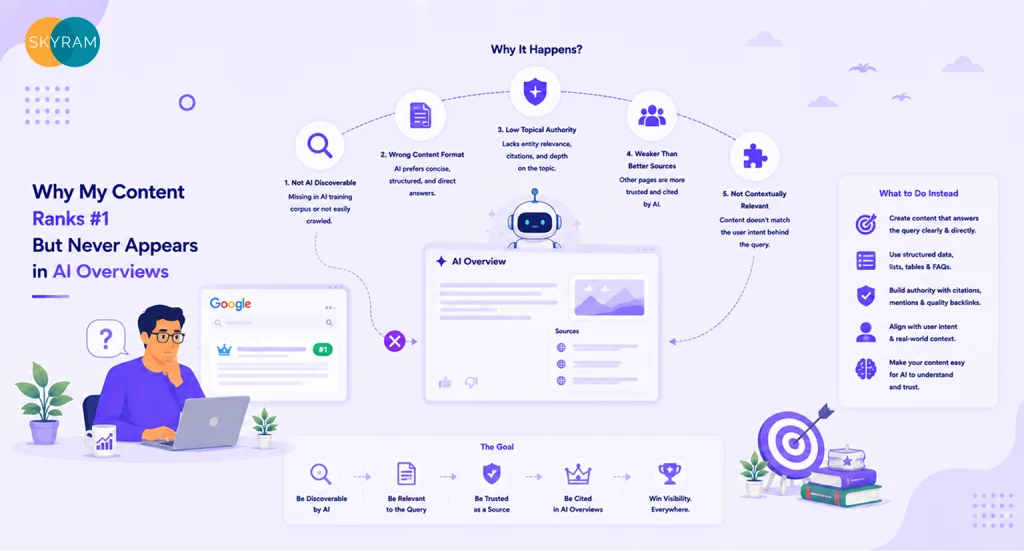
That disconnect is not a glitch, and it is not a sign the page is about to lose its ranking. It is evidence that ranking and AI Overview citation are now two separate evaluations running on the same search results page, judged by different criteria. This guide walks through why that split happens, the five most common reasons strong content gets passed over, and a diagnostic process for finding and fixing the gap without rebuilding content that is already performing well organically.

Content that ranks number one organically but doesn’t appear in AI Overviews typically fails on answer extractability, not authority. Google’s AI Overview system prioritizes content structured for direct extraction: clear question-answer pairing, concise definitions, and scannable formatting, over content that is comprehensive but requires synthesis to locate the answer. Rank position measures relevance. AI Overview inclusion measures extractability.

Rank Position vs. AI Overview Eligibility: Two Different Systems

The core misunderstanding behind this problem is treating AI Overview inclusion as a downstream effect of ranking well. It is not. Ranking gets a page into consideration. A separate set of factors then decides whether that page’s content is usable as a citation source.

What Traditional Ranking Factors Still Control

Backlink authority, keyword relevance, historical performance, content comprehensiveness, and technical health continue to determine organic rank position largely the way they always have. These factors answer the question, “Is this page a credible, relevant match for the query?” A page that ranks first has already cleared this bar convincingly, often with years of accumulated authority that a newer competitor cannot match.

None of that changes under an AI Overview evaluation. A page’s rank one status is not revoked or diminished when a competitor gets cited instead. The two systems are not competing for the same judgment. Ranking answers “does this page deserve to be here.” AI Overview citation answers a different question entirely.

What AI Overview Extraction Factors Control Instead

AI Overview citation depends on whether the generation model summarizing the query can locate a specific, self-contained answer inside the page without doing significant interpretive work. This is a content-structure question, not an authority question. A page can have outstanding backlink profiles and still lose the citation to a thinner page because the winning page states its answer in one clear sentence and the number one page states the same answer across four paragraphs of qualifying context.

This is precisely the gap our answer engine optimization work addresses for clients whose pages already rank well but show zero AI Overview presence. The fix rarely touches rank-driving factors like backlinks. It touches how the answer sits on the page.

Key Takeaway: Ranking and AI Overview citation are governed by different systems. A page’s rank one position reflects authority and relevance. Whether that same page gets cited depends entirely on how extractable its answer is, a structural property, not an authority property.

The Five Reasons High-Ranking Content Gets Skipped by AI Overviews

Most high-ranking pages that get passed over fall into one or more of five identifiable patterns. Diagnosing which pattern applies is the first step toward a fix.

The Answer Is Buried Past the First 100 Words

The most common reason. A page opens with an introduction, some context-setting, maybe a statistic or two, and only reaches its actual answer three or four paragraphs in. Google’s AI Overview system tends to weight the opening portion of a page’s relevant section heavily when deciding whether the content is usable, because that is the section most likely to contain the direct response the model needs. A correct, well-supported answer sitting past the first hundred words is functionally invisible to the extraction process, even though a human reader would find it easily by scrolling.

The Content Lacks a Clean, Quotable Definition or Direct Answer

Some pages answer a question thoroughly across an entire section without ever stating the answer as a single, standalone sentence. The information is present, but it is distributed: part of it in one paragraph, a qualifying detail in the next, a caveat somewhere after that. A generation model cannot easily stitch a citation together from scattered fragments. It needs one sentence, or a tight cluster of sentences, that states the complete answer on its own.

No Structured Data Supporting Entity or Answer Clarity

Pages missing FAQPage schema, HowTo schema, or clear Article markup give Google’s systems less confidence about what type of content they are looking at and how to parse it. This does not disqualify a page from ranking, since traditional ranking factors do not weight schema nearly as heavily. But for AI Overview eligibility, schema functions as a labeling system that reduces ambiguity. Its absence does not break eligibility outright, but it removes a signal that helps close borderline cases in the page’s favor.

Sentence Structure Requires Inference Rather Than Direct Extraction

Some content is written in a way that assumes the reader will connect ideas across sentences. “This approach works well for most cases, though the second method described below tends to perform better under specific conditions” requires a reader, or a model, to hold multiple pieces of information in mind and synthesize a conclusion. Content written for extraction states conclusions directly: “Method B outperforms Method A when X condition applies.” The information can be identical. The extractability is not.

Competing Pages Answer the Same Question More Concisely

Sometimes the content itself is fine, but a competing page simply states the same answer in fewer words, with less friction for the extraction process. AI Overview citation is comparative in this sense. The generation model is not evaluating a page against some absolute quality bar. It is selecting the best available source among the retrieved candidates for that specific query, and “best” in this context often means “most efficiently extractable,” not “most comprehensive.”

Comparison Table: Rank-Optimized Page Structure vs. AI-Overview-Optimized Page Structure

Structural Element Rank-Optimized Structure AI-Overview-Optimized Structure
Answer placement Anywhere within a comprehensive section Within the first 100 words of the relevant section
Definition format Woven into supporting narrative Stated as one standalone, quotable sentence
Schema usage Optional, often limited to Article schema FAQPage and HowTo schema layered where relevant
Sentence construction Allows inference and qualification States conclusions directly, minimal hedging
Competitive benchmark Compared on backlinks and domain authority Compared on extraction efficiency against retrieved pages
Typical fix required None, page already performs Restructure the opening of the target section


Key Takeaway: The five reasons above are diagnostic categories, not a checklist to apply blindly. Most underperforming pages show two or three of these patterns at once, which is why a structured audit matters more than a general rewrite.

How to Audit Your Existing Top-Ranking Content for AI Overview Fit

Before restructuring anything, run a specific diagnostic against the pages already holding strong rank positions but showing no AI Overview presence. This targets effort at the pages most likely to respond quickly.

The Extraction Test: Could an AI Summarize Your Answer in One Sentence?

Take the primary question your page targets and try to answer it using only a single sentence pulled directly from the page, with no editing. If no sentence on the page states the complete answer on its own, the page fails the extraction test regardless of how good the surrounding content is. This is the fastest, cheapest diagnostic available and it takes about two minutes per page.

Run this test against your top 15 to 20 pages by organic traffic that currently show no AI Overview impressions in Search Console. Pages that fail the test are your highest-priority restructuring candidates, since the fix is usually contained to a single paragraph rather than the whole page.

Restructuring Existing Content Without a Full Rewrite

Most pages that fail the extraction test do not need a full rewrite. They need a new opening sentence or two added to the top of the relevant section, stating the answer directly, followed by the existing supporting content left largely intact. This preserves the comprehensiveness and internal linking equity that earned the page its rank in the first place, while adding the extraction-friendly element that was missing.

This is the same restructuring discipline covered in our broader guide to getting cited in ChatGPT, Perplexity, and Google AI Overviews, which walks through the entity and schema layer that often needs to accompany structural changes for the citation to stick.

Key Takeaway: The one-sentence extraction test is the fastest way to identify which top-ranking pages are failing on structure rather than substance. Most fixes are additive, a new answer-first opening, not a wholesale rewrite of content that already ranks well.

What to Change First: Quick Fixes vs. Structural Rebuilds

Not every underperforming page needs the same level of effort, and treating them all the same wastes budget on pages that need a light touch while under-investing in pages that need real restructuring.

Quick fixes apply to pages that fail the extraction test but otherwise have strong content. Add a direct answer sentence to the top of the target section. Add FAQPage schema if the page already has a natural Q&A section, even an informal one. Tighten hedged sentence constructions in the immediate vicinity of the core answer. These changes typically take under an hour per page and can be rolled out across a priority list quickly.

Structural rebuilds apply to pages where the answer is genuinely diffuse across the entire piece, where no single section can be reasonably edited to contain a clean answer without disrupting the rest of the content, or where the page was never built around a specific question in the first place. These pages need the content reorganized around a clear question-answer architecture, sometimes with new subheadings added to break the topic into extractable segments. This is closer to the work our AI content optimization process handles for clients with large content libraries, where dozens of pages need triage between the two categories before any actual editing starts.

Prioritize by traffic and business value first, then by which fix category applies. A high-traffic page needing only a quick fix should move ahead of a lower-traffic page needing a full rebuild, simply because the return on effort is faster and larger.

Key Takeaway: Sort underperforming pages into quick fixes and structural rebuilds before touching any of them. Quick fixes should be batched and shipped fast. Rebuilds need dedicated planning and should be prioritized by traffic value, not urgency of discovery.

Measuring Whether Restructuring Actually Improves Citation Rate

Restructuring without measurement leaves a team unable to tell whether the changes worked or whether citation appeared for unrelated reasons. Set a baseline before making any changes.

Record, for each target page, whether an AI Overview currently appears for its primary query and whether the page is cited within it. Google Search Console’s search appearance filter for AI Overviews gives this data directly for queries already generating impressions. For queries with low or no current impression volume, run the query manually and log the result alongside the date.

After restructuring a batch of pages, re-check the same queries on a biweekly cadence rather than daily, since AI Overview citation can fluctuate short-term as Google’s retrieval pool shifts. Look for a sustained pattern over four to six weeks rather than reacting to single-day changes. A structured visibility audit run before and after a restructuring push gives a clean before-and-after comparison across the full priority list, which is more reliable than spot-checking individual pages as changes go live.

Track citation rate as a distinct metric from rank position in your reporting. A page can hold its rank one position throughout the entire process while its citation status changes independently. Reporting that conflates the two will misrepresent whether the restructuring effort is actually working.

Frequently Asked Questions

  1. Why does my page rank #1 but not show up in the AI Overview?

A page can rank first while being excluded from the AI Overview because the two are governed by separate evaluations. Rank position reflects relevance and authority signals like backlinks and content comprehensiveness. AI Overview inclusion depends on whether Google’s generation model can extract a clean, self-contained answer from the page without needing to synthesize information across multiple paragraphs. A page can be highly authoritative and still lack the extractable structure the citation process requires.

  1. How do I know if my content is failing because of structure or because of authority?

Run the extraction test: try to answer your page’s primary target question using only one unedited sentence pulled directly from the page. If no single sentence states the complete answer, the issue is structural, not authority-related, since the page is already ranking well enough to prove its authority is sufficient. Authority problems show up as low or unstable rank positions, not as a rank one page with zero AI Overview presence.

  1. Do I need to rewrite my entire page to get cited in AI Overviews?

Usually not. Most pages that rank well but lack AI Overview citation need an additive fix: a direct answer sentence added near the top of the relevant section, tightened sentence structure around that answer, and schema markup where a natural Q&A element already exists. A full structural rebuild is only necessary when the answer is genuinely spread across the entire piece with no section that can reasonably be edited to contain it.

  1. How long does it take to see AI Overview citation after restructuring a page?

Most pages that already rank well and receive regular crawl attention show citation changes within two to six weeks of a structural update, since the page does not need to earn new rank position, only be reprocessed with its new structure. Pages that are crawled less frequently due to lower traffic or fewer internal links may take longer to reflect the change.

  1. Does losing AI Overview citation mean my page is about to lose its ranking?

No. AI Overview citation and organic rank position are separate metrics that can move independently of each other. A page can hold a stable rank one position indefinitely while its AI Overview citation status changes based on structural factors, competitor content updates, or shifts in Google’s retrieval pool. Rank position should be monitored through standard Search Console ranking reports, and citation status should be monitored separately through the AI Overview search appearance filter.

Talk to Skyram About Closing Your AI Overview Visibility Gap

The gap between ranking first and getting cited is not a sign that content needs to be rebuilt from scratch. It is usually a narrow, fixable structural problem sitting inside content that is already doing most of its job well. The extraction test, the five diagnostic patterns, and the quick-fix-versus-rebuild triage above give a team enough to start closing that gap on their own.

For teams managing a large page inventory where manual auditing does not scale, Skyram Technologies runs this exact diagnostic across a full site, prioritizes pages by traffic value and fix complexity, and implements the structural changes without disturbing the ranking signals already in place. Talk to Skyram about closing your AI Overview visibility gap and get a clear picture of which pages are costing you citations right now.
How to Get Your Brand Cited in Google AI Overviews: A Technical Framework

Marketing director reviewing a technical framework for getting brand content cited in Google AI Overviews on a laptop dashboard

Search results changed shape faster than most marketing teams adjusted their content strategy. AI Overviews now sit above the traditional blue links for a growing share of queries, and the ranking rules that determine placement inside them are not the same rules that determine organic position. A brand sitting at position three in the organic results can appear inside the AI Overview while the page holding position one does not get cited at all. That gap is not random. It reflects a separate selection process running on top of traditional search, one that rewards a different kind of content structure entirely.

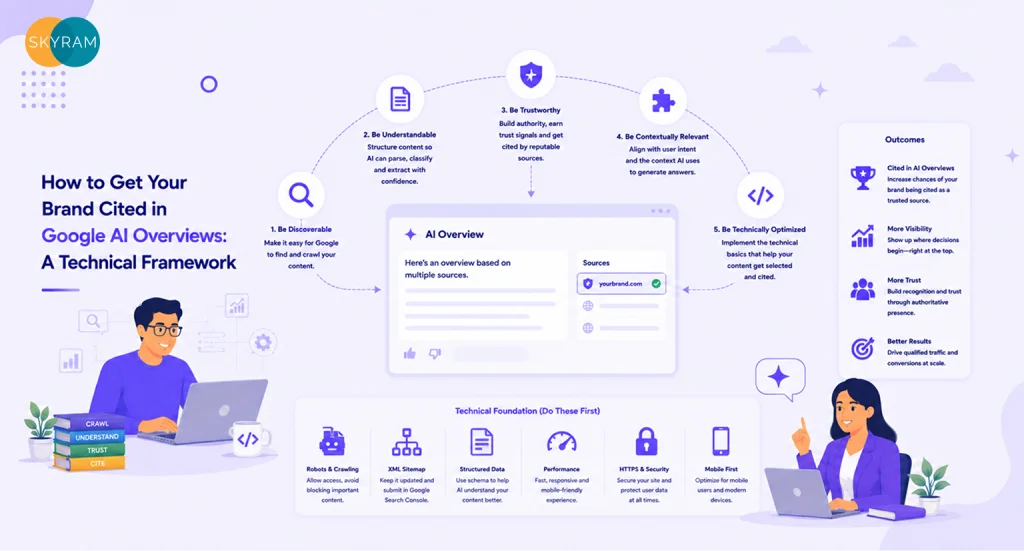
Getting cited in Google AI Overviews requires structuring content around direct, self-contained answers to specific questions, implementing schema markup that clarifies entity relationships, and building topical depth that signals authority on the exact query being answered. AI Overviews pull from pages that answer questions clearly in the first few sentences, not pages that bury the answer inside narrative content.

This guide breaks down the technical framework behind that selection process. It covers how Google’s AI Overview system actually retrieves and ranks source content, the structural patterns that earn citations, the schema markup that supports eligibility, the technical prerequisites that have to be in place before any of it matters, and how to track whether your pages are actually showing up.

How Google AI Overviews Select and Cite Sources

AI Overviews do not work like the traditional ten blue links. Understanding the mechanism behind source selection is the starting point for any optimization effort, because tactics that worked for organic ranking do not automatically transfer.

The Retrieval-Augmented Generation Process Behind AI Overviews

Google AI Overviews run on a retrieval-augmented generation process, commonly shortened to RAG. Instead of generating an answer purely from the language model’s training data, the system retrieves a set of candidate pages from Google’s index that appear relevant to the query, then uses those retrieved pages as grounding context to generate the summary the user sees. The pages cited beneath the AI Overview are the sources the model actually pulled from during that retrieval step.

This matters because it means two separate processes are happening. First, traditional ranking signals still determine which pages even enter the retrieval pool. A page that cannot rank at all for a query is unlikely to be retrieved. Second, once a page is inside that retrieval pool, a different evaluation happens: does the content contain a clean, extractable answer the generation model can lift and summarize accurately? A page can rank on page one and still fail this second test if the actual answer is diluted across long paragraphs, hedged with qualifiers, or missing entirely from the sections Google’s crawlers associate with the query.

Why Rank Position and AI Overview Inclusion Are Increasingly Decoupled

The decoupling between organic rank and AI Overview citation happens because the two systems optimize for different outcomes. Traditional ranking rewards comprehensive coverage, backlink authority, and historical performance signals. AI Overview citation rewards clarity and extractability at the sentence and paragraph level. A page can have strong domain authority and still lose the citation to a lower-ranking competitor whose content answers the exact question in a cleaner, more self-contained way.

This is why marketing teams sometimes see a competitor with a thinner backlink profile earning the AI Overview citation while their own page, ranking higher, gets skipped. The content structure, not the domain strength alone, determines which page the generation model chooses to summarize from.

Key Takeaway: AI Overviews run on a retrieval-then-generate process, not a pure ranking algorithm. Getting into the retrieval pool still requires solid organic performance, but earning the actual citation depends on whether your content contains a clean, extractable answer the model can summarize with confidence.

Content Structure That Wins AI Overview Citations

Once a page qualifies for the retrieval pool, structure becomes the deciding factor in whether it gets cited. The formatting choices that follow are the highest-leverage changes a content team can make.

Direct-Answer-First Formatting vs. Narrative Lead-Ins

Content written for AI Overview citation states the answer first, then supports it. Content written in a traditional editorial style often builds context before arriving at the point, a structure that reads well for a human but creates friction for a generation model trying to extract a clean summary.

Compare the two approaches. A narrative lead-in might read: “There has been a lot of discussion recently about how brands can improve their standing in AI-powered search results, and the answer involves several interconnected factors that marketing teams need to understand.” That sentence contains no answer. A direct-answer version reads: “Brands get cited in Google AI Overviews by structuring content around self-contained answers, implementing schema markup, and building topical authority on the specific query.” The second version can be lifted and summarized without any additional processing. The first cannot.

This does not mean every page needs to abandon narrative style entirely. It means every section that targets a specific question needs to open with the answer in the first sentence, before any supporting narrative appears.

Question-Based Subheadings That Mirror Actual Search Queries

Subheadings phrased as questions perform better for AI Overview extraction than subheadings phrased as abstract topic labels. A subheading reading “What Schema Markup Does Google AI Overviews Prioritize” maps directly to how a user might phrase the search query, which makes it easier for the retrieval system to match the section to the query and for the generation model to treat that section as the direct source of the answer.

Audit existing content by pulling the actual “People Also Ask” questions and related search terms for your target keyword, then rewrite H2 and H3 subheadings to mirror that language wherever it fits naturally. This is not keyword stuffing. It is aligning your content’s internal structure with the way the query itself is phrased.

Optimal Answer Length for Extraction

Answer blocks that run 40 to 60 words tend to perform best for AI Overview extraction. Short enough to summarize cleanly, long enough to contain a complete, specific answer rather than a vague fragment. An answer under 20 words often lacks the specificity the model needs to trust it as a standalone claim. An answer running past 100 words before making its point forces the model to do more interpretive work, increasing the odds it selects a competitor’s tighter answer instead.

The discipline here is similar to what our answer engine optimization process applies across every client page: every section that targets a specific question gets a direct answer within that 40 to 60 word window before any elaboration begins.

Key Takeaway: Structure every section that targets a specific question with the answer in the first sentence, a question-based subheading that mirrors real search phrasing, and a response length in the 40 to 60 word range. This is the single highest-leverage change most content teams can make.

The Schema Markup That Supports AI Overview Eligibility

Structure gets content into a citable shape. Schema markup tells Google’s systems what that content actually is, reducing the ambiguity the retrieval and generation process has to resolve on its own.

FAQ Schema, HowTo Schema, and Article Schema Priorities

Three schema types carry the most weight for AI Overview eligibility on informational content. FAQPage schema marks up question-and-answer pairs directly, giving the generation model a pre-formatted answer block it can extract with minimal interpretation. HowTo schema serves the same function for process-based content, breaking a procedure into discrete, labeled steps that map cleanly onto how-to queries. Article schema, when it includes complete author and publisher markup, signals the content’s provenance and helps establish the credibility layer that supports citation.

Prioritize FAQPage schema on any page with a dedicated FAQ section, HowTo schema on any content walking through a sequential process, and Article schema with full author attribution on every blog post. Pages carrying two or more of these schema types consistently show stronger AI Overview inclusion rates than pages with none, because the schema removes guesswork from how the content should be parsed.

Entity Markup and Structured Data Consistency Across Your Site

Beyond content-type schema, Organization schema and consistent entity markup across the site help Google resolve who is actually publishing the content. This includes a complete sameAs array linking to verified profiles, consistent naming conventions across every page, and structured data that does not contradict itself from one page to the next. Inconsistent entity signals, such as a company name that appears one way in the footer schema and another way in the Article schema, create the kind of ambiguity that makes AI systems less confident about attributing content to a trustworthy source.

Structured data consistency is a site-wide discipline, not a page-by-page task. A single well-marked-up blog post sitting inside a site with inconsistent entity signals elsewhere will not perform as well as the same post on a site where every page reinforces the same clear entity profile.

Comparison Table: Traditional Ranking-Optimized Content vs. AI Overview-Optimized Content

Content Element Traditional Ranking Optimization AI Overview Citation Optimization
Opening structure Builds context, then narrows to the point States the direct answer in the first sentence
Ideal section length Comprehensive, often 300+ words per section 40 to 60 word answer block, then supporting depth
Heading phrasing Broad topic labels for keyword coverage Question-based, mirrors actual search phrasing
Schema priority Article schema for rich snippet eligibility FAQPage, HowTo, and Article schema combined
Depth signal Total word count and topical breadth Specificity and self-contained clarity per section
Primary success metric Organic rank position and click-through rate Citation frequency inside AI-generated summaries
Update cadence Periodic refresh tied to ranking decay Frequent updates tied to freshness windows


Key Takeaway: FAQPage, HowTo, and Article schema each remove a specific layer of ambiguity for Google’s retrieval and generation process. Site-wide entity consistency matters as much as individual page markup, since contradictory signals undermine the credibility schema is supposed to establish.

Technical Foundations That Must Be in Place First

Content structure and schema markup only matter if Google can crawl, index, and render the page in the first place. Skipping this layer is the most common reason technically sound content strategies underperform.

Crawlability and Indexation Health Checks

Before investing in content restructuring, confirm that the pages you want cited are actually indexed and crawlable without obstruction. Check for accidental noindex tags, broken canonical chains pointing to the wrong URL, and robots.txt rules that unintentionally block sections of the site. Run a fresh crawl audit specifically on your priority pages rather than assuming a general site health check from months ago still reflects current status.

Indexation depth matters too. A page that Google crawls infrequently is less likely to have its most recent updates reflected in the retrieval pool that feeds AI Overviews. Pages targeting priority AI Overview queries should sit within the site’s primary crawl path, linked from high-authority internal pages rather than buried several clicks deep.

Page Speed and Core Web Vitals as Citation Prerequisites

Core Web Vitals remain part of Google’s page experience signals, and slow-loading or layout-shifting pages compete at a disadvantage for retrieval consideration. This is not a direct AI Overview ranking factor in the way schema or answer structure are, but it functions as a gate: pages that struggle with Largest Contentful Paint or Interaction to Next Paint tend to underperform across the broader signals that determine whether a page enters the retrieval pool at all.

Treat page speed and Core Web Vitals as a prerequisite layer rather than an optimization to revisit later. A structurally excellent, fully schema-marked page sitting behind a slow, JavaScript-heavy template is starting from a technical deficit before any content work even gets evaluated. Our technical SEO work treats this foundation as the first phase of any AI Overview optimization engagement, not an afterthought layered on once content is finished.

Key Takeaway: Content and schema improvements cannot compensate for a page that Google struggles to crawl, index, or render quickly. Confirm crawlability and Core Web Vitals health before investing further budget in content restructuring.

How to Monitor Whether You’re Being Cited

Optimization without measurement leaves a marketing team guessing whether the framework is actually working. Tracking AI Overview citations requires a different approach than tracking traditional keyword rankings.

Tools and Manual Tracking Methods for AI Overview Appearances

Google Search Console now surfaces AI Overview impression and click data under the Search Results report when you filter by search appearance type. This is the most direct free method available, showing exactly which queries triggered an AI Overview that included your site and whether users clicked through from it.

Manual tracking supplements this well. Run your priority target queries directly in Google search on a biweekly cadence, record whether an AI Overview appears, and note whether your domain shows up among the cited sources. A simple spreadsheet tracking query, date, citation status, and cited URL builds a useful trend line over a few months without requiring paid tooling.

For teams managing a larger query set, paid platforms including Semrush’s AI Overview tracking module and BrightEdge’s Generative Parser automate this monitoring at scale, running scheduled checks against a full keyword list and reporting citation frequency alongside competitor comparisons. A structured AI visibility audit is a faster way to get a baseline reading across your full priority keyword set before deciding whether to invest in ongoing paid tracking.

Key Takeaway: Google Search Console’s AI Overview filter is the essential free starting point. Layer in manual biweekly query checks for your top targets, and consider paid tracking tools once your priority keyword list grows past what manual checking can reasonably cover.

Common Mistakes That Keep Strong Content Out of AI Overviews

A few recurring mistakes explain most of the gap between content that ranks well and content that gets cited. Writing a strong answer but placing it in paragraph four instead of the opening sentence is the most common one. The model retrieves and summarizes what it finds fastest, and an answer buried behind three paragraphs of setup often gets skipped in favor of a competitor’s tighter opening.

Treating schema as optional or implementing only Article schema while skipping FAQPage and HowTo markup leaves eligibility signals on the table for content that would otherwise qualify. Publishing comprehensive, long-form content without corresponding short, self-contained answer sections inside it creates pages that rank well but rarely get cited, since length and extractability are not the same quality. Neglecting technical prerequisites, particularly Core Web Vitals and crawl health, undermines otherwise strong content before the generation model ever evaluates it. And letting priority pages go stale, without periodic substantive updates, gradually reduces citation frequency even for pages that performed well when first published.

The fix for each of these is procedural, not creative. Audit existing high-potential pages against this list, prioritize the pages closest to qualifying, and work through the gaps systematically rather than rewriting everything at once.

Frequently Asked Questions

  1. What is the fastest way to get cited in Google AI Overviews?

The fastest measurable improvement typically comes from restructuring an existing, already-indexed page to open each key section with a direct 40 to 60 word answer, then adding FAQPage schema to the page’s existing FAQ content. Pages that already rank on page one for a target query but currently bury the answer inside narrative paragraphs tend to show citation improvements within four to eight weeks of restructuring, since the retrieval and indexing groundwork is already in place.

  1. Does ranking number one guarantee an AI Overview citation?

No. AI Overview citation depends on content structure and extractability, not organic rank position alone. A page ranking third or fourth with a cleaner, more self-contained answer can earn the citation over a page ranking first that buries its answer inside longer narrative content. Rank position affects whether a page enters the retrieval pool, but it does not determine which page the generation model chooses to summarize from within that pool.

  1. Which schema type matters most for AI Overview eligibility?

FAQPage schema generally provides the most direct eligibility support because it pre-labels question-and-answer pairs in a format the generation model can extract with minimal interpretation. HowTo schema provides similar value for process-based content. Article schema with complete author markup supports the credibility layer that underlies citation decisions. Most high-performing pages combine at least two of these three schema types rather than relying on a single one.

  1. How is optimizing for Google AI Overviews different from traditional SEO?

Traditional SEO optimizes primarily for rank position through backlink authority, keyword targeting, and comprehensive topical coverage. Optimizing for Google AI Overviews optimizes for extractability: whether a specific section of a page contains a clean, self-contained answer a generation model can summarize confidently. Both disciplines share a technical foundation, including crawlability and Core Web Vitals, but the content-level tactics diverge once a page is capable of ranking at all.

  1. How long does it take for schema markup changes to affect AI Overview citations?

Schema markup changes typically need to be crawled and reprocessed by Google before they influence citation eligibility, a process that generally takes two to six weeks depending on the page’s existing crawl frequency. Pages that are crawled frequently due to strong internal linking and regular traffic tend to see schema changes reflected faster than lower-priority pages that Google crawls less often.

  1. Can new content compete for AI Overview citations against established competitor pages?

Yes, if the new content is structured correctly from the first draft. AI Overview citation rewards extractability and specificity more than it rewards raw domain age or historical authority. A newly published page with a tightly structured, schema-marked answer can outcompete an older, higher-authority page that never restructured its content for extraction. The technical foundation, particularly crawlability and indexation, still needs to be solid, but content age itself is not a primary factor in the citation decision.

Talk to Skyram About AI Overview Optimization Strategy

The framework above covers what changes when content moves from ranking-optimized to citation-optimized: answer-first structure, targeted schema, technical prerequisites, and consistent monitoring. Implementing it across an entire content library, prioritizing correctly, and validating that the changes actually move citation frequency is where most internal teams run out of bandwidth.

Skyram Technologies works with US marketing teams to audit existing content against this exact framework, identify which pages are closest to qualifying for AI Overview citation, and implement the structural and schema changes at scale. If you want a clear picture of where your current content stands, talk to Skyram Technologies about an AI Overview optimization strategy built around your specific keyword priorities.

How to Choose an AWS Cloud Services Partner That Won’t Disappear After Go-Live

How to Choose an AWS Cloud Services Partner

The migration was clean. The architecture review passed. The go-live cutover ran on schedule and under budget. Three months later, an IT Director is fielding a P1 incident at 11 PM on a Friday, and their AWS partner’s account manager responds the next business day with a note clarifying that post-launch support was not included in the engagement scope.

The architecture did not fail. The contract did.

This is the most common and most preventable failure mode in AWS partner engagements. The partner delivered exactly what was scoped. The scope was delivery, not operations. The internal team inherited a complex new environment with no runbooks, no incident response protocol, and no escalation path to someone who actually built it.

Choosing an AWS cloud services partner that sustains engagement after go-live means evaluating their post-launch support model, SLA commitments for ongoing operations, incident response protocols, and knowledge transfer practices before the engagement starts. Most AWS partner failures are not technical. They are contractual. When the build is done, the partner disappears, and the internal team inherits an environment they do not fully understand.

This guide covers the specific questions to ask, contract provisions to demand, and evaluation criteria to apply before you sign.

The Post-Launch Support Gap That Most AWS Partner Contracts Don’t Cover

Build vs. operate: how most AWS partner scopes end at delivery

Standard AWS partner engagements are scoped around a deliverable: a migration, an architecture build, a security review, a cost optimization sprint. The engagement ends when the deliverable is accepted. Ongoing operations are a separate conversation, and most partners expect you to initiate it.

The problem is that most IT leaders assume operational continuity is implied by a successful delivery. It is not. Unless ongoing managed services are written into the contract with defined scope and SLAs, delivery is where the relationship legally ends.

What an internal team actually needs to inherit a new AWS environment

Inheriting a new AWS cloud environment without proper knowledge transfer puts your internal team in an impossible position. They did not design the architecture. They were not in the room for every technical decision. They do not know which services are load-bearing and which are experimental, or what the failover sequence is when a specific component goes down.

At minimum, a responsible handover includes architecture documentation in a format your team can actually navigate, runbooks for the ten most likely operational scenarios, a secrets and access management guide, cost anomaly alert configurations with defined thresholds, and at least one live walkthrough session where the engineers who built it explain what they built and why.

Most project-based engagements deliver none of these by default. They require explicit contractual specification.

The incident response vacuum that appears in week one of post-launch operations

The first production incident after go-live is the moment that exposes whether your AWS partner engagement was structured correctly. If your team has runbooks, alert routing, and an escalation path to someone with environment context, the incident gets handled. If none of those things exist, the incident becomes a crisis because your team is debugging an environment they are still learning while a production system is down.

This vacuum is predictable and preventable. The only way to close it is to require incident response support as a written contract deliverable before go-live, not as a verbal assurance that your partner will pick up the phone if something goes wrong.

What to Demand in an AWS Partner Engagement From Day One

Ongoing managed services vs. project-based delivery: what each includes post-launch

Knowing which engagement model you actually need before you evaluate partners is the foundational decision. A project-based engagement delivers a defined output on a fixed timeline. A managed services engagement delivers ongoing operational ownership with continuous monitoring, incident response, and environment management as part of the scope.

The critical difference is not cost. It is accountability. In a managed services engagement, someone is accountable for uptime. In a project-based engagement, the partner is accountable for delivery quality, and accountability for uptime transfers entirely to your team on day one of go-live.

Neither model is wrong. But choosing the wrong one for your organization’s internal capacity is how you end up in the 11 PM incident scenario described above.

SLA requirements for infrastructure incidents, performance degradation, and cost anomalies

If you engage a partner for ongoing operations, demand specific SLA language for three categories: infrastructure incidents by severity tier (P1 through P4), performance degradation alerts with response time commitments, and cost anomaly notifications with a defined threshold and response protocol.

Vague language like “24/7 support” and “rapid response” is not an SLA. An SLA specifies the maximum time between incident detection and acknowledgment, between acknowledgment and active remediation, and between remediation start and resolution for each severity tier. Require this in writing before contracting.

Knowledge transfer deliverables: runbooks, architecture documentation, escalation protocols

Make documentation a milestone-gated contract deliverable, not a post-engagement courtesy. Specify what documents must exist, what format they must be in, and when they must be delivered relative to go-live. Require partner sign-off that the documentation is accurate and complete as a condition of final payment.

A cloud engineering engagement that produces no usable documentation is an engagement that created dependency, not capability. Your team should be able to operate the environment confidently 90 days after the partner’s active involvement ends.

Comparison Table: Project-Delivery AWS Partner vs. Managed AWS Partner

Dimension Project-Delivery Partner Managed AWS Partner
Scope Defined deliverable with acceptance criteria Ongoing operational ownership with defined SLAs
Post-launch coverage None unless separately contracted Included: monitoring, incident response, patching
Internal team dependency High: team inherits full operational load at go-live Low: partner retains operational accountability
Documentation Varies; often minimal without explicit contractual requirement Typically structured as part of ongoing engagement
Cost structure Fixed project fee Monthly retainer or consumption-based
Escalation path post-go-live None by default Defined contractually with response time commitments
Best fit Organizations with strong internal cloud ops capacity Organizations without dedicated cloud operations resources

The Contract Provisions That Prevent Post-Launch Abandonment

Operational SLA tied to response time and resolution time

Write SLA commitments into the master services agreement, not the statement of work. Statements of work define project scope and can expire. Master agreements govern the ongoing relationship. Operational SLAs belong in the document that survives the project.

Documentation deliverable schedule with milestone-based acceptance

Attach documentation deliverables to payment milestones. If final payment requires delivery of a complete runbook package, architecture diagrams, and a live walkthrough session, your partner has a financial incentive to produce them on time and at the quality level specified.

Transition support clause: minimum engagement period post-go-live

Require a defined post-go-live support window in the contract, typically 30 to 90 days during which the partner maintains active operational responsibility alongside your team. This is the window during which your team learns the environment under live conditions with expert support available. It is not an optional add-on. It is the difference between a successful handover and an inherited problem.

How to Evaluate an AWS Partner’s Post-Launch Track Record

Ask for references specifically about post-launch operations, not the build

When you call an AWS partner’s references, ask one question first: what happened six months after go-live? Most partners will give you references who can speak to delivery quality. Fewer will give you references who can speak to what operational support looked like after the engagement technically ended. Ask specifically for a reference from a client who ran into a production issue after go-live and needed partner support. How the partner responded in that moment is more predictive of your experience than how clean the migration was.

How do they handle cost anomaly alerts after the engagement formally ends?

AWS cost anomalies can appear weeks or months after go-live as traffic scales, reserved instance commitments expire, or configurations drift from their original state. Ask your prospective partner directly: if my AWS bill spikes 40 percent three months after our engagement ends, what is your process? A partner who has a defined answer, even a paid incident review, is materially better positioned than one who does not have an answer at all. The answer tells you whether post-launch operations are part of their operating model or entirely outside it.

What does their standard runbook deliverable look like?

Ask to see an anonymized runbook from a previous engagement. Not a description of what a runbook contains. An actual document. A strong runbook covers at least ten common operational scenarios with step-by-step resolution procedures, tool-specific commands, escalation contacts, and rollback instructions. A weak runbook is a two-page document with bullet points describing what each service does.

The quality of the runbook is the single most reliable proxy for whether a partner is building your team’s capability or their own indispensability.

AWS Managed Services vs. Internal Operations: The Hybrid Model Most IT Leaders End Up Using

Pure internal cloud operations require a dedicated cloud ops team with AWS certifications, on-call rotation coverage, and deep environment knowledge. For most IT organizations outside of large enterprise, this is an unrealistic staffing model.

Pure external managed services mean your internal team loses environment familiarity over time and becomes dependent on the partner for every operational decision.

The model most IT leaders actually land on is a hybrid: the managed services partner handles monitoring, alerting, and incident response, while the internal team handles day-to-day configuration changes, cost reviews, and application-level decisions. The partner is the operational backbone; the internal team is the business context layer.

Getting this split right requires defining it explicitly in the engagement structure, not discovering it organically through six months of ambiguous ownership. A well-structured cloud services engagement documents the operational ownership model from day one so neither side inherits surprises.

Cost Optimization as an Ongoing Function, Not a One-Time Engagement

AWS cost optimization is not something you complete. It is something you operate. Reserved instance terms expire. Savings Plans need renewal and adjustment. Traffic patterns shift. New services get provisioned and forgotten. Auto-scaling configurations drift from their original tuning.

A partner who scopes cost optimization as a one-time audit and leaves is not solving your cost problem. They are delaying it by a few months.

Demand cost optimization as a defined ongoing function in any managed services engagement. Specify that cost reviews happen on a defined cadence, that anomaly alerts are configured and routed to a named contact, and that reserved capacity planning is revisited at least quarterly. The AWS bill is not a static artifact of your architecture. It is a live indicator of how well your environment is being managed, and it should be treated that way from the first day of the engagement.

Skyram Technologies structures its AWS and DevOps engagements around this principle: operational accountability does not end at go-live. Monitoring, cost governance, incident response, and documentation transfer are built into the engagement model from day one, not added as optional extras after the build is done.

Frequently Asked Questions

  1. What should I look for in an AWS cloud services partner to ensure they provide post-launch support?

When evaluating an AWS cloud services partner for post-launch support, an IT Director or CTO should look for three specific things: a written managed services option with defined SLAs for incident response by severity tier, documentation deliverables listed as milestone-gated contract items rather than implied courtesies, and a transition support clause requiring the partner to maintain active operational involvement for a defined period after go-live. Partners who cannot specify their post-launch support model in contract language before signing are partners whose support model does not exist.

  1. What is the difference between a project-based AWS partner and a managed AWS services partner?

A project-based AWS partner delivers a defined output, such as a migration, architecture build, or security review, and their contractual obligations end when the deliverable is accepted. A managed AWS services partner maintains ongoing operational ownership of the cloud environment, including monitoring, incident response, patching, and cost anomaly management, under defined SLAs. The key difference is not the quality of the technical work but the scope of accountability after go-live. Project-based engagements transfer full operational responsibility to the internal team on day one of go-live. Managed services engagements retain partner accountability for ongoing operations.

  1. What SLAs should an AWS partner provide for cloud infrastructure support?

An AWS partner providing infrastructure support should specify SLAs across three categories. First, incident response SLAs by severity tier: the maximum time from incident detection to acknowledgment, and from acknowledgment to active remediation, for P1 through P4 severity levels. Second, performance degradation alert response times. Third, cost anomaly notification thresholds and response protocols. Language like “24/7 support” or “rapid response” without numeric commitments is not an SLA and should not be accepted as one.

  1. What documentation should an AWS partner deliver at the end of an engagement?

At minimum, an AWS partner should deliver complete architecture diagrams for all environments, runbooks covering the ten to fifteen most common operational scenarios with step-by-step resolution procedures, a secrets and access management guide, cost anomaly alert configurations with defined thresholds, an incident escalation contact matrix, and a live walkthrough session with the engineers who built the environment. Documentation that cannot be acted on without the partner’s interpretation is documentation that serves the partner’s interests, not the client’s.

  1. How do I evaluate an AWS partner’s post-launch experience before signing?

Request references specifically from clients who experienced a production incident or cost anomaly after the engagement formally ended, and ask how the partner responded. Ask to see an anonymized runbook from a previous engagement to evaluate documentation quality directly. Ask the partner to describe their process when a client’s AWS bill increases significantly three to six months post-go-live. A partner with defined answers to these questions has a post-launch support model. A partner who responds vaguely does not.

  1. What is a transition support clause and why does it matter in an AWS partner contract?

A transition support clause is a contract provision that requires the AWS partner to maintain active operational involvement for a defined period after go-live, typically 30 to 90 days. During this period, the partner retains responsibility for incident response and environment support while the internal team learns the new environment under live conditions. Without a transition support clause, the partner’s obligations end the moment the go-live milestone is accepted, leaving the internal team to manage a new and unfamiliar environment without available expert support from the people who built it.

Talk to Skyram About AWS Cloud Services and Managed Operations

If you are evaluating AWS partners for a migration, architecture project, or ongoing managed operations, the conversation should start with post-launch support, not end there. Skyram Technologies structures AWS engagements with defined operational SLAs, documentation deliverables, and managed services models built to sustain your environment long after go-live.

Book a conversation with our AWS team and bring your current partner evaluation criteria. We will tell you what is missing.

How to Hire an AEO Consultant vs. Retaining an AEO Agency: A Framework for B2B Teams

B2B marketing director comparing AEO consultant engagement vs AEO agency retainer on a decision framework whiteboard

You ran the test. You typed your core category queries into ChatGPT and Perplexity. Your competitors appeared. Your brand did not. The problem is real and it is costing you pipeline, because B2B buyers now use AI tools to build their initial shortlists before they ever land on a vendor website.

The question is not whether to address it. The question is how. Two legitimate paths exist. You can bring in an AEO consultant to diagnose the gap, restructure the content that matters most, and hand the implementation blueprint to your internal team. Or you can retain an AEO agency to own citation monitoring, content production, and AI answer presence management as an ongoing function. Both approaches work. Picking the wrong one for your situation wastes budget and extends the time before your brand appears in the answers your buyers read.

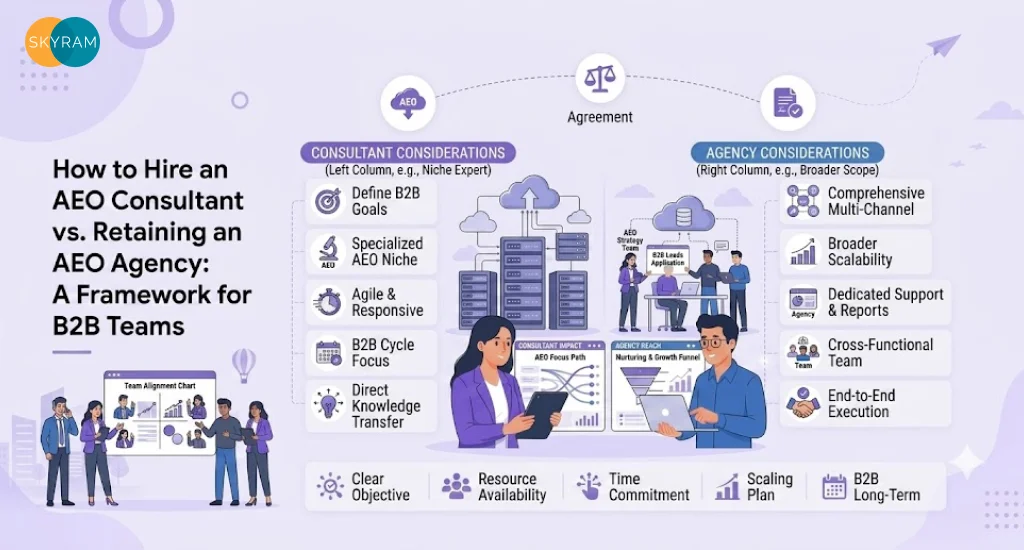
B2B marketing teams choosing between hiring an AEO consultant and retaining an AEO agency face a trade-off between depth and breadth. An AEO consultant delivers focused expertise on a defined scope, typically an audit, a content restructuring project, or a schema implementation sprint. An AEO agency provides ongoing citation monitoring, content production, and AI answer presence management across the full keyword universe. The right choice depends on whether AEO is a one-time gap or a continuous channel.

This framework gives you the criteria to make that decision without guesswork.

What an AEO Consultant Delivers vs. What an AEO Agency Delivers

The distinction is not primarily about quality. Both engagement types can deliver excellent work. The distinction is about scope, ownership, and what happens after the initial engagement ends.

Consultant Scope: Audit, Structured Content Sprint, Schema Implementation

An AEO consultant engages on a defined deliverable set with a clear end date. The typical consultant engagement runs eight to sixteen weeks and produces three categories of output.

The first is a citation gap audit: a systematic review of how your brand currently appears, or does not appear, across ChatGPT, Perplexity, Google AI Overviews, and Gemini for your priority queries. This audit identifies which pages are structurally eligible for AI extraction and which are not, and why.

The second is a content restructuring sprint: the consultant rewrites or restructures the highest-priority pages to introduce direct answer blocks, FAQ schema, and author markup. They may produce a content architecture template your internal team uses for new production going forward.

The third is a schema implementation guide or direct implementation: FAQPage, Article, and Organization schema applied to priority pages, validated against Google’s Rich Results Test, and documented for your development team to extend to the rest of the site.

At the end of the engagement, the consultant delivers the work and exits. Your internal team owns execution from that point forward.

Agency Scope: Ongoing Citation Monitoring, Content Production, AI Answer Presence Management

An AEO agency retainer is a continuous function, not a project. The agency maintains active ownership of three workstreams simultaneously.

Citation monitoring is ongoing: the agency tracks how often your brand appears in AI-generated answers for your priority queries, which competitors appear instead, and what content changes move the needle. This tracking happens monthly at minimum, with alerts for significant shifts.

Content production is the volume layer: the agency publishes AEO-structured content at a defined cadence, mapped to the keyword clusters where your brand needs to build or defend citation presence. This is not generic content production. Each piece follows an AI-extractable structure, including a direct answer block in the opening, FAQPage schema, and entity markup.

AI answer presence management is the strategic layer: the agency monitors platform changes across ChatGPT, Perplexity, and Google AI Overviews, adjusts content strategy as extraction logic shifts, and reports citation rate trends alongside traditional organic metrics.

Where the Scopes Overlap and Where They Diverge

Both a consultant and an agency will run a citation audit at the start of an engagement. Both will restructure priority content and implement schema. Both will measure AEO progress using citation frequency rather than rankings alone.

Where they diverge is sustainability. A consultant project produces a strong foundation and a clear execution blueprint. It does not produce ongoing citation growth after the engagement ends unless your internal team executes the blueprint consistently. An agency retainer produces sustained citation growth because production, monitoring, and optimization continue without interruption.

The overlap also creates a strategic opportunity: the best hybrid path often starts with a consultant to build the foundation correctly, then converts to an agency retainer once the baseline is established. More on that in the final section.

Comparison Table: AEO Consultant Engagement vs. AEO Agency Retainer

Dimension AEO Consultant AEO Agency Retainer
Engagement type Project-based, defined scope Ongoing retainer, continuous function
Typical duration 8 to 16 weeks 6 to 12 months minimum
Primary deliverable Audit report, content templates, schema implementation Monthly content production, citation monitoring, reporting
Content production volume Low to moderate (priority pages only) High (sustained cadence across full keyword universe)
Citation monitoring One-time or periodic Continuous, with monthly reporting
Cost structure Fixed project fee Monthly recurring retainer
Typical cost range (US market) $5,000 to $25,000 per project $3,000 to $15,000 per month
Internal team dependency High (team executes the blueprint) Low (agency owns execution)
Best fit Defined gap, capable internal team, budget constraint AEO as a primary acquisition channel, volume need, no internal capacity
Exit flexibility Project ends at defined milestone Requires retainer notice period

Key Takeaway: The choice between a consultant and an agency is primarily a question of who owns execution after the diagnosis is complete. A consultant diagnoses and blueprints. An agency diagnoses and then builds, monitors, and optimizes continuously.

When a Consultant Is the Right Call

Three conditions reliably indicate that a consultant engagement will produce a better return than a full agency retainer.

You Have a Specific Gap: Your Content Is Not Being Extracted by AI Answers

If your diagnostic work points to a clear structural problem rather than a volume problem, a consultant is often the higher-value engagement. A structural problem means your existing content is not formatted for AI extraction: no direct answer blocks, no FAQ schema, no author markup, entity signals that are inconsistent across your site.

A consultant can audit the structural gaps, restructure the 15 to 20 pages that matter most for your priority queries, and produce a template your content team uses for every subsequent piece. This is a defined problem with a defined solution, and a project-based engagement is the right match for it.

The contrast is a volume problem: your content is structured well but you need to publish 30 new AEO-optimized pages across a keyword cluster where you have no presence at all. That is an agency problem, not a consultant problem.

Your Internal Team Can Execute If Given the Right Framework

A consultant engagement produces its best results when your internal content team has the capacity to implement the blueprint after handoff. If your team can publish consistently, apply a content template correctly, and monitor basic citation signals in Google Search Console, a consultant gives them everything they need to sustain progress independently.

The test is honest: can your team publish two to four AEO-structured pieces per month for the next six months without someone actively managing the process? If yes, a consultant is likely sufficient. If the answer is uncertain, be direct with yourself about it before committing to the lower-cost option.

Understanding how AI content optimization works at the structural level helps internal teams assess their own capability gaps before making this call.

Budget Constraints Favor a Bounded Project Over an Open-Ended Retainer

A well-scoped consultant engagement delivers a defined output at a defined cost. For marketing teams operating under budget pressure or working through a formal procurement cycle that prefers project-based spend over ongoing retainers, a consultant engagement is often the path of least resistance to getting AEO work funded and started.

A $12,000 project that produces a 90-day content blueprint is an easier budget conversation than a $5,000 per month retainer that requires a 12-month commitment. If the budget constraint is real, a consultant project lets you demonstrate AEO results before asking for recurring spend.

Key Takeaway: A consultant is the right call when the problem is structural and bounded, your internal team can sustain execution post-handoff, and budget constraints favor a project over a retainer. If any of these three conditions does not hold, the calculus shifts toward an agency.

When an Agency Retainer Is the Right Call

An agency retainer makes the most sense when AEO is no longer a diagnostic exercise. It is a growth channel that needs to compound.

AEO Is a Primary Acquisition Channel You Need to Own Continuously

If a meaningful share of your B2B buyer journey runs through AI-powered research, AEO is not a project. It is infrastructure. B2B buyers in high-consideration categories, including SaaS, professional services, and technology, increasingly use ChatGPT and Perplexity to build their initial vendor shortlists. If your brand is absent from those answers when a buyer in your ICP is actively researching, you lose consideration before you even know the evaluation started.

That level of competitive urgency requires continuous management: monitoring which queries trigger competitor citations, publishing content that closes the gaps, and adjusting content structure as AI platform extraction logic evolves. A one-time consultant project cannot maintain that posture. An agency retainer can.

Understanding how brands get cited in ChatGPT, Perplexity, and Google AI Overviews clarifies how sustained the citation-building process actually is, and why it requires ongoing production rather than a single content sprint.

Your Content Volume and Keyword Universe Exceed What a Consultant Project Can Cover

An AEO consultant working a focused engagement typically restructures 15 to 30 pages and produces templates for the next 20 to 40. That scope covers a defined priority cluster. For B2B companies with broad product lines, multiple buyer personas, or competitive categories where dozens of query variations need coverage, the consultant’s output represents the starting point, not the complete program.

If your keyword universe spans multiple service lines and you need new AEO-structured content across all of them, an agency retainer delivers the production volume that a project engagement cannot. An agency that runs ongoing AEO services for B2B clients maintains the production infrastructure, editorial processes, and platform monitoring tools that individual consultants rarely replicate at scale.

You Need Citation Monitoring and Reporting as an Ongoing Function

Citation monitoring is not a one-time diagnostic. Your competitive position in AI-generated answers shifts as competitors publish new content, as platform algorithms update, and as your own content ages out of the freshness window. A static snapshot from a consultant audit tells you where you were at the moment of the engagement. It does not tell you whether a competitor gained ground in month three.

An agency retainer includes citation monitoring as a standing function: monthly tracking of which queries produce citations for your brand versus competitors, quarterly trend analysis, and strategic adjustment based on what the data shows. For marketing teams accountable for AI search visibility as a reported metric, ongoing monitoring is not optional.

Key Takeaway: An agency retainer is the right structure when AEO is a primary acquisition channel, your keyword universe is broad, and citation monitoring needs to be a continuous reporting function rather than a periodic snapshot.

The Evaluation Framework for AEO Consultants

Once you decide a consultant is the right path, the evaluation narrows to three questions that distinguish consultants with genuine AEO depth from those who have rebranded SEO services.

How Do They Measure Current AI Citation Footprint?

Ask the consultant to walk you through their diagnostic process for measuring AI citation presence. The answer should include specific platforms, specific query types, and a methodology for documenting citation frequency over a defined period.

A strong answer describes: manual query testing across ChatGPT, Perplexity, Gemini, and Google AI Overviews for your priority queries, a process for documenting which content gets cited and from what source, and a framework for interpreting citation gaps in terms of structural content issues rather than just “you need more content.”

A weak answer describes running a Semrush or Ahrefs report and calling it an AEO audit. Citation footprint is not a rankings metric. Consultants who conflate the two are doing SEO under an AEO label.

What Structured Content Formats Do They Prioritize for LLM Extraction?

AEO content structure is specific. Ask the consultant which formats they prioritize and why. The answer should include direct answer blocks of 40 to 80 words at the opening of key sections, FAQPage schema with questions phrased in buyer language, Article schema with author markup, and entity consistency across the page and across the domain.

If the consultant’s answer focuses primarily on keyword optimization, meta tag structure, or word count, they are describing SEO, not AEO. The structural requirements for LLM extraction are meaningfully different, and a consultant who cannot articulate that difference cannot execute AEO effectively.

What Does Their Deliverable Look Like at the End of the Engagement?

Request a sample deliverable from a prior engagement, with client details anonymized. The deliverable should include a citation gap report with specific queries and current citation status, a prioritized list of pages with structural improvement recommendations, and either restructured content ready for publication or a content template detailed enough for your team to execute against.

If the consultant’s deliverable is a slide deck with general recommendations and no implementation-ready output, the value of the engagement will depend entirely on your internal team’s ability to translate those recommendations into execution. That is a high-risk dependency.

Key Takeaway: Evaluate AEO consultants on their citation measurement methodology, structural content knowledge, and the implementation-readiness of their deliverables. Generalist recommendations without execution specificity transfer risk from the consultant to your team.

The Evaluation Framework for AEO Agencies

Agency evaluation follows a similar logic but focuses on the continuous functions that distinguish sustained performance from a retainer that looks like a consultant project on a monthly billing cycle.

How Do They Track Citation Frequency Across ChatGPT, Perplexity, and Google AI Overviews?

Citation frequency tracking is the defining capability of a genuine AEO agency. Ask for a demonstration of their tracking methodology and their reporting output.

A credible agency tracks citation frequency using a combination of manual query testing, AI-specific analytics tools such as Profound, Otterly.ai, or platform-native reporting, and GA4 referral source monitoring to capture traffic from chat.openai.com, perplexity.ai, and related AI platforms. They should be able to show you a reporting template that distinguishes AEO performance metrics from standard organic search metrics.

If the agency reports only on keyword rankings and organic sessions without any platform-specific citation data, their AEO program is SEO with a renamed service tier.

What Content Production Cadence Do They Commit To?

Ask the agency for their content production commitment in writing: how many AEO-structured pieces per month, what the editorial review process looks like, and how they ensure each piece follows the structural requirements for AI extraction rather than generic content standards.

Strong agencies commit to a specific monthly output with defined quality standards. They should describe their editorial process for verifying that each published piece includes the structural elements required for AI citation eligibility: answer blocks, schema, author markup, and entity consistency.

Be specific in the question: not “how much content do you produce” but “what does an AEO-optimized piece look like at publication, and how do you verify it meets that standard.” The answer reveals whether they have a repeatable process or a loosely defined production volume.

How Do They Report AEO Progress Differently From SEO Progress?

AEO progress and SEO progress are measured differently. An agency that reports AEO using only organic traffic and keyword ranking data is not measuring AEO. Ask directly: what metrics appear in the monthly AEO report that would not appear in a standard SEO report?

The answer should include citation frequency by query category, AI Overview impression data from Google Search Console, referral traffic from identified AI platforms in GA4, and qualitative notes on which platform extraction patterns shifted during the reporting period.

For B2B teams building the case internally for AEO as a search strategy alongside SEO, the reporting distinction matters: leadership needs to see evidence that AI search investment is producing a different type of visibility than what SEO already delivers. An agency that cannot separate those metrics cannot help you make that case.

Key Takeaway: Evaluate AEO agencies on their citation tracking infrastructure, production quality standards, and reporting that distinguishes AI citation performance from traditional organic metrics. Agencies that conflate the two are delivering SEO, not AEO.

The Hybrid Model: Starting With a Consultant, Converting to an Agency Retainer

The most pragmatic path for most B2B marketing teams is not consultant or agency. It is consultant first, then agency.

A consultant engagement in weeks one through twelve establishes the foundation: a citation gap audit, structured content restructuring for the highest-priority pages, schema implementation, and a content template your team can use while the agency search runs in parallel. This phase costs a defined amount, produces a defined output, and de-risks the agency selection process by giving you a baseline against which to evaluate agency claims.

At the end of the consultant engagement, you have three pieces of information you did not have at the start: the specific structural gaps in your current content, a content architecture template that works for AEO extraction, and a baseline citation rate against which an agency’s performance can be measured.

You then select an agency with that baseline in place. The agency inherits a site that already has foundational AEO structure implemented, which means month one of the retainer focuses on expanding coverage and monitoring rather than fixing problems the consultant already addressed. Engagement velocity is higher. The baseline makes the agency’s citation growth claims verifiable against an established measurement point.

Skyram Technologies offers both project-based AEO engagements and ongoing AEO retainer programs, which means you can move from consultant-scope work to a retainer without switching vendors or rebuilding the context of your program. This continuity matters: the audit findings, content templates, and structural decisions made in a consultant engagement are assets that compound in an agency retainer only if the same team owns both phases.

The hybrid path also reduces the risk of the most common mistake in AEO procurement: retaining an agency before the foundational structural work is done, paying retainer rates for the agency to fix problems that a lower-cost consultant engagement could have resolved first. Get the diagnosis right. Then scale it.

Key Takeaway: The hybrid model, consultant first, agency second, gives you a verified foundation before committing to retainer spend, and produces a measurable baseline that holds the agency accountable from day one. It is the most efficient path for teams that are serious about AEO as a long-term channel but want to sequence the investment correctly.

Frequently Asked Questions

  1. What is the difference between an AEO consultant and an AEO agency?

An AEO consultant engages on a project basis with a defined scope, typically a citation gap audit, content restructuring of priority pages, and schema implementation. The consultant delivers a blueprint and exits. Execution after the engagement depends on the client’s internal team. An AEO agency retains ongoing responsibility for citation monitoring, content production at scale, and AI answer presence management across the full keyword universe. The agency does not deliver a blueprint and exit. It sustains and compounds the program month over month. The right choice depends on whether AEO represents a one-time structural gap or an ongoing acquisition channel.

  1. How much does it cost to hire an AEO consultant vs. an AEO agency?

AEO consultant engagements in the US market typically range from $5,000 to $25,000 as a fixed project fee, depending on the scope of the audit, the number of pages restructured, and the complexity of the schema implementation. AEO agency retainers typically range from $3,000 to $15,000 per month for mid-market B2B companies, with enterprise programs exceeding $20,000 per month. The total cost of a six-month agency retainer is therefore significantly higher than a one-time consultant engagement, but the agency delivers sustained production volume, continuous citation monitoring, and ongoing optimization that a project engagement does not.

  1. When should a B2B company hire an AEO consultant instead of an agency?

A B2B company should hire an AEO consultant when three conditions are true: the problem is structural rather than volumetric, meaning existing content needs restructuring rather than new content needing to be produced at scale; the internal marketing team has the capacity to sustain execution after the consultant’s blueprint is delivered; and budget constraints favor a defined project fee over an ongoing retainer commitment. Companies where AEO is already a primary acquisition channel, or where the keyword universe is broad enough to require sustained production across multiple clusters, will outgrow a consultant engagement quickly and should consider an agency retainer from the outset.

  1. How do you measure AEO progress after hiring a consultant or agency?

AEO progress is measured differently from traditional SEO progress. The primary metrics are citation frequency, meaning how often your brand appears as a cited source in AI-generated answers for priority queries; AI Overview impression data from Google Search Console; referral traffic from AI platforms including chat.openai.com and perplexity.ai tracked as a distinct referral channel in GA4; and branded search volume lift as a lagging indicator of increased AI citation exposure. After a consultant engagement, teams should run manual query tests monthly across ChatGPT, Perplexity, Google AI Overviews, and Gemini to track citation rate changes against the pre-engagement baseline the consultant established.

  1. What should an AEO consultant deliverable include?

An AEO consultant deliverable should include four components: a citation gap report documenting current brand presence across priority queries on ChatGPT, Perplexity, Google AI Overviews, and Gemini; a prioritized list of pages with specific structural improvement recommendations tied to AI extraction requirements; restructured content or a content template detailed enough for an internal team to apply to future production; and schema implementation documentation for FAQPage, Article, and Organization markup, validated against Google’s Rich Results Test and formatted for handoff to a development team. A deliverable that consists only of strategic recommendations without implementation-ready output transfers too much execution risk to the client’s internal team.

Talk to Skyram About AEO Consulting and Agency Engagement Options

If your brand is not appearing in AI-generated answers for your core category queries, the right first step is understanding why. That diagnostic work should happen before you commit to either engagement model, because the structure of the problem determines which path makes sense.

Skyram Technologies offers both AEO consulting engagements and ongoing AEO retainer programs designed specifically for B2B marketing teams at the MOFU and BOFU stages of their AI search strategy. Every engagement starts with a citation gap audit scoped to your specific domain and priority query set. From that baseline, you decide whether a project-based engagement or a retainer structure serves your program goals.

If you are still building the strategic case internally, our generative engine optimization and SEO services pages explain how AEO fits within a broader search visibility program. When you are ready to move from research to engagement, book a strategy call with the Skyram team and walk through your current citation footprint and what a well-sequenced AEO program looks like for your specific situation.